If you have ever typed inbalance or imbalance and paused before hitting publish then you are not alone. The two forms look close enough to make the choice feel uncertain. The prefix in can often mean not or the opposite of something. That makes inbalance look perfectly logical at first glance.
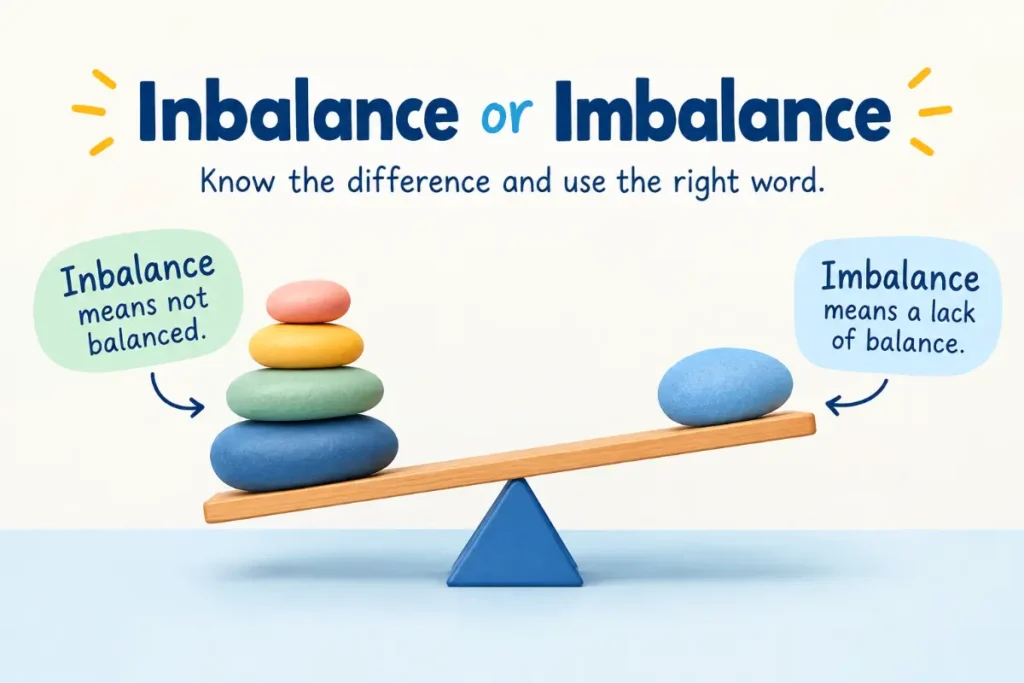
The standard English word is imbalance. It means a lack of balance or a situation in which two or more things are not equal or properly proportioned. Major dictionaries such as Merriam Webster and Cambridge Dictionary recognize imbalance as the standard noun.
The form inbalance is generally treated as a misspelling when you mean the noun referring to a lack of balance. There is an important detail behind the confusion, though. English does use the phrase in balance as two separate words. That phrase means that something is balanced or financially even in the right context.
This guide explains the distinction in plain English. You will learn the correct spelling, the meaning of the word, its pronunciation, its grammar, its history, common examples, related terms, and the difference between expressions such as hormonal imbalance, mental imbalance, and unbalanced. You will also see why some apparently logical spellings are not accepted standard forms.
Quick Definition
Imbalance is the standard English noun for a lack of balance or a condition in which things are unequal or out of proportion. Inbalance is normally a misspelling of that noun. The separate phrase in balance is correct when you mean that something is balanced or in equilibrium.
Quick Answer
The correct spelling is imbalance.
Use it when you mean a lack of balance or an unequal relationship between things. For example:
- There is an imbalance between supply and demand.
- The report identified a serious imbalance in the budget.
- The doctor discussed a possible chemical imbalance.
Do not write inbalance as one word in standard English.
There is a separate expression that looks similar but works differently: in balance. It is written as two words.
For example:
The company finally brought its budget in balance.
That distinction explains much of the confusion. The noun uses imbalance while the ordinary phrase uses in balance.
Comparison Table
| Feature | Imbalance | Inbalance |
|---|---|---|
| Standard English form | Yes | No |
| Part of speech | Noun | Not normally accepted as the standard noun |
| Basic meaning | Lack of balance or equality | Usually intended to mean imbalance |
| Word formation | im plus balance | in plus balance |
| Formality | Standard | Nonstandard when used as a noun |
| Common contexts | Health language economics science business relationships | Mostly spelling errors |
| Usage frequency | Common | Very uncommon in edited English |
| Example | There is an imbalance of power. | Incorrect in standard English |
| Related adjective | Imbalanced | Not normally used |
| Correct alternative | Imbalance | Imbalance or in balance depending on meaning |
The distinction is especially important in professional writing. A spelling mistake in a casual message may pass unnoticed. In an academic paper, medical article, business report, or website published for a broad audience, the standard form is the better choice.
Meaning Of Both Terms
The two forms create confusion because inbalance looks as if it should be formed naturally from the prefix in and the noun balance. English does not always build words that way. Prefixes have developed through different historical patterns and can change form depending on the word that follows.
Imbalance Meaning
The noun imbalance means a lack of balance. It can describe a physical condition, an unequal distribution, a difference between opposing forces, or a situation where two things are not properly proportioned.
Cambridge defines it as a situation in which things that should be equal or normally equal are not. Merriam Webster similarly defines it as a lack of balance or a state of being out of equilibrium or proportion.
The word can describe many kinds of situations.
- Physical imbalance can refer to difficulty maintaining physical stability.
- Economic imbalance can describe unequal trade or financial conditions.
- Power imbalance can describe unequal influence between people or groups.
- Chemical imbalance can describe an uneven level or proportion of substances.
- Hormonal imbalance is commonly used when discussing irregular hormone levels or related health concerns.
- Work life imbalance describes a situation in which work receives too much attention compared with personal life.
The underlying idea remains the same. Something that should be balanced is not balanced.
Inbalance Meaning
When someone writes inbalance as one word, they usually intend to write imbalance.
For example:
- Incorrect: There is an inbalance between the two groups.
- Correct: There is an imbalance between the two groups.
The spelling mistake is understandable because English contains many words beginning with in that express negation or opposition. However, the established noun is imbalance.
There is also a legitimate phrase that contains the same letters in a different arrangement.
In balance is written as two words.
For example:
- The books are in balance.
- The budget is finally in balance.
This phrase does not mean the same thing grammatically as the noun imbalance.
Key Differences
The biggest difference is not meaning. It is standard word formation and grammar.
- Imbalance is a noun. It names a condition or state.
- In balance is a phrase. It describes a state in which something is balanced.
- Inbalance as one word is generally not the standard form you want.
Consider these examples:
- The company has an imbalance between revenue and expenses.
- The company’s accounts are in balance.
- The accounts show an imbalance.
- The accounts are now in balance.
These sentences demonstrate an important distinction. One word names the problem. The two word phrase describes the state.
Meaning Differences
- Imbalance focuses on a lack of equality or equilibrium.
- In balance focuses on being balanced.
The meanings therefore point in opposite directions.
Grammar Differences
Imbalance is a noun.
You can use it after articles and adjectives.
- An imbalance.
- A serious imbalance.
- A growing imbalance.
- The imbalance.
- Several imbalances.
In balance functions as a phrase.
Examples include:
- The system is in balance.
- The accounts are in balance.
- The two forces remain in balance.
Context Differences
The noun appears frequently in technical and professional language.
Examples include:
- Trade imbalance.
- Power imbalance.
- Chemical imbalance.
- Hormonal imbalance.
- Financial imbalance.
- Nutritional imbalance.
The phrase appears when describing a condition of equilibrium.
Examples include:
- Keep the mixture in balance.
- The budget is in balance.
- The machine remains in balance.
Tone Differences
There is no major difference in tone between different English speaking countries. The standard noun remains imbalance in American English, British English, Australian English, and Canadian English.
The main difference is between standard and nonstandard usage rather than between regions.
Which One Is Correct
Imbalance is the correct spelling when you need the noun meaning a lack of balance.
That answer is supported by major dictionaries. Merriam Webster lists imbalance as a noun meaning lack of balance or a state of being out of equilibrium or proportion. Cambridge likewise lists it as a noun describing a situation in which things that should be equal are not.
The form inbalance should normally be corrected to imbalance. There is no need to invent a new spelling when English already has an established word.
The easiest rule is this:
Use imbalance when naming the problem. Use in balance when describing something that is balanced.
For example:
- The company has an imbalance in its budget.
- The company brought its budget in balance.
That small grammatical distinction clears up most cases.
How To Remember The Correct Spelling
A useful memory trick is to connect the word with its adjective imbalanced.
If you know that something can be described as imbalanced, the noun naturally becomes imbalance.
For example:
- The system is imbalanced.
- The system has an imbalance.
You can also remember the word as a complete unit instead of trying to construct it from scratch.
Think:
balance → imbalance → imbalanced
This pattern is more reliable than trying to decide between in and im every time you write.
Another useful clue is pronunciation. The first syllable is pronounced with a short ih sound. The word is commonly pronounced im BAL uhns in American English. Cambridge gives the American pronunciation as /ɪmˈbæl.əns/.
Once you recognize the sound and the established spelling together, the word becomes much easier to remember.
Pronunciation Guide
The pronunciation is straightforward even though the spelling can cause confusion.
IPA Pronunciation
In American English the pronunciation is approximately:
/ɪmˈbæl.əns/
Cambridge gives the same basic pronunciation for American English and a closely related form for British English.
Syllable Breakdown
The word has three syllables:
im BAL uhns
The main stress falls on the second syllable. The strongest part is bal.
Common Pronunciation Mistakes
Some learners may try to pronounce the first part as in because of the spelling they expect. The standard pronunciation begins with an im sound.
A good way to practice it is to say:
im + balance
Then blend the two parts naturally:
imbalance
The word should not sound like three equally stressed syllables. The middle syllable receives the main emphasis.
Pronunciation And Spelling
Pronunciation can help reinforce the spelling but should not be the only method you use. English contains many words where pronunciation does not perfectly reveal spelling.
In this case the pronunciation supports the standard form because the first sound naturally resembles im rather than a clearly separate in syllable.
The goal is not simply to tell you which spelling is correct. It is to show you how native speakers actually use the word so you can recognize the pattern and apply it confidently.
Examples In Sentences.
Seeing the correct word in context makes the spelling difference much easier to understand. Imbalance is the standard noun when you mean a lack of balance, equality, stability, or proportion. The form inbalance is generally incorrect when used as one word with that meaning.
10 examples with imbalance.
- The report found an imbalance between supply and demand.
- An imbalance in the budget can create problems for the organization.
- The athlete noticed an imbalance in strength between his left and right legs.
- The discussion revealed an imbalance of power between the two groups.
- The doctor explained that several different conditions can cause an imbalance in the body.
- A hormonal imbalance may require medical evaluation to identify the underlying cause.
- The team worked to correct the imbalance between offense and defense.
- An imbalance in the ecosystem can affect many species.
- The unusual distribution created an imbalance in the final results.
- The company wanted to address the imbalance between workload and available staff.
Notice how imbalance works as a noun in each sentence. It can describe physical stability, unequal distribution, differences in power, biological conditions, financial situations, or broader problems involving proportion.
The word is flexible because the basic idea stays the same. Something that should be balanced or reasonably proportioned has moved away from that state.
10 examples showing the problem with inbalance.
The following examples are intentionally marked as incorrect. They show the kind of spelling mistake readers commonly make.
- Incorrect: There is an inbalance between the two sides.
Correct: There is an imbalance between the two sides. - Incorrect: The doctor discussed an inbalance in the body.
Correct: The doctor discussed an imbalance in the body. - Incorrect: The team suffered from an inbalance of power.
Correct: The team suffered from an imbalance of power. - Incorrect: The budget shows an inbalance between income and spending.
Correct: The budget shows an imbalance between income and spending. - Incorrect: Researchers observed an inbalance in the system.
Correct: Researchers observed an imbalance in the system. - Incorrect: The player developed an inbalance while standing.
Correct: The player developed an imbalance while standing. - Incorrect: The article explains the causes of hormonal inbalance.
Correct: The article explains the causes of hormonal imbalance. - Incorrect: The market has an inbalance between buyers and sellers.
Correct: The market has an imbalance between buyers and sellers. - Incorrect: An inbalance of nutrients can affect plant growth.
Correct: An imbalance of nutrients can affect plant growth. - Incorrect: The study examined an inbalance within the population.
Correct: The study examined an imbalance within the population.
There is one important exception to remember. English does use the phrase in balance as two separate words. For example, you can say that a budget is in balance when its income and expenses are balanced. The problem occurs when someone combines those two words into inbalance and uses the result as the noun.
Common Mistakes.
The biggest mistake is simply adding the prefix in to balance and assuming the result must be inbalance. English does not always create words in such a predictable way. In this case, the established noun is imbalance.
Another common mistake happens when writers confuse imbalance with unbalance. Both words exist, but they do not have identical patterns of use. Imbalance is the ordinary noun for a lack of balance. Unbalance is much less common as a noun and is also used as a verb meaning to disturb or remove balance.
A third mistake involves the phrase in balance. This is perfectly correct when you are describing a state of balance.
For example:
- The books are in balance.
- The budget is in balance.
- The two sides remained in balance.
These sentences do not need imbalance because they describe something that is balanced rather than something that lacks balance.
Writers also sometimes confuse imbalanced and unbalanced. Both adjectives can describe something that is not balanced, but their natural usage depends on context. Imbalanced is common in discussions of proportions, systems, relationships, or distributions. Unbalanced has broader uses and can describe physical instability, uneven composition, or something that lacks stability.
Another mistake appears in medical writing. People sometimes use the phrase hormonal imbalance as though it were a complete medical diagnosis. It is better understood as a general phrase describing a situation involving hormone levels or hormone activity that may not be functioning normally. The underlying cause can vary, so specific medical concerns require professional evaluation rather than assumptions based on the phrase alone.
The same caution applies to searches for imbalance symptoms. There is no single set of symptoms that proves an imbalance because the word can describe many different situations. An electrolyte issue, hormone related condition, balance disorder, nutritional problem, or emotional situation can involve very different signs and causes.
Etymology And Word Origin.
Understanding the history of a word can make its spelling easier to remember.
The word balance has a long history in English and ultimately traces back through French and Latin. Its historical development is connected with ideas of scales, equilibrium, and equal weight. Over time, English expanded the meaning beyond physical scales to include financial accounts, stability, proportion, judgment, and harmony.
Imbalance developed by adding the negative prefix im to balance. The prefix im is a form of the negative prefix in that commonly appears before certain consonant sounds. English has many examples of this pattern, including words such as impossible and immature.
That spelling pattern helps explain why imbalance looks different from the simple combination in + balance. The established word developed as a single lexical item rather than as the phrase in balance joined together.
Merriam Webster lists imbalance as a noun meaning a lack of balance or a condition of being out of equilibrium or proportion. The dictionary also dates its first known use to around 1890.
The historical meaning also explains why the word works across many subjects. Balance originally suggests proportion or equilibrium. Adding the negative prefix creates the idea of a departure from that condition.
This gives you a useful mental pattern:
- balance = a state of proportion or equilibrium
- imbalance = a lack of that proportion or equilibrium
The spelling is therefore not random. It reflects the established form of the word in English.
Regional Usage.
American English and British English both use imbalance as the standard noun. The spelling does not normally change based on the English speaking country.
This is useful for writers because some English words do have major regional spelling differences. Words such as color and colour or organize and organise can vary by region. Imbalance is not normally one of those words.
A writer in the United States can use imbalance, and a writer in the United Kingdom can also use imbalance.
Cambridge Dictionary gives imbalance as a noun and includes an American pronunciation of approximately /ɪmˈbæl.əns/.
The more important regional distinction is not spelling but context. Different fields may use the word in slightly different ways.
In business writing, an imbalance can describe unequal supply and demand. It can describe differences between financial quantities or market conditions in economics. In sports, it can refer to unequal strength or stability. It can describe a system that has moved away from equilibrium in science.
Medical writing can use the word for different physiological situations. Everyday speakers may also use it more loosely to describe an emotional or personal situation that feels unstable.
The spelling remains the same across these contexts.
Grammar Rules.
Imbalance is primarily a noun. It names a condition or state in which balance is lacking.
You can use it as a singular countable noun when you are talking about one specific problem.
For example:
The imbalance affected the results.
You can also use the plural form imbalances when discussing multiple types or instances.
For example:
The researchers identified several imbalances in the system.
The word commonly appears after articles and determiners.
Examples include:
- an imbalance
- the imbalance
- this imbalance
- that imbalance
- several imbalances
- serious imbalances
The word can also appear in common grammatical patterns such as imbalance between, imbalance in, and imbalance of.
Imbalance between.
Use this structure when comparing two or more sides, groups, quantities, or forces.
There is an imbalance between income and spending.
Imbalance in.
Use this structure when describing something within a particular system, area, or condition.
The study found an imbalance in the distribution of resources.
Imbalance of.
Use this structure when focusing on unequal amounts or proportions.
The policy created an imbalance of power.
These patterns make the word easy to use naturally once you understand its grammatical role. The adjective imbalanced can describe something that lacks balance.
For example:
The system became imbalanced after the change.
However, writers should not automatically replace every use of unbalanced with imbalanced. The two adjectives overlap, but their natural usage differs depending on the context.
The phrase in balance follows a different grammatical structure. Here, in is a preposition and balance is a noun.
For example:
The accounts are in balance.
This does not mean the same thing as The accounts show an imbalance. The first sentence says the accounts are balanced. The second says a lack of balance exists. That small grammatical distinction prevents many spelling errors.
Real Life Usage Examples.
You will encounter imbalance in many areas of everyday American English.
In finance, people may discuss an imbalance between income and expenses. A household might have an imbalance in its monthly budget when spending consistently exceeds available income. Businesses can also use the word when discussing supply, demand, staffing, or resources.
In sports, imbalance often refers to physical stability or unequal development. A coach might notice an imbalance between the strength of two muscle groups or between different areas of a team. The word works well because it describes a measurable difference rather than simply saying that something is wrong.
In science and environmental discussions, imbalance can describe a system that has moved away from a stable relationship. An ecosystem, chemical process, or population can be described as having an imbalance when important components are no longer present in suitable proportions.
Medical language provides another familiar setting. People commonly search for phrases such as imbalance meaning, imbalance definition medical, hormonal imbalance, and imbalance symptoms. The word itself is broad, so the surrounding words are important for understanding the intended meaning.
For example, hormonal imbalance points toward a hormone related issue, while balance imbalance in a physical context may refer to difficulty maintaining physical stability. The same noun appears in both expressions, but the subject changes its meaning.
The phrase can also appear in discussions about mental and emotional experiences. However, language such as mentally imbalanced or mentally unbalanced can sound judgmental, vague, or outdated when used to describe a person.
Modern professional writing usually benefits from more precise and respectful language. Instead of labeling someone as mentally imbalanced, a writer can describe the specific situation, such as someone experiencing emotional distress or living with a mental health condition. If a recognized diagnosis is known, using its accurate clinical name is clearer than relying on a broad label.
This distinction matters because language can shape how readers understand people. A useful word does not become more accurate simply because it sounds familiar. Good writing chooses the term that communicates the intended idea without adding unnecessary judgment.
The same principle applies outside medicine. If you can name the specific kind of imbalance, doing so usually produces stronger writing.
For example, an imbalance between workload and staffing tells the reader far more than simply saying there is an imbalance.
That is one of the most useful lessons from this spelling question. Imbalance is the correct general noun, but the strongest sentence usually explains what is out of balance.
Related Words And Confused Terms
Several words and phrases are closely connected to imbalance, but they do not all work in the same grammatical or semantic way. Understanding these differences can help you choose the right word instead of simply looking for a synonym.
Balance.
Balance is the direct opposite of imbalance in many contexts. It can describe physical stability, equal distribution, financial accounts, emotional steadiness, or a suitable proportion between different elements.
For example:
The two sides reached a balance.
Imbalance describes a lack of that balance.
Imbalanced.
Imbalanced is an adjective that describes something that is not balanced.
For example:
The distribution became imbalanced after the policy changed.
It can describe systems, proportions, workloads, resources, or other situations where the parts are not appropriately balanced.
Unbalanced.
Unbalanced is another adjective with a broad meaning. It can describe something physically unstable or something that lacks proportion.
For example:
The table feels unbalanced on the uneven floor.
The word can also have a sensitive mental health related meaning in everyday language. Merriam Webster notes that this meaning exists but is not used technically.
For that reason, calling a person mentally unbalanced can sound outdated or stigmatizing. More precise language is usually better in professional and respectful communication.
Unbalance.
Unbalance is a real English word, but it is much less common than imbalance when used as a noun. It can also function as a verb meaning to disturb or remove balance.
For general writing, imbalance is normally the better noun when you want to describe a lack of balance.
In balance.
In balance is a correct two word phrase.
It means that something is balanced or remains in a suitable state of equilibrium.
For example:
- The budget is in balance.
- The two sides remain in balance.
This is probably the most important distinction to remember. In balance is correct as a phrase, while inbalance is generally not the standard spelling of the noun.
Imbalance synonyms.
The best synonym depends on the context. Common related words include disparity, inequality, disproportion, difference, disequilibrium, discrepancy, and unevenness.
These words are not interchangeable in every sentence. Disparity often emphasizes a significant difference. Inequality commonly focuses on unequal amounts or treatment. Disproportion highlights a lack of suitable proportion. Disequilibrium is more specialized and often appears in scientific or technical contexts.
Choosing the closest synonym makes your writing more precise.
For example, saying a disparity in income may be more specific than saying an imbalance in income when the focus is on a significant difference between groups.
Expert Language Insight.
The spelling question becomes much easier when you separate spelling from grammar.
Many people see in + balance and naturally assume that combining the two creates inbalance. English does not always work that way. Established words develop through historical usage, sound changes, prefixes, borrowing, and convention. A spelling that looks logical is not automatically the standard form.
The practical rule is simple. Use imbalance when you need the noun meaning a lack of balance. Use in balance when you are describing something that is currently balanced.
There is also a useful semantic lesson here. Imbalance does not always mean that something is completely chaotic or unusable. It can refer to a relatively small difference in proportion.
A company can have a slight imbalance between departments. A sports team can have an imbalance in its lineup. A budget can have an imbalance between income and expenses. In each case, the word identifies an unequal relationship without automatically suggesting a severe problem.
Medical and scientific contexts require extra care. Expressions such as hormonal imbalance and chemical imbalance are common in everyday communication, but the surrounding context matters. A phrase alone does not establish a diagnosis or explain the underlying cause.
The same principle applies to imbalance symptoms. The word imbalance is broad and can refer to very different physical or biological situations. There is no universal symptom list that applies to every use of the term. Specific symptoms should be interpreted in the context of the condition being discussed and evaluated by an appropriate professional when medical advice is needed.
Language about mental health deserves similar care. Mentally imbalanced and mentally unbalanced are understandable expressions, but they are vague labels when applied to people. They can also carry negative or stigmatizing implications.
A better approach is to describe the actual experience or condition when the information is known. Phrases such as experiencing emotional distress, experiencing mental health symptoms, or living with a mental health condition are generally more respectful and informative. Specific clinical terminology is preferable when a qualified professional has established a diagnosis.
This is a good example of how strong writing goes beyond spelling. The correct word is important, but the most effective writer also considers precision, context, tone, and the effect a phrase can have on the reader.
Frequently Asked Questions
Is inbalance a correct English word?
Inbalance is generally not the standard spelling when you mean a lack of balance. The standard noun is imbalance.
If you mean that something is balanced, use the two word phrase in balance instead.
What is the meaning of imbalance?
Imbalance means a lack of balance, equality, proportion, or equilibrium. It can describe physical stability, financial conditions, relationships between quantities, biological processes, or many other situations.
The exact meaning depends on the context surrounding the word.
Is imbalance one word or two words?
Imbalance is one word. It is spelled I M B A L A N C E.
Do not normally write inbalance as one word when you mean the noun. The phrase in balance is written as two separate words and has a different grammatical function.
What is the medical definition of imbalance?
In medical language, imbalance is a broad term describing a lack of normal balance or equilibrium within a particular physical or biological system. Dictionaries can use the word in medical contexts involving physiological equilibrium.
The term itself does not identify one specific disease. The meaning depends on what is described as being out of balance.
What does hormonal imbalance mean?
Hormonal imbalance is a general phrase referring to a situation in which hormone levels or hormone activity are not functioning within an appropriate range for a particular physiological context.
It is not a complete diagnosis by itself. Different hormone related conditions have different causes and require appropriate medical evaluation.
What are imbalance symptoms?
There is no single list of imbalance symptoms because imbalance can refer to many different situations.
For example, an imbalance involving physical stability is very different from an imbalance involving hormones, nutrients, electrolytes, or another biological system. Symptoms therefore depend on the underlying issue rather than the word imbalance itself.
If someone is experiencing persistent or concerning symptoms, a qualified healthcare professional can determine the appropriate next step.
Is mentally imbalanced correct English?
Mentally imbalanced is understandable English, but it is usually not the best modern phrase for describing a person. It is vague and can sound stigmatizing.
More precise alternatives include experiencing mental health symptoms, experiencing emotional distress, or living with a mental health condition. If a specific condition is known, using its established name is clearer.
What is the difference between imbalance and unbalance?
Imbalance is the common noun for a lack of balance. Unbalance is a less common noun and can also function as a verb meaning to disturb balance.
For ordinary writing, imbalance is usually the natural choice when you need a noun.
Conclusion
The correct spelling is imbalance when you need the noun meaning a lack of balance, proportion, equality, or equilibrium. The form inbalance is generally a spelling error in that context.
The confusion happens because English also has the perfectly correct phrase in balance. That phrase describes something that is balanced or remains in a balanced state. It is not simply another spelling of imbalance.
A quick memory trick can help. Think of the pair balance and imbalance as opposites. If something has moved away from balance, use imbalance. If something remains balanced, you can describe it as being in balance.
The distinction also extends beyond spelling. Imbalanced, unbalanced, unbalance, and in balance have related meanings but different grammatical roles and usage patterns. Choosing among them depends on the sentence you are writing.
For everyday American English, the safest rule is straightforward: write imbalance as one word for the noun. Write in balance as two words when you mean that something is balanced.
Once you recognize that difference, this commonly confused spelling becomes much easier to handle.