Have you ever heard someone say My brother is a walking encyclopedia or Her smile is sunshine? Those are metaphors, and they make language more colorful, creative, and fun. Many children first come across metaphors while reading stories or poems, but they can seem confusing at first because the words are not meant to be taken literally. Learning Metaphor Examples for Kids does not have to feel difficult.
Once children understand that a metaphor compares two different things without using the words like or as, everything starts to make sense. Instead of memorizing rules, they learn to picture ideas in a new way.
In this guide, you will discover simple explanations, easy examples, fun comparisons, classroom activities, and practice questions designed for young learners. Parents, teachers, and students can all use this resource to build confidence in reading and writing. By the end, you will know how to recognize a metaphor, understand its meaning, and even create your own.
Quick Definition
A metaphor is a figure of speech that compares two different things by saying one thing is another. It does not use like or as. Instead, it creates a vivid picture that helps readers understand an idea, feeling, or object in a more interesting way.
Quick Answer
If you need a quick explanation, remember these key points.
- A metaphor compares two unlike things.
- It says one thing is another, even though they are not literally the same.
- It helps readers imagine ideas more clearly.
- Writers use metaphors to make stories, poems, and everyday language more engaging.
- Children can understand metaphors by thinking about the qualities being compared instead of the literal meaning.
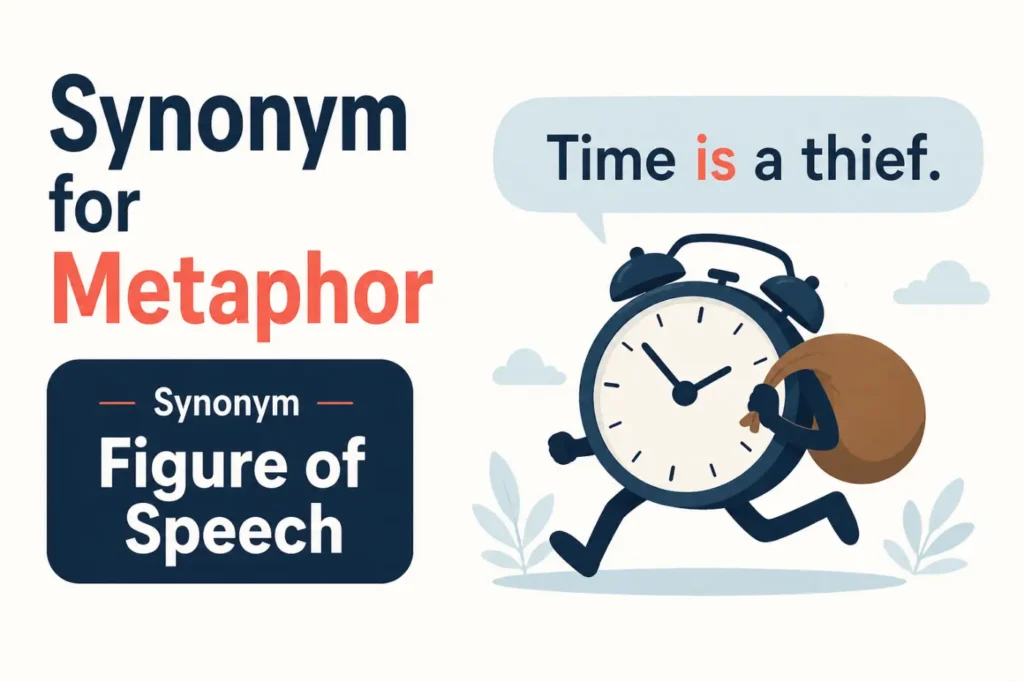
If you’re looking for words similar to metaphor, understanding related terms can help kids recognize the different ways writers compare ideas creatively.
What Is A Metaphor
A metaphor is one of the most common literary devices in English. It compares two unrelated things to highlight a shared quality or characteristic. Instead of making a direct factual statement, it paints a picture in the reader’s mind.
For example, if someone says The classroom was a zoo, they do not mean wild animals were running around. They mean the classroom was noisy, busy, and difficult to control.
Here are a few more simple examples.
- Time is a thief.
- My teacher is a guiding star.
- His brain is a computer.
- The blanket was a warm hug.
- Her voice is music.
Each sentence compares two different things to help readers understand an idea more vividly.
Why Kids Learn Metaphors
Metaphors are more than a grammar lesson. They help children become stronger readers, better writers, and more creative thinkers.
When kids understand figurative language, they begin to notice deeper meanings in books, poems, and conversations. This skill improves reading comprehension because many authors use metaphors to describe emotions, people, and places.
Learning metaphors also encourages imagination. Instead of writing The cake was delicious, a child might write The cake was a slice of happiness. The second sentence creates a stronger picture and leaves a lasting impression.
Children who practice using metaphors often become more confident writers because they learn how to express ideas in creative and memorable ways.
Metaphor Versus Simile
Many students confuse metaphors and similes because both compare two things. The difference is easy to remember once you know what to look for.
| Feature | Metaphor | Simile |
|---|---|---|
| Comparison | Direct | Uses like or as |
| Uses like or as | No | Yes |
| Meaning | Says one thing is another | Says one thing is like another |
| Purpose | Creates a vivid image | Makes an easy comparison |
| Example | The moon is a silver coin. | The moon is like a silver coin. |
Notice how both sentences compare the moon to a silver coin. The metaphor makes the comparison directly, while the simile uses like.
How To Recognize A Metaphor
Recognizing a metaphor becomes much easier when children ask themselves a few simple questions while reading.
- Is the sentence comparing two different things?
- Does it avoid using like or as?
- Is the meaning symbolic instead of literal?
- Does the comparison create a mental picture?
- Does it describe a quality rather than a fact?
If the answer is yes, the sentence is probably a metaphor.
Consider this example.
Dad is a rock.
No one believes Dad is actually made of stone. The sentence means he is dependable, calm, and strong during difficult times.
Now look at another example.
The stars were diamonds in the sky.
The stars are not real diamonds, but the comparison helps readers imagine how brightly they shine.
Simple Metaphor Examples
Children learn best through clear and familiar examples. The following comparisons use everyday situations that are easy to picture.
- My backpack is a treasure chest.
- The playground is a kingdom of adventure.
- Her smile is sunshine.
- The baby is an angel.
- My pillow is a fluffy cloud.
- The library is a gold mine of knowledge.
- His imagination is a rocket.
- The snow is a white blanket.
- The classroom is a beehive.
- The puppy is a ball of energy.
After reading each sentence, ask yourself what quality the writer wants you to notice. That simple habit helps children understand the hidden meaning instead of focusing only on the words.
How To Remember A Metaphor
Many children worry about mixing up metaphors and similes. Fortunately, there is an easy way to remember the difference.
Think about the word is. A metaphor usually tells you that one thing is another, even though the comparison is not literally true.
For example:
- My friend is a superhero.
- The wind is a dancer.
- The river is a ribbon.
Now compare those with similes.
- My friend is like a superhero.
- The wind moves like a dancer.
- The river looks like a ribbon.
The metaphor makes a direct comparison, while the simile uses like or as.
Another helpful tip is to imagine the picture in your mind. If the sentence creates a strong image while describing something symbolically, you are probably reading a metaphor.
The more children read stories and poems, the easier it becomes to recognize these creative comparisons naturally.
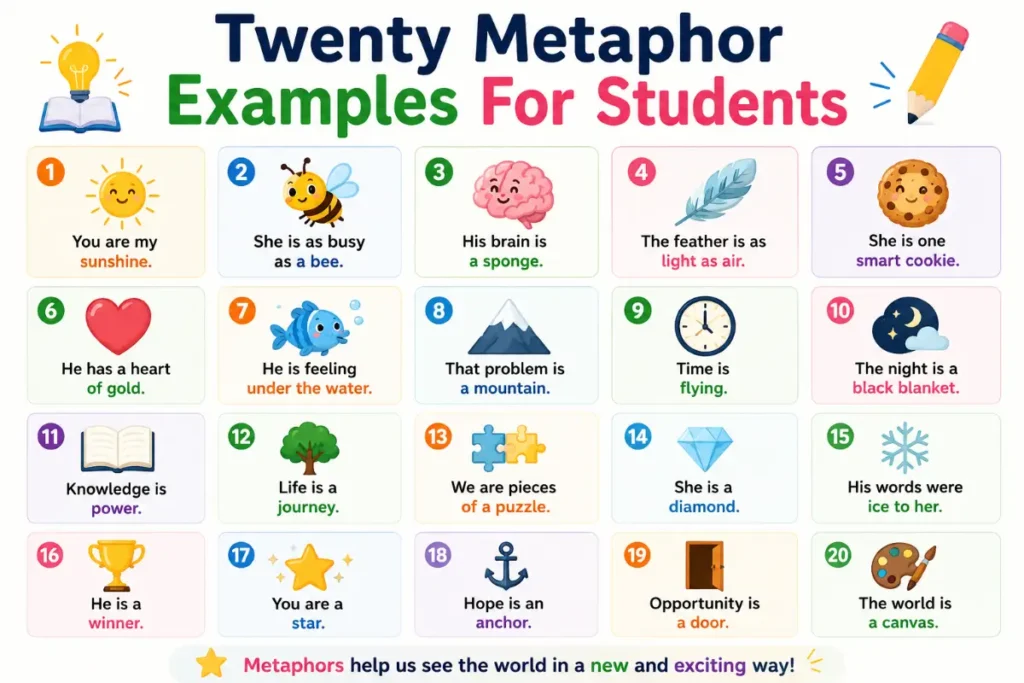
Twenty Metaphor Examples For Students
The best way to understand metaphors is to read them in context. Each example below includes a short explanation so children can understand the hidden meaning instead of guessing.
- The classroom was a beehive.
Answer: The classroom was busy, noisy, and full of activity. - My teacher is a guiding star.
Answer: The teacher helps and inspires students. - The test was a mountain to climb.
Answer: The test felt difficult and challenging. - His mind is a sponge.
Answer: He learns and remembers information quickly. - The city is a jungle.
Answer: The city is crowded, busy, and full of activity. - The snow is a soft blanket.
Answer: The snow covers everything gently. - Her laugh is music.
Answer: Her laugh sounds pleasant and joyful. - The moon is a glowing lantern.
Answer: The moon lights up the night. - The book is a doorway to adventure.
Answer: Reading opens the imagination and introduces new experiences. - My brother is a tornado.
Answer: He is energetic and leaves everything messy. - The playground is a kingdom.
Answer: Children rule the space with imagination and fun. - His heart is gold.
Answer: He is kind and generous. - The internet is a giant library.
Answer: It contains an enormous amount of information. - My backpack is a treasure chest.
Answer: It holds many valuable school supplies. - Time is a thief.
Answer: Time seems to disappear quickly. - The wind is a playful dancer.
Answer: The wind moves gracefully. - The garden is a rainbow.
Answer: The flowers display many beautiful colors. - The baby is a little sunshine.
Answer: The baby brings happiness to everyone. - The puppy is a bouncing ball.
Answer: The puppy is full of excitement and energy. - Hope is a candle in the dark.
Answer: Hope provides comfort during difficult times.
These examples help children see that a metaphor compares ideas to make descriptions stronger and easier to imagine.
Short Metaphor Examples For Kids
Sometimes a short sentence is all it takes to teach a big idea. These examples are easy to remember and work well in elementary classrooms.
- Life is a journey.
- Her smile is sunshine.
- The clouds are cotton.
- My room is a disaster zone.
- His voice is thunder.
- The lake is glass.
- My dog is a shadow.
- The classroom is a family.
- The stars are diamonds.
- My pillow is a cloud.
- The train is a snake.
- Books are windows.
- The forest is a maze.
- The rain is music.
- My imagination is a rocket.
Encourage children to explain what each sentence means. Understanding the comparison is more important than simply recognizing it as a metaphor.
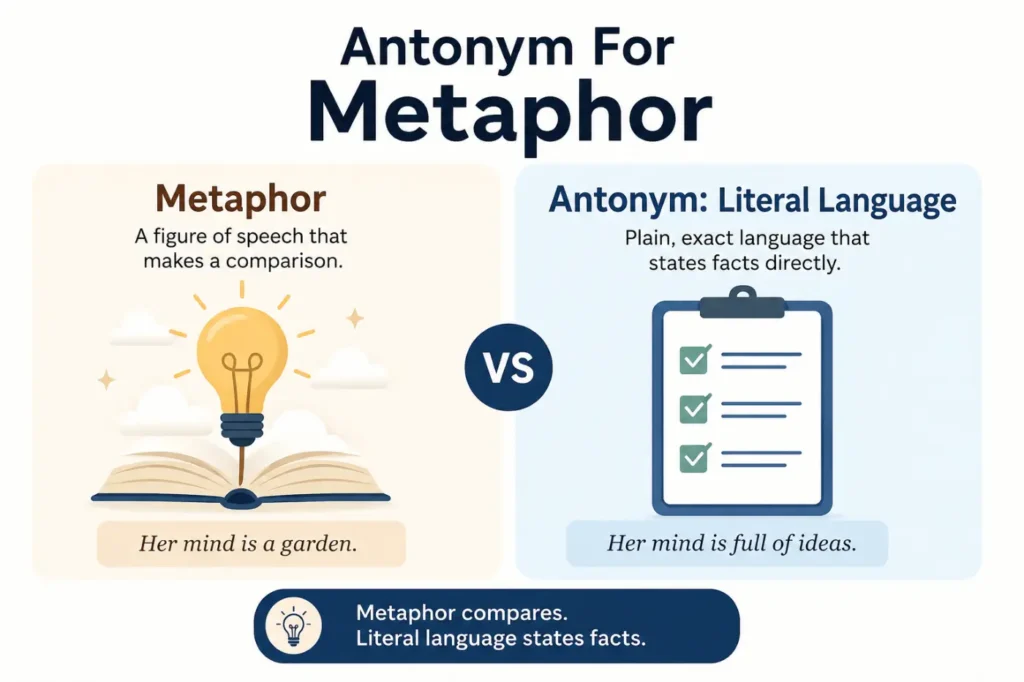
Once children understand figurative comparisons, it can also be helpful to explain how literal language instead communicates an idea without using an imaginative comparison.
Funny Metaphor Examples For Kids
Humor makes learning more enjoyable. These playful examples encourage children to think creatively while practicing figurative language.
- My little brother is a popcorn machine because he never stops bouncing.
- Dad is a walking toolbox because he can fix almost anything.
- Our puppy is a tornado wearing fur because he races through every room.
- My backpack is a bottomless pit because I can never find anything inside.
- Grandpa is a storytelling machine because he always has another tale to tell.
- My alarm clock is a rooster because it wakes me up every morning.
- My baby cousin is a tiny comedian because everyone laughs at the funny faces.
- My stomach is a growling bear before lunch.
- My hair is a bird’s nest after sleeping.
- The school bus is a parade because everyone talks at the same time.
These examples remind children that metaphors can be imaginative, funny, and memorable without being difficult to understand.
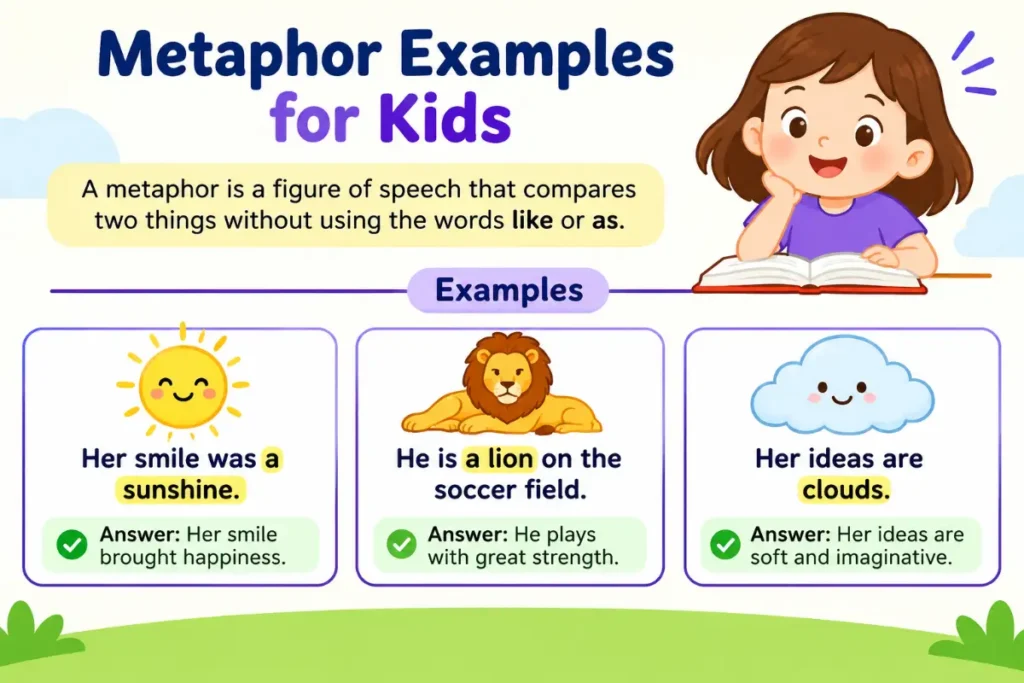
Metaphor Examples With Answers
Practice helps children build confidence. Read each sentence first, then check the explanation.
Practice One
The computer is my brain after school.
Answer: The computer helps with learning, homework, and thinking.
Practice Two
The playground is an ocean of laughter.
Answer: The playground is filled with happy children enjoying themselves.
Practice Three
My grandmother is a walking history book.
Answer: She has many memories and shares valuable life experiences.
Practice Four
The pencil is my magic wand.
Answer: Writing and drawing allow the child to create ideas.
Practice Five
The library is a treasure island.
Answer: The library contains many valuable books and discoveries.
Practice Six
The classroom clock is a race car.
Answer: Time seems to move very quickly during enjoyable lessons.
Practice Seven
Friendship is a bridge.
Answer: Friends connect people and bring them together.
Practice Eight
The cake is happiness on a plate.
Answer: Eating the cake brings joy and celebration.
Practice Nine
The mountain is a giant.
Answer: The mountain looks enormous and powerful.
Practice Ten
My dreams are wings.
Answer: Dreams help people imagine exciting possibilities and reach new goals.
Classroom Practice Activities
Teachers and parents can make metaphor lessons more engaging with simple activities that encourage discussion and creativity.
Complete The Metaphor
Ask children to finish each sentence.
- My best friend is a __________.
- Our school is a __________.
- The ocean is a __________.
- Reading is a __________.
- My bicycle is a __________.
After completing the sentences, ask students to explain their choices. This develops both vocabulary and critical thinking.
Guess The Meaning
Read a metaphor aloud without explaining it.
Example:
The moon is a nightlight.
Students discuss what the comparison means before revealing the answer.
Draw The Metaphor
Invite children to draw both the literal meaning and the intended meaning of a metaphor.
For example, they can draw a person made of gold beside a kind person for His heart is gold. Comparing the two pictures helps children understand figurative language.
Create Your Own Metaphor
Challenge students to write one original metaphor about each topic.
- School.
- Family.
- Nature.
- Friendship.
- Favorite hobby.
Sharing their ideas with classmates encourages creativity and builds confidence.
Common Mistakes Kids Make
Learning metaphors takes practice, and making mistakes is part of the process. Understanding these common errors helps children avoid confusion.
Taking The Meaning Literally
Some children think every metaphor describes a real event.
For example, The classroom was a zoo does not mean animals entered the room. It means the classroom was noisy and busy.
Confusing Metaphors With Similes
This is the most common mistake.
Remember:
- A metaphor says one thing is another.
- A simile compares using like or as.
Looking For Only One Correct Answer
Many metaphors allow more than one reasonable explanation.
For example, The river is a ribbon may describe its long shape, its smooth appearance, or the way it winds through the land.
Encourage children to support their ideas with evidence from the sentence instead of worrying about finding a single perfect answer.
Creating Comparisons That Do Not Make Sense
A strong metaphor connects two things that share a clear quality.
For example:
The sun is a giant flashlight creates an understandable image.
A comparison with no shared characteristic may confuse readers instead of helping them imagine the idea.
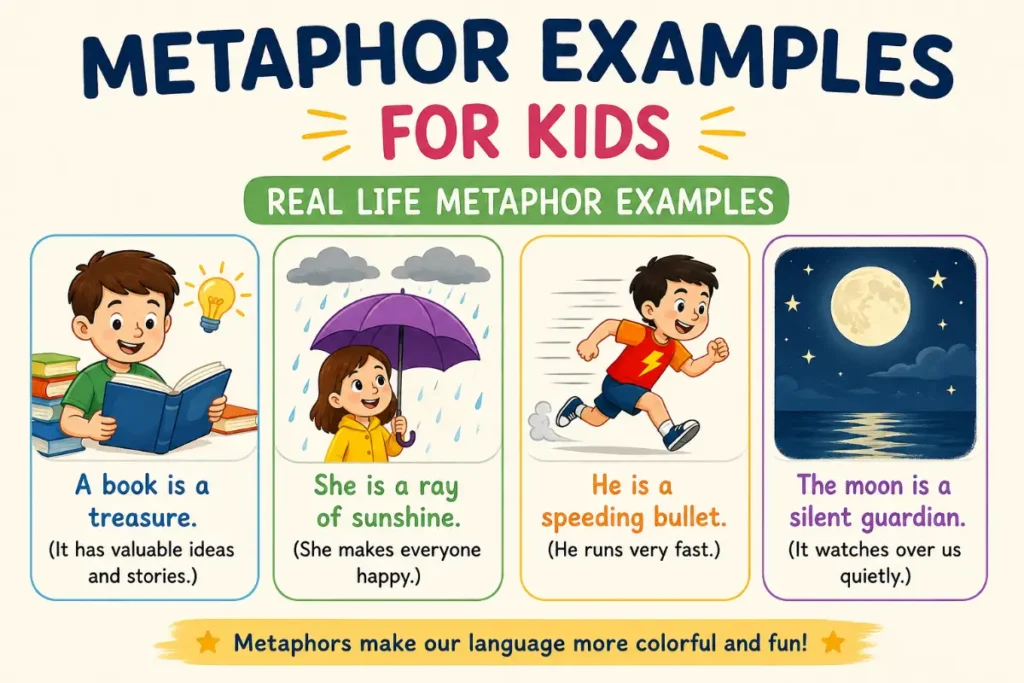
Real Life Metaphor Examples
Metaphors are not limited to storybooks or poetry. People use them every day without even realizing it. You can hear them at home, in school, on television, in songs, and in conversations with friends. Learning to recognize these expressions helps children become stronger readers and more confident communicators.
Everyday Conversations
Parents, teachers, and friends often use metaphors to describe feelings and situations.
- My little sister is a ray of sunshine.
- Dad is the rock of our family.
- The house became a circus during the birthday party.
- My stomach is a drum because I am hungry.
- Your idea is a seed that can grow into something amazing.
These comparisons make ordinary conversations more interesting and expressive.
Books And Stories
Children’s authors regularly use metaphors to help readers imagine characters, settings, and emotions.
Examples include:
- The forest was a sleeping giant.
- The river was a silver ribbon.
- Her courage was a bright flame.
- The castle was a mountain of stone.
- His thoughts were racing trains.
These descriptions create vivid mental pictures and make stories more enjoyable.
School Writing
Teachers encourage students to use metaphors because they make writing more descriptive.
Instead of writing:
The playground was fun.
A student could write:
The playground was a kingdom of adventure.
The second sentence paints a much stronger picture and captures the reader’s imagination.
Poems And Songs
Many poems and songs rely on metaphors to express feelings.
Writers may describe:
- Love as a journey.
- Hope as a light.
- Fear as a shadow.
- Dreams as wings.
- Friendship as a bridge.
These comparisons help readers connect with emotions in a memorable way.
Starting with simple metaphors for children makes it easier for young readers to understand how one thing can be described as another to create a vivid picture.
Related Literary Devices And Commonly Confused Terms
As children learn about metaphors, they often encounter other figures of speech. Knowing the difference makes reading and writing much easier.
| Literary Device | Meaning | Example |
|---|---|---|
| Metaphor | Direct comparison | Time is a thief. |
| Simile | Comparison using like or as | Time is like a river. |
| Personification | Gives human qualities to nonhuman things | The wind whispered. |
| Hyperbole | Extreme exaggeration | I have a million toys. |
| Idiom | A phrase with a figurative meaning | Break the ice. |
| Alliteration | Repeated beginning sounds | Busy buzzing bees. |
These literary devices often appear together in stories, but each one has a different purpose.
Expert Language Insight
One of the biggest changes children experience as they become stronger readers is learning to look beyond the literal meaning of words. Metaphors play an important role in that journey because they teach children to think about ideas instead of just definitions.
Experienced teachers rarely ask students to memorize dozens of metaphors. Instead, they encourage children to ask one simple question.
What quality is the writer comparing?
For example, if a sentence says My teacher is a lighthouse, nobody believes the teacher stands in the ocean. The comparison highlights guidance, safety, and direction. Once children focus on the shared quality instead of the literal words, understanding becomes much easier.
Another helpful strategy is to discuss metaphors after reading a story. Asking children why an author chose a particular comparison encourages deeper thinking and improves reading comprehension. Over time, they begin recognizing figurative language naturally and start using it in their own writing.
The goal is not to fill every sentence with creative comparisons. Strong writers use metaphors thoughtfully, choosing images that make ideas clearer instead of more confusing. A simple, meaningful comparison usually has a greater impact than one that feels forced.
Frequently Asked Questions
What is a metaphor for kids?
A metaphor is a figure of speech that compares two different things by saying one thing is another. It helps children imagine ideas more clearly and makes reading and writing more interesting. Unlike a simile, it does not use the words like or as.
What is the easiest way to explain a metaphor?
The easiest explanation is that a metaphor paints a picture with words. It compares two different things to show they share a similar quality. Instead of saying something is like another thing, it says it is that thing.
What is the difference between a metaphor and a simile?
A metaphor makes a direct comparison, while a simile uses like or as. For example, The clouds are cotton is a metaphor, while The clouds are like cotton is a simile.
Why do writers use metaphors?
Writers use metaphors to make ideas more vivid, emotional, and memorable. They help readers picture people, places, feelings, and events in creative ways that ordinary descriptions cannot achieve.
At what age do children learn metaphors?
Many children begin learning simple metaphors during the elementary school years, often between second and fifth grade. As their reading skills grow, they become better at understanding figurative language in stories, poems, and classroom activities.
How can parents teach metaphors at home?
Parents can read books together, point out interesting comparisons, and ask children what they think each one means. Encouraging kids to create their own metaphors about everyday objects also builds creativity and confidence.
Are metaphors only used in poetry?
No. Metaphors appear in stories, songs, conversations, speeches, advertisements, movies, and everyday language. They are a natural part of communication and help people express ideas in creative ways.
How can children become better at using metaphors?
Practice is the best teacher. Reading books, discussing figurative language, and writing original comparisons help children understand how metaphors work. Focusing on shared qualities instead of literal meanings makes creating metaphors much easier.
Conclusion
Learning metaphors opens the door to more expressive reading, writing, and speaking. Once children understand that a metaphor compares two different things by saying one thing is another, they begin to notice creative language all around them.
The examples in this guide show that metaphors do more than decorate sentences. They help explain ideas, describe emotions, and create memorable images that stay with readers long after they finish a story. From simple classroom activities to funny examples and practice exercises, every step builds confidence and encourages imagination.
The best way to master metaphors is through regular practice. Read stories, look for creative comparisons, talk about their meanings, and try writing your own. Over time, recognizing and using figurative language will become second nature.