If you have searched for Synonym for Metaphor, chances are you are looking for a better word to use in your writing, trying to understand a literary term, or comparing similar figures of speech. The answer is not as straightforward as replacing one word with another. While several words share similarities with metaphor, each carries its own meaning and works best in different situations.
A metaphor is a figure of speech that describes one thing as if it were another to create a vivid image or express an idea more powerfully. Depending on your purpose, words like analogy, symbol, image, comparison, allegory, and representation may serve as suitable alternatives. However, none of them is a perfect replacement in every context.
This guide explains the meaning of a metaphor, explores the closest synonyms, highlights the differences between related literary devices, and shows you how experienced writers choose the right word. You will also find practical examples, pronunciation guidance, grammar tips, and expert insights that make the topic easy to understand.
Quick Definition
A synonym for metaphor depends on the context. Common alternatives include analogy, symbol, image, allegory, representation, and figure of speech. Although these words share similarities, they do not always mean exactly the same thing. Choosing the right one depends on your sentence, audience, and purpose.
Quick Answer
There is no single synonym that replaces metaphor in every situation. Here are some of the closest alternatives.
- Analogy.
- Symbol.
- Allegory.
- Image.
- Comparison.
- Representation.
- Figure of speech.
- Trope.
Among these, analogy and symbol are the most common substitutes, but each has a different meaning. Understanding those differences helps you choose the most accurate word.
Comparison Table
| Word | Part of Speech | Origin | Meaning | Formality | Common Contexts | Usage Frequency | Example |
|---|---|---|---|---|---|---|---|
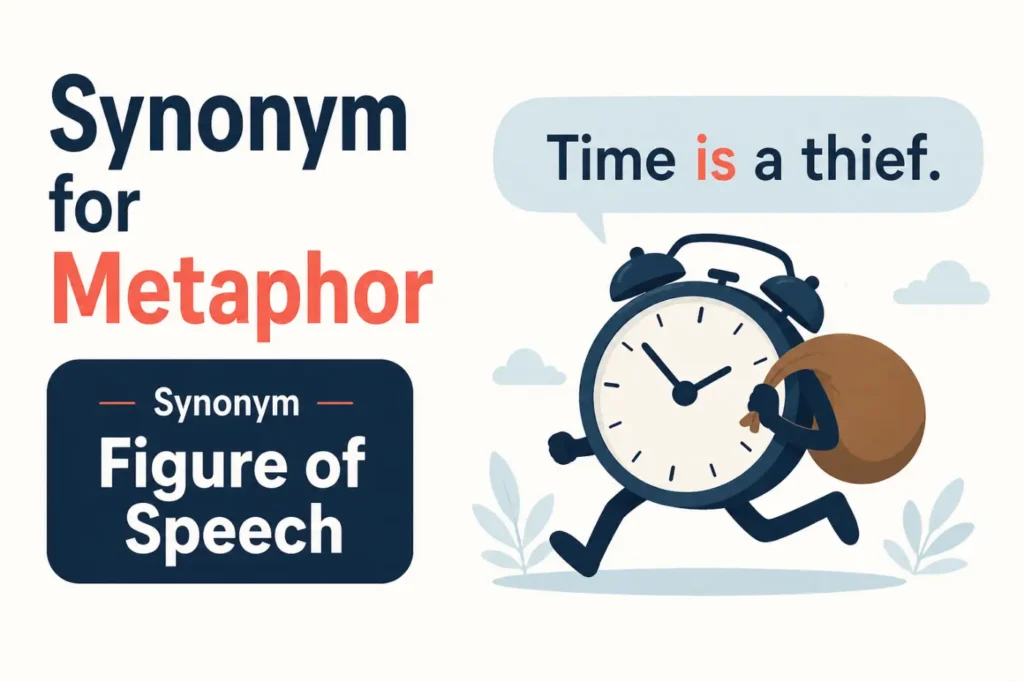
| Metaphor | Noun | Greek | A figure of speech that describes one thing as another | Formal and informal | Literature education everyday writing | Very high | Time is a thief. |
| Analogy | Noun | Greek | A comparison explaining similarities | Formal | Education science writing | Very high | The teacher used an analogy to explain electricity. |
| Symbol | Noun | Greek | Something representing another idea | Formal and informal | Literature art culture | High | A dove is a symbol of peace. |
| Allegory | Noun | Greek | A story with a deeper symbolic meaning | Formal | Literature | Moderate | Animal Farm is an allegory. |
| Image | Noun | Latin | A mental picture created through language | Informal and formal | Writing poetry communication | High | The description created a vivid image. |
| Trope | Noun | Greek | A recurring literary device or expression | Formal | Literary criticism | Moderate | The hero’s journey is a common trope. |
Understanding how a metaphor shapes meaning becomes even clearer when you compare it with subtle changes over time, where word choice can significantly influence interpretation.
What Is A Metaphor
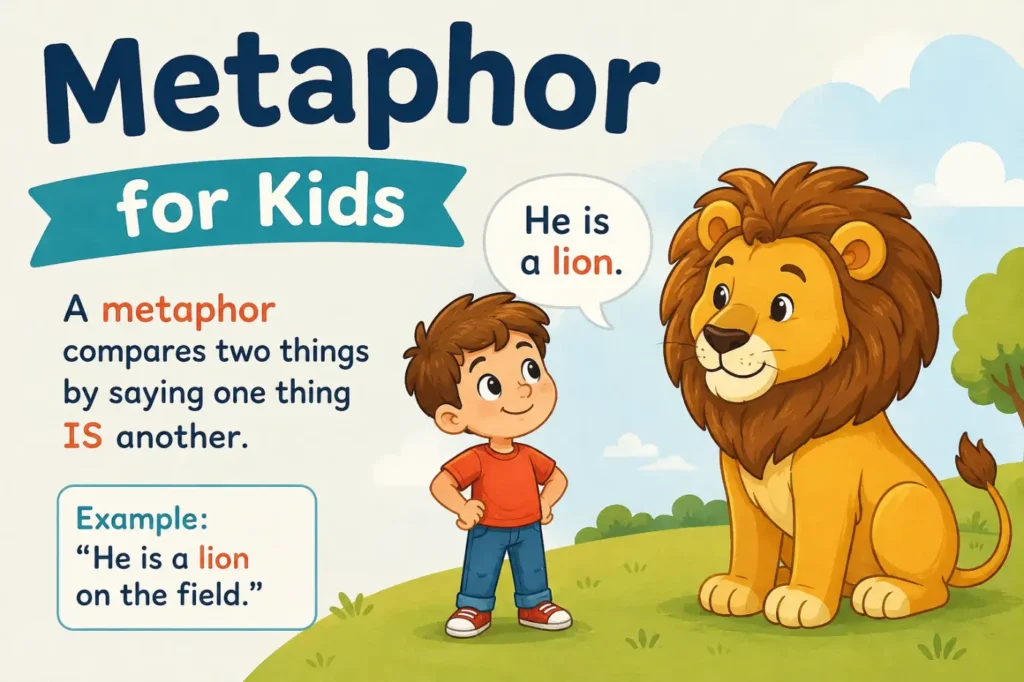
A metaphor is a figure of speech that compares two unlike things by stating that one is the other. Unlike a literal statement, a metaphor is not meant to be factually true. Instead, it creates a stronger mental image or expresses an idea in a memorable way.
For example, consider this sentence.
Her voice was velvet.
The writer is not saying her voice is made of fabric. The comparison suggests that her voice is smooth, soft, and pleasant to hear.
Writers use metaphors to make descriptions more engaging, emotional, and memorable. They appear in novels, poems, speeches, advertisements, song lyrics, and everyday conversations.
Here are a few familiar examples.
- Time is a thief.
- Life is a journey.
- His words were daggers.
- The classroom was a zoo.
- My backpack is a mountain of homework.
These expressions communicate ideas more vividly than literal language alone.
Best Synonyms For Metaphor
Although no single word matches metaphor perfectly, several alternatives work well in specific contexts.
Analogy
An analogy explains one idea by comparing it with another that is easier to understand.
Example:
The teacher used an analogy about water flowing through pipes to explain electricity.
This is often the best substitute when the goal is explanation rather than artistic expression.
Symbol
A symbol represents a larger idea or concept.
Example:
The broken chain became a symbol of freedom.
Unlike a metaphor, a symbol does not directly state that one thing is another.
Allegory
An allegory is an extended narrative in which characters, events, or objects represent broader ideas.
Example:
Many readers consider Animal Farm an allegory about political power.
An allegory may contain many metaphors, but it is much larger in scope.
Image
In writing, an image refers to language that creates a vivid mental picture.
Example:
The author’s description painted a beautiful image of the countryside.
Images often strengthen metaphors but are not identical to them.
Representation
A representation stands for or depicts something else.
Example:
The sculpture served as a representation of hope.
This word is useful in academic writing and art criticism.
Trope
A trope is a recurring literary device or familiar pattern in storytelling.
Example:
The wise mentor is a classic fantasy trope.
A metaphor is one type of trope, but not every trope is a metaphor.
When Each Synonym Works Best
Choosing the right alternative depends on what you want to express.
- Use analogy when explaining a difficult idea through comparison.
- Use symbol when an object represents a deeper meaning.
- Use allegory for stories with an underlying message.
- Use image when describing vivid mental pictures.
- Use representation in formal discussions about art, history, or communication.
- Use trope when discussing recurring literary techniques.
Understanding these differences makes your writing more precise and helps you communicate exactly what you mean.
Pronunciation Guide
Most learners find the spelling easier than the pronunciation. Here is how the key terms are spoken.
| Word | IPA | Syllables |
|---|---|---|
| Metaphor | /ˈmet.ə.fɔːr/ | met a phor |
| Analogy | /əˈnæl.ə.dʒi/ | a nal o gy |
| Symbol | /ˈsɪm.bəl/ | sym bol |
| Allegory | /ˈæl.ə.ɡɔːr.i/ | al le go ry |
| Trope | /troʊp/ | trope |
Common Pronunciation Mistakes
Here are a few mistakes language learners often make.
- Stressing the wrong syllable in metaphor.
- Pronouncing the final sound in analogy too sharply.
- Confusing trope with troupe because the spellings look similar.
- Adding an extra syllable to symbol.
Listening to native speakers and reading aloud can quickly improve pronunciation and confidence.
How To Choose The Right Alternative
Instead of searching for a single replacement every time, think about what you want your sentence to accomplish.
Ask yourself these questions.
- Am I explaining an idea or creating imagery?
- Am I discussing literature, art, or everyday communication?
- Does the word represent something, compare something, or describe a writing technique?
- Will my audience understand the term without additional explanation?
If your goal is to explain, analogy is often the strongest choice. Trope or figure of speech may be more accurate if you are discussing literary devices. If you are describing hidden meaning, symbol or allegory usually fits better.
Choosing the most precise word improves clarity, strengthens your writing, and helps readers understand exactly what you mean.
Synonym Comparison
Although several words are related to metaphor, they are not interchangeable. Each one has a distinct purpose, and using the right term makes your writing clearer and more accurate.
The table below highlights the most important differences.
| Word | Primary Purpose | Best Used In | Can Replace Metaphor Directly? |
|---|---|---|---|
| Analogy | Explaining an idea through comparison | Education and technical writing | Sometimes |
| Symbol | Representing a deeper meaning | Literature art and culture | Sometimes |
| Allegory | Telling a story with symbolic meaning | Novels fables and satire | No |
| Image | Creating a mental picture | Creative writing and poetry | Rarely |
| Figure of speech | General category for figurative language | Grammar and language studies | Yes in broad discussions |
| Trope | Describing a literary device or recurring pattern | Literary analysis | No |
| Representation | Standing for another idea or concept | Academic and formal writing | Rarely |
Think of these words as members of the same family rather than identical twins. They share similarities, but each serves a different purpose.
Synonym For Metaphor Examples
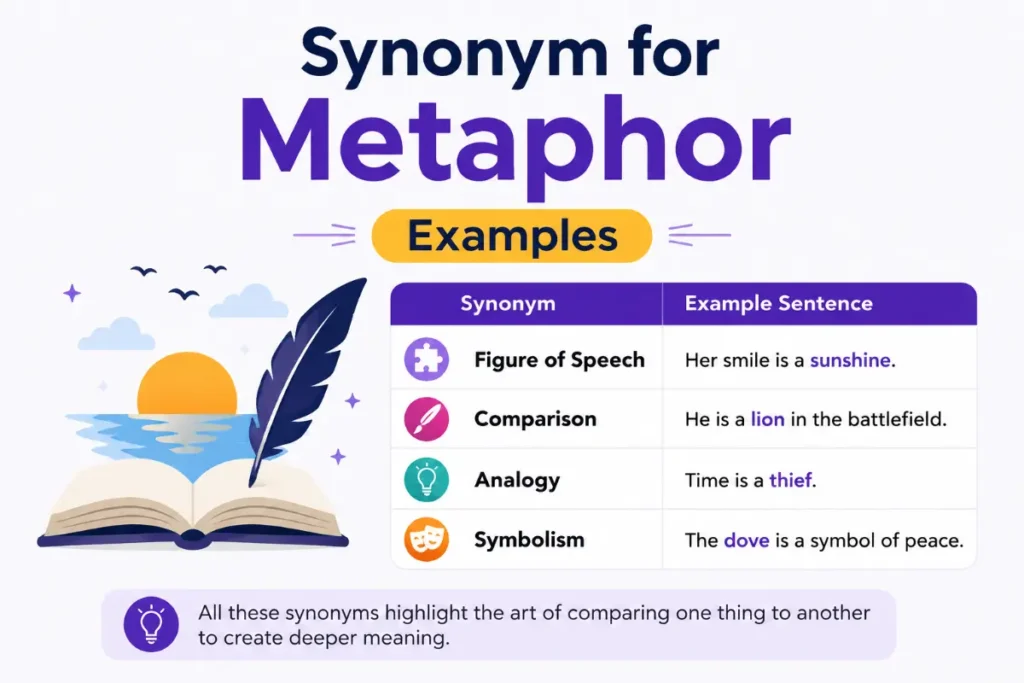
The easiest way to understand these alternatives is to see them in context.
Analogy
- The coach used an analogy to explain teamwork.
- Comparing the brain to a computer is a helpful analogy.
Symbol
- The white flag became a symbol of peace.
- The old oak tree served as a symbol of strength.
Allegory
- Many readers interpret the novel as an allegory about freedom.
- The film uses allegory to explore social issues.
Image
- The poem creates an unforgettable image of the sea.
- The description painted a beautiful image in my mind.
Figure Of Speech
- A metaphor is a type of figure of speech.
- Teachers often introduce this figure of speech in middle school.
Trope
- The reluctant hero is a familiar fantasy trope.
- The story avoids common tropes to feel more original.
These examples show that the best alternative depends on the idea you want to express rather than on the word itself.
If you enjoy learning about precise language, you’ll also benefit from avoiding a common word mix-up that often appears in everyday writing.
Metaphor In A Sentence
Looking at complete sentences helps you understand how metaphors work in everyday English and creative writing.
Everyday Examples
- His mind is a steel trap.
- Her smile was sunshine after a storm.
- The city is the heart of the country.
- My schedule is a puzzle.
- Their friendship is a bridge between families.
Literature Inspired Examples
- The moon was a silver lantern in the night sky.
- Hope became a tiny flame that refused to go out.
- Fear was a shadow following every step.
- The classroom was a garden where ideas could grow.
- Her words were arrows that struck without warning.
These examples compare one thing with another without using words like as or like, which is one of the defining features of a metaphor.
Synonym For Metaphor In Literature
Literary critics rarely use one replacement for metaphor because each term describes a different technique. Instead, they choose the word that best matches the discussion.
Here are some common choices.
- Figure of speech when discussing figurative language in general.
- Trope when referring to literary devices or recurring expressions.
- Symbol when an object represents an abstract idea.
- Imagery when the focus is on creating vivid mental pictures.
- Allegory when an entire story carries a symbolic meaning.
For example, a critic might write that a novel contains powerful symbolism, vivid imagery, and memorable metaphors. Although these concepts work together, each contributes something different to the writing.
Understanding these distinctions makes literary analysis more accurate and more persuasive.
Grammar Rules
Although metaphor is a literary term, it follows standard English grammar.
Part Of Speech
Metaphor is a noun.
Examples include:
- The metaphor strengthened the speech.
- The writer used a memorable metaphor.
- We discussed the metaphor during class.
Singular And Plural Forms
The singular form is metaphor.
The plural form is metaphors.
Examples:
- Shakespeare used many metaphors in his plays.
- Students identified several metaphors in the poem.
Common Sentence Patterns
Native speakers commonly use phrases such as:
- Use a metaphor.
- Create a metaphor.
- Identify a metaphor.
- Explain a metaphor.
- Interpret a metaphor.
- Analyze a metaphor.
- Extend a metaphor.
- Compare metaphors.
These combinations appear frequently in classrooms, writing guides, and literary discussions.
Adjective Forms
You may also see related adjectives such as:
- Metaphorical.
- Figurative.
- Symbolic.
Each one describes language that goes beyond literal meaning.
Common Mistakes
Many writers confuse metaphor with other literary devices because they all involve creative language. Learning the differences helps you choose the right term with confidence.
Confusing Metaphor With Simile
This is the most common mistake. A metaphor makes a direct comparison.
Example:
Life is a marathon.
A simile compares using like or as.
Example:
Life is like a marathon.
Both create vivid imagery, but they are not the same device.
Treating Every Comparison As A Metaphor
Not every comparison qualifies as a metaphor. Writers often describe facts, measurements, or similarities without using figurative language. Those statements should not be labeled as metaphors.
Using Analogy As A Direct Replacement
An analogy explains an idea by comparing it with something familiar. A metaphor creates imagery through direct comparison. Because they serve different purposes, one cannot always replace the other.
Calling Symbolism A Metaphor
A symbol represents something beyond its literal meaning. A metaphor states that one thing is another. Although both appear frequently in literature, they function differently.
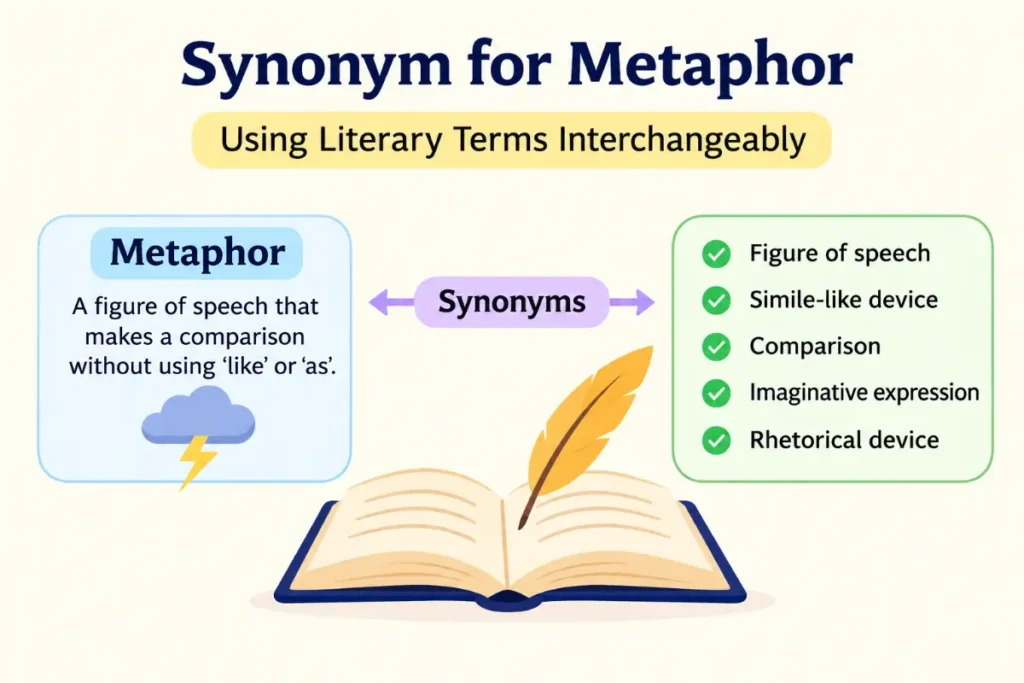
Using Literary Terms Interchangeably
Words such as imagery, trope, allegory, and figure of speech are related, but each has a specific meaning. Choosing the most precise term improves both clarity and credibility.
Etymology And Word Origin
The word metaphor has a long history that stretches back to ancient Greece. It comes from the Greek word metaphora, which means to transfer or to carry across. The term combines meta, meaning beyond or across, and pherein, meaning to carry.
Ancient Greek philosophers and writers used the concept to describe language that transferred meaning from one thing to another. Instead of making a literal statement, a metaphor allowed writers to express ideas through imaginative comparison.
The word entered Latin as metaphora before becoming part of Middle English. Over the centuries, its meaning remained remarkably consistent. Today, it is still used to describe one of the most powerful tools in language, literature, advertising, speeches, and everyday communication.
Just as metaphors help compare ideas figuratively, comparison symbols explained can help you understand literal comparisons in mathematics and everyday contexts.
Related Words And Confused Terms
Many literary terms are connected to metaphors, but each has its own purpose. Knowing the difference helps you write and analyze language more accurately.
| Term | Meaning | Relationship |
|---|---|---|
| Simile | A comparison using like or as | Closely related |
| Analogy | An extended comparison used to explain an idea | Similar but different |
| Symbol | Something representing a deeper meaning | Often works alongside metaphors |
| Allegory | A complete story with symbolic meaning | May contain many metaphors |
| Imagery | Descriptive language that creates mental pictures | Often includes metaphors |
| Personification | Giving human qualities to nonhuman things | A type of figurative language |
| Figure of speech | A broad category of nonliteral language | Includes metaphors |
| Trope | A literary device or recurring pattern | Metaphor is one type of trope |
Learning these terms together makes it easier to understand literature and improve your own writing.
Simile Compared With Metaphor
People often confuse these two figures of speech because both compare one thing with another. The difference lies in how the comparison is expressed.
A metaphor makes a direct comparison.
Example:
The classroom was a jungle.
A simile uses like or as to make the comparison.
Example:
The classroom was like a jungle.
Neither device is better than the other. Writers choose the one that creates the strongest effect for the situation.
Simile Synonym
If you are searching for a synonym for simile, there is no exact replacement. Depending on the context, you may see related terms such as:
- Comparison.
- Figure of speech.
- Analogy.
- Literary device.
Each has a broader meaning than simile, so choose carefully.
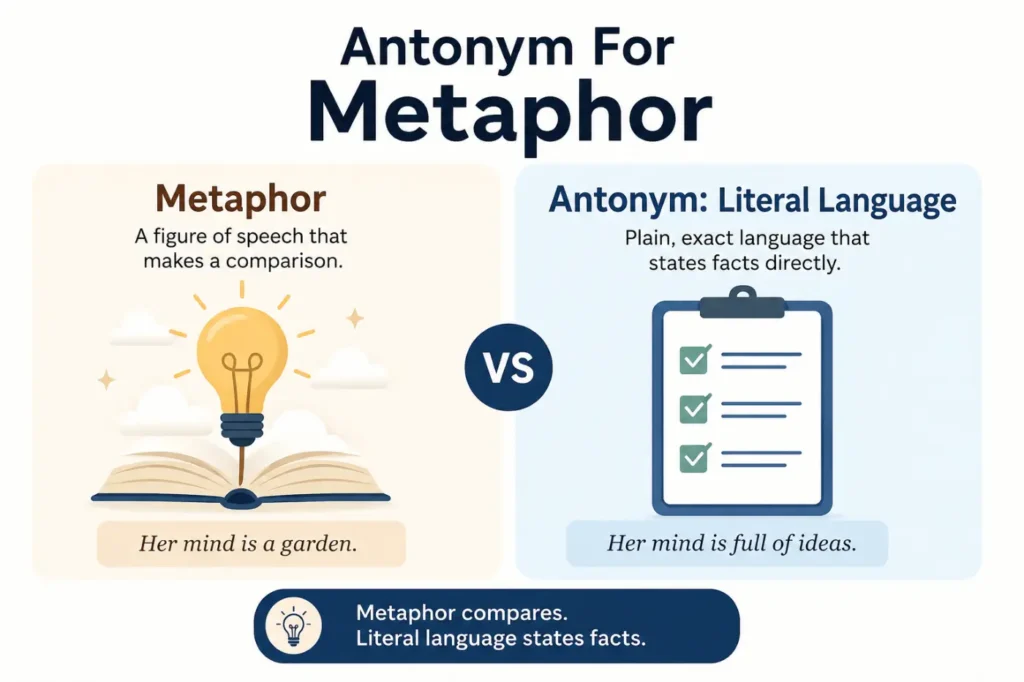
Metaphor Antonym And Synonym
Unlike many everyday words, metaphor does not have one perfect synonym or one universally accepted antonym.
Closest Synonyms
- Analogy.
- Figure of speech.
- Symbol.
- Trope.
- Representation.
- Image.
Each works in specific situations rather than replacing metaphor completely.
Antonyms
The closest opposite ideas include:
- Literal statement.
- Literal language.
- Direct expression.
- Factual description.
These terms describe language that communicates exactly what it means without figurative comparison.
Another Word For Metaphor That Starts With A
If you specifically need an alternative beginning with the letter A, these are the strongest choices.
- Analogy. The most common and useful alternative, especially when explaining ideas through comparison.
- Allegory. Best used for stories that carry a symbolic message.
- Allusion. A reference to another work, event, or person. Although related to literary writing, it is not a synonym for metaphor.
Among these, analogy is usually the closest substitute in everyday writing.
Metaphor Synonym With Eight Letters
People often search for an eight letter synonym, especially when solving crossword puzzles.
A few possibilities include:
- Allegory. Eight letters.
- Symbolic. Eight letters, although it is an adjective rather than a noun.
Keep in mind that crossword clues often depend on the specific puzzle, so the intended answer may vary.
Expert Language Insight
Experienced writers do not search for a synonym simply to avoid repeating a word. They choose the term that best matches the idea they want to express.
For example, if you are explaining a complex concept to students, analogy is usually the strongest choice because its purpose is to clarify. If you are analyzing a novel, symbol, imagery, or allegory may describe the author’s technique more accurately. In literary criticism, precision matters more than variety.
Another point worth remembering is that readers rarely notice occasional repetition of an important technical term. Replacing metaphor with an inaccurate synonym simply to avoid repetition can confuse your audience. Good writing values clarity over unnecessary variation.
When editing, ask yourself one question before changing the word. Does this alternative preserve the original meaning? If the answer is no, keep the original term.
Frequently Asked Questions
What is the best synonym for metaphor?
There is no perfect synonym because each related word has a different meaning. Analogy, symbol, figure of speech, and trope are among the closest alternatives, but the best choice depends on your sentence and purpose.
Is analogy the same as a metaphor?
No. An analogy explains an idea by comparing it with something familiar, while a metaphor creates a direct figurative comparison. Both involve comparison, but they achieve different goals.
What is another word for metaphor in literature?
Literary discussions often use terms such as figure of speech, trope, symbol, imagery, and allegory. The most suitable term depends on the specific literary technique being discussed.
What is the opposite of a metaphor?
The closest opposite is literal language or a literal statement. Instead of expressing an idea through figurative comparison, literal language communicates exactly what the words mean.
Can I replace metaphor with symbolism?
Not always. Symbolism refers to the use of symbols to represent larger ideas, while a metaphor directly compares one thing with another. They often work together, but they are not interchangeable.
Is metaphor a noun or an adjective?
Metaphor is a noun. The related adjective is metaphorical, which describes language that uses or resembles a metaphor.
Why do writers use metaphors?
Metaphors make writing more vivid, memorable, and emotionally engaging. They help readers picture ideas, understand complex concepts, and connect with a message on a deeper level.
What is the easiest way to identify a metaphor?
Look for a direct comparison in which one thing is described as another without using like or as. If the comparison is figurative rather than literal, it is likely a metaphor.
Conclusion
Finding the right synonym for metaphor is about more than choosing a different word. It is about selecting the term that communicates your meaning with precision. Although words such as analogy, symbol, allegory, trope, and figure of speech are closely related, each serves a different purpose.
Understanding these differences improves both your writing and your reading. It helps you analyze literature more accurately, explain ideas more clearly, and choose language that fits your audience and context.
When you are unsure, focus on the role the word plays rather than on replacing it. The most effective writers value accuracy over variety, and that habit leads to stronger, more confident communication.