If you have searched for gradual vs insidious, you are probably trying to understand why these two words sometimes seem interchangeable but are used differently in everyday English and medical writing. They both describe something that develops over time, yet they do not carry the same meaning. Choosing the wrong one can change the message you want to convey.
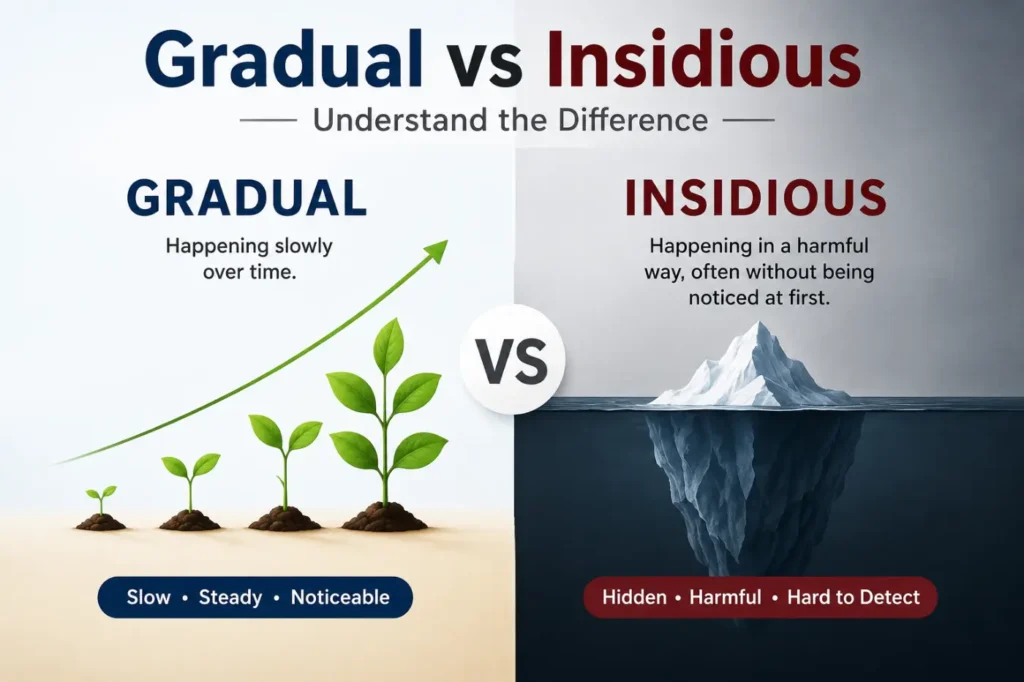
The short answer is this. Gradual simply describes a slow and steady change. Insidious describes something that develops slowly but often in a hidden, subtle, or harmful way. That extra meaning is what makes the words different.
The confusion is especially common in healthcare. Doctors often describe an illness as having an insidious onset, while patients may simply say the symptoms appeared gradually. Although both descriptions involve slow development, they emphasize different aspects of the condition.
This guide explains each word in plain English with practical examples and expert language insights. You will learn the definitions, pronunciation, grammar, real world usage, common mistakes, and the differences that native speakers instinctively recognize. By the end, you will know exactly which word fits your sentence and why.
Quick Definition
Gradual means something happens slowly over time through small, noticeable stages. Insidious also describes slow development, but it usually suggests the change is subtle, difficult to detect at first, or quietly harmful. In medical writing, an insidious onset refers to symptoms that appear so slowly that they may go unnoticed during the early stages.
Quick Answer
If you only need a quick explanation, remember these points.
- Gradual means slow, steady, and progressive.
- Insidious means slow but also subtle, hidden, or potentially harmful.
- Both words can describe change over time, but they are not synonyms in every situation.
- Medical professionals often use insidious onset to describe symptoms that develop quietly instead of appearing suddenly.
- In everyday writing, gradual is usually the safer and more common choice unless you want to emphasize hidden progression.
Gradual vs Insidious Comparison Table
| Feature | Gradual | Insidious |
|---|---|---|
| Part of speech | Adjective | Adjective |
| Origin | Latin gradus meaning step | Latin insidiosus meaning deceitful or treacherous |
| Core meaning | Happening little by little | Developing slowly in a subtle or harmful way |
| Emotional tone | Neutral | Usually negative |
| Formality | Common in all writing | More common in formal, academic, and medical writing |
| Common contexts | Learning, growth, improvement, climate, recovery | Disease, health, social problems, corruption, hidden risks |
| Usage frequency | Very common | Less common but precise |
| Example | There was a gradual improvement in sales. | The illness had an insidious onset. |
While gradual describes a slow pace of change, choosing the correct spelling of incorporate is equally important to ensure your writing stays clear and professional.
Meaning Of Both Words
Although both words describe change over time, they highlight different ideas. Understanding those ideas is the key to using them naturally.
What Does Gradual Mean
Gradual describes something that happens step by step instead of all at once. The change is usually easy to observe if you watch it over a period of time. The word itself does not suggest anything good or bad. It simply focuses on the pace of change.
You will often see it in situations such as:
- Learning a new skill.
- Recovering from an injury.
- Economic growth.
- Seasonal weather changes.
- Weight loss.
- Business development.
- Personal improvement.
Examples include a gradual increase, gradual improvement, gradual decline, and gradual recovery. Because the word is neutral, it works equally well for positive, negative, or ordinary situations.
What Does Insidious Mean
Insidious has a more specific meaning. It describes something that spreads or develops slowly while remaining difficult to notice at first. In many situations, the word also suggests hidden danger or harmful consequences.
Native speakers often associate the word with illnesses, social problems, or situations that quietly become worse over time.
Common examples include:
- An insidious disease.
- An insidious infection.
- An insidious threat.
- An insidious influence.
- An insidious habit.
- An insidious form of corruption.
One of the most common medical expressions is insidious onset. It describes symptoms that begin so gradually that the person may not realize anything is wrong until the condition becomes more noticeable.
Gradual vs Insidious Key Differences
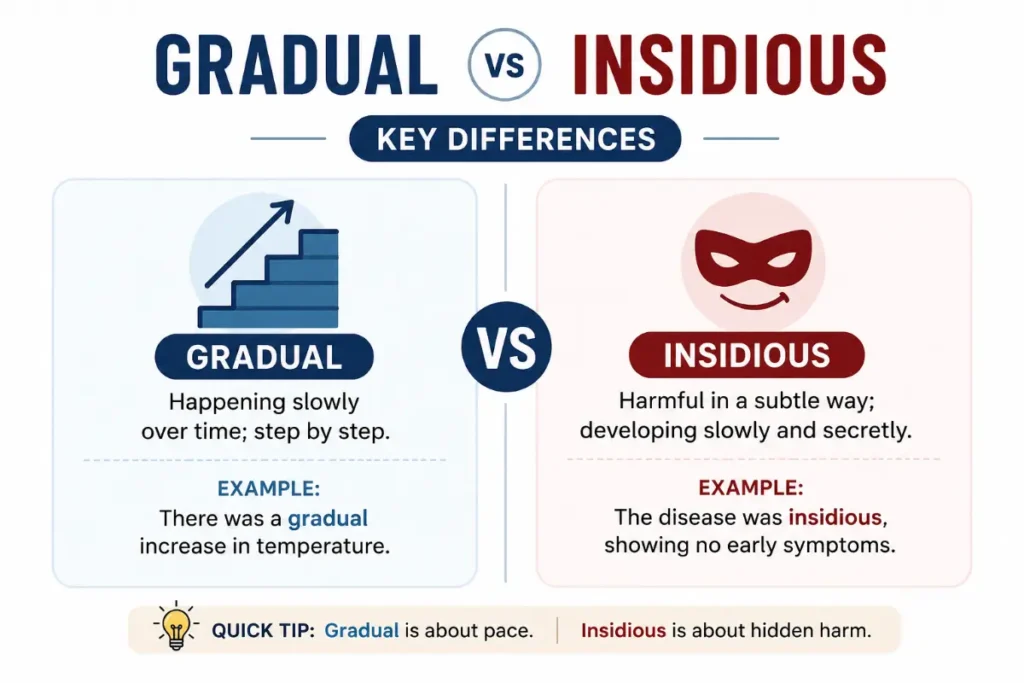
These words overlap because they both describe slow development, but they are not interchangeable.
The most important distinction is that gradual describes the speed of change, while insidious describes both the speed and the hidden or harmful nature of that change.
Here are the main differences.
- Gradual is neutral. Insidious usually has a negative meaning.
- Gradual focuses on slow progress. Insidious focuses on slow progress that is difficult to detect.
- Gradual works in everyday conversation and all types of writing.
- Insidious appears more often in medicine, psychology, academic writing, journalism, and formal English.
- An event can be gradual without being dangerous, but something described as insidious almost always carries a warning.
For example, a person’s confidence may improve gradually over several months. In contrast, an illness may spread insidiously because the symptoms remain subtle until significant damage has already occurred.
Which Word Is Correct
Neither word is more correct than the other. The right choice depends entirely on what you want to communicate.
- Choose gradual when you simply want to describe a slow change over time.
- Choose insidious when you want to emphasize that the change is subtle, difficult to recognize, or quietly harmful.
This difference is especially important in medical writing. A doctor may describe a condition as having an insidious onset because the symptoms appeared slowly and were not obvious in the beginning. Saying the symptoms developed gradually is not wrong, but it leaves out the idea that the early signs were easy to miss.
As a general rule, use the more precise word rather than the more dramatic one. If hidden progression is not part of the meaning, gradual is usually the better choice.
Pronunciation Guide
These words are pronounced quite differently even though they sometimes appear in similar contexts.
IPA Pronunciation
Gradual
/ˈɡrædʒ.u.əl/
Insidious
/ɪnˈsɪd.i.əs/
Syllable Breakdown
Gradual
Grad • u • al
Insidious
In • sid • i • ous
Common Pronunciation Mistakes
People learning English sometimes make these errors.
- Pronouncing gradual as two syllables instead of three.
- Stressing the first syllable of insidious instead of the second.
- Dropping the middle sound in insidious, making the word sound rushed.
- Confusing pronunciation with meaning and assuming the words are interchangeable because they often appear in discussions about change.
Listening to native speakers or using dictionary audio can help you master both pronunciations quickly.
How To Remember The Difference
A simple memory trick can help you choose the right word every time.
Think of gradual as a staircase. Each step represents a small, visible change. You can clearly see the progress from one step to the next.
Now think of insidious as a crack hidden beneath a carpet. The problem grows quietly, but you may not notice it until it becomes serious.
Remember these simple rules.
- Gradual equals slow and visible.
- Insidious equals slow and hidden.
- If the situation includes secrecy, subtle warning signs, or concealed harm, insidious is usually the better choice.
- If you are only describing the pace of change, gradual is often the most natural word.
That distinction may seem small, but it makes a noticeable difference in clear, accurate writing.
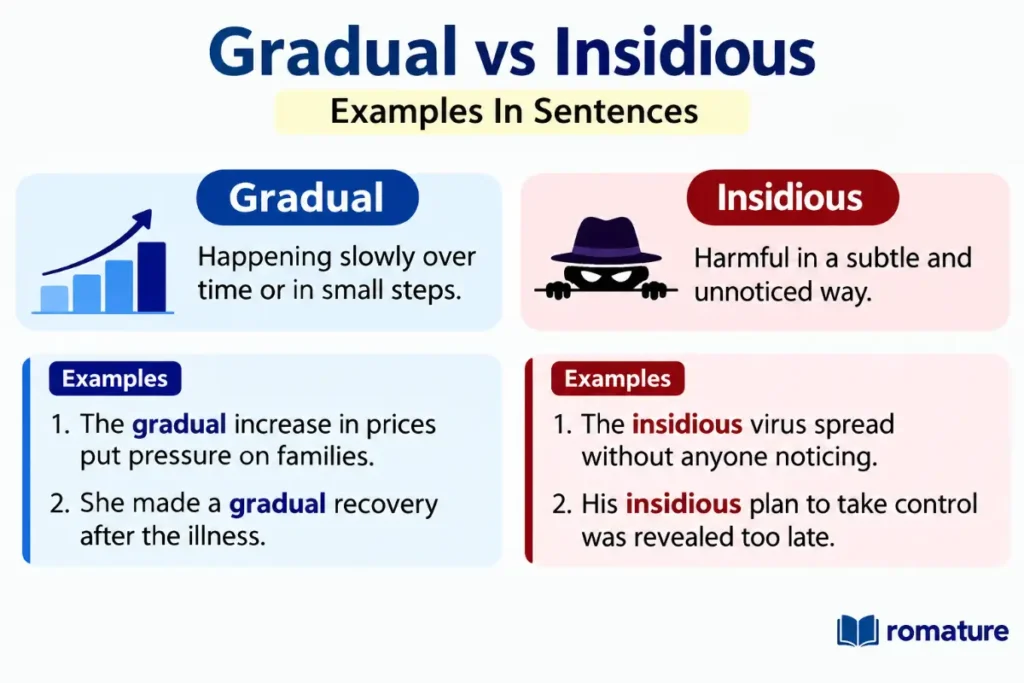
Examples In Sentences
Seeing these words in real sentences is the fastest way to understand the difference. As you read the examples, pay attention to the idea each word conveys instead of focusing only on the definition.
Examples Using Gradual
These sentences show how gradual describes a slow and steady change.
- The patient’s strength returned through a gradual recovery after surgery.
- There was a gradual increase in housing prices over the past five years.
- The company made gradual improvements to its customer service.
- Children often show gradual progress as they develop new language skills.
- The weather changed in a gradual way throughout the afternoon.
- The teacher introduced new concepts through a gradual learning process.
- His confidence grew gradually after months of practice.
- The town experienced a gradual population increase.
- The river carved a gradual slope into the landscape over thousands of years.
- The transition to the new software happened through a gradual rollout.
In every example, the focus is simply on the pace of change. The word itself does not suggest danger or hidden problems.
Examples Using Insidious
These examples highlight the subtle or harmful nature of the change.
- The disease had an insidious onset that delayed diagnosis.
- Stress can have an insidious effect on both physical and mental health.
- The report warned about the insidious spread of misinformation.
- The infection progressed through an insidious process with few early symptoms.
- Corruption can become an insidious problem if ignored.
- The medication helped control an illness with an insidious onset.
- Doctors explained that the damage occurred through an insidious progression.
- The novel describes an insidious threat that slowly changes the community.
- Financial fraud often begins in an insidious way before becoming obvious.
- The scientist studied a neurological disorder known for its insidious development.
Notice that these examples almost always carry a sense of hidden danger, delayed recognition, or negative consequences.
Gradual vs Insidious Common Mistakes
Because both words describe something that develops over time, people often confuse them. Understanding the most common mistakes will help you choose the right word with confidence.
Using Them As Perfect Synonyms
This is the mistake editors correct most often. Although both words involve slow change, they are not interchangeable.
For example:
Incorrect:
The flowers showed an insidious growth during spring.
Correct:
The flowers showed gradual growth during spring. Flowers do not normally carry the negative meaning implied by insidious.
Using Insidious For Positive Situations
The word almost always suggests something undesirable.
Incorrect:
She made insidious progress while learning Spanish.
Correct:
She made gradual progress while learning Spanish. Positive achievements rarely call for insidious because the word implies hidden harm or an undesirable outcome.
Assuming Gradual Always Means Hidden
A change can be slow without being difficult to notice.
For example:
- A child gradually grows taller.
- The seasons change gradually.
- A business gradually expands into new markets.
These changes happen over time, but they are not concealed or deceptive.
Misunderstanding Medical Terminology
Many readers think insidious onset simply means slow symptoms.
The phrase is more precise than that.
It means the symptoms develop slowly and may be difficult to recognize during the early stages. That subtle beginning is what separates it from an ordinary gradual change.
Replacing Medical Terms With Simpler Words
In healthcare writing, precision matters.
Doctors often choose insidious onset because it communicates more information than simply saying symptoms developed gradually.
Replacing the medical term can unintentionally remove an important clinical detail.
Etymology And Word Origin
Learning where these words came from helps explain why their meanings differ today.
Origin Of Gradual
The word gradual comes from the Latin word gradus, meaning step.
That origin explains why the word describes progress made little by little, almost like climbing a staircase one step at a time.
Over the centuries, English speakers began using the word for any slow or progressive change.
Origin Of Insidious
The word insidious comes from the Latin insidiosus, which means deceitful, treacherous, or characterized by hidden danger.
Its historical meaning explains why modern English still associates the word with problems that develop quietly before becoming obvious.
Although the word now appears in many fields, the underlying idea of concealed harm has remained remarkably consistent.
Paying attention to subtle language differences can help you avoid common maintenance word mistakes, especially when deciding between standard and nonstandard word forms.
Regional Usage
The meanings of these words stay consistent across major varieties of English. Unlike spelling differences such as color and colour, there is no regional preference for one form over the other.
American English
American English uses both words regularly.
- Gradual appears in everyday conversation, journalism, education, and business writing.
- Insidious is especially common in medicine, psychology, law, public health, and investigative reporting.
British English
British English follows the same usage. Medical journals, newspapers, universities, and publishers use both words with essentially the same meanings.
Australian English
Australian English also maintains the same distinction.
Healthcare professionals frequently use insidious onset, while gradual remains the preferred word for ordinary situations involving slow change.
Canadian English
Canadian English follows the same pattern. Professional writing, academic publications, and healthcare documentation all distinguish between slow change and hidden progression in the same way. Regardless of the country, the meanings remain remarkably stable.
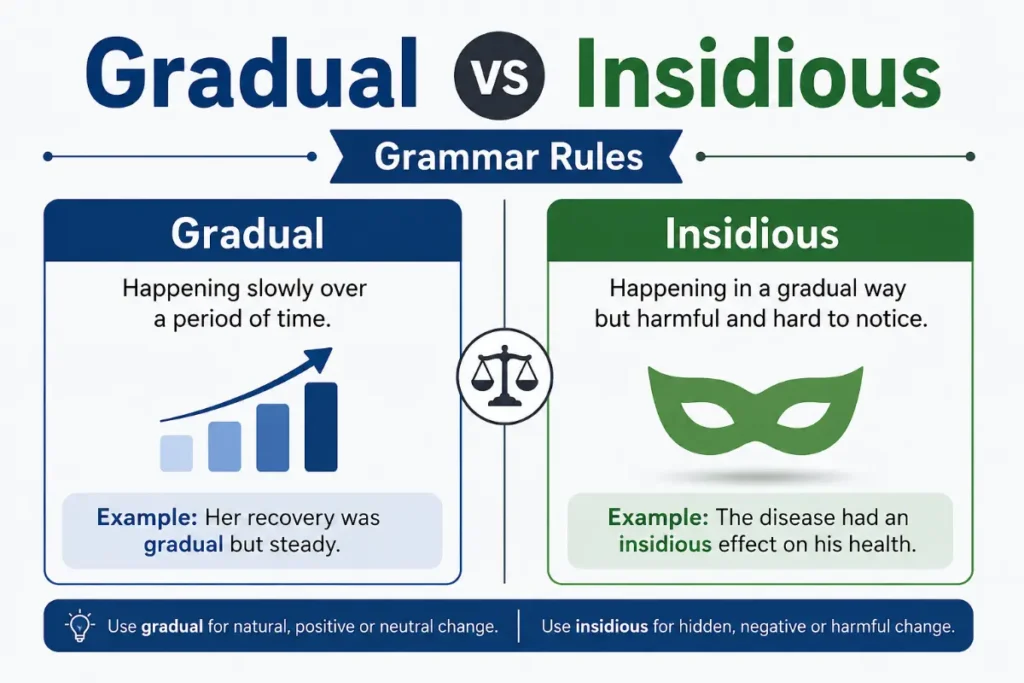
Grammar Rules
Both words are adjectives, but they describe different qualities.
Part Of Speech
Both gradual and insidious function as adjectives.
Examples include:
- A gradual recovery.
- A gradual decline.
- An insidious disease.
- An insidious influence.
Adverb Forms
Each adjective has a related adverb.
- Gradually.
- Insidiously.
Examples:
- The economy gradually improved over several years.
- The damage spread insidiously through the structure.
Common Word Partnerships
Native speakers naturally pair these adjectives with certain nouns.
Common combinations with gradual include:
- Improvement.
- Recovery.
- Increase.
- Decrease.
- Growth.
- Transition.
- Change.
- Progress.
Common combinations with insidious include:
- Onset.
- Disease.
- Threat.
- Influence.
- Infection.
- Harm.
- Effect.
- Corruption.
Learning these natural combinations makes your writing sound more fluent.
Real Life Usage Examples
These words appear in many fields, but each has its own preferred contexts.
Daily Conversation
People commonly use gradual to describe everyday experiences.
Examples include:
- A gradual improvement in fitness.
- A gradual increase in confidence.
- A gradual adjustment to a new job.
In ordinary conversation, insidious appears less often because it has a more formal tone.
Medical Communication
This is where the distinction becomes especially important.
Healthcare professionals frequently describe illnesses using terms such as:
- Insidious onset.
- Gradual onset.
- Acute onset.
- Although gradual onset and insidious onset both describe symptoms that develop over time, they are not identical.
- An insidious onset emphasizes that the symptoms begin quietly and may not be recognized immediately.
- A gradual onset simply indicates that symptoms appear progressively over time.
The opposite of an insidious onset is generally an acute onset, where symptoms begin suddenly and become noticeable almost immediately.
Academic Writing
Researchers often choose insidious when discussing hidden influences, long term risks, or diseases with subtle early stages.
The word gradual appears more often when describing measurable trends, development, or change over time.
Professional Communication
Business reports commonly describe gradual improvements in revenue, productivity, or customer satisfaction.
Words like insidious are more likely to appear when discussing hidden risks, unethical practices, cybersecurity threats, or organizational problems that develop quietly before becoming serious.
Literature And Media
Authors frequently use gradual to describe character growth or changes in relationships.
The word insidious often appears in suspense, crime, and psychological fiction because it creates a sense of concealed danger or slowly increasing tension.
Just as it’s essential to distinguish between gradual and insidious, knowing the proper spelling of bachelor can prevent common spelling errors in everyday writing.
Related Words And Confused Terms
People comparing these words often come across other terms that describe change, progression, or the beginning of a condition. Some overlap in meaning, but each has its own purpose. Understanding these related terms will help you choose the most accurate word for every situation.
| Word or Phrase | Meaning | Typical Context |
|---|---|---|
| Gradual | Happening little by little over time | Everyday writing, education, business |
| Insidious | Developing slowly in a subtle or harmful way | Medicine, psychology, journalism |
| Progressive | Continuing to develop or advance over time | Medicine, science, general English |
| Acute | Sudden and often severe | Medicine, emergencies |
| Chronic | Lasting for a long time | Healthcare |
| Gradual onset | Symptoms appear slowly over time | Medical writing |
| Insidious onset | Symptoms develop slowly and are difficult to notice at first | Clinical medicine |
| Acute onset | Symptoms begin suddenly | Healthcare |
You may also encounter these closely related words and phrases.
- Slow progression.
- Steady development.
- Subtle change.
- Hidden progression.
- Progressive symptoms.
- Early signs.
- Delayed recognition.
- Silent disease.
- Gradual improvement.
- Underlying condition.
Although these expressions are related, they are not interchangeable. Choosing the right one depends on the message you want to communicate.
Gradual vs Insidious Expert Language Insight
One habit separates experienced writers from beginners. They choose words based on meaning, not simply because they sound similar.
In editing, gradual is treated as a neutral description of pace. It tells readers that something changes step by step without suggesting anything about the outcome.
Insidious does much more than describe speed. It introduces an additional layer of meaning by suggesting that the change is difficult to notice or quietly harmful. That is why healthcare professionals, researchers, and journalists often prefer it when discussing diseases, social problems, or hidden risks.
A useful editing question is this.
Does the sentence need to communicate hidden danger, delayed recognition, or subtle progression?
If the answer is yes, insidious is probably the better choice.
If the answer is no and you only want to describe slow development, gradual will usually sound more natural.
Following this simple approach makes your writing more precise and closer to the way educated native speakers use these words.
Frequently Asked Questions
What is the difference between gradual and insidious?
Both words describe something that develops over time, but they are not identical. Gradual focuses on the speed of change, while insidious describes slow development that is subtle, difficult to detect, or quietly harmful.
Can gradual and insidious be used interchangeably?
Not in most situations. Replacing one with the other can change the meaning of a sentence. A gradual improvement sounds positive or neutral, while an insidious improvement would sound unnatural because insidious usually carries a negative meaning.
What does insidious onset mean?
An insidious onset means symptoms begin slowly and are difficult to recognize during the early stages. People may not notice the condition until it has progressed further. Healthcare professionals commonly use this expression in clinical documentation and medical research.
What is the difference between insidious onset and gradual onset?
Both phrases describe symptoms that develop over time. The difference is that gradual onset emphasizes the pace of development, while insidious onset also suggests the early symptoms are subtle or easily overlooked.
What is the opposite of insidious onset?
The most common opposite is acute onset. An acute onset describes symptoms that appear suddenly and become noticeable almost immediately, often prompting a person to seek medical attention quickly.
Is insidious always negative?
Almost always. The word generally describes harmful influences, diseases, risks, or problems that develop quietly. It is rarely used for positive situations because its negative meaning is deeply established in English.
Which word is more common in everyday conversation?
Gradual is much more common in daily speech because people frequently describe slow progress, recovery, learning, or change. Insidious appears more often in formal writing, medicine, psychology, journalism, and academic discussions.
How can I remember the difference?
Think of gradual as visible progress that happens one step at a time. Think of insidious as a hidden problem that quietly grows before anyone realizes it. This simple comparison helps you choose the correct word in most situations.
Conclusion
Understanding the difference between these two words is easier once you focus on the meaning instead of the pace alone. Gradual describes change that happens little by little and carries no positive or negative judgment. It is the natural choice for everyday situations involving steady progress, improvement, decline, or development.
Insidious also describes slow development, but it adds an important idea. The change is subtle, difficult to recognize, or quietly harmful. That is why the word appears so often in healthcare, psychology, research, and discussions about hidden risks.
When you are writing or speaking, ask yourself one simple question. Am I describing a slow change, or am I emphasizing that the change is concealed or potentially damaging? The answer will usually point you toward the right word.
Using the more precise term makes your writing clearer, more accurate, and more trustworthy. It also helps your readers understand exactly what you mean without stopping to interpret your wording.