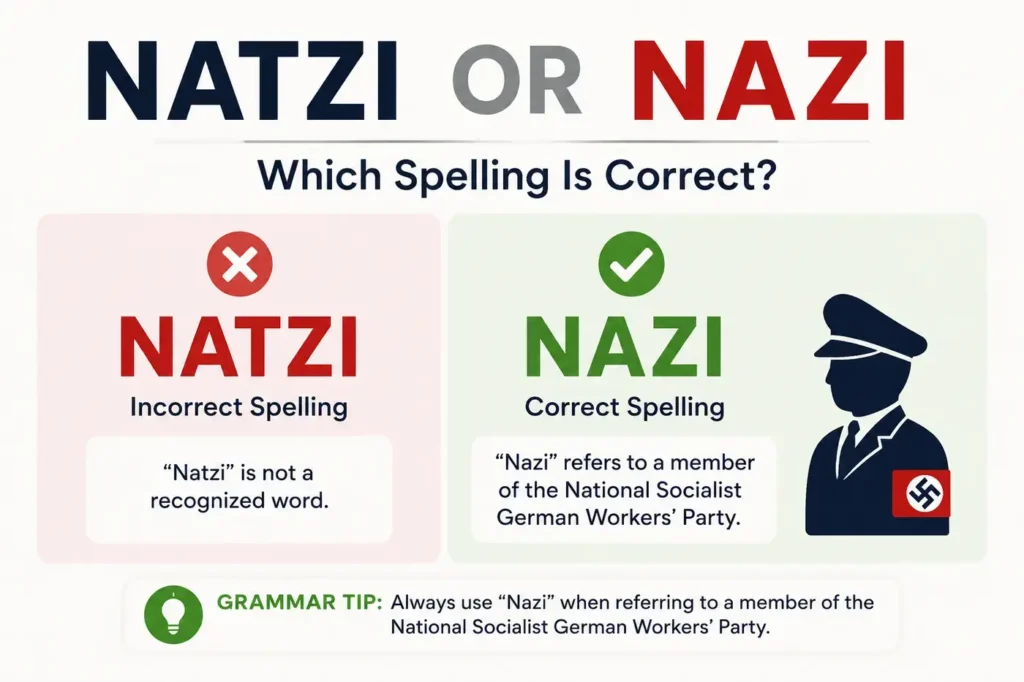
If you’ve searched for natzi or nazi, you’re probably trying to figure out the correct spelling. The answer is straightforward. Nazi is the correct spelling in English. Natzi is a misspelling and isn’t recognized as a standard English word.
People often type natzi by mistake because the letters t and z are close together on many keyboards. Others may assume the word follows a different spelling pattern or simply misremember it. Since search engines display results for both spellings, it’s easy to wonder if they’re different words. They’re not.
Understanding the correct spelling matters because this word refers to a specific historical and political movement. Using the right form helps keep your writing accurate, especially in academic work, historical discussions, journalism, and educational content.
This guide explains the correct spelling, pronunciation, meaning, origin, grammar, and usage in clear, simple language. You’ll also learn why the misspelling appears online, how dictionaries treat the word, and how to avoid common mistakes when writing about this historical term.
Quick Definition
Nazi is the correct English spelling for a member of Germany’s National Socialist German Workers’ Party or something related to that regime. Natzi is simply a spelling mistake and has no separate meaning in English. If you’re writing about history or referring to the political movement, always use Nazi.
Quick Answer
The answer is easy to remember.
- Nazi is the correct spelling.
- Natzi is a common misspelling.
- Major English dictionaries recognize only Nazi.
- The pronunciation stays the same because natzi isn’t a standard word.
- Use Nazi in historical, educational, and factual writing.
If you accidentally type natzi, simply correct it to Nazi before publishing your work.
If you’re interested in other commonly confused word pairs, learning the difference between “filed” and “filled” can help you avoid another frequent writing mistake.
Comparison Table
| Feature | Natzi | Nazi |
|---|---|---|
| Part of speech | Not recognized in standard English | Noun and adjective |
| Correct spelling | No | Yes |
| Meaning | None | Refers to a member of or something related to the National Socialist German Workers’ Party |
| Origin | Typographical error | Abbreviation developed in German during the early twentieth century |
| Dictionary status | Not listed as a standard word | Listed in major English dictionaries |
| Formality | Not applicable | Standard historical term |
| Common contexts | Search errors and typing mistakes | History education journalism documentaries and academic writing |
| Usage frequency | Very low and usually accidental | Standard worldwide |
| Example | Incorrect spelling | The museum includes exhibits about the Nazi regime. |
Meaning Of The Correct Term
The word Nazi refers to a member of the political party that ruled Germany under the leadership of Adolf Hitler from 1933 to 1945. It can also describe policies, organizations, symbols, or events connected with that historical regime.
Today, the term appears primarily in historical, educational, journalistic, and legal contexts. Because it describes a specific political movement responsible for widespread persecution and atrocities, it’s important to use the word accurately and only when the context genuinely calls for it.
Depending on the sentence, the word can function in two ways.
- As a noun referring to a member of the historical political party.
- As an adjective describing something connected with that regime.
Examples include.
- The documentary examined the rise of the Nazi government before the Second World War.
- Historians continue to study Nazi policies to better understand the period.
- The museum displays artifacts from the Nazi era for educational purposes.
In each example, the word identifies a specific historical subject rather than serving as a general description.
Meaning Of Natzi
Unlike Nazi, natzi has no accepted definition in English dictionaries. It isn’t a separate word, alternate spelling, or regional variation.
Most appearances of natzi fall into one of these categories.
- A typing error.
- A spelling mistake made by someone unfamiliar with the word.
- An incorrect search query.
- An accidental misspelling repeated from another source.
Because the misspelling has no recognized meaning, professional editors replace it with the correct spelling whenever it appears in historical or educational writing.
Key Differences
At first glance, the two spellings look similar, but only one is correct. The difference comes down to standard English usage rather than meaning.
Here’s what separates them.
- Nazi is the accepted spelling in dictionaries and reference works.
- Natzi isn’t recognized as a standard English word.
- Both spellings may appear in online searches, but only one is considered correct.
- Professional writers, editors, historians, and educators consistently use Nazi.
- Spell checkers usually flag natzi as an error.
This isn’t like American and British spelling differences, where both forms may be correct. In this case, there’s only one accepted spelling.
Which One Is Correct?
The correct spelling is Nazi.
English dictionaries, history textbooks, academic journals, and reputable news organizations all use this spelling. You’ll also find it in historical archives, museum publications, and educational resources around the world.
If you write natzi, readers are likely to assume it’s a simple typing mistake rather than an alternative form. Correcting it improves accuracy and helps maintain credibility, especially when discussing historical topics.
A helpful way to remember the spelling is to notice that it contains only four letters.
N A Z I
There isn’t a silent t anywhere in the word.
Pronunciation Guide
Even though many people misspell the word, the pronunciation stays consistent across English.
American English
IPA pronunciation.
/ˈnɑːtsi/
Syllable breakdown.
Na zi
The first syllable receives the primary stress.
German Pronunciation
The German pronunciation is very similar, although native speakers often produce a slightly sharper ts sound.
IPA pronunciation.
/ˈnaːtsi/
The rhythm differs slightly from English, but the word remains easy to recognize in both languages.
Common Pronunciation Mistakes
People occasionally make these mistakes.
- Pronouncing the letter z like the English sound in zebra instead of the ts sound.
- Adding an extra syllable.
- Stressing the second syllable instead of the first.
Listening to native speakers or reliable dictionary audio can help reinforce the correct pronunciation.
Expert Language Insight
Language professionals treat this as a straightforward spelling question rather than a matter of style or regional preference. Unlike words such as color and colour, there aren’t multiple accepted English forms.
Editors don’t decide between two valid spellings. They simply correct natzi to Nazi because that’s the standard form found in dictionaries, history books, and academic publications.
If you’re writing about this period of history, accuracy matters. Using the correct spelling shows attention to detail and helps readers focus on the historical discussion instead of a distracting typo.
Examples In Sentences
The following examples show how the correctly spelled word is used in neutral, historical, and educational contexts. They are intended to demonstrate proper grammar and usage, not to promote or endorse the ideology associated with the term.
Examples Using the Correct Spelling
- The history teacher explained how the Nazi Party rose to power in Germany during the early 1930s.
- The museum features an exhibit about life under the Nazi regime during the Second World War.
- Historians continue to study Nazi policies to understand their impact on Europe and the wider world.
- Several documentaries examine how Nazi propaganda influenced public opinion at the time.
- The author relied on primary historical sources when writing about Nazi Germany.
- Students discussed the consequences of Nazi rule during their modern history class.
- The archive contains letters written during the Nazi era.
- Researchers analyzed how Nazi symbols have been regulated in different countries.
- The documentary focused on the experiences of civilians living under Nazi occupation.
- Many universities teach the history of the Nazi regime to help students understand the causes and consequences of authoritarian governments.
Examples of the Misspelling
The following sentences illustrate common typing or spelling mistakes.
- He searched for natzi before realizing the correct spelling is Nazi.
- The student accidentally typed natzi in the essay and corrected it during proofreading.
- Spell check flagged natzi because it is not a recognized English word.
- The editor replaced every instance of natzi with the correct spelling.
- A search for natzi usually leads users to information about Nazi because search engines recognize it as a misspelling.
- The incorrect spelling appeared because the writer typed too quickly.
- Proofreading helped catch the typo before publication.
- The dictionary does not include natzi as a standard English word.
- The article explained why natzi is considered a spelling error.
- Always verify unfamiliar historical terms before publishing your work.
Common Mistakes
Because the word refers to a specific historical movement, accuracy is important. Most errors involve spelling or capitalization rather than meaning.
Here are the mistakes editors see most often.
Misspelling the Word
The most common mistake is adding an extra t and writing natzi.
The correct spelling is Nazi. Standard English dictionaries and academic references do not recognize natzi as an alternative form.
Using Lowercase When Referring to the Historical Party
When referring to the historical political movement or its members, Nazi is normally capitalized because it originates from a proper name.
Examples.
- Correct: The museum displays artifacts from the Nazi era.
- Incorrect: The museum displays artifacts from the nazi era.
Following standard capitalization rules makes historical writing clearer and more accurate.
Assuming It Has Regional Variants
Unlike words such as color and colour, this term does not have separate American and British spellings.
Writers in the United States, the United Kingdom, Australia, Canada, and other English speaking countries all use the same spelling.
Treating the Misspelling as a Different Word
Some people think natzi and Nazi have different meanings because both appear in online searches.
They do not. The extra letter simply creates a spelling error rather than a new word.
Etymology And Word Origin
The word Nazi originated in Germany during the early twentieth century. It developed as a shortened form of the German name Nationalsozialist, which refers to a supporter of the National Socialist movement.
Over time, the shortened form became widely used in newspapers, political discussions, and everyday speech. As the movement gained power in Germany, the word entered English and many other languages without changing its spelling.
Today, the term remains closely associated with that specific historical period. Because of its historical significance, it is generally used in educational, historical, legal, and journalistic contexts rather than in ordinary conversation.
Writers who enjoy mastering tricky word choices may also find it useful to learn when to use “drier” or “dryer”, since those two words are often mixed up for similar reasons.
Regional Usage
The spelling remains the same across the major varieties of English.
American English
American publications consistently use Nazi. You’ll find this spelling in history textbooks, newspapers, museums, and academic writing.
British English
British English also uses Nazi. There is no alternative British spelling.
Australian English
Australian writers follow the same convention. Educational materials and news organizations use the standard spelling.
Canadian English
Canadian English likewise uses Nazi in historical and educational contexts.
Unlike many English words that vary by region, this term has one accepted spelling regardless of where English is spoken.
Grammar Rules
The word can function as both a noun and an adjective depending on the sentence.
As a Noun
When used as a noun, it refers to a member of the historical political party.
Example.
The historian wrote about a former Nazi who was interviewed after the war.
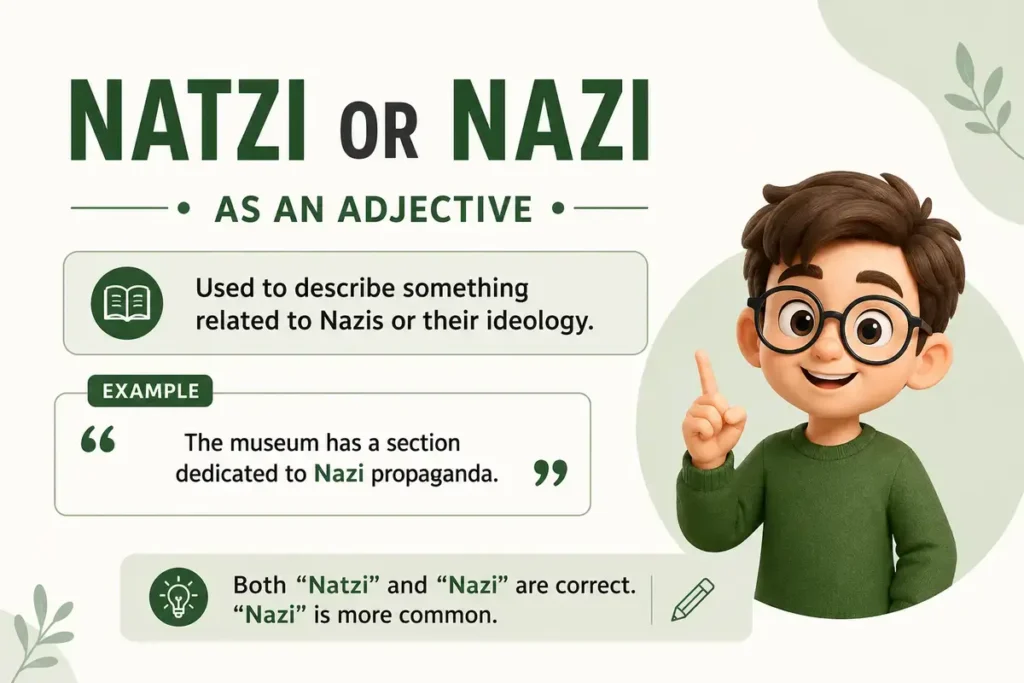
As an Adjective
When used as an adjective, it describes something connected with the historical regime.
Examples.
- Nazi policies.
- Nazi propaganda.
- Nazi occupation.
- Nazi documents.
In both cases, the word is normally capitalized because it derives from a proper name.
Real Life Usage
Today, the word appears primarily in factual discussions about history rather than everyday conversation.
You’ll most often encounter it in contexts such as:
- History classes and university courses.
- Museum exhibitions.
- Academic books and journal articles.
- Historical documentaries.
- Newspaper reporting on historical events.
- Legal discussions involving historical records.
- Biographies and memoirs.
- Archive collections and research libraries.
Professional writers use the term carefully and precisely. They avoid using it loosely or inaccurately because of its specific historical meaning and the serious events associated with it.
Related Words And Commonly Confused Terms
Several historical and language terms are closely connected to this topic. Understanding the differences helps you read historical sources more accurately and avoid common mistakes.
| Term | Meaning |
|---|---|
| National Socialism | The political ideology associated with the historical movement. |
| Third Reich | The name commonly used for Germany during the period from 1933 to 1945. |
| Weimar Republic | The German government that existed before the Nazi regime came to power. |
| Fascism | A broader political ideology. While often discussed alongside Nazism, the two terms are not identical and should not be used interchangeably. |
| Holocaust | The systematic persecution and murder of six million Jews, along with millions of other victims, by the Nazi regime and its collaborators. |
| World War II | The global conflict from 1939 to 1945 during which the Nazi regime played a central role. |
It’s also helpful to distinguish between a simple spelling mistake and a different word. In this case, natzi is not an alternative spelling, regional variation, or separate term. It’s simply a misspelling of Nazi.
If you’re exploring other commonly misused expressions, it’s worth understanding why “unfazed” is the correct word in the popular “unphased or unfazed” debate.
Expert Language Insight
Professional editors approach this word the same way they handle any historically significant term. Accuracy comes first.
Unlike many English words that have accepted American and British spellings, this one has a single standard form across major dictionaries and style guides. If an editor finds natzi in a manuscript, article, or academic paper, it’s corrected as a spelling error rather than treated as a stylistic choice.
Another important point is context. Because the word refers to a specific historical movement responsible for crimes against humanity, experienced writers use it carefully and precisely. They avoid using it as a casual label or exaggeration because doing so can confuse readers and diminish the historical meaning of the term.
When discussing this subject, clear language, accurate facts, and appropriate historical context always make the writing stronger.
Frequently Asked Questions
Is natzi a real word?
No. Natzi is not recognized as a standard English word. It usually appears because of a typing error or a spelling mistake. The correct spelling is Nazi.
Why do people spell it natzi?
The mistake often happens because people type quickly or aren’t familiar with the word’s spelling. Search engines may still return results because they recognize common misspellings and redirect users to the intended term.
Is Nazi always capitalized?
Yes. In standard English, Nazi is normally capitalized because it comes from a proper name. This convention is followed in dictionaries, history books, newspapers, and academic publications.
How is Nazi pronounced in American English?
In American English, the standard pronunciation is /ˈnɑːtsi/. The first syllable carries the primary stress, and the z is pronounced as part of a ts sound rather than like the z in zebra.
How is the word pronounced in German?
The German pronunciation is /ˈnaːtsi/. It sounds very similar to the English pronunciation, although native German speakers typically produce a slightly sharper ts sound.
Is there a plural form?
Yes. The regular English plural is Nazis when referring to multiple members of the historical political party or discussing them in a historical context.
Do American and British English spell it differently?
No. Both American English and British English use the same spelling. Unlike words such as color and colour, there is no accepted regional variation.
Why is the correct spelling important?
Using the correct spelling improves clarity and credibility. It also helps readers understand that you’re referring to a specific historical movement rather than making a typographical mistake.
Conclusion
If you’ve been wondering about the correct spelling, the answer is clear. Nazi is the accepted English spelling, while natzi is simply a misspelling.
Major dictionaries, academic institutions, museums, publishers, and news organizations all use the same standard form. There are no regional spelling differences, and the word has one accepted pronunciation in English with only minor pronunciation differences in German.
When writing about history, accuracy matters. Using the correct spelling, proper capitalization, and appropriate historical context helps your writing remain clear, credible, and respectful of the subject. Taking a few seconds to proofread can prevent a simple spelling mistake from distracting readers or reducing the quality of your work.