If you’ve searched for unphased or unfazed, you’re probably trying to figure out which spelling is correct. It’s an easy mistake to make because both words sound exactly the same when spoken. Add autocorrect, social media, and casual writing into the mix, and the confusion grows even more.
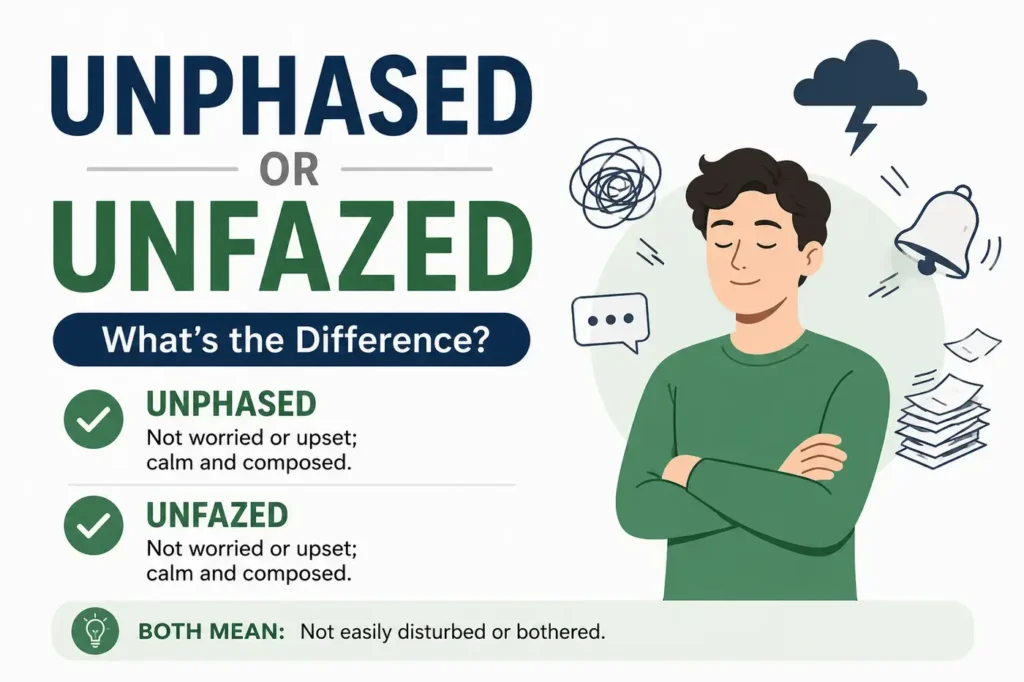
The short answer is simple. Unfazed is the correct word in standard English. It describes someone who stays calm, confident, or unaffected during a difficult, surprising, or stressful situation. Unphased is usually a misspelling that appears because people confuse it with the word phase. Although you’ll find it online and in informal conversations, most dictionaries and style guides don’t recognize it as the correct spelling.
In this guide, you’ll learn what unfazed means, why so many people mistakenly write unphased, how to remember the correct spelling, and how native English speakers actually use the word. You’ll also find real examples, grammar explanations, pronunciation tips, common mistakes, and practical advice you can apply in everyday writing.
Quick Definition
Unfazed is the correct spelling. It means calm, composed, or not disturbed by something surprising, difficult, or stressful. Unphased is generally considered a misspelling because it incorrectly replaces fazed with phased. If you want to describe someone who isn’t bothered by a situation, unfazed is the word to use.
Quick Answer
If you’re in a hurry, here’s the answer.
- Unfazed is the correct word.
- It means calm, unaffected, or not easily disturbed.
- Unphased is almost always a spelling mistake.
- Major dictionaries recognize unfazed, not unphased.
- Use unfazed in school assignments, professional writing, emails, articles, and everyday conversations.
A simple way to remember it is to think about the verb faze, which means to disturb or unsettle someone. Adding the prefix un creates unfazed, meaning not disturbed.
Comparison Table
| Feature | Unfazed | Unphased |
|---|---|---|
| Part of speech | Adjective | Usually treated as a misspelling |
| Meaning | Calm and not disturbed | Commonly intended to mean unfazed but considered incorrect |
| Origin | From the verb faze | Formed by confusing phase with faze |
| Correct form | Yes | No in standard English |
| Formality | Standard in all writing | Avoid in formal writing |
| Common contexts | Daily conversation journalism business academic writing | Informal posts social media typing errors |
| Usage frequency | Very common | Appears online but mainly as a misspelling |
| Example | She remained unfazed by the criticism. | She remained unphased by the criticism. Incorrect in standard English. |
What Unfazed Means
The adjective unfazed describes someone who stays calm even when facing pressure, criticism, unexpected news, or difficult circumstances. An unfazed person doesn’t appear nervous, shocked, or discouraged.
You’ll often hear the word in situations involving confidence and emotional control.
For example:
- A firefighter stays unfazed during an emergency.
- A public speaker remains unfazed after forgetting one line.
- An experienced athlete looks unfazed before a championship game.
- A doctor stays unfazed while treating patients in a busy emergency room.
- A business owner remains unfazed despite a challenging market.
The word often suggests confidence, resilience, or emotional stability rather than a complete lack of emotion.
If you’re unsure about the past tense here, our guide on proper use of laid and layed explains the difference with clear examples.
Definition
The simplest definition is:
Unfazed means not disturbed, not worried, or not affected by something that might upset other people.
Context
You’ll see this word in many kinds of writing.
- News articles.
- Sports reporting.
- Business publications.
- Novels.
- Everyday conversations.
- Professional emails.
- Interviews.
- Academic writing.
Word Origin
Unfazed comes from the verb faze, which has meant to disturb, unsettle, or embarrass since the nineteenth century. Adding the prefix un reverses the meaning, creating a word that describes someone who remains unaffected.
Is Unphased A Word
This question appears in search results surprisingly often, and it’s easy to understand why.
Technically, unphased can occasionally appear in very specific situations if someone literally means not phased in the sense of not divided into phases or not arranged by stages. That’s an uncommon technical use and has nothing to do with staying calm under pressure.
In everyday English, people almost always write unphased when they actually mean unfazed. That’s why dictionaries, editors, teachers, and professional writers treat it as a spelling mistake in ordinary communication.
If your sentence is talking about someone’s reaction to a difficult situation, unfazed is almost certainly the word you’re looking for.
Key Differences
Although the two words differ by only one letter, they come from completely different roots.
Unfazed comes from the verb faze, which means to disturb or unsettle someone emotionally.
Unphased looks like it comes from the noun or verb phase, which refers to a stage, period, or step in a process. Those meanings are unrelated to emotional reactions.
Here are the main differences.
| Unfazed | Unphased |
|---|---|
| Means calm or unaffected | Usually a misspelling |
| Derived from faze | Based on phase |
| Accepted in dictionaries | Rarely accepted in everyday English |
| Appropriate in formal writing | Best avoided |
| Common in books, newspapers, and professional writing | Mostly found in social media posts and typing mistakes |
Understanding the root word makes the correct spelling much easier to remember.
Which One Should You Use
If you’re writing about someone staying calm, confident, or unaffected, always choose unfazed.
Think about the meaning first instead of the spelling.
Ask yourself this question.
Is the sentence describing someone who isn’t bothered by a situation?
If the answer is yes, unfazed is the correct choice.
Here are a few examples.
- She stayed unfazed after receiving unexpected feedback.
- He looked unfazed despite the loud crowd.
- The experienced pilot remained unfazed during the turbulence.
- Our manager stayed unfazed when the meeting changed at the last minute.
- The goalkeeper appeared unfazed before the penalty kick.
Each sentence describes someone who remains calm instead of becoming upset.
Pronunciation Guide
One reason people confuse these words is that they sound almost identical in conversation.
Unfazed
IPA pronunciation:
/ʌnˈfeɪzd/
Syllable breakdown:
Un fazed
Unphased
When people say unphased, they usually pronounce it exactly like unfazed.
IPA pronunciation:
/ʌnˈfeɪzd/
Because the pronunciation doesn’t reveal the spelling, writers often choose the wrong version without realizing it.
A good habit is to connect the word with faze, not phase. That mental link makes the correct spelling much easier to remember.
Expert Tip To Remember The Correct Spelling
Instead of memorizing the entire word, focus on the root.
The verb faze means to disturb someone.
Now add the prefix un, which means not.
Together they form unfazed, or not disturbed.
This simple connection is much easier to remember than trying to recall the spelling from memory. It also explains the meaning at the same time, which helps the word stick long after you’ve finished reading this guide.
Examples in Sentences
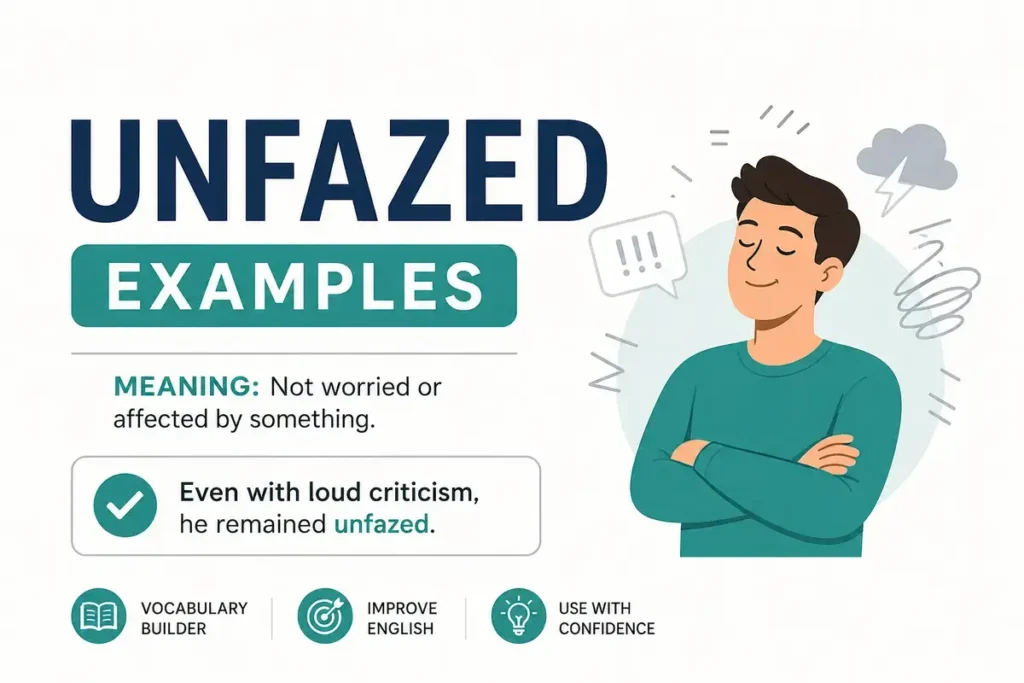
The easiest way to remember the correct word is to see it in real sentences. Notice how unfazed naturally describes someone who stays calm or isn’t bothered by a difficult situation. The examples using unphased show why the spelling causes confusion and why editors usually correct it.
Unfazed Examples
These examples all use the correct spelling.
- She remained unfazed after receiving unexpected criticism.
- The experienced firefighter stayed unfazed during the rescue.
- He looked unfazed even after missing the first question.
- Our coach was unfazed by the early setback because the team still had plenty of time.
- The CEO appeared unfazed during the challenging interview.
- Despite the heavy rain, the hikers were completely unfazed and continued their journey.
- The little girl stayed unfazed when the lights suddenly went out.
- The actor seemed unfazed by the negative comments online.
- Everyone expected him to panic, but he remained unfazed throughout the presentation.
- The doctor stayed unfazed while treating patients during a busy shift.
These examples show that the word often describes confidence, emotional control, and resilience.
Unphased Examples
The following sentences reflect how people commonly write the word online. In standard English, each sentence should use unfazed instead.
- She was unphased by the bad news. ❌
- He stayed unphased throughout the meeting. ❌
- Our teacher looked unphased during the fire drill. ❌
- The goalkeeper remained unphased after the first goal. ❌
- They seemed unphased by the long delay. ❌
- My brother was completely unphased during the storm. ❌
- The speaker looked unphased by the difficult questions. ❌
- Her calm attitude made her appear unphased. ❌
- The manager stayed unphased despite the complaints. ❌
- We were surprised that she looked so unphased. ❌
Each sentence sounds natural when spoken because the words have the same pronunciation. The spelling, however, is incorrect for standard English.
Common Mistakes
The confusion isn’t limited to one group of writers. Students, professionals, native speakers, and English learners all make this mistake because the two words sound alike. Understanding why it happens makes it much easier to avoid.
Similar spelling variations appear in English, and understanding flyer spelling differences can help you choose the correct form for your audience.
Replacing Faze With Phase
This is by far the most common mistake.
People recognize the word phase because they see it often in expressions like the next phase of the project or a learning phase. Since faze is less common, many writers assume phase must be correct.
The meanings are completely different.
- Faze means to disturb or unsettle someone.
- Phase refers to a stage or period in a process.
Once you remember that difference, the correct spelling becomes much easier to choose.
Assuming Both Spellings Are Accepted
Some websites suggest that both spellings are acceptable.
That’s misleading.
Standard dictionaries, professional editors, and style guides recognize unfazed as the correct word for describing someone who isn’t bothered by a situation. The spelling unphased usually appears because of confusion, not because it’s an accepted alternative.
Letting Autocorrect Or Social Media Decide
Many people first encounter unphased on social media, discussion forums, or text messages. Seeing the spelling repeatedly can make it look correct even though it isn’t.
If you’re writing for school, work, or publication, don’t rely on how often a word appears online. Always check a trusted dictionary when you’re unsure.
Confusing Sound With Spelling
English contains many words that sound the same but have different spellings.
Examples include:
- Their and there.
- Brake and break.
- Principal and principle.
- Stationary and stationery.
- Faze and phase.
Hearing a word correctly doesn’t always tell you how to spell it.
Using The Wrong Word In Formal Writing
A single spelling mistake can distract readers and reduce your credibility, especially in professional communication.
Before sending an email, publishing an article, or submitting an assignment, take a moment to check the spelling. Small details often leave a lasting impression.
Etymology And Word Origin
Looking at the history of these words explains why they’re so easy to confuse.
The verb faze entered English during the nineteenth century. Linguists believe it developed from an older dialect word meaning to startle, disturb, or frighten someone. Although the exact origin isn’t completely certain, its meaning has remained remarkably consistent.
The adjective unfazed appeared later by adding the prefix un, which simply reverses the meaning. Instead of describing someone who feels disturbed, it describes someone who remains calm and unaffected.
The word phase, on the other hand, comes from Ancient Greek through Latin and French. It originally referred to an appearance or stage and later came to describe different periods in a process, cycle, or development.
Because faze and phase are pronounced the same in modern English, many writers accidentally substitute one for the other even though their histories and meanings are completely unrelated.
Regional Usage
Unlike many spelling pairs in English, this isn’t a difference between American and British English. The correct spelling stays the same across major English speaking countries.
American English
American dictionaries, newspapers, universities, and publishers use unfazed. The spelling unphased is almost always treated as an error.
British English
British English follows the same rule. You’ll find unfazed in newspapers, books, magazines, and professional writing throughout the United Kingdom.
Australian English
Australian publications also prefer unfazed. Editors generally correct unphased before publication unless it’s being quoted exactly as written.
Canadian English
Canadian English matches the same standard. Although Canada combines some American and British spelling conventions, this word doesn’t change. Unfazed remains the accepted form.
No matter where your audience lives, you’ll almost always want to choose unfazed.
Grammar Rules
Understanding how the word functions in a sentence helps you use it naturally.
Part Of Speech
Unfazed is an adjective.
It describes a person, group, or sometimes an attitude.
Examples include:
- She remained unfazed throughout the interview.
- The players looked unfazed despite the pressure.
- His unfazed expression surprised everyone.
Common Sentence Patterns
You’ll often see these structures.
- Subject plus be plus unfazed.
- Remain plus unfazed.
- Stay plus unfazed.
- Look plus unfazed.
- Appear plus unfazed.
These combinations sound natural because they’re widely used by native speakers.
Common Collocations
Professional writers frequently pair the word with expressions like these.
- Unfazed by criticism.
- Unfazed by pressure.
- Unfazed by setbacks.
- Completely unfazed.
- Surprisingly unfazed.
- Seemingly unfazed.
- Remained unfazed.
- Stayed unfazed.
Learning these combinations helps your writing sound more natural than simply memorizing the definition.
Real Life Usage Examples
You’ll encounter unfazed in many different situations because it describes a quality people admire: staying calm under pressure.
Daily Conversation
Friends often use the word when talking about someone’s reaction.
Examples include:
- She was unfazed by the traffic.
- He stayed unfazed during the argument.
- They looked unfazed after hearing the announcement.
Academic Writing
Teachers and researchers may use the word when describing behavior, emotional responses, or observations.
For example, a psychology paper might explain that participants appeared unfazed despite unexpected changes during an experiment.
Professional Communication
Managers and business leaders often praise employees who remain calm during stressful situations.
You might read sentences like these.
- She remained unfazed while handling customer complaints.
- The project manager stayed unfazed despite the deadline changes.
Literature And Media
Novelists and journalists regularly use unfazed to describe characters, athletes, politicians, and public figures who remain composed in difficult moments.
The word is especially common in sports reporting because it quickly communicates confidence and emotional control.
Related Words And Confused Terms
Learning similar words helps you build a stronger vocabulary and avoid common mistakes. Since unfazed often appears in situations involving confidence or emotional control, it’s useful to know other words with similar or related meanings.
Synonyms For Unfazed
The best synonym depends on the context, but these words are often good alternatives.
- Calm.
- Composed.
- Unshaken.
- Untroubled.
- Unruffled.
- Cool headed.
- Collected.
- Relaxed.
- Self assured.
- Steady.
Each word has a slightly different nuance. For example, composed often suggests emotional control, while unshaken emphasizes that someone’s confidence hasn’t been affected by an unexpected event.
Related Words
These terms are closely connected and may appear in articles or dictionary entries about the same topic.
- Faze.
- Phase.
- Confidence.
- Resilience.
- Composure.
- Poise.
- Emotional control.
- Self confidence.
- Stress management.
- Calmness.
Words Commonly Confused With Unfazed
Some English words create confusion because they sound alike or look similar.
- Faze and phase.
- Accept and except.
- Affect and effect.
- Advice and advise.
- Compliment and complement.
- Stationary and stationery.
These pairs have different meanings, so checking the context is always more reliable than relying on pronunciation alone.
Expert Language Insight
One reason this spelling mistake has become so common is that phase is a familiar word, while faze appears less often in everyday writing. When people hear the pronunciation, their brain naturally connects it to the spelling they recognize first.
Professional editors don’t guess in situations like this. They trace the word back to its root.
Like many regional spelling differences, American vs British theater spelling depends on whether you’re writing for U.S. or international readers.
Since unfazed comes from faze, the spelling stays the same after adding the prefix un. The word has nothing to do with phase, which refers to a stage in a process.
This is also how native speakers tend to think about the word. They rarely stop to analyze the spelling because they already understand its meaning through repeated exposure. Writers who don’t use the word often are much more likely to replace faze with phase, especially when typing quickly.
- If you’re ever unsure, ask yourself a simple question.
- Is the sentence describing someone who stays calm despite pressure or unexpected events?
- If it is, unfazed is almost certainly the right choice.
Frequently Asked Questions
Is unphased or unfazed correct?
Unfazed is the correct spelling in standard English. It means calm, composed, or not disturbed by a situation. Unphased is usually a misspelling that results from confusing the words faze and phase.
Is unphased a real word?
In everyday English, it isn’t considered the correct word for describing someone who stays calm. In very specialized technical contexts, unphased could literally describe something that hasn’t been divided into phases, but that meaning is rare and unrelated to the common expression.
What does unfazed mean?
Unfazed describes someone who isn’t upset, worried, surprised, or discouraged by a difficult situation. It often suggests confidence, emotional control, and the ability to stay calm under pressure.
Why do people write unphased?
The mistake happens because phase is a much more familiar word than faze. Since both words sound the same, many people assume the spelling with ph must be correct.
Is unfazed used in British English?
Yes. Unfazed is the accepted spelling in American English, British English, Australian English, and Canadian English. This isn’t one of the spelling differences that change between regions.
What is a good synonym for unfazed?
Some of the best alternatives include composed, unshaken, calm, unruffled, collected, and self assured. The right choice depends on the tone and context of your sentence.
Can I use unfazed in formal writing?
Absolutely. The word appears regularly in newspapers, academic writing, business communication, biographies, and professional publications. It’s a standard English word and is appropriate in both formal and informal contexts.
How can I remember the correct spelling?
Think about the verb faze, which means to disturb or unsettle someone. Add the prefix un, and the meaning becomes not disturbed. Remembering the root word is much easier than memorizing the entire spelling.
Conclusion
Choosing between these two spellings is much easier once you know where the word comes from. Unfazed is the correct choice when you want to describe someone who stays calm, confident, or unaffected by a difficult situation. It comes directly from the verb faze, which means to disturb or unsettle.
Although unphased appears frequently on social media, discussion forums, and casual online conversations, it isn’t the standard spelling for this meaning. The confusion happens because phase is a familiar word and both spellings sound exactly alike when spoken.
If you want your writing to look polished and professional, remember the root word instead of relying on pronunciation. That simple habit will help you avoid a common spelling mistake and communicate more clearly.
The next time you describe someone who keeps their composure under pressure, you’ll know exactly which word belongs on the page.