If you have ever paused before writing reins vs reigns, you are in good company. These two words sound exactly alike, but they have completely different meanings. Many people use the wrong one in everyday writing because the spelling changes while the pronunciation stays the same. The confusion becomes even more common in phrases like take the reins and free rein, where a single misplaced letter changes the meaning of the entire expression.
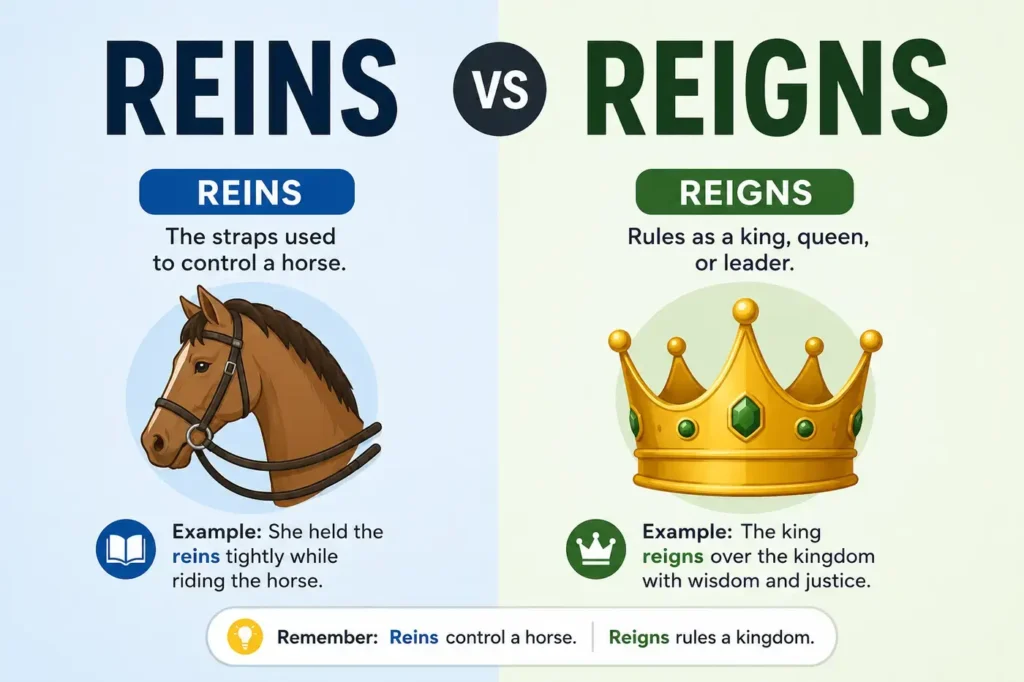
The short answer is simple. Reins relates to controlling a horse and, by extension, guiding or directing someone or something. Reigns refers to the period during which a king, queen, or ruler governs. Although they are homophones, they are not interchangeable.
This guide explains the difference in plain English with practical examples, grammar tips, pronunciation guidance, and real world usage. You will also learn the history behind both words, discover why so many people confuse them, and understand how professional editors decide which one belongs in a sentence. By the end, you will be able to use both words confidently in conversation, academic writing, and professional communication.
Quick Definition
Reins are straps attached to a horse’s bridle that riders use to guide and control the animal. The word also appears in figurative expressions that describe taking control or directing a situation. Reigns refers to the time during which a monarch rules a country. The two words sound identical but have different meanings, origins, and uses.
Quick Answer
The easiest way to remember the difference is to connect each word with its original meaning.
- Use reins when talking about controlling, guiding, or directing something.
- Use reigns when talking about the rule of a king, queen, emperor, or another monarch.
- If the sentence refers to leadership instead of royalty, reins is usually the correct choice.
- If the sentence refers to a ruler’s time in power, reigns is the right word.
For example:
- She took the reins of the company after the founder retired.
- Queen Elizabeth II’s reign lasted more than seventy years.
Although the words sound the same, their meanings come from entirely different histories.
Just as writers often confuse reins and reigns, many also struggle with the difference between busing and bussing, especially because both spellings appear in different contexts and regional varieties of English.
Comparison Table
| Feature | Reins | Reigns |
|---|---|---|
| Part of speech | Noun | Noun and verb |
| Meaning | Straps used to control a horse. Also means guidance or control. | Period during which a monarch rules. Also the verb form of rule. |
| Origin | Old French and Latin | Old French and Latin |
| Common context | Horse riding, leadership, management, idioms | Monarchy, history, politics, literature |
| Formality | Standard English | Standard English |
| Usage frequency | Common in literal and figurative writing | Common in historical and political writing |
| Example | She took the reins of the business. | His reign brought lasting reforms. |
Meaning Of Reins
The word reins originally referred to the leather straps attached to a horse’s bridle. A rider holds the reins to guide the horse, change direction, slow down, or stop. For centuries, reins have been an essential part of horseback riding because they allow the rider to communicate with the horse through gentle movements.
Over time, the word developed a broader figurative meaning. Today, people often use reins to describe taking charge of a project, leading a team, or assuming responsibility for an organization. The connection is easy to understand. Just as a rider guides a horse with the reins, a leader guides people toward a goal.
You will often see reins in these situations.
- Horse riding and equestrian sports.
- Business leadership.
- Government administration.
- Team management.
- Everyday idioms.
One of the most common expressions is take the reins, which means to accept leadership or responsibility for something.
Examples include:
- She took the reins of the family business after her father retired.
- The new coach quickly took the reins of the struggling team.
- The rider held the reins firmly as the horse crossed the stream.
Meaning Of Reign
The word reign refers to the period during which a king, queen, emperor, or another monarch rules over a country or territory. It can also be used as a verb meaning to rule, govern, or hold royal authority.
Unlike reins, this word has nothing to do with horses or leadership in a general sense. It belongs primarily to discussions about royalty, history, politics, and literature.
You’ll commonly encounter reign in topics such as:
- World history.
- Royal families.
- Historical biographies.
- Government studies.
- Historical documentaries.
Examples include:
- The queen’s reign lasted for decades.
- Historians continue to study the emperor’s reign.
- The king reigned during a period of economic growth.
In figurative writing, reign sometimes describes something dominating or prevailing for a period of time.
For example:
- Peace reigned throughout the region.
- Silence reigned in the courtroom.
These examples describe a condition that prevailed rather than a monarch ruling a nation.
Key Differences
At first glance, these words seem almost impossible to tell apart because they share the same pronunciation. The difference becomes much clearer once you understand what each word represents.
Reins is connected to guidance, direction, and control. Its meaning comes directly from horseback riding, and many modern expressions still reflect that origin. Whenever someone takes charge of a business, project, or organization, the figurative image is that they are holding the reins and guiding it forward.
Reign, on the other hand, belongs to the language of kings, queens, emperors, and royal authority. It describes a ruler’s period in power or the act of ruling. Outside royal contexts, it also describes something that dominates or prevails, as in the expression peace reigned across the country.
Here are the easiest ways to tell them apart.
- Reins relates to control, guidance, or horse riding.
- Reign relates to rulers, kingdoms, or royal authority.
- Take the reins is correct because leadership comes from guiding a horse.
- The king’s reign is correct because it refers to his years as ruler.
- Both words sound identical, but they never share the same meaning.
Which Word Is Correct
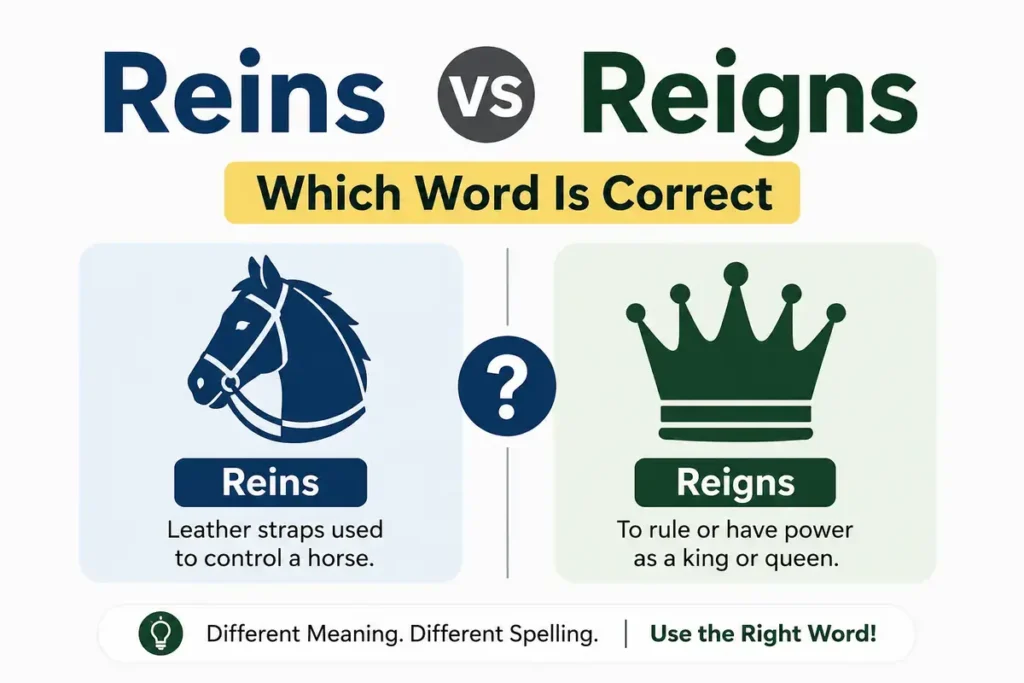
Neither word is more correct than the other. The correct choice depends entirely on the meaning of your sentence.
If you’re talking about leadership, responsibility, guidance, or horse riding, choose reins.
If you’re discussing a monarch, royal history, or a ruler’s time in power, choose reign.
A simple way to decide is to ask yourself one question.
Is the sentence about guiding something or ruling a kingdom?
If the answer involves guidance or control, use reins. If it involves royalty or governing, use reign.
Professional editors rarely confuse these words because they focus on the meaning first and the spelling second. Adopting the same habit will help you avoid one of the most common homophone mistakes in English.
Pronunciation Guide
One reason these words cause so much confusion is that they are perfect homophones. They are pronounced exactly the same even though they have different spellings and meanings.
Reins
IPA pronunciation:
/reɪnz/
Syllable breakdown:
Reins
One syllable.
Reigns
IPA pronunciation:
/reɪnz/
Syllable breakdown:
Reigns
One syllable.
Because the pronunciation is identical, listening alone will not tell you which spelling is correct. You must rely on the context of the sentence.
For example:
- She took the reins of the company.
- The king’s reign lasted thirty years.
Both words sound exactly alike when spoken, but their meanings make the correct spelling clear.
Expert Learning Tip
Many writers remember these words by focusing on the first letter after rei.
The n in reins can remind you of navigation because reins help guide and direct. The g in reign can remind you of government because a monarch governs during a reign.
Memory tricks can be helpful at first, but understanding the meaning behind each word is far more effective. Once you connect reins with guidance and reign with royalty, choosing the correct spelling becomes much easier in every kind of writing.
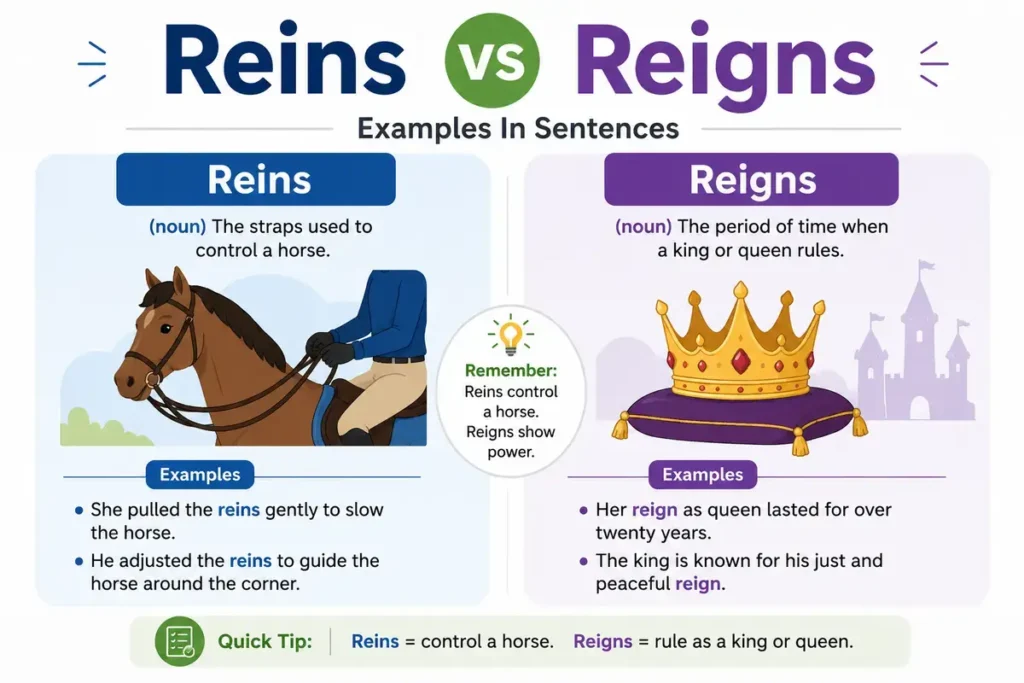
Examples In Sentences
The easiest way to remember the difference between these two words is to see them in context. As you read the examples, pay attention to the meaning instead of the spelling. That habit will help you choose the correct word naturally when you write.
Examples Using Reins
These examples show reins in both its literal and figurative meanings.
- The rider gently pulled the reins to slow the horse.
- She handed the reins to her younger brother before taking a break.
- After the retirement of the founder, the new chief executive took the reins of the company.
- Parents gradually loosen the reins as their children become more responsible.
- The coach kept a firm grip on the reins during a difficult season.
- The instructor showed beginners how to hold the reins correctly.
- The manager took the reins of the project after several delays.
- Good leaders know when to tighten the reins and when to give people more freedom.
- He grabbed the reins before the horse changed direction.
- The experienced pilot took the reins during the emergency.
Notice that only two examples involve an actual horse. The remaining sentences use reins figuratively to describe leadership, guidance, or control.
Examples Using Reign And Reigns
These examples focus on royalty, ruling, and the broader figurative meaning of the word.
- The queen’s reign lasted more than seventy years.
- Historians continue to study the emperor’s reign.
- The young king began his reign at the age of eighteen.
- During her reign, the country experienced rapid economic growth.
- The monarch reigned during a period of peace and stability.
- Fear reigned throughout the village after the storm.
- Excitement reigned in the stadium after the winning goal.
- Justice should reign in every society.
- The ruler hoped his reign would be remembered for fairness.
- Peace finally reigned after years of conflict.
These examples show that reign is not limited to kings and queens. It can also describe a condition, emotion, or situation that dominates for a period of time.
If you’re interested in avoiding other common writing mistakes, our guide on how to write large numbers correctly explains when to use lacs or lakhs in South Asian English.
Common Mistakes
Because these words are pronounced the same way, they are among the most commonly confused homophones in English. Most mistakes happen when people write familiar expressions from memory without thinking about the original meaning.
Here are the errors editors see most often.
Writing Take The Reigns Instead Of Take The Reins
This is probably the most common mistake.
Correct:
- She took the reins of the business.
Incorrect:
- She took the reigns of the business.
The expression comes from horse riding. A rider holds the reins to guide the horse, so the idiom naturally refers to taking control or accepting responsibility.
Writing Free Reign Instead Of Free Rein
Another frequent mistake involves the phrase free rein.
Correct:
- The designer was given free rein to create a new logo.
Incorrect:
- The designer was given free reign to create a new logo.
The expression originally referred to giving a horse enough slack in the reins to move freely. Today it means giving someone the freedom to make decisions without unnecessary restrictions.
Writing Full Reign Instead Of Full Rein
The traditional expression is full rein.
For example:
- The teacher gave students full rein to explore their ideas.
Although full reign appears online, it is generally considered an error because the phrase comes from horseback riding rather than monarchy.
Assuming Every Leadership Sentence Uses Reign
Leadership and royalty are not the same thing.
If someone becomes the leader of a company, school, or sports team, they usually take the reins, not the reigns.
Reserve reign for monarchs or situations where something prevails.
Ignoring Context
Since both words sound identical, pronunciation cannot help you choose the correct spelling.
Always ask yourself what the sentence is describing.
- Guidance or control points to reins.
- Royal rule or dominance points to reign.
Etymology And Word Origin
Although these words share the same pronunciation today, they developed from different historical paths.
The Origin Of Reins
The word rein entered English through Old French and ultimately comes from the Latin word retinere, meaning to hold back or restrain. The earliest use referred to the leather straps used to guide and control a horse.
As horseback riding became an important part of travel, farming, and military life, the word naturally expanded into figurative language. Writers began using take the reins, tighten the reins, and give free rein to describe leadership and control.
The Origin Of Reign
The word reign also entered English through Old French but comes from the Latin word regnum, meaning kingdom or royal authority.
From the beginning, the word referred to ruling a nation or exercising sovereign power. Over time, English speakers also began using it figuratively to describe ideas, emotions, or conditions that dominate for a period.
Even though the two words developed from different Latin roots, centuries of language change caused them to share the same pronunciation.
Reins vs Reigns Regional Usage
Unlike many spelling pairs such as color and colour, these words keep the same spelling across the major varieties of English.
American English
American English uses rein, reins, reign, and reigns exactly as described above. Idioms such as take the reins and free rein are common in business writing, journalism, and everyday conversation.
British English
British English follows the same distinctions. Historical writing frequently uses reign because of the country’s long royal history, while figurative leadership expressions continue to use reins.
Australian English
Australian English also follows the standard meanings. Horse related expressions remain especially familiar because of the country’s strong equestrian traditions.
Canadian English
Canadian English uses both words in the same way as American and British English. The meaning depends entirely on the context rather than regional preference.
This consistency makes these words easier than many other commonly confused pairs. The spelling does not change from one country to another. Only the meaning determines which word is correct.
Grammar Rules
Understanding the grammar behind these words makes them even easier to use correctly.
Rein
Rein functions as both a noun and a verb.
As a noun, it refers to one of the straps used to control a horse.
Example:
- The rider adjusted the rein before starting the race.
As a verb, rein means to control, limit, or restrain.
Examples:
- The manager tried to rein in unnecessary spending.
- Parents sometimes need to rein in excessive screen time.
The phrasal verb rein in is especially common in everyday English. It means to bring something under control.
Reign
Reign functions as both a noun and a verb.
As a noun, it refers to the period during which a monarch rules.
Example:
- Her reign changed the nation’s history.
As a verb, it means to rule or dominate.
Examples:
- The king reigned for nearly four decades.
- Calm reigned after the disagreement ended.
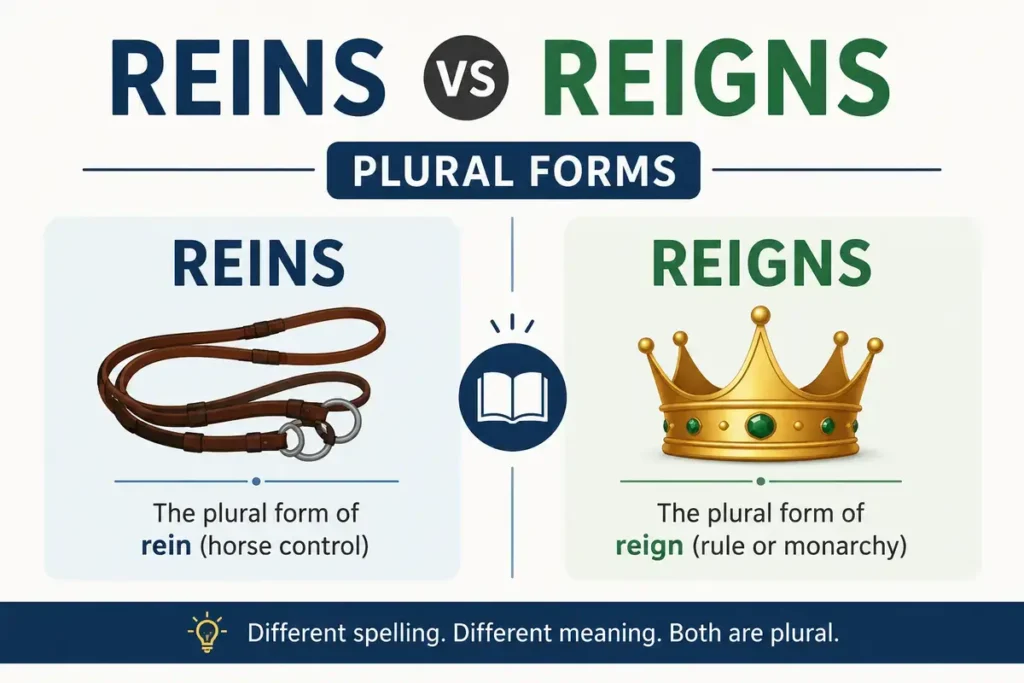
Plural Forms
The plural forms are straightforward.
- Rein becomes reins.
- Reign becomes reigns when referring to multiple periods of rule or as the third person singular verb.
Reins vs Reigns Real Life Usage
These words appear in many different kinds of writing, although their contexts are very different.
Everyday Conversation
People often use take the reins, free rein, and rein in without thinking about their equestrian origins.
Examples include:
- She took the reins after her manager retired.
- We need to rein in our monthly expenses.
- The creative team was given free rein.
Business Communication
Leadership articles frequently use take the reins when discussing new executives, project managers, or department heads.
Academic Writing
History books regularly use reign to describe monarchs and important historical periods.
Examples include:
- The reign of Queen Victoria.
- The reign of Louis XIV.
Literature And Media
Authors often use reign figuratively to describe powerful emotions or situations.
For example:
- Silence reigned throughout the hall.
- Joy reigned after the victory.
At the same time, journalists and business writers continue to use reins when describing changes in leadership.
Understanding these patterns makes it much easier to recognize the correct word whenever you encounter it.
Related Words And Commonly Confused Terms
Learning a few related words makes it easier to remember the difference between rein and reign. Many of these terms appear in the same conversations, but each has its own meaning.
Rein
The word rein is closely connected with horses, control, and leadership.
Related expressions include:
- Rein in.
- Tighten the reins.
- Loosen the reins.
- Take the reins.
- Give someone free rein.
- Keep a firm rein.
All of these expressions trace their origins to horseback riding. Even when they describe business, parenting, or management, the underlying idea is still guidance and control.
Reign
The word reign belongs to the language of monarchy and authority.
You’ll often see it alongside words such as:
- Monarch.
- King.
- Queen.
- Crown.
- Throne.
- Kingdom.
- Empire.
- Sovereign.
- Dynasty.
- Royal family.
These words naturally appear in discussions about history, politics, and royal succession.
Commonly Confused Expressions
Some English expressions are frequently misspelled because people rely on pronunciation instead of meaning.
Take The Reins Or Take The Reigns
The correct expression is take the reins.
It comes from horseback riding, where the person holding the reins controls the horse. Today, the phrase means accepting responsibility, leading a team, or taking charge of an organization.
Examples:
- She took the reins of the nonprofit after the previous director retired.
- The assistant coach took the reins while the head coach recovered from surgery.
Free Rein Or Free Reign
The correct phrase is free rein.
Originally, it described giving a horse enough freedom to move by loosening the reins. In modern English, it means allowing someone to act independently or make decisions without unnecessary restrictions.
Examples:
- The editor gave the writers free rein to explore new ideas.
- Our teacher gives students free rein during creative projects.
Full Rein Or Full Reign
The traditional expression is full rein.
Although full reign appears online from time to time, it is generally considered a spelling mistake because the expression comes from horse riding rather than royal rule.
Rein In
The phrasal verb rein in means to control, limit, or reduce something.
Examples include:
- The company needs to rein in unnecessary expenses.
- Parents sometimes need to rein in unhealthy habits.
- The government introduced new policies to rein in inflation.
Because the phrase refers to pulling a horse’s reins to slow or direct it, rein in is always the correct spelling.
Learning the correct spelling of naive is another great way to sharpen your English, particularly if you enjoy exploring commonly confused words like reins and reigns.
Expert Language Insight
Professional editors rarely confuse these words because they focus on meaning before spelling. That habit is worth adopting in your own writing.
Instead of asking which word sounds right, ask what the sentence is trying to communicate.
If the sentence is about guidance, leadership, control, or horse riding, the answer almost always points to rein or reins. If the discussion involves a monarch, royal authority, or a period of rule, reign is the correct choice.
Another useful habit is to think about the origin of familiar expressions. Phrases such as take the reins, free rein, and rein in all began with horseback riding. Remembering that history makes them much easier to spell correctly.
Native speakers occasionally make these mistakes because the words are perfect homophones. Even experienced writers rely on context rather than pronunciation when proofreading. That is why understanding the meaning is much more reliable than trying to memorize the spelling.
Frequently Asked Questions
What is the difference between reins and reigns?
Reins refers to the straps used to guide a horse and, by extension, to leadership or control. Reigns relates to the period during which a monarch rules or the act of ruling. Although the words sound identical, they have different meanings and should not be used interchangeably.
Is it take the reins or take the reigns?
The correct expression is take the reins. The phrase comes from horseback riding, where holding the reins allows the rider to guide the horse. Today, it means taking charge of a project, business, team, or another responsibility.
Is it free rein or free reign?
The correct phrase is free rein. It originally referred to giving a horse enough slack in the reins to move freely. In modern English, it means giving someone the freedom to make decisions or act independently.
What does rein in mean?
Rein in means to control, reduce, or limit something. It is commonly used in discussions about spending, emotions, behavior, or government policies. The expression comes from pulling a horse’s reins to slow or direct its movement.
What does reign mean?
Reign refers to the period during which a king, queen, emperor, or another monarch rules. It can also describe something that dominates or prevails, as in the sentence Peace reigned throughout the country.
Are reins and reigns pronounced differently?
No. Both words are pronounced /reɪnz/. They are perfect homophones, which explains why they are frequently confused in writing.
Can reign be used outside discussions about royalty?
Yes. Writers often use reign figuratively to describe something that dominates or prevails. Expressions such as silence reigned or chaos reigned are common in literature, journalism, and everyday English.
How can I remember the correct spelling?
Think about the meaning first. If the sentence involves guiding, controlling, or leading, choose rein or reins. If it refers to a monarch or a period of royal rule, choose reign. Focusing on context is much more reliable than relying on pronunciation.
Conclusion
Although reins and reigns sound exactly the same, they belong to different parts of the English language. Reins comes from horseback riding and represents guidance, control, and leadership. Reign belongs to the language of royalty and describes the period during which a monarch rules or the act of ruling itself.
The easiest way to choose the correct spelling is to think about the meaning of your sentence before you start writing. If someone is taking charge of a team, business, or project, the correct expression is take the reins. If you are describing the years a king or queen ruled a country, reign is the word you need.
Many popular expressions, including free rein, rein in, and take the reins, still reflect their equestrian origins. Remembering that connection helps you avoid some of the most common spelling mistakes in English.
Once you understand the history and meaning behind these words, choosing the correct one becomes much more natural. If you still find yourself pausing over reins vs reigns, think about the context before you write. Is the sentence about guiding and controlling something, or is it about a monarch ruling a country? That simple question will lead you to the correct spelling almost every time and help you write with greater accuracy and confidence.