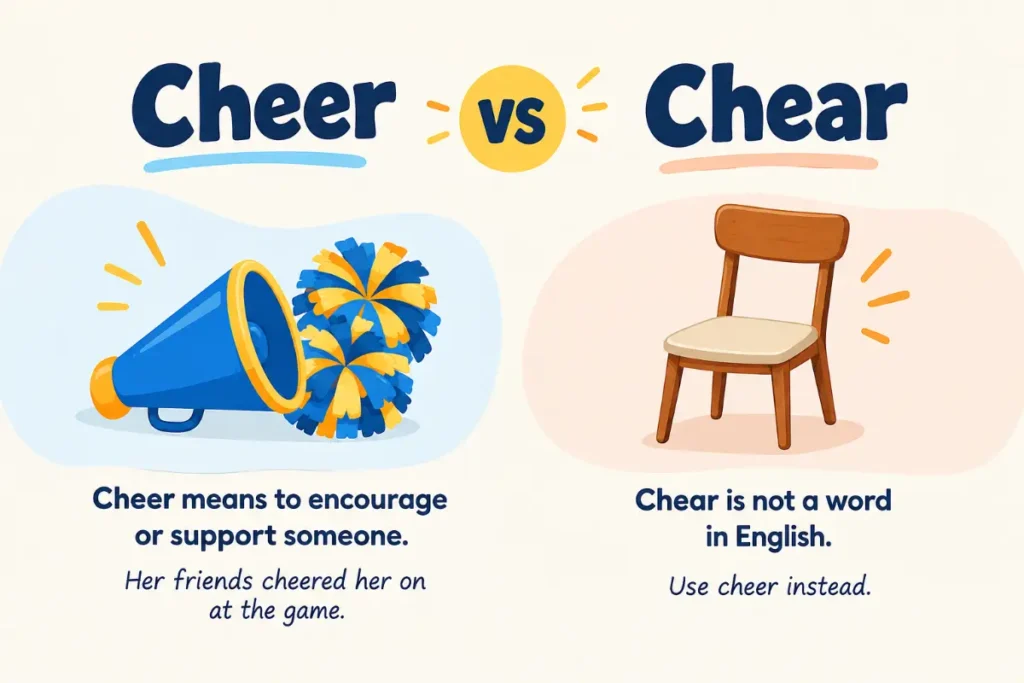
If you are unsure about cheer vs chear, the answer depends on the kind of English you are writing. For modern American English, cheer is the correct and standard spelling. The form chear is not normally used in contemporary English, although it appears in older English texts and can sometimes be found in historical or specialized contexts.
The confusion is understandable because both forms look similar and are pronounced in closely related ways. The older spelling also appears in historical dictionaries, digitized books, and older quotations, which can make it seem like an alternative spelling that is still acceptable today. For ordinary writing, however, cheer is the form you want.
This distinction matters because cheer has several common meanings. It can describe happiness or encouragement, a loud expression of support, a group of people supporting a team, or the act of making someone feel happier. You may also encounter familiar expressions such as cheer up, cheer for, and cheer someone on.
This guide explains the modern spelling, the older form, the meaning of each, pronunciation, grammar, examples, word origin, common mistakes, and the way native speakers use the word in everyday American English.
Quick Answer
Cheer is the standard spelling in modern American English. It can mean happiness, encouragement, a shout of support, or the act of encouraging someone. Chear is an obsolete or historical spelling that may appear in older texts. For modern emails, schoolwork, websites, business writing, and everyday communication, use cheer.
Cheer vs Chear Comparison
| Feature | Cheer | Chear |
|---|---|---|
| Correct modern form | Yes | No |
| Part of speech | Noun and verb | Historical spelling |
| Meaning | Happiness, encouragement, support, or an expression of support | Historical form related to cheer |
| Modern US usage | Common | Extremely uncommon |
| Historical usage | Yes | Yes |
| Formality | Neutral | Archaic or historical |
| Common contexts | Sports, conversation, writing, celebrations | Older books and historical texts |
| Pronunciation | Usually pronounced like cheer | Historically related to the same word |
| Example | The crowd began to cheer. | Found mainly in historical writing |
The most important distinction is simple. Cheer belongs to modern standard English. Chear belongs primarily to the history of English spelling.
That means you should not normally treat these forms as two interchangeable choices. If you are writing a modern sentence, choose cheer.
What Does Cheer Mean
Cheer has several related meanings, but they all connect with positive emotion, encouragement, or an expression of support.
As a noun, cheer can mean a feeling of happiness or optimism.
For example:
Her cheerful attitude brought cheer to the entire office.
It can also mean a shout or cry expressing support.
The crowd erupted in cheer when the team scored.
As a verb, cheer can mean to encourage someone or to make someone feel happier.
We went to cheer our friend on during the race.
The word also appears in several common phrases. Cheer up means to become happier or to help someone become happier. Cheer for means to support a person or team. Cheer on means to encourage someone while they are doing something.
These meanings are closely related, so learning the central idea of encouragement and positive feeling makes the different uses easier to remember.
Cheer As A Noun
As a noun, cheer can describe an expression of enthusiasm or support.
The fans gave a loud cheer.
It can also refer to happiness or a pleasant emotional atmosphere.
The decorations brought some holiday cheer to the room.
In this sense, the word often appears in expressions such as good cheer, holiday cheer, and Christmas cheer.
The noun can be countable or uncountable depending on the meaning. A specific shout can be a cheer, while happiness or optimism is often treated as an uncountable idea.
Compare these examples:
- The crowd gave three loud cheers.
- Her kindness filled the room with cheer.
The first sentence describes individual expressions of support. The second describes a general feeling of happiness.
Cheer As A Verb
As a verb, cheer means to encourage, support, or make someone happier.
For example:
The students cheered when their teacher announced the good news.
Here, the students expressed excitement. In another sentence:
I called my friend to cheer her up.
Here, the action means trying to make someone feel happier. The verb also commonly appears with for and on.
- We cheered for the home team.
- Everyone cheered him on during the final lap.
These structures are worth learning because they occur frequently in everyday American English.
What Does Chear Mean
Chear is an old spelling associated with the word cheer. It is not the normal spelling used by modern American English speakers.
You may encounter it in historical documents, older books, transcriptions of early English writing, or discussions about the development of English vocabulary. Seeing the spelling in an old source does not mean that it remains a standard alternative today.
This is an important distinction when reading historical material. English spelling has changed considerably over time. Many words that once appeared in multiple forms eventually settled into the spellings that modern readers recognize.
The form chear is one example of an older spelling that has largely disappeared from ordinary modern usage.
If you are writing a current article, email, school assignment, social media post, or professional document, chear will generally look like a spelling error.
Just as cheer is sometimes misspelled as “chear,” English has other tricky word pairs that can cause confusion, including a common balance-related spelling confusion.
Why The Two Spellings Cause Confusion
The two forms look almost identical. Only one letter changes, and that difference is easy to overlook.
There is also a historical reason for the confusion. Older English texts did use spellings that are unfamiliar to modern readers. Digital archives have made these texts much easier to find, so someone researching the word may encounter chear and assume that it is still an accepted spelling.
Search results can add another layer of confusion. A search engine does not automatically treat every appearance of a word as evidence that the spelling is standard. Old books, scanned documents, names, user generated content, and historical quotations can all contain unusual spellings.
The practical rule is therefore straightforward. If your audience is reading modern American English, write cheer.
Which One Is Correct
Cheer is the correct modern spelling.
Use it when you mean happiness, encouragement, a supportive shout, or the act of encouraging someone. Use chear only when you are deliberately reproducing a historical spelling or discussing the history of the word.
For example:
Correct modern English:
The fans began to cheer.
Historical context:
The old text used the spelling chear.
The second sentence is not recommending chear as a modern spelling. It is simply describing an older form.
This distinction is especially important for editors and content writers. An unusual spelling can be correct inside a quotation or historical source while being incorrect in newly written prose.
Examples In Sentences
The best way to understand cheer is to see how it behaves in different contexts.
Cheer As A Noun
- The crowd gave a huge cheer when the quarterback scored.
- Her smile brought cheer to everyone at the table.
- The children shouted three cheers for their teacher.
- Holiday cheer filled the house during the family gathering.
- The team heard a loud cheer from the stands.
These examples show two major noun meanings. The word can refer to a specific expression of support, or it can describe a general feeling of happiness and optimism.
Cheer As A Verb
- The fans cheered when the final score appeared.
- We went to cheer for our school team.
- Her friends tried to cheer her up after the difficult day.
- The audience cheered the performer after the final song.
- Everyone cheered when the runner crossed the finish line.
- I called my brother to cheer him up.
- The students cheered for their classmates.
- The parents cheered their daughter on from the sidelines.
- The crowd continued to cheer throughout the game.
- A funny message helped cheer him up.
Notice how the surrounding words help determine the exact meaning. Cheer for usually expresses support for a person or team. Cheer someone on emphasizes encouragement during an activity. Cheer someone up means to make that person happier.
Examples With The Historical Form
Because chear is not standard modern spelling, it would be misleading to present ordinary contemporary sentences using it as if it were interchangeable with cheer.
Instead, the useful examples are correction examples:
Incorrect in modern standard English:
The fans began to chear.
Correct:
The fans began to cheer.
Incorrect in modern standard English:
She tried to chear him up.
Correct:
She tried to cheer him up.
Historical context:
The spelling chear may appear in an older text.
This approach keeps the distinction clear. You can recognize the old spelling without accidentally adopting it in modern writing.
Common Mistakes With Cheer
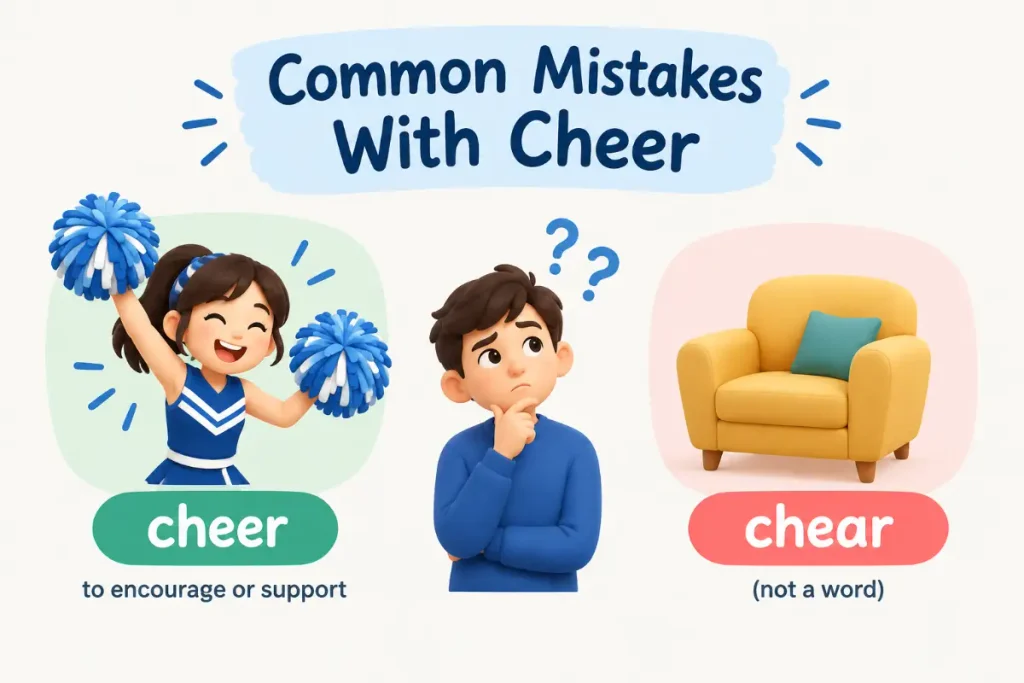
The most common mistake is simply using the historical spelling in modern prose.
Mistake One
Incorrect:
The audience began to chear.
Correct:
The audience began to cheer.
The modern spelling uses ee.
Mistake Two
Incorrect:
I hope this message will chear you up.
Correct:
I hope this message will cheer you up.
The phrase is cheer up, not chear up.
Mistake Three
Incorrect:
We are going to chear for the team.
Correct:
We are going to cheer for the team.
The standard expression is cheer for.
Mistake Four
Some writers confuse cheer for and cheer on.
Both can be correct, but they are used slightly differently.
We cheered for the team.
This focuses on supporting the team.
We cheered the runners on.
This focuses on encouraging the runners as they continued their activity.
Mistake Five
Another error is assuming that an old spelling must be a modern spelling variant simply because it appears in a book.
Historical sources often preserve older forms of English. Writers should distinguish historical evidence from current standard usage.
Pronunciation Guide
Cheer is pronounced approximately like cheer in everyday American English, with the familiar long vowel sound found in words such as near and clear.
A common American English pronunciation is represented in IPA as:
/tʃɪr/
The word has one syllable.
You can think of the sound as:
cheer
The opening sound is the same sound found in chair, although the vowel is different. The ending resembles the sound heard in near.
Because chear is not a standard modern form, it does not have a separate pronunciation that modern American writers need to learn. Historical pronunciation can vary according to the period and variety of English being studied.
For ordinary communication, focus on the modern word cheer.
Word Origin And Etymology
The history of cheer helps explain why older spellings such as chear can appear in historical texts.
The word entered English through Anglo French and Old French forms connected with ideas of face, countenance, mood, and state of mind. It is related to an older word referring to the face or expression because a person’s face was traditionally seen as an outward sign of emotional condition.
Over time, the meaning developed from a person’s appearance or state of mind toward ideas such as mood, happiness, encouragement, and support.
This semantic development is visible in modern expressions. When someone says cheer up, the phrase refers to improving a person’s mood. When fans cheer, they express enthusiasm and support. When someone speaks of holiday cheer, the word describes a positive emotional atmosphere.
Older English spelling was less standardized than modern spelling. As English spelling became more consistent, cheer became the established modern form.
That history explains why readers can occasionally find chear in older material without finding it as a normal modern spelling.
American And British English
There is no major modern American versus British spelling difference here.
American English uses:
cheer
British English also uses:
cheer
Canadian and Australian English likewise use cheer as the standard modern spelling.
The historical form chear should therefore not be treated as a British spelling of the word. It is better understood as an older spelling found in historical English.
This matters because readers sometimes assume that any unusual spelling must belong to British English. That assumption does not work here. Modern regional varieties may differ in vocabulary, pronunciation, or spelling for some words, but chear is not the standard regional counterpart of American cheer.
If you’re comparing cheer and chear while checking other commonly confused spellings, you may also find provider spelling explained clearly useful for avoiding similar mistakes.
Grammar Rules For Cheer
Cheer works mainly as both a noun and a verb. As a noun, it can refer to an expression of support or a feeling of happiness.
- The crowd gave a cheer.
- The room was full of holiday cheer.
As a verb, it can describe expressing support or improving someone’s mood.
- The fans cheered loudly.
- She cheered her friend up.
Present Tense
The basic verb is cheer.
I cheer for the team.
With a third person singular subject, use cheers.
He cheers for the local team.
Past Tense
The past tense is cheered.
The crowd cheered after the announcement.
The same form works as a past participle.
The fans have cheered throughout the game.
Present Participle
The present participle is cheering.
The crowd is cheering.
The word can also function as a noun in the expression cheering section, although the phrase refers specifically to a group of supporters.
Plural Noun
The plural of the noun cheer is cheers.
Three cheers for the winning team.
This expression is commonly used to invite people to celebrate or applaud someone.
Cheer Up Meaning
Cheer up is one of the most familiar expressions containing the word. As a verb phrase, cheer up means to become happier or to make another person happier.
For example:
Cheer up. Things will get better.
This tells someone not to remain discouraged. You can also use it transitively:
The good news cheered her up.
Here, the good news caused her mood to improve.
The expression can be friendly and supportive, but context matters. Telling someone to cheer up can occasionally sound dismissive if the person is dealing with a serious problem. In sensitive situations, a more empathetic sentence may be better.
For example:
I am sorry you are having such a difficult day. I hope things get easier soon.
That wording acknowledges the person’s feelings rather than simply telling them to change their mood.
Cheer For And Cheer On
These two expressions are closely related but not identical.
Cheer for usually means to support a person, team, or cause.
I always cheer for the home team.
Cheer on usually means to encourage someone while that person is doing something.
Her family cheered her on during the race.
Both expressions are natural in American English.
You can sometimes hear speakers use them in overlapping situations, especially in casual conversation. Still, the distinction above provides a useful guide for formal and careful writing.
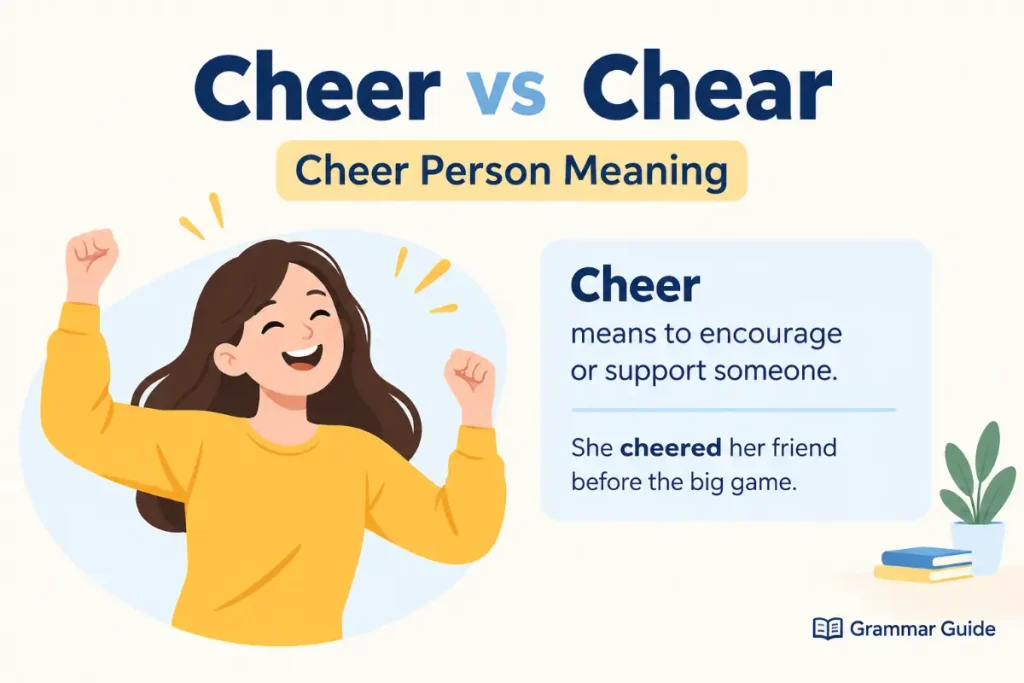
Cheer Person Meaning
People searching for cheer person meaning may actually be looking for the phrase cheer person, cheerleader, or a description of someone who brings encouragement to others.
A cheerleader is traditionally a person who performs organized cheering and support for a sports team. In everyday language, the word can also describe someone who consistently encourages another person, group, idea, or organization.
Cheer person is not normally the standard term for this role in American English. If you mean someone who encourages a team through organized performances, cheerleader is the natural word.
If you mean someone who provides emotional encouragement, alternatives such as supporter, encourager, or cheerleader can work depending on the context.
Formal And Casual Usage
Cheer is a neutral everyday word. It works comfortably in casual conversation, professional communication, journalism, academic writing, and creative writing.
Casual:
We went to cheer for our friends.
Workplace:
The team cheered when the project was completed.
Academic:
The crowd responded with a loud cheer.
Creative:
The room filled with warmth and holiday cheer.
The word does not sound excessively formal or informal. Its suitability comes from context rather than register.
The phrase cheer up is more conversational. It is common in speech, personal messages, and informal writing.
Real Life Usage Examples
You will encounter cheer in many everyday situations.
Sports
Sports is one of the most familiar contexts.
Thousands of fans cheered when the home team scored.
People can cheer for teams, individual athletes, schools, and players.
School
Students may cheer for classmates during competitions, performances, graduations, or other events.
The students cheered when their class won the competition.
Work
The word also works naturally in professional environments.
The office erupted in cheer when the team reached its goal.
However, professional writers may choose more precise words such as applause, celebration, or enthusiasm depending on the situation.
Family
Families often use cheer in everyday conversation.
We decorated the house to bring some holiday cheer.
Social Media
The word is common in supportive online messages.
Everyone was cheering her on as she launched her new business.
Texting
A friend might write:
Cheer up. You have got this.
This is casual and encouraging.
Related Words And Similar Terms
Several words are semantically connected to cheer.
Cheerful
Cheerful is an adjective meaning happy, positive, or pleasant.
She has a cheerful personality.
Cheerfully
Cheerfully is an adverb.
He cheerfully accepted the invitation.
Cheerfulness
Cheerfulness is a noun referring to a happy or positive quality.
Her natural cheerfulness made people feel comfortable.
Cheerleader
A cheerleader is traditionally someone who performs organized cheering for a sports team. The word can also describe a person who strongly encourages or supports someone.
Encouragement
Encouragement is closely related to cheer but has a broader meaning. Encouragement can involve words, actions, advice, or emotional support.
Applause
Applause refers specifically to clapping or other expressions of approval. A cheer can involve shouting, chanting, or vocal excitement.
Support
Support is broader than cheer. You can support someone quietly without cheering for them publicly.
These distinctions help writers choose the most precise word instead of treating every positive reaction as the same thing.
Beyond spelling differences like cheer vs. chear, understanding word distinctions is important in professional English too, such as understanding investor and investee roles.
Expert Usage Tips
For modern American English, the safest rule is simple: spell the word cheer. If you are writing a normal sentence and type chear, correct it. Most readers will interpret it as a spelling mistake.
If you are reading an older document and encounter chear, do not automatically assume that the author made a mistake. The spelling may reflect the conventions of the period in which the text was written.
Context also determines the best modern expression. Use cheer for when you want to describe support for a person or team. Use cheer on when you want to emphasize encouragement during an activity. Use cheer up when someone becomes happier or when another person helps improve their mood.
There is also a useful stylistic point. Cheer is broad enough to work in many contexts, but it is not always the most precise word. In a formal report, applause, support, approval, enthusiasm, or celebration may sometimes communicate the situation more accurately.
Good writing is not simply about avoiding mistakes. It is about choosing the word that tells the reader exactly what happened.
Frequently Asked Questions
Which Is Correct Cheer Or Chear
Cheer is the correct standard spelling in modern English. Chear is an older spelling that may appear in historical texts but is not normally used in contemporary American English. For schoolwork, business writing, websites, emails, and everyday communication, use cheer.
Is Chear A Correct Spelling
Chear is not the standard modern spelling of the word. It is an obsolete or historical form associated with cheer. You may encounter it in older English sources, but modern writers should normally use cheer unless they are deliberately reproducing a historical spelling.
What Does Cheer Mean
Cheer can mean happiness, encouragement, support, or a vocal expression of enthusiasm. As a verb, it can mean to express support or make someone feel happier. Common expressions include cheer up, cheer for, and cheer on, each of which has a slightly different use.
What Does Cheer Up Mean
Cheer up means to become happier or to help someone feel happier. For example, you can say, “The good news cheered me up.” You can also tell someone, “Cheer up,” although this expression can sound too direct when someone is dealing with a serious emotional difficulty.
What Is The Difference Between Cheer For And Cheer On
Cheer for usually means supporting a person, team, or cause. Cheer on usually emphasizes encouraging someone while they perform an activity. For example, “We cheer for our team” expresses support, while “We cheered her on during the race” emphasizes encouragement during the race.
Is Chear A British Spelling Of Cheer
No. Modern British English uses cheer, just like American English. Chear is better understood as a historical spelling rather than a modern British alternative. Older English texts can contain spelling forms that are no longer standard, so historical usage should not be confused with current regional English.
How Do You Pronounce Cheer
Cheer is normally pronounced as one syllable, approximately /tʃɪr/ in American English. It begins with the same general consonant sound heard in words such as chair and ends with a sound similar to the ending in near. Regional accents can produce small differences in pronunciation.
What Is A Cheer Person
Cheer person is not normally the standard term for someone who encourages others. If you mean someone who performs organized support for a sports team, cheerleader is the usual word. If you mean someone who encourages another person, terms such as supporter or encourager may fit better.
Final Verdict
When deciding between cheer vs chear, choose cheer for modern American English. It is the standard spelling for the noun and verb associated with happiness, encouragement, support, and expressions of enthusiasm.
Chear belongs mainly to historical English and may appear in older books or documents. It should not normally be used as an alternative spelling in modern writing.
Remember the modern form with a simple visual connection: cheer contains ee, just like cheerful and cheering. If you are writing an email, school assignment, article, business document, social media post, or everyday message, cheer is the safe and natural choice.
The old spelling is useful to recognize when reading historical material, but it does not need a place in ordinary modern prose.