
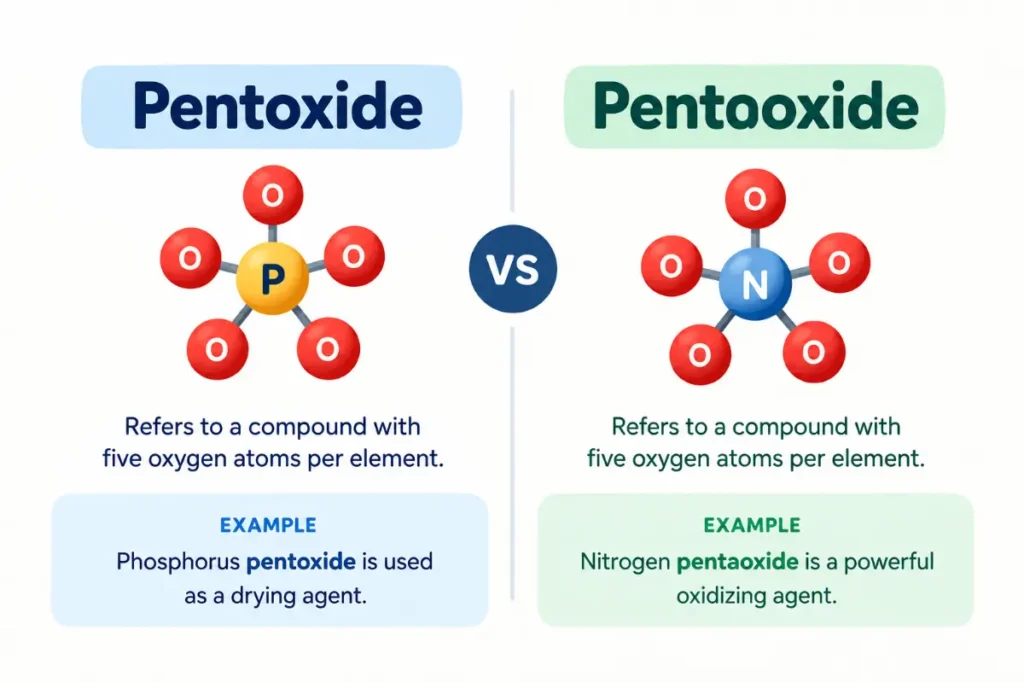
If you have searched for pentoxide vs pentaoxide, you have probably noticed that both forms look chemically reasonable. The confusion is understandable because the Greek numerical prefix penta means five, while oxide refers to oxygen. At first glance, it seems logical to combine them as pentaoxide.
In standard American chemistry education and in many established chemical names, however, pentoxide is the form you will most often see and the form you should generally use. Examples include phosphorus pentoxide, dinitrogen pentoxide, vanadium pentoxide, and arsenic pentoxide. Major scientific references list phosphorus pentoxide as an established name for the phosphorus oxide commonly represented by P₂O₅.
There is an important naming nuance, though. Formal chemical nomenclature does not always follow the simple rule that every familiar compound must use the shortened form. IUPAC nomenclature material includes names such as pentaoxide in systematic compositional naming. That means the two forms should not be treated as a simple spelling mistake versus correct spelling question in every possible chemistry context.
This guide explains the distinction clearly, with special attention to phosphorus pentoxide, chemical formulas, naming rules, pronunciation, examples, common mistakes, and practical scientific writing.
Quick Answer
Pentoxide is the established and commonly preferred form in names such as phosphorus pentoxide and dinitrogen pentoxide. Pentaoxide can also appear in formal systematic chemical nomenclature. For ordinary US chemistry writing, textbooks, and established compound names, use pentoxide unless a specific nomenclature system calls for pentaoxide.
Pentoxide vs Pentaoxide At A Glance
| Feature | Pentoxide | Pentaoxide |
|---|---|---|
| Basic meaning | An oxide associated with five oxygen atoms | The uncontracted penta plus oxide form |
| Spelling | Pentoxide | Pentaoxide |
| Common US chemistry usage | Very common | Much less common |
| Established compound names | Very common | Sometimes used |
| Phosphorus compound | Phosphorus pentoxide | Phosphorus pentaoxide can appear as a synonym |
| Dinitrogen compound | Dinitrogen pentoxide | Dinitrogen pentaoxide can occur in systematic naming |
| Formal nomenclature | Used in established names | Used in some systematic compositional naming |
| Best choice for general writing | Pentoxide | Use only when the naming system supports it |
The key point is that pentoxide is not simply an accidental spelling. It is a well established chemical term. At the same time, pentaoxide has a legitimate place in systematic nomenclature, so calling it universally incorrect would oversimplify the chemistry. PubChem, for example, lists both phosphorus pentoxide and phosphorus pentaoxide among the names associated with the phosphorus oxide compound.
If you’re comparing similar-looking English words, checking the correct spelling of terms such as provider or providor spelling can help you avoid common writing mistakes.
What Does Pentoxide Mean
Pentoxide is a chemical term used for an oxide containing five oxygen atoms in the relevant molecular or formula representation. Dictionaries define pentoxide in essentially this way and give phosphorus pentoxide as a standard example.
The word can be understood through its components.
Pent relates to the number five.
Oxide refers to a compound containing oxygen combined with another element or elements.
So pentoxide communicates the idea of an oxide involving five oxygen atoms.
Examples include:
- Phosphorus pentoxide.
- Dinitrogen pentoxide.
- Vanadium pentoxide.
- Arsenic pentoxide.
- Antimony pentoxide.
The term is a noun in chemical usage. It can also form part of a longer chemical name.
For example:
Phosphorus pentoxide is used as a powerful drying agent.
The word itself does not identify the other element. The full chemical name does that.
What Does Pentaoxide Mean
Pentaoxide is formed by keeping the complete numerical prefix penta before oxide.
The construction is easy to understand:
penta + oxide = pentaoxide
The prefix penta indicates five, while oxide identifies the oxygen containing compound.
The reason this form causes confusion is that many introductory chemistry lessons teach shortened forms such as pentoxide. Students therefore encounter the shortened spelling first and may assume that pentaoxide is always an error.
That conclusion is too broad.
IUPAC material on chemical nomenclature gives pentaoxide in systematic naming examples. For instance, its table includes disulfur pentaoxide for S₂O₅. This shows that the uncontracted form has a legitimate role in formal chemical nomenclature.
The practical lesson is simple. Do not judge the form only by how familiar it looks. First identify the naming convention being used.
Why The Two Spellings Exist
The confusion comes from the relationship between numerical prefixes and the word oxide.
Students often learn prefixes such as:
- Mono.
- Di.
- Tri.
- Tetra.
- Penta.
- Hexa.
- Hepta.
- Octa.
- Nona.
- Deca.
If you apply the prefix mechanically, penta plus oxide gives pentaoxide.
Yet traditional and educational naming conventions often use the shorter pentoxide. Introductory chemistry resources commonly teach the spelling with the final vowel removed before oxide. Pearson chemistry material, for example, teaches pentoxide as the name produced for P₂O₅ in its binary molecular compound naming lessons.
The important distinction is that chemical nomenclature contains both systematic rules and established names. A compound can have a familiar conventional name that remains widely used even when another systematic naming framework produces a different construction.
That is why a simple rule such as “the a is always removed” does not explain every formal chemical name.
Which One Should You Use
For most American readers writing ordinary chemistry content, pentoxide is the safest choice.
Use it in established names such as:
- Phosphorus pentoxide.
- Dinitrogen pentoxide.
- Vanadium pentoxide.
- Arsenic pentoxide.
- Antimony pentoxide.
Use pentaoxide when the context specifically calls for a systematic compositional nomenclature form that retains the prefix vowel.
This distinction matters most in advanced chemistry. A high school worksheet may expect pentoxide, while a discussion of formal IUPAC compositional nomenclature may use pentaoxide.
Therefore, the best answer is not simply “one is right and one is wrong.” The better answer is:
Pentoxide is the established and commonly preferred form in ordinary US chemical writing, while pentaoxide is also a legitimate systematic form in specific nomenclature contexts.
Phosphorus Pentoxide Or Pentaoxide
The phosphorus compound is probably the main reason people search this spelling question. The familiar name is phosphorus pentoxide.
It is commonly represented by P₂O₅, although the molecular structure of phosphorus oxide is more accurately represented as P₄O₁₀ for the molecular form. PubChem lists P₂O₅ and P₄O₁₀ in connection with phosphorus pentoxide and notes that the substance is often referred to using the empirical formula P₂O₅.
This distinction is important because P₂O₅ is an empirical formula rather than a statement that the material exists simply as isolated P₂O₅ molecules.
The established name remains phosphorus pentoxide.
You may also encounter phosphorus pentaoxide in chemical databases and reference material. PubChem lists phosphorus pentaoxide among the synonyms associated with the compound.
For a general chemistry paper, laboratory report, educational article, or US science website, phosphorus pentoxide is the natural choice unless the assignment specifically requires a particular systematic naming convention.
Chemical Formula And Naming
The spelling question becomes easier once you separate the name from the formula.
For phosphorus oxide, you may see:
P₂O₅
or
P₄O₁₀
The first represents the empirical composition. The second represents the molecular formula associated with the molecular form of phosphorus oxide. PubChem identifies P₄O₁₀ as phosphorus oxide and also records P₂O₅ as the commonly used empirical representation.
For dinitrogen pentoxide, the formula is:
N₂O₅
Here the name communicates the composition directly. Di indicates two nitrogen atoms, while pentoxide indicates five oxygen atoms.
This gives students a useful way to connect chemical names with formulas.
Dinitrogen pentoxide
means two nitrogen atoms and five oxygen atoms.
Vanadium pentoxide
refers to V₂O₅.
Phosphorus pentoxide
is commonly represented empirically as P₂O₅ but has a molecular form represented as P₄O₁₀.
The terminology becomes more useful when you understand what the formula represents rather than treating the chemical name as a spelling exercise.
Examples In Sentences
The following examples show how the established form works in natural scientific writing.
- Phosphorus pentoxide is commonly represented by the empirical formula P₂O₅.
- Dinitrogen pentoxide has the chemical formula N₂O₅.
- Vanadium pentoxide is represented by V₂O₅.
- The laboratory stored phosphorus pentoxide in a dry environment.
- The reaction involved dinitrogen pentoxide as one of the reactants.
- The student identified the compound as vanadium pentoxide.
- Phosphorus pentoxide is known for its strong ability to remove water.
- The textbook lists arsenic pentoxide as an oxide containing five oxygen atoms.
- The researcher recorded the use of phosphorus pentoxide during the experiment.
- The chemical name appeared as dinitrogen pentoxide in the laboratory manual.
Now consider examples where pentaoxide is appropriate in a systematic naming discussion.
- The nomenclature table gives disulfur pentaoxide as a systematic name for S₂O₅.
- The instructor explained why pentaoxide can occur in formal compositional nomenclature.
- The student compared pentoxide with pentaoxide during the nomenclature lesson.
- The reference used pentaoxide as part of its systematic naming framework.
- The chemistry class discussed the difference between established names and systematic names.
These examples show why context matters. The two forms do not necessarily represent two different chemical substances.
Just as scientific terms can be confusing, business-related terms can also be easy to mix up, especially when understanding the difference between investor and investee roles.
Common Mistakes
Treating Pentaoxide As Always Wrong
This is the most important mistake to avoid.
In ordinary chemistry education, pentoxide is the familiar form. However, formal nomenclature references can use pentaoxide. IUPAC material specifically provides pentaoxide in a systematic naming example.
Treating Pentoxide As A Casual Misspelling
Pentoxide is not a random shortening. It is an established chemical term recognized by major dictionaries and scientific references. Merriam Webster defines pentoxide as an oxide containing five oxygen atoms in the molecule.
Assuming Every Compound Must Follow One Naming Pattern
Chemical names can reflect different naming systems. A conventional name, an empirical description, and a systematic name may coexist.
Trying to force every chemical name into one simple spelling rule can therefore produce incorrect corrections.
Confusing Formula And Molecular Structure
Another common mistake is assuming that P₂O₅ always means that phosphorus pentoxide exists as simple P₂O₅ molecules.
For phosphorus oxide, the molecular form is commonly represented as P₄O₁₀, while P₂O₅ represents the empirical composition.
Changing Established Names Without Checking Context
If a scientific source calls a substance phosphorus pentoxide, changing it automatically to phosphorus pentaoxide can make the writing less consistent with established terminology.
Scientific editing requires more than mechanically replacing one spelling with another.
Pronunciation
In American English, pentoxide is commonly pronounced approximately:
pen TOK side
A dictionary pronunciation is represented approximately as /pɛnˈtɑkˌsaɪd/ in American English.
The word can be divided into three easy sound units:
pen
tok
side
The stress falls strongly on the middle part.
Pentaoxide adds another syllable:
pen ta OK side
Because pentaoxide is less familiar in everyday chemistry classes, speakers may hesitate over its pronunciation.
The pronunciation difference is another reason the shortened form pentoxide feels more natural to many English speakers. Still, pronunciation alone does not determine the correct nomenclature.
Word Origin And Etymology
The word pentoxide combines the numerical element pent or penta with oxide.
The underlying numerical prefix comes from Greek pente, meaning five. Chemical terminology adopted Greek numerical prefixes because they provide a compact way to communicate atomic proportions.
The word oxide has a separate history connected with oxygen and chemical combination.
The English word pentoxide has been established for well over a century. Merriam Webster records its first known use in 1851, while Collins traces the English term to the nineteenth century.
This history helps explain why pentoxide became a familiar English scientific term rather than remaining a simple combination of the complete forms penta and oxide.
American English Usage
American chemistry textbooks, educational resources, dictionaries, and scientific databases commonly use pentoxide in established names.
Examples include:
- Phosphorus pentoxide.
- Dinitrogen pentoxide.
- Vanadium pentoxide.
- Arsenic pentoxide.
- Antimony pentoxide.
Dictionary sources specifically define pentoxide using American English terminology.
There is no major American versus British spelling distinction here comparable to words such as color and colour.
The main variation comes from nomenclature style, not national English spelling.
Formal Chemistry Usage
Formal chemistry requires more care than ordinary spelling advice.
The International Union of Pure and Applied Chemistry publishes nomenclature guidance that distinguishes systematic naming practices from established chemical names. Its Principles of Chemical Nomenclature includes examples such as disulfur pentaoxide for S₂O₅.
This means a writer should not claim that pentaoxide is universally forbidden.
At the same time, established names such as phosphorus pentoxide remain widely recognized. PubChem lists phosphorus pentoxide as a name for the phosphorus oxide compound and includes phosphorus pentaoxide among its synonyms.
For students, the practical rule is to follow the nomenclature system specified by the instructor or textbook.
For professional writers, the better rule is to preserve established chemical names unless there is a clear reason to use a systematic alternative.
Related Chemical Terms
Several nearby terms can create similar confusion.
Tetroxide
Tetroxide refers to an oxide involving four oxygen atoms in the relevant composition. The shortened form appears in established chemical terminology.
Examples include nitrogen tetroxide and osmium tetroxide.
Hexoxide
Hexoxide follows the familiar shortened pattern for an oxide involving six oxygen atoms. It is much less common in everyday chemistry writing than pentoxide or tetroxide.
Dinitrogen Pentoxide
Dinitrogen pentoxide is a particularly useful example because its formula is N₂O₅ and the name clearly demonstrates the numerical prefix system.
Phosphorus Pentoxide
Phosphorus pentoxide is one of the best known examples associated with this spelling question. Its empirical formula is P₂O₅, while the molecular form is represented as P₄O₁₀.
Expert Language Insight
The safest way to handle this terminology is to stop thinking of the issue as a normal English spelling contest.
In ordinary writing, pentoxide is the familiar and established form. If you are writing a US chemistry article, preparing a school assignment, describing phosphorus pentoxide, or discussing dinitrogen pentoxide, pentoxide will usually be the natural choice.
In formal nomenclature, however, the exact naming framework matters. IUPAC nomenclature demonstrates that pentaoxide can be a legitimate systematic construction. That makes the statement “pentaoxide is always wrong” too absolute.
There is also a difference between naming a specific known substance and constructing a systematic name from a formula. Established names have a history of usage, and scientific databases preserve those names for identification and retrieval.
An experienced editor should therefore ask three questions before changing the spelling.
- What compound is being named?
- What nomenclature system is being used?
- Is the name an established conventional name or a newly constructed systematic name?
Those questions produce a much better answer than relying on a blanket rule about dropping the final a.
For most readers, the practical takeaway remains straightforward: use pentoxide for familiar established names such as phosphorus pentoxide. If a chemistry exercise or formal nomenclature discussion specifically requires the systematic compositional form, check the applicable rules and use pentaoxide when that system calls for it.
Paying attention to spelling is equally important when choosing between words that sound similar, such as the correct spelling of cheer.
Frequently Asked Questions
Is pentoxide or pentaoxide correct
Both forms can be valid in chemistry, but they do not have identical usage. Pentoxide is the established and very common form in names such as phosphorus pentoxide and dinitrogen pentoxide. Pentaoxide appears in systematic compositional nomenclature. The correct choice depends on the naming system and context.
Is phosphorus pentoxide or pentaoxide correct
Phosphorus pentoxide is the established common name and is the safest choice for general US chemistry writing. Phosphorus pentaoxide also appears as a synonym in scientific databases, so it should not automatically be labeled a spelling error.
What is the formula for phosphorus pentoxide
Phosphorus pentoxide is commonly represented by the empirical formula P₂O₅. The molecular form of phosphorus oxide is represented as P₄O₁₀. This distinction matters because P₂O₅ expresses the empirical composition rather than necessarily describing the molecular structure.
Why is it called pentoxide
The name relates to the presence of five oxygen atoms in the relevant chemical composition. The term combines a form of the Greek numerical prefix penta, meaning five, with oxide. The established English word pentoxide has been used in chemistry since the nineteenth century.
Is pentaoxide a spelling mistake
Not necessarily. In general educational and established chemical names, pentoxide is much more familiar. However, pentaoxide appears in formal systematic nomenclature, including IUPAC material. Therefore, it is better to treat the two forms as context dependent rather than automatically calling pentaoxide incorrect.
What is dinitrogen pentoxide
Dinitrogen pentoxide is a nitrogen oxide with the formula N₂O₅. The name indicates two nitrogen atoms and five oxygen atoms. Dinitrogen pentoxide is one of the clearest examples of the established pentoxide spelling used in chemistry.
Is pentoxide used in British English
Yes. Pentoxide is used in both American and British English. The main spelling does not change between these varieties. Differences arise mainly from chemical naming conventions and established terminology rather than regional English spelling.
Should students use pentoxide or pentaoxide
Students should follow the naming system required by their course, textbook, or assignment. For familiar compound names such as phosphorus pentoxide and dinitrogen pentoxide, pentoxide is the normal choice. If an exercise specifically asks for formal compositional nomenclature, check the stated rules before choosing between the two forms.
Conclusion
The answer to pentoxide vs pentaoxide depends on the chemistry naming system, but the practical choice is clear for most US readers. Pentoxide is the established form used in familiar names such as phosphorus pentoxide, dinitrogen pentoxide, and vanadium pentoxide. Major dictionaries and scientific databases recognize it as a standard chemical term.
Pentaoxide is not simply a meaningless spelling mistake. It appears in systematic chemical nomenclature, including IUPAC examples, so it can be appropriate in a specific formal context.
For everyday chemistry writing, use pentoxide unless your assignment or nomenclature system specifically requires the systematic form pentaoxide. The best approach is to consider the compound, the naming convention, and the purpose of the name before making a correction.