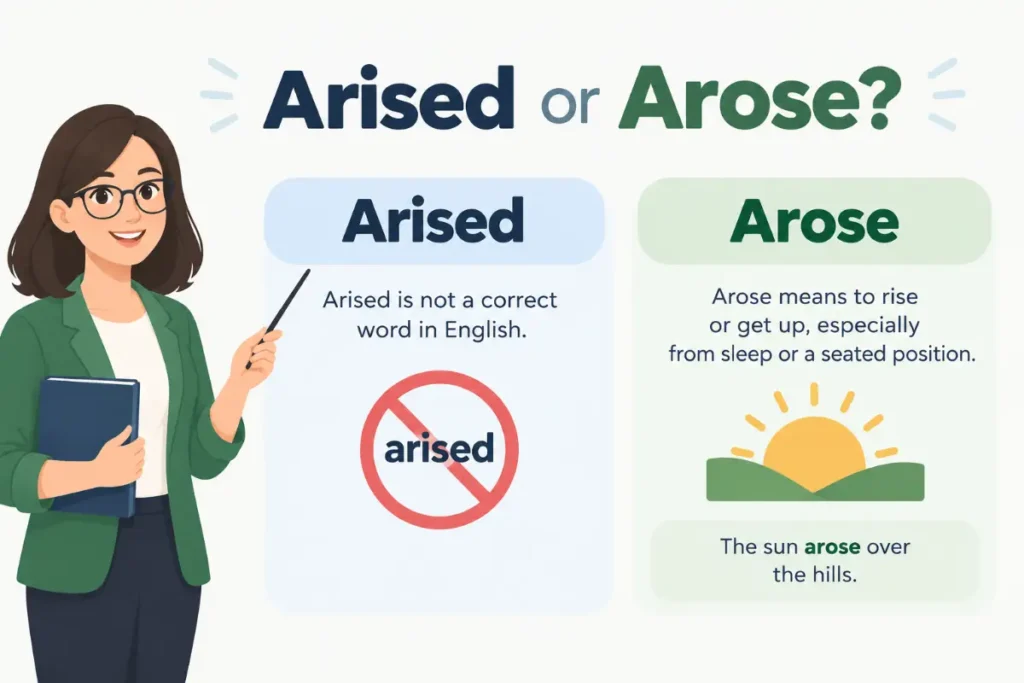
If you are confused about arised or arose, the correct choice in standard English is arose. Arised is a common mistake made by people who assume the verb arise follows the regular pattern of adding ed to form the past tense. However, arise is an irregular verb, so its forms do not follow that pattern.
You might write, “A problem arose during the meeting,” or “Several questions arose after the presentation.” In both sentences, arose describes something that happened or began to exist in the past. Writing “a problem arised” is incorrect in standard American English.
The confusion becomes easier to understand once you learn the three main forms of the verb: arise, arose, and arisen. Each form has a specific grammatical role, and choosing the right one depends on the tense and structure of your sentence. This guide explains the meaning of arise, its past tense, the difference between arose and arisen, and how to use each form naturally in everyday conversation, professional emails, academic writing, and other situations.
Quick Answer
Arose is the correct simple past tense of arise. Arised is not a standard English verb form. Use arise for the present tense, arose for a completed past event, and arisen with helping verbs such as has, have, or had. For example, a problem arises today, a problem arose yesterday, and a problem has arisen recently.
What Does Arise Mean
Arise is an irregular verb that means to begin to exist, appear, develop, or come up. It can also mean to get up from a sitting or lying position, although that use sounds more formal than simply saying get up. The meaning depends on the context, but the central idea involves something emerging, beginning, or moving upward.
For example, “A question may arise during the discussion” means that a question may come up. Similarly, “New opportunities arise when people develop useful skills” means that opportunities appear or become available. In a more literal context, “She arose from her chair” means that she stood up.
Arise is common in professional, academic, legal, and formal writing. In everyday American English, people often use simpler alternatives such as come up, appear, happen, develop, or get up. However, arise remains useful when you want to express the idea clearly and concisely.
Just as arose is the correct past tense of arise, learning to recognize commonly confused English spellings can help you avoid common writing mistakes and improve your overall accuracy.
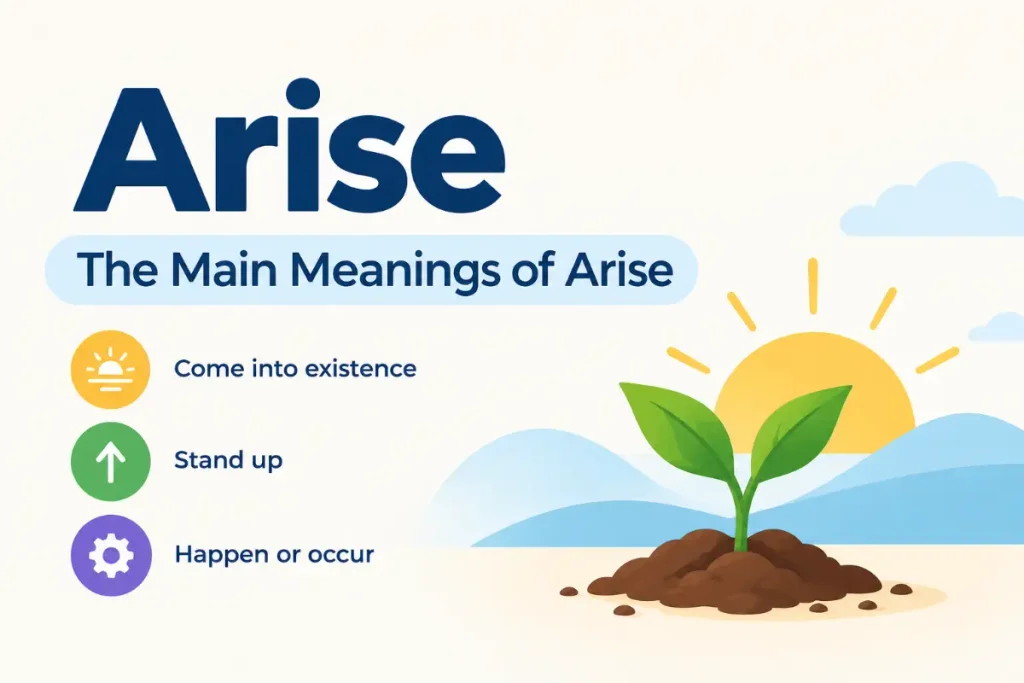
The Main Meanings of Arise
The verb has several related meanings that are worth understanding before you learn its forms.
1. To appear or develop. A problem, question, concern, or opportunity can arise when it begins to exist or becomes noticeable. For example, “A disagreement arose during the negotiations.”
2. To happen as a result of something. A situation can arise from a decision, action, or set of circumstances. For example, “The confusion arose from an unclear email.”
3. To get up or stand. Arise can describe someone rising from a chair or bed. For example, “The witness arose and approached the bench.” This use is more formal than stood up.
4. To emerge or become apparent. An issue, need, or possibility can arise when circumstances bring it to attention. For example, “A need for additional training arose after the new software was introduced.”
These meanings share the idea of something coming into view, beginning, or rising. Recognizing that connection helps you understand why arise works with so many different nouns.
Arised or Arose Which Form Is Correct
Arose is correct because arise is an irregular verb. Regular verbs usually form the simple past by adding ed or d, as in walk and walked or arrive and arrived. Irregular verbs follow different patterns, so their past forms must be learned individually.
Arise belongs to the same general family of irregular verbs as rise and raise, although each verb has its own meaning and grammatical pattern. Its forms are arise, arose, and arisen. The form arised does not belong to the standard conjugation.
Consider these examples.
Incorrect: A serious issue arised during the meeting.
Correct: A serious issue arose during the meeting.
Incorrect: Several questions arised after the lecture.
Correct: Several questions arose after the lecture.
The correct form does not change based on the subject. You use arose with I, you, he, she, it, we, and they when describing a completed past event. For example, “I arose early,” “She arose early,” and “Several problems arose” all use the same past tense.
Arise Arose and Arisen Explained
The easiest way to understand the grammar is to learn the three principal forms together. Each form serves a different purpose, so you cannot simply substitute one for another in every sentence.
| Verb form | Grammatical role | Example |
|---|---|---|
| Arise | Base form and simple present form | New problems arise every week. |
| Arose | Simple past tense | A problem arose yesterday. |
| Arisen | Past participle | A problem has arisen. |
| Arising | Present participle or gerund | The arising concerns require attention. |
The last example uses arising as an adjective. In ordinary writing, a more natural expression may be “the concerns that are arising.” The important point is that arise has several forms, and each fits a different sentence structure.
When to Use Arise
Use arise for the base form of the verb, after to, after modal verbs such as can and may, and in the simple present tense when the subject is plural or the subject is I or you.
Examples include “Problems arise when instructions are unclear,” “New questions may arise,” and “We expect difficulties to arise during the transition.” These sentences refer to situations in general or possibilities that have not necessarily happened yet.
For a third person singular subject in the simple present, use arises. For example, “A new issue arises whenever the schedule changes.” The s ending is required because issue is singular and the sentence uses the simple present tense.
When to Use Arose
Use arose when something appeared, developed, happened, or began in the past. The simple past describes an event or situation as a completed part of the past, without requiring a helping verb.
For example, “A misunderstanding arose during the phone call.” The sentence places the misunderstanding in the past. You could also write, “Several concerns arose after the company announced the changes.”
Arose works with singular and plural subjects alike. You can say “A question arose,” “A question arose from the discussion,” or “Several questions arose from the discussion.” The verb does not take an additional s or ed ending.
When to Use Arisen
Arisen is the past participle of arise. It normally appears with a form of the helping verb have, such as has, have, or had. Unlike arose, it generally cannot stand alone as the simple past tense.
Examples include “A problem has arisen,” “Several concerns have arisen,” and “A similar issue had arisen before the deadline.” Each sentence uses a helping verb to create a perfect tense.
The difference becomes clearer when you compare these examples.
Correct: A new concern arose yesterday.
Correct: A new concern has arisen.
Incorrect: A new concern has arose.
Incorrect: A new concern has arised.
The first correct sentence uses the simple past. The second uses the present perfect, which connects a past event or development to the present. The helping verb determines which form of arise belongs in the sentence.
Arises Meaning and Usage
Arises is the third person singular form of arise in the simple present tense. Use it with he, she, it, or a singular noun when describing something that happens regularly, generally, or under certain conditions.
For example, “A problem arises when employees receive conflicting instructions.” The sentence describes a general situation rather than a specific event that happened yesterday. Similarly, “The opportunity arises when the market changes” describes a condition under which an opportunity appears.
Arises is not a past tense form. If you are describing something that happened last week, use arose. If you are describing something that has happened and remains relevant now, has arisen may be the better choice.
Compare these sentences.
1. A new question arises during every review.
2. A new question arose during yesterday’s review.
3. A new question has arisen since the last review.
All three are grammatical, but they refer to different time frames. Choosing the right one makes your meaning more precise.
Understanding when to use arose instead of arised is one way of improving your everyday writing accuracy, especially when writing about events that happened in the past.
Arose vs Rose Which Is Correct
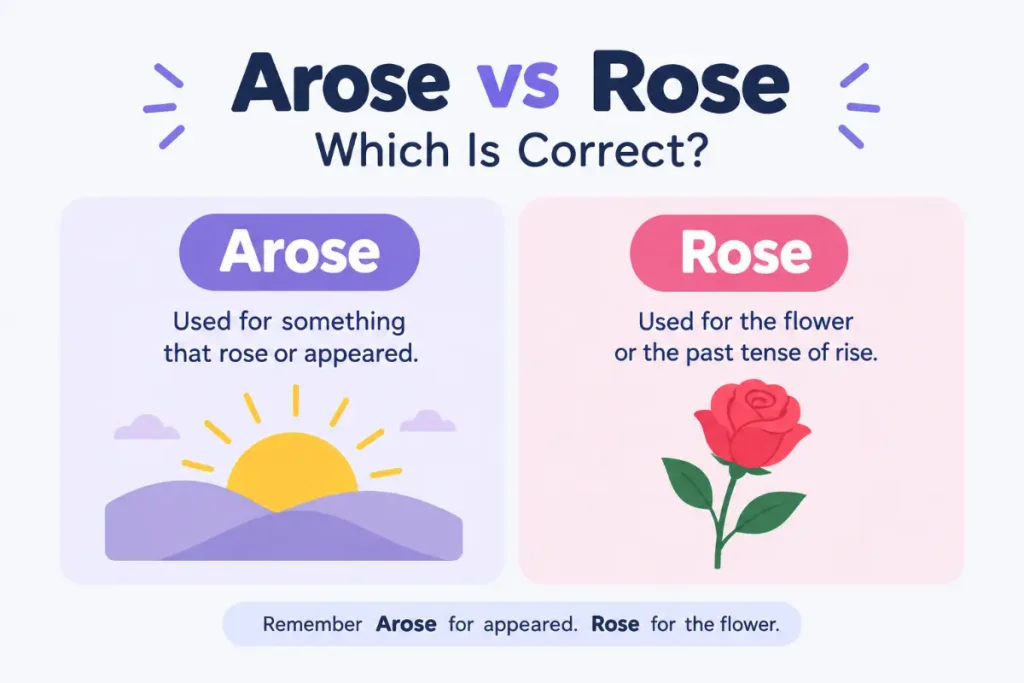
Both arose and rose are correct English words. They are the simple past tense forms of two different verbs: arise and rise. The confusion occurs because the verbs have related meanings, but they are not interchangeable in every sentence.
Arise usually means to appear, develop, or come up. Rise usually means to move upward, increase, or get up. For example, “A problem arose during the meeting” means a problem appeared, while “The sun rose at 6:30 a.m.” means the sun appeared above the horizon.
Here is a simple comparison.
| Present form | Past tense | Past participle | Common meaning |
|---|---|---|---|
| Arise | Arose | Arisen | Appear or develop |
| Rise | Rose | Risen | Move upward or increase |
| Raise | Raised | Raised | Lift something or cause something to increase |
The third verb, raise, follows a regular pattern and usually takes a direct object. You raise your hand, raise prices, or raise a concern. You might say that prices rose, but you would say that the company raised prices.
The distinction matters because similar meanings do not automatically make verb forms interchangeable. If a concern appeared, write “A concern arose.” If the temperature increased, write “The temperature rose.”
Arised or Arose Grammar Rules
The grammar becomes much easier once you identify the tense and the helping verbs in your sentence. You do not need to memorize complicated terminology to choose the right form. Focus on when the event happened and how the sentence is structured.
Simple Present Tense
Use arise for plural subjects and for I and you in the simple present. Use arises for third person singular subjects.
Examples include “Questions arise during complex projects,” “Concerns arise when deadlines are unclear,” and “A new problem arises when the system loses its connection.” These sentences describe recurring situations or general truths.
Simple Past Tense
Use arose to describe an event that happened in the past. It works with every grammatical person and does not require a helping verb.
For example, “A disagreement arose during the meeting,” “Several concerns arose after the announcement,” and “A new opportunity arose last year.” Each sentence describes a past development.
Present Perfect Tense
Use has arisen or have arisen when you want to connect a past event or development with the present. Has goes with singular third person subjects, while have goes with I, you, we, they, and plural nouns.
For example, “A new issue has arisen” and “Several issues have arisen.” The sentences emphasize that the issue or issues have appeared and remain relevant to the current situation.
Past Perfect Tense
Use had arisen when one event or situation had already developed before another past event. The past perfect helps establish the order of events.
For example, “A similar problem had arisen before the team changed its process.” The problem appeared before the process changed. Using had arisen makes that sequence clear.
Future and Modal Constructions
After modal verbs such as will, may, might, can, and should, use the base form arise. Do not use arose or arised after these verbs.
Correct examples include “A new issue may arise,” “Several questions will arise,” and “Concerns could arise during implementation.” These sentences discuss possible or expected developments rather than completed past events.
Arised or Arose in a Sentence
The best way to remember the correct form is to see it in different situations. The following examples show how arose works in everyday conversations, workplace messages, academic writing, and other common contexts.
Everyday Examples
1. A strange question arose during dinner.
2. Several problems arose while we were planning the trip.
3. An unexpected opportunity arose last summer.
4. A disagreement arose when the friends discussed their plans.
5. A new concern arose after the doctor explained the results.
Each sentence describes something that appeared or developed in the past. Arose is appropriate because the events are presented as completed past developments.
Workplace Examples
1. A scheduling conflict arose during the planning meeting.
2. Several questions arose after the manager explained the new policy.
3. An issue arose when the software update failed.
4. A concern arose regarding the proposed budget.
5. A misunderstanding arose because the email lacked important details.
These examples work in professional emails, meeting summaries, and project reports. Arose gives the writing a concise, professional tone without making the sentence unnecessarily complicated.
Academic Examples
1. A new research question arose after the initial results were reviewed.
2. Several objections arose during the classroom discussion.
3. An important distinction arose during the analysis.
4. A debate arose over the interpretation of the historical evidence.
5. New possibilities arose as the researchers examined the data.
In academic writing, arose often describes questions, debates, objections, and possibilities that developed during research or discussion. It helps explain how an idea or issue emerged.
Examples With Arisen
1. A new concern has arisen since the policy changed.
2. Several technical issues have arisen during testing.
3. A similar question had arisen in an earlier meeting.
4. An unexpected complication has arisen.
5. Questions may have arisen after you read the report.
These sentences use arisen with helping verbs. The examples also show why replacing arisen with arose can create a grammatical error.
Common Mistakes With Arise and Its Forms
One of the most frequent mistakes is treating arise as a regular verb. Because many English verbs form the past tense with ed, writers sometimes assume that arised must be correct. However, irregular verbs have their own forms, and arise follows the pattern arise, arose, arisen.
Incorrect: A problem arised during the interview.
Correct: A problem arose during the interview.
Another common error is using arose after a helping verb that requires the past participle. For example, “A problem has arose” is incorrect because has should be followed by arisen. The correct sentence is “A problem has arisen.”
Writers sometimes make the opposite mistake by using arisen alone as the simple past. For example, “A problem arisen yesterday” is incorrect in standard English. The correct form is “A problem arose yesterday.”
A final source of confusion is mixing arise with rise and raise. Remember that a problem arises, the sun rises, and a person raises a hand. These verbs have related meanings, but each has its own grammar and typical uses.
Along with learning the correct past tense of arise, getting tricky English word forms right can help you distinguish correct spellings and grammatical forms from common errors.
Is Arised Ever Correct
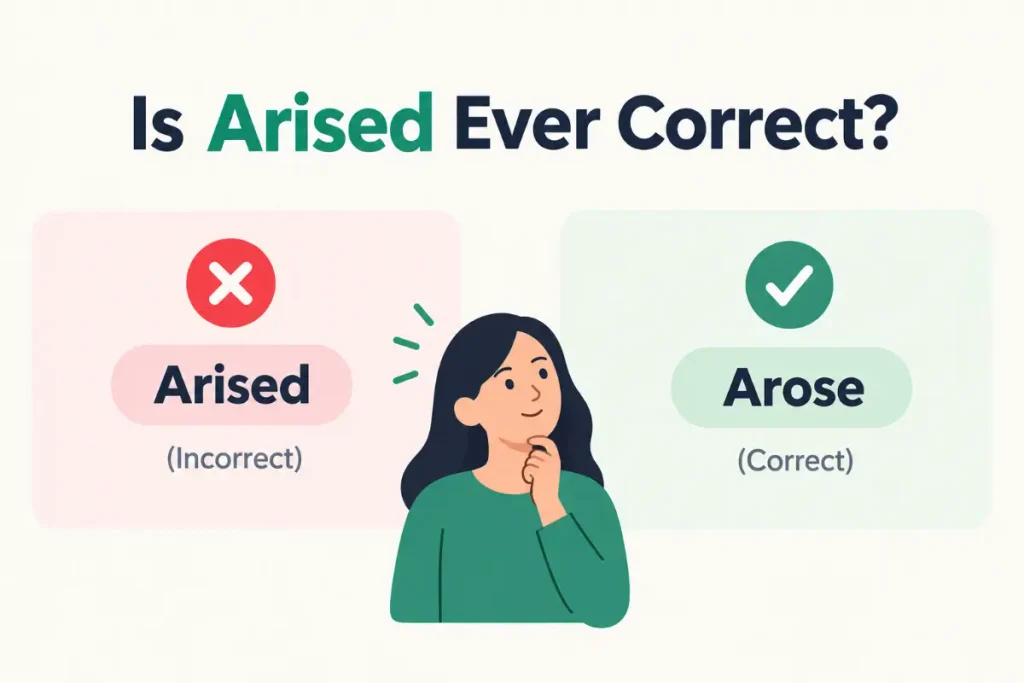
In standard American English, arised is not an accepted form of arise. It may appear in informal online writing, learner writing, or other contexts where someone has applied a regular past tense pattern to an irregular verb. However, it is not the form you should use in school assignments, professional documents, published articles, or formal communication.
If you encounter arised in a sentence, the intended form is usually arose or arisen. The correct choice depends on the sentence structure. Use arose for the simple past and arisen after a suitable helping verb.
For example, “A problem arised last week” should become “A problem arose last week.” If the sentence says “A problem has arised,” correct it to “A problem has arisen.” These corrections follow the standard conjugation of the verb.
What Is the Meaning of Arised
People searching for the meaning of arised are usually trying to understand a form they have encountered or are unsure how to spell. In standard English, arised is not the correct past tense or past participle of arise. The intended meaning is generally that something appeared, developed, or came up.
For example, if someone writes “A concern arised after the announcement,” they likely mean “A concern arose after the announcement.” The corrected sentence explains that the concern appeared following the announcement.
If the sentence uses a helping verb, the appropriate correction may be arisen instead. “A concern has arisen after the announcement” is grammatical, although the most natural tense depends on the intended timing. Understanding the surrounding sentence is the best way to identify the correct form.
Is Arisen a Correct Word
Yes. Arisen is the correct past participle of arise and is widely used in standard English. It is not a spelling mistake or an outdated form. The key is to use it in the appropriate grammatical structure.
You will commonly see arisen after has, have, or had. For example, “A new issue has arisen” means a new issue has appeared and is relevant now. “Several problems had arisen before the team changed its strategy” places those problems before another past event.
You can also encounter arisen in formal writing involving questions, difficulties, opportunities, risks, and concerns. It is especially useful when the writer wants to connect an earlier development with a later situation. Remember that arose is the simple past, while arisen is the past participle.
Formal and Casual Usage
Arise, arose, and arisen are standard English forms, but the verb can sound more formal than everyday alternatives. In casual conversation, Americans often say something came up, happened, appeared, or developed. In professional and academic writing, arise can be a concise and appropriate choice.
For example, in a text message, someone might write, “Something came up, so I will be late.” In a formal email, the same idea could be expressed as, “An unexpected issue arose, so I will arrive later than planned.” Both versions are correct, but the second sounds more formal.
The choice should depend on the audience and context. Do not use arise simply to make a sentence sound sophisticated. If came up is clearer and more natural for the situation, it may be the better option.
Frequently Asked Questions
Is arised or arose correct
Arose is correct in standard English. It is the simple past tense of arise, an irregular verb that does not form its past tense by adding ed. For example, write “A problem arose during the meeting,” not “A problem arised during the meeting.”
What is the past tense of arise
The past tense of arise is arose. Use it when something appeared, developed, or happened in the past. For example, “A new question arose during the discussion.” The past participle is arisen, as in “A new question has arisen.”
What is the meaning of arose
Arose means appeared, developed, emerged, or came into existence in the past. For example, “A disagreement arose during the meeting” means that a disagreement developed during the meeting. Arose can also describe someone getting up from a seated or lying position, although that use is more formal.
Is arisen a correct word
Yes, arisen is the correct past participle of arise. It generally appears with a helping verb such as has, have, or had. For example, “Several concerns have arisen” is correct, while “Several concerns have arose” is not standard grammar.
Which is correct rose or arose
Both words are correct, but they come from different verbs. Rose is the past tense of rise, which often means to move upward or increase. Arose is the past tense of arise, which often means to appear or develop. For example, “The sun rose” and “A problem arose” are both correct.
What is the difference between arise and arises
Arise is the base form and is used with I, you, we, they, plural subjects, and modal verbs. Arises is the third person singular form in the simple present tense. For example, “Questions arise during discussions” and “A question arises during the discussion” are both correct.
Can I use arised in informal writing
It is best to avoid arised even in informal writing because it is not the standard form of arise. Use arose when describing a completed past event and arisen when the sentence requires a past participle. These forms are understood throughout standard American English and are appropriate for both casual and formal communication.
How do you use arose in a sentence
Use arose when describing something that appeared or developed in the past. For example, “A scheduling conflict arose after the meeting time changed.” You can use the same pattern for concerns, questions, problems, disagreements, and opportunities. The verb remains arose regardless of whether the subject is singular or plural.
Conclusion
When choosing between arised or arose, remember that arose is the correct simple past tense of arise. Arised is not a standard form in American English, so avoid it in everyday writing, schoolwork, professional emails, and published content. The three main forms are arise, arose, and arisen, and each serves a different grammatical purpose.
Use arise for the base form and present tense, arose for a completed past event, and arisen with helping verbs such as has, have, and had. If you remember only one example, make it this: “A problem arose yesterday, and another problem has arisen today.” That sentence captures the key distinction and gives you a reliable pattern to follow.