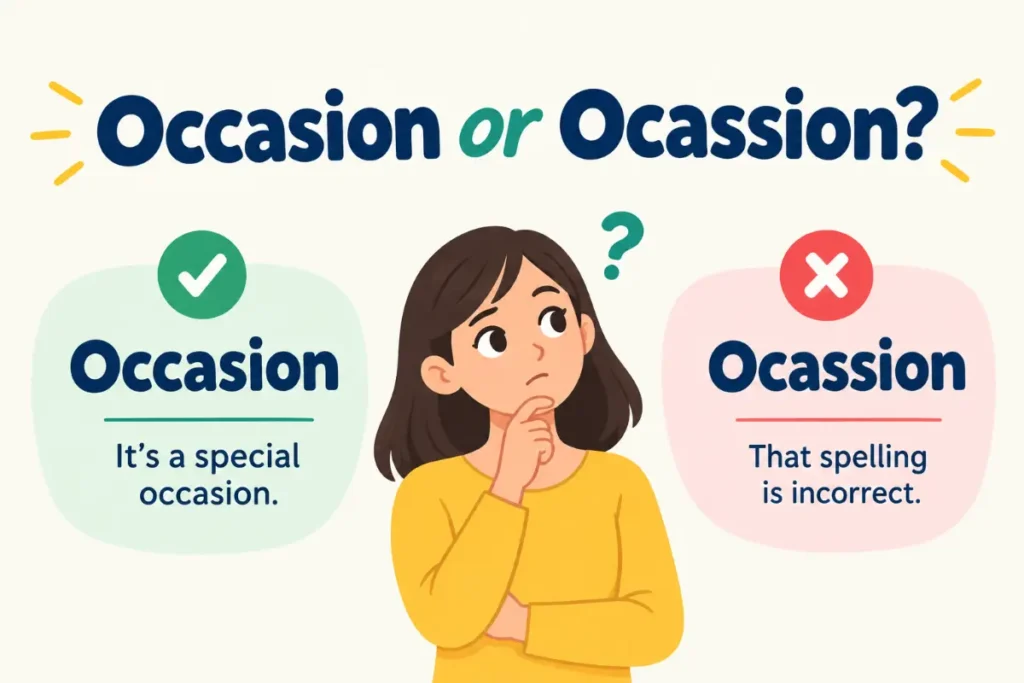
If you have searched for occasion or ocassion, you probably want to know which spelling is correct and how to remember it. The correct spelling is occasion, with one C and two S letters. Ocassion is a common misspelling and is not accepted as the standard spelling in American English or British English.
The confusion is understandable because English spelling does not always follow predictable patterns. When people write quickly, they may remember the sound of a word but accidentally add or remove a letter. Occasion can be particularly tricky because its C and S letters appear close together, making it easy to mix up their order or number.
Beyond spelling, occasion has several useful meanings. It can refer to a special event, a particular time, or a situation that causes something to happen. You might use it when writing a birthday invitation, describing a wedding, sending a professional email, or talking about something that happened once in a while.
This guide explains the correct spelling, meaning, pronunciation, plural form, synonyms, and common expressions involving occasion. You will also find practical sentence examples, spelling tricks, and answers to common questions so you can use the word confidently in everyday and professional writing.
Quick Answer
Occasion is the correct spelling. It contains one C followed by two S letters. Ocassion is incorrect in standard English. Occasion can mean a special event, a particular time, or a circumstance that causes something to happen. Its plural form is occasions, with an S added at the end.
Occasion vs Ocassion
The difference between these two spellings is simple. Occasion is the standard English word, while ocassion is a misspelling. The error usually happens because writers remember the sound of the word but misplace or duplicate letters.
| Feature | Occasion | Ocassion |
|---|---|---|
| Correct spelling | Yes | No |
| Standard English word | Yes | No |
| Letter pattern | One C and two S letters | One C and two S letters in the wrong order |
| Meaning | An event, time, or circumstance | No standard meaning |
| American English | Correct | Incorrect |
| British English | Correct | Incorrect |
| Example | We celebrated the special occasion. | We celebrated the special ocassion. |
Notice that both forms contain one C and two S letters. The problem is their order. In occasion, the C comes before the two consecutive S letters, producing the spelling o c c a s i o n? No. The correct sequence is o c c a s i o n, which has two C letters and one S.
The accurate letter count is two Cs and one S. This is the pattern to remember: occasion has two Cs followed by one S. The misspelling ocassion has one C followed by two Ss.
A reliable way to check the word is to break it into its letters: O, C, C, A, S, I, O, N. If you write ocassion, you have removed one C and added an extra S. That small change makes the spelling incorrect.
Just as “occasion” is often misspelled, learning to recognize commonly misspelled English words can help you avoid spelling mistakes in everyday writing.
What Does Occasion Mean
Occasion is a noun that refers to an event, a particular time, or a situation that gives someone a reason to do something. Its precise meaning depends on how it appears in a sentence.
The word is common in everyday American English. It works in casual conversations, invitations, business communication, academic writing, and formal announcements. Its meaning can range from a joyful celebration to a serious event or a specific circumstance.
Occasion as a Special Event
The most familiar meaning of occasion is a special or important event. These events may involve celebrations, ceremonies, gatherings, or milestones.
For example, a wedding is a special occasion because it marks an important moment in someone’s life. A graduation ceremony is another occasion because it celebrates an achievement. Birthdays, anniversaries, retirement parties, and award ceremonies can all be described as special occasions.
Consider these sentences.
1. We bought a beautiful cake for the occasion.
2. Her graduation was a memorable occasion for the entire family.
3. The hotel prepared a private dining room for the special occasion.
In these examples, occasion refers to an event worth recognizing or celebrating.
Occasion as a Particular Time
Occasion can also refer to a specific time when something happens. This meaning appears in phrases such as on one occasion, on several occasions, and on that occasion.
For example, you might say, “On one occasion, I forgot my keys at work.” Here, occasion refers to a particular instance or time when something happened.
Similarly, “She has visited the office on several occasions” means she has visited it multiple times. The word does not suggest that each visit was a celebration. It simply identifies separate instances.
This use is especially helpful when describing past experiences, recounting events, or explaining how frequently something has happened.
Occasion as a Reason or Cause
A third meaning involves a circumstance that gives someone a reason to act or causes something to happen. This meaning appears in expressions such as give occasion for, take occasion to, and on the occasion of.
For example, “His unexpected comment gave occasion for a lengthy discussion.” The comment created a reason for the discussion to take place.
Another example is, “The award ceremony gave her an occasion to thank her mentors.” The ceremony provided an opportunity to express gratitude.
This meaning can sound more formal than the use of occasion for a party or gathering. Still, it remains useful in professional and academic writing.
How to Spell Occasion Correctly
The most reliable way to spell occasion is to remember its letter pattern rather than relying only on how it sounds.
The correct spelling is:
O C C A S I O N
It contains nine letters, including two Cs next to each other and one S later in the word.
The incorrect spelling is:
O C A S S I O N
This version contains eight letters because one C has been removed and an extra S has been added. The two forms may look similar at first glance, but only occasion is standard.
A Simple Spelling Trick
Remember the phrase two Cs and one S. When you write occasion, check that the two Cs appear together before the A and that only one S appears later.
You can also connect the spelling to familiar phrases such as special occasion and happy occasion. Repeating these common combinations can help you remember the correct letter pattern without having to think through every letter each time.
Another useful method is to type the word slowly a few times while saying it aloud. This practice helps connect its visual pattern with its pronunciation. It is particularly useful if you often make the same spelling mistake while typing emails, messages, or articles.
Occasion Pronunciation
In American English, occasion is commonly pronounced uh KAY zhuhn. Its International Phonetic Alphabet transcription is /əˈkeɪʒən/. The main stress falls on the second syllable, which contains the long A sound.
You can divide the word into three syllables for practice: uh, KAY, zhuhn. The middle syllable receives the strongest emphasis, while the final syllable sounds like the ending of words such as reason and season.
A common mistake is to pronounce the word with too much emphasis on the first syllable or to pronounce the S like a sharp S sound. In standard pronunciation, the S in occasion sounds like the ZH sound in words such as measure.
Pronunciation can help you recognize the word when speaking, but it does not reveal the exact spelling. If spelling is your main concern, remember the two Cs and one S pattern.
Is Occasion Spelled Differently in British English
No. Occasion is spelled the same way in American and British English. The spelling ocassion is incorrect in both varieties.
Some English words have different regional spellings. For example, American English commonly uses color, while British English uses colour. Occasion does not follow that pattern, so you do not need to change its spelling for a British audience.
The same spelling is standard in Canadian and Australian English as well. Regional pronunciation and preferred expressions may vary slightly, but the written form remains occasion.
If you are writing for an international audience, use occasion in the same way you would for an American audience. There is no regional spelling alternative to memorize.
What Is the Plural of Occasion
The plural of occasion is occasions. You form it by adding S to the end of the singular noun. The spelling inside the word stays exactly the same.
| Form | Example |
|---|---|
| Singular | This is a special occasion. |
| Plural | These are special occasions. |
| Singular with an article | We planned an occasion for the celebration. |
| Plural with a number | The team met on three occasions. |
Use occasion when referring to one event or instance. Use occasions when referring to more than one.
For example, “The restaurant is perfect for a special occasion” refers to one event. “The restaurant hosts weddings and other special occasions” refers to multiple events.
Do not write occasion’s when you simply need the plural. The apostrophe form usually indicates possession or a contraction in other contexts, not an ordinary plural noun.
English spelling can be tricky, especially when a word’s ending causes confusion, so understanding tricky spelling differences can help you choose the correct form with confidence.

How to Use Occasion in a Sentence
Occasion appears in several common sentence patterns. Learning these patterns makes it easier to use the word naturally instead of forcing it into an awkward sentence.
On Occasion
The phrase on occasion means sometimes or from time to time. It describes something that happens occasionally but not regularly.
1. I enjoy eating dessert on occasion.
2. Our manager works from home on occasion.
3. The neighbors host outdoor movie nights on occasion.
4. She visits her former classmates on occasion.
The phrase often sounds slightly more formal than sometimes, but both can work in many everyday situations.
On One Occasion
The phrase on one occasion introduces a particular event or experience. It is useful when telling a story or describing something that happened at a specific time.
1. On one occasion, the power went out during dinner.
2. On one occasion, our teacher organized a surprise field trip.
3. On one occasion, I accidentally sent an email to the wrong person.
The phrase directs the reader’s attention to one specific instance rather than a repeated habit.
Special Occasion
A special occasion is an event that deserves particular attention or celebration. Weddings, birthdays, graduations, anniversaries, and family reunions are common examples.
1. We reserved a table for a special occasion.
2. She wore her favorite dress for the special occasion.
3. The family gathered to celebrate the special occasion.
The phrase works well in everyday conversation, invitations, restaurant bookings, and event planning.
On the Occasion of
The phrase on the occasion of means at the time of a particular event. It often appears in formal announcements, speeches, invitations, and commemorative messages.
1. The school published a special newsletter on the occasion of its anniversary.
2. The mayor delivered a speech on the occasion of the town’s centennial celebration.
3. The company presented awards on the occasion of its annual meeting.
In casual writing, simpler wording may sound more natural. For example, “During the anniversary celebration” can replace “on the occasion of the anniversary” when a shorter expression fits better.
Occasion Synonyms and Related Words
Occasion has several synonyms, but the best replacement depends on its meaning in the sentence. A word that works for a birthday party may not work for a specific moment or a reason for taking action.
| Synonym | Best use | Example |
|---|---|---|
| Event | Something that happens or is organized | The event attracted hundreds of guests. |
| Celebration | A gathering that marks something happy or important | The celebration continued late into the evening. |
| Ceremony | A formal event with a particular purpose | The graduation ceremony began at noon. |
| Instance | One specific example or occurrence | I remember one instance clearly. |
| Time | A particular point or period | There was a time when we worked together. |
| Opportunity | A chance to do something | The meeting gave us an opportunity to talk. |
| Circumstance | A situation or condition | Under the circumstances, we postponed the trip. |
| Reason | A cause or explanation | The delay gave us a reason to reconsider. |
These words overlap with occasion but are not always interchangeable. For example, an anniversary party is an event and a celebration, but a particular occasion in someone’s life may not involve a party at all.
Choose the synonym that expresses the intended meaning most clearly. If you mean a planned gathering, event or celebration may work best. If you mean one time something happened, instance is often more precise.
Common Spelling Mistakes With Occasion
The most frequent mistake is writing ocassion instead of occasion. This error changes the number of Cs and Ss, even though the result may look familiar when read quickly.
Here are a few examples of incorrect and correct usage.
1. Incorrect: We planned a party for the special ocassion.
Correct: We planned a party for the special occasion.
2. Incorrect: The school celebrated the occassion with a concert.
Correct: The school celebrated the occasion with a concert.
3. Incorrect: She bought a new dress for the occassion.
Correct: She bought a new dress for the occasion.
Another error involves adding an apostrophe to create the plural. For example, “We celebrate many occasion’s throughout the year” is incorrect if the intended meaning is simply multiple events. The correct sentence is “We celebrate many occasions throughout the year.”
Autocorrect may not catch every spelling error, especially if the text contains unusual names or the correction system does not recognize the intended word. Proofreading remains useful, particularly in professional emails, invitations, resumes, and published content.
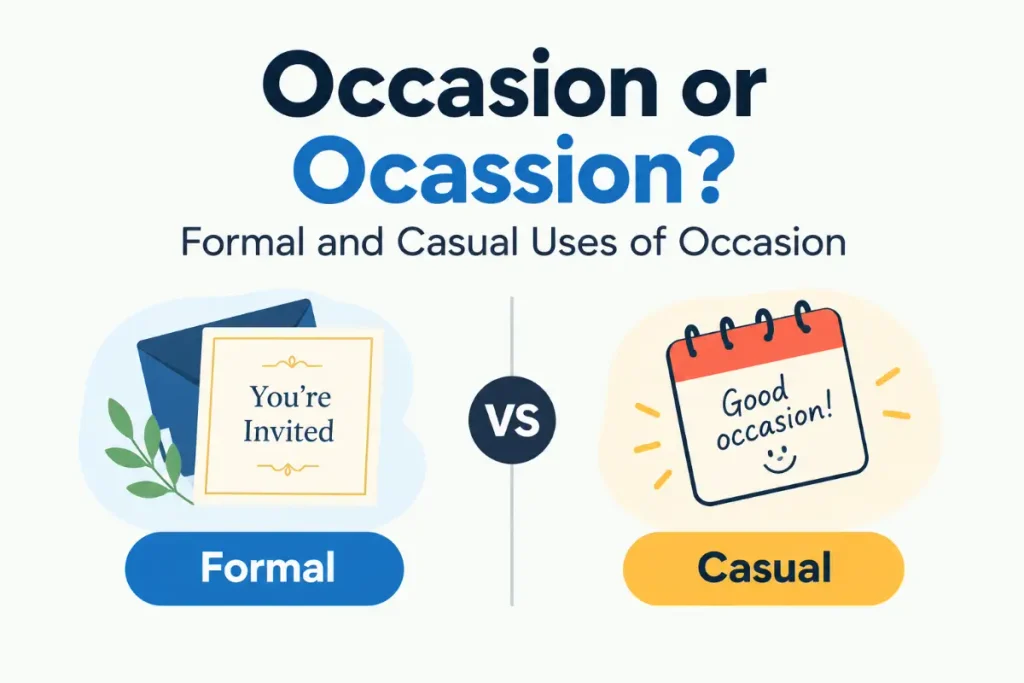
Formal and Casual Uses of Occasion
Occasion is a neutral word that works in both casual and formal English. Some expressions containing it, however, sound more formal than others.
In everyday conversation, you might say, “We go out for dinner on occasion.” This sounds natural, although “We go out for dinner sometimes” is more direct and casual.
In professional writing, you might use a sentence such as, “The annual meeting provides an occasion to review the team’s progress.” This wording is appropriate when describing a formal purpose or organized event.
In invitations, occasion often appears with words such as special, memorable, important, and celebratory. A message such as “Join us for this special occasion” works well for weddings, anniversaries, graduation parties, and similar gatherings.
For most readers, the best approach is simple. Use occasion when it fits naturally, but do not choose it merely to make a sentence sound formal. Sometimes event, time, or opportunity communicates the same idea more clearly.
Occasion in Everyday American English
Americans use occasion in a variety of situations, from family celebrations to workplace communication. The word is especially common when discussing events that deserve attention or specific moments in the past.
For example, someone planning a birthday dinner might ask a restaurant for a table suitable for a special occasion. A manager might say that a team has met on several occasions to discuss a project. A friend might explain that they eat at a particular restaurant only on occasion.
The word also appears in writing for cards, invitations, announcements, and social media captions. Phrases such as happy occasion, memorable occasion, and special occasion are familiar because they help describe the importance of an event without requiring a long explanation.
In academic writing, occasion may refer to a specific instance or circumstance. In business writing, it can describe a meeting, celebration, or opportunity for discussion. Its meaning shifts slightly with context, but the spelling never changes.
Beyond spelling, grammar also matters, and choosing the correct word form is essential for writing clear, natural English.
Frequently Asked Questions
Which one is correct, occasion or ocassion
Occasion is correct, while ocassion is a misspelling. The standard spelling contains two Cs followed by one S. This form is used in American, British, Canadian, and Australian English. If you are writing an invitation, email, article, or school assignment, always use occasion.
How do you spell occasion correctly
Spell it o c c a s i o n. The word contains nine letters, with two Cs together and one S after the A. A useful memory trick is to remember two Cs and one S. Checking this letter pattern can help you avoid the common error of writing ocassion.
Does occasion have one C or two
Occasion has two Cs and one S. The two Cs appear together near the beginning of the word, followed by A, S, I, O, and N. The misspelling ocassion removes one C and adds an extra S, which creates the wrong letter pattern.
How do you spell occasion in British English
British English uses the spelling occasion, just like American English. There is no standard British spelling called ocassion. The word has the same core meanings in both varieties, including a special event, a particular time, or a circumstance that creates an opportunity.
What is the plural of occasion
The plural form is occasions. Add S to the singular word without changing any of its existing letters. For example, “The hotel hosts weddings and other special occasions.” Do not use an apostrophe to form the ordinary plural.
What does occasion mean in English
Occasion can mean a special event, a particular time, or a circumstance that gives someone a reason to do something. In “a special occasion,” it means an important event. In “on one occasion,” it refers to a specific instance. Context determines the intended meaning.
How do you pronounce occasion
In American English, occasion is pronounced approximately uh KAY zhuhn, with the main stress on the second syllable. Its IPA transcription is /əˈkeɪʒən/. The S produces a sound similar to the ZH in measure. Pronunciation helps with recognition, but the correct spelling still requires two Cs and one S.
What is another word for occasion
Possible synonyms include event, celebration, ceremony, instance, time, opportunity, and circumstance. The best choice depends on the sentence. Use celebration for a happy gathering, instance for one occurrence, and opportunity for a chance to do something. Occasion is often the more flexible option when the exact meaning depends on context.
Conclusion
The correct spelling is occasion, not ocassion. Remember that occasion contains two Cs followed by one S, and use the same spelling in American and British English. The word can describe a special event, a particular time, or a circumstance that gives someone a reason to act.
You can use occasion in phrases such as special occasion, on occasion, on one occasion, and on the occasion of. Its plural form is occasions, formed by adding S at the end. When you are unsure about the spelling, pause for a moment and check the letter pattern. That small habit can help you avoid a common error in emails, invitations, schoolwork, and professional writing.