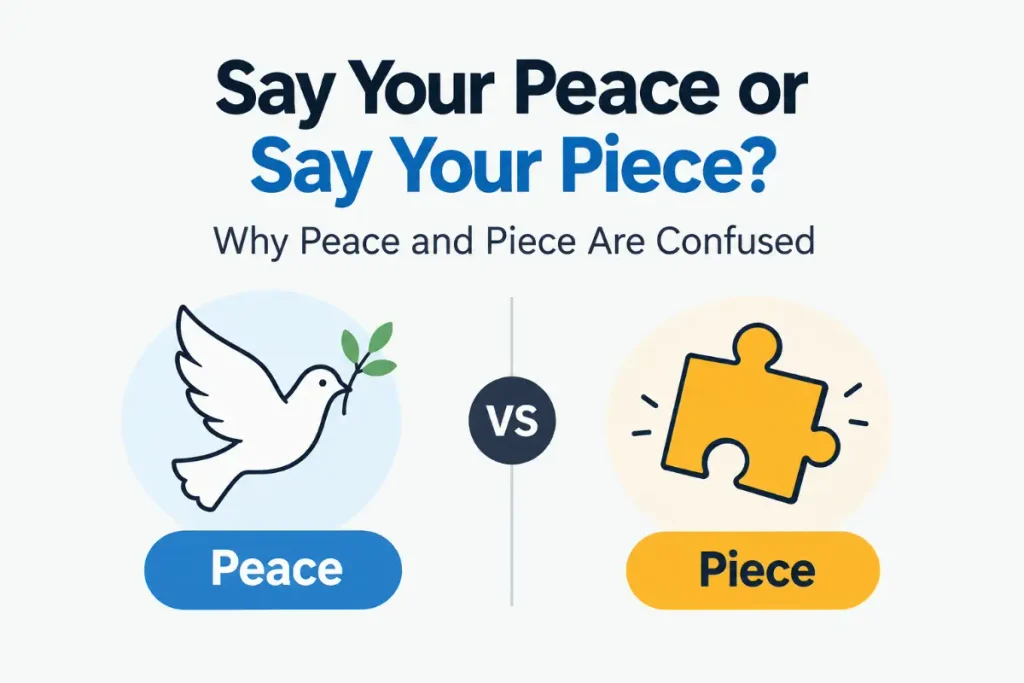
Have you ever wondered if the correct expression is say your peace or say your piece? Both versions sound exactly alike, but only one is the standard expression when you mean to speak your mind, share your opinion, or express something you have been holding back. The correct phrase is say your piece. The word piece refers to something you have to say, such as your opinion, argument, or contribution to a conversation.
The confusion comes from the homophones peace and piece. They sound identical in American English but have different meanings and spellings. Peace refers to calm, harmony, or freedom from conflict, while piece can mean a portion of something or a contribution to a larger whole. Because speaking your mind can help you feel calmer or resolve a disagreement, the incorrect version may seem reasonable at first.
Understanding this expression will help you use it naturally in conversations, workplace discussions, emails, and everyday writing. You will also learn what the phrase means, how it differs from similar expressions, why people confuse the two spellings, and how to use it correctly in a sentence.
Quick Answer
Say your piece is the correct expression when you mean to express your opinion or say what you want to say. Piece refers figuratively to your contribution to a conversation. For example, you might say, “I listened to everyone, and now I want to say my piece.” Say your peace is a common mix up, not the standard idiom.
What Does Say Your Piece Mean
The expression say your piece means to express your opinion, share your thoughts, or say what you feel needs to be said. It often suggests that someone has something important to communicate and wants an opportunity to express it without interruption.
Imagine a team meeting where several employees disagree about a new policy. One employee listens to the discussion and then says, “I would like to say my piece before we make a decision.” The employee wants a chance to contribute an opinion before the group moves forward.
The phrase can also describe a personal conversation. Someone who feels hurt by a friend’s actions might want to explain their feelings instead of keeping them bottled up. Saying their piece gives them an opportunity to communicate their perspective, even if the other person does not agree.
The expression is generally conversational and informal, although it works perfectly well in many professional settings. It can sound assertive, emotional, or slightly confrontational depending on the situation. The surrounding words and the speaker’s tone determine how it comes across.
What Piece Means in This Expression
The word piece usually refers to a portion or part of something larger. For example, a piece of cake is one portion of a cake, and a piece of advice is one contribution of guidance or information.
In the expression say your piece, the word carries a figurative meaning. Your piece is your contribution to a conversation, discussion, argument, or exchange of ideas. You are not literally speaking a physical object. You are sharing the part of the discussion that belongs to you.
Think of a conversation as a larger whole made up of different people’s thoughts and opinions. Each person may have a piece to contribute. When you say your piece, you express your share of the ideas being discussed.
This interpretation also explains why the expression uses the possessive word your. It emphasizes the speaker’s own opinion or contribution rather than someone else’s point of view.

Just as “say your peace” and “say your piece” have different meanings, choosing the right word for the context can help you communicate your thoughts more accurately and avoid common usage mistakes.
Why Say Your Peace Is Incorrect
Say your peace is usually a spelling mistake when the intended meaning is to express an opinion or speak one’s mind. The mistake occurs because peace and piece sound identical, making it impossible to distinguish them by pronunciation alone.
Peace refers to a state of calm, harmony, or freedom from fighting. You might talk about maintaining peace in a family, negotiating a peace agreement, or finding peace after a stressful period. None of these meanings refers directly to a person’s contribution to a conversation.
For example, consider the sentence, “I finally got to say my piece during the meeting.” The speaker had an opportunity to express an opinion. Replacing piece with peace would not preserve the established idiom’s meaning.
The confusion is understandable because speaking openly can sometimes bring emotional relief or help people resolve conflicts. Someone might feel more at peace after expressing an opinion. However, that connection does not change the conventional spelling of the expression.
If you want to describe expressing your thoughts, use say your piece. If you want to discuss calm, harmony, or the absence of conflict, use peace in a sentence that fits that meaning.
Say Your Piece vs Say Your Peace
The two expressions differ in spelling and meaning, even though they sound the same. Understanding the individual words makes the distinction easier to remember.
| Feature | Say Your Piece | Say Your Peace |
|---|---|---|
| Standard expression | Yes | No, not for this meaning |
| Intended meaning | Express your opinion | Usually a mistaken version of the idiom |
| Key word | Piece | Peace |
| Meaning of the key word | A part or contribution | Calm or harmony |
| Typical context | Discussions, disagreements, meetings | Peace, harmony, or conflict resolution |
| Example | Let me say my piece before we decide. | Incorrect for the intended idiomatic meaning |
The distinction is not a difference between American and British English. The standard idiom is say your piece in both varieties. The confusion comes from two words that share a pronunciation but have different meanings.
There are situations where the words peace and piece can appear together naturally in a sentence. For example, “She spoke her piece and finally found some peace” is grammatically correct. The first piece refers to her contribution to a conversation, while peace refers to her resulting sense of calm.
How to Use Say Your Piece Correctly
The expression usually appears with a possessive adjective such as my, your, his, her, our, or their. The possessive changes according to the person whose thoughts or opinion are being expressed.
Common forms include say my piece, say your piece, say his piece, say her piece, say our piece, and say their piece. The form can also change to match the tense of the sentence. For example, you might say, “I need to say my piece,” “She said her piece,” or “They will say their piece tomorrow.”
The expression often appears with verbs such as let, want, need, allow, and finish. These combinations help show that a person wants an opportunity to speak or has completed what they wanted to communicate.
Consider these examples.
1. Let me say my piece before we end the meeting.
2. She wanted to say her piece before making a final decision.
3. Everyone had a chance to say their piece during the discussion.
4. He said his piece and left the room.
5. I have said my piece, so the decision is up to you.
Each sentence uses piece because the speaker is referring to an opinion or contribution. The expression does not require the speaker to win an argument or persuade anyone. It simply means that the person has expressed what they wanted to say.
Say Your Piece Examples in Sentences
The best way to understand an idiom is to see how it works in different situations. Say your piece can sound friendly, assertive, emotional, or formal depending on the conversation.
Everyday Conversation
1. I listened to your side of the story, so please let me say my piece.
2. She said her piece, and then we agreed to move on.
3. Everyone deserves a chance to say their piece.
4. He wanted to say his piece before leaving the family gathering.
5. I have said my piece, and I do not want to argue about it anymore.
These examples show how the expression works in ordinary conversations. It often appears when someone wants to make sure their perspective has been heard before the discussion ends.
Workplace Communication
1. Let me say my piece before we finalize the project plan.
2. The manager gave each employee an opportunity to say their piece.
3. I appreciate your feedback, but I would like to say my piece as well.
4. After everyone had said their piece, the team agreed on a solution.
5. She said her piece during the meeting and supported her recommendation with evidence.
In professional settings, the expression is natural in everyday conversation. However, it can sound somewhat direct in a formal email or a sensitive discussion. If you want a more diplomatic tone, you might write, “I would like to share my perspective before we make a final decision.”
Arguments and Disagreements
1. He needed to say his piece before he could move on from the argument.
2. I will let you explain your side, but then I want to say my piece.
3. She said her piece calmly instead of turning the disagreement into a fight.
4. After saying his piece, Mark listened to what the others had to say.
5. They both said their piece, and eventually they found a way to compromise.
In disagreements, the expression often suggests that someone wants to be heard. It does not necessarily mean that the person intends to continue arguing. Sometimes, expressing a point of view is the first step toward resolving a conflict.

English has many words with easily confused meanings, and understanding their differences can help you express your opinions clearly and avoid misunderstandings.
Text Messages and Casual Writing
1. I just want to say my piece, and then we can leave it there.
2. Let me say my piece before you make up your mind.
3. She said her piece, so I think we should respect her decision.
4. I have said my piece about the situation, and I am ready to move on.
5. Everyone got to say their piece, which made the discussion fairer.
The expression fits naturally into text messages and social media discussions. Still, its tone can feel firm or emotional when someone uses it during an argument. If you want to sound less confrontational, phrases such as “share my thoughts” or “explain my perspective” may work better.
What Does Said My Piece Mean
Said my piece is the past tense form of say my piece. It means that you have already expressed your opinion, shared your thoughts, or communicated what you wanted to say.
For example, “I said my piece during the meeting, so I will leave the final decision to the manager.” The speaker has already contributed an opinion and does not need to repeat it.
The expression can also suggest that someone considers the matter settled from their side. For instance, “I said my piece, and now I am ready to move on.” This indicates that the person has expressed their feelings and wants to stop discussing the issue.
You may also encounter the phrase in the present perfect tense. “I have said my piece” emphasizes that the speaker has already made their contribution and that it remains relevant to the current situation.
Hold Your Peace or Piece
Another expression that creates confusion is hold your peace. Unlike say your piece, hold your peace is a legitimate idiom with its own established meaning. It generally means to remain silent, refrain from speaking, or avoid expressing an objection.
The phrase is often associated with traditional wedding wording, particularly the familiar instruction to speak now or forever hold your peace. In that context, a person who has an objection is invited to speak before the ceremony proceeds. Otherwise, the person is expected to remain silent about that objection.
The word peace is correct in this expression because it relates to keeping silent or refraining from raising a dispute. Piece would not be the standard spelling when the intended meaning is to remain silent.
Compare these examples.
1. I decided to hold my peace instead of arguing with my coworker.
2. He held his peace while the others discussed the issue.
3. If you have an objection, speak now or forever hold your peace.
The first two examples describe choosing not to speak. The third uses the traditional expression about raising an objection before a decision or ceremony moves forward.
Hold Your Peace Meaning
To hold your peace means to remain quiet, keep an objection to yourself, or refrain from speaking when you might otherwise express disagreement. The phrase often carries a more formal or old fashioned tone than simply saying stay quiet.
For example, someone might say, “I wanted to correct the misunderstanding, but I held my peace because the meeting was already running late.” The speaker chose not to speak at that moment.
The expression does not always mean that a person agrees with what is happening. Someone can hold their peace while privately disagreeing with a decision. The phrase describes the choice to remain silent, not necessarily the reason for that silence.
In modern American English, people often use simpler alternatives such as stay quiet, keep silent, or say nothing. Hold your peace remains recognizable, especially in traditional expressions, literary writing, and discussions involving restraint or disagreement.
Say Your Piece or Forever Hold Your Peace
The familiar expression is speak now or forever hold your peace. It is traditionally associated with wedding ceremonies, where an objection is invited before the marriage proceeds. The wording contrasts speaking up at the appropriate moment with remaining silent afterward.
Say your piece is related in meaning because it involves expressing an opinion. However, it is not the exact wording of the traditional expression. If you want to use the familiar phrase, write speak now or forever hold your peace.
The difference between the two expressions is straightforward. Say your piece means to express your thoughts or opinion. Hold your peace means to remain silent or refrain from voicing an objection.
For example, a meeting organizer might say, “Everyone can say their piece before we vote.” A wedding officiant might use the traditional wording, “Speak now or forever hold your peace.” Both expressions involve speaking, but they serve different purposes.
Synonyms for Say Your Piece
Several expressions can replace say your piece, depending on the situation. The best choice depends on how formal, emotional, or direct you want to sound.
1. Speak your mind. This means to express your honest thoughts or opinions, often openly and directly.
2. Have your say. This means to get an opportunity to express your opinion or participate in a discussion.
3. Voice your opinion. This means to state what you think about a particular issue. It works well in professional and formal settings.
4. Speak up. This means to express something rather than remain silent. It can suggest confidence or the need to address a concern.
5. Share your perspective. This is a diplomatic alternative that works especially well in workplace communication.
6. Get something off your chest. This means to express feelings or concerns that have been bothering you.
7. State your case. This means to explain your position or provide reasons supporting your argument.
8. Make your point. This means to communicate a particular idea or argument clearly.
These expressions overlap with say your piece, but they are not identical in every situation. Speak your mind emphasizes honesty, while state your case emphasizes an argument or explanation. Get something off your chest focuses more on emotional relief than on contributing to a discussion.
Common Mistakes to Avoid
The most common mistake is writing say your peace when you mean to express your opinion. The correct form is say your piece because piece represents the speaker’s contribution to the conversation.
Incorrect: I need to say my peace before we finish the discussion.
Correct: I need to say my piece before we finish the discussion.
Another mistake is confusing say your piece with hold your peace. These expressions are almost opposites in their usual meanings. The first means to speak and express your thoughts, while the second means to remain silent or refrain from voicing an objection.
Incorrect: She decided to hold her piece and avoid the argument.
Correct: She decided to hold her peace and avoid the argument.
Writers also sometimes replace the traditional wedding expression with an incorrect version. The established wording is speak now or forever hold your peace. If you are referring to that familiar expression, keep the word peace.
Finally, remember that autocorrect may not catch the mistake. Since peace and piece are both correctly spelled English words, a spell checker may accept either one. Reading the sentence for meaning is the best way to identify the correct choice.
Beyond choosing between “peace” and “piece,” understanding subtle differences in English grammar can help you build clearer sentences and communicate your intended meaning more effectively.
Why Peace and Piece Are Confused
Peace and piece are homophones, meaning they sound alike but have different spellings and meanings. Other familiar examples include right and write, flower and flour, and hear and here. Homophones can cause spelling mistakes because pronunciation alone does not tell you which word belongs in a sentence.
The confusion is especially understandable in expressions involving emotions or disagreements. Speaking your mind may help you feel peaceful afterward, so the word peace can seem logically connected to the situation. However, the idiom developed around the idea of saying one’s piece, meaning one’s contribution or part of a discussion.
A simple memory trick can help. Think of a piece of cake as one portion of a larger whole. Your piece in a conversation is your contribution to the discussion. Peace, on the other hand, is the calm or harmony you might feel after the conversation ends.
Is Say Your Piece Formal or Informal
Say your piece is an established English idiom that sounds natural in everyday American conversation. It is also acceptable in many workplace discussions, interviews, meetings, and informal writing. Its tone depends on the situation and the way the speaker uses it.
In a friendly conversation, “Let me say my piece” may simply mean that someone wants an opportunity to share an opinion. During a heated disagreement, the same words may sound defensive or confrontational. The phrase can also suggest that the speaker intends to express an opinion once and then leave the matter alone.
For highly formal communication, a more neutral alternative may be preferable. In a business email, for example, you might write, “I would like to share my perspective before we finalize the decision.” That wording communicates the same general intention while sounding more diplomatic.
Frequently Asked Questions
Is it say your peace or say your piece
Say your piece is the correct expression when you mean to express your opinion or speak your mind. Piece refers figuratively to your contribution to a conversation. Peace refers to calm or harmony, so it does not fit the established idiom in this context.
What does say your piece mean
Say your piece means to express your opinion, share your thoughts, or communicate what you feel needs to be said. It often appears when someone wants an opportunity to speak during a conversation or disagreement. For example, “I listened to everyone, and now I want to say my piece.”
Can you say say your peace
You can write those words together in a sentence, but say your peace is not the standard idiom for expressing an opinion. The conventional expression is say your piece. Peace is appropriate when the sentence refers to calm or harmony rather than a contribution to a discussion.
What is another way to say your piece
Common alternatives include speak your mind, have your say, voice your opinion, state your case, and share your perspective. Get something off your chest is another option when the main goal is to express feelings that have been bothering you. Choose the alternative that best matches the situation and tone.
What does hold your peace mean
Hold your peace means to remain silent or refrain from expressing an objection. It often sounds more formal or traditional than simply saying stay quiet. The expression is familiar from the wording speak now or forever hold your peace, which invites objections before a ceremony proceeds.
Is it hold your peace or hold your piece
Hold your peace is the standard expression when you mean to remain silent or refrain from speaking. Peace relates to quiet or the absence of conflict in this idiom. Hold your piece is not the conventional wording for this meaning.
What does say your piece or forever hold your peace mean
The familiar traditional expression is speak now or forever hold your peace. It invites someone to raise an objection before a ceremony proceeds and suggests remaining silent afterward. Say your piece is a separate expression that means to express your opinion or share your thoughts.
Is say your piece appropriate in professional writing
Yes, say your piece is acceptable in many workplace conversations and informal professional writing. However, it can sound assertive or confrontational in sensitive situations. In a formal email, phrases such as share my perspective, express my concerns, or offer my opinion may sound more diplomatic.
Conclusion
The correct expression is say your piece, not say your peace, when you mean to express your opinion or speak your mind. The word piece refers figuratively to your contribution to a conversation, while peace means calm, harmony, or freedom from conflict. Although the two words sound identical, their meanings determine which spelling belongs in the sentence.
Remember that hold your peace is also correct, but it means to remain silent or refrain from expressing an objection. The traditional phrase is speak now or forever hold your peace. When you understand how these expressions differ, you can use them confidently in everyday conversations, workplace discussions, and formal writing.