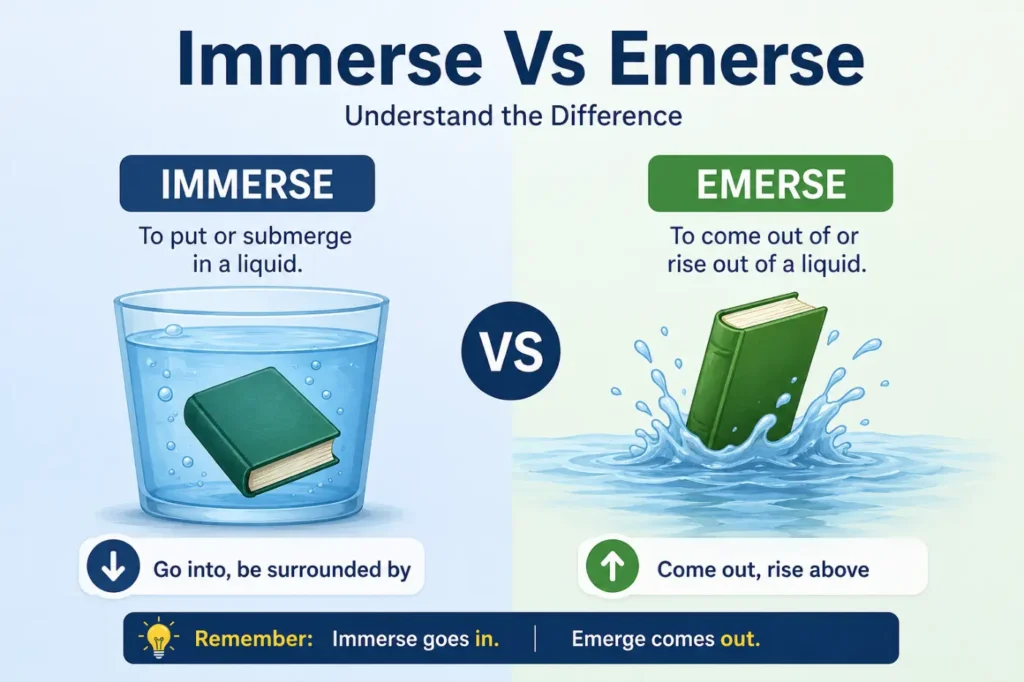
The difference between immerse vs emerse can be confusing because the words look and sound closely related. One is common in everyday English. The other is a specialized term that appears mainly in scientific and technical writing. Many people also confuse immerse with emerge, which has a completely different meaning.
The short answer is this. Immerse is the standard word you need in ordinary English when you mean to put something deeply into a liquid or to become deeply involved in an activity, culture, subject, or experience. Emersed is a legitimate technical term that describes something rising out of water or existing above the water’s surface. Emerse exists but is rare and specialized.
That difference matters because these words are not interchangeable. You can immerse yourself in a new language. A plant can be emersed above the water. A person can emerge from a building. Each word describes a different direction or relationship.
This guide explains the meaning, spelling, pronunciation, grammar, history, and real world usage of these terms. It also explores the psychology behind immersion, the difference between being emersed and immersed in culture, and the common confusion between immerse vs emerge and immerse vs submerge.
Quick Definition
Immerse means to place something deeply into a liquid or to become deeply involved in an activity, subject, language, culture, or experience. Emerse is a rare technical term related to rising out of water, while emersed commonly describes something that has emerged above the water’s surface. In ordinary writing, immerse is usually the word you need.
Quick Answer
If you are asking which word to use in normal English, choose immerse.
- Immerse means to put something into a liquid or become deeply involved in something.
- Emersed means above the surface of water and is mainly used in botany and aquatic science.
- Emerse is rare and specialized.
- Emerge means to come out or become visible and is a different word.
- Submerge means to put something completely underwater.
For example, you can immerse yourself in a new culture, but a plant may be described as emersed when its leaves grow above the water.
Just as writers often confuse immerse and emerse, many also struggle with the proper plural spelling of copy when writing emails, documents, or academic work.
Comparison Table
| Feature | Immerse | Emerse | Emersed |
|---|---|---|---|
| Part of speech | Verb | Rare verb or adjective related form | Adjective and participle |
| Standard everyday English | Yes | Rare | Mainly technical |
| Core meaning | Put into liquid or become deeply involved | Rise out of or come above water | Existing above the water’s surface |
| Origin | Latin immergere | Latin emersus and related forms | From emerge and Latin roots |
| Formality level | Common and versatile | Highly specialized | Technical and scientific |
| Common contexts | Culture, education, language, water, experiences | Botany and aquatic science | Aquatic plants and ecology |
| Usage frequency | Very common | Uncommon | Specialized |
| Example | She immersed herself in Japanese culture. | The plant may emerse from the water. | The emersed leaves grew above the pond. |
The table shows why these words should not be treated as simple spelling alternatives. Immerse is a familiar everyday verb. Emersed belongs mainly to specialized descriptions of organisms or objects that are above water.
Meaning Of Both Terms
The clearest way to understand the difference is to look at each word on its own before comparing them.
Immerse Meaning
Immerse means to put something deeply into a liquid. It can also mean to become completely involved in an activity, subject, environment, or experience.
The physical meaning is easy to picture. You might immerse a cloth in water. Might immerse vegetables in a cleaning solution. You might immerse an object in a tank for scientific testing.
The figurative meaning is just as common. You can immerse yourself in:
- A language.
- A culture.
- A book.
- A subject.
- A creative project.
- A new environment.
- A learning experience.
For example:
She immersed herself in Spanish before moving to Madrid.
This does not mean she physically placed herself inside the language. It means she surrounded herself with Spanish and became deeply involved in learning and using it.
That figurative use is one of the most important meanings to understand because it appears constantly in education, psychology, travel, business, literature, and everyday conversation.
Emerse Meaning
Emerse is much less common than immerse. It is associated with the idea of coming out of water or rising above a surface. In modern English, however, the related forms emerge and emersed are generally more familiar and useful.
The word belongs mainly to specialized scientific and botanical contexts. A plant that grows with its roots underwater but has stems or leaves above the water may be described as emersed.
For example:
The emersed leaves extended above the pond’s surface.
In this sentence, the word describes a physical position. The plant is not fully underwater. Part of it exists above the water. That is very different from the figurative meaning of immerse.
Emerse And Emersed
It is useful to separate the rare verb emerse from the much more common technical adjective emersed.
- Emerse suggests the action of coming out of water or rising above a surface.
- Emersed describes something that is already above the water.
In practice, scientific writers are much more likely to use emersed when describing aquatic plants. For most general readers, the distinction can be remembered this way.
- Immerse means go into.
- Emersed means already above the water.
- Emerge means come out or become visible.
Key Differences
The difference between these words becomes much easier when you focus on direction.
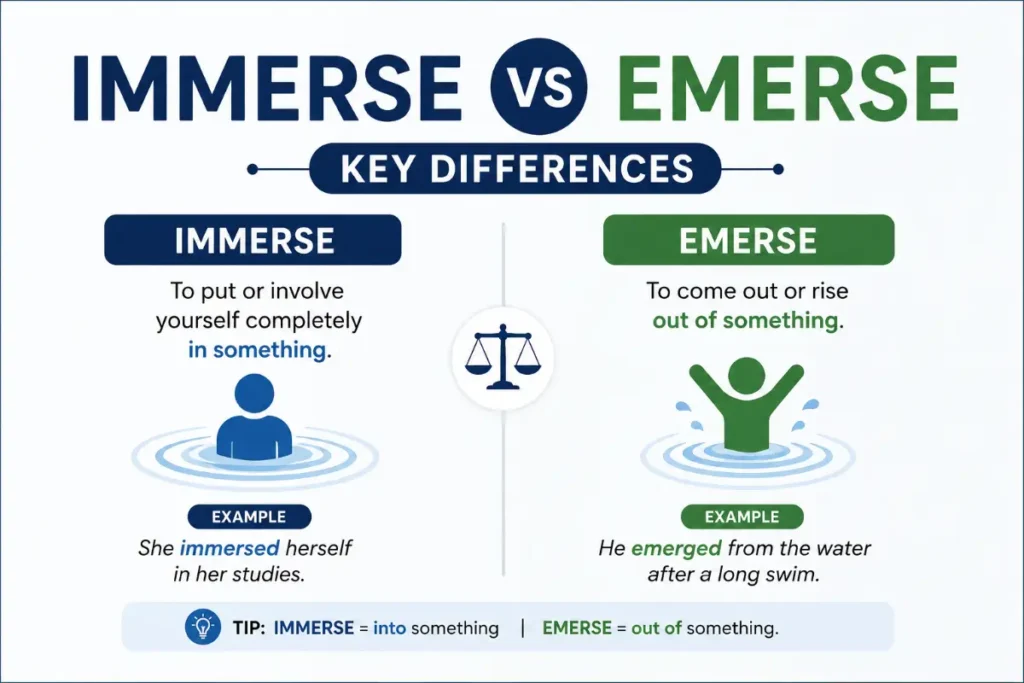
- Immerse points inward or downward. Something goes into a liquid or a person becomes deeply involved in an experience.
- Emersed points outward or upward. Something is above the water’s surface.
This basic contrast explains most of the difference.
Meaning Difference
The words describe opposite physical relationships with water.
- If you immerse an object, you place it into water.
- If an aquatic plant is emersed, part of it is above the water.
The difference becomes even clearer with examples.
The researcher immersed the sample in water.
The sample went into the water.
The emersed leaves reached above the water.
The leaves were outside the water.
Tone Difference
Immerse is a normal everyday word. It works in casual conversation, academic writing, professional communication, and creative writing.
Emersed has a technical tone. Most people encounter it in botany, aquatic ecology, biology, horticulture, or scientific descriptions.
For example, this sounds completely natural:
I want to immerse myself in the language before my trip.
This sounds specialized:
The aquarium contains both submerged and emersed plant species.
The second sentence is perfectly correct, but it belongs to a more specific field.
Grammar Difference
Immerse is primarily a verb.
You can say:
- Immerse the paper in water.
- She immersed herself in the project.
- They are immersing themselves in the local culture.
Emersed is usually an adjective or a past participle used descriptively.
You can say:
- Emersed leaves.
- An emersed aquatic plant.
- The plant became emersed as the water level fell.
This grammatical difference alone prevents the two words from functioning as simple substitutes.
Regional Difference
Unlike color and colour, there is no major American and British spelling difference here.
English speakers in the United States, the United Kingdom, Canada, and Australia generally use immerse with the same meaning and spelling.
The specialized term emersed also retains the same spelling across these varieties of English. The main difference is frequency. A general reader may rarely encounter it, while a botanist or aquatic plant specialist may use it regularly.
Context Difference
Context is often the fastest way to choose the right word.
Use immerse when discussing:
- Learning.
- Culture.
- Language.
- Reading.
- Personal experiences.
- Physical objects placed in liquid.
Use emersed when discussing:
- Aquatic plants.
- Water levels.
- Botany.
- Wetland ecology.
- Aquariums.
- Plant morphology.
Immerse Vs Emerge
Many people confuse immerse with emerge because the words share several letters and both can describe movement involving water. Their meanings are different.
- Immerse means to put into something or become deeply involved.
- Emerge means to come out, become visible, or appear.
Compare these examples.
The swimmer immersed himself in the cold water.
He went into the water.
The swimmer emerged from the water.
He came out of the water. The difference is almost like entering and exiting a room.
Immerse describes going in.
Emerge describes coming out.
This distinction also works in figurative language.
She immersed herself in her studies.
She became deeply involved in studying.
A new idea emerged during the discussion.
The idea appeared or became clear. If you remember the movement involved, the words become much easier to separate.
Which Word Is Correct
For almost every everyday situation, immerse is the correct word.
Use it when you mean:
- Put something into liquid.
- Become deeply involved in an activity.
- Surround yourself with a language or culture.
- Focus deeply on a subject.
- Become fully engaged in an experience.
Use emersed only when you are describing something that exists above the water’s surface, especially in a scientific or botanical context. Also, use emerge when you mean come out, appear, or become visible.
A practical editor’s rule is simple.
- If you are writing about a person learning a language, exploring a culture, reading a book, or becoming deeply involved in a subject, use immerse.
- If you are describing an aquatic plant growing above the water, emersed may be the precise technical term.
- If you are describing someone or something coming out of water or becoming visible, use emerge.
Pronunciation Guide
Pronunciation can add to the confusion because the words are closely related in sound.
Immerse
- IPA: /ɪˈmɜːrs/ in many British pronunciations.
- IPA: /ɪˈmɝːs/ in American English.
Syllable breakdown:
i MERSE
The stress falls on the second syllable.
Emerse
IPA: /ɪˈmɜːrs/ or /ɪˈmɝːs/ depending on the variety of English.
The pronunciation is very close to immerse, but the first vowel sound differs slightly.
Emersed
- IPA: /ɪˈmɜːrst/ or /ɪˈmɝːst/.
Syllable breakdown:
- i MERSED
The final d is pronounced as part of the st ending.
Common Pronunciation Mistakes
Learners sometimes stress the first syllable in these words. That sounds unnatural in standard English. The natural stress is usually on the second syllable:
- im MERSE
- e MERSE
When speaking quickly, the difference between the first syllables may become less noticeable. That is one reason context matters so much when listeners hear these words.
How To Remember The Difference
A simple mental picture can make the distinction stick. Think of immerse as moving in. The first part of the word begins with im, which can remind you of going into something.
Immerse = go in deeply.
Think of emerse and emersed as moving out or existing above the water.
Emersed = above the water.
For everyday English, remember this three word comparison:
- Immerse means go in.
- Emerge means come out.
- Emersed means above the water.
That small contrast solves most confusion.
It also helps to connect each word with a familiar sentence.
Immerse yourself in a language.
Emerge from the water.
Emersed leaves grow above the surface.
Once you attach each word to a clear image, the spelling and meaning become much easier to recall.
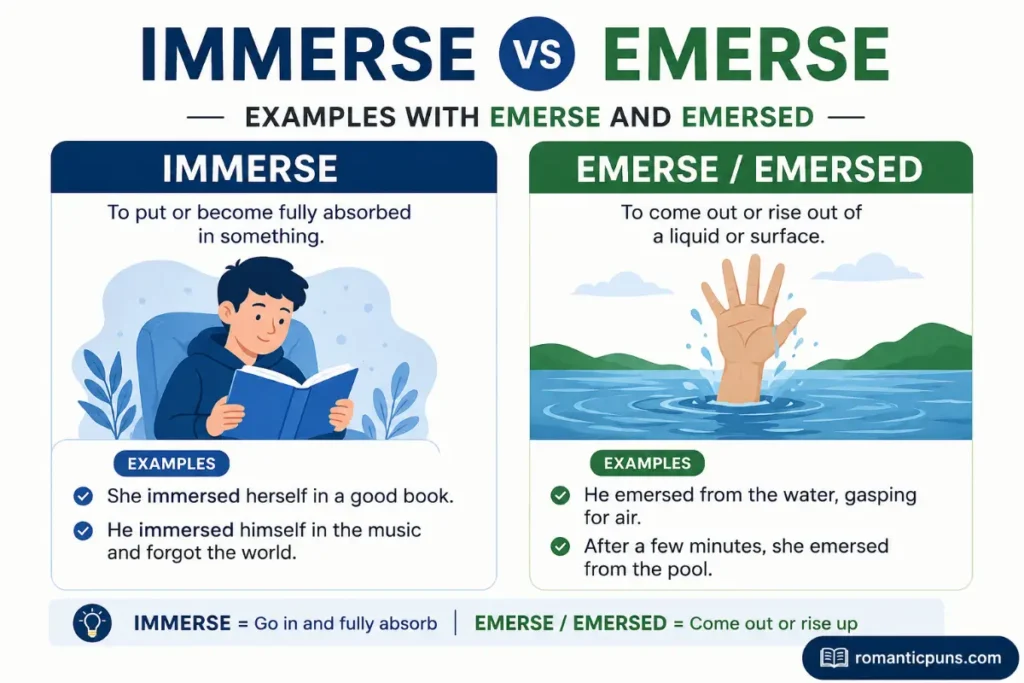
Immerse Vs Emerse Examples In Sentences
The easiest way to understand these words is to see how native speakers use them in complete sentences. The standard verb immerse works naturally in both literal and figurative contexts. The rarer forms connected with emerse appear mainly in scientific descriptions of plants and organisms that grow above the water.
10 Examples With Immerse
- The teacher encouraged students to immerse themselves in the new language by reading and speaking it every day.
- She immersed the fabric in warm water before washing it.
- He spent the summer immersing himself in Italian culture.
- The researcher immersed the sample in a controlled chemical solution.
- I like to immerse myself in a good novel on quiet evenings.
- The program allows students to immerse themselves in the local community.
- She immersed herself in the history of ancient Rome before writing her paper.
- The artist became completely immersed in the creative process.
- Listening to native speakers can help language learners immerse themselves in natural conversation.
- The documentary immersed viewers in the daily lives of people living in remote communities.
These examples show an important pattern. The verb often appears with yourself, himself, herself, or themselves when a person becomes deeply involved in an experience.
10 Examples With Emerse And Emersed
Because emerse is rare, natural examples are more likely to use emersed, the technical descriptive form.
- The aquatic plant developed broad emersed leaves above the surface of the pond.
- The aquarium contained both submerged and emersed forms of the same species.
- As the water level dropped, more of the plant became emersed.
- The botanist studied how the species adapted to emersed growth.
- Several emersed stems extended above the shallow water.
- The wetland contained plants with both underwater and emersed foliage.
- The researcher recorded changes in the plant after it became emersed.
- Emersed leaves often have a different structure from leaves that grow underwater.
- The aquarium keeper allowed the plant to grow in an emersed state.
- The species can survive both submerged and emersed conditions.
The important point is that emersed describes a position or condition. It does not mean deeply involved in something. You would not normally say that someone is emersed in a book, culture, or conversation.
Common Mistakes
The most common errors come from confusing similar looking words that describe different ideas. A quick spelling check is not always enough because the real problem is often meaning.
Using Emerse Instead Of Immerse
A writer may see the beginning em and assume it works as a variation of immerse.
It does not.
If you mean to become deeply involved in something, use immerse.
- Correct: She immersed herself in the study of psychology.
- Incorrect: She emersed herself in the study of psychology.
The second sentence does not express the intended meaning.
Confusing Immerse And Emerge
These words are related in appearance but move in opposite directions.
- Immerse means go into or become deeply involved.
- Emerge means come out, appear, or become visible.
Compare the following.
- The diver immersed himself in the water.
- The diver emerged from the water.
One word describes entering. The other describes leaving.
Confusing Immerse And Submerge
These words are close in meaning when you are talking about water, but they are not identical.
- Submerge usually means put something completely under water or another liquid.
- Immerse can also describe placing something in liquid, but it has a much broader figurative meaning.
You can say:
The technician submerged the equipment completely.
You can also say:
The student immersed herself in the subject.
You cannot normally replace submerge with immerse in every context. You can immerse yourself in a language, but you cannot naturally say that you submerged yourself in a language.
Writing Emersed In Everyday Situations
The word emersed is precise but specialized.
A writer might incorrectly use it to describe someone who has become deeply involved in a hobby or culture. That is not standard usage.
- Correct: He immersed himself in Japanese culture.
- Incorrect: He became emersed in Japanese culture.
The second sentence sounds like a mistaken version of immersed.
Confusing Immersed And Emersed
These two words are particularly easy to confuse because they differ by only one letter.
- Immersed means deeply involved or placed in liquid.
- Emersed means above the water’s surface.
Compare:
The child was immersed in the swimming lesson.
The child was deeply engaged.
The plant had emersed leaves.
The leaves were above the water. The spelling difference changes the meaning completely.
Internet And Autocorrect Confusion
Online writing can make rare words appear more common than they really are. Search engines may show technical pages, informal posts, or incorrectly written content together. A reader may then assume that every form has the same meaning.
Autocorrect can add to the problem because it may recognize a rare technical term or suggest a related word without explaining the difference.
When you are unsure, look at the meaning you want to express first. Then choose the word that matches that meaning.
Etymology And Word Origin
The history of these words explains why they are related in form but different in meaning.
The Origin Of Immerse
Immerse comes from Latin immergere, meaning to dip or plunge into. The word is built from elements associated with going into or beneath something.
English adopted the word through French and Latin influenced vocabulary. Over time, its physical meaning expanded into a figurative one.
At first, the central idea was physical immersion in a liquid. Later, English speakers began using the word to describe deep mental and emotional involvement.
That is how we arrived at common expressions such as:
- Immerse yourself in a language.
- Immerse yourself in a culture.
- Immerse yourself in a book.
- Immerse yourself in research.
The basic idea remains the same. Something becomes surrounded by or deeply involved in its environment.
The Origin Of Emerse
Emerse is related to Latin forms connected with rising out or coming forth. The same family of ideas is connected with emerge, which means to come out or become visible.
The related adjective emersed developed as a technical term for organisms or plant parts that exist above water.
This explains the contrast between the two word families.
- Immerse is connected with going into.
- Emerge and emerse are connected with coming out or being above.
The Development Of The Figurative Meaning
The figurative meaning of immerse became especially useful because English often describes mental experiences through physical movement.
We speak of:
- Diving into a subject.
- Getting absorbed in a book.
- Entering a new culture.
- Going deep into research.
Immerse fits naturally into this pattern. It gives the reader a strong image of complete involvement.
That is why the word appears so often in education, language learning, psychology, travel, literature, and personal development.
Regional Usage
The spelling and core meanings remain consistent across major varieties of English. The main difference is not regional preference but the level of familiarity with the specialized term emersed.
American English
American English uses immerse in ordinary conversation, academic writing, professional communication, and creative writing.
The word appears frequently in phrases such as:
- Immersive learning.
- Immersed in culture.
- Immersed in research.
- Immersed in a book.
Emersed is mainly used in technical fields such as botany, aquatic science, and horticulture.
British English
British English follows the same pattern. Immerse is the normal everyday word, while emersed remains specialized.
British writers may also use immersive frequently in education, entertainment, and cultural discussions.
Australian English
Australian English uses both terms in the same general way.
Because Australia has extensive wetlands, waterways, and aquatic ecosystems, the technical term emersed may appear in environmental and botanical writing. Most general readers, however, are much more familiar with immerse.
Canadian English
Canadian English also follows the standard distinction.
Immerse is common in everyday and formal writing. Emersed appears mainly in scientific or environmental contexts.
There is no major spelling difference between these varieties of English.
If you enjoy exploring commonly confused terms, you might also find the container naming differences between Conex and Connex surprisingly interesting.
Grammar Rules
Understanding the grammar of each word helps prevent misuse.
Immerse As A Verb
Immerse is a transitive verb. That means it usually takes an object.
The scientist immersed the sample in water.
The object is the sample.
It can also be used reflexively.
She immersed herself in the project.
Here, herself receives the action.
Common Structures With Immerse
The most useful patterns include:
- Immerse something in something.
- Immerse yourself in something.
- Become immersed in something.
- Be immersed in something.
Examples:
Immerse the cloth in cold water.
He immersed himself in the language.
She became immersed in the research.
The audience was immersed in the story.
Tense Forms
The verb changes normally.
Present: immerse.
Past: immersed.
Present participle: immersing.
Past participle: immersed.
Examples:
- I immerse myself in the subject.
- She immersed herself in the project.
- They are immersing themselves in the local culture.
- He has immersed himself in the study of music.
Immerse And Immersed
The distinction between the verb and adjective is important.
Immerse describes the action.
The teacher immersed students in the language.
Immersed describes the resulting state.
The students were immersed in the language.
This is a common pattern in English. One form describes what happens. The other describes the condition that follows.
Emersed As An Adjective
Emersed usually describes something above water.
Examples include:
- Emersed plants.
- Emersed leaves.
- Emersed growth.
- An emersed state.
It is not normally used as a general synonym for immersed.
Plural Forms
The words do not have unusual plural forms because the main everyday use of immerse is as a verb.
The noun immersion is the related noun.
The adjective immersive describes an experience that surrounds or deeply engages someone.
The related forms include:
- Immerse.
- Immersed.
- Immersing.
- Immersion.
- Immersive.
For the specialized word, emersed functions mainly as an adjective and does not need a plural form.
Real Life Usage Examples
The word immerse appears in many areas of life because people regularly become deeply involved in experiences.
Daily Conversation
People use it when talking about hobbies, entertainment, reading, and personal interests.
- I like to immerse myself in a good mystery novel on weekends.
- She immersed herself in cooking after moving into her new apartment.
The word sounds natural but slightly more expressive than simply saying spend time on.
Language Learning
Language education is one of the most common modern contexts. A learner may immerse themselves in a language by:
- Speaking with native speakers.
- Watching films.
- Listening to podcasts.
- Reading books.
- Practicing every day.
- Living in a place where the language is spoken.
This is where the phrase language immersion comes from. The idea is to surround learners with the language instead of limiting learning to isolated vocabulary lists.
Psychology
The phrase immerse vs emerse psychology usually reflects confusion between immersed and emersed, but psychology primarily uses immersion and immersed.
Psychologists and researchers may discuss immersion in relation to:
- Attention.
- Flow states.
- Virtual reality.
- Emotional engagement.
- Narrative experiences.
- Cultural adaptation.
Someone who becomes deeply focused on an activity may feel immersed in it. This idea overlaps with the psychological concept of flow, in which attention becomes highly concentrated on a task.
Culture
The phrase immersed in culture describes deep participation in the customs, language, traditions, and daily life of a community.
For example:
Living with a local family helped her become immersed in the culture.
This means she experienced the culture directly rather than learning about it only from books. The phrase emersed in culture is incorrect in this context. The correct word is immersed.
Academic Writing
Researchers often use the term when discussing education, anthropology, language learning, media, and human behavior.
Examples include:
- Students who are immersed in a second language may gain more opportunities for daily practice.
- Participants were immersed in a simulated environment during the study.
The word works well in academic writing because it communicates deep involvement clearly.
Professional Communication
Businesses use the word when describing training, customer experiences, technology, and workplace learning.
Examples include:
- Immersive training.
- Immersed in the project.
- Immersive customer experiences.
- Immersive technology.
- Immersive learning environments.
These expressions are especially common in education, entertainment, technology, and marketing.
Literature
Writers have long used the idea of immersion to describe a reader’s relationship with a story.
A compelling novel can immerse readers in another world. A strong setting can make a fictional place feel vivid and immediate. This figurative use is powerful because it treats the reader as if they have entered the world of the story.
Media And Entertainment
Movies, video games, virtual reality experiences, and interactive exhibits often aim to immerse the audience. This is why the word immersive appears so often in entertainment descriptions.
A film may immerse viewers in a historical period. A game may immerse players in a fictional world. A virtual reality program may create an immersive environment.
Aquatic Science
This is where emersed becomes useful. An aquatic plant may grow in several forms. Some parts may be fully underwater, while other parts rise above the water.
A scientific description might distinguish between:
- Submerged leaves.
- Floating leaves.
- Emersed leaves.
In this context, emersed is a precise technical term rather than a spelling mistake.
Related Words And Confused Terms
The easiest way to separate these words is to group them by the idea they express. Immerse belongs to the language of going deeply into something. Emerge belongs to the language of coming out or becoming visible. Emersed describes a position above water. Submerge describes being pushed or placed below the surface.
These words are related in meaning, but they are not interchangeable.
Immerse And Immersed
- Immerse is the verb.
- Immersed is the past tense or past participle and can also function as an adjective.
Compare these sentences:
- The teacher immersed the students in the language.
- The students became immersed in the language.
The first sentence focuses on the action. The second focuses on the state of deep involvement. This distinction appears constantly in writing about education, culture, psychology, reading, and personal experiences.
Immerse And Immersion
Immersion is the noun form.
Examples include:
- Language immersion.
- Cultural immersion.
- Virtual reality immersion.
- Immersion in a subject.
- Immersion learning.
The word describes the experience or process of becoming deeply involved.
- Immerse tells you what someone does.
- Immersion names the experience or method.
Immerse And Immersive
Immersive is an adjective that describes something capable of drawing a person deeply into an experience.
For example:
- The museum created an immersive exhibition.
- The game offers an immersive environment.
The experience itself is immersive. The person becomes immersed in it.
This difference is useful in professional and academic writing because it allows you to describe both the experience and the participant’s response.
Immerse And Emerge
These words are often confused because they look similar.
- Immerse means go into or become deeply involved.
- Emerge means come out, appear, or become visible.
Compare:
- The diver immersed himself in the water.
- The diver emerged from the water.
The first word describes entering. The second describes coming out. The same contrast works figuratively.
- She immersed herself in her research.
- A clear pattern emerged from the research.
One describes deep involvement. The other describes something becoming visible or apparent.
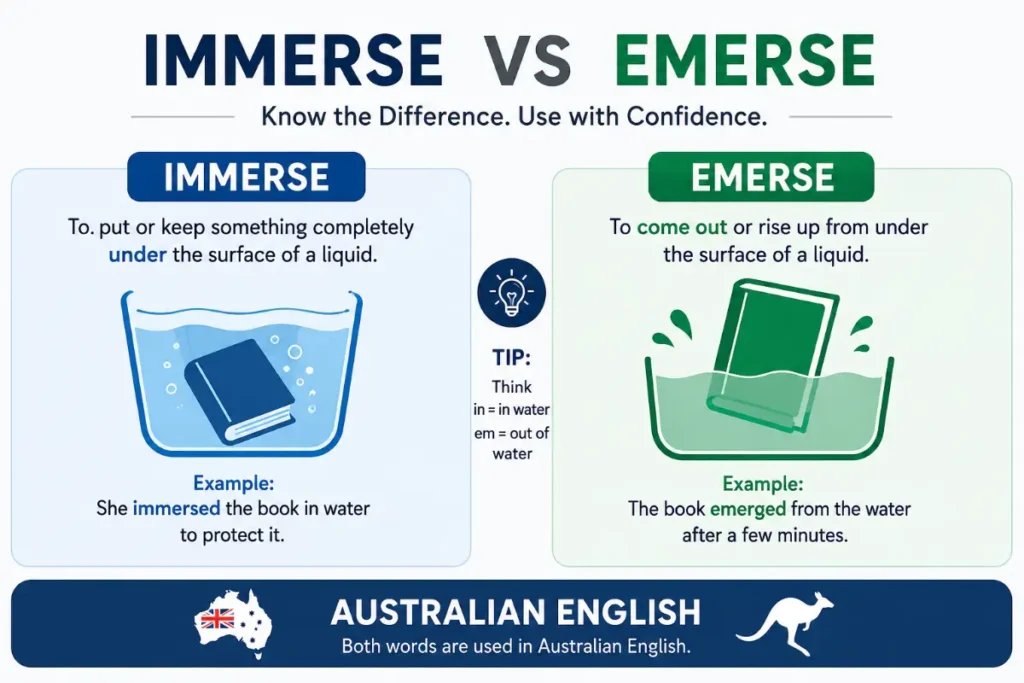
Immerse And Submerge
These words overlap when talking about water, but their meanings are not identical.
- Submerge means to put something completely under water or another liquid.
- Immerse can also mean to place something in liquid, but it has a much wider figurative meaning.
You can:
- Immerse a cloth in water.
- Submerge a boat beneath the surface.
- Immerse yourself in a new culture.
- Become immersed in a novel.
You cannot normally replace immerse with submerge in figurative expressions. Saying that someone submerged themselves in a language sounds unusual because submerge does not naturally carry the same meaning of deep mental or cultural involvement.
Emersed And Submerged
These terms are often used as opposites in aquatic science.
- Submerged means below the water’s surface.
- Emersed means above the water’s surface.
An aquatic plant may have submerged roots, floating leaves, and emersed stems or foliage. The exact terminology depends on which part of the plant is being described.
This distinction is especially useful in botany, aquarium keeping, wetland studies, and ecology.
Learning the difference between immerse and emerse also helps you spot other common spelling mistakes in English, such as whether mentioned or mentionned is the correct form.
Expert Language Insight
From an editor’s perspective, the most important lesson is not simply memorizing which spelling is correct. It is understanding the image or relationship each word creates.
When native speakers use immerse, they usually communicate depth. A person becomes deeply involved in an activity, a reader enters a fictional world, or an object is placed into a liquid.
When scientific writers use emersed, they communicate position. Something is above the water’s surface. The word is precise, but it is not a general replacement for immersed.
This distinction matters because spelling alone can hide a meaning error. A sentence may look almost correct while expressing the opposite idea.
For example:
She became immersed in Japanese culture.
This means she became deeply involved in the culture.
She became emersed in Japanese culture.
This is not standard usage. The writer almost certainly intended immersed.
Experienced editors also pay attention to register. Immerse works naturally in a personal email, a school essay, a research paper, and a novel. Emersed is more likely to appear in a botanical report or scientific description.
A useful editing test is to replace the word with a simpler phrase.
- If you mean become deeply involved, use immerse or immersed.
- If you mean come out or become visible, use emerge.
- If you mean above the water, use emersed.
- If you mean completely under the water, use submerged.
That test is more reliable than trying to remember the spelling in isolation.
Frequently Asked Questions
What is the difference between immerse and emerse?
Immerse means to put something into a liquid or become deeply involved in an activity, subject, language, or culture. Emerse is a rare term related to coming out of water, while emersed describes something above the water’s surface. In ordinary English, these words are not interchangeable.
What does immerse mean?
Immerse means to place something deeply into a liquid or to become completely involved in an experience or activity. For example, you can immerse a cloth in water or immerse yourself in a new language. The word has both a literal physical meaning and a common figurative meaning.
What does immerse yourself mean?
To immerse yourself means to become deeply involved in something. You might immerse yourself in a language by practising it daily, immerse yourself in a culture by participating in local life, or immerse yourself in a book by giving it your complete attention.
Is immerse the opposite of emerge?
Not exactly, but the words can describe opposite directions in some contexts. Immerse means go into or become deeply involved, while emerge means come out, appear, or become visible. A swimmer can immerse themselves in water and later emerge from it.
Is immerse the same as submerge?
No. The words can overlap when describing something placed in water, but submerge usually emphasizes going completely below the surface. Immerse also has a broad figurative meaning. You can immerse yourself in a language, culture, book, or subject, but you would not normally submerge yourself in those things.
What does emersed mean in botany?
In botany, emersed describes a plant or plant part that grows above the surface of water. An aquatic plant may have submerged roots and emersed leaves or stems. The term is mainly technical and is common in discussions of aquatic plants, wetlands, ecology, and horticulture.
Is emersed in culture correct?
No. The natural expression is immersed in culture or immersed in a culture. The word immersed means deeply involved in the customs, language, traditions, and daily life of a culture. Emersed is a technical term associated mainly with being above water.
How do you remember the difference between immerse and emerse?
Think of immerse as going in deeply. Think of emerge as coming out. Think of emersed as being above the water. A simple memory line is: immerse goes in, emerge comes out, and emersed is above the surface.
Conclusion
The answer to immerse vs emerse depends on the meaning you want to express, but immerse is the correct choice for almost all everyday situations involving deep involvement or placing something into liquid.
Use immerse when someone becomes deeply involved in a language, culture, subject, book, project, or experience. Use immersed to describe the resulting state. Use emerge when someone or something comes out or becomes visible. Use emersed when describing an aquatic plant or other object positioned above the water’s surface. Also, use submerge when the focus is on placing something completely below the surface.
The most important distinction is simple. Immerse means go deeply in. Emerge means come out. Emersed means above the water.
Once you connect each word with that basic image, the confusion largely disappears. Choose the word that matches the meaning first, then check the spelling. That habit will serve you far better than trying to memorise similar looking words one letter at a time.