If you searched for prooving vs proving, you are probably wondering if both spellings are acceptable or if one is simply a typo. It is a common point of confusion because many English words double the vowel before adding ing, while others do not. At first glance, both versions can look convincing.
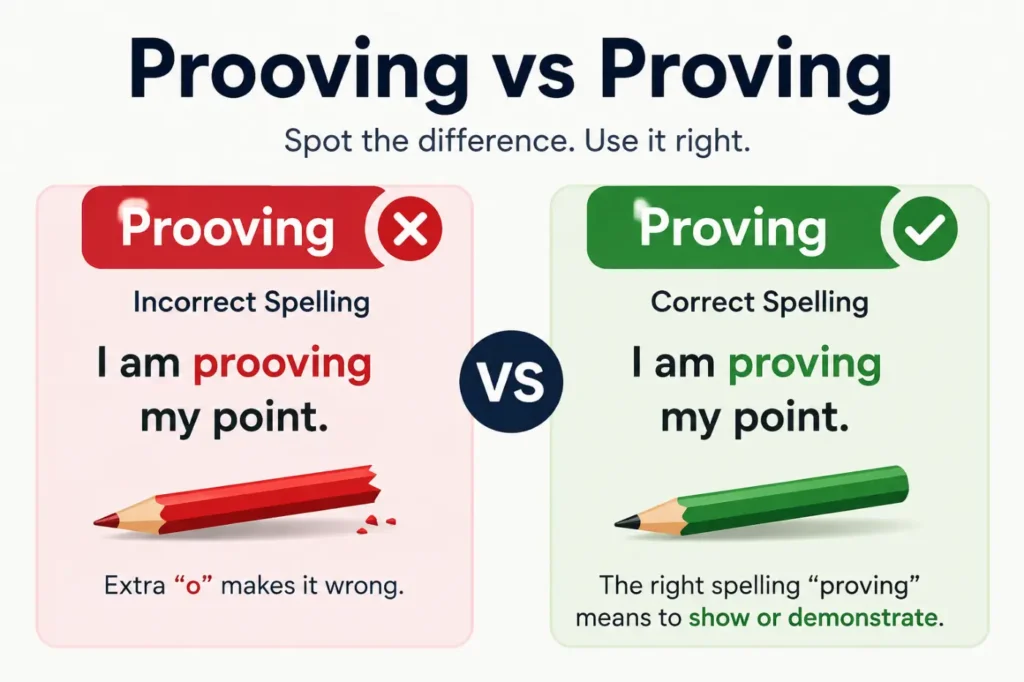
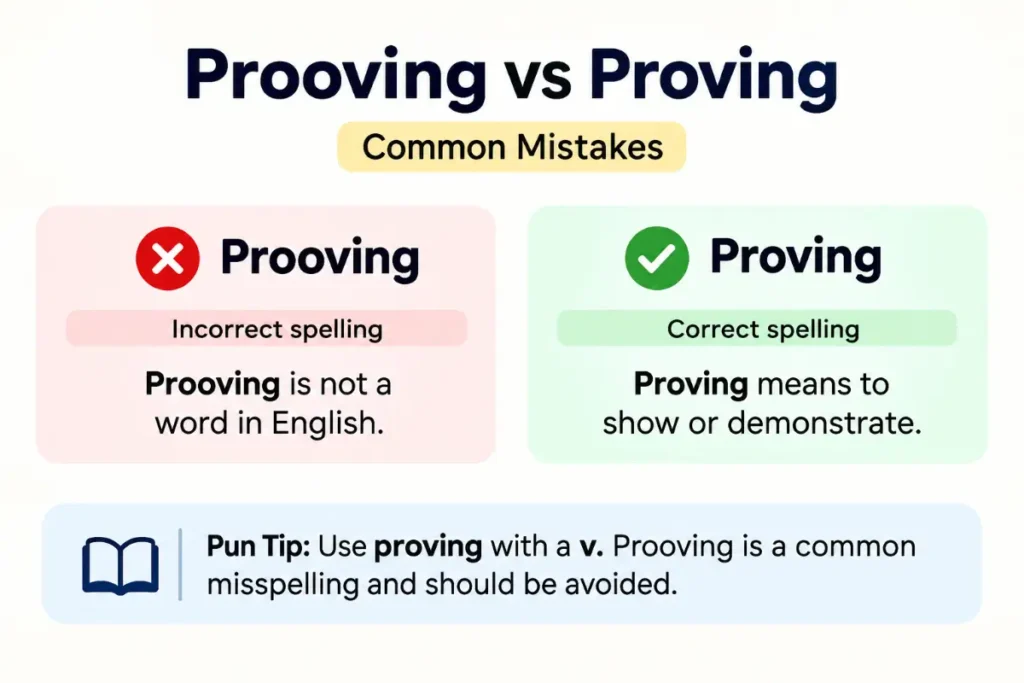
The answer is straightforward. Proving is the correct spelling. It is the standard present participle and gerund form of the verb prove. Prooving is a misspelling and should not be used in formal or informal writing.
The confusion comes from English spelling patterns. Some verbs keep or double certain letters before adding ing, while others drop a silent e. Without knowing the rule, it is easy to assume an extra o belongs in the word.
This guide explains the correct spelling in plain English. You will learn why proving is correct, how the spelling rule works, how native speakers use the word, and how to avoid this mistake in your own writing. You will also find examples, pronunciation guidance, grammar tips, and practical editing advice to help you write with confidence.
Just as the correct spelling of developed often causes confusion because of double-letter rules, proving is another word that is frequently misspelled when people rely on pronunciation instead of standard spelling.
Quick Definition
Proving is the correct ing form of the verb prove. It means demonstrating that something is true, valid, or correct through evidence, facts, testing, or experience. Prooving is not a recognized English word and is considered a spelling error, except when discussing the mistake itself.
Quick Answer
If you only need the short answer, remember these points.
- Proving is the correct spelling.
- Prooving is incorrect.
- Remove the silent e from prove before adding ing.
- Use proving in academic, professional, business, and everyday writing.
Comparison Table
| Feature | Proving | Prooving |
|---|---|---|
| Part of speech | Present participle and gerund of prove | Misspelling |
| Correct spelling | Yes | No |
| Meaning | Showing that something is true or correct | No accepted meaning |
| Origin | Derived from the verb prove | Formed by incorrect spelling |
| Formality | Standard in all writing | Not accepted |
| Common contexts | Education law science business everyday communication | Discussions about spelling mistakes |
| Usage frequency | Very common | Extremely rare |
| Dictionary status | Recognized by major dictionaries | Not recognized as a standard word |
| Example | She is proving her point with evidence. | This spelling should be corrected to proving. |
Meaning Of Both Words
Although the two spellings look similar, only one belongs to standard English.
What Does Proving Mean
Proving is the present participle and gerund form of prove. It describes the act of showing that something is true, accurate, or valid.
People use it in many situations, including:
- Presenting evidence in court.
- Confirming scientific results.
- Demonstrating a mathematical solution.
- Supporting an argument with facts.
- Showing personal growth through actions.
- Testing ideas or theories.
- Verifying information.
The word can function as both a verb and a noun.
Examples include:
- She is proving her theory through careful research.
- Proving your skills takes patience and practice.
In both examples, the spelling remains exactly the same.
What Does Prooving Mean
Prooving is not a standard English word. It usually appears because someone incorrectly assumes that prove should keep both vowels before adding ing. English spelling does not follow that pattern for this verb.
You may occasionally see prooving in:
- Typing mistakes.
- Social media posts.
- Online forums.
- Search engine queries.
- Discussions about spelling errors.
Professional editors replace prooving with proving because it does not follow accepted spelling rules.
Key Differences
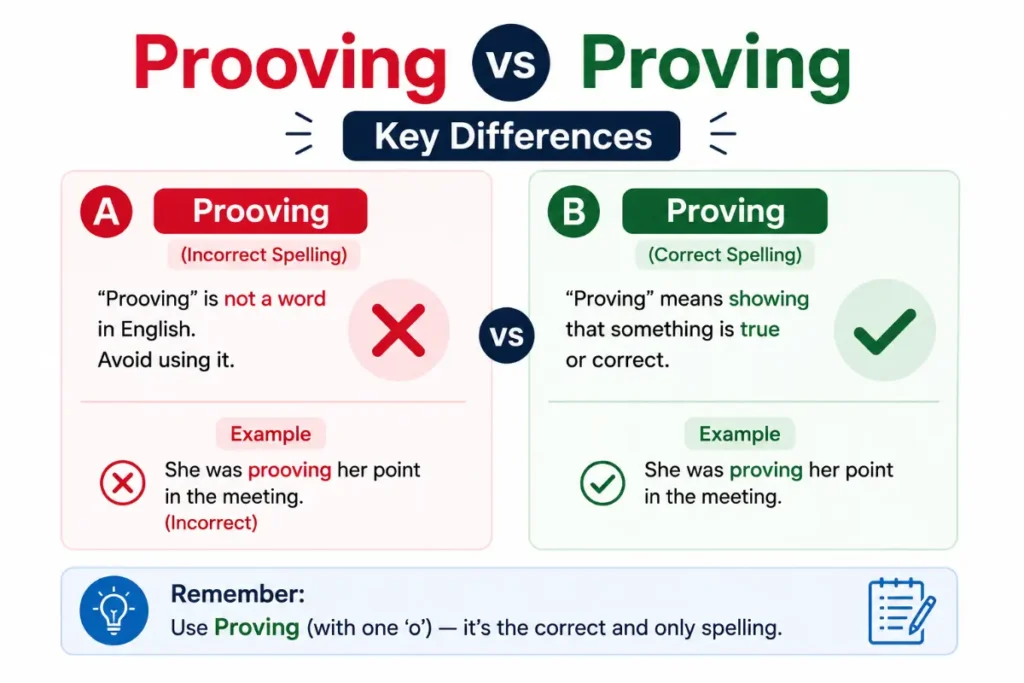
The difference between these spellings is simple but important. Proving follows standard English spelling rules and appears in dictionaries, textbooks, newspapers, and professional writing. Prooving does not.
Here are the main differences.
- Proving is the correct grammatical form.
- Prooving is a spelling mistake.
- Proving is accepted worldwide.
- Prooving should only appear when discussing the incorrect spelling itself.
- Spell checkers and grammar tools recognize proving as the standard form.
Understanding this distinction helps your writing appear more polished and professional.
Which One Is Correct?
The correct spelling is proving.
When a verb ends with a silent e, English usually drops that e before adding ing.
Examples include:
- Make becomes making.
- Bake becomes baking.
- Write becomes writing.
- Drive becomes driving.
- Prove becomes proving.
This spelling pattern is one of the most consistent rules in English. Once you learn it, you’ll recognize many similar words immediately.
There are exceptions elsewhere in English, but prove is not one of them. The correct form has only one o.
Pronunciation Guide
The incorrect spelling often appears because people try to match pronunciation with spelling. Fortunately, the pronunciation is straightforward.
IPA Pronunciation
Proving
/ˈpruː.vɪŋ/
The incorrect spelling would be pronounced exactly the same, even though it is not accepted in standard English.
Syllable Breakdown
The word has two syllables.
Proov ing
The stress falls on the first syllable.
Common Pronunciation Mistakes
Most pronunciation problems come from learners who are unfamiliar with the long oo sound.
Common mistakes include:
- Pronouncing it like proh ving.
- Stressing the second syllable.
- Confusing the vowel sound with the word prove even though both share the same long vowel.
Listening to native speakers quickly reinforces the correct pronunciation because the spoken form remains consistent across American English, British English, Australian English, and Canadian English.
How To Remember The Correct Spelling
A simple memory trick can help you avoid this mistake every time. Think about the base verb first.
Prove
Now apply the standard spelling rule. Remove the silent e and add ing. The result is proving. Another helpful strategy is to compare it with similar verbs.
- Bake becomes baking.
- Drive becomes driving.
- Write becomes writing.
- Make becomes making.
- Prove becomes proving.
Notice that none of these words add an extra vowel before ing. They simply drop the silent e and continue with the new ending.
If you ever hesitate while typing, return to the base verb. That quick check is usually enough to spot the mistake before you finish your sentence.
Prooving vs Proving Examples In Sentences
The easiest way to remember the correct spelling is to see it in real situations. Notice how proving fits naturally into each sentence. Then compare those examples with the incorrect form so you can recognize the mistake immediately.
Examples Using Proving
These sentences use the correct spelling.
- She is proving her argument with reliable evidence.
- The scientist is proving the theory through repeated experiments.
- He spent years proving his skills as a talented engineer.
- The lawyer focused on proving the client’s innocence.
- They are proving that teamwork leads to better results.
- The teacher praised the student for proving the answer step by step.
- We are proving our commitment through consistent action.
- The company is proving that customer service remains its top priority.
- Careful testing is proving the new design is more efficient.
- She keeps proving that hard work pays off.
These examples reflect how native speakers use the word in everyday conversation, education, business, and professional writing.
Examples Using Prooving
The following examples show the incorrect spelling as it commonly appears online. Each sentence should use proving instead.
- She is prooving her point with facts.
- They are prooving the formula in class.
- He keeps prooving everyone wrong.
- The lawyer is prooving the case with new evidence.
- We are prooving the results through testing.
- The report is prooving the hypothesis.
- She is prooving her abilities at work.
- They are prooving their dedication every day.
- The data is prooving the claim.
- He spent years prooving his experience.
Every sentence above contains the same spelling mistake. Replacing prooving with proving makes each sentence correct.
If you enjoy exploring confusing English spellings, you’ll also find it interesting to learn why this scientific term has two spellings, since many technical words have accepted regional variations.
Common Mistakes
Many spelling errors happen because English has several different rules for adding endings to verbs. Knowing the most common mistakes helps you avoid repeating them.
Adding An Extra Letter
The most frequent mistake is adding another o before ing.
Incorrect:
Prooving
Correct:
Proving
The extra vowel is never needed because the silent e is removed before adding ing.
Forgetting The Silent E Rule
Many verbs ending in a silent e follow the same spelling pattern.
For example:
- Hope becomes hoping.
- Move becomes moving.
- Save becomes saving.
- Believe becomes believing.
- Prove becomes proving.
Learning this rule makes dozens of English words easier to spell.
Relying On Pronunciation
Because both spellings sound the same, some writers assume either version is acceptable.
English spelling does not always match pronunciation exactly. That is why checking the base word is more reliable than writing the word the way it sounds.
Copying Incorrect Online Text
Typing mistakes spread quickly across social media, discussion forums, and comment sections.
Seeing an incorrect spelling repeatedly can make it look familiar, but familiarity does not make it correct. Dictionaries, grammar checkers, and professional editors consistently recognize proving as the accepted form.
Confusing Similar Words
Some learners mix up words from the same word family.
For example:
- Proof.
- Prove.
- Proven.
- Proving.
Each word has its own grammatical role, so choosing the correct form depends on the sentence.
Etymology And Word Origin
The verb prove has a long history that stretches back hundreds of years.
It entered Middle English through Old French and ultimately traces its roots to the Latin word probare, meaning to test, examine, approve, or demonstrate.
As English developed, prove became the standard verb used to express the idea of establishing truth through evidence, reasoning, testing, or experience.
The ing form follows one of the language’s regular spelling rules. Because prove ends with a silent e, that letter is dropped before adding ing, creating proving.
The incorrect spelling developed much later through typing errors and misunderstandings of English spelling patterns rather than through historical language change.
Regional Usage
One advantage of this word is that its spelling remains consistent across the major varieties of English.
American English
American English always uses proving in schools, universities, businesses, legal writing, journalism, and everyday communication.
British English
British English follows the same spelling rule. Whether the writing appears in newspapers, academic journals, or government documents, the accepted form remains unchanged.
Australian English
Australian English also uses proving in both formal and informal contexts. The incorrect spelling appears only as an error or when someone is discussing the mistake itself.
Canadian English
Canadian English follows the same convention. Although Canadian spelling sometimes combines American and British influences, this verb does not change across regions.
No major English speaking country recognizes prooving as the standard spelling.
Prooving vs Proving Grammar Rules
Understanding how this word functions in sentences makes it much easier to use correctly.
Present Participle
The most common use is as the present participle of prove.
Examples include:
- She is proving her point.
- They are proving the results.
- We are proving our commitment.
In these examples, the word works with a helping verb to form the present continuous tense.
Gerund
The same spelling also functions as a noun.
Examples include:
- Proving your skills requires patience.
- Proving the claim took several months.
Here, the action itself becomes the subject of the sentence.
Common Sentence Patterns
Native speakers frequently use combinations such as:
- Proving a point.
- Proving a theory.
- Proving a claim.
- Proving a case.
- Proving your innocence.
- Proving your worth.
- Proving your skills.
- Proving responsibility.
These natural combinations appear regularly in both spoken and written English.
Proof Or Prove Which Is Correct
This question comes up often because the two words are closely related. The answer depends on how the word functions in the sentence.
- Proof is usually a noun that means evidence or confirmation.
- Prove is a verb that means to demonstrate or establish that something is true.
Examples:
- We need more proof before making a decision.
- You must prove your identity before entering the building.
Both words are correct when used in the appropriate grammatical role.
Real Life Usage Examples
The word appears in many areas of everyday life because people constantly support ideas with evidence, facts, or experience.
Daily Conversation
People often use the word when discussing personal achievements or opinions.
Examples include:
- She keeps proving herself at work.
- He is proving that persistence makes a difference.
- They are proving everyone wrong.
Academic Writing
Teachers, researchers, and students frequently use the word when discussing evidence, experiments, mathematics, and logical arguments.
Examples include:
- Proving a mathematical theorem.
- Proving a scientific hypothesis.
- Proving an argument with reliable sources.
Professional Communication
Business professionals use the word when describing results, performance, or measurable outcomes.
Examples include:
- Proving compliance with regulations.
- Proving product quality.
- Proving financial stability.
- Proving customer satisfaction.
Bread Making
The word also has a completely different meaning in baking. In bread making, proving refers to the stage where dough rests and rises before baking. During this time, yeast produces gas that causes the dough to expand, creating a lighter texture and better structure.
Although the meaning changes, the spelling does not. Bakers still use proving, never prooving.
Proof Of Payment Or Prove Of Payment
This is another common point of confusion. The correct phrase is proof of payment because proof is the noun. Prove of payment is grammatically incorrect because prove is a verb and cannot replace the noun in this expression.
Examples include:
- Please attach your proof of payment.
- The bank requested proof of payment before processing the refund.
Using the correct form makes business communication clear and professional.
Related Words And Confused Terms
The verb prove belongs to a larger family of related words. Learning how these words work together helps you choose the right one for every sentence.
| Word | Part of Speech | Meaning |
|---|---|---|
| Prove | Verb | To show that something is true or correct. |
| Proving | Present participle or gerund | The act of demonstrating or establishing something. |
| Proven | Adjective or past participle | Shown to be true or effective. |
| Proof | Noun | Evidence that confirms something is true. |
| Proofread | Verb | To check written work for errors before publishing. |
You may also come across these closely related terms.
- Evidence.
- Verification.
- Validation.
- Confirmation.
- Demonstration.
- Authentication.
- Justification.
- Corroboration.
- Support.
- Substantiation.
Proving Meaning
The word proving means demonstrating that something is true, accurate, or valid through facts, testing, observation, or evidence. Depending on the sentence, it can function as a verb or a noun.
Proving Synonyms
No single synonym works in every context, but these words often have a similar meaning.
- Demonstrating.
- Confirming.
- Verifying.
- Establishing.
- Validating.
- Showing.
- Supporting.
- Substantiating.
Choose the synonym that best matches the sentence instead of replacing the word automatically.
Learning the difference between proving and prooving becomes much easier when you understand avoiding common double-letter mistakes, especially in words where adding or dropping a consonant changes the correct spelling.
Expert Language Insight
Editors rarely hesitate when correcting this spelling because the rule is well established. The correct form follows a standard English pattern that applies to many verbs ending in a silent e.
When reviewing documents, professional editors often look for repeated spelling habits rather than isolated mistakes. Someone who writes prooving usually makes similar errors with words like making, moving, or hoping. Fixing the underlying spelling rule solves several problems at once instead of correcting each word individually.
Native speakers almost always write proving without thinking about the rule because they have seen it thousands of times in books, newspapers, emails, and everyday communication. The more you read professionally edited content, the more natural the correct spelling becomes.
If you are unsure while writing, pause for a moment and think about the base verb. Start with prove, remove the silent e, then add ing. That simple habit is faster than relying on guesswork and helps you build lasting confidence in your spelling.
Frequently Asked Questions About Prooving vs Proving
Is proving or prooving correct?
Proving is the correct spelling. It is the accepted present participle and gerund form of the verb prove. Prooving is a spelling mistake and should not be used in standard English writing.
Why is proving spelled with one o?
The verb prove ends with a silent e. English spelling rules normally drop that e before adding ing, producing proving. There is no rule that adds another o, so prooving is incorrect.
Is prooving a real word?
No. It is not recognized as a standard English word. You may see it in typing mistakes, online discussions, or searches about spelling, but dictionaries and style guides use proving.
What does proving mean?
Proving means showing that something is true, correct, or valid through evidence, facts, testing, reasoning, or experience. It can also describe the process of allowing bread dough to rise before baking.
What is the difference between proof and prove?
Proof is a noun that refers to evidence or confirmation. Prove is a verb that means to demonstrate that something is true.
For example:
- We need proof before making a decision.
- You must prove your claim with evidence.
Is proving used in bread making?
Yes. In baking, proving describes the stage where dough rests and rises before it is baked. During this process, yeast creates gas that helps the dough expand and develop its texture.
How do I remember the correct spelling?
Start with the base word prove. Remove the silent e, then add ing. This follows the same spelling pattern as making, saving, driving, and writing.
Why do people search for prooving?
Most people search for the incorrect spelling because they are unsure about the rule or have seen the mistake online. Search engines recognize this confusion and often return results explaining that proving is the correct form.
Conclusion
The correct spelling is proving, and it is the only form accepted in standard English. It follows a common spelling rule where verbs ending in a silent e drop that letter before adding ing. Once you understand this pattern, the choice becomes much easier.
The misspelling prooving usually appears because people rely on pronunciation instead of spelling rules or because they have copied the error from informal online sources. Although the mistake is common, it should be corrected in academic work, business writing, professional communication, and everyday documents.
It also helps to remember that the same spelling applies in different contexts. You can use proving when talking about evidence in science, arguments in law, personal growth, or the stage where bread dough rises before baking. The meaning changes with the situation, but the spelling stays the same.
Whenever you feel uncertain, return to the base verb. Write prove, remove the silent e, add ing, and continue with confidence. That simple habit will help you avoid this mistake every time.