
If you have searched for kinesthesiology vs kinesiology, you are probably wondering if these terms describe different subjects or if one is simply a misspelling. The confusion is understandable. Both words look almost identical, they sound alike, and they are often used in discussions about movement, exercise, health, rehabilitation, and sports science.
The short answer is that kinesiology is the standard and widely accepted term. It is the name used by universities, researchers, healthcare professionals, and scientific publications to describe the study of human movement. Kinesthesiology is far less common and is usually considered a nonstandard variant or an incorrect spelling in most contexts.
The confusion often comes from the word kinesthesia, which refers to the body’s ability to sense movement and position. Because both terms share the same Greek root and relate to movement, many people assume they are interchangeable. In practice, they are not used the same way.
This guide explains the difference in simple language. You will learn what each term means, why one is preferred, how professionals use these words, how to pronounce them correctly, and when each term is appropriate in academic, medical, and everyday writing.
Quick Definition
Kinesiology is the scientific study of human movement and is the accepted term in education, healthcare, sports science, and research. Kinesthesiology is a much less common variant that occasionally appears because of confusion with kinesthesia, but it is rarely used in professional or academic settings.
Quick Answer
If you only need a fast answer, remember these points.
- Kinesiology is the correct and widely accepted term.
- Most universities, journals, and healthcare organizations use kinesiology.
- Kinesthesiology is uncommon and is usually treated as a nonstandard form.
- Use kinesiology in academic, professional, medical, and everyday writing unless you are referring to a specific organization or title that intentionally uses the alternative spelling.
Comparison Table
| Feature | Kinesiology | Kinesthesiology |
|---|---|---|
| Part of speech | Noun | Noun |
| Correct form | Yes | Usually no |
| Meaning | Scientific study of human movement | Generally intended to mean the same subject |
| Origin | Greek roots related to movement | Influenced by the word kinesthesia |
| Formality | Standard and formal | Rare and nonstandard |
| Common contexts | Universities healthcare sports science research rehabilitation | Occasional informal use specific names |
| Usage frequency | Very common | Very rare |
| Dictionary recognition | Widely recognized | Limited recognition |
| Example | She earned a degree in kinesiology. | The brochure mistakenly used kinesthesiology. |
Meaning Of Both Terms
Although these words are closely related, they do not carry the same level of acceptance in modern English.
What Does Kinesiology Mean
Kinesiology is the scientific study of human movement. It brings together knowledge from anatomy, physiology, biomechanics, neuroscience, psychology, and exercise science to understand how the body moves and performs.
Professionals in this field study topics such as:
- Muscle function.
- Joint movement.
- Physical rehabilitation.
- Athletic performance.
- Injury prevention.
- Motor learning.
- Exercise physiology.
- Human biomechanics.
The field supports many careers, including physical therapy, athletic training, occupational therapy, sports medicine, fitness coaching, rehabilitation, and academic research.
What Does Kinesthesiology Mean
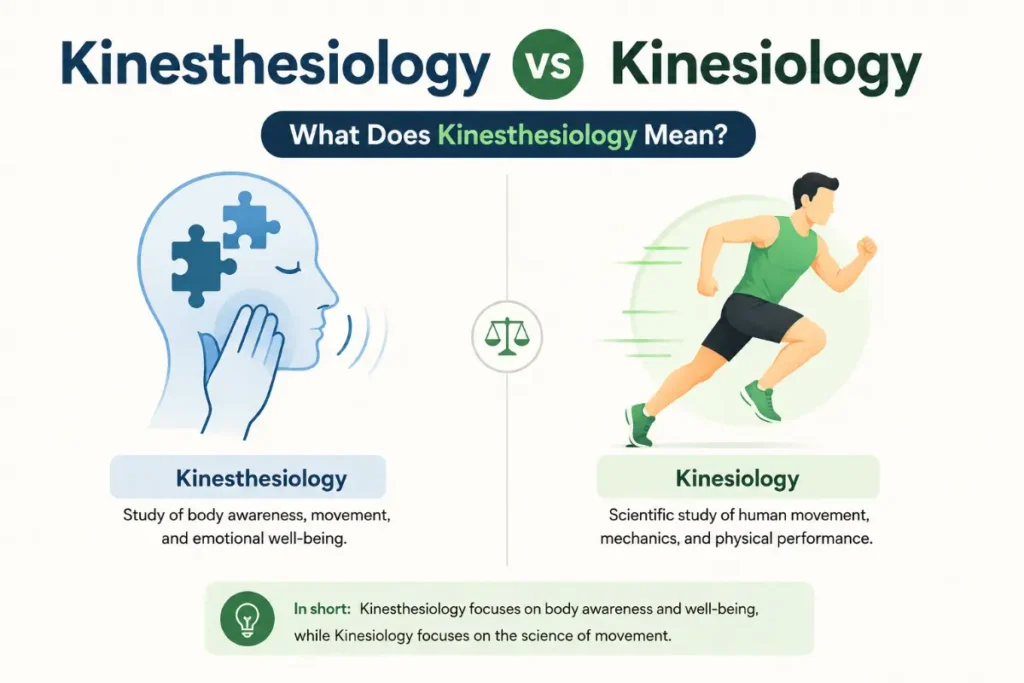
Kinesthesiology is not the standard name for the academic discipline. In most cases, people use it because they mistakenly combine kinesthesia with kinesiology.
The word kinesthesia refers to the body’s ability to sense the position and movement of muscles and joints without relying on sight. This sensory ability helps you walk, reach for objects, balance, and perform everyday activities without constantly watching your body.
Because both terms relate to movement, it is easy to understand why people mix them up. However, professional publications almost always reserve kinesthesia for the sensory process and kinesiology for the scientific study of movement.
If you’re interested in similar English spelling confusions, our guide to common spelling mix-ups like doubt explains why certain forms look convincing but are still incorrect.
Key Differences
At first glance, these terms appear to describe the same subject. The important difference lies in accepted usage rather than meaning.
The word kinesiology has become the recognized name of the discipline. Universities around the world offer degrees under this title, research journals publish studies using this terminology, and healthcare professionals use it in clinical and academic settings.
The alternative spelling developed because people naturally associate the field with kinesthesia, the body’s awareness of movement. Even though the connection makes sense, language standards have settled on kinesiology as the correct term.
Here are the main differences.
- Kinesiology is the accepted academic and scientific term.
- Kinesthesiology appears only occasionally and is usually considered a spelling variation rather than a separate discipline.
- Universities almost always use kinesiology in department names and degree programs.
- Scientific journals overwhelmingly publish research using kinesiology.
- Healthcare professionals, exercise scientists, and rehabilitation specialists rely on the standard term in professional communication.
Understanding this distinction helps you write with greater accuracy and ensures your work matches the language used by experts in the field.
Which One Is Correct
For almost every situation, kinesiology is the correct choice. If you are writing a research paper, college assignment, professional email, healthcare document, or educational article, use kinesiology. It is the spelling recognized by dictionaries, universities, medical organizations, and scientific literature.
The less common form may appear in isolated cases, such as an organization’s official name or older publications. When referring to those specific names, preserve the original spelling exactly as it appears.
A simple way to remember the rule is this. If you are talking about the science of human movement, choose kinesiology.
If you encounter kinesthesiology, check the context carefully. In most cases, it is simply an uncommon variation rather than the preferred term.
Pronunciation Guide
The similar spelling is one reason these terms are often confused. Their pronunciation is also very close.
IPA Pronunciation
Kinesiology
/kɪˌniːsiˈɒlədʒi/
Kinesthesiology
/kɪˌnɛsθiːsiˈɒlədʒi/
Syllable Breakdown
Kinesiology
ki nee see ol uh jee
Kinesthesiology
ki nes thee see ol uh jee
The second word contains an additional th sound, making it slightly longer to pronounce.
Common Pronunciation Mistakes
People often make these mistakes when saying the words aloud.
- Skipping the long ee sound in kinesiology.
- Omitting the th sound in kinesthesiology.
- Stressing the wrong syllable.
- Assuming both words are pronounced exactly the same.
Listening to university lectures, medical presentations, or educational videos is a good way to become familiar with the standard pronunciation.
How To Remember The Correct Term
Many learners remember the correct spelling once they understand the connection between the two words.
Use these simple tips.
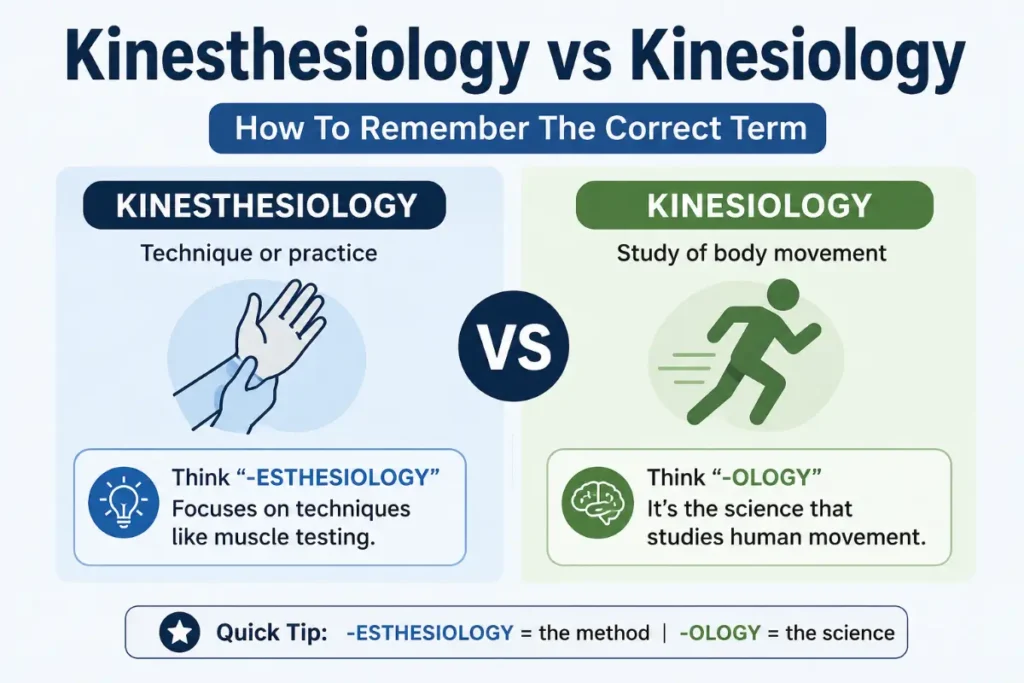
- Think of kinesiology as the official name of the academic field. This is the word you will see in university programs, textbooks, and scientific research.
- Remember that kinesthesia is the name of the body’s sense of movement. The extra letters in kinesthesiology come from blending these two different words.
- If you are writing for school, work, healthcare, or publication, choose kinesiology unless an official title uses the alternative spelling.
- When in doubt, search the name of a university department. You will almost always find Department of Kinesiology, which reinforces the accepted terminology.
Once you associate kinesiology with education, science, and professional practice, choosing the correct term becomes much easier.
Examples In Sentences
Seeing both terms in real sentences makes the difference much easier to understand. The first group uses the accepted academic term, while the second shows how the less common form usually appears in context.
Examples Using Kinesiology
These examples reflect standard English and professional usage.
- She earned a bachelor’s degree in kinesiology before applying to physical therapy school.
- The university expanded its kinesiology department to support new research programs.
- Kinesiology students study anatomy, biomechanics, and exercise physiology.
- His interest in kinesiology began after recovering from a sports injury.
- Researchers published a new kinesiology study on injury prevention in runners.
- The professor explained how kinesiology combines several scientific disciplines.
- Many athletic trainers begin their careers with a degree in kinesiology.
- The conference featured leading experts in kinesiology and rehabilitation.
- Advances in kinesiology continue to improve athletic performance and patient care.
- She chose kinesiology because she wanted to help people move more effectively after injuries.
These examples show the term in the same way you will find it in textbooks, research papers, university websites, and healthcare publications.
Examples Using Kinesthesiology
The alternative form appears much less often and is rarely the preferred choice.
- The brochure mistakenly referred to the program as kinesthesiology.
- A few older documents still use the word kinesthesiology.
- The student searched for kinesthesiology before discovering that universities use kinesiology.
- An online discussion compared kinesthesiology with kinesiology.
- Someone edited the article to replace kinesthesiology with the accepted spelling.
- The website contained several outdated references to kinesthesiology.
- A local organization used Kinesthesiology as part of its historical name.
- The writer confused kinesthesia with kinesiology and created the word kinesthesiology.
- Search engines often suggest kinesiology after someone types kinesthesiology.
- Editors corrected the spelling before the article was published.
These examples illustrate that the uncommon form usually appears because of confusion, editing, or historical naming rather than standard language use.
Understanding these naming variations is similar to choosing the correct form of comparable, where one spelling is standard English and the other is a frequent mistake.
Common Mistakes
Most mistakes happen because the words look and sound similar. Understanding the source of the confusion helps you avoid repeating it.
Mixing Up Two Different Concepts
The biggest mistake is assuming both words describe separate academic fields. They do not. One refers to the scientific study of movement, while the other is generally a variation created by blending two related words.
Confusing Kinesiology With Kinesthesia
This is the reason the uncommon spelling exists. Kinesthesia is a sensory ability. It describes your body’s awareness of movement and position.
Kinesiology is an academic discipline that studies human movement from scientific, medical, and physical perspectives. Although the concepts are related, they are not interchangeable.
Assuming Both Spellings Are Accepted
Many people believe both terms are equally correct because search engines return results for each one.
In reality, universities, professional organizations, and scientific journals overwhelmingly use the standard term.
Copying Unverified Online Sources
Not every website follows accepted language standards.
Some blogs and discussion forums repeat the uncommon spelling without checking authoritative references. Always compare unfamiliar terms with university websites, medical organizations, or reputable dictionaries before using them in formal writing.
Using The Wrong Term In Academic Work
If you are writing an assignment, research paper, scholarship application, or professional report, use the accepted terminology throughout your work.
Accurate language demonstrates subject knowledge and careful editing.
Etymology And Word Origin
The history of these words explains why people continue to confuse them today. The accepted term comes from the Greek word kinesis, meaning movement. The ending logy comes from the Greek word logos, meaning study or science.
Together, the word literally means the study of movement. The related word kinesthesia has a different origin. It combines Greek elements referring to movement and sensation, describing the body’s ability to detect the position and movement of muscles and joints.
Because both words begin with the same root and relate to movement, writers occasionally combine them into kinesthesiology. Despite this logical connection, the scientific community adopted kinesiology as the standard name for the discipline.
Today, universities, journals, and healthcare organizations continue to use the accepted terminology consistently.
Kinesthesiology vs Kinesiology Regional Usage
Unlike many spelling differences in English, this terminology remains remarkably consistent across English speaking countries.
American English
Universities, colleges, hospitals, and research institutions throughout the United States use kinesiology. Degree programs, academic departments, and professional associations follow this standard.
British English
British universities and healthcare professionals also recognize kinesiology as the accepted term. Although some institutions emphasize sports science or human movement science, the spelling remains consistent whenever the word is used.
Australian English
Australian universities commonly offer programs related to exercise science, human movement, and kinesiology. The uncommon spelling is rarely seen outside isolated references.
Canadian English
Canadian educational institutions follow the same convention. Departments, research centers, and healthcare organizations consistently use the standard terminology. Across these regions, professional communication shows overwhelming agreement on the accepted spelling.
Grammar Rules
Understanding how the word functions in sentences makes your writing more natural and accurate.
Part Of Speech
The accepted term functions as a noun.
Examples include:
- Kinesiology is a multidisciplinary field.
- She teaches kinesiology at the university.
- He studied kinesiology before entering graduate school.
Singular And Plural Usage
The word is generally treated as an uncountable academic discipline.
For example:
- Kinesiology is becoming more popular among health science students.
- She specializes in kinesiology.
You will rarely see a plural form because the word refers to an area of study rather than individual objects.
Common Word Combinations
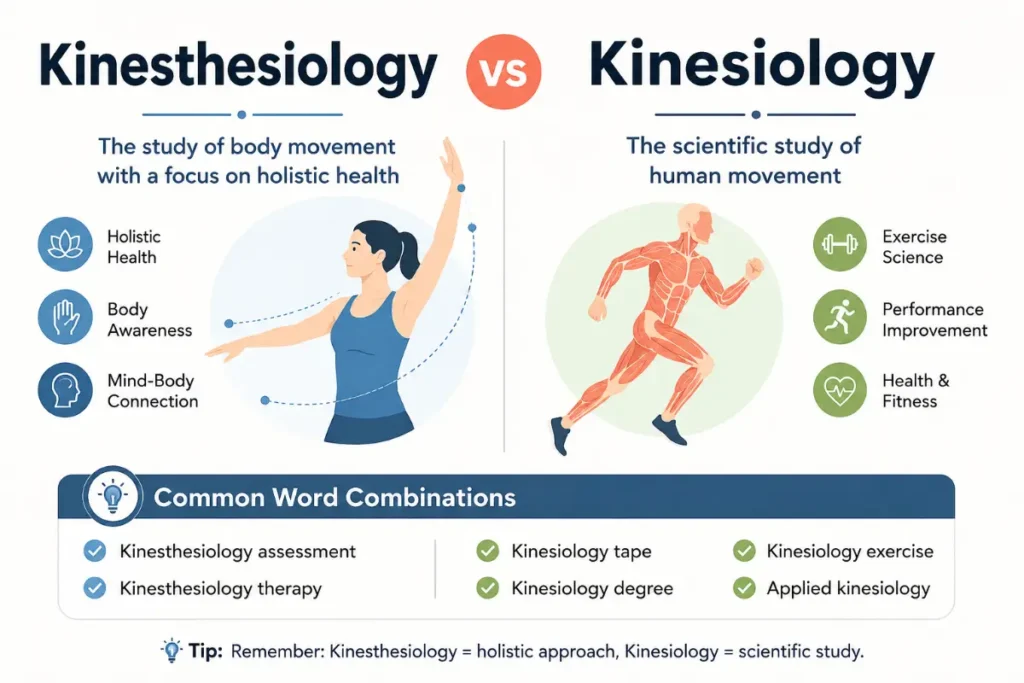
Native speakers frequently use combinations such as:
- Kinesiology degree.
- Kinesiology department.
- Kinesiology program.
- Kinesiology research.
- Kinesiology student.
- Kinesiology professor.
- Kinesiology laboratory.
- Kinesiology major.
These combinations appear naturally in educational and professional writing.
Real Life Usage Examples
The study of human movement influences many professions beyond sports.
Healthcare
Healthcare professionals use knowledge from this field to improve rehabilitation, mobility, injury prevention, and long term physical function.
Examples include:
- Physical therapy.
- Occupational therapy.
- Sports medicine.
- Orthopedic rehabilitation.
Education
Universities teach subjects such as biomechanics, exercise physiology, motor learning, anatomy, and neuroscience as part of their movement science programs. Graduates often continue into healthcare, research, coaching, or education.
Sports And Fitness
Athletes, coaches, and trainers apply movement science to improve performance while reducing the risk of injury. Understanding efficient movement patterns helps people train more effectively and recover more safely.
Scientific Research
Researchers investigate topics such as muscle activation, balance, posture, gait analysis, exercise adaptation, and motor control. Their findings contribute to better healthcare practices and athletic training methods.
Everyday Life
Even people outside healthcare benefit from the principles studied in this field.
Examples include:
- Improving posture while working.
- Lifting heavy objects safely.
- Preventing exercise related injuries.
- Maintaining balance as people age.
- Choosing exercises that support healthy movement.
The science of movement affects daily life far more than many people realize.
The same spelling principles apply when learning why developed has one “p”, another commonly confused word that often trips up English writers.
Related Words And Confused Terms
People researching this topic often come across several related terms. Some belong to the same field, while others describe specific areas within movement science. Understanding these words makes it easier to recognize the differences.
| Term | Meaning | Relationship |
|---|---|---|
| Kinesiology | The scientific study of human movement | Main academic discipline |
| Kinesthesia | The body’s ability to sense movement and body position | Sensory process |
| Biomechanics | The study of forces and movement in living organisms | Subfield of movement science |
| Exercise physiology | The study of how the body responds to physical activity | Related discipline |
| Motor learning | The study of how people develop and improve movement skills | Related discipline |
| Sports science | The application of science to athletic performance | Closely connected field |
| Physical therapy | Healthcare profession focused on restoring movement | Career path linked to movement science |
| Occupational therapy | Healthcare profession that improves daily functional abilities | Related profession |
You may also encounter these closely related terms.
- Human movement science.
- Anatomy.
- Physiology.
- Rehabilitation.
- Athletic training.
- Motor control.
- Exercise science.
- Sports medicine.
- Functional movement.
- Movement assessment.
Although these subjects overlap, each has its own focus. Learning the differences helps you understand how movement science connects multiple areas of health and performance.
Expert Language Insight
From an editorial perspective, this question is less about spelling and more about accepted terminology.
Professional writers do not choose words based on personal preference. They follow the terminology used by universities, scientific journals, healthcare organizations, and recognized style guides. In this case, those sources consistently use kinesiology as the name of the discipline.
The less common form usually appears because someone combines kinesthesia and kinesiology into a single word. While the connection is understandable, it does not reflect the terminology used by experts.
If you are writing for an academic audience, applying for a university program, preparing healthcare content, or creating educational material, using the accepted term demonstrates subject knowledge and attention to detail.
One practical editing habit can save time.
- Check the official name used by universities or professional organizations.
- Follow the terminology used in peer reviewed research.
- Keep your wording consistent throughout the document.
These simple steps strengthen clarity and improve credibility.
Frequently Asked Questions
Is kinesiology the correct term?
Yes. Kinesiology is the accepted name for the scientific study of human movement. Universities, healthcare organizations, researchers, and professional publications consistently use this terminology in education, clinical practice, and academic research.
Is kinesthesiology a real word?
The word does appear occasionally, but it is not the standard name of the discipline. In most cases, it results from confusion with kinesthesia or appears in older publications or specific organizational names.
Do the two terms have different meanings?
In practice, most people intend the same meaning when they use either term. The important difference is accepted usage. One is the recognized academic term, while the other is generally viewed as a nonstandard variation.
Why do people confuse these terms?
The confusion comes from their shared Greek roots and their connection to human movement. Since kinesthesia is a legitimate scientific term, many people naturally assume the longer variation is also the correct name for the field.
Which term should I use in college assignments?
Always use kinesiology unless your instructor specifically requests otherwise or you are quoting the official name of an organization that uses the alternative spelling. Following accepted academic terminology reflects professional writing standards.
Is the spelling different in American and British English?
No. English speaking countries consistently use the same standard terminology. Although academic programs may have different names, the accepted spelling remains the same.
What careers are related to kinesiology?
Graduates often pursue careers in physical therapy, occupational therapy, athletic training, exercise physiology, sports medicine, fitness coaching, rehabilitation, research, ergonomics, and higher education.
Can I use the terms interchangeably?
That is not recommended. Although readers may understand your meaning, using the accepted terminology improves clarity and matches the language used in textbooks, scientific literature, and professional communication.
Kinesthesiology vs Kinesiology Conclusion
The difference is simpler than it first appears. Kinesiology is the accepted term for the scientific study of human movement and the one used by universities, healthcare professionals, researchers, and academic publishers around the world.
The alternative form usually appears because people connect the field with kinesthesia, the body’s sense of movement and position. While the relationship between the two concepts is real, the terminology is not interchangeable in professional writing.
If your goal is clear and accurate communication, choose the accepted term for assignments, research papers, business writing, healthcare content, and educational resources. Reserve the uncommon form only for official names that intentionally use it.
Learning the correct terminology does more than improve spelling. It helps you communicate with confidence, match professional standards, and use the same language trusted by experts in movement science.