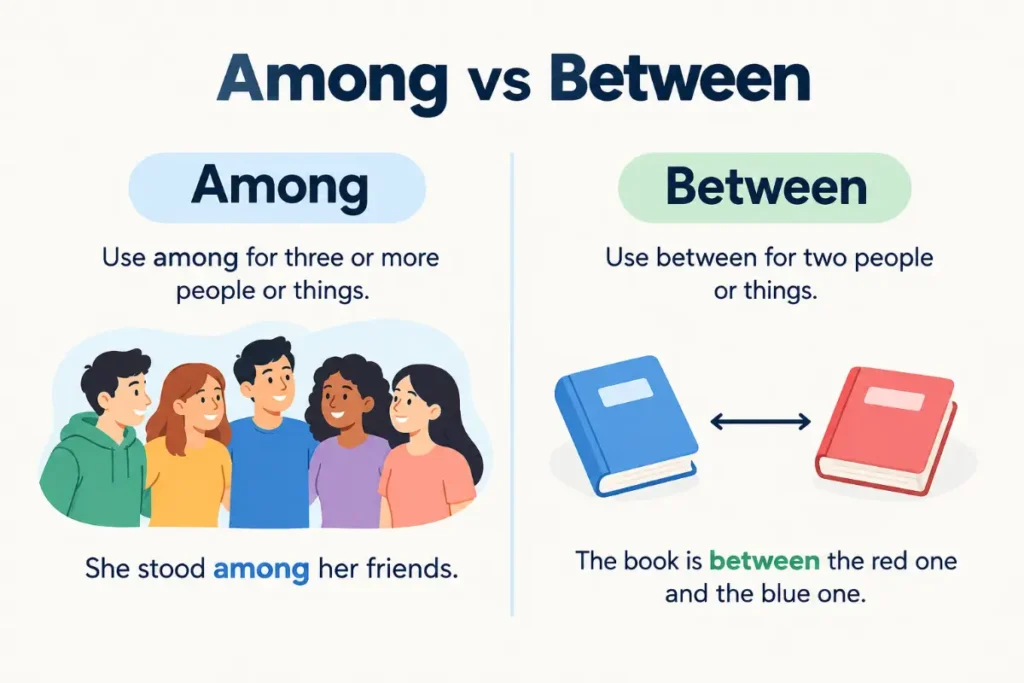
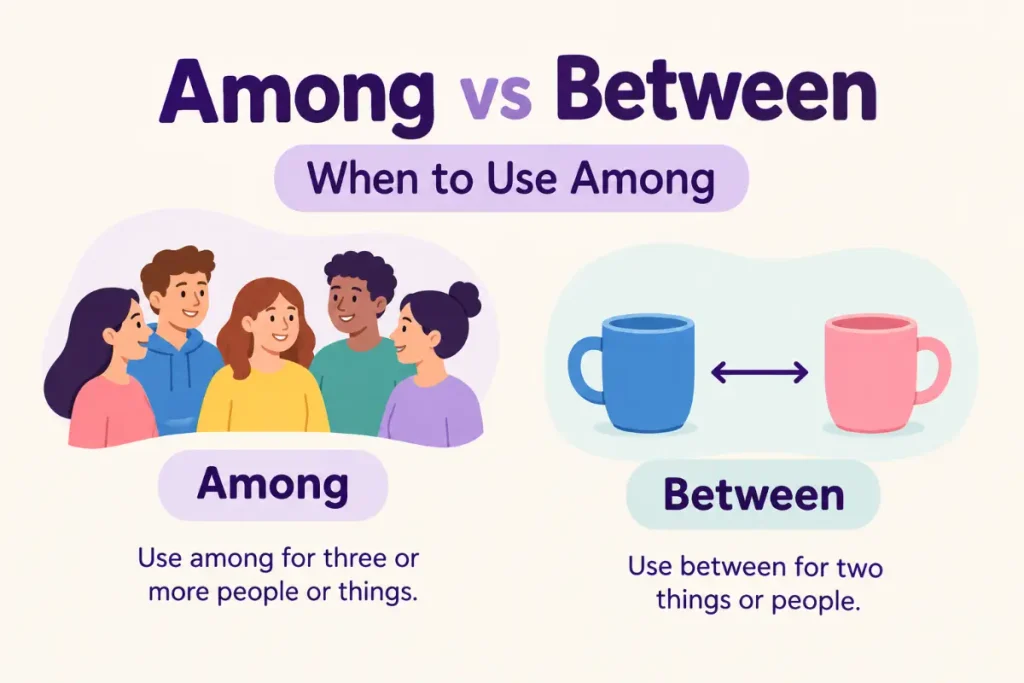
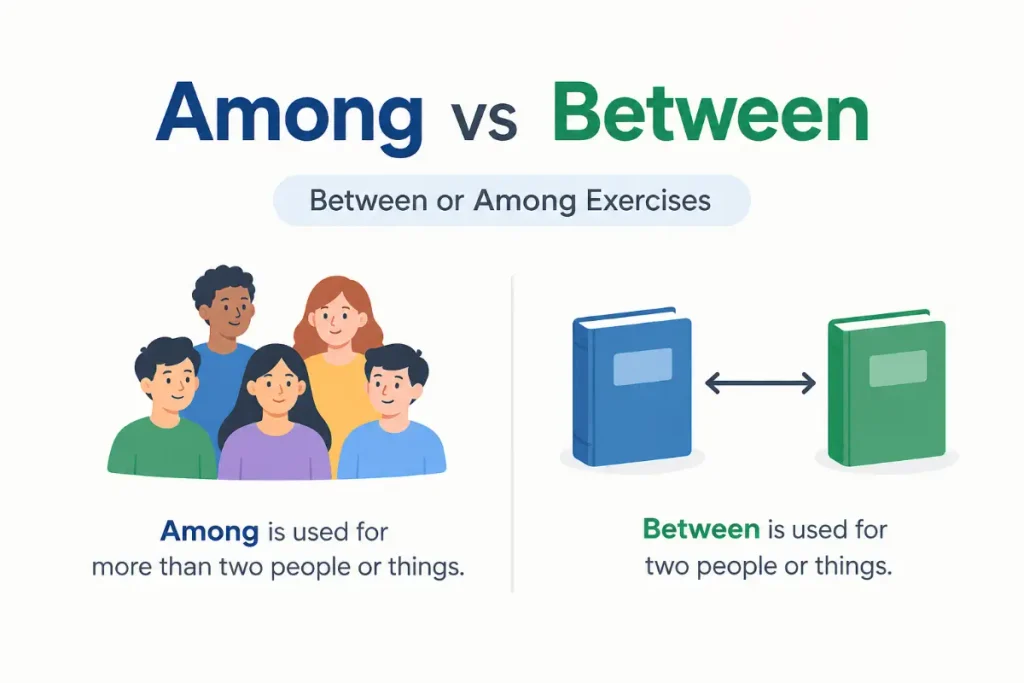
Choosing between among vs between can seem simple at first. The traditional rule says to use between for two people or things and among for three or more. That rule is useful as a starting point, but it is not the full story. In standard English, between can refer to more than two people or things when they are treated as distinct, separate participants. Among usually presents people or things as a group, collection, crowd, or surrounding environment.
That distinction explains why both between the three candidates and among the candidates can be correct in different contexts. The number of people or things matters, but the relationship between them matters more.
This guide explains the practical difference, shows how each preposition works in everyday and professional writing, and gives you examples you can use as a quick reference. You will also see why between works with more than two named people, how among expresses membership in a group, and how phrases such as among others and between you and me work.
Quick Answer
Between usually refers to separate, clearly identified people or things, even when there are more than two. Among usually refers to people or things considered collectively as a group. Use between for distinct relationships, choices, connections, and boundaries. Use among for membership, surroundings, or an undefined group.
The Main Difference Between Among and Between
The easiest way to understand the distinction is to focus on how the people or things are being viewed.
Between emphasizes separation or individual relationships. Imagine several points connected by lines. Each person or thing remains identifiable, and the sentence focuses on the connections, differences, choices, or boundaries involving them.
Among emphasizes a group or shared environment. Imagine one person standing inside a crowd. The individual members are less important than the group as a whole.
Cambridge describes between as referring to clearly separated things and among as referring to things that are part of a group, crowd, or mass. It also specifically notes that between can be used with more than two people or things.
Compare these sentences:
- The agreement was between the three companies.
- She felt comfortable among the employees.
The first sentence treats the three companies as distinct participants in an agreement. The second treats the employees as a group.
This is why the old rule that between always means two and among always means three or more is too restrictive.
A Simple Memory Trick
Think of between as focusing on separate points.
Think of among as focusing on the group.
For example:
- The negotiations were between the three departments.
- She found herself among three departments competing for funding.
In the first sentence, the departments have distinct relationships with one another. In the second, the speaker places someone within a larger group.
Confusing similar-looking words like lightning and lightening is common, especially when spelling and pronunciation make their meanings easy to mix up.
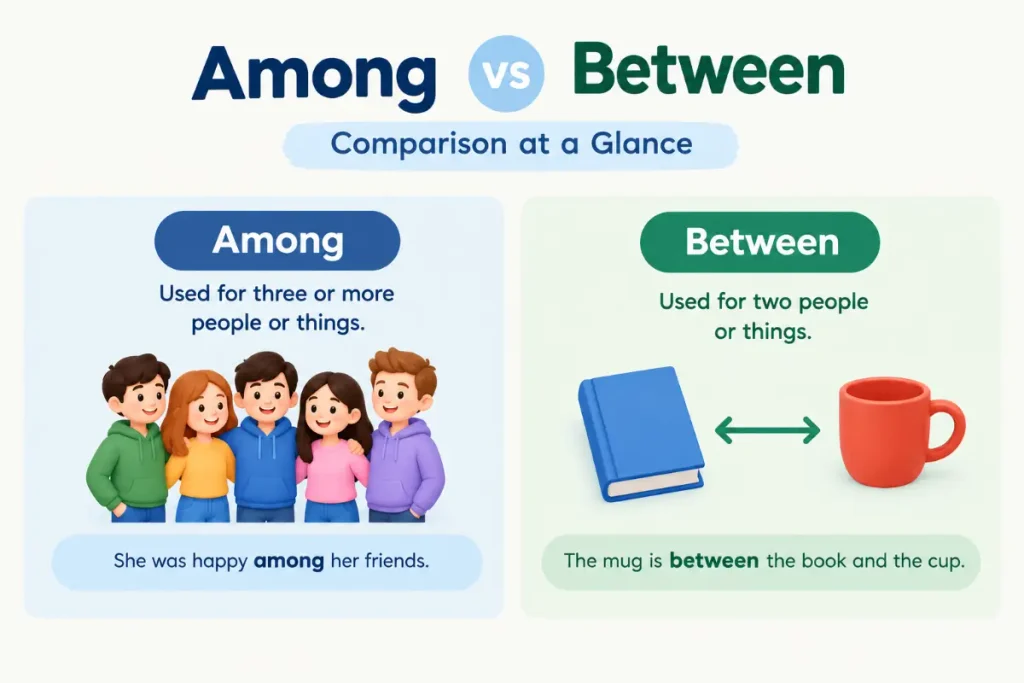
Comparison at a Glance
| Feature | Between | Among |
|---|---|---|
| Basic idea | Separation or distinct relationships | Membership in or presence within a group |
| Typical use | Two or more distinct people or things | A group, crowd, collection, or mass |
| Can refer to more than two? | Yes | Yes |
| Focus | Individual participants or boundaries | Collective group |
| Common contexts | Choices, relationships, differences, connections, time, space | Groups, crowds, surroundings, inclusion |
| Example | The decision was made between the three partners. | She was popular among her coworkers. |
| Common phrase | between you and me | among friends |
| Formality | Neutral and widely used | Neutral and widely used |
The important point is that the number alone does not determine the choice. Modern English allows between with more than two distinct entities. The Chicago Manual of Style also recognizes that the old two versus three rule does not settle every usage question.
What Does Between Mean?
Between is a preposition that commonly expresses a relationship involving separate people, things, places, times, amounts, or choices.
It can describe physical position:
- The pharmacy is between the bank and the grocery store.
- The child stood between his parents.
It can describe relationships:
- There is strong communication between the two teams.
- The agreement between the companies was finalized yesterday.
It can describe differences:
- What is the difference between these two models?
- Researchers found important differences between the three groups.
It can describe choices:
- She had to choose between the two offers.
- He could not decide between the three colleges.
It can also describe time and numerical ranges:
- The meeting is between 2 and 3 p.m.
- The temperature stayed between 60 and 70 degrees.
Cambridge specifically identifies uses involving space, time, amounts, choices, connections, relationships, and separation.
Between Does Not Always Mean Two
This is the most important correction to the traditional grammar rule.
You can correctly write:
- The money was divided between the three children.
- The negotiations between the four companies continued.
- She had to choose between three job offers.
- The differences between the five versions were minor.
- The agreement between the six partners was signed Friday.
These examples work because the participants are being treated as distinct entities.
Cambridge gives similar guidance, including examples in which between refers to several people or things sharing something or having relationships with one another.
What Does Among Mean?
Among is a preposition that generally places someone or something within a group or collection.
It can mean in the middle of, surrounded by, included with, or as part of a group.
For example:
- She was sitting among her friends.
- We found the missing document among the old files.
- He felt comfortable among experienced writers.
- There was excitement among the crowd.
- The restaurant is popular among college students.
The focus is not normally on individual relationships between every member. Instead, the sentence presents the group as a collective setting.
Cambridge explains that among commonly suggests being part of, surrounded by, or included in something and is typically followed by a plural noun phrase.
Among Can Refer to Only Two People
The idea that among must involve three or more people is also too rigid.
Consider:
- She felt safe among friends.
The word friends refers to a group concept. The sentence does not identify or separate individual friends. It simply describes the social environment.
The important factor is the collective meaning, not a mathematical count.
Why Between Can Be Used With Three or More
This is where many grammar explanations become confusing.
Suppose three companies are negotiating with one another:
- The agreement between Apple, Microsoft, and Google covered data sharing.
Here, each company is a distinct participant. The sentence treats the companies as individually identifiable parties.
Now consider:
- The new policy caused concern among technology companies.
Here, technology companies represents a broad group. The sentence focuses on the collective reaction.
Both sentences involve more than two companies, but the perspective changes.
The same principle works with people:
- The discussion between Sarah, James, and Maria lasted two hours.
- There was confusion among the students.
In the first sentence, the participants are named individually. In the second, the students are treated collectively.
The Chicago Manual of Style addresses this exact kind of issue and notes that some cases cannot be resolved simply by counting the participants.
When to Use Between
Use between when you are emphasizing distinct people, things, positions, endpoints, or relationships.
Choices
Use between when someone is choosing among clearly identified alternatives.
- I had to choose between the blue dress and the black dress.
- She was deciding between Harvard, Yale, and Princeton.
- We are choosing between three software plans.
Notice that three options do not require among. Each option is presented as a separate choice.
Relationships
Use between for relationships involving identifiable parties.
- There is trust between the two partners.
- The relationship between the departments has improved.
- Communication between the four offices has been inconsistent.
Differences
Difference between is one of the most common constructions in English.
- What is the difference between these words?
- We noticed several differences between the two reports.
- The study examined differences between the four age groups.
Connections
Use between for links or connections.
- There is a connection between sleep and concentration.
- Researchers found a relationship between diet and exercise.
- The link between the two systems needs further testing.
Cambridge lists connection, difference, distinction, link, and relationship among nouns commonly followed by between.
Time and Numbers
Use between for endpoints in a range.
- The store is open between 9 a.m. and 8 p.m.
- The package should arrive between Tuesday and Thursday.
- The project will cost between $5,000 and $7,000.
- The temperature remained between 65 and 70 degrees.
This is a particularly clear case because between identifies the two endpoints of the range. Among does not normally perform this function.
Just as whether and weather can cause confusion because they sound alike, among and between are often mixed up even though they serve different grammatical purposes.
When to Use Among
Use among when the sentence emphasizes a group, crowd, collection, or surrounding environment.
Being Part of a Group
- She was well known among local artists.
- He felt at home among his coworkers.
- The author is respected among academics.
- The new policy is unpopular among employees.
The people are treated as a collective group rather than as individually identified participants.
Being Surrounded by Something
- We found the cabin among the trees.
- The letter was hidden among the papers.
- A small cottage stood among the hills.
- The child disappeared among the crowd.
Here, among gives the reader the sense of something being surrounded by or situated within a collection.
Being Included in a Group
- She was among the finalists.
- Several well known authors were among the guests.
- His name was among those listed for the award.
- The painting was among the most valuable pieces.
The person or thing belongs to the larger group being discussed.
Between and Among Examples
Seeing the two words side by side makes the distinction easier to recognize.
Examples With Between
- The restaurant is between the hotel and the theater.
- We need to decide between the two proposals.
- The money was divided between the three siblings.
- There is a clear difference between these approaches.
- The negotiations between the five companies lasted for weeks.
- The meeting is scheduled between 10 and 11 a.m.
- The relationship between the departments has improved.
- She had to choose between three colleges.
- The bridge connects the towns between the river and the highway.
- The disagreement between the committee members delayed the decision.
Each example focuses on identifiable points, participants, choices, boundaries, or relationships.
Examples With Among
- She felt relaxed among her friends.
- The lost key was found among the cushions.
- He was popular among his classmates.
- A sense of excitement spread among the crowd.
- The house was hidden among the trees.
- The award was shared widely among the team members.
- She was among the first students to arrive.
- The rumor quickly spread among employees.
- His name appeared among the finalists.
- The puppy happily ran among the children.
Each example focuses on inclusion, surroundings, or a collective group.
Common Mistakes
Mistake 1: Using the Two Versus Three Rule Too Strictly
A common claim is:
- Use between for two and among for three or more.
That is an oversimplification.
Better examples are:
- Correct: The negotiations were between the three companies.
- Correct: She chose between three universities.
- Correct: The money was divided between the four children.
The participants are individually identifiable, so between is appropriate.
Mistake 2: Assuming Among Is Always Better for Groups
The presence of several people does not automatically require among.
Compare:
- The conflict between the three departments was resolved.
- The conflict among employees created uncertainty.
The first sentence identifies distinct departments. The second describes employees collectively.
Mistake 3: Using Among for Time Ranges
Do not write:
- The store is open among 9 and 5.
Use:
- The store is open between 9 and 5.
Between is the natural choice for a range with two endpoints.
Mistake 4: Treating Between and Among as Completely Interchangeable
Some sentences can accept either word with little practical difference, especially when several distinct participants are involved. However, changing the preposition can shift the focus from individual relationships to the group as a whole.
For professional writing, choose the word that matches the intended relationship instead of treating the two prepositions as interchangeable.
Between and Among in Professional Writing
Both words are completely standard in professional and academic English. The important issue is precision.
Use between when writing about:
- Agreements between named organizations.
- Differences between specific models.
- Relationships between departments.
- Comparisons between identifiable options.
- Negotiations between named parties.
- Connections between specific concepts.
Use among when writing about:
- Trends among employees.
- Opinions among consumers.
- Reactions among voters.
- Changes among different industries.
- Participation among students.
- Competition among businesses.
For example:
Professional:
The agreement between the three companies established new reporting requirements.
Professional:
The policy created concern among employees.
Neither word is more formal than the other. The choice depends on the meaning you want to express.
Between vs Among in Everyday Speech
In casual American English, native speakers often use these words naturally without consciously applying a grammar rule. That is because the distinction is usually based on meaning rather than arithmetic.
You might hear:
- There is a lot of competition between the teams.
- There is a lot of competition among local businesses.
- Keep this between you and me.
- I was standing among a bunch of strangers.
The first pair shows the difference particularly well. Teams can be viewed as distinct competitors, while local businesses can be viewed collectively.
The Chicago Manual of Style has also addressed examples such as competition between companies and notes that the distinction is not always a simple matter of right versus wrong.
Among and Amongst
Amongst is a valid variant of among, not a different grammatical concept.
For American English, among is generally the more natural everyday choice. Amongst can sound more formal, literary, or traditional.
Compare:
- She felt comfortable among her friends.
- She felt comfortable amongst her friends.
Both can be grammatical. The first is usually the simpler choice for modern American prose.
If you are writing for a general US audience, among is normally the safest and most natural form.
Useful Expressions With Between
Some common expressions naturally use between.
Between You and Me
The phrase between you and me means that information is private or confidential.
- Between you and me, I think the plan needs more work.
The pronoun me is correct after the preposition between. The phrase between you and I is not standard in careful English.
In Between
In between refers to a position or period separating two things.
- There is a small café in between the two buildings.
- I usually snack in between meals.
Between Two Things
This can describe a physical, conceptual, or temporal separation.
- The truth lies between the two extremes.
- There is a strong connection between the ideas.
Useful Expressions With Among
Among Others
Among others means as well as other people or things.
- Several researchers, among others, supported the proposal.
- The conference attracted writers, editors, and designers, among others.
Among Other Things
Among other things introduces one or more examples from a larger set.
- Among other things, we discussed the new schedule.
- The job requires, among other things, strong writing skills.
Cambridge specifically identifies these expressions as established uses of among.
Among Friends
This means within a group of friends or in the company of friends.
- She felt comfortable among friends.
It does not require the reader to identify individual friends. The group itself is the focus.
Pronunciation
Both words are common enough that pronunciation rarely causes confusion, but it is useful to know the standard American forms.
Between
- IPA: /bɪˈtwiːn/
- Sounds like: bih TWEEN
Among
- IPA: /əˈmʌŋ/
- Sounds like: uh MUNG
The stress falls on the second syllable in both words. Cambridge gives these pronunciations for its American English entries.
A Better Way to Choose the Right Word
Instead of counting the people or things, ask one question:
Am I talking about distinct participants or about a group?
If the answer is distinct participants, choose between.
- The agreement was between the three organizations.
- She had to choose between four candidates.
- The differences between the five versions were minor.
If the answer is a group or surrounding environment, choose among.
- She was popular among the employees.
- The house was hidden among the trees.
- The rumor spread among the students.
A second useful question is:
Can I clearly identify each participant in the relationship?
If yes, between is often the natural choice.
If the sentence treats them as one collective group, among is often better.
This approach is more reliable than memorizing a simple two versus three rule.
Another easily confused word pair, breach and breech, shows why paying attention to meaning and context matters when choosing the correct word.
Between or Among Exercises
Choose the word that best completes each sentence.
- The store is located ___ the bank and the post office.
- She was sitting ___ her classmates.
- The decision was made ___ the four partners.
- The announcement caused concern ___ employees.
- The temperature stayed ___ 60 and 70 degrees.
- We found the document ___ hundreds of old files.
- There is a strong connection ___ sleep and memory.
- The new product became popular ___ teenagers.
- The negotiations ___ the three companies continued.
- He felt comfortable ___ friends.
Answers
- between
- among
- between
- among
- between
- among
- between
- among
- between
- among
The answers become easier once you focus on the relationship rather than the number of people or things involved.
Frequently Asked Questions
Which is correct, among or between?
Both are correct, but they serve different purposes. Between usually focuses on separate, identifiable people or things and their relationships, choices, differences, or boundaries. Among usually focuses on a group, crowd, collection, or surrounding environment. The number of participants alone does not determine the choice.
Can between be used for more than two people?
Yes. Between can correctly refer to three or more people or things when they are considered as distinct participants. For example, The agreement between the three companies was finalized is standard English. The older rule that limits between to exactly two entities is an oversimplification.
Can among be used for two people?
Yes, in contexts where the people are treated as a group or collective setting. For example, She felt comfortable among friends is natural. The word friends describes a group rather than two separately identified individuals.
Should I use between or among for three choices?
Between is often appropriate when the three choices are separately identified. For example, He had to choose between accounting, finance, and economics is standard. Use among when the alternatives are viewed collectively, as in She searched among several career options.
Is between or among used for time?
Use between for a time range with two endpoints. Examples include between 8 and 10 a.m., between Monday and Friday, and between breakfast and lunch. Among is not normally used to connect the endpoints of a time range.
Is among more formal than between?
No. Both are standard prepositions used in everyday, professional, academic, and formal English. The choice depends on meaning rather than formality. Among may sometimes appear in more literary expressions, but it is not inherently more formal than between.
Is amongst correct English?
Yes. Amongst is a legitimate variant of among. It is more common in some varieties and styles of English and can sound somewhat formal or literary. For most US writing, among is the simpler and more natural choice.
How can I remember the difference?
Think of between as focusing on separate points and among as focusing on a group. Use between for distinct relationships, choices, differences, connections, and ranges. Use among for being inside, surrounded by, included in, or associated with a group.
Final Takeaway
The best way to understand among vs between is to stop treating the choice as a simple counting exercise. Between can refer to two or more distinct people or things when the sentence focuses on their individual relationships, choices, differences, connections, or boundaries. Among usually presents people or things as a collective group, surrounding environment, or larger set.
For everyday writing, remember this practical test: if you can picture separate participants connected by relationships, between will often fit. If you can picture someone or something inside a group or surrounded by a collection, among will often fit. Once you focus on that distinction, examples such as between the three companies and among the employees become much easier to understand.