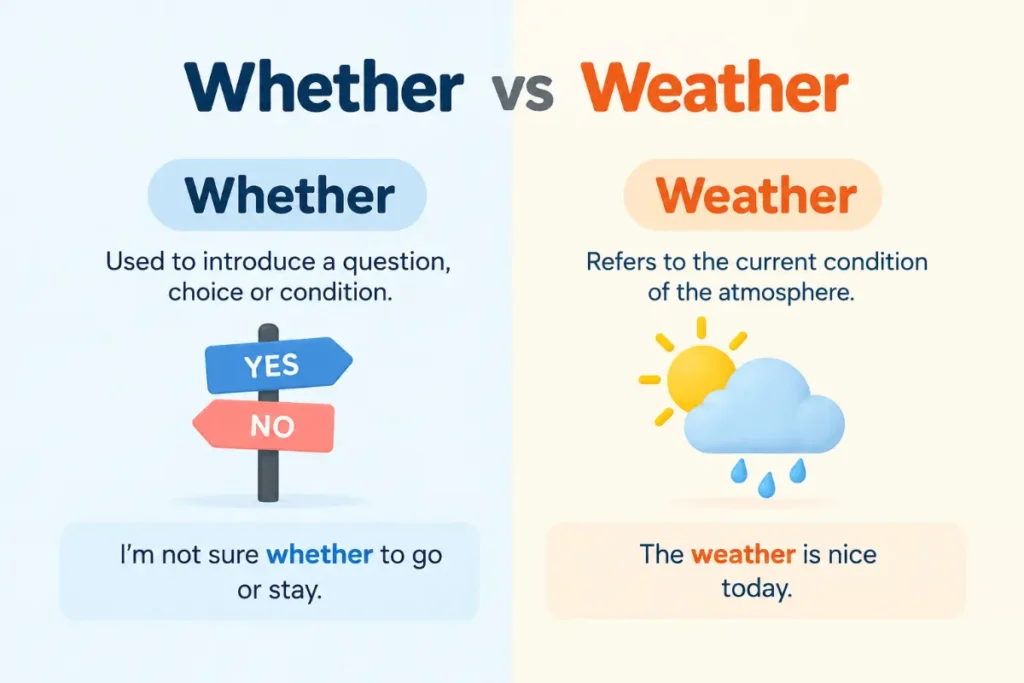
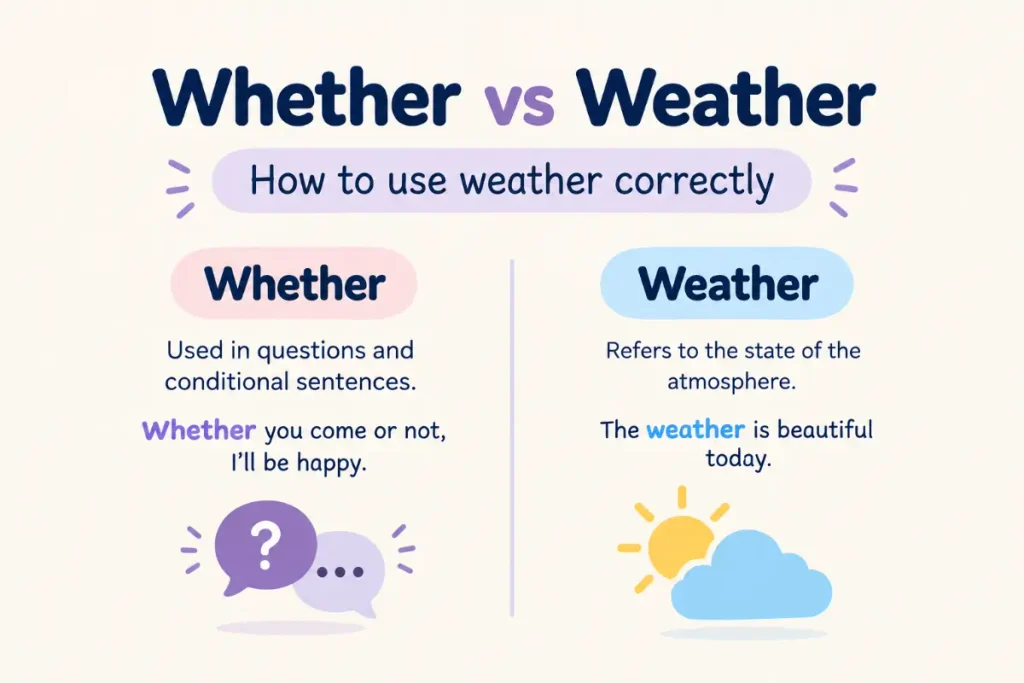
If you are confused by whether vs weather, you are dealing with two words that sound almost exactly the same but have completely different meanings. Whether is used when talking about possibilities, alternatives, or uncertainty. Weather refers to conditions in the atmosphere, such as rain, snow, wind, heat, and sunshine.
The confusion usually comes from pronunciation. In most American English speech, the two words are pronounced the same or very similarly, making them homophones for many speakers. Their spelling and grammatical roles, however, are completely different. You would write whether the meeting is canceled, but weather the storm has a different meaning because weather can also function as a verb.
This guide explains the difference in plain English, shows how each word works in real sentences, covers common mistakes, and explains useful expressions such as whether or not and weather the storm. By the end, choosing the right spelling should feel much more straightforward.
Quick Answer
Whether is used to introduce a choice, possibility, or uncertainty, as in “I do not know whether she will come.” Weather refers to atmospheric conditions, as in “The weather is rainy today.” They sound alike in many varieties of English but have completely different meanings and grammatical functions.
Whether vs weather at a glance
| Feature | Whether | Weather |
|---|---|---|
| Part of speech | Conjunction, sometimes noun in formal or specialized usage | Noun and verb |
| Main meaning | Introduces alternatives, possibilities, or uncertainty | Atmospheric conditions or enduring difficult conditions |
| Common context | Choices, uncertainty, indirect questions | Rain, snow, temperature, storms, climate conditions |
| Example | “I am unsure whether he will attend.” | “The weather is cold today.” |
| Related expression | whether or not | weather forecast, weather report, weather the storm |
| Common confusion | Mistaken for weather because they sound alike | Mistaken for whether in writing |
| US usage | Standard American English | Standard American English |
The easiest distinction is semantic. Whether is connected with a choice or possibility. Weather is connected with conditions outside, especially atmospheric conditions.
If you often mix up similar-looking English words, learning the difference between envelop and envelope can help you avoid another common spelling and usage mistake.
What does whether mean?
Whether is primarily a conjunction used to introduce two or more possibilities. It often appears when someone is uncertain about an outcome or needs to consider alternatives.
Consider this sentence:
I do not know whether Alex will attend.
The sentence expresses uncertainty about Alex’s attendance. The implied possibilities are that Alex will attend or Alex will not attend.
You can also use the word when presenting alternatives directly:
We need to decide whether to stay or leave.
Here, the alternatives are staying and leaving.
The word commonly appears after verbs and expressions related to knowledge, uncertainty, decisions, questions, and consideration. Common combinations include:
- know whether
- decide whether
- determine whether
- ask whether
- wonder whether
- consider whether
- see whether
- find out whether
- check whether
- unsure whether
For example, a manager might write:
Please check whether the payment has been processed.
The writer is asking someone to determine if the payment has been processed.
Whether in indirect questions
One of the most common grammatical uses appears in indirect questions.
A direct question might be:
Is the store open?
An indirect version can be:
I do not know whether the store is open.
The question becomes part of a larger sentence, so the normal word order changes. You do not write:
I do not know whether is the store open.
The correct structure is:
I do not know whether the store is open.
This pattern is especially important in formal and professional writing.
Whether for alternatives
The word can introduce an explicit choice:
We need to decide whether to drive or take the train.
It can also introduce alternatives involving two clauses:
I cannot decide whether I should call now or wait until tomorrow.
The choice does not always have to be expressed with or. The alternative can be understood from context:
She is deciding whether to apply for the position.
The implied possibilities are applying and not applying.
What does weather mean?
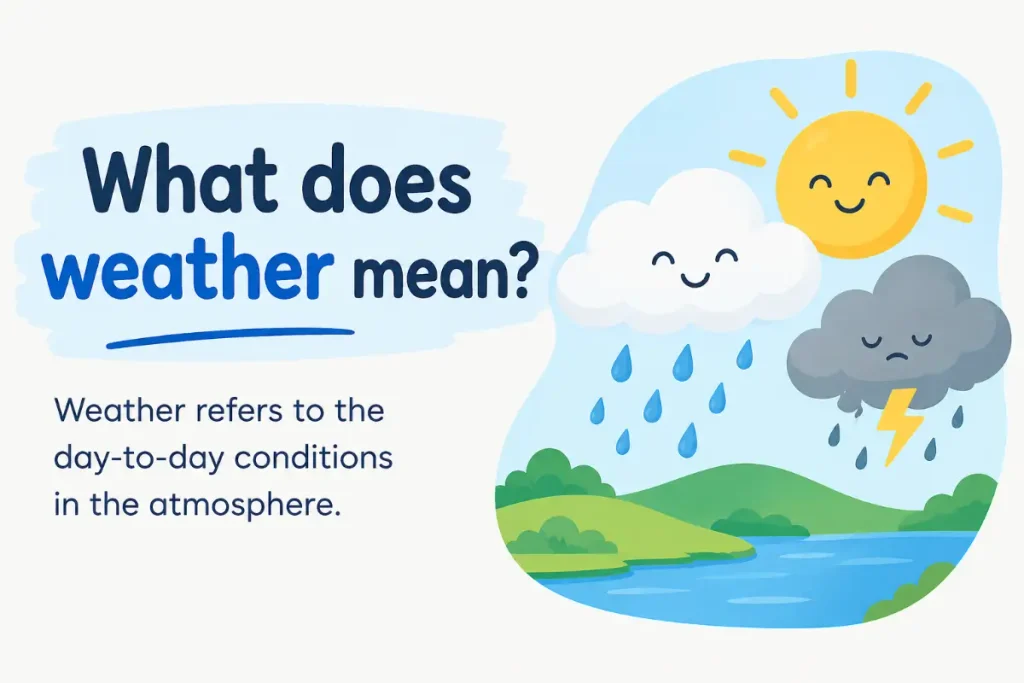
Weather is primarily a noun referring to atmospheric conditions at a particular time and place. These conditions can include temperature, precipitation, wind, humidity, cloud cover, and storms.
For example:
- The weather is beautiful today.
- The weather forecast predicts heavy rain tonight.
- Cold weather can make driving more difficult.
In everyday American English, this is the meaning people usually have in mind when they talk about the weather.
The word can describe short term conditions:
The weather changed suddenly this afternoon.
It can also describe general conditions over a period:
We had warm weather throughout the weekend.
Weather as a verb
Less commonly, weather can function as a verb. In this use, it means to endure, survive, or withstand something difficult.
For example:
The company managed to weather the economic downturn.
Here, the word has nothing to do with rain or sunshine. It means the company survived a difficult period.
You may also encounter:
- The team weathered several challenges during the season.
- The building has weathered decades of harsh conditions.
This verbal use creates another useful connection: something can weather a storm literally or figuratively.
The core difference between the two words
The simplest way to remember the distinction is to ask what the sentence is talking about.
If the sentence involves a choice, possibility, uncertainty, or alternative, use whether.
If it involves rain, temperature, wind, storms, sunshine, or atmospheric conditions, use weather.
Compare these sentences:
- I do not know whether it will rain.
- The weather looks rainy today.
The first sentence is about uncertainty. The second is about atmospheric conditions.
You can even use both words in the same sentence:
I am not sure whether the weather will improve tomorrow.
This sentence contains both concepts. Whether introduces uncertainty, while weather refers to atmospheric conditions.
Another example:
We need to decide whether the weather is safe enough for the flight.
Again, each word performs a different grammatical job.
This is why replacing one with the other does not simply create a minor spelling mistake. It can change the meaning of the sentence completely.
How to use whether correctly
There are several common patterns worth learning because they appear frequently in everyday and professional writing.
Whether with or
The structure whether … or … explicitly presents alternatives.
Examples:
- I cannot decide whether to stay or leave.
- Let me know whether you want coffee or tea.
- We need to determine whether the report is accurate or incomplete.
- She asked whether we wanted to eat at home or go out.
The alternatives can involve actions, choices, descriptions, or entire clauses.
Whether without or
You do not always need or after whether.
For example:
I do not know whether he is coming.
The sentence still presents an implied alternative: he is coming or he is not coming.
Other examples include:
- Please confirm whether the appointment is still scheduled.
- I am wondering whether this approach will work.
- We need to see whether the problem has been fixed.
- She asked whether I had received the email.
This construction is extremely common in professional communication.
Whether to plus a verb
Another common structure is whether to + verb.
Examples:
- I am trying to decide whether to accept the offer.
- He has not decided whether to move.
- We need to determine whether to continue.
The pattern works well when someone is considering an action.
Whether or not
Whether or not means that the outcome does not depend on the condition being considered.
Examples:
- I will attend whether or not it rains.
- We need to finish the project whether or not everyone agrees.
- She plans to apply whether or not the position is advertised again.
The phrase is standard English and is common in both conversation and writing.
Sometimes or not is unnecessary because the meaning is already clear:
I will attend whether it rains.
This construction can sound more formal or literary in some contexts. In ordinary American English, whether or not it rains is often the more natural phrasing when the writer wants to emphasize that both possibilities lead to the same result.
How to use weather correctly
The noun weather is generally uncountable when referring to atmospheric conditions.
You normally say:
The weather is terrible.
Not:
The weathers are terrible.
You can describe different kinds of weather:
- We experienced severe weather last night.
- Warm weather is expected this weekend.
- The weather has been unpredictable lately.
Common expressions include:
- bad weather
- good weather
- cold weather
- hot weather
- severe weather
- stormy weather
- wet weather
- dry weather
- winter weather
- summer weather
- weather forecast
- weather report
- weather conditions
- weather warning
The word also appears in many compound expressions related to atmospheric conditions.
Weather as a verb
When weather functions as a verb, the meaning changes from atmospheric conditions to enduring or surviving something.
Examples:
- The small business weathered the recession.
- The house has weathered several major storms.
- She weathered a difficult period at work.
The figurative meaning is especially common in expressions involving challenges, pressure, crises, and difficult periods.
Examples of whether in sentences
These examples show different uses of the word in everyday, workplace, academic, and conversational contexts.
- I am not sure whether Mark will join us tonight.
The word introduces uncertainty about someone’s attendance. - Please let me know whether you need additional information.
This is a natural professional email construction. - We need to decide whether to leave now or wait.
The word introduces two possible actions. - She asked whether I had finished the assignment.
This is an indirect question. - I wonder whether the store is still open.
The sentence expresses uncertainty. - The manager will determine whether the request meets the requirements.
This is common in formal workplace writing. - He could not decide whether the blue shirt or the gray one looked better.
The alternatives are explicitly stated. - Check whether the file was saved before closing the program.
This gives a practical instruction. - They are discussing whether to expand the business.
The decision involves a possible future action. - I will go whether or not you come with me.
The result remains the same regardless of the alternative.
Examples of weather in sentences
These examples demonstrate the noun and verb uses.
- The weather is unusually warm for January.
Here, weather refers to atmospheric conditions. - We canceled the picnic because of the bad weather.
The word describes conditions that affected a plan. - The weather forecast says it will snow tonight.
This is a common everyday use. - Heavy weather caused several flights to be delayed.
Atmospheric conditions affect transportation. - I always check the weather before going hiking.
This is a natural everyday expression. - The weather changed quickly during the afternoon.
The word describes changing atmospheric conditions. - The building was designed to withstand severe weather.
Here, the phrase refers to potentially dangerous atmospheric conditions. - The company managed to weather the financial crisis.
Weather is a verb meaning to survive or endure. - The old fence has weathered many harsh winters.
The verb describes surviving exposure to difficult conditions. - The team weathered a difficult stretch of games.
The meaning is figurative and refers to enduring a challenging period.
Just as “whether” and “weather” have completely different meanings, understanding who implies and who infers can make it easier to distinguish between words that sound or seem closely related.
Whether and weather in the same sentence
Seeing the two words together can make their difference especially clear.
- I do not know whether the weather will improve.
- We need to decide whether the weather is good enough for the event.
- She asked whether the weather forecast had changed.
- I will go whether or not the weather is perfect.
In each example, whether introduces a possibility or choice, while weather refers to atmospheric conditions.
This is one of the most useful ways to understand the distinction. Instead of memorizing two isolated definitions, look at what each word contributes to the sentence.
Common mistakes with these homophones
Because the words sound alike, spelling mistakes are common, especially in quick emails, texts, school assignments, and informal online writing.
Mistake 1: Using weather for uncertainty
Incorrect:
I do not know weather she is coming.
Correct:
I do not know whether she is coming.
The sentence is about uncertainty, not atmospheric conditions.
Mistake 2: Using whether for atmospheric conditions
Incorrect:
The whether is beautiful today.
Correct:
The weather is beautiful today.
The sentence describes outdoor conditions, so weather is required.
Mistake 3: Confusing weather with the phrase weather the storm
Incorrect:
The company hopes to whether the storm.
Correct:
The company hopes to weather the storm.
Here, weather is a verb meaning to endure or survive.
Mistake 4: Choosing based only on sound
When speaking, the distinction may not be obvious because the words are homophones for many speakers. In writing, however, context tells you which spelling is required.
A useful habit is to identify the meaning before choosing the spelling.
Ask:
Am I talking about a choice or possibility?
Use whether.
Ask:
Am I talking about atmospheric conditions or enduring a difficulty?
Use weather.
Pronunciation and homophones
In most American English speech, whether and weather are pronounced the same or nearly the same.
A common pronunciation is approximately:
- whether: /ˈwɛðər/
- weather: /ˈwɛðər/
Both contain the voiced th sound found in words such as this and that.
The important point for writers is that pronunciation cannot reliably tell you which spelling to use. You need to understand the meaning and grammatical function.
This is why the pair causes more trouble in writing than in speech. When someone says the word aloud, the listener normally relies on context. When you type the word, the spelling itself has to communicate the intended meaning.
Whether and if
Another useful comparison is whether vs. if. In some sentences, the two can be interchangeable, especially when introducing an indirect question.
For example:
- I do not know whether she is coming.
- I do not know if she is coming.
Both are common in American English.
There are situations where whether is preferable or required, especially when presenting alternatives:
I cannot decide whether to stay or leave.
The construction if to stay or leave is not standard English.
Whether is also useful when the meaning involves two explicit possibilities:
The question is whether we should continue.
The choice between whether and if can involve grammatical and stylistic considerations, but it is separate from the distinction between whether and weather.
Whether and rather
The word rather is sometimes confused with whether because both can appear in sentences involving choices, but they perform different functions.
Whether introduces an alternative or possibility:
I do not know whether he will accept the offer.
Rather can indicate preference, degree, or correction:
I would rather stay home tonight.
You can combine them:
I would rather wait and see whether the price changes.
Here, rather expresses preference, while whether introduces the possibility being considered.
How to remember the difference
A simple memory trick can help.
Think of weather as the word connected to the outside world.
Rain, snow, sunshine, wind, heat, and storms are all types of weather.
Think of whether as the word connected to choices and possibilities.
You might be deciding whether to stay, wondering whether someone will arrive, or checking whether something is true.
Another useful test is substitution.
If you can replace the word with if, you probably need whether:
- I do not know whether he is coming.
- I do not know if he is coming.
If you can replace the word with rain, sunshine, temperature, or atmospheric conditions, you need weather:
- The weather is terrible.
- The atmospheric conditions are terrible.
This substitution test does not work in every grammatical situation, but it is a quick and practical check for common sentences.
Formal and casual usage
Both words are standard in American English and work in formal, neutral, and casual contexts. The difference is not one of formality. It is a difference in meaning and grammatical function.
Whether is especially common in professional and academic writing because writers frequently need to discuss uncertainty, alternatives, conditions, and decisions.
For example:
The committee will determine whether the proposal meets the requirements.
A casual version might be:
I am not sure whether he is coming.
Weather is equally normal in everyday and professional communication:
Please check the weather before scheduling the outdoor event.
In technical and professional contexts, you may also see expressions such as weather conditions, severe weather, and weather related delays.
The key is not to choose between the words based on tone. Choose based on meaning.
Which word should you use?
Use this quick decision guide:
| If you mean… | Use… | Example |
|---|---|---|
| A possibility | whether | “I do not know whether she will come.” |
| A choice | whether | “Decide whether to stay.” |
| An indirect question | whether | “Ask whether the store is open.” |
| Two alternatives | whether | “Choose whether to call or email.” |
| Rain or sunshine | weather | “The weather is rainy.” |
| Temperature conditions | weather | “The weather is getting colder.” |
| A storm | weather | “The weather is dangerous.” |
| A forecast | weather | “Check the weather forecast.” |
| Survive a difficulty | weather | “They weathered the crisis.” |
| Endure a storm | weather | “The ship weathered the storm.” |
If you remember only one thing, remember this: whether deals with possibilities, while weather deals with atmospheric conditions and, as a verb, endurance.
Weather-related vocabulary has its own share of confusing pairs, including two easily confused weather terms, “lightning” and “lightening,” which differ in both meaning and usage.
Frequently Asked Questions
Which is correct, whether or weather?
Both are correct words, but they are used in different situations. Whether introduces a choice, possibility, or uncertainty, while weather normally refers to atmospheric conditions such as rain, wind, and temperature. Weather can also be a verb meaning to survive or endure something difficult.
Are whether and weather homophones?
Yes. In most American English speech, they are pronounced the same or nearly the same, which makes them homophones for many speakers. Their meanings and spellings are different, however. Context determines which word belongs in a sentence, so listening alone may not reveal the intended spelling.
What is the easiest way to remember the difference?
Connect weather with things happening outside, such as rain, snow, wind, heat, and storms. Connect whether with choices and possibilities. If you can replace the word with if in a sentence such as “I do not know whether he is coming,” you likely need whether.
Is whether or not grammatically correct?
Yes. Whether or not is a standard construction used to emphasize that something will happen regardless of two possible outcomes. For example, “We will continue whether or not the weather improves.” In some sentences, or not can be omitted without changing the essential meaning.
Can weather be a verb?
Yes. As a verb, weather means to endure, survive, or withstand something. For example, “The company weathered the financial crisis.” The expression weather the storm can describe surviving a literal storm or enduring a difficult period figuratively.
Can I use if instead of whether?
Sometimes. In sentences such as “I do not know whether she is coming,” if can also be used in ordinary American English: “I do not know if she is coming.” However, whether is necessary in some structures, especially when clearly presenting alternatives such as “whether to stay or leave.”
Why do whether and weather sound the same?
They developed into very similar pronunciations in modern English. For many American English speakers, both are pronounced approximately /ˈwɛðər/. Their identical or near identical pronunciation explains why the words are frequently confused in writing even though their meanings are unrelated.
Is weather always about rain?
No. Weather includes many atmospheric conditions, not just rain. It can involve temperature, wind, humidity, snow, ice, clouds, storms, and sunshine. For example, “The weather is extremely hot today” uses weather correctly even though there is no precipitation.
Conclusion
The difference between whether vs weather becomes simple once you focus on meaning instead of sound. Whether introduces a possibility, choice, alternative, or uncertainty, while weather describes atmospheric conditions such as rain, wind, temperature, and storms. Weather can also work as a verb meaning to survive or endure a difficult situation.
When you are writing, ask yourself what the sentence is doing. If you are considering a possibility, use whether. If you are talking about conditions outside, use weather. If you mean surviving a difficult situation, weather is also the right choice. Remembering those three meanings will prevent most spelling and word choice mistakes.