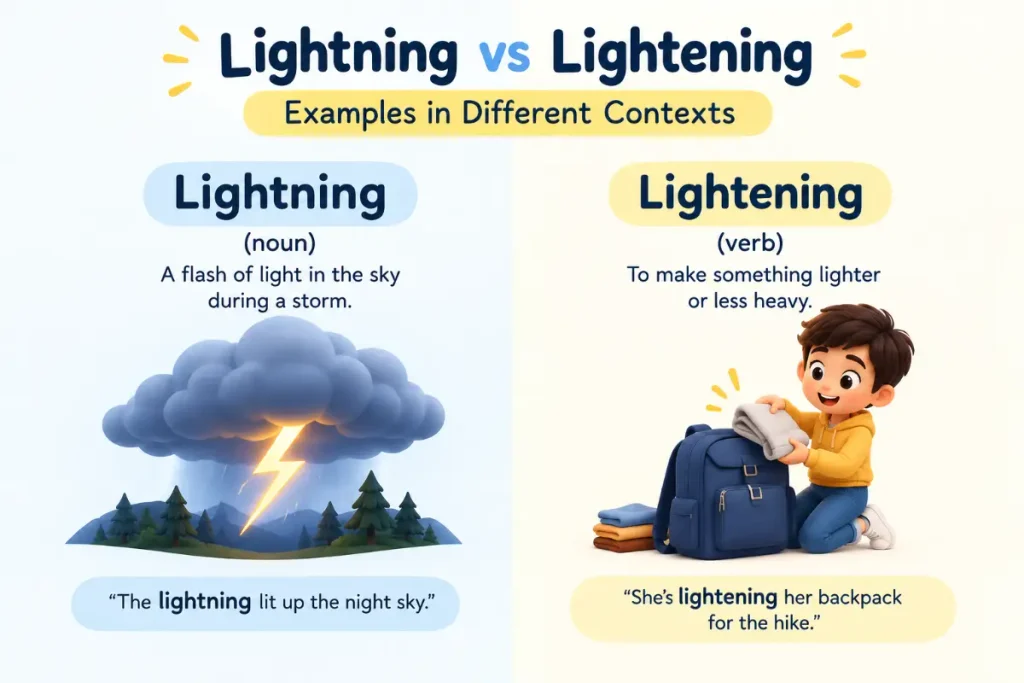
If you have ever wondered about lightning vs lightening, the difference comes down to meaning and word formation. Lightning is the bright electrical discharge you see during a storm. Lightening is the present participle of the verb lighten, meaning to make something lighter, brighter, less heavy, or less serious. The two words look and sound similar, but they are not interchangeable.
This spelling difference matters because the wrong form can change the meaning of an entire sentence. You might write about lightning striking a tree, for example, but you would use lightening when describing a load becoming less heavy or a dark room becoming brighter. The confusion is understandable because both words are pronounced similarly and share the word light in their spelling.
The easiest way to remember them is to connect each spelling with its meaning. Lightning refers to the electrical flash associated with thunderstorms. Lightening describes the process of becoming lighter or making something lighter. The sections below explain the distinction, grammar, pronunciation, examples, common mistakes, regional usage, and practical ways to choose the right word.
Quick Answer
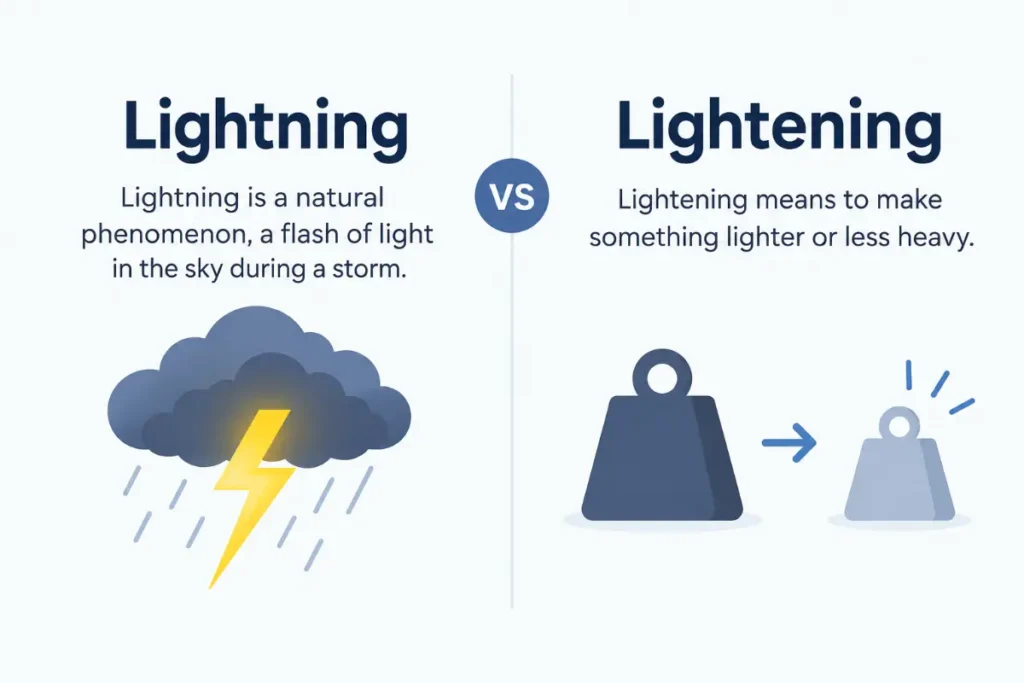
Lightning refers to the natural electrical discharge that produces a bright flash during a storm. Lightening is the form of the verb lighten, meaning to make something less heavy, less dark, brighter, or less serious. If you are talking about a thunderstorm, use lightning. If something is becoming lighter, use lightening.
Lightning vs Lightening: The Basic Difference
The two words have only one letter of difference, but they belong to different parts of the vocabulary.
Lightning is primarily a noun. It names the visible electrical discharge that occurs in the atmosphere, usually during a thunderstorm.
Lightening is the present participle and gerund form of the verb lighten. It describes an action or process involving something becoming lighter or being made lighter.
| Feature | Lightning | Lightening |
|---|---|---|
| Part of speech | Usually a noun | Verb form or gerund |
| Basic meaning | Electrical discharge during a storm | Making or becoming lighter |
| Main word | Lightning | Lighten |
| Common context | Thunderstorms and weather | Weight, color, mood, darkness, burden |
| Example | Lightning flashed across the sky. | The sky is lightening. |
| Pronunciation | Usually pronounced with three syllables | Usually pronounced with three syllables |
| American English | Standard | Standard |
| British English | Standard | Standard |
A useful distinction is that lightning names a phenomenon, while lightening describes a process.
Consider these two sentences:
- Lightning illuminated the sky.
- The sky was lightening as morning approached.
The first sentence describes an electrical flash. The second describes the sky becoming brighter.
Just as disinterested and uninterested describe different ideas despite looking similar, “lightning” and “lightening” have distinct meanings that are easy to confuse.
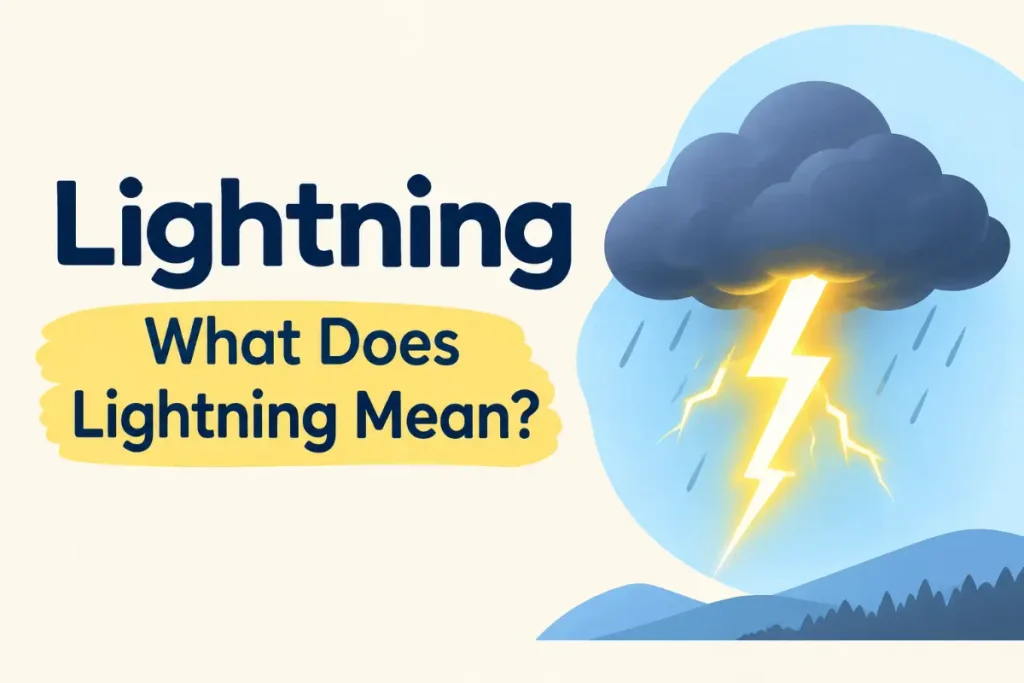
What Does Lightning Mean?
Lightning is the visible flash caused by a powerful electrical discharge in the atmosphere. It commonly occurs during thunderstorms and can happen within clouds, between clouds, or between a cloud and the ground.
The word is generally used as a noun.
For example:
- Lightning struck a nearby tree.
- We watched the lightning from the porch.
- The storm produced frequent lightning.
- A flash of lightning lit up the neighborhood.
Lightning is strongly associated with storms, thunder, rain, and electrical activity. In ordinary American English, this is the meaning most people have in mind when they see the word.
The word can also appear in figurative language. Someone might describe an athlete as moving with the speed of lightning or call a very fast response lightning quick. In these expressions, the word still draws on the idea of the speed and suddenness associated with the natural phenomenon.
The important point is simple: lightning does not mean making something lighter.
If you want to describe a dark room becoming brighter, a burden becoming easier to carry, or a serious mood becoming more relaxed, you need lightening, not lightning.
What Does Lightening Mean?
Lightening comes from the verb lighten. The verb has several related meanings, all connected to the idea of becoming or making something lighter.
It can refer to physical weight:
- The workers are lightening the load.
- Removing a few books is lightening the backpack.
It can refer to brightness or color:
- The sky is lightening in the east.
- The painter is lightening the blue paint.
It can refer to emotional or mental weight:
- Talking about the problem helped with lightening her mood.
- The joke helped lighten the tension.
It can also describe reducing the seriousness of something:
- The speaker used humor for lightening the mood.
- A short break helped lighten the atmosphere.
Notice the extra e in lightening. That spelling reflects its connection to lighten.
A useful memory trick is:
Lightening = light + en + ing
The word contains the base verb lighten, followed by ing.
Why Are These Words So Easy to Confuse?
The confusion comes from both spelling and pronunciation.
The words look almost identical:
- lightning
- lightening
They also sound very similar in ordinary speech. The extra syllable or sound represented by the second e in lightening can be difficult to notice, particularly when someone speaks quickly.
There is another reason the confusion persists. Both words are connected visually to light.
Lightning contains the letters in light, but it does not mean the act of making something light.
Lightening actually comes from lighten, which means to make something lighter or brighter.
That distinction is especially important when writing. A spell checker may not catch the error because both words are correctly spelled English words. If you type lightning when you mean lightening, your software may not flag it.
That is why meaning is a better guide than appearance.
Ask yourself:
- Am I talking about a storm or an electrical flash?
- Or am I describing something becoming lighter, brighter, less heavy, or less serious?
If the answer involves a storm, choose lightning. If the answer involves the verb lighten, choose lightening.
When Should You Use Lightning?
Use lightning when you are referring to the natural electrical phenomenon associated with thunderstorms.
Common contexts include:
- A lightning strike.
- A lightning flash.
- Lightning damage.
- Lightning safety.
- Lightning storms.
- Lightning in the distance.
- Lightning striking an object.
- Lightning illuminating the sky.
Here are natural examples:
- Lightning flashed across the sky just before the rain began.
- The lightning was bright enough to illuminate the entire room.
- We heard thunder shortly after seeing the lightning.
- The pilot reported heavy lightning near the storm.
- Lightning struck a tree in the park.
- The storm produced several flashes of lightning.
- We stayed indoors because of the lightning.
- A sudden bolt of lightning lit up the horizon.
- The photographer captured lightning over the mountains.
- The weather service warned residents about frequent lightning.
In all these sentences, the word names or refers to the electrical event.
You would not use lightening in these situations.
When Should You Use Lightening?
Use lightening when you mean the act or process of making something lighter or less burdensome.
Because lighten has several meanings, lightening can appear in several different contexts.
Physical weight
When something becomes less heavy, lightening can describe the process.
- Lightening the load made the truck easier to drive.
- She was lightening her suitcase before the flight.
- The crew began lightening the equipment load.
Brightness or color
When something becomes brighter or less dark, lightening can describe the change.
- The sky is lightening before sunrise.
- She is lightening the paint with white.
- The room began lightening as the curtains opened.
Mood or emotional pressure
When something becomes less serious, tense, or emotionally heavy, the word can also be used.
- His joke helped with lightening the mood.
- The conversation was lightening after everyone relaxed.
- They tried lightening the atmosphere with humor.
Burden or difficulty
Lighten can also describe reducing a burden.
- The assistant helped by lightening her workload.
- The extra staff are lightening the pressure on the team.
- Sharing the responsibility helped with lightening the burden.
The common idea is reduction. Something becomes less heavy, less dark, less serious, or less burdensome.
Like envelop and envelope, which differ in both meaning and grammatical function, “lightning” and “lightening” should be chosen based on the context of the sentence.
Lightning Examples in Different Contexts
The following examples show how naturally the word fits into everyday American English.
Everyday conversation
Did you see that lightning? It was incredibly bright.
The speaker is talking about a storm.
Weather report
Frequent lightning is expected during the afternoon storm.
Here, lightning is the weather phenomenon.
Workplace communication
The storm caused a brief power outage after lightning struck nearby.
The word refers to the electrical discharge.
School writing
Lightning occurs when electrical charges build up in the atmosphere.
This is a factual scientific use.
Text message
That lightning was wild. I thought it was going to hit the house.
The informal context does not change the spelling.
Descriptive writing
Lightning split the dark sky for an instant.
The word creates a vivid image of a storm.
Social media
The lightning over the city looked incredible tonight.
Again, the subject is the weather phenomenon.
Professional communication
The outdoor event was delayed because of nearby lightning.
This is a natural formal use.
Lightening Examples in Different Contexts
Lightening appears in a wider range of situations because the verb lighten has several meanings.
Weight
Lightening the backpack made it easier to carry.
The backpack became less heavy.
Workload
Hiring another employee is helping with lightening the team’s workload.
The workload is being reduced.
Color
Lightening the walls with a softer shade made the room feel brighter.
The color is becoming lighter.
Sky
The eastern sky was lightening as the sun approached the horizon.
The sky was becoming brighter.
Mood
Her comment helped with lightening the mood.
The emotional atmosphere became less serious.
Conversation
A little humor helped with lightening the conversation.
The conversation became less tense or serious.
Emotional burden
Talking to someone she trusted helped with lightening the emotional burden.
The burden became easier to carry emotionally.
Design
The designer suggested lightening the background color.
The color was being made less dark.
Work
Delegating smaller tasks is lightening his workload.
The amount of work he must handle is being reduced.
Physical object
Removing the extra equipment is lightening the load.
The load is becoming less heavy.
Common Mistakes With These Words
Because both forms are legitimate English words, the most common mistake is not spelling a nonexistent word. It is choosing the wrong word for the intended meaning.
Mistake 1: Using lightning for becoming brighter
Incorrect:
The sky is lightning as sunrise approaches.
Correct:
The sky is lightening as sunrise approaches.
The second sentence describes the sky becoming brighter, so the verb lighten is required.
Mistake 2: Using lightening for a storm
Incorrect:
We could see lightening in the distance.
Correct:
We could see lightning in the distance.
The sentence refers to electrical flashes during a storm, so lightning is correct.
Mistake 3: Confusing a lightning strike with lightening a load
Incorrect:
The crew was lightning the load.
Correct:
The crew was lightening the load.
The crew is reducing the weight, so the word comes from lighten.
Mistake 4: Assuming the extra e is optional
The extra e is not merely a spelling variation.
Lightning and lightening have different meanings.
Changing one into the other can change the entire sentence.
Mistake 5: Trusting spell check
Both words are standard English words. A grammar or spelling checker may recognize either spelling as valid without understanding your intended meaning.
For example, both of these are correctly spelled:
- The lightning was intense.
- The sky was lightening.
The question is not simply, “Is this word spelled correctly?” The better question is, “Does this word express what I mean?”
Pronunciation of Lightning and Lightening
The two words are pronounced very similarly, which contributes to the confusion.
Lightning is commonly pronounced approximately as:
LIGHT ning
IPA: /ˈlaɪtnɪŋ/
Lightening is commonly pronounced approximately as:
LIGHT uh ning
IPA: /ˈlaɪtənɪŋ/
The exact realization can vary in natural speech, and the distinction may become less noticeable when people speak quickly.
The spelling difference is therefore more reliable than trying to hear the difference in casual conversation.
If you are unsure which word to write, focus on meaning rather than pronunciation.
Ask whether you are describing a storm flash or the process of becoming lighter.
The Grammar Behind Lightening
Understanding the base verb makes this spelling much easier.
The verb is:
lighten
Its common forms include:
- Present: lighten.
- Third person singular: lightens.
- Past tense: lightened.
- Present participle: lightening.
- Past participle: lightened.
For example:
The paint is lightening.
Here, lightening functions as the present participle in a progressive verb phrase.
Lightening the load made the trip easier.
Here, lightening functions as a gerund phrase because it names an activity.
By contrast, lightning is generally a noun when used for the weather phenomenon.
That grammatical difference provides another useful way to distinguish them.
If the word can naturally be replaced by a form of lighten, you probably need lightening.
For example:
They are lightening the load.
This corresponds to:
They are making the load lighter.
But you cannot replace lightning in a weather sentence with lighten.
Lightning flashed across the sky.
This does not mean:
Lighten flashed across the sky.
The grammatical role and meaning are completely different.
Lightning and Lightening in Formal Writing
Both words are appropriate in formal American English when used correctly.
In professional or academic writing, accuracy matters because context may not provide enough information to correct a wrong word automatically.
For example:
The facility was closed because of lightning in the area.
This is clear and professional.
Likewise:
The company is lightening the workload by adding another employee.
This is also appropriate for professional writing.
In formal writing, avoid relying on sound alone. The two words can be difficult to distinguish when spoken, but their written meanings are separate.
A useful editing technique is to replace lightening with making lighter temporarily.
If the sentence still makes sense, you probably have the right word.
For example:
The designer is lightening the background.
Becomes:
The designer is making the background lighter.
That confirms the intended meaning.
Understanding the difference between imply and infer can also help you recognize how seemingly similar words can describe different actions or meanings.
American and British English Usage
There is no major American versus British spelling difference between these two words.
Both lightning and lightening are standard forms in American English and British English.
The distinction is based on meaning rather than geography.
American English:
- Lightning struck the building.
- The sky is lightening.
British English:
- Lightning struck the building.
- The sky is lightening.
Regional vocabulary can differ in many areas of English, but this particular distinction does not normally change across these major varieties.
So if you are writing for a US audience, you do not need to choose between the two based on regional spelling. Choose the form that matches your meaning.
Related Words That Can Cause Confusion
Several words are closely related to these forms.
Light
Light can be a noun, adjective, or verb. It can refer to illumination, low weight, or the act of igniting something.
Examples include:
- Turn on the light.
- This bag is light.
- Please light the candle.
Lighten
Lighten is a verb meaning to make or become lighter, brighter, less heavy, or less serious.
Example:
The joke helped lighten the mood.
Lightning
Lightning is the atmospheric electrical phenomenon.
Example:
Lightning flashed over the ocean.
Lightening
Lightening is the present participle or gerund form of lighten.
Example:
Lightening the load made transportation easier.
These relationships are worth remembering because they show exactly where the confusing extra e comes from.
A Simple Memory Trick
If you regularly confuse these words, use a meaning based memory trick.
Think:
Lightning = light in a storm.
The word refers to the flash you see during a thunderstorm.
Then remember:
Lightening = making something lighter.
The extra e connects the word to lighten.
You can also use this quick test:
Can I replace the word with making lighter or becoming lighter?
If yes, use lightening.
If you are talking about a bright electrical flash in a storm, use lightning.
For example:
The sky is lightening.
The sky is becoming brighter.
Lightning crossed the sky.
An electrical discharge flashed across the sky.
This simple distinction handles most everyday uses.
Which Word Should You Use?
Choose lightning when the sentence involves:
- Thunderstorms.
- Electrical discharges.
- Lightning strikes.
- Flashes in the sky.
- Storm related electricity.
- Figurative references to the speed or suddenness of lightning.
Choose lightening when the sentence involves:
- Reducing physical weight.
- Making a color brighter or less dark.
- Making a room brighter.
- Reducing a workload.
- Easing a burden.
- Making a mood less serious.
- Making a situation less tense.
A quick comparison makes the distinction clear:
- Lightning: The lightning scared the dog.
- Lightening: Lightening the room with brighter curtains changed its appearance.
- Lightning: We saw lightning before the thunder.
- Lightening: The sky was lightening before sunrise.
- Lightning: The storm produced dangerous lightning.
- Lightening: Delegating the work is lightening her workload.
The context tells you which spelling belongs.
Frequently Asked Questions
Is lightning or lightening correct?
Both lightning and lightening are correct English words, but they have different meanings. Lightning refers to the electrical flash associated with storms. Lightening comes from the verb lighten and describes making something lighter, brighter, less heavy, or less serious.
How do you spell lightning in a storm?
The correct spelling for the weather phenomenon is lightning, without the extra e. For example, you would write, “We saw lightning in the distance.” The word refers to the visible electrical discharge that occurs in the atmosphere.
What does lightening mean?
Lightening means the process of making something lighter or becoming lighter. It can refer to physical weight, color, brightness, emotional pressure, or seriousness. For example, “Lightening the workload gave the team more time to focus on the project.”
Why is lightening spelled with an extra e?
Lightening is formed from the verb lighten plus the ending ing. The spelling preserves the connection to the base verb. Lightning, on the other hand, is a separate noun referring to the electrical phenomenon seen during storms.
Is lightning an adjective or a noun?
Lightning is primarily a noun when it refers to the electrical phenomenon. It can also function attributively before another noun, as in lightning strike or lightning safety, where it helps describe a related noun. It does not function as the verb meaning “to make lighter.”
Can lightening refer to the sky?
Yes. Lightening can describe the sky becoming brighter, particularly around sunrise or as a storm begins to clear. For example, “The sky was lightening in the east.” The word is appropriate because the sky is becoming lighter.
Are lightning and lightening pronounced differently?
They can be pronounced differently, although the distinction may be subtle in fast or casual speech. Lightning is commonly pronounced like “LIGHT ning,” while lightening is commonly pronounced like “LIGHT uh ning.” When writing, meaning is a more reliable guide than pronunciation.
Is lightening an acceptable word in American English?
Yes. Lightening is a standard English word in American English. It is the present participle and gerund form of lighten. It is appropriate when describing something becoming or being made lighter, brighter, less burdensome, or less serious.
Conclusion
The difference between lightning vs lightening is straightforward once you connect each spelling to its meaning. Lightning is the electrical phenomenon that produces bright flashes during storms. Lightening comes from lighten and describes making something lighter, brighter, less heavy, or less serious.
The easiest memory trick is to associate lightning with storms and lightening with the verb lighten. If you are writing about thunder, clouds, or an electrical flash, choose lightning. If you are describing a reduced load, a brighter color, a brighter sky, or a less serious mood, choose lightening.
Both words are correct in American English. The key is choosing the one that matches the meaning you intend.