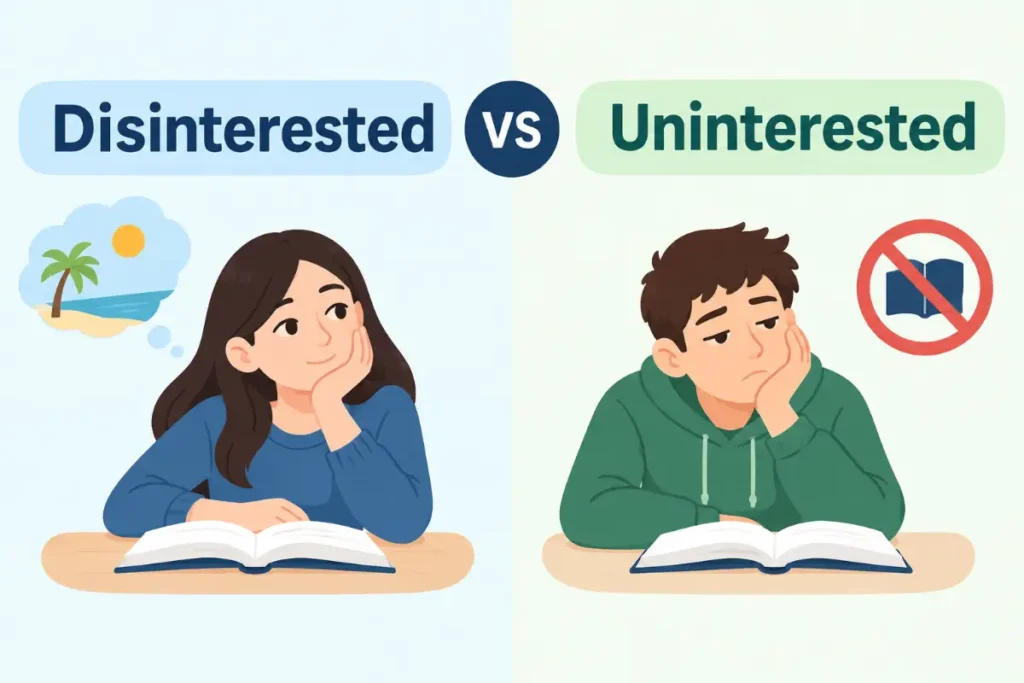
Disinterested vs uninterested is a common word choice problem because the two adjectives look almost interchangeable, but they traditionally describe two different ideas. Uninterested means not interested in something, while disinterested traditionally means impartial or free from personal interest in an outcome. If you do not care about a movie, class, hobby, or conversation, uninterested is usually the clearer word. If you can judge a dispute fairly because you have no personal stake in it, disinterested is the better choice.
The confusion gets more interesting because disinterested is also used to mean not interested in modern English, including American English. Major dictionaries recognize this newer or revived sense, but traditional usage guides still recommend keeping the distinction clear.
This guide explains the difference in plain English, shows how both words work in real sentences, covers pronunciation and grammar, and explains which choice is safest in professional and formal writing.
Quick Answer
Uninterested means not interested, curious, or engaged. Disinterested traditionally means impartial and free from personal advantage or involvement. For clear writing, use uninterested when someone does not care about something and disinterested when someone has no personal stake in an issue. Modern dictionaries also recognize disinterested as meaning uninterested in some contexts.
What Does Uninterested Mean
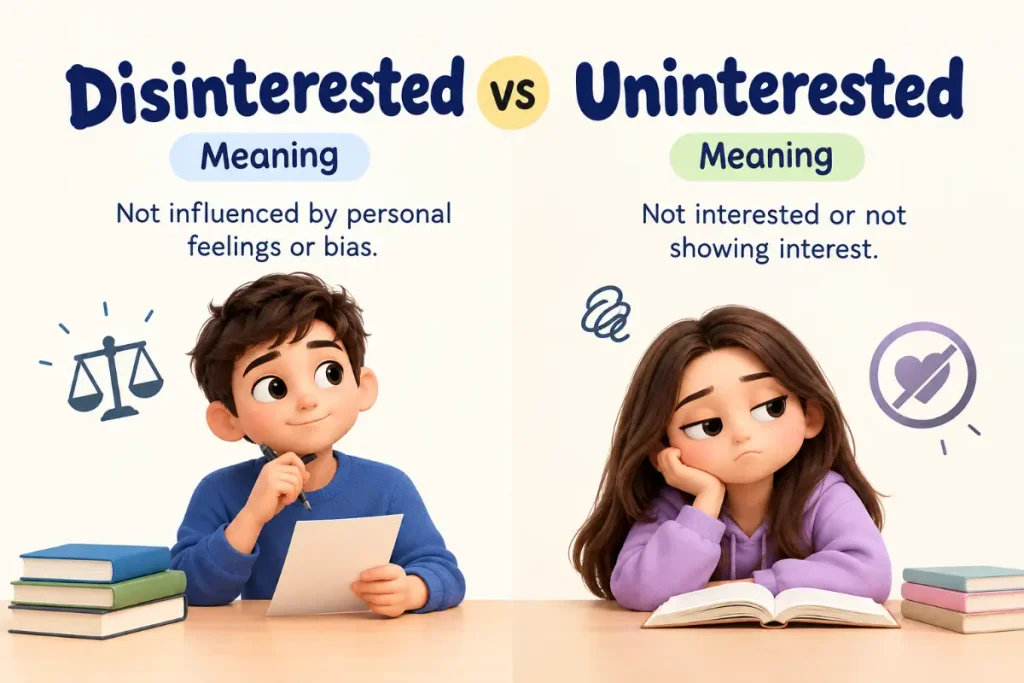
Uninterested is an adjective meaning not interested in something or someone. It describes a lack of curiosity, attention, enthusiasm, or desire to become involved.
The usual grammatical pattern is uninterested in + noun, pronoun, or gerund.
Examples include:
- She is uninterested in professional sports.
- He seemed uninterested in the conversation.
- The students were uninterested in the lecture.
- I am uninterested in buying a new car right now.
The word can describe a temporary reaction or a more general lack of interest. Someone might be uninterested in a particular movie because it looks boring, or they might be uninterested in politics as a broader personal preference.
Oxford defines uninterested as not interested or not wanting to know about someone or something. Its American English guidance specifically identifies uninterested as the normal opposite of interested.
It is also important to distinguish uninterested from uninteresting. An uninterested person lacks interest. An uninteresting thing fails to create interest.
Compare these sentences:
- Maria was uninterested in the lecture.
- The lecture was uninteresting.
The first sentence describes Maria’s reaction. The second describes the lecture.
That distinction is useful because writers sometimes treat these adjectives as interchangeable. They are not.
What Does Disinterested Mean
Disinterested traditionally means impartial, unbiased, or free from personal interest in an outcome.
A disinterested person has no personal advantage to gain from the decision. That lack of personal involvement can make the person more capable of judging an issue fairly.
For example:
- The judge needed a disinterested party to review the dispute.
- We asked a disinterested expert to evaluate the proposal.
- The committee wanted a disinterested observer at the meeting.
- Her advice was disinterested because she had nothing to gain from the decision.
The central idea is lack of personal stake, not lack of curiosity.
A referee can be disinterested in a game because the referee is not playing for either team and has no personal interest in which team wins. That does not mean the referee is bored or does not care about doing the job.
Cambridge defines the traditional sense as having no personal involvement or receiving no personal advantage, allowing someone to act fairly. Oxford similarly describes disinterested as not influenced by personal feelings or the possibility of personal advantage.
This is the meaning you should preserve when precision matters.
If you’re unsure about whether someone is leaving a country or moving into one, understanding the difference between emigrate and immigrate explained can make the distinction much clearer.
Disinterested vs Uninterested Meaning
The easiest way to remember the traditional distinction is to ask one simple question.
Does the person lack interest, or does the person lack a personal stake?
| Feature | Uninterested | Disinterested |
|---|---|---|
| Part of speech | Adjective | Adjective |
| Traditional meaning | Not interested | Impartial or unbiased |
| Main idea | Lack of interest | Lack of personal stake |
| Common pattern | Uninterested in something | Disinterested observer, judgment, advice |
| Describes boredom or lack of curiosity | Yes | Traditionally no |
| Describes impartiality | No | Yes |
| Common in American English | Yes | Yes |
| Formal writing | Clear and standard | Especially useful for impartiality |
| Alternative modern sense | Not usually needed | Sometimes means not interested |
The distinction becomes obvious in context.
The customer was uninterested in the sales pitch.
The customer did not want to hear the pitch.
The mediator was disinterested in the dispute.
The mediator had no personal stake in the outcome and could approach the dispute impartially.
Changing the words changes the meaning.
Why Are These Words So Confusing
Part of the problem comes from the way the prefixes work.
The prefix un commonly creates a negative meaning. Uninterested naturally looks like the opposite of interested, and that is exactly how it functions.
The prefix dis can also suggest separation, removal, or reversal. That makes disinterested look as if it should simply mean not interested. In fact, dictionaries recognize that meaning too.
The history is more complicated than the simple modern distinction suggests. American Heritage notes that disinterested originally had a sense related to not being interested and that the impartial meaning became especially important in traditional usage. It also notes that the not interested sense has returned to widespread use despite longstanding criticism from traditional usage authorities.
So the confusion is not simply caused by careless writers. The two words have a genuinely complicated history.
That history also explains why you may encounter sentences such as:
- He was disinterested in the movie.
- She became disinterested in the project.
- The audience seemed disinterested in the speaker.
Many readers understand these sentences to mean uninterested. Some dictionaries now recognize that usage. Still, readers who expect the traditional distinction may find it imprecise or confusing.
Which One Should You Use
For most modern American writing, the safest rule is straightforward.
Use uninterested when you mean not interested.
Use disinterested when you mean impartial, unbiased, or free from personal advantage.
This distinction is particularly useful in professional, academic, legal, editorial, and formal writing.
Consider these examples:
Less precise:
The employee was disinterested in the training session.
Clearer:
The employee was uninterested in the training session.
The second sentence tells the reader exactly what you mean.
Now consider:
Clear:
The company asked a disinterested consultant to review the dispute.
Here disinterested means the consultant had no personal stake in the result.
You can also use phrases such as impartial, neutral, or unbiased when you want to eliminate any possible ambiguity.
For example:
- We need an impartial reviewer.
- We need a neutral third party.
- We need an unbiased assessment.
In casual conversation, context often makes the intended meaning obvious. In careful writing, choosing the more precise word removes the need for the reader to guess.
Examples of Uninterested in Sentences
These examples show the standard meaning of uninterested across everyday and professional situations.
- I was uninterested in the movie, so I left early.The speaker did not find the movie engaging.
- The students looked uninterested during the long lecture.The students showed little interest or attention.
- She is completely uninterested in celebrity news.Celebrity news does not appeal to her.
- He seemed uninterested in joining the after school club.He did not want to participate.
- My son is uninterested in baseball but loves basketball.Baseball does not hold his attention.
- The customer sounded uninterested in the new service.The customer did not show interest in buying or learning more.
- I am uninterested in discussing the issue again.The speaker does not want to continue the discussion.
- The class became uninterested after the presentation went on too long.The students gradually lost interest.
- She was uninterested in the job offer because the schedule did not suit her.She did not want the position.
- He appeared uninterested in the conversation but was actually tired.
The sentence shows that a person can appear uninterested without actually lacking interest.
Notice the common structure uninterested in. This pattern is especially useful for remembering how the word works grammatically.
Examples of Disinterested in Sentences
These examples use the traditional sense of disinterested.
- The judge must remain disinterested throughout the case.The judge should not have a personal stake in the outcome.
- We asked a disinterested expert to review the report.The expert had no personal advantage connected to the result.
- A disinterested mediator helped both sides reach an agreement.The mediator was impartial.
- The board wanted a disinterested opinion before making a decision.The opinion needed to be free from personal interests.
- The journalist sought a disinterested source to examine the allegations.The source was expected to have no personal stake in the matter.
- A disinterested observer can sometimes see the problem more clearly.The observer is not personally involved.
- The committee appointed a disinterested reviewer.The reviewer had no reason to favor one side.
- Her advice was disinterested because she would not benefit from the decision.Her lack of personal advantage supported her impartiality.
- The mediator offered a disinterested assessment of the disagreement.The assessment was intended to be neutral.
- The organization needed a disinterested party to investigate the complaint.
The investigator needed independence from the people involved.
These examples show why disinterested is valuable. English already has several words for impartiality, but disinterested specifically highlights the absence of personal interest or personal advantage.
When Disinterested Means Uninterested
Modern usage complicates the traditional rule because disinterested can also mean not interested.
Cambridge’s American English dictionary includes both meanings. Collins also lists uninterested and indifferent as a second sense of disinterested, while noting that this usage has been disputed. Oxford labels the not interested sense informal and explains that it is sometimes used in speech instead of uninterested.
You may therefore see:
He was disinterested in the lecture.
In context, most readers will probably understand this as:
He was uninterested in the lecture.
The sentence is not necessarily incomprehensible or outside modern dictionary usage. The issue is precision.
If you are writing an email, report, essay, article, application, or other text where clarity matters, uninterested is usually the safer choice for the meaning not interested.
If you mean impartial, disinterested remains an excellent choice.
This approach avoids the ambiguity entirely.
English has many words that sound alike but have completely different meanings, and similar-sounding words like these can be especially confusing when you’re writing carefully.
Common Mistakes With These Words
Using Disinterested for Every Situation
One common mistake is using disinterested whenever someone is not interested.
Less precise:
The manager was disinterested in the new software.
Clearer:
The manager was uninterested in the new software.
The second version makes the intended meaning immediately obvious.
Using Uninterested for Impartiality
The opposite mistake also occurs.
Less precise:
The mediator was uninterested in the dispute.
This sounds as if the mediator simply did not care about the dispute.
Clearer:
The mediator was disinterested in the dispute.
Here the intended meaning is that the mediator had no personal stake.
Confusing Uninteresting With Uninterested
These words describe different things.
The lecture was uninteresting.
The lecture failed to hold attention.
The student was uninterested.
The student lacked interest.
You can have an uninteresting lecture and an interested student who is simply having a bad day. You can also have a fascinating lecture and an uninterested student.
Assuming Disinterested Always Means Bored
It does not.
In its traditional sense, disinterested says nothing about boredom. A disinterested judge may be highly attentive and deeply concerned about reaching a fair decision.
The word describes the person’s relationship to the outcome, not the person’s level of attention.
Grammar and Common Usage Patterns
Both uninterested and disinterested are adjectives.
The most common construction for uninterested is:
be + uninterested + in + noun or activity
Examples:
- She is uninterested in cooking.
- They were uninterested in the proposal.
- He became uninterested in the course.
The preposition in is important. We normally say uninterested in something, not uninterested on something.
With disinterested, common noun combinations often make the meaning clearer:
- a disinterested observer
- a disinterested party
- a disinterested opinion
- a disinterested judgment
- disinterested advice
- a disinterested assessment
- a disinterested mediator
These combinations naturally suggest impartiality.
You can also encounter disinterested in in sentences where the writer means impartial or free from personal interest, but context is important because the same structure can now be interpreted as not interested.
Compare:
The attorney was disinterested in the case.
This could be understood as the attorney having no personal stake, but some readers could interpret it as the attorney lacking interest in the case.
For maximum clarity, rewrite it if needed:
The attorney had no personal stake in the case.
Or:
The attorney was an impartial adviser.
Clear writing sometimes means choosing a different phrase rather than defending a technically possible word choice.
Pronunciation
Both words can be pronounced in more than one natural way, particularly disinterested.
In American English, uninterested is commonly pronounced approximately:
/ˌʌnˈɪntrəstɪd/
A simple guide is:
un IN truh sted
You may also hear a pronunciation closer to un IN ter est id, especially when speakers pronounce every part more carefully. Oxford lists American pronunciations including forms based on /ʌnˈɪntrəstɪd/ and /ʌnˈɪntrestɪd/.
Disinterested is commonly pronounced approximately:
/dɪsˈɪntrəstɪd/
A simple guide is:
dis IN truh sted
Some speakers pronounce the middle more distinctly, producing a form closer to dis IN ter est id. Cambridge and Oxford both provide multiple pronunciation forms for the word.
The important point is that pronunciation does not reliably tell you which meaning is intended. Context does.
Disinterested vs Uninterested in American English
Both words are established in American English, but they have different core uses.
Uninterested is the straightforward choice for a lack of interest. It is common in everyday conversation, workplace writing, school writing, and professional communication.
Disinterested is especially useful when discussing impartiality, neutrality, or freedom from personal advantage.
American dictionaries also recognize the not interested meaning of disinterested. American Heritage, for example, lists both the traditional impartial sense and the not interested sense while noting that traditional usage authorities have objected to the latter.
This means you should not assume that every use of disinterested to mean not interested is simply a spelling or grammar error. Modern dictionaries document the usage.
At the same time, dictionary recognition does not mean every context is equally clear. A writer who wants to communicate precisely should preserve the distinction when possible.
A useful editorial rule is:
- Everyday lack of interest: uninterested
- Impartiality or lack of personal stake: disinterested
- Formal writing with possible ambiguity: choose a clearer synonym if necessary
Formal and Casual Usage
In casual conversation, people often use disinterested to mean uninterested, and listeners can usually understand the intended meaning from context.
For example:
I was completely disinterested in that movie.
Most people will understand that the speaker did not care for the movie.
In formal writing, however, uninterested is a better choice for this meaning because it removes ambiguity.
For professional communication:
The client appeared uninterested in the proposal.
This clearly means the client showed little interest.
For impartiality:
An independent and disinterested reviewer evaluated the proposal.
This tells the reader that the reviewer had no personal interest in the outcome.
In academic and professional writing, precision is usually more valuable than relying on context to rescue an ambiguous word.
Synonyms and Related Words
The best synonym depends on the intended meaning.
Synonyms for Uninterested
Useful alternatives include:
- indifferent
- apathetic
- unconcerned
- disengaged
- inattentive
- bored
- unenthusiastic
- incurious
These words are not perfect replacements in every sentence.
Bored usually describes a feeling caused by a lack of stimulation.
Apathetic can suggest a stronger lack of concern or motivation.
Indifferent can mean that someone does not care or has no preference.
Disengaged often suggests that someone has stopped participating or paying attention.
So uninterested is often the most neutral option when you simply mean not interested.
Synonyms for Disinterested
When disinterested means impartial, useful alternatives include:
- impartial
- unbiased
- neutral
- objective
- fair
- dispassionate
- independent
- unprejudiced
Again, the meanings are not perfectly identical.
Impartial emphasizes fairness between competing sides.
Unbiased emphasizes freedom from bias.
Neutral often means not taking either side.
Objective emphasizes judging based on relevant facts rather than personal feelings.
Disinterested specifically carries the idea of having no personal interest or advantage at stake.
Disinterested vs Indifferent
These words can overlap, but they are not interchangeable.
Indifferent commonly means showing little concern, preference, or interest.
Disinterested traditionally means free from personal interest in an outcome.
Consider:
- She was indifferent to the criticism.
She did not care much about it.
- She was disinterested in the decision.
She had no personal stake in the decision.
The first sentence describes an attitude. The second describes a relationship to the outcome.
In some contexts, indifferent can also suggest neutrality, so context matters. Still, disinterested is more precise when the intended meaning is impartiality because there is no personal advantage involved.
Disinterested vs Uninterested in a Sentence
A quick side by side comparison can make the distinction easier to remember.
| Sentence | Meaning |
|---|---|
| The student was uninterested in chemistry. | The student did not care about chemistry. |
| The reviewer was disinterested in the dispute. | The reviewer had no personal stake in the dispute. |
| I am uninterested in reality television. | I have no interest in it. |
| The mediator was disinterested. | The mediator was impartial. |
| The customer seemed uninterested in the offer. | The customer did not want the offer. |
| We need a disinterested person to evaluate both proposals. | We need someone without a personal stake. |
If you can replace the word with not interested, choose uninterested. If you can replace it with impartial or without a personal stake, choose disinterested. That simple substitution test works remarkably well.
How to Remember the Difference
A useful memory trick is to focus on the word interest. With uninterested, the person has no interest in the subject. With traditional disinterested, the person has no personal interest in the outcome. Think about a referee.
A referee can be deeply interested in the game. The referee needs to pay attention, understand the rules, and make good decisions. But the referee should have no personal interest in which team wins.
That makes the referee a useful example of a disinterested decision maker. Now think about someone watching a sport they dislike.
They may be completely uninterested. They do not care who wins and may not even watch the game. The first person lacks a personal stake. The second person lacks interest. That is the traditional distinction in a nutshell.
Just as disinterested and uninterested have distinct meanings, the difference between continual and continuous shows why choosing the right word depends on the context.
Frequently Asked Questions
Which is correct disinterested or uninterested
Both words are correct, but they normally serve different purposes. Use uninterested when you mean not interested. Use disinterested when you mean impartial or free from personal advantage. Modern dictionaries also recognize disinterested as meaning not interested, but uninterested remains the clearer choice when you want to express a simple lack of interest.
Does disinterested mean not interested
It can, but that is not the traditional distinction. Modern American dictionaries document disinterested with a not interested sense, and the usage is common enough to be recognized. Traditional usage recommends reserving disinterested for impartiality and using uninterested for a lack of interest. That distinction is still useful in careful writing.
Does uninterested mean impartial
Not in its standard modern sense. Uninterested normally means not interested or not wanting to know about something. If you mean that someone can judge an issue fairly because they have no personal stake, disinterested is the more precise word.
Is disinterested a negative word
Not necessarily. When disinterested means impartial, it can describe a desirable quality. A disinterested mediator or reviewer has no personal advantage tied to the outcome. The word becomes potentially negative only when context uses it to mean lacking interest, and even then the tone depends on the sentence.
Is uninterested the opposite of interested
Yes. Uninterested is the standard adjective for someone who is not interested in something. Oxford specifically describes it as the opposite of interested. For example, She is interested in art becomes She is uninterested in art.
Is disinterested more formal than uninterested
Not exactly. The two words have different core meanings, so formality is not the main distinction. Disinterested is especially common in formal contexts involving impartiality, such as legal, academic, professional, or evaluative discussions. Uninterested is neutral and works naturally in both everyday and formal writing.
Can I use disinterested to mean uninterested in formal writing
You can encounter this usage in formal writing, and major dictionaries recognize it. However, it can create ambiguity because disinterested traditionally means impartial. If you mean not interested, uninterested is usually the safer and clearer choice. If precision matters, there is little reason to make the reader interpret an ambiguous sentence.
What is an easy way to remember disinterested vs uninterested
Use uninterested for a lack of interest and disinterested for a lack of personal stake. An uninterested student does not care about the lesson. A disinterested mediator has no personal reason to favor either side. When in doubt, try replacing the word with not interested or impartial to identify the intended meaning.
Final Takeaway
The traditional distinction is simple once you focus on the kind of interest involved. Uninterested means not interested, while disinterested means impartial or free from personal advantage. A student can be uninterested in a class, while a neutral reviewer can be disinterested in the decision being reviewed.
Modern English does allow disinterested to mean not interested, and major dictionaries now document that sense. Still, writers who want maximum clarity should preserve the distinction. Use uninterested for a lack of curiosity or enthusiasm and disinterested for impartiality. That choice is especially helpful in professional, academic, and formal writing, where a small difference in wording can change the reader’s interpretation.