
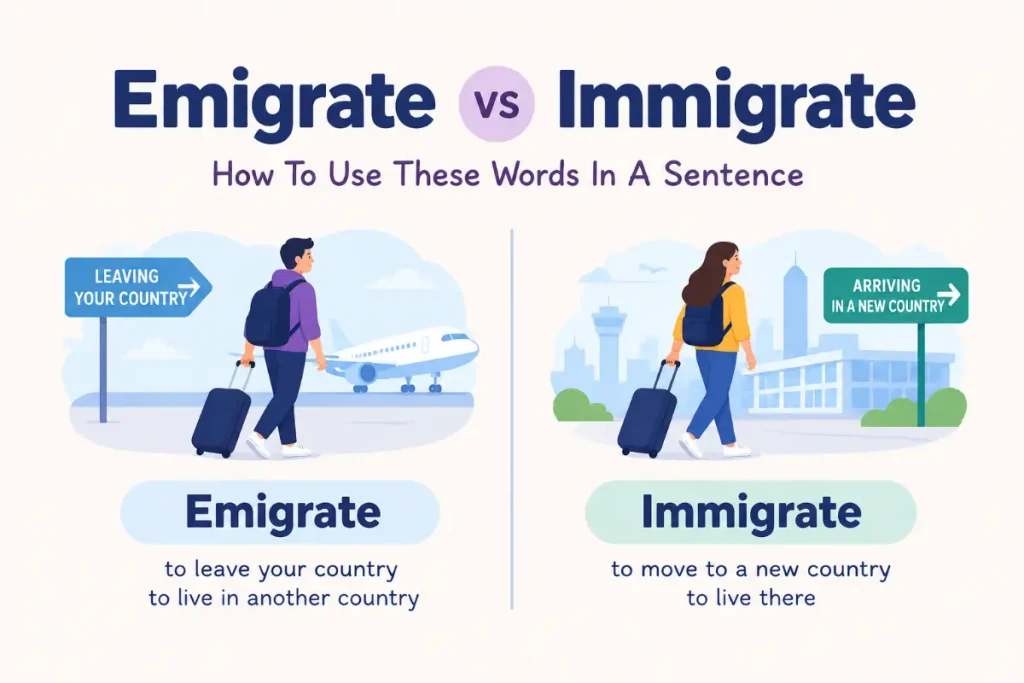
The difference between emigrate vs immigrate is mainly about direction. Emigrate means to leave a country or region to live somewhere else. Immigrate means to come into another country or region to live there. The same person can do both. Someone who leaves Mexico to settle in the United States emigrates from Mexico and immigrates to the United States.
The two words are easy to confuse because they look and sound almost identical. They also come from the same Latin root related to moving from one place to another. Their prefixes provide the useful clue. The beginning of emigrate is connected with the idea of moving out while the beginning of immigrate is connected with moving in.
Once you understand that difference the choice becomes much easier. This guide explains the meanings of both words with clear examples. It also covers emigrate vs immigrate pronunciation, the difference between migrate and the two more specific verbs, common grammar mistakes, American English usage, word history, and how these terms work in biology.
Quick Answer
Emigrate means to leave a country or region to live somewhere else. Immigrate means to enter another country or region to live there. Use emigrate from for the place someone leaves and immigrate to for the destination. A person can emigrate from Canada and immigrate to the United States during the same move.
What Does Emigrate Mean
Emigrate is a verb that means to leave one country or region and move to another place to live there. The focus is on the place the person is leaving.
For example:
- Maria emigrated from Brazil.
- Her grandparents emigrated from Ireland.
- Thousands of people emigrated from the region during the decade.
In each sentence the important idea is departure. The word tells the reader that someone left one place and established a life somewhere else.
The most common pattern is emigrate from.
- He emigrated from Italy.
- She emigrated from Canada.
- Their family emigrated from Poland.
You can also mention the destination.
- He emigrated from Italy to the United States.
- She emigrated from Canada to Australia.
The related noun is emigration. It refers to the process of leaving a country or region to live somewhere else. The related person noun is emigrant.
For example:
- Emigration from the country increased during the period.
- Her grandfather was an emigrant from Germany.
A simple way to remember the meaning is to connect the first letter of emigrate with exit. That is only a memory trick rather than a formal grammar rule, but it makes the distinction much easier to recall.
Much like other easily confused word pairs, elicit and illicit look and sound similar but have completely different meanings.
What Does Immigrate Mean
Immigrate is a verb that means to come into another country to live there. The focus is on the destination.
For example:
- Maria immigrated to the United States.
- Her grandparents immigrated to New York.
- Thousands of people immigrated to the country during the decade.
The most useful pattern is immigrate to.
- He immigrated to Canada.
- She immigrated to the United States.
- Their family immigrated to Australia.
You can also mention the country of origin.
- He immigrated to the United States from Italy.
- She immigrated to Canada from India.
The related noun is immigration. The related person noun is immigrant. Cambridge defines immigration as the process of coming to live in another country.
For example:
- Immigration has shaped the history of many American cities.
- Her parents were immigrants from Mexico.
- The book examines immigration to the United States.
The easiest memory trick is to connect immigrate with in. Again the idea is simple. Immigrate focuses on coming in.
Emigrate vs immigrate difference
The two verbs describe the same general type of movement but from different points of view.
| Feature | Emigrate | Immigrate |
|---|---|---|
| Basic meaning | Leave a country or region to live elsewhere | Enter another country or region to live there |
| Main focus | Place being left | Place being entered |
| Common preposition | From | To |
| Related noun | Emigration | Immigration |
| Person noun | Emigrant | Immigrant |
| Simple memory clue | Exit | In |
| Example | She emigrated from Spain | She immigrated to the US |
Imagine someone moving from France to the United States.
If you focus on France you can say:
- She emigrated from France.
If you focus on the United States you can say:
- She immigrated to the United States.
Both sentences describe the same person’s move. The difference comes from the viewpoint.
This is why it is not useful to think of the two words as one correct word and one incorrect word. Both are standard English verbs. The important question is which part of the move you are describing.
A useful sentence can contain both.
- She emigrated from France and immigrated to the United States.
That sentence makes the direction completely clear.
Emigrate vs immigrate examples
Examples make this distinction much easier to see because the difference often depends on a single preposition.
Emigrate examples
- Her family emigrated from Poland in the 1980s.
- His grandparents emigrated from Italy and settled in New York.
- She plans to emigrate from Canada after retirement.
- Many families emigrated from Ireland during the nineteenth century.
- The writer emigrated from South Africa and settled in California.
- His parents emigrated when he was a child.
- Several scientists emigrated from the country to continue their work abroad.
- They decided to emigrate from the United States.
- Her ancestors emigrated from Germany several generations ago.
- Many workers emigrated from the region in search of new opportunities.
These examples put attention on the place people left. That is the central idea behind emigrate.
Immigrate examples
- Her family immigrated to the United States in the 1980s.
- His grandparents immigrated to New York from Italy.
- She plans to immigrate to Canada next year.
- Many families immigrated to the United States during the twentieth century.
- His parents immigrated to California when he was a child.
- The scientist immigrated to the United States and continued his work there.
- They immigrated to Australia after several years of planning.
- Her grandparents immigrated to California from Mexico.
- Many workers immigrated to the country during the period.
- He immigrated to the United States as a young adult.
These examples put attention on the destination.
The pattern is worth noticing because it gives you a practical editing shortcut.
Emigrate from the place you leave.
Immigrate to the place you enter.
Immigrate vs emigrate vs migrate
Migrate is the broader word of the three. It means to move from one place to another. It does not automatically tell the reader to focus on the starting point or the destination.
For example:
- The family migrated to another region.
- The birds migrate south each winter.
- Many workers migrated to the city.
The word can describe human movement and animal movement. It can also describe seasonal movement and other forms of relocation. The exact meaning depends on context.
The difference becomes clearer when you compare all three words.
- Migrate focuses on the movement itself.
- Emigrate focuses on moving out of a country or region.
- Immigrate focuses on moving into another country or region to live there.
Consider someone moving from India to the United States.
- The family migrated from India to the United States.
- The family emigrated from India.
- The family immigrated to the United States.
The first sentence gives the broadest description. The second emphasizes departure. The third emphasizes arrival.
This distinction follows the historical development of the words. The root behind migrate relates to moving from one place to another. Emigrate developed with a sense of moving away while immigrate developed with a sense of moving into a place.
English has many similar-sounding English words that can cause confusion, such as bear and bare, even though their meanings and uses are quite different.
How To Use These Words In A Sentence
Both emigrate and immigrate are verbs. They normally describe people or groups moving to another country or region to live there.
The most useful sentence patterns are straightforward.
Emigrate from
Use emigrate from when the sentence focuses on the starting place.
- She emigrated from France.
- They emigrated from Mexico.
- His family emigrated from India.
Emigrate from one place to another
You can include the destination when both sides of the move matter.
- She emigrated from France to the United States.
- They emigrated from Mexico to Canada.
- His family emigrated from India to Australia.
Immigrate to
Use immigrate to when the sentence focuses on the destination.
- She immigrated to France.
- They immigrated to Canada.
- His family immigrated to Australia.
Immigrate to a place from another place
You can also identify both sides of the move.
- She immigrated to the United States from France.
- They immigrated to Canada from Mexico.
- His family immigrated to Australia from India.
These patterns are not complicated. Most confusion comes from forgetting to identify the direction before choosing the verb.
Common Mistakes
One of the most common mistakes is choosing the word simply because the sentence describes international movement. Movement alone does not tell you which verb to use.
Using immigrate for the place someone left
A sentence such as this can create confusion:
- She immigrated from Mexico.
If the writer intends to focus on leaving Mexico the clearer choice is:
- She emigrated from Mexico.
If the writer wants to describe arrival in the United States the sentence can become:
- She immigrated to the United States from Mexico.
Using emigrate for the destination
Consider:
- He emigrated to Canada.
The intended meaning may be clear but immigrate to Canada is the more precise choice when Canada is the destination.
A better sentence is:
- He immigrated to Canada.
If the writer wants to focus on the country he left then emigrate from works better:
- He emigrated from the United States.
Forgetting the viewpoint
Writers sometimes treat the two verbs as interchangeable. They are closely related but their focus is different.
Compare:
- She emigrated from Spain.
- She immigrated to the United States.
Neither sentence is more correct than the other. They simply answer different questions.
The first tells us where she left. The second tells us where she went.
Confusing immigrant and emigrant
The same distinction applies to the nouns.
- An emigrant leaves a country or region.
- An immigrant comes into another country or region to live there.
For example:
- He was an emigrant from Ireland.
- He was an immigrant to the United States.
The same person can be described with both nouns depending on the viewpoint.
Emigrate vs immigrate pronunciation
The two words are very close in pronunciation. The main difference comes at the beginning.
In US English emigrate is pronounced approximately:
EM uh grayt
Its IPA pronunciation is /ˈem.ə.ɡreɪt/.
In US English immigrate is pronounced approximately:
IM uh grayt
Its IPA pronunciation is /ˈɪm.ə.ɡreɪt/.
The final part of both words sounds essentially the same. The opening vowel gives you the clearest contrast.
- Emigrate begins with an em sound.
- Immigrate begins with an im sound.
The related nouns follow the same basic distinction.
- Emigration is pronounced approximately em uh GRAY shun.
- Immigration is pronounced approximately im uh GRAY shun.
The US pronunciations listed by Cambridge use a reduced vowel in the middle syllable of both words.
If you are learning these words for speaking practice it helps to exaggerate the first syllable at first.
- EMigrate.
- IMmigrate.
Once the difference feels natural you can return to normal conversational pronunciation.
Emigrate From The USA
The phrase emigrate from the USA is correct when the United States is the country a person leaves to settle somewhere else.
For example:
- She emigrated from the United States and settled in Portugal.
- His family emigrated from the United States to Canada.
- They plan to emigrate from the United States after retirement.
You can describe the same movement from the destination’s perspective.
- She immigrated to Portugal from the United States.
- His family immigrated to Canada from the United States.
The choice depends on the location you want to emphasize.
If your sentence is about departure from the United States use emigrate from the United States.
Use immigrate to that country if your sentence is about arrival in another country.
If the direction is not important you can simply say:
- They moved abroad.
- They moved to Portugal.
- They relocated to Canada.
You do not need a specialized migration word in every sentence. Clear writing often comes from choosing the simplest accurate word.
Emigrate vs immigrate in biology
The distinction also appears in biology and population science.
In biology immigration refers to individuals entering a population from another area. Emigration refers to individuals leaving a population. These movements can affect population structure and genetic variation. OpenStax explains that gene flow can occur when individuals or reproductive cells move between populations and notes that immigration and emigration can contribute to changes in population genetics.
Imagine two populations of the same species living in separate areas.
- An animal leaves Population A and joins Population B. From the perspective of Population A it has emigrated.
- From the perspective of Population B the same animal has immigrated.
- The movement of individuals between populations can contribute to gene flow.
The basic directional idea has not changed. The context has simply moved from human communities to biological populations.
This is also a useful reminder that emigrate and immigrate are not limited to discussions about modern international borders. Their underlying concepts describe movement out of and into a population or place.
Word Origin And Etymology
The history of these words explains why they look so similar.
Both words are connected to the Latin verb migrare, meaning to move or change one’s place.
Emigrate developed from Latin emigrare, which carried the sense of moving away or departing from a place. Its first part is associated with the Latin idea of moving out. English later developed the modern verb emigrate with the meaning of leaving one country or region to settle elsewhere.
Immigrate comes from Latin immigrare, which carried the sense of moving into a place. The beginning of the word is connected with the Latin idea of moving in.
The broader word migrate also comes from the same Latin family. Its basic sense is movement from one place to another.
That gives you a useful word family.
- Migrate means move from one place to another.
- Emigrate means move out of a country or region to live elsewhere.
- Immigrate means move into another country or region to live there.
- Emigrant means a person viewed as leaving.
- Immigrant means a person viewed as entering a new country to live.
- Emigration means the process of leaving.
- Immigration means the process of entering and settling.
The history gives the words a logical structure rather than making them feel like two unrelated vocabulary items.
American English Usage
Both words are standard in American English. The distinction is not mainly a difference between American and British spelling. Instead the words express different viewpoints.
American readers commonly encounter immigration when the discussion concerns people entering the United States. They also encounter emigration when writers discuss people leaving a country.
For example:
- Immigration has played an important role in the history of many American communities.
- Emigration can change the population of the country people leave.
- The study examined immigration to the United States.
- The report discussed emigration from rural regions.
The noun immigration also has another common meaning in American English. At an airport or border crossing it can refer to the process or place where officials check documents as people enter a country.
For example:
- We went through immigration after landing.
- The immigration officer checked her documents.
That meaning is different from the broader process of people moving to another country to live there. Context makes the distinction clear.
Formal And Casual Usage
Both emigrate and immigrate are neutral words. They work in everyday conversation as well as professional and academic writing.
In casual conversation Americans often choose the simpler verb move.
- My family moved to Canada.
- They moved to the United States last year.
- Her parents moved abroad when she was young.
There is nothing wrong with these sentences. In fact they may sound more natural when the exact migration terminology does not matter.
More precise writing can use emigrate or immigrate.
- Her parents emigrated from Italy.
- Her parents immigrated to the United States.
The more specific verbs become useful in history, journalism, academic writing, demographic research, legal discussions, and other contexts where the direction of movement matters.
The key editorial principle is simple. Use the specialized term when it adds useful precision. Use move when a simpler expression communicates the idea just as clearly.
Related Words People Often Confuse
Several words belong to the same semantic group but are not exact substitutes.
Migrant
A migrant is a person who moves from one place to another. The word is broader than immigrant and emigrant. It can describe different types of movement depending on context.
Immigrant
An immigrant is a person who comes to another country to live there. The focus is on entering the new country.
Emigrant
An emigrant is a person who leaves a country or region to settle elsewhere. The focus is on departure.
Migration
Migration is the broader process of moving from one place to another. It can apply to people and animals and can describe many different types of movement.
Immigration
Immigration focuses on people coming into a country or population.
Emigration
Emigration focuses on people leaving a country or population.
Expatriate
Expatriate refers to someone living outside their native country. It can overlap with the idea of an immigrant but does not carry exactly the same meaning in every context. Someone may live abroad temporarily for work or personal reasons and be described as an expatriate.
Understanding these relationships prevents another common problem. Writers sometimes treat every word connected with moving across borders as interchangeable. They are not. Each term carries a slightly different focus.

Another useful example is cite, site, and sight, three commonly confused words that differ in both meaning and grammatical function.
Expert Usage Tips
The fastest way to choose between these verbs is to identify the location you want the sentence to emphasize.
Ask yourself:
- Where did the person leave?
- Where did the person go?
- Do I need to emphasize either location?
If you are talking about the place left, use emigrate.
- She emigrated from Brazil.
- His family emigrated from Ireland.
Use immigrate if you are talking about the destination.
- She immigrated to the United States.
- His family immigrated to Ireland.
If both places matter, include both.
- She emigrated from Brazil and immigrated to the United States.
If neither location needs special emphasis, use a broader verb.
- She moved abroad.
- Her family moved to another country.
- The population migrated to a new region.
This approach keeps your writing natural. You do not need to force a specialized word into every sentence simply because it exists.
Another useful editing habit is to check the preposition after the verb. From strongly suggests departure and works naturally with emigrate. To strongly suggests a destination and works naturally with immigrate.
That small grammar check can catch many errors before you publish your writing.
Frequently Asked Questions
Which is correct emigrate or immigrate
Both words are correct. Emigrate describes leaving a country or region to live somewhere else. Immigrate describes coming into another country or region to live there. Someone can emigrate from India and immigrate to the United States. The correct choice depends on the direction and viewpoint of the sentence.
What is the easiest way to remember emigrate and immigrate
Think of E in emigrate as exit and I in immigrate as in. Then remember the common patterns emigrate from and immigrate to. These are simple memory aids rather than formal grammar rules, but they make the distinction easy to recall.
Can the same person emigrate and immigrate
Yes. A single move can be described with both verbs. If someone leaves France and settles in the United States, that person emigrates from France and immigrates to the United States. The two words describe the same movement from opposite viewpoints.
What is the difference between migrate and immigrate
Migrate is broader and focuses on movement from one place to another. Immigrate specifically focuses on entering another country or region to live there. Emigrate focuses on leaving. In simple terms, migrate describes movement while the other two give the movement a direction.
How do you pronounce emigrate
In American English emigrate is pronounced approximately EM uh grayt. The US IPA pronunciation is /ˈem.ə.ɡreɪt/. The first syllable begins with the vowel sound found in words such as bed.
How do you pronounce immigrate
In American English immigrate is pronounced approximately IM uh grayt. The US IPA pronunciation is /ˈɪm.ə.ɡreɪt/. The first syllable has the short vowel sound heard in words such as sit.
Is emigrate from the USA correct
Yes. If someone leaves the United States to settle in another country you can say that the person emigrated from the United States. If you focus on the destination you can say that the person immigrated to that country from the United States.
Are emigration and immigration used in biology
Yes. Biology uses emigration for individuals leaving a population and immigration for individuals entering a population. These movements can affect population size and genetic structure and can contribute to gene flow between populations.
Conclusion
The difference between these two words is easier than it first appears. Emigrate means to leave. Immigrate means to enter and settle in another country or region. The most useful grammar patterns are emigrate from and immigrate to.
Think about the direction before choosing the word. If you are focusing on the country someone left, use emigrate. If you are focusing on the destination, use immigrate. A person can do both during the same move. Someone can emigrate from Mexico and immigrate to the United States.
When the exact direction does not matter, move or migrate may be the better choice. Clear writing does not depend on using the most specialized word. It depends on choosing the word that communicates the intended meaning without making the reader stop and think.