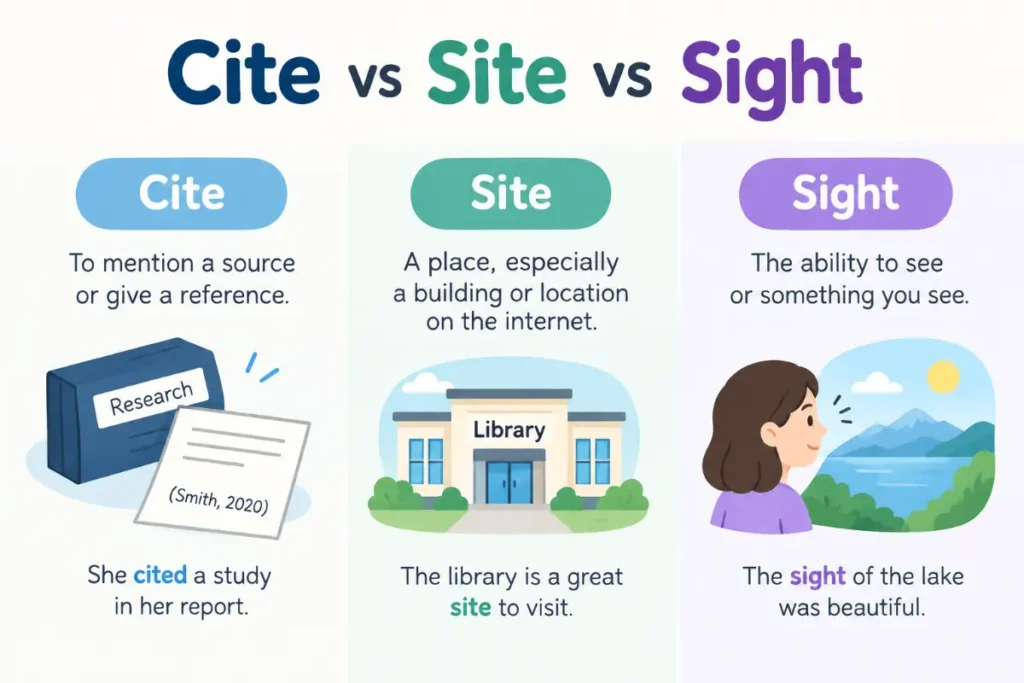
The difference between cite vs site vs sight comes down to meaning and grammatical function. Although all three words are pronounced the same in American English, they are not interchangeable. Cite is mainly a verb used when you mention a source, example, reason, or authority. Site is usually a noun meaning a place or location, and it can also refer to a website. Sight is mainly a noun connected with seeing, something you see, or the ability to see.
These words are homophones, meaning they sound alike but have different spellings and meanings. That makes them easy to confuse in emails, school assignments, professional documents, online writing, and everyday messages. The good news is that each word has a distinct job once you connect it with its meaning.
This guide explains the differences with clear definitions, practical examples, pronunciation, common mistakes, grammar patterns, word origins, and real world usage. You will also see how to choose the right word quickly when writing about sources, locations, websites, views, or things you see.
Quick Answer
Cite means to mention or refer to a source, person, example, or reason. Site means a physical location or a website. Sight relates to seeing, vision, or something seen. All three are pronounced /saɪt/ in American English, but their meanings and grammatical uses are different.
Cite vs site vs sight difference
The easiest way to understand these words is to connect each spelling with one central idea.
| Word | Part of speech | Main meaning | Common context | Example |
|---|---|---|---|---|
| cite | Verb | Mention or refer to a source, example, or reason | Research, writing, law, discussion | Please cite your sources. |
| site | Noun, sometimes verb | A place, location, or website | Construction, history, business, internet | The company chose a new site. |
| sight | Noun, sometimes verb | Vision or something seen | Seeing, travel, observation | The mountain was an amazing sight. |
The spelling gives you an important clue. Cite is connected with referring to information. Site is connected with a place. Sight is connected with seeing.
For example, a student might cite a book, visit a historical site, and enjoy the sight of an old building. The words sound identical, but each one performs a different grammatical and semantic role.

Just as easily confused word pair can have completely different meanings, cite, site, and sight require careful attention to context and spelling.
What Does Cite Mean
Cite is a verb. It means to mention, refer to, or point to something as support, evidence, an example, or a source.
This word is especially common in academic writing. When you cite a book, article, study, website, or other source, you identify that source as support for information or an argument. It is also common in journalism, business writing, law, and formal discussions.
For example:
- You should cite the article in your research paper.
- The report cites several studies about consumer behavior.
- She cited cost as the main reason for the decision.
- The lawyer cited a previous court case.
- The professor asked students to cite reliable sources.
The object after cite is often a source, person, reason, example, case, or piece of evidence. The word can also be followed by a quotation or a reference to someone’s work.
In academic writing, cite does not necessarily mean that you copy someone’s exact words. You can cite a source when you summarize or paraphrase its ideas. A citation tells readers where supporting information came from.
The word also has specialized legal and official uses. Someone can be cited for a violation, and a person can be formally cited in a legal matter. Cite can also mean to publicly recognize someone for an achievement in certain formal contexts.
Common grammar patterns with cite
Several structures appear frequently in natural English:
- Cite a source: The researcher cited three sources.
- Cite something as evidence: The report cited declining sales as evidence of weaker demand.
- Cite someone or something as an example: The teacher cited the company as an example of successful branding.
- Cite a work: The author cited several books in the introduction.
- Be cited for something: The company was cited for violating safety regulations.
The past tense and past participle are cited, while the present participle is citing.
- She cited two studies.
- She is citing two studies.
- The studies were cited in the report.
What Does Site Mean
Site is most commonly a noun meaning a particular place or location. It can describe the location of a building, event, accident, historical event, construction project, or other activity.
For example:
- The company selected a site for its new office.
- Workers arrived at the construction site early.
- The museum stands on the site of an old fort.
- Police examined the site of the accident.
- The school is located on a large site.
A site can be a physical location that already exists or a place where something will be built or happen. This makes the word especially common in construction, real estate, history, business, and public planning.
Site also has an important modern meaning related to the internet. In everyday American English, site can mean a website.
- I found the information on the company’s website.
- I found the information on the company’s site.
Both are natural. In casual and professional online communication, site is often used as a shorter form of website.
Site as a verb
Although the noun is much more common for most readers, site can also function as a verb. As a verb, it means to place or locate something in a particular position.
For example:
- The city plans to site the new library near the train station.
- The company wants to site its headquarters closer to major airports.
This use is more formal than the everyday noun site. In ordinary conversation, people are more likely to use locate or place.
What Does Sight Mean
Sight is mainly a noun related to seeing. It can mean the ability to see, the act of seeing something, or something that comes into view.
For example:
- She began to lose her sight as she grew older.
- The sight of the ocean made him smile.
- We caught sight of the deer near the trail.
- The fireworks were an incredible sight.
- The mountains came into sight after the clouds cleared.
The word has several closely related meanings, but they all connect to vision or something perceived visually. Sight can refer to physical vision, something visible, or an interesting place or object that people visit.
This explains expressions such as:
- at first sight
- at the sight of
- catch sight of
- come into sight
- keep something in sight
- out of sight
- within sight of
- sightseeing
- sight unseen
For example, We caught sight of the Statue of Liberty means that we saw it, often briefly or unexpectedly. We visited the sights of New York refers to notable places that visitors see.
Sight as a verb
Sight can also be used as a verb meaning to see something, especially suddenly or after looking for it.
For example:
- The sailors sighted land after several days at sea.
- The hikers finally sighted a cabin in the distance.
This use is less common than the noun in everyday conversation, but it is standard English.
Examples in Sentences
Seeing the three words in related situations makes the distinction easier to remember. The following examples show how each word works in everyday, academic, workplace, and professional contexts.
Examples With Cite
Cite is appropriate when you refer to information, evidence, sources, examples, reasons, or authorities.
- Please cite the source at the end of your paper.
- The researcher cited a recent study to support the claim.
- She cited several reasons for leaving the company.
- The article cites data from government reports.
- Students must cite their sources correctly.
- The manager cited rising costs as the reason for the price increase.
- The attorney cited a similar case during the hearing.
- The report cited customer feedback as an important factor.
- He cited the author’s earlier work in his presentation.
- The professor reminded the class to cite every source they used.
Notice that cite usually involves information or authority. If you are pointing readers toward a source, cite is the natural choice.
Examples With Site
Site is appropriate when you mean a physical location or website.
- The builders inspected the site before construction began.
- The company purchased a site for its new headquarters.
- The historical site attracts thousands of visitors each year.
- Police secured the site after the accident.
- The hospital will be built on the former industrial site.
- We found the application form on the university’s website.
- The company redesigned its site last year.
- The camping site had plenty of shade.
- The city is considering several possible sites for the new stadium.
- You can register through the official site.
In each example, site refers to a location or an online location.
Examples With Sight
Sight is appropriate when the meaning involves seeing, vision, or something visible.
- The sunset was a beautiful sight.
- She lost her sight after a serious illness.
- We caught sight of a fox near the road.
- The city skyline came into sight as we approached.
- The children laughed at the sight of the balloons.
- Keep the vehicle in sight while we wait here.
- The waterfall was an impressive sight.
- The mountains were barely visible, but they eventually came into sight.
- The tourists spent the afternoon seeing the sights.
- He recognized her by sight but had never spoken with her.
These examples all connect the word to vision or something that can be seen.
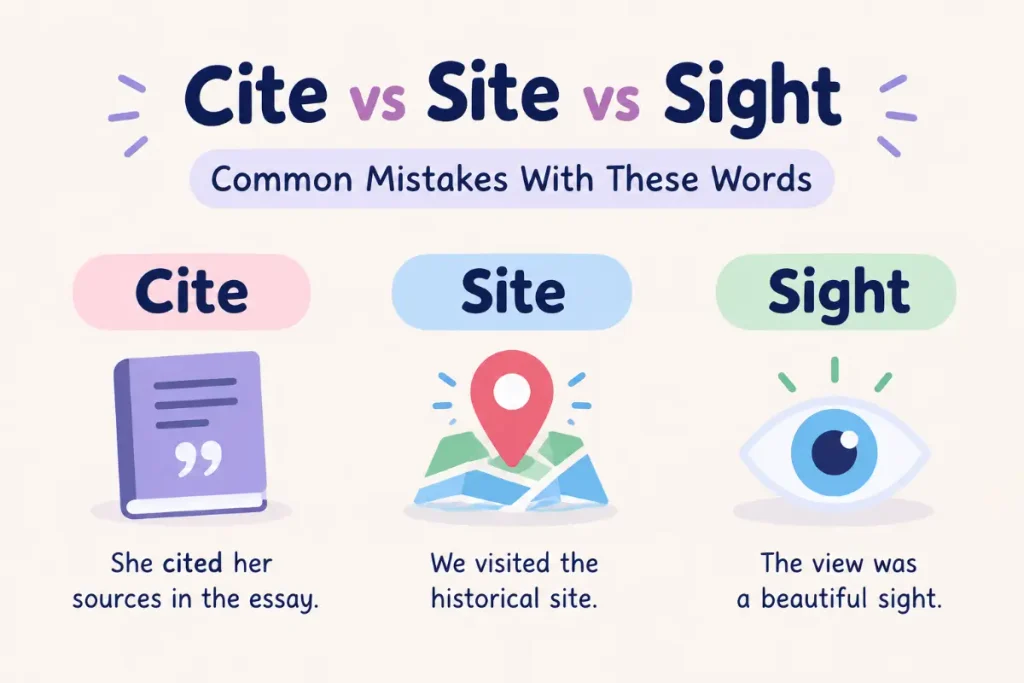
Common Mistakes With These Words
The most common mistake is choosing a spelling based on sound instead of meaning. Since all three words are pronounced the same in standard American English, listening alone cannot tell you which spelling to use.
Cite and Site
Incorrect: Please site your sources in the essay.
Correct: Please cite your sources in the essay.
The verb cite is required because the writer means to refer to sources.
Another common error appears in academic writing.
Incorrect: The study sites several previous researchers.
Correct: The study cites several previous researchers.
Here, cites means refers to or mentions as sources. Sites would normally suggest locations or websites.
Site and Sight
Incorrect: We visited the historical sight.
Correct: We visited the historical site.
If you mean a physical location with historical importance, site is the correct word.
However, sight can be correct if you mean something visually impressive.
Correct: The ancient temple was an amazing sight.
The distinction is subtle but important. A site is the place itself. A sight is something you see.
Cite and Sight
Incorrect: The paper sights several important studies.
Correct: The paper cites several important studies.
Sight has a connection to seeing, while cite has a connection to referring to a source.
A useful test is to ask what the sentence is doing. If it is pointing readers toward evidence or information, use cite. If it is describing seeing or something visible, use sight.
Pronunciation
In American English, cite, site, and sight are homophones. They have the same pronunciation: /saɪt/.
A simple pronunciation guide is:
- cite: rhymes with light
- site: rhymes with light
- sight: rhymes with light
The vowel sound is the same as the sound in eye, followed by the final t sound.
Because the pronunciation is identical, you cannot reliably identify the spelling from speech. Context determines the meaning, and meaning determines the spelling.
This is why the words frequently cause mistakes in writing. Someone may know exactly what they want to say but choose the wrong spelling because all three forms sound identical when spoken.
Word Origins and Why the Spellings Differ
The three words have different histories even though modern English pronounces them alike.
Cite came into English through French from Latin roots associated with calling, summoning, or mentioning. Its modern English uses developed around referring to or quoting authorities and sources.
Site came through French from Latin situs, meaning position or location. That history fits its modern meaning as a place or position.
Sight developed from Old English forms related to seeing and vision. Its history is connected to the broader family of English words associated with sight and seeing.
Their different origins help explain why the spellings remain distinct. English spelling preserves historical information that pronunciation does not always reveal.
You do not need to memorize these etymologies to use the words correctly. The practical distinction is much more useful: cite refers to information, site refers to a place, and sight refers to seeing.
American English Usage
All three words are standard in American English, and the basic distinction does not change across American usage.
Cite is common in academic, legal, professional, and formal writing.
Site is common in everyday language for both physical locations and websites.
Sight is common in everyday conversation, descriptive writing, travel contexts, and expressions involving vision.
There is no American spelling variant that changes the core distinction among these three homophones. British, Canadian, and Australian English also use the same basic spellings and meanings.
Some related words can differ by region, but that is not the case with these three forms. American readers should therefore focus on meaning and grammatical function rather than regional spelling.
How to Choose the Right Word
A quick mental test can prevent most mistakes.
Use Cite for Sources and Reasons
Ask yourself:
Am I referring to information, evidence, a source, a person, or a reason?
If yes, use cite.
- The report cites several studies.
- She cited cost as the main problem.
Use Site for a Place or Website
Ask yourself:
Am I talking about a location, piece of land, building location, or website?
If yes, use site.
- The company chose a new site.
- I found the instructions on the website.
- The information is available on our site.
Use Sight for Seeing
Ask yourself:
Am I talking about vision, seeing something, or something that can be seen?
If yes, use sight.
- The waterfall was a beautiful sight.
- We caught sight of a deer.
- The mountains came into sight.
This three question test works because it focuses on meaning instead of pronunciation.
A Simple Memory Trick
One useful way to remember the words is to associate each spelling with a concept.
- Cite = citation. If you are referring to a source, think of a citation. That points you toward cite.
- Site = place. A site is a place where something is located or happens. Think of a construction site or website.
- Sight = seeing. Think of eyesight, sightseeing, or something coming into sight.
Another useful way to remember the distinction is through three short sentences:
- Cite your source.
- Visit the site.
- Enjoy the sight.
The words sound the same, but the meaning changes completely.
Related Words People Often Confuse
These homophones appear alongside several other words that can cause confusion.
Citation and Cite
A citation is a reference to a source, while cite is the verb used for the act of referring to that source.
- You need to cite the book.
- Add the citation to your reference list.
The two words belong to the same word family.
Website and Site
A website is an online location made up of related web pages and resources. Site is often used informally as a shorter form.
- Visit our website.
- Visit our site.
Both can be natural in context.
Sight and Vision
Vision and sight overlap, but they are not identical in every context. Sight can mean the ability to see, while vision can also refer to someone’s ability to imagine or plan something.
- She has excellent sight.
- The company has a long term vision for growth.
When you specifically mean physical seeing, sight is often the clearer choice.
Sight and View
A view commonly refers to what can be seen from a particular position, while sight has broader meanings connected with seeing and something seen.
- The hotel has a beautiful view of the lake.
- The sight of the lake surprised us.
The first focuses on the scenery from a particular position. The second focuses more on the experience of seeing it.
Formal and Casual Usage
Cite tends to appear more often in formal and academic contexts because referring to evidence and sources is a common part of research and professional writing.
- The author cites several historical records.
- The report cites data from multiple sources.
Site is neutral and extremely common. You can use it in casual conversation, business communication, technical writing, and professional documents.
- The team will visit the site tomorrow.
- You can find the details on our site.
Sight is also neutral and widely used in everyday English.
- We caught sight of a bald eagle.
- The sunset was an incredible sight.
The word itself is not slang. Its level of formality depends more on the expression and context surrounding it.
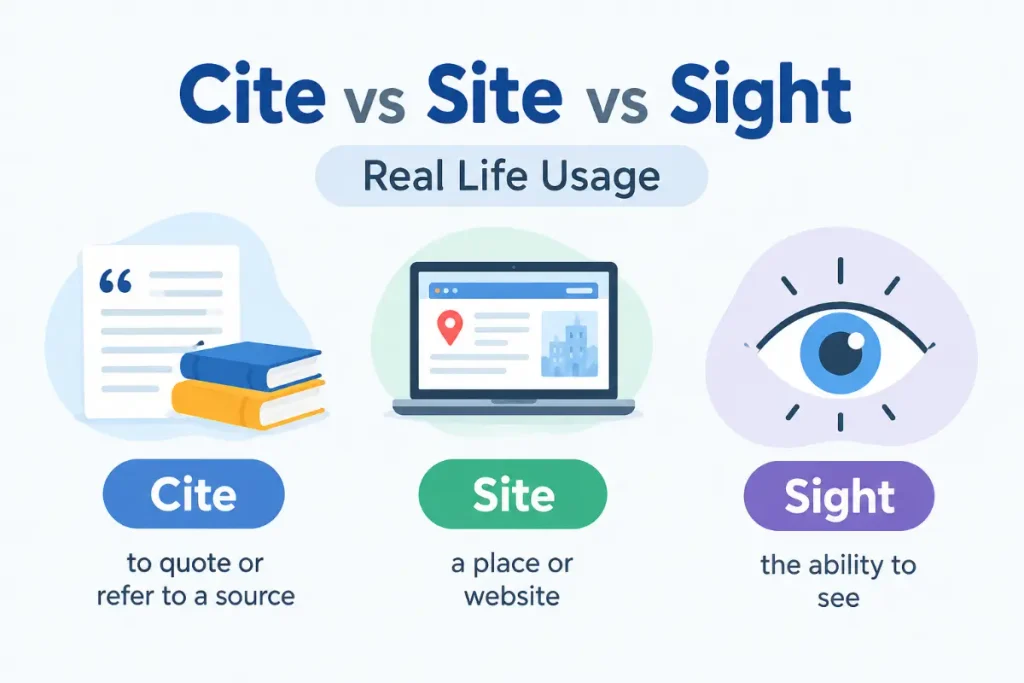
Like another commonly confused pair, cite, site, and sight sound similar but serve different grammatical and semantic roles.
Real Life Usage
These words appear in very different situations, so context provides a strong clue.
In a classroom, a teacher may tell students to cite sources in a research paper. In a workplace, a manager may discuss a construction site or direct employees to the company site for information. During a trip, visitors may admire the sights of a city.
Consider how the three words work together in one situation:
- Before writing the report, Maya visited the historical site.
- She took notes about what she saw and later cited three books in her paper.
- The old courthouse was the most memorable sight of the trip.
All three words work naturally because each expresses a different idea.
Site identifies the place.
Sight identifies something seen.
Cited identifies the act of referring to sources.
This is a useful real world pattern because it shows that the words are not merely spelling variations. They represent different concepts.
Expert Usage Tips
The safest approach is to choose the word based on meaning before thinking about spelling.
If you are writing an academic paper and need to mention a source, start with cite. Use site if you are describing where something is located. If you are describing vision or something someone sees, use sight.
It is also important to distinguish a site from a sight when describing places. A historical site is a location with historical significance. A historical sight can mean a historical thing that visitors see. Both can be grammatically correct, but they communicate different ideas.
The same principle applies to websites. A company can have a site, but you do not sight a website and you do not cite it simply because it is online. You cite the website when you use it as a source.
For example:
- I found the information on the company’s site.
- I cited the company’s site in my report.
The first sentence identifies the website. The second explains what the writer did with information from that website.
That distinction is especially useful in academic and professional writing.
Frequently Asked Questions
Which is correct cite or site
Both cite and site are correct words, but they have different meanings. Use cite when you mention or refer to a source, example, reason, or authority. Use site when you mean a physical location or a website. The correct choice depends on the meaning of the sentence.
What is the difference between site and sight
Site means a place or location, and it can also mean a website. Sight relates to seeing, vision, or something seen. For example, a construction site is a location, while a beautiful sunset can be a memorable sight.
How do you remember cite vs site vs sight
A simple memory trick is cite equals source, site equals place, and sight equals seeing. If you are referring to a book or study, use cite. If you are talking about a location or website, use site. Use sight if you are talking about vision or something visible.
Is cite a noun or a verb
Cite is primarily a verb. It means to mention or refer to a source, example, reason, or authority. For example, The student cited three sources uses cited as the past tense of the verb. The related noun is citation.
Is site only used for websites
No. Site has a much broader meaning. It commonly refers to a physical place or location, such as a construction site, historical site, or accident site. It is also commonly used as a shortened form of website, especially in everyday and professional communication.
Can sight be a verb
Yes. Sight can be a verb meaning to see something, especially suddenly or after looking for it. For example, The hikers sighted a bear in the distance means that they saw the bear. The noun sight is more common in many everyday contexts.
Are cite site and sight pronounced the same
Yes. In standard American English, all three are pronounced /saɪt/. They are homophones, so pronunciation does not tell you which spelling to use. You need to identify the meaning and grammatical function of the word from context.
Is sight the same as view
Not always. Sight can mean the ability to see, the act of seeing, or something seen. View often refers to the scenery or things visible from a particular position. For example, The hotel has a beautiful view focuses on the scenery, while The sight of the mountains amazed me focuses on the experience of seeing them.
Final Takeaway
The difference among these three homophones becomes simple once you connect each spelling with its core meaning. Cite is the verb you use for referring to sources, evidence, examples, reasons, or authorities. Site refers to a physical location or a website. Sight relates to seeing, vision, or something that comes into view.
When you are unsure, ask what the sentence is talking about. If it involves a source, choose cite. Choose site if it involves a place or website. If it involves seeing or something visible, choose sight.
The pronunciation will not help because all three sound alike, so meaning is your best guide. Once that connection becomes automatic, choosing the right spelling in academic writing, professional communication, emails, and everyday sentences becomes much easier.