If you’ve ever paused while writing because you couldn’t decide between has been vs have been you’re not alone. It’s one of the most common grammar questions in English. Native speakers usually pick the right form without thinking. Learners and even experienced writers often stop and second guess themselves.
The confusion comes from one simple reason. Both phrases use the present perfect tense and both describe actions or situations that started in the past and still matter now. The difference isn’t about time. It’s about the subject that comes before the verb.
Using the wrong form can make a sentence sound awkward or grammatically incorrect. That matters in school assignments business emails blog posts social media updates and everyday conversations. Good grammar helps your message sound clear and professional without making your writing feel stiff.
This guide explains this in plain English. You’ll learn the difference between the two forms when to use each one common mistakes to avoid and plenty of real examples that make the rule easy to remember. By the end you’ll know which phrase fits naturally in almost any sentence.
Quick Definition
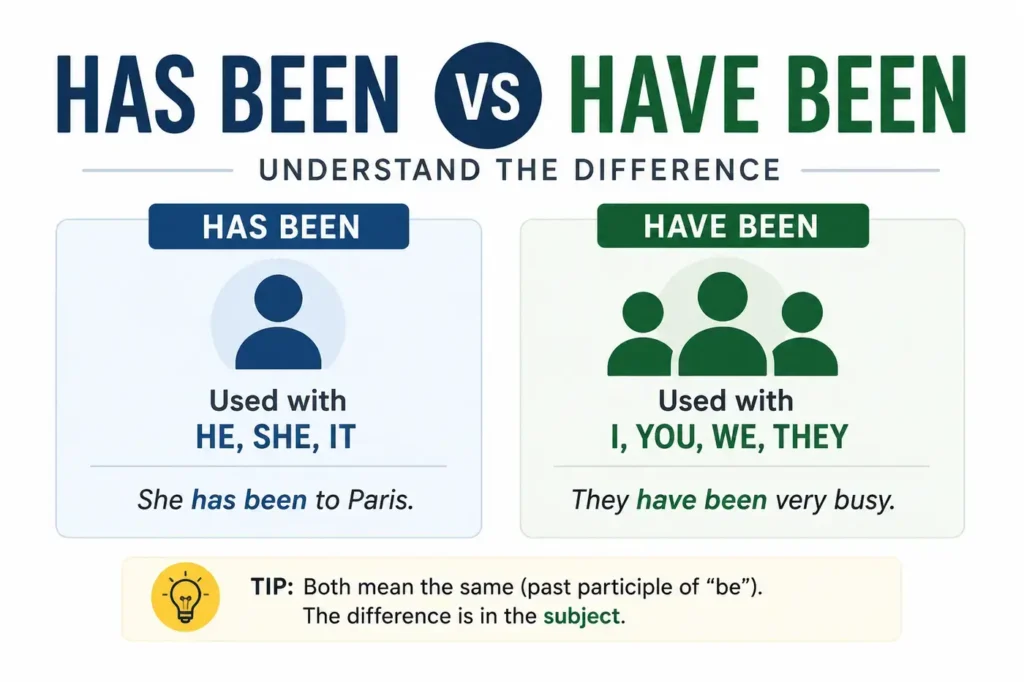
Has been is used with singular third person subjects like he, she, it or a singular noun. Have been is used with I, you, we, they, and plural nouns. Both belong to the present perfect tense and describe actions states or experiences connected to the present.
Quick Answer
The correct choice depends on the subject of the sentence.
- Use has been with singular subjects except I and you.
- Use have been with I, you, we, they, and all plural nouns.
- Both forms are grammatically correct when they match the subject.
For example.
- She has been busy all morning.
- They have been working since sunrise.
- The dog has been sleeping on the couch.
- My friends have been waiting outside.
A simple way to remember the rule is this. If the subject takes has use has been. If the subject takes have use have been.
Has Been Vs Have Been Comparison Table
| Feature | Has Been | Have Been |
|---|---|---|
| Part of speech | Present perfect verb phrase | Present perfect verb phrase |
| Origin | From the verb have with has and been | From the verb have with have and been |
| Correct form | Singular third person subjects | I you we they and plural subjects |
| Meaning | Describes a past action or state connected to the present | Describes a past action or state connected to the present |
| Formality level | Works in both formal and informal English | Works in both formal and informal English |
| Common contexts | Conversation writing education business emails news | Conversation writing education business emails news |
| Usage frequency | Very common | Very common |
| Example | He has been sick all week. | They have been busy all week. |
Meaning Of Has Been
Has been combines the helping verb has with the past participle been. It creates the present perfect tense for singular third person subjects.
The phrase describes an action condition or experience that began in the past and still matters now or has a clear connection to the present.
Examples include.
- My brother has been in New York since Monday.
- The weather has been pleasant this week.
- The teacher has been patient with every student.
- The restaurant has been popular for years.
- The movie has been a huge success.
In each sentence the action or condition started earlier but still has relevance now.
Etymology Of Has Been
The word has comes from Old English hæfð which developed from the verb have. The word been is the past participle of be one of the oldest verbs in the English language with roots stretching back to Proto Germanic and Proto Indo European languages.
Over time English combined helping verbs with past participles to create perfect tenses. That evolution gave us forms like has been and have been that are now essential in modern English.
Meaning Of Have Been
Have been also forms the present perfect tense but pairs with different subjects. It is used with I you we they and plural nouns.
Like has been it connects the past with the present. The action may still continue or its result still matters now.
Examples include.
- I have been studying for my exam.
- You have been very helpful today.
- We have been friends for years.
- They have been planning the trip for months.
- The children have been outside all afternoon.
Notice that the time frame reaches from the past into the present. That’s the main purpose of the present perfect tense.
Etymology Of Have Been
The helping verb have comes from Old English habban which meant to possess or hold. Over centuries it also became an auxiliary verb used to build perfect tenses.
When have joins the past participle been it forms a grammatical structure that expresses completed actions ongoing situations or experiences linked to the present.
Has Been Vs Have Been Meaning Differences
The biggest misconception is that has been and have been carry different meanings. They don’t.
Both phrases express the same tense and the same basic idea. The only difference is subject agreement.
Compare these examples.
- Emma has been reading for two hours.
- The students have been reading for two hours.
The activity is identical. The subject changes from singular to plural so the helping verb changes too.
Another comparison makes the pattern even clearer.
- The car has been in the garage all week.
- The cars have been in the garage all week.
Again the meaning stays the same. Only the number of the subject changes.
Has Been Vs Have Been Grammar Differences
Subject and verb agreement is the rule that decides which phrase to use.
Use has been after singular third person subjects.
Examples include.
- He has been excited all day.
- She has been preparing dinner.
- It has been raining since morning.
- The company has been growing rapidly.
- My phone has been acting strangely.
Use have been after I you we they and plural nouns.
Examples include.
- I have been learning Spanish.
- You have been very patient.
- We have been neighbors for years.
- They have been traveling together.
- The players have been practicing every evening.
This single grammar rule solves almost every case involving has been vs have been.
Which One Is Correct
Neither phrase is universally correct because each one serves a different subject.
Choose has been for singular third person subjects.
Examples.
- Sarah has been busy lately.
- My computer has been slow this week.
- The baby has been sleeping peacefully.
Choose have been for I you we they and plural nouns.
Examples.
- I have been waiting for your reply.
- You have been amazing.
- We have been lucky.
- They have been supportive.
- My cousins have been visiting every summer.
If you’re unsure look at the subject first. Once you identify it the correct choice becomes obvious.
Expert Tip
Professional editors rarely think about has been vs have been as separate grammar rules. They first identify the subject. After that the correct helping verb follows naturally.
A useful editing habit is to ignore the rest of the sentence for a moment and read only the subject and verb together.
- The manager has been.
- The managers have been.
- She has been.
- They have been.
That quick check catches most agreement mistakes before they reach your readers.
Has Been Vs Have Been Grammar Rules
Understanding the grammar behind has been vs have been is much easier once you know how the present perfect tense works.
The present perfect uses two parts.
- A helping verb.
- The past participle of the main verb.
In this case the helping verb is has or have and the past participle is been.
The formula looks like this.
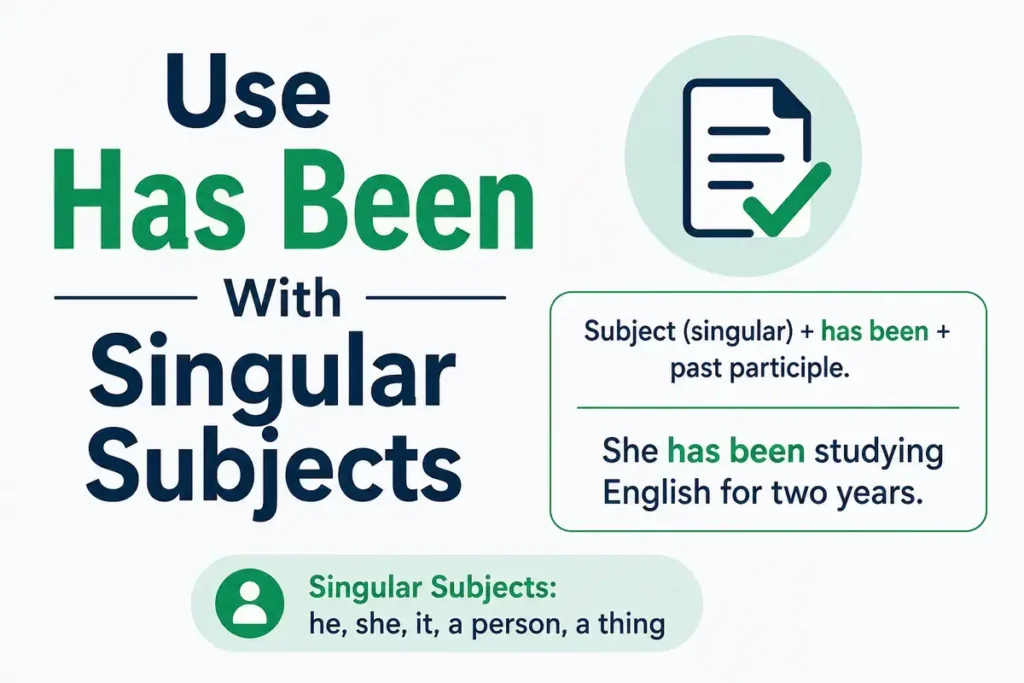
- Singular third person subject + has + been.
- I You We They or plural subject + have + been.
The verb been never changes. Only the helping verb changes to match the subject.
Use Has Been With Singular Subjects
Choose has been when the subject is a singular noun or the pronouns he she or it.
Examples.
- He has been working from home all week.
- She has been excited about the concert.
- It has been snowing since dawn.
- The dog has been barking for an hour.
- My laptop has been running slowly.
- The manager has been out of the office.
- The book has been on my desk all day.
- The restaurant has been busy tonight.
- The child has been quiet today.
- Every student has been respectful.
Use Have Been With Plural Subjects
Choose have been with I you we they and plural nouns.
Examples.
- I have been learning English every day.
- You have been very supportive.
- We have been neighbors for years.
- They have been planning their vacation.
- The teachers have been preparing new lessons.
- My parents have been traveling across Europe.
- The players have been practicing every afternoon.
- The books have been on the shelf for months.
- My friends have been calling all morning.
- The flowers have been blooming beautifully.
Has Been Vs Have Been In Different Sentence Types
The same agreement rule applies in positive negative and question forms.
Positive sentences.
- She has been studying since breakfast.
- They have been exercising together.
Negative sentences.
- He has not been feeling well.
- We have not been waiting very long.
Questions.
- Has your sister been here today?
- Have your coworkers been informed?
No matter how the sentence changes the subject still controls the helping verb.
Has Been Vs Have Been In Continuous Actions
People often see has been and have been inside longer verb phrases like has been working or have been studying.
This is the present perfect continuous tense.
It describes an activity that started in the past and continues now or recently ended with visible results.
Examples.
- She has been reading for three hours.
- I have been exercising every morning.
- The team has been improving steadily.
- We have been saving money for our trip.
- The baby has been crying all afternoon.
- They have been renovating their house.
- My neighbor has been planting flowers.
- The children have been playing outside.
- The company has been hiring new employees.
- You have been asking great questions.
Has Been Vs Have Been Examples In Sentences
Ten Examples Using Has Been
- My brother has been in Chicago since Monday.
- The teacher has been kind to every student.
- Sarah has been practicing the piano daily.
- The weather has been warm this week.
- The movie has been a huge success.
- The coffee has been sitting on the table for hours.
- The museum has been open since early morning.
- My phone has been unusually slow today.
- The project has been challenging but rewarding.
- The cat has been asleep most of the afternoon.
Ten Examples Using Have Been
- I have been thinking about your advice.
- You have been incredibly helpful.
- We have been friends since childhood.
- They have been waiting outside for thirty minutes.
- My grandparents have been married for fifty years.
- The students have been preparing for the final exam.
- My neighbors have been decorating their house.
- The birds have been singing since sunrise.
- The employees have been working overtime.
- We have been looking forward to this event.
Common Mistakes With Has Been Vs Have Been
Even advanced English speakers make mistakes from time to time. Most of them come from overlooking the subject instead of the verb.
Using Has With A Plural Subject
Incorrect.
The students has been studying all night.
Correct.
The students have been studying all night.
Using Have With A Singular Subject
Incorrect.
My sister have been busy.
Correct.
My sister has been busy.
Forgetting The Subject
Writers sometimes focus on the noun closest to the verb instead of the true subject.
Incorrect.
The box of books have been delivered.
Correct.
The box of books has been delivered.
The real subject is box not books.
Confusing Present Perfect With Simple Past
Incorrect.
She has been to Paris yesterday.
Correct.
She went to Paris yesterday.
Or.
She has been to Paris before.
The present perfect usually does not pair with finished time expressions like yesterday last week or in 2024.
Has Been Vs Have Been Pronunciation Guide
The pronunciation difference is small but important.
Has Been
IPA.
/hæz bɪn/ or /hæz biːn/
Syllables.
Has.
Been.
Many native speakers pronounce been like bin during casual conversation.
Have Been
IPA.
/hæv bɪn/ or /hæv biːn/
Syllables.
Have.
Been.
In relaxed speech people often reduce have so the phrase sounds smoother.
Common Pronunciation Mistakes
- Stressing both words equally.
- Pronouncing been differently in every sentence.
- Dropping the helping verb completely during careful speech.
Listening to native speakers in podcasts interviews and news broadcasts is one of the easiest ways to develop a natural rhythm.
Etymology And Word Origin
The phrase has been and have been comes from the history of the English perfect tense.
Old English used forms of the verb have together with past participles to describe completed actions connected to the present.
The verb be is one of the oldest words in English. Its past participle been developed over centuries through Germanic languages before reaching its modern form.
Today English relies on this structure every day.
Examples include.
- She has been happy lately.
- We have been busy this month.
- It has been difficult.
- They have been successful.
Although English vocabulary continues to evolve this grammar pattern has remained remarkably stable for hundreds of years.
Has Been Vs Have Been Regional Usage
English speakers around the world follow the same grammar rule for has been vs have been.
American English
American English uses both forms exactly according to subject agreement.
Examples.
- My car has been reliable.
- We have been working remotely.
British English
British English follows the same grammar.
British speakers may use the present perfect even more often than American speakers in everyday conversation.
Example.
I have been waiting for ages.
Canadian English
Canadian English closely matches American English while keeping some British influences.
The rule for has been and have been does not change.
Australian English
Australian English also follows identical subject agreement.
Informal speech may sound different because of accent and rhythm but the grammar remains the same.
This consistency makes the rule easy to remember. Once you learn the correct subject agreement you can confidently use these phrases in English almost anywhere in the world.
Has Been Vs Have Been In Real Life
Grammar rules make more sense when you see them in everyday situations. Native speakers don’t stop to think about has vs have. They naturally match the helping verb to the subject.
Daily Conversation
- She has been really busy this week.
- I have been thinking about getting a new car.
- They have been waiting for us.
- The baby has been sleeping all afternoon.
- We have been watching that TV series together.
Academic Writing
You’ll often see the present perfect when discussing research findings or ongoing studies.
Examples.
- The research has been widely accepted.
- Scientists have been studying climate patterns for decades.
- The theory has been revised several times.
- Researchers have been collecting data since January.
- The results have been consistent across multiple studies.
Professional Communication
Business writing frequently uses these forms to describe ongoing projects and completed work with present relevance.
Examples.
- The project has been approved.
- We have been reviewing your application.
- The team has been meeting every Friday.
- Our clients have been satisfied with the service.
- The report has been submitted.
Literature And Media
Books newspapers and magazines regularly use the present perfect to connect past events with current situations.
Examples.
- The city has been transformed over the years.
- People have been discussing the issue online.
- The actor has been praised by critics.
- Fans have been sharing their opinions on social media.
- The novel has been translated into many languages.
Related Words And Commonly Confused Terms
Several grammar structures look similar to has been and have been. Learning the differences helps you write with more confidence.
Had Been
This form belongs to the past perfect tense.
Example.
She had been waiting before the train arrived.
The action happened before another event in the past.
Has Gone And Have Gone
These forms show that someone went somewhere and has not returned.
Example.
My brother has gone to the store.
Has Been To And Have Been To
These phrases describe visiting a place and returning.
Examples.
- She has been to Japan twice.
- They have been to New York several times.
Is And Are
These verbs describe a present state instead of connecting the past with the present.
Example.
She is happy today.
Was And Were
These forms describe completed situations in the past.
Example.
They were excited yesterday.
Understanding these related structures makes it easier to recognize the role of has been and have been in English grammar.
Expert Language Insight
One habit separates experienced writers from beginners. They don’t memorize long grammar rules. They look at the subject first.
Professional editors often scan a sentence for the subject before checking anything else. Once the subject is clear the correct helping verb usually becomes obvious.
Another useful habit is reading your sentence aloud. Your ear often catches agreement mistakes that your eyes miss.
Compare these two sentences.
- The employees has been working late.
- The employees have been working late.
Most native speakers immediately notice that the second sentence sounds natural.
If you’re proofreading an important document slow down and check every helping verb. Small grammar mistakes may seem harmless but they can affect credibility in business academic and professional writing.
Frequently Asked Questions
Is Has Been Or Have Been More Common?
Both are extremely common because they belong to the present perfect tense. The one you use depends entirely on the subject. Neither form is more correct or more formal than the other.
Can I Use Has Been With I?
No. The pronoun I always takes have been.
Correct example.
I have been busy all week.
Can I Use Have Been With A Singular Noun?
Usually no.
Singular third person nouns take has been.
Correct example.
The teacher has been helpful.
Is Has Been Past Or Present Tense?
It belongs to the present perfect tense. The action began in the past but still connects to the present.
Why Do Native Speakers Mix Them Up?
Most native speakers actually use these forms correctly during conversation. Mistakes usually happen while writing quickly proofreading poorly or dealing with long complicated sentences.
Can Has Been And Have Been Show Ongoing Actions?
Yes. They often appear in the present perfect continuous tense.
Example.
They have been studying for three hours.
The action started earlier and is still happening now.
Do British And American English Use Different Rules?
No. Both varieties follow the same subject agreement rule.
Only vocabulary spelling and pronunciation differ in some situations. The grammar stays the same.
What Is The Easiest Way To Remember Has Been Vs Have Been?
Start with the subject.
If the subject takes has use has been.
If the subject takes have use have been.
This simple check solves almost every grammar question involving these phrases.
Final Thoughts
Choosing between has been vs have been is easier than many people think. The meaning stays the same. The helping verb changes to match the subject.
Use has been with singular third person subjects like he, she, it or a singular noun.
Use have been with I, you, we, they, and plural nouns.
When proofreading don’t focus on the entire sentence at once. Find the subject first. Then match the helping verb to it. This simple habit helps you avoid one of the most common grammar mistakes in English.
The more you read and write the more natural this pattern becomes. Before long you’ll choose the correct form without stopping to think about the rule.