Have you ever typed pricy or pricey into a search engine because one spelling just did not look right? You are not alone. This is one of those English words that causes plenty of hesitation, even among native speakers. Since both versions appear online, it is easy to wonder if they are interchangeable or if one is simply a common misspelling.
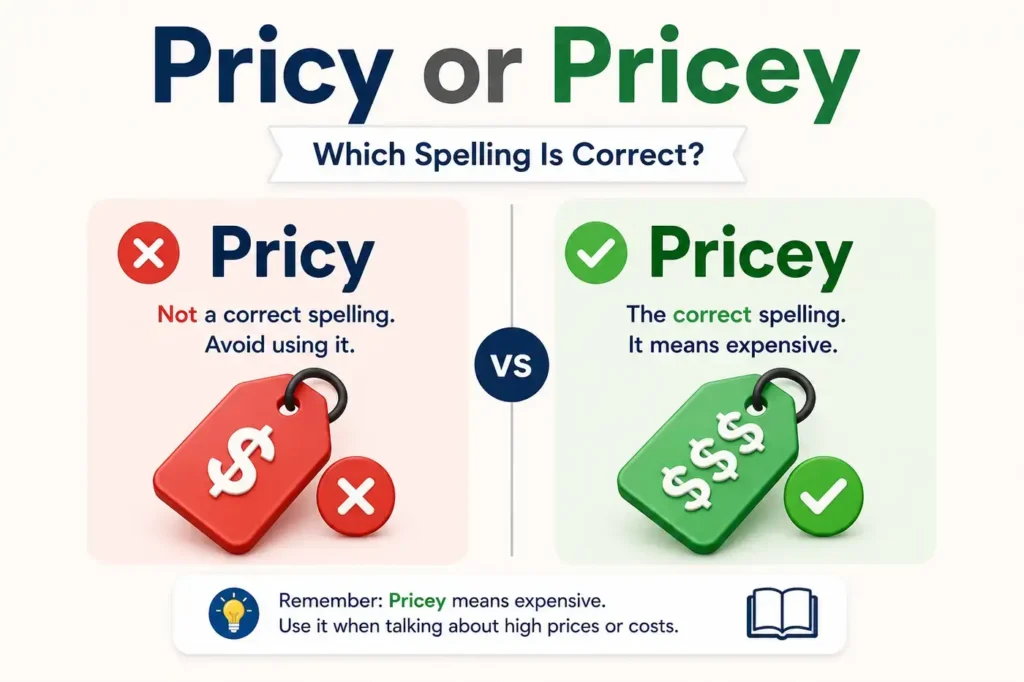
The short answer is straightforward. Pricey is the standard and widely accepted spelling in American English, British English, Australian English, and Canadian English. Pricy is also recognized by many modern dictionaries and style guides, but it is far less common. Most editors, publishers, and professional writers prefer pricey because it has become the dominant spelling in modern English.
This article explains the difference in clear and simple language. You will learn the meaning of both spellings, discover their history, see how native speakers use them, compare examples, understand regional preferences, and avoid common writing mistakes. By the end, you will know which spelling fits your audience and why one form appears much more often in everyday writing.
Quick Definition
Pricey and pricy both describe something that costs a lot of money or seems expensive. The words share the same meaning and pronunciation. The main difference is usage. Pricey is the preferred spelling in modern English and appears far more often in dictionaries, books, newspapers, and professional writing.
Quick Answer
If you want the safest choice, use pricey.
Although pricy is accepted by several dictionaries, it is much less common. Most professional editors, teachers, publishers, and style guides recommend pricey because it is the spelling readers expect to see.
Here is the simple rule to remember.
- Use pricey for school assignments, business writing, blogs, books, and professional communication.
- You may see pricy in informal writing or online discussions, but it is relatively uncommon.
- If consistency and readability matter, stick with pricey throughout your writing.
Comparison Table
| Feature | Pricy | Pricey |
|---|---|---|
| Part of speech | Adjective | Adjective |
| Meaning | Expensive or costing more than expected | Expensive or costing more than expected |
| Origin | Variant spelling of pricey | Derived from the noun price with the suffix y |
| Accepted spelling | Recognized but uncommon | Standard and preferred |
| Formality | Informal to neutral | Informal to neutral |
| Common contexts | Online discussions casual writing | Everyday speech journalism blogs marketing books |
| Usage frequency | Low | Very high |
| Pronunciation | Same | Same |
| Example | The restaurant looks pricy. | The restaurant looks pricey. |
If you’re trying to improve your writing accuracy, understanding the difference between ensure and insure can help you avoid another commonly confused pair of English words.
Meaning Of Each Spelling
Both words describe something that costs a lot or feels expensive for its value. They carry the same definition, but one spelling has become much more popular over time.
What Does Pricey Mean
Pricey is an adjective used to describe products, services, experiences, or anything that seems expensive. It does not always mean something is overpriced. Sometimes it simply suggests that the cost is higher than expected.
For example, someone might call a luxury hotel pricey because it costs more than an average hotel. That does not automatically mean the hotel is poor value. It simply highlights the higher price.
You will often hear pricey in conversations about:
- Restaurants.
- Clothing.
- Electronics.
- Cars.
- Homes.
- Vacations.
- Concert tickets.
- Everyday shopping.
Here are a few natural examples.
- That laptop is a little pricey for my budget.
- The new restaurant is excellent, but it is quite pricey.
- Their furniture looks beautiful, although it is fairly pricey.
What Does Pricy Mean
Pricy has exactly the same meaning as pricey. The only real difference is that it appears less frequently in modern English.
Some dictionaries list pricy as an alternative spelling, while others mention it as a variant of pricey. Because readers are much more familiar with pricey, many editors choose that spelling to avoid distracting the audience.
You may still come across pricy in places such as:
- Online forums.
- Social media posts.
- Personal blogs.
- Informal messages.
- User reviews.
Although the meaning never changes, using pricey generally makes your writing look more polished and consistent.
Key Differences
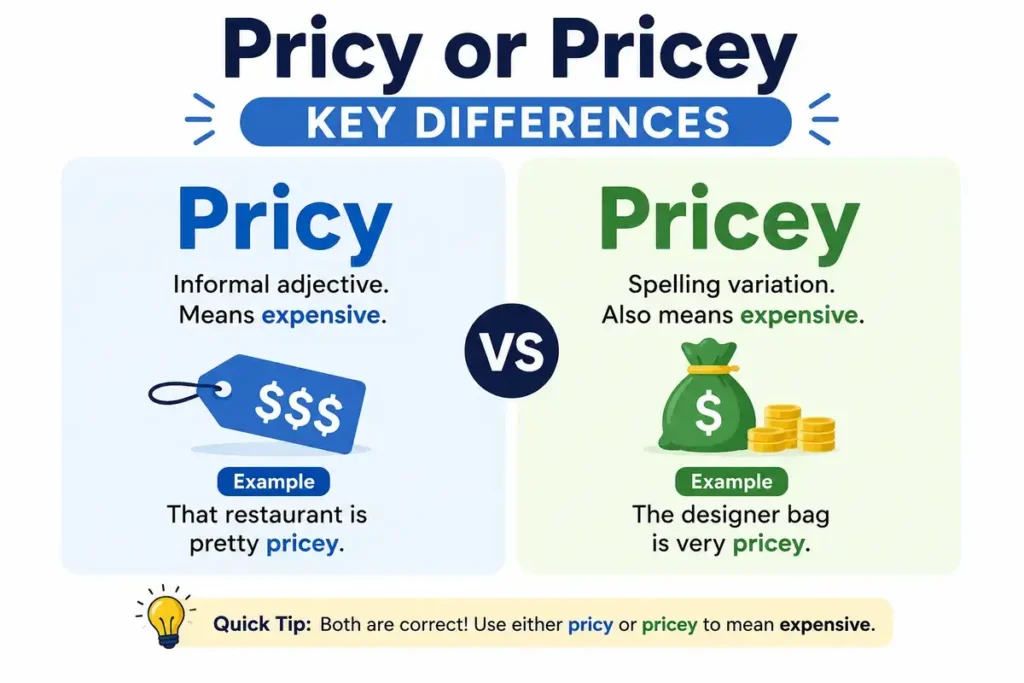
Since both spellings mean the same thing, many writers assume there is no practical difference. In everyday conversation that is mostly true, but there are a few important distinctions worth knowing.
The biggest difference is popularity. Pricey has become the standard spelling across modern English, while pricy appears much less often. Most dictionaries recognize both forms, yet newspapers, publishers, and professional editors overwhelmingly favor pricey.
Here are the main differences at a glance.
| Pricy | Pricey |
|---|---|
| Alternative spelling | Standard spelling |
| Less common | More common |
| Seen mainly in informal writing | Used in both informal and professional writing |
| Recognized by many dictionaries | Preferred by most dictionaries and editors |
| May surprise some readers | Familiar to most readers |
Another difference involves reader expectations. Most people instinctively recognize pricey because they have seen it countless times in books, magazines, advertisements, and online articles. When readers encounter pricy, they may briefly wonder if it is a typo, even though it is an accepted variant.
For that reason, experienced editors usually recommend choosing the spelling that feels most familiar to the widest audience.
Which Spelling Should You Use
If your goal is clear, professional, and natural writing, pricey is the better choice.
That recommendation is not based on personal preference. It reflects current usage across major dictionaries, publishing houses, newspapers, and educational resources. Since pricey appears far more often in modern English, readers recognize it immediately.
Before deciding which spelling to use, keep these points in mind.
- Choose pricey for articles, books, emails, reports, marketing copy, and academic writing.
- Expect to see pricy occasionally in informal online conversations.
- Follow your publication’s style guide if one is available.
- Once you choose a spelling, use it consistently throughout the document.
Consistency is one of the simplest ways to make your writing look more professional.
Pronunciation Guide
One reason people become confused is that both spellings sound exactly the same.
IPA pronunciation:
/ˈpraɪ.si/
Syllable breakdown:
Price y
Since pricy and pricey share the same pronunciation, listeners cannot tell which spelling you mean during a conversation. The difference exists only in writing.
Here are a few pronunciation tips.
- Stress the first syllable.
- Pronounce the ending like the word see.
- Do not add an extra syllable.
- Both spellings are spoken exactly the same way.
Expert Language Insight
Professional editors rarely reject pricy because it is incorrect. They replace it because pricey has become the expected spelling in modern English.
Language changes over time through repeated use. When one spelling consistently appears in books, newspapers, dictionaries, and digital publications, readers naturally become more familiar with it. That familiarity improves readability because people can focus on the message instead of noticing an unusual spelling.
If you are writing for a broad audience, choosing the spelling readers expect is usually the smartest editorial decision. It keeps your content clear, polished, and easy to read without changing the meaning of what you want to say.
Like deciding between pricy and pricey, knowing the correct spelling of duchess can prevent subtle spelling mistakes that often slip past spell check.
Examples In Sentences
Seeing both spellings in real sentences makes the difference much easier to understand. As you read these examples, notice that the meaning never changes. The only noticeable difference is the spelling.
Pricey Examples
These examples use the preferred spelling found in most modern dictionaries and publications.
- The hotel was beautiful, but it was too pricey for our vacation budget.
- That new smartphone looks impressive, although it feels a little pricey.
- We almost bought the sofa, but it turned out to be pricier than we expected.
- Fresh seafood can be quite pricey during the holiday season.
- Their handmade furniture is pricey, but the craftsmanship is outstanding.
- The concert tickets became surprisingly pricey after they sold out.
- This neighborhood is known for its pricey homes and luxury apartments.
- The designer handbag is undeniably stylish, but it is also very pricey.
- Organic groceries are sometimes pricier than regular products.
- The mechanic did excellent work, although the repair bill was fairly pricey.
These examples show that pricey often describes something that costs more than average. It does not always suggest poor value. In many cases, the higher price reflects better quality, premium materials, or exclusive features.
Pricy Examples
The following examples use the less common variant.
- The café looked nice, but the menu seemed a little pricy.
- Their vacation packages can be pricy during the summer months.
- That watch is pricy compared with similar models.
- Some shoppers avoid the store because they think it is too pricy.
- The apartment feels pricy for such a small space.
- Those imported chocolates are quite pricy.
- The repair service was reliable, although it seemed pricy.
- I expected the headphones to be expensive, but they were even more pricy than I imagined.
- The boutique sells unique clothing, but many customers consider it pricy.
- Several online reviews described the restaurant as pricy.
Although these sentences are grammatically correct, many editors would simply replace pricy with pricey because it is the more familiar spelling.
Common Mistakes Pricey Or Pricy
Most confusion comes from seeing both spellings online. Since search engines, forums, and social media include content from many writers, it is easy to assume both forms are equally common. They are not.
Here are the mistakes people make most often.
Assuming Pricy Is Wrong
Many writers believe pricy is always a misspelling.
That is not entirely accurate. Several respected dictionaries recognize it as a valid variant. The problem is not correctness. It is frequency. Most readers encounter pricey far more often, so it feels more natural.
Mixing Both Spellings
Some writers begin an article with one spelling and later switch to the other.
That inconsistency distracts readers and makes the writing feel less polished.
Choose one spelling and use it throughout the entire document.
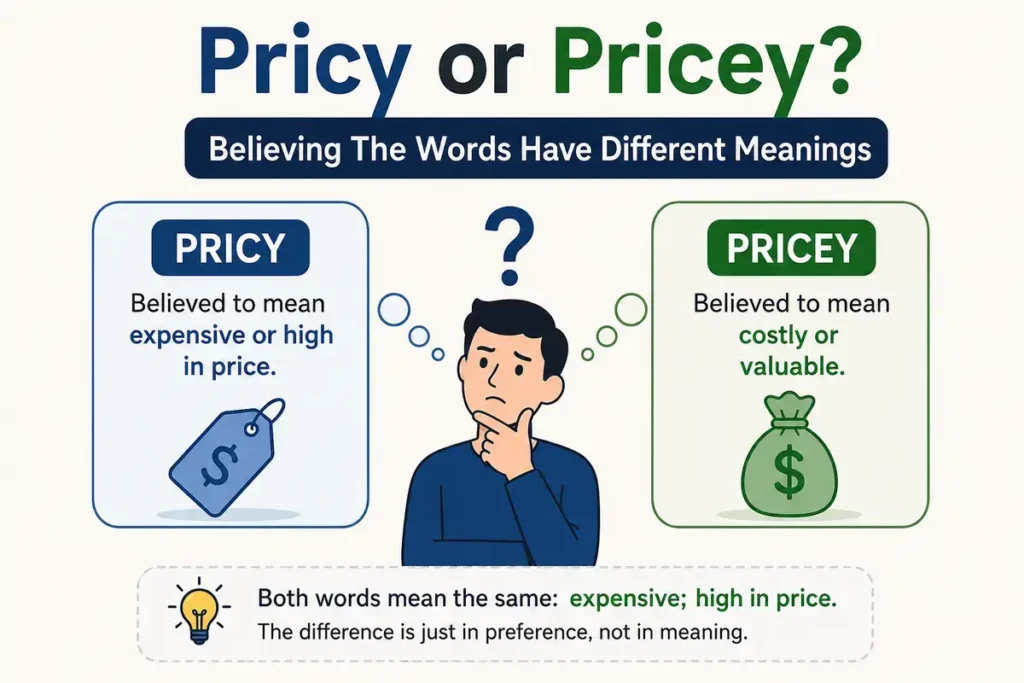
Believing The Words Have Different Meanings
Another common misconception is that one word means expensive while the other means overpriced.
There is no meaningful difference in definition. Both adjectives describe something that costs a lot or seems expensive.
Relying On Internet Popularity Alone
You may notice both spellings in online searches or discussion forums.
That does not mean they carry the same editorial weight. Informal websites often reflect personal preference rather than professional writing standards.
When accuracy matters, check a trusted dictionary or follow your publication’s style guide.
Etymology And Word Origin
Understanding a word’s history often explains why multiple spellings exist.
The noun price entered English through Old French, which borrowed it from the Latin word pretium, meaning value, worth, or cost.
As English evolved, writers added the suffix y to create the adjective pricey, describing something that carries a high price.
Over time, the shorter spelling pricy also appeared. English contains many words that developed alternative spellings through everyday use, and this is one example.
Although both spellings have existed for many years, published books, newspapers, magazines, and professional editors gradually favored pricey. That preference became stronger as dictionaries and style guides standardized modern English.
Today, both forms remain understandable, but one clearly dominates everyday writing.
Regional Usage
Unlike many spelling differences that separate American and British English, this pair does not follow a strict regional pattern.
American English
American dictionaries generally recognize both spellings. Still, pricey appears much more frequently in newspapers, magazines, educational resources, and business writing.
If your audience is in the United States, pricey is the safest and most natural choice.
British English
British English also favors pricey.
You’ll find it in newspapers, books, online publications, and everyday conversations. Although pricy occasionally appears, it remains uncommon.
Australian English
Australian writers typically use pricey as well.
The spelling matches what readers expect in newspapers, websites, and professional communication.
Canadian English
Canadian English follows the same general pattern.
Both spellings are recognized, but pricey is considerably more common in published writing.
Across all four major English varieties, the preference is remarkably consistent. That makes this one of the easier spelling decisions for writers because you do not need to switch spellings for different audiences.
Grammar Rules
Both spellings function exactly the same way in English grammar.
Part Of Speech
Both words are adjectives.
They describe nouns by indicating that something costs a lot or seems expensive.
Examples include:
- A pricey restaurant.
- A pricey vacation.
- A pricey handbag.
Comparative Form
When comparing two things, use the comparative adjective pricier.
Examples:
- This laptop is pricier than the older model.
- Downtown apartments are usually pricier than homes in the suburbs.
Superlative Form
To describe something with the highest price in a group, use priciest.
Examples:
- That is the priciest meal on the menu.
- It became one of the priciest houses in the neighborhood.
Common Sentence Patterns
Native speakers often use these structures.
- Too pricey for my budget.
- Slightly pricier than expected.
- Surprisingly pricey.
- Quite pricey compared with similar products.
- A bit pricey, but worth it.
These expressions sound natural because they appear regularly in everyday conversations.
Real Life Usage Examples
The adjective appears in many situations outside dictionaries and grammar books.
Daily Conversation
People commonly use it when discussing purchases and everyday expenses.
Examples include:
- That coffee shop is a little pricey.
- I love the jacket, but it is too pricey for me.
- The vacation looked amazing, although it was fairly pricey.
Academic Writing
Formal academic papers usually avoid informal adjectives like pricey.
Instead, writers often choose words such as expensive, high cost, or costly.
Even so, pricey may appear in quotations, surveys, or discussions of everyday language.
Professional Communication
Businesses sometimes use pricey in blog posts, customer reviews, and marketing content because it sounds conversational and relatable.
In formal reports, writers usually prefer more precise terms like premium priced or higher priced.
Literature
Novelists often choose pricey in dialogue because it reflects natural speech.
For example, a character might say that a restaurant is “a little pricey” instead of describing it as expensive.
Media And Product Reviews
Technology websites, travel blogs, food critics, and consumer reviews regularly describe products or services as pricey.
The word communicates that something costs more than expected while keeping the tone friendly and conversational.
Related Words And Commonly Confused Terms
English has plenty of words that describe something with a high cost, but each carries a slightly different meaning. Choosing the right one helps your writing sound more natural and precise.
Here are some common alternatives and related terms.
- Expensive describes something with a high price. It is the most neutral and widely used option.
- Costly often appears in formal or business writing and may describe money, time, or consequences.
- Overpriced suggests something costs more than it is worth.
- Premium refers to products or services positioned at the higher end of the market.
- High priced is a straightforward description commonly used in retail and marketing.
- Luxury describes items associated with exceptional quality and a premium price.
- Exorbitant emphasizes an unreasonably high price.
- Steep is an informal way to describe a price that feels higher than expected.
Although these words are related, they are not perfect substitutes. For example, calling a watch pricey simply suggests it costs a lot, while calling it overpriced adds the opinion that it is not worth the money.
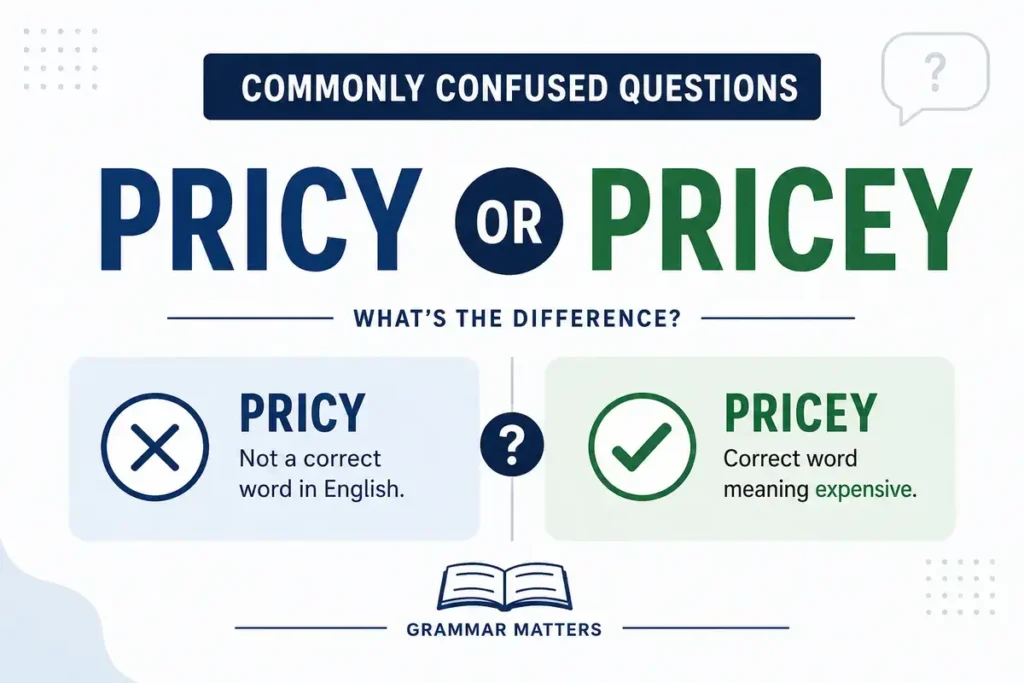
Commonly Confused Questions
People often search for similar questions because they are unsure about spelling or usage.
- Pricey or expensive. Both words describe something that costs a lot. Expensive is more neutral and works well in formal writing. Pricey sounds slightly more conversational and often suggests that the cost feels higher than expected.
- Pricey person meaning. When describing a person, pricey usually refers to someone with expensive tastes or someone who expects costly gifts, services, or experiences. This usage is informal and depends heavily on context.
- Pricey synonym. Common synonyms include expensive, costly, high priced, premium, luxurious, and overpriced, depending on the intended meaning.
- Pricy in Scrabble. Pricy is accepted in many modern dictionaries used by word games, but always check the official dictionary your tournament or app follows because word lists can differ.
- Funny uses. People sometimes jokingly describe everyday items as pricey, such as a cup of coffee, a slice of pizza, or a movie ticket, to exaggerate how expensive they feel.
This variation is similar to other regional spelling choices, including British and American spelling differences, where the preferred form depends on the audience you’re writing for.
Expert Language Insight
One reason this spelling question continues to appear online is that both forms are legitimate. Many writers expect English to have only one correct spelling, but the language has always included alternative forms that developed through history and usage.
Professional editors rarely ask, “Is this spelling acceptable?” Instead, they ask, “Which spelling will feel most natural to the intended audience?”
That small difference changes the decision.
If you are writing an email to a friend, either form will probably be understood. If you are publishing a blog post, writing marketing copy, preparing a report, or submitting an academic assignment, pricey is usually the better editorial choice because it matches what most readers see every day.
Native speakers also use the word with a particular tone. Saying something is pricey often sounds lighter and more conversational than calling it expensive. It can even soften criticism.
Compare these examples.
- “That restaurant is expensive.” This sounds direct and factual.
- “That restaurant is a little pricey.” This feels more conversational and less critical.
That subtle difference explains why the word appears so often in reviews, travel blogs, shopping guides, and everyday conversations.
Frequently Asked Questions
Is pricy a real word?
Yes. Pricy is recognized by several modern dictionaries as a variant spelling. Even so, it appears much less often than pricey, which is the preferred choice in most published writing.
Which spelling should I use?
For most situations, choose pricey. It is the spelling readers are most familiar with and the one commonly used by publishers, businesses, and professional editors.
Do both words have the same meaning?
Yes. Both adjectives describe something that costs a lot or seems expensive. The difference lies in frequency and reader expectations, not in meaning.
Is one spelling American and the other British?
No. Unlike spelling pairs such as color and colour, this pair does not follow a clear regional pattern. Writers in the United States, the United Kingdom, Australia, and Canada generally prefer pricey.
Can I use the word in formal writing?
You can, but consider your audience. In highly formal documents, words such as expensive, costly, or high priced may fit the tone better. In blogs, reviews, and general business writing, pricey sounds perfectly natural.
Why does one spelling appear more often online?
Search results reflect how people write, not just what dictionaries accept. Because publishers and content creators overwhelmingly choose pricey, it naturally appears more often in books, articles, and websites.
Does pronunciation change with the spelling?
No. Both spellings share the same pronunciation.
The IPA pronunciation is /ˈpraɪ.si/, and native speakers pronounce them identically.
How can I remember the preferred spelling?
Think of the word price followed by the letter y. Since that spelling appears in most books, articles, and dictionaries, it quickly becomes the easiest version to recognize and remember.
Conclusion
The answer is simple. Both spellings are accepted, but pricey is the form you’ll see most often in modern English. It appears consistently in dictionaries, books, newspapers, websites, and professional writing, making it the safest choice for almost every situation.
The alternative spelling is not wrong, but it is far less common. Because many readers are unfamiliar with it, using the preferred form helps your writing feel smoother and more polished.
If you are writing for school, work, a blog, or a broad online audience, stick with pricey and use it consistently. That small decision improves readability and matches the expectations of most English speakers.
Whenever you are unsure about pricy or pricey, remember this simple rule. Both spellings are recognized, but pricey is the preferred choice in modern English because it is far more common in dictionaries, books, and professional writing. If your goal is clear, natural, and polished writing, pricey is almost always the best option.