If you have ever wondered about centre vs center, you are asking a question that even fluent English speakers pause to answer. Both words are correct, both have the same meaning, and both appear in trusted dictionaries. The difference is not about right or wrong. It comes down to the type of English you are using and the audience you are writing for.
This spelling difference appears everywhere. You might see city centre on a British travel website, then read shopping center on an American business page. The same pattern applies to signs, books, newspapers, schools, and official documents. If you switch between British and American English without realizing it, your writing can look inconsistent.
This guide explains everything in clear, simple language. You will learn the meaning of each spelling, how they developed, where they are commonly used, and how professional editors decide which one to choose. You will also find practical examples, grammar guidance, pronunciation tips, and expert writing advice that helps you pick the right spelling with confidence.
Quick Definition
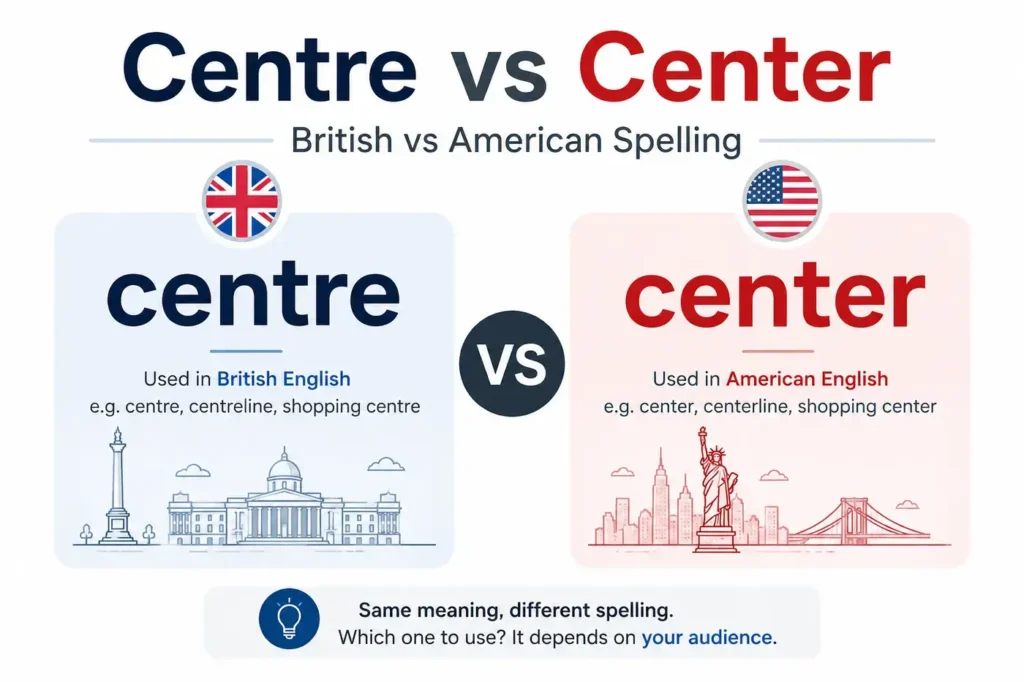
Centre and center are two accepted spellings of the same word. Center is the standard spelling in American English, while centre is preferred in British English and most countries that follow British spelling conventions. Their meaning, pronunciation, and grammar are identical. The only difference is regional spelling.
Quick Answer
The answer is straightforward once you know your audience.
- Use center when writing for readers in the United States.
- Use centre when writing for readers in the United Kingdom.
- Australia and New Zealand also prefer centre.
- Canadian English uses centre in most formal writing, although center appears in some business names and brands.
- Choose one spelling and use it consistently throughout your document.
If your organization follows a style guide, always follow that standard. Consistency is one of the first things editors look for when reviewing content.
Just as common chef spelling mistake can confuse writers, choosing between centre and center depends on following the correct spelling convention for your audience.
Comparison Table Centre vs Center
| Feature | Centre | Center |
|---|---|---|
| Part of speech | Noun Verb Adjective | Noun Verb Adjective |
| Meaning | Middle point or place | Middle point or place |
| Preferred spelling | British English | American English |
| Origin | Traditional British spelling | American spelling standardized by language reform |
| Formality | Standard | Standard |
| Common contexts | Education Government Media Travel | Business Education Media Everyday writing |
| Usage frequency | Higher outside the United States | Higher in the United States |
| Pronunciation | Same | Same |
| Example | The town centre was busy. | The shopping center was crowded. |
Meaning Of Both Words
Although the spellings are different, they share the same definition. Both words refer to the middle of something or a place where activities, services, or people come together.
What Does Centre Mean
Centre is the traditional British spelling. It can describe a physical location, an organization, or the middle point of an object.
For example:
- The town centre was full of visitors.
- The community centre offers evening classes.
- Draw a circle and mark its centre.
- The research centre published a new report.
- She stood in the centre of the room.
British newspapers, universities, government agencies, and publishers almost always use this spelling.
What Does Center Mean
Center carries exactly the same meaning but follows American spelling conventions. It appears in schools, businesses, government publications, newspapers, and everyday writing throughout the United States.
Common examples include:
- The shopping center closes at nine.
- He stood at the center of the stage.
- The medical center serves the entire county.
- The conference center welcomed thousands of visitors.
- The training center opened last year.
Both spellings work as nouns, verbs, and adjectives depending on the sentence.
Key Differences
At first glance, these spellings look quite different, but the differences are surprisingly small. They do not change the definition, pronunciation, or grammar. The only real distinction is the variety of English being used.
Here are the main differences.
| Centre | Center |
|---|---|
| British spelling | American spelling |
| Common in the United Kingdom | Common in the United States |
| Used across Australia and New Zealand | Used throughout American publications |
| Appears in many Canadian publications | Appears in American companies and organizations |
| Same pronunciation | Same pronunciation |
| Same meaning | Same meaning |
When choosing between the two, think about your readers instead of the word itself. A British audience expects centre, while an American audience naturally expects center.
Which Spelling Is Correct
Both spellings are correct. The better choice depends entirely on the type of English you are writing.
Professional editors rarely ask which spelling is correct. Instead, they ask which spelling matches the publication’s language style. That is why you will see centre in British newspapers and center in American newspapers, even when the articles discuss the same topic.
To choose the correct spelling, follow these simple guidelines.
- Writing for readers in the United States. Use center.
- Writing for readers in the United Kingdom. Use centre.
- Writing for an international audience. Follow your company’s or publisher’s style guide.
- Editing an existing document. Match the spelling already used throughout the content.
Keeping the spelling consistent helps readers focus on your message instead of noticing unnecessary changes.
Pronunciation Guide
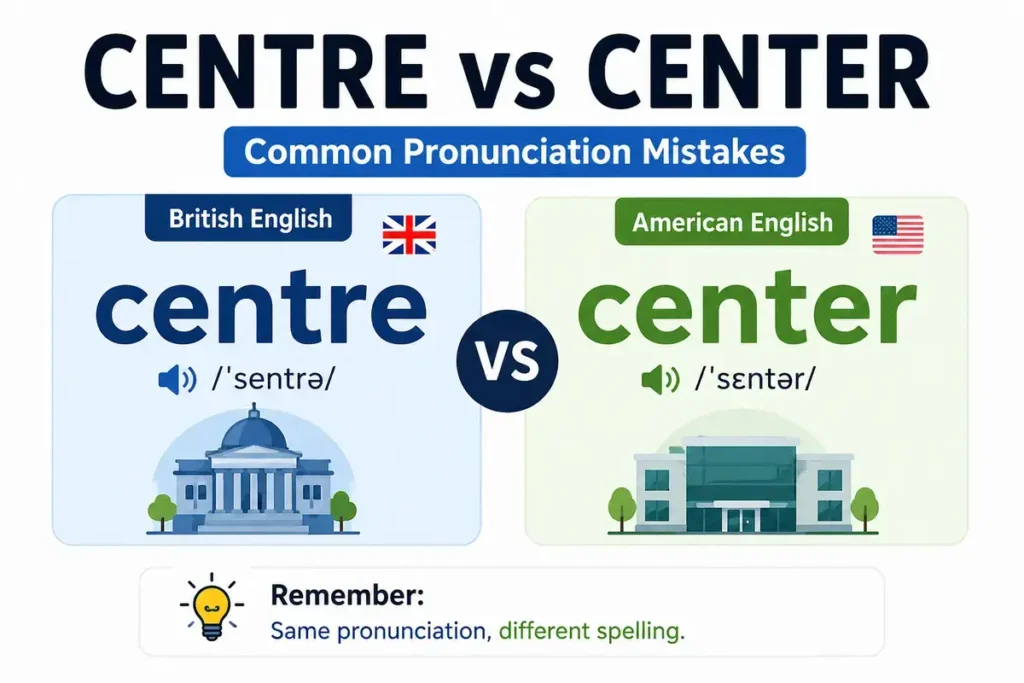
One reason this spelling pair causes confusion is that both words sound exactly the same when spoken. Changing the letters does not change the pronunciation.
IPA Pronunciation
/ˈsɛn.tər/
This pronunciation applies to both spellings.
Syllable Breakdown
- Cen.
- Ter.
The word has two syllables regardless of the spelling.
Common Pronunciation Mistakes
Most pronunciation mistakes come from overthinking the spelling instead of listening to the spoken word.
Keep these points in mind.
- Do not pronounce centre differently from center.
- The ending sounds the same in both British and American English.
- Focus on natural speech instead of the written letters.
If you hear native speakers from different English speaking countries, you may notice slight differences in accent. Those accent differences are normal, but the word itself is pronounced in essentially the same way.
Expert Learning Tip Centre vs Center
Many learners spend too much time trying to memorize which spelling belongs to which country. A more effective approach is to connect each spelling with the other words used in that variety of English.
For example, American English uses center, color, favorite, and theater. British English uses centre, colour, favourite, and theatre. Learning these spelling patterns together is much easier than memorizing each word on its own.
Once you recognize the pattern, choosing the correct spelling becomes almost automatic. Instead of asking which word is right, you simply ask which variety of English you are writing.
Examples In Sentences
Reading real examples is one of the easiest ways to understand when each spelling belongs. Since both words have the same meaning, the examples below focus on the audience and writing style instead of the definition.
Centre Examples
These sentences follow British English conventions.
- The town centre becomes busy every Saturday morning.
- A new community centre opened near the library.
- The conference will take place at the city centre.
- She waited in the centre of the garden for her friends.
- The sports centre offers swimming lessons for children.
- The research centre published its annual report yesterday.
- Tourists gathered in the historic town centre before the parade.
- The shopping centre has more than one hundred stores.
- The visitor centre provides free maps and travel advice.
- The science centre attracts thousands of students every year.
Notice that every example would sound perfectly natural to readers in the United Kingdom, Australia, and many other countries that follow British English.
Consistency in regional spelling helps understanding the difference between commonly confused word pairs like ensure and insure, preventing unnecessary writing mistakes.
Center Examples
These sentences use American English spelling.
- The shopping center is open until ten tonight.
- She stood at the center of the stage during the performance.
- The medical center added a new emergency department.
- Our community center offers free fitness classes.
- The city plans to build a new recreation center next year.
- The training center welcomed employees from across the country.
- He placed the table in the center of the room.
- The conference center hosted more than five thousand visitors.
- The visitor center is located near the park entrance.
- The technology center supports local startup companies.
Although the spelling changes, the meaning stays exactly the same in every example.
Common Mistakes
One of the biggest mistakes people make when comparing centre vs center is mixing American and British spellings in the same document. That inconsistency can distract readers and make otherwise polished writing look unprofessional. Choosing the spelling that matches your audience and using it consistently throughout the content creates a smoother reading experience and reflects careful editing.
Here are the mistakes editors see most often.
Mixing Both Spellings
Many writers use centre in one paragraph and center in the next without noticing.
For example:
Incorrect.
The shopping centre has a new food court. The entertainment center opens tomorrow.
Correct.
Choose one spelling and use it consistently throughout the document.
Assuming One Spelling Is Wrong
A common misconception is that one version is correct and the other is a mistake.
That is not true.
Both spellings are accepted by major dictionaries and style guides. The choice depends on the variety of English you are using.
Ignoring The Target Audience
Some writers copy text from American and British websites into the same article. This often results in mixed spellings.
Before publishing, ask yourself these questions.
- Who will read this content?
- Which variety of English do they expect?
- Does every spelling match that audience?
Confusing Business Names With Standard Spelling
Business names do not always follow regional spelling rules.
For example, you may find an organization in a British English speaking country that uses Center as part of its official name. Likewise, some companies in the United States use Centre for branding.
Always use the official spelling when referring to a specific business or organization.
Word Origin And History
The history of these spellings begins long before modern English.
The word comes from the Latin word centrum, meaning the middle point of a circle. It later entered Old French as centre before becoming part of Middle English.
For centuries, English writers generally used centre. During the nineteenth century, American spelling reforms led by lexicographer Noah Webster encouraged simpler and more consistent spellings. As a result, center became the standard form in the United States, while centre remained the preferred spelling in Britain and countries influenced by British English.
The same pattern appears in many familiar word pairs.
- Colour and color.
- Theatre and theater.
- Favourite and favorite.
- Metre and meter.
- Fibre and fiber.
These spelling differences reflect regional writing conventions rather than changes in meaning.
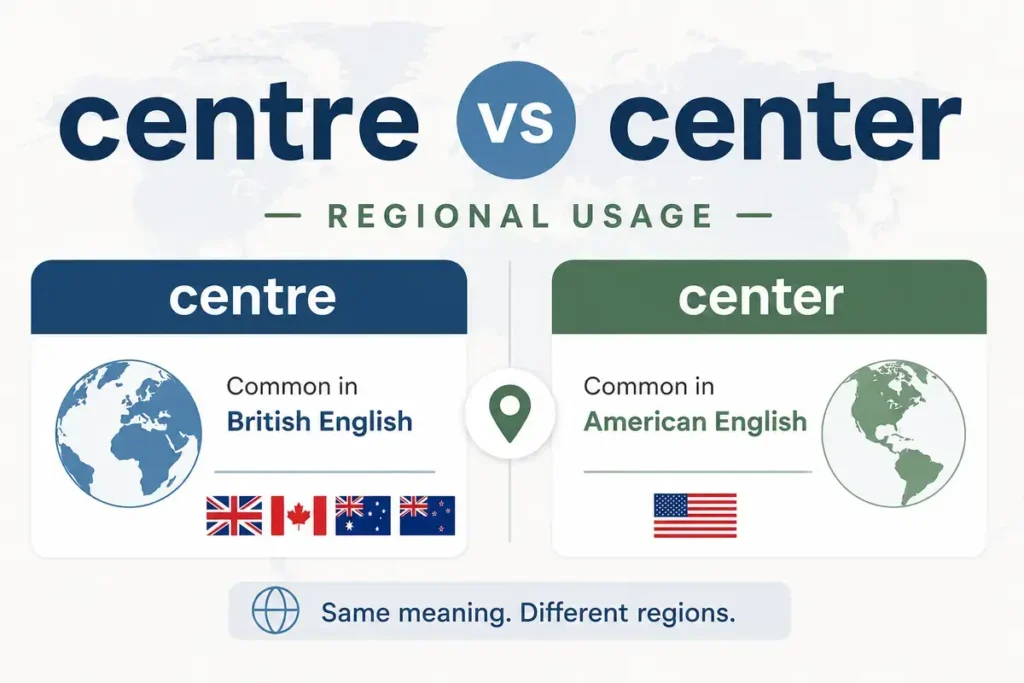
Regional Usage Centre vs Center
Knowing where each spelling is preferred helps you write naturally for your audience.
American English
American English consistently uses center in schools, government publications, newspapers, books, websites, and business communication.
Examples include:
- Shopping center.
- Medical center.
- Community center.
- City center.
- Visitor center.
British English
British English almost always uses centre in formal and informal writing.
Common examples include:
- Town centre.
- Shopping centre.
- Leisure centre.
- City centre.
- Health centre.
Australian English
Australian English follows British spelling conventions, so centre is the standard choice in education, media, and government publications.
Canadian English
Canadian English generally prefers centre, especially in education, government, and traditional publishing.
However, some businesses use center because of American influence or branding. That is why you may occasionally see both spellings in Canada.
Grammar Rules
The spelling changes by region, but the grammar remains identical.
As A Noun
This is the most common use.
Examples include:
- The center of the circle.
- The centre of attention.
- The shopping center.
- The sports centre.
As A Verb
The word can also function as a verb, meaning to place something in the middle or focus attention on something.
Examples include:
- Please center the title on the page.
- The discussion centred on customer satisfaction.
- The design centers around simplicity.
- Their research centred on climate change.
Notice that the verb spelling also changes with the variety of English.
As An Adjective
The word sometimes describes the central position of an object.
Examples include:
- The center lane remained closed.
- The centre aisle filled quickly before the ceremony.
Plural Forms
The plural follows the spelling pattern.
- Centers.
- Centres.
Examples include:
- Community centers often offer free classes.
- Sports centres play an important role in local communities.
Real Life Usage
This spelling difference appears in many situations outside the classroom.
Everyday Conversation
People naturally use the spelling that matches their country.
Examples include:
- Let’s meet at the shopping center.
- The town centre looks beautiful at night.
- The visitor center opens at nine.
- The leisure centre closes at eight.
Academic Writing
Universities expect students to follow one spelling style consistently.
A paper written in American English should use center throughout. A paper following British English should consistently use centre.
Professional Communication
Businesses often adopt a style guide to maintain consistency across emails, reports, websites, and marketing materials.
Following that guide helps create a professional and trustworthy brand.
Literature And Media
Publishers almost always match the spelling to the target audience.
American novels, newspapers, and magazines typically use center.
British publications naturally prefer centre.
Readers rarely notice the spelling when it matches their expectations, but they quickly notice inconsistencies when both versions appear in the same document.
Common Questions People Search Online
Many online searches focus on practical writing situations rather than dictionary definitions. Here are some of the most common topics.
Centre Or Center Meaning Middle
Both spellings refer to the middle point of something. The meaning never changes. Only the regional spelling is different.
Service Center Or Centre
Use the spelling that matches your audience or the official name of the business.
- American English usually prefers service center.
- British English generally prefers service centre.
Medical Center Or Centre
The same rule applies here.
- Medical center is standard in American English.
- Medical centre is standard in British English and many Commonwealth countries.
When referring to a specific hospital or organization, always use its official name, even if it does not match the usual regional convention.
If you often mix up British and American spellings, our royal title spelling guide explains another frequently confused word pair that trips up many English learners.
Related Words And Commonly Confused Terms
Learning this spelling pair becomes much easier when you understand the broader pattern behind British and American English. The same language differences appear in many everyday words, and recognizing those patterns helps you write more naturally.
Here are some of the most common examples.
- Color and colour.
- Favorite and favourite.
- Theater and theatre.
- Meter and metre.
- Fiber and fibre.
- Catalog and catalogue.
- Analyze and analyse.
- Organize and organise.
- Traveling and travelling.
- License and licence in British English when used as a noun.
These pairs follow the same principle. Neither version is more correct than the other. The appropriate choice depends on the variety of English you are using.
You may also come across related terms that describe a central location or position.
- Middle.
- Central point.
- Core.
- Hub.
- Heart.
- Focus.
- Midpoint.
- Headquarters.
- Main location.
- Central area.
Understanding these related words helps you choose the most natural wording instead of repeating the same term throughout your writing.
Expert Language Insight
Professional editors rarely ask which spelling is better because both are accepted. Their first concern is consistency.
Imagine reading an article that begins with shopping centre, later mentions a medical center, and finishes by discussing the city centre. Most readers will understand the meaning, but the mixed spelling creates the impression that the article was not carefully edited.
Experienced writers solve this problem by deciding on the language style before they begin writing. If the content targets an American audience, every spelling follows American English. If the audience is British, Australian, or another country that follows British conventions, the entire document follows that standard.
Another point many learners overlook is that brand names are different from ordinary words. A company’s official name should never be changed, even if it uses a spelling that is unusual for your audience. Always respect the spelling chosen by the organization.
This approach is exactly how professional publishers, newspapers, universities, and businesses maintain clear and consistent writing.
Frequently Asked Questions
Is centre or center correct?
Both spellings are correct. Center is the standard spelling in American English, while centre is preferred in British English and most countries that follow British spelling conventions. The meaning, pronunciation, and grammar are exactly the same.
Why do Americans write center instead of centre?
American English adopted center during the spelling reforms promoted by Noah Webster in the nineteenth century. His goal was to simplify English spelling and make it more consistent. British English continued using centre, and both forms remain correct today.
What does the word mean?
Both spellings refer to the middle point of something or a place where activities, services, or people come together. The definition never changes. Only the spelling changes according to regional English conventions.
Which spelling should I use in the United Kingdom?
If you are writing for readers in the United Kingdom, centre is the expected spelling. It appears in schools, universities, newspapers, government documents, and most professional writing across the country.
Which spelling should I use in the United States?
American English uses center in almost every situation. You will see it in books, websites, schools, newspapers, businesses, and official publications throughout the United States.
What do dictionaries say?
Major dictionaries recognize both spellings as correct. They simply identify the regional preference. Dictionaries such as Oxford, Cambridge, and Merriam Webster explain that centre belongs to British English, while center is the standard American spelling.
What do people on Reddit say about centre and center?
Discussions on Reddit usually reach the same conclusion. Most users explain that neither spelling is wrong. The best choice depends on your audience and the variety of English you are using. Native speakers generally recommend staying consistent instead of mixing both spellings in the same piece of writing.
Can I use both spellings in one article?
It is better not to. Mixing spellings can distract readers and make your writing appear inconsistent. Choose the version that matches your audience or your organization’s style guide, then use that spelling throughout the entire document.
Conclusion
Choosing between centre and center is much simpler than many people expect. Both words have the same meaning, the same pronunciation, and the same grammatical functions. The only real difference is the variety of English they belong to.
If your audience is in the United States, center is the natural choice. If you are writing for readers in the United Kingdom, Australia, New Zealand, or many other countries that follow British English, centre is the preferred spelling. Canadian English generally favors centre, although some organizations use center as part of their official name.
If you are still unsure about centre vs center, remember that the choice depends on the audience you are writing for, not the meaning of the word. Use center for American English and centre for British English and most other varieties that follow British spelling conventions. Once you decide which style fits your readers, use it consistently throughout your writing. That simple habit makes your content look polished, professional, and more trustworthy.