Have you ever typed dutchess vs duchess into a search engine because you were unsure which spelling was right? It is a common question, especially when you see both versions online. At first glance, they look almost identical. One extra letter can make it difficult to tell if they are simply different spellings or if they have different meanings.
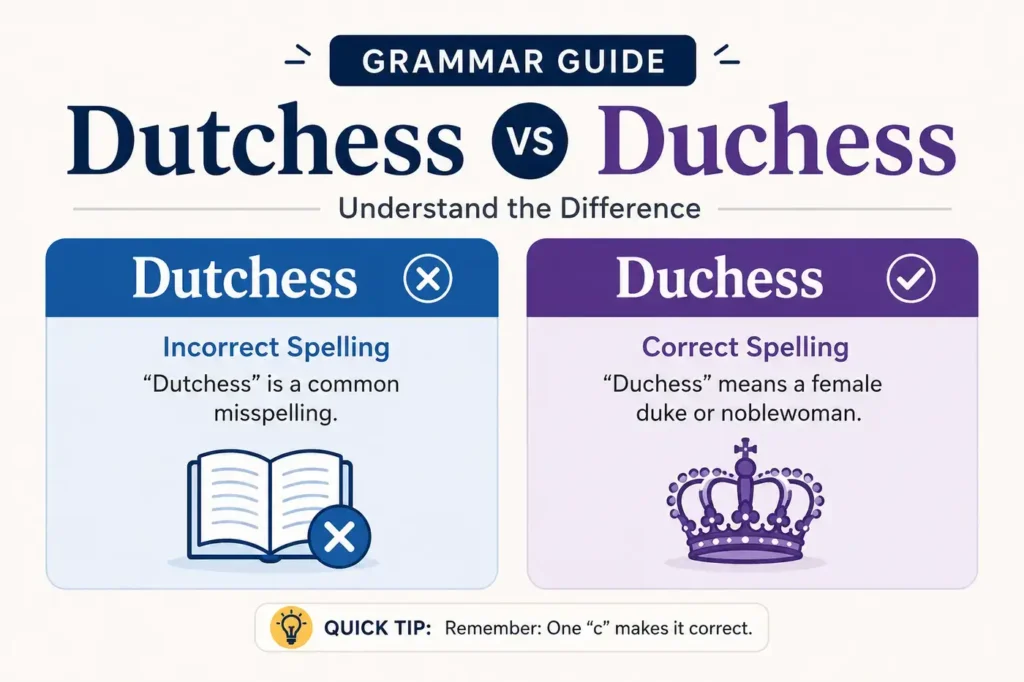
The short answer is simple. Duchess is the correct English word for a female noble who holds the rank of duchess or is married to a duke. Dutchess is usually a misspelling. The only time it is considered correct is when it appears as part of a proper noun, such as the name of a county, business, brand, or another officially named entity.
The confusion often comes from familiar words like Dutch, which refers to the Netherlands or its people. Since Dutch is a common English word, many people accidentally add the extra t when spelling duchess. Autocorrect, typing habits, and internet searches also contribute to the mix up.
This guide explains the difference in clear, simple language. You will learn the correct spelling, pronunciation, meaning, history, grammar rules, real world examples, common mistakes, and the few situations where Dutchess is actually the correct choice. By the end, you will know exactly which word to use and why.
If you enjoy learning about commonly confused spellings, our guide to the spelling of “choosing” explains why one version is correct and the other is a frequent mistake.
Quick Definition
Duchess is the correct English spelling for a female duke or the wife of a duke. Dutchess is generally a spelling mistake unless it is part of an official name, such as Dutchess County or another proper noun. Although both words appear online, only duchess is recognized as the standard dictionary spelling.
Quick Answer
If you only need the answer, here it is.
- Duchess is the correct English word.
- Dutchess is usually incorrect in regular writing.
- Use Dutchess only when it is part of an official name.
- If you are referring to a royal title, noble rank, or a female duke, always write duchess.
This simple rule works in almost every situation and will help you avoid one of the most common spelling mistakes related to royal titles.
Comparison Table
| Feature | Duchess | Dutchess |
|---|---|---|
| Part of speech | Noun | Usually a proper noun or a misspelling |
| Meaning | A female duke or the wife of a duke | Usually not a standard English word |
| Dictionary status | Standard English word | Not recognized as the standard spelling |
| Origin | Old French and Latin roots | Formed by adding an unnecessary letter |
| Correct form | Yes | No except in proper names |
| Formality | Standard in every type of writing | Appropriate only as an official name |
| Common contexts | Royal families history literature news | County names business names brands |
| Usage frequency | Very common | Much less common outside proper nouns |
| Example | The duchess attended the ceremony. | Dutchess County is located in New York. |
Meaning Of Each Word
Although the two spellings look similar, they do not serve the same purpose. Understanding each word separately makes the difference much easier to remember.
What Does Duchess Mean
A duchess is a woman who holds the rank of duke in her own right or a woman who gains the title through marriage to a duke. The title belongs to the European system of nobility and has been used for centuries.
You will commonly find the word in history books, biographies, newspapers, novels, and discussions about royal families.
Examples include:
- The duchess welcomed guests to the palace.
- Everyone admired the duchess for her charity work.
- The young duchess became popular across the country.
- Historians studied the life of the duchess.
- The duke and duchess attended the official event together.
Today, the word also appears in entertainment, documentaries, and media coverage involving members of modern royal families.
What Does Dutchess Mean
Unlike duchess, the word Dutchess is not a standard English noun. In most cases, it is simply a misspelling caused by adding the letter t.
However, there are important exceptions.
Some organizations, places, and businesses officially use Dutchess as part of their name. In those cases, the spelling is completely correct because proper nouns must always keep their official spelling.
Examples include:
- Dutchess County in New York.
- Businesses that include Dutchess in their registered name.
- Local organizations named after Dutchess County.
If you are referring to one of these official names, never change the spelling to duchess.
Key Differences
The difference between these two words goes beyond a single letter. One is a recognized English word, while the other is usually tied to proper nouns.
Here are the main distinctions.
- Duchess is the standard dictionary spelling.
- Dutchess is usually a misspelling in everyday writing.
- Duchess refers to a noble title.
- Dutchess is correct only when it forms part of an official name.
- Both words are pronounced almost the same, which explains why many people confuse them when writing.
A good way to remember the difference is to think about purpose instead of spelling. If you are writing about royalty, history, or noble titles, choose duchess. If you are copying the official name of a place or organization, keep the spelling exactly as it appears.
Which Spelling Is Correct
For almost every writing situation, duchess is the correct choice. It appears in dictionaries, grammar guides, style manuals, books, newspapers, and academic writing. English speakers around the world recognize it as the standard spelling for the feminine form of duke.
The spelling Dutchess becomes correct only when it belongs to a proper noun. For example, Dutchess County has used that spelling since its official naming. Changing it to Duchess County would actually be incorrect because proper names should never be altered.
If you are unsure which spelling to use, ask yourself a simple question.
Are you referring to a royal title or an official name?
If it is a royal title, use duchess.
If it is the official name of a place, business, or organization, keep the spelling exactly as it is registered.
Pronunciation Guide Dutchess vs Duchess
One reason people confuse these words is that they sound almost identical when spoken.
Duchess Pronunciation
IPA pronunciation:
/ˈdʌtʃɪs/
Syllable breakdown:
Duch • ess
Pronounce the first syllable like the beginning of the word judge, followed by ess.
Dutchess Pronunciation
When Dutchess appears as a proper noun, people generally pronounce it the same way as duchess.
IPA pronunciation:
/ˈdʌtʃɪs/
Because the pronunciation is identical, spelling mistakes usually happen while writing rather than speaking.
Expert Language Insight
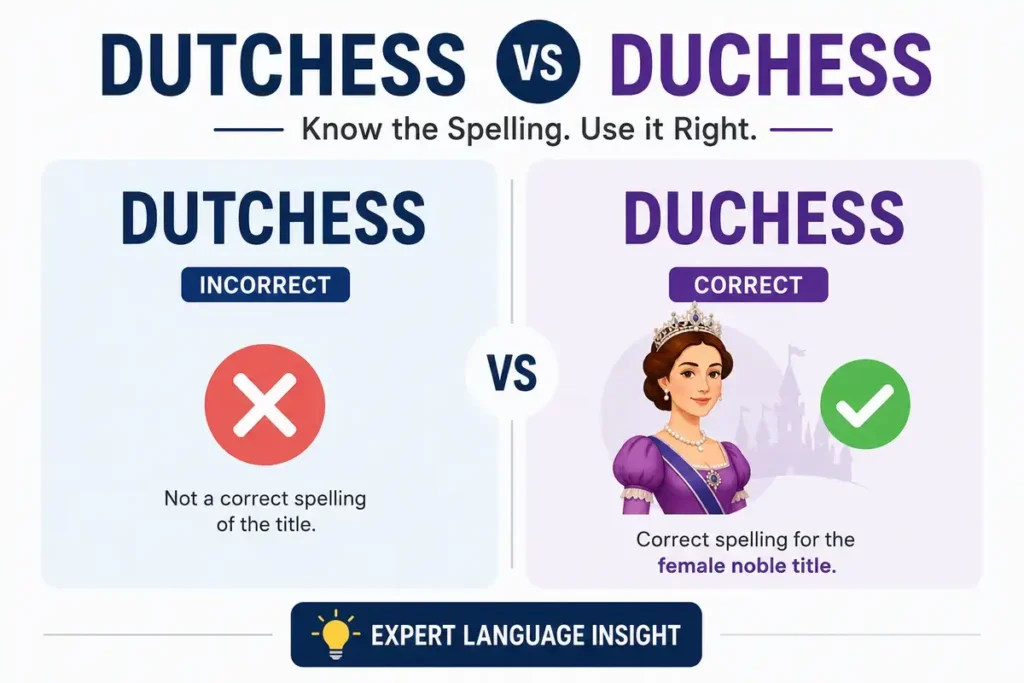
Professional editors rarely need to think twice about this spelling because dictionaries and editorial style guides are clear. Duchess is the accepted English word, while Dutchess belongs mainly to proper nouns.
When proofreading, editors pay close attention to capitalization as well. The word duchess is usually written in lowercase when it is used as a common noun. It is capitalized only when it forms part of an official title or begins a sentence. Proper nouns such as Dutchess County always keep their official capitalization and spelling.
This distinction may seem small, but it helps your writing look accurate, polished, and trustworthy. Choosing the correct spelling also shows readers that you understand the difference between standard English vocabulary and official names.
Examples In Sentences
The easiest way to remember the difference is to see each word used in context. As you read these examples, notice that duchess refers to a royal title, while Dutchess appears only as part of official names.
Duchess Examples
These examples show the correct use of the standard English word.
- The duchess greeted visitors at the palace with a warm smile.
- Everyone admired the duchess for her dedication to charitable causes.
- The young duchess quickly became one of the most recognizable members of the royal family.
- Historians continue to study the life of the duchess and her influence on the kingdom.
- The duke and duchess hosted an official dinner for foreign leaders.
- The novel tells the story of a courageous duchess during medieval times.
- The museum displayed a portrait of the famous duchess from the eighteenth century.
- She dressed as a duchess for the historical costume event.
- The documentary explored how a duchess balanced family life with public duties.
- Every guest bowed respectfully as the duchess entered the grand hall.
Dutchess Examples
These examples use Dutchess correctly because it is part of an official name.
- My family plans to visit Dutchess County next weekend.
- Dutchess Community College offers a wide range of academic programs.
- The event attracted visitors from across Dutchess County.
- She works for a local organization based in Dutchess County.
- Several hiking trails can be found throughout Dutchess County.
- The business has proudly served residents of Dutchess County for decades.
- Their office recently opened a second location in Dutchess County.
- The annual fair is one of the largest events held in Dutchess County.
- Many local farms contribute to the economy of Dutchess County.
- The tourism website highlights the history and natural beauty of Dutchess County.
These examples highlight an important rule. If you are writing about nobility, use duchess. If you are referring to an official place or business name, keep the spelling exactly as it appears.
Common Mistakes
The confusion between these spellings usually comes from typing habits rather than misunderstanding the meaning. Here are the mistakes editors see most often and how to avoid them.
Adding An Extra Letter
The most common mistake is inserting the letter t because the word Dutch is so familiar.
Incorrect:
- The Dutchess attended the ceremony.
Correct:
- The duchess attended the ceremony.
Reading the word slowly while proofreading helps catch this error.
Correcting A Proper Name
Some writers see Dutchess County and assume it should be changed to Duchess County.
That edit is actually incorrect because official names should never be altered. Always use the spelling adopted by the organization, place, or business.
Similar to the confusion between duchess and dutchess, many writers also wonder about the correct spelling of chef, especially when writing about cooking or restaurants.
Assuming Both Are Accepted Spellings
Unlike words such as gray and grey, these are not regional spelling variations.
Only duchess is the standard English word. Dutchess becomes correct only when it is part of a proper noun.
Trusting Autocorrect
Spell check tools are helpful, but they are not perfect. Some programs fail to recognize the difference between a common noun and a proper noun. Always review names carefully before publishing your work.
Confusing Similar Words
People sometimes associate duchess with the adjective Dutch, even though the two words are unrelated.
Remember this simple rule.
- Dutch refers to the Netherlands or its people.
- Duchess refers to a female noble.
- Dutchess is generally an official name or a spelling error.
Word Origin And History
Learning where a word comes from often makes it easier to remember its correct spelling.
The word duchess entered English through Old French duchesse, which developed from the medieval Latin word ducissa. Its origin is closely connected to the word duke, a title that traces back to the Latin word dux, meaning leader or commander.
As the English language evolved, duchess became the accepted feminine form of duke. The spelling remained remarkably stable over the centuries, which is why modern dictionaries still recognize it as the standard form.
The spelling Dutchess has a different story. It did not develop as an alternative form of the title. Instead, it became associated with proper names, most notably Dutchess County in New York. The county received its name in honor of Mary of Modena, who held the title Duchess of York. The spelling chosen at the time became the county’s official name and has remained unchanged ever since.
This historical detail explains why both spellings appear online, even though only one is correct as a common English word.
Duke And Duchess Meaning
Understanding the relationship between these titles helps place the word in its historical context.
A duke is a high ranking nobleman. Traditionally, he governed a duchy and held significant political or military authority.
A duchess is the female equivalent of a duke. The title may belong to a woman through inheritance or through marriage to a duke.
Here are the key differences.
- A duke is the masculine title.
- A duchess is the feminine title.
- Both belong to the European system of nobility.
- Their exact responsibilities have changed over time, but the titles remain important in many royal traditions.
Today, most people encounter these titles in history books, royal news, documentaries, and works of fiction.
Duchess Versus Princess
Many people assume a duchess and a princess hold the same rank, but they are different titles with different meanings.
A princess is usually the daughter of a monarch or the wife of a prince. Her title comes through birth or marriage within a royal family.
A duchess, on the other hand, is connected to the rank of duke. While some women hold both titles, the terms are not interchangeable.
Here are the main distinctions.
- A princess belongs directly to a royal family.
- A duchess holds a noble title linked to a duke.
- A princess generally ranks higher than a duchess in most royal systems.
- One person can hold both titles at the same time, depending on royal tradition.
Knowing this distinction helps readers understand historical documents and modern royal news more accurately.
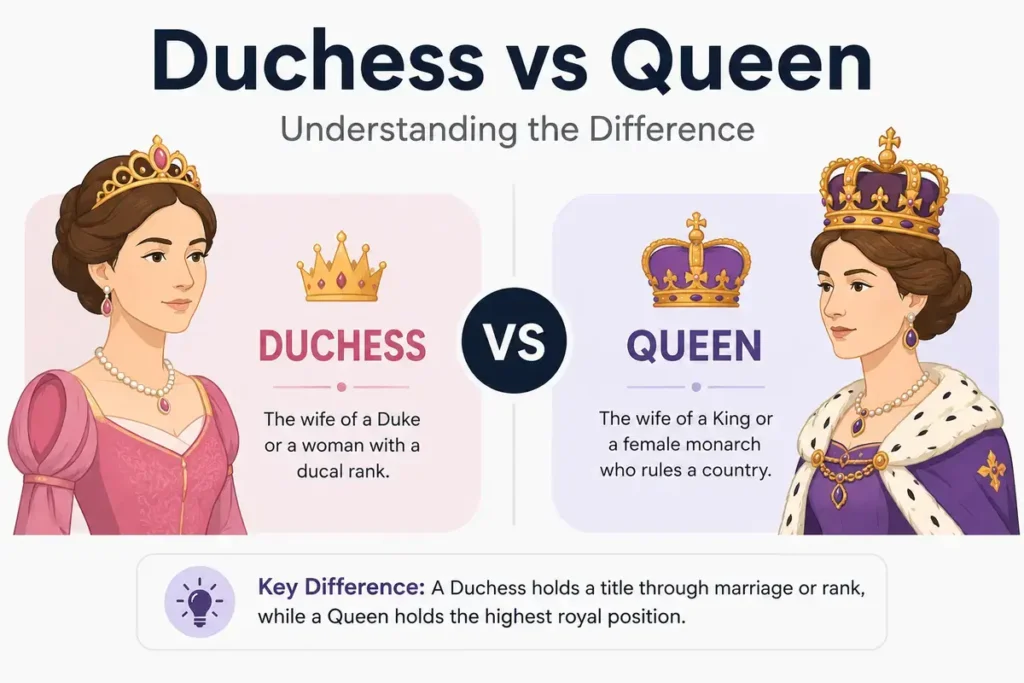
Duchess Versus Queen
Another common point of confusion involves the titles duchess and queen.
A queen is usually the wife of a king or a woman who rules a kingdom in her own right. She occupies one of the highest positions in a monarchy.
A duchess ranks below a queen. Although a duchess may hold considerable influence, her title does not place her above the monarch.
A simple way to remember the hierarchy is this.
- Queen.
- Princess in many royal systems.
- Duchess.
The exact order can vary slightly depending on a country’s royal traditions, but a duchess is never the same as a queen.
Grammar Rules Duchess Vs Dutchess
Using the word correctly is just as important as spelling it correctly.
Part Of Speech
Duchess is a noun. It names a person who holds a noble title.
Example:
The duchess greeted the crowd.
Plural Form
The plural is duchesses.
Example:
Several duchesses attended the royal gathering.
Capitalization
Most of the time, write duchess in lowercase.
Capitalize it only when it forms part of an official title or begins a sentence.
Examples.
- The duchess attended the banquet.
- Duchess Sophie greeted the guests.
Official names always keep their original spelling and capitalization.
For example:
- Dutchess County.
- Dutchess Community College.
Following these grammar rules makes your writing more accurate and reflects the standards used by professional editors.
Real Life Usage
The word duchess appears in many forms of communication, from everyday conversations to historical research. Knowing how it is used in different settings makes it easier to recognize the correct spelling and avoid common mistakes.
Daily Conversation
Most people use the word when talking about royal families, historical figures, or popular television series.
Examples include:
- We watched a documentary about a famous duchess last night.
- She joked that she felt like a duchess in her elegant gown.
- The tour guide shared stories about a well known duchess who once lived in the castle.
Academic Writing
History books, biographies, and research papers use the standard spelling because it is the accepted English word.
You might see sentences such as:
- The duchess played an important role in diplomatic relations.
- Scholars continue to debate the duchess’s political influence during that period.
Professional Communication
Editors, journalists, and publishers follow the same spelling in newspapers, magazines, and online articles. Using the correct word helps maintain credibility and consistency.
Literature And Media
Classic novels, historical fiction, films, and television dramas often feature dukes and duchesses. Modern news coverage also uses the title when reporting on members of royal families.
Duchess Pronunciation Tips
The pronunciation of duchess is straightforward once you hear it a few times, but some learners still make small mistakes.
Remember these points.
- The first syllable sounds like duch, similar to the beginning of Dutch, but the spelling is different.
- The second syllable is ess.
- The stress falls on the first syllable.
Common mistakes include:
- Adding an extra syllable.
- Pronouncing the ending like ees instead of ess.
- Spelling the word with an extra t because of its pronunciation.
Reading the word aloud while writing it can help reinforce the correct spelling.
Duchess Or Duchess Fabric
The word duchess also appears in the fashion industry.
Duchess satin is a luxurious fabric known for its smooth surface, elegant appearance, and structured feel. It is commonly used for wedding dresses, evening gowns, formal skirts, and high end clothing.
Many people accidentally search for Dutchess satin because they assume the spelling matches the pronunciation. The correct term is duchess satin.
If you are shopping for fabric or reading sewing patterns, remember this simple rule.
- Duchess satin is correct.
- Dutchess satin is almost always a spelling mistake unless a brand intentionally uses that spelling.
Duchess Nightreign
Another reason people search for Dutchess is because of names used in games, books, or entertainment.
For example, Duchess Nightreign may appear as the name of a fictional character, item, or piece of media depending on the context. In cases like this, always follow the official spelling used by the creator.
Proper names do not follow normal spelling rules. They keep the spelling chosen by their owners, even if it differs from standard English.
Duchess Restaurant
You may also come across businesses that include Duchess in their name.
For example, Duchess Restaurant is an official business name in some locations. Since business names are proper nouns, they should always be written exactly as registered.
The same rule applies to restaurants, hotels, clothing brands, charities, and companies.
- Do not change the spelling of a business name.
- Do not assume every appearance of Dutchess is a mistake.
- Check the official website or signage if you are unsure.
To avoid other common word-choice mistakes, it’s also worth understanding the difference between ensure and insure, since these similar-looking words have distinct meanings and uses.
Related Words And Commonly Confused Terms
People searching for this topic often confuse duchess with other royal titles or similar looking words.
Here are some of the most common ones.
| Word | Meaning |
|---|---|
| Duke | A male noble ranking below a monarch in many systems. |
| Duchess | A female duke or the wife of a duke. |
| Princess | A female member of a royal family or the wife of a prince. |
| Queen | A female monarch or the wife of a king. |
| Countess | A female count or the wife of a count. |
| Baroness | A female baron or the wife of a baron. |
People also confuse these spelling pairs.
- Principal and principle.
- Stationary and stationery.
- Desert and dessert.
- Advice and advise.
- Then and than.
The pattern is similar. The words may look or sound alike, but each one has a different meaning or purpose.
Expert Language Insight
Professional editors rarely hesitate when choosing between these spellings because dictionaries, style guides, and publishing standards are consistent. Duchess is the accepted English word, while Dutchess belongs primarily to proper nouns.
One habit that experienced writers develop is checking the context before correcting a spelling. If the word refers to a royal title, the answer is simple. Use duchess. If it refers to a county, organization, or business, verify the official name before making any changes.
This small step prevents unnecessary editing mistakes and shows respect for official names. It also helps readers trust your writing because it reflects careful research instead of assumptions.
Frequently Asked Questions
Is duchess the correct spelling?
Yes. Duchess is the correct English spelling for a female duke or the wife of a duke. It appears in dictionaries, style guides, academic writing, and professional publications.
Is Dutchess ever correct?
Yes. Dutchess is correct when it is part of an official name, such as Dutchess County or another registered place, business, or organization. Outside those situations, it is usually a spelling mistake.
Why do people spell duchess as Dutchess?
The mistake often happens because people recognize the word Dutch and accidentally insert the extra letter while typing. Since both spellings sound almost identical, the error is easy to miss during proofreading.
How do you pronounce duchess?
The standard pronunciation is /ˈdʌtʃɪs/. The word has two syllables, and the stress falls on the first one.
Is duchess a royal title?
Yes. A duchess is a noble title traditionally held by a woman who is a duke in her own right or the wife of a duke.
What is the difference between a duchess and a princess?
A princess is connected directly to a royal family through birth or marriage, while a duchess holds the rank of duke or is married to one. Although one person can hold both titles, they are not the same.
Is a duchess higher than a queen?
No. In most monarchies, a queen ranks above a duchess. A queen is the monarch or the wife of a king, while a duchess holds a lower noble title.
Should I correct Dutchess when proofreading?
Yes, unless it is part of an official name. Always check the context before making corrections because changing the spelling of a proper noun can introduce an error instead of fixing one.
Conclusion
The difference between these two spellings is easier than many people expect. Duchess is the correct English word for a female duke or the wife of a duke, and it should be used in almost every piece of writing about royalty, history, literature, or current events.
Dutchess is not an alternative spelling. Instead, it usually appears as part of an official name, such as a county, business, or organization. That distinction explains why both forms appear in search results even though only one belongs in standard English.
If you remember one rule, make it this. Use duchess for royal titles and keep Dutchess only when you are writing an official name exactly as it is registered. Following that simple guideline will help your writing stay accurate, professional, and easy for readers to trust.
The next time you find yourself wondering about dutchess vs duchess, remember that duchess is the correct spelling for the royal title, while Dutchess should be used only as part of an official proper name.