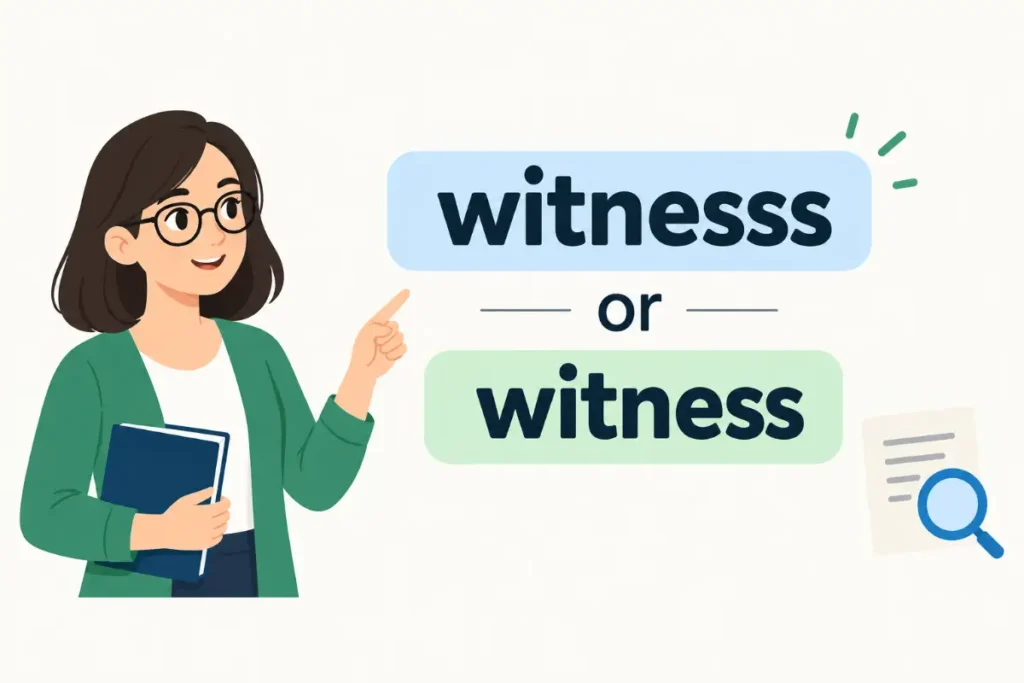
The correct spelling is witness, not witnesss. The word witness refers to someone who sees an event happen, gives evidence about something, or observes an important moment. It can also function as a verb, meaning to see or experience an event firsthand. The confusion often comes from adding an extra s by mistake or mixing up the singular, plural, and possessive forms.
For example, you can write, “The witness gave a statement to the police.” If several people saw the same event, you would write, “The witnesses gave statements to the police.” When you need to show ownership, the spelling changes again. One witness’s statement belongs to one person, while multiple witnesses’ statements belong to several people.
These small differences matter in everyday writing, legal documents, school assignments, workplace communication, and formal reports. This guide explains the correct spelling, meaning, plural form, possessive rules, and common sentence patterns. You will also learn the difference between witness, witness’s, witnesses, and witnesses’ so you can choose the right form without second guessing yourself.
Quick Answer
Witness is the correct singular spelling. Witnesss is incorrect because the word does not need a third final s. Use witnesses for the plural, witness’s for the singular possessive, and witnesses’ for the plural possessive. The correct form depends on the number of people and the meaning of the sentence.
Is It Witness or Witnesss
The correct spelling is witness. The spelling witnesss is a misspelling that adds an unnecessary letter at the end of the word. In standard American English, witness already ends with two letters that look like an s sound in writing: s and the final s is part of the established spelling. You do not add another one.
For example, write, “A witness saw the accident.” Do not write, “A witnesss saw the accident.” The first sentence uses the standard singular noun, while the second contains a spelling error.
The mistake can happen when someone tries to form the plural or possessive by adding letters without considering the existing spelling. However, English has specific patterns for making nouns plural and possessive. Learning those patterns will help you avoid the same error in other words.
When describing when a witness will appear in court or provide testimony, avoiding confusion with time expressions can make your communication clearer and prevent scheduling misunderstandings.
What Does Witness Mean
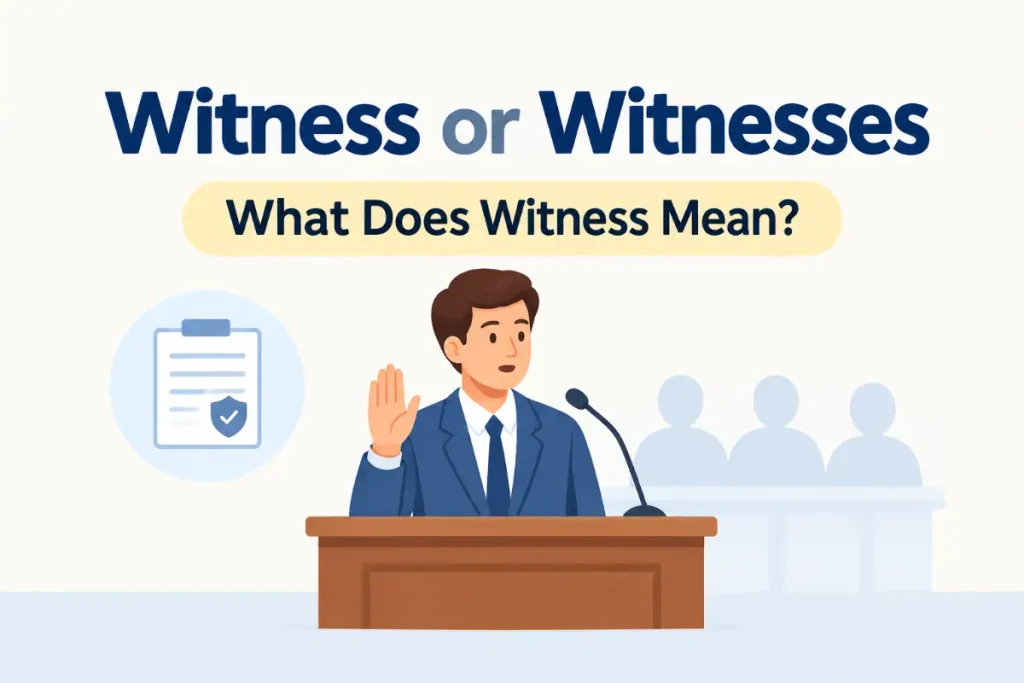
Witness can function as both a noun and a verb. As a noun, it describes someone who sees an event or provides information about something that happened. In legal settings, a witness may give testimony in court or provide a statement to investigators. In everyday situations, a witness can be anyone who observes an event firsthand.
For example, “A witness saw the driver run the red light.” Here, witness identifies the person who observed the incident. The word does not automatically mean that the person is involved in a crime or legal dispute. A witness can observe a wedding, a sporting event, a celebration, an accident, or an ordinary moment.
As a verb, witness means to see, observe, or experience something. For example, “Thousands of fans witnessed the team’s championship victory.” In this sentence, witnessed describes what the fans experienced. The word also appears in expressions such as witness a change, witness an event, and witness an improvement.
Witness as a Noun
When witness functions as a noun, it names a person who observes an event or provides evidence about it. The word can refer to one person or serve as the base form from which the plural is created. The surrounding sentence helps you understand its role.
Examples include a witness to an accident, a witness in court, a witness to a marriage, and an eyewitness to a robbery. Although these expressions appear in different contexts, they share the idea of observation or providing an account of an event.
Witness as a Verb
When witness functions as a verb, it describes the act of seeing or experiencing something. Its common forms include witness, witnesses, witnessed, and witnessing. These forms follow ordinary English verb patterns.
For example, “She witnesses the daily operations of the business” uses the present tense. “She witnessed the accident yesterday” uses the past tense. “They are witnessing a major change” uses the present participle to describe an ongoing experience.
Witness vs Witnesses vs Witness’s vs Witnesses’
These four forms look similar, but each serves a different grammatical purpose. The easiest way to choose correctly is to identify the number of people and determine if the sentence expresses ownership.
| Form | Meaning | Example |
|---|---|---|
| Witness | One person or the base verb | The witness spoke to the officer. |
| Witnesses | More than one person or a verb form | The witnesses arrived early. |
| Witness’s | Something belonging to one witness | The witness’s statement was clear. |
| Witnesses’ | Something belonging to multiple witnesses | The witnesses’ statements differed. |
The apostrophe is important because it changes the grammatical relationship between the words. Witnesses without an apostrophe normally refers to multiple people when used as a noun. Witnesses’ uses an apostrophe after the plural ending to show that something belongs to those people.
Consider these sentences. “The witness’s phone was missing” refers to one witness’s phone. “The witnesses’ phones were missing” refers to phones belonging to multiple witnesses. The difference is small on the page, but it changes the meaning of the sentence.
How to Make Witness Plural
The plural of witness is witnesses. Because witness ends in s, you add es to form the standard plural. This pattern also appears in nouns such as bus, class, and address.
For example, one person is a witness, while two or more people are witnesses. You would write, “One witness answered the questions” and “Three witnesses answered the questions.” The plural form does not require an additional s beyond the standard es ending.
Here are a few examples of the plural form in natural sentences.
1. Two witnesses saw the collision.
2. The witnesses arrived at the courthouse before noon.
3. Police interviewed several witnesses after the incident.
4. The witnesses provided different accounts of what happened.
5. All witnesses must follow the court’s instructions.
Remember that witnesses can also be a verb form. In “She witnesses the process every day,” the word describes what one person observes. The subject and context tell you if the word is a plural noun or a verb.
How to Use the Singular Possessive Witness’s
Use witness’s when you want to show that something belongs to one witness. Add an apostrophe and an s to the singular noun. This is the standard approach in American English for most singular nouns, including nouns that already end in s.
For example, “The witness’s testimony helped clarify the timeline.” The testimony belongs to one witness. Similarly, “The witness’s car was parked outside” identifies a car belonging to one person.
The singular possessive form is useful in legal writing, news reports, school assignments, and everyday communication. It can describe a person’s statement, account, signature, identity, clothing, or belongings.
Examples include:
1. The witness’s statement was included in the report.
2. The witness’s signature appeared at the bottom of the document.
3. The attorney reviewed the witness’s account of the incident.
4. The witness’s memory of the event was incomplete.
5. The witness’s phone contained a photograph of the scene.
6. The officer recorded the witness’s contact information.
7. The witness’s explanation answered the investigator’s question.
8. The witness’s identity remained confidential.
In each sentence, witness’s refers to one person. If the sentence refers to more than one witness, the possessive form generally changes to witnesses’.
How to Use the Plural Possessive Witnesses’
Use witnesses’ when something belongs to two or more witnesses. First, make the noun plural by adding es. Then place the apostrophe after the final s to indicate possession.
For example, “The witnesses’ statements were reviewed by the attorney.” The statements belong to multiple witnesses. The apostrophe follows the plural ending because the noun is already plural.
This rule applies to shared or individual belongings associated with multiple witnesses. You might discuss the witnesses’ accounts, the witnesses’ signatures, or the witnesses’ contact details. The sentence does not need to identify each person separately for the plural possessive to work.
Examples include:
1. The witnesses’ statements were added to the case file.
2. The attorney compared the witnesses’ accounts of the accident.
3. The witnesses’ signatures appeared on the final document.
4. Investigators checked the witnesses’ contact information.
5. The witnesses’ observations helped establish the timeline.
6. The judge considered the witnesses’ testimony.
7. The reporters recorded the witnesses’ comments.
8. The witnesses’ identities were protected during the investigation.
The main rule is simple. Use witness’s for one witness and witnesses’ for multiple witnesses.
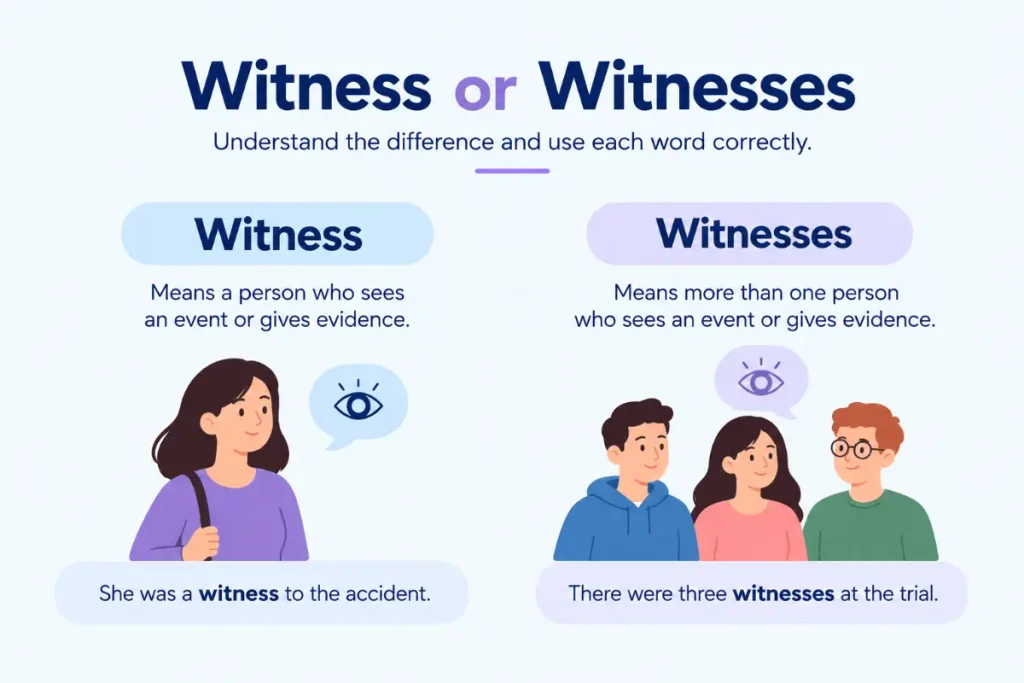
Whether you are referring to one witness or several witnesses, choosing between singular and plural expressions helps ensure your sentence is grammatically correct and conveys your intended meaning.
Witness’s or Witnesses Meaning
The distinction between witness’s and witnesses depends on grammar. Witness’s usually expresses possession by one person, while witnesses can refer to multiple people or function as a verb. You should not choose a form based only on how it sounds.
Compare these examples:
“The witness’s account was detailed.” This means one witness gave the account.
“The witnesses arrived at the scene.” This means multiple people arrived.
“The witnesses’ accounts were detailed.” This means multiple witnesses gave the accounts.
Each sentence uses a different grammatical form. The apostrophe in the first and third examples signals possession, while the second example uses a regular plural noun.
A useful editing technique is to replace witness’s with “belonging to one witness.” If the sentence still makes sense, the singular possessive is probably correct. For witnesses’, try “belonging to multiple witnesses.” This quick test often reveals the right spelling.
Witness Signature or Witness’s Signature
The correct choice depends on how the phrase is used. Witness signature is common as a short label on forms, while witness’s signature is appropriate in a sentence that describes a signature belonging to one witness. Both can be useful, but they serve different purposes.
For example, a printed form might include a field labeled “Witness Signature.” This is a compact label, similar to “Applicant Name” or “Date of Birth.” Labels often omit possessive markers for brevity.
In a complete sentence, the possessive form is usually clearer. You could write, “The witness’s signature is required at the bottom of the form.” If multiple witnesses must sign, you might write, “The witnesses’ signatures are required.”
Use the context to decide which form fits. A form label does not always follow the same wording conventions as a complete sentence, so do not assume that every missing apostrophe is a spelling mistake.
Common Mistakes With Witness
Writers often confuse the singular, plural, and possessive forms because they differ by only a few letters. The solution is to identify what the sentence means before choosing the spelling. Here are some common errors and their corrections.
Incorrect: The witnesss gave a statement.
Correct: The witnesses gave a statement.
The plural form is witnesses, not witnesss.
Incorrect: The witness signature was missing from the document.
Correct: The witness’s signature was missing from the document.
In a complete sentence referring to one person’s signature, the singular possessive is the natural choice. The shorter phrase witness signature may still work as a form label.
Incorrect: The witnesses’s statements were recorded.
Correct: The witnesses’ statements were recorded.
The plural noun already ends in s, so the apostrophe follows that ending. You do not add another s after the apostrophe.
Incorrect: The witness’ account was unclear.
Correct: The witness’s account was unclear.
In standard American English, the usual singular possessive form is witness’s. Some style guides use different rules for certain singular nouns ending in s, but witness’s is the standard choice for general writing.
Examples of Witness in Sentences
Examples can help you see how the word changes depending on its role. The following sentences cover everyday, professional, academic, and legal contexts.
Examples With Witness
1. The witness described what happened at the intersection.
2. A witness called emergency services after the accident.
3. The witness answered every question clearly.
4. Each witness provided a separate statement.
5. The witness signed the document in front of the notary.
6. The witness remembered seeing a blue car near the building.
7. A witness to the wedding signed the marriage paperwork.
8. The defense attorney questioned the witness about the timeline.
9. The witness reported the missing property to the police.
10. One witness noticed a detail that others had overlooked.
These examples use witness as a singular noun. Each sentence refers to one person who observed an event or provided information.
Examples With Witnesses
1. Several witnesses gathered outside the courthouse.
2. The witnesses gave their statements to the investigators.
3. Police asked the witnesses to describe the vehicle.
4. Two witnesses confirmed the time of the incident.
5. The witnesses waited in a separate room.
6. All witnesses were asked to provide accurate information.
7. The witnesses disagreed about the direction the car traveled.
8. Investigators interviewed witnesses from the neighborhood.
9. The witnesses attended the hearing on Monday.
10. Three witnesses saw the same event from different angles.
These examples show the regular plural form. Notice that witnesses does not require an apostrophe when it simply refers to multiple people.
Examples With Witness’s
1. The witness’s statement included an important detail.
2. The witness’s signature was missing from the form.
3. The witness’s account helped clarify the sequence of events.
4. The witness’s memory of the conversation was limited.
5. The witness’s phone was examined during the investigation.
These sentences refer to something belonging to one witness.
Examples With Witnesses’
1. The witnesses’ statements were placed in the case file.
2. The witnesses’ accounts differed in several important ways.
3. The witnesses’ signatures appeared on the last page.
4. The witnesses’ observations helped investigators understand the incident.
5. The witnesses’ contact details were stored securely.
Each sentence uses the plural possessive because something belongs to multiple witnesses.
Grammar Rules for Witness
The word witness follows regular English patterns in most common uses. As a noun, it has a singular form and a plural form. As a verb, it changes according to tense and subject.
| Grammatical form | Correct spelling | Example |
|---|---|---|
| Singular noun | Witness | The witness spoke. |
| Plural noun | Witnesses | The witnesses spoke. |
| Singular possessive | Witness’s | The witness’s account was clear. |
| Plural possessive | Witnesses’ | The witnesses’ accounts were clear. |
| Base verb | Witness | I witness the event. |
| Third person singular verb | Witnesses | She witnesses the process. |
| Past tense | Witnessed | They witnessed the accident. |
| Present participle | Witnessing | We are witnessing a change. |
These forms may look similar, but their functions differ. The apostrophe is used to indicate possession, not to create an ordinary plural. The ending es creates the plural noun and also appears in the third person singular form of the verb.
When writing about people who serve as witnesses, choosing the correct plural form is essential for clear communication, just as understanding the difference between singular and plural forms helps you avoid mistakes like using coach’s instead of coaches.
Frequently Asked Questions
Is witnesss a word
No. Witnesss is not the standard spelling in English. The correct singular form is witness, and the plural is witnesses. If you want to show ownership by one person, use witness’s. If you want to show ownership by multiple people, use witnesses’.
What is the plural of witness
The plural of witness is witnesses. Add es to the singular noun because it ends in s. For example, “One witness spoke to the officer” becomes “Three witnesses spoke to the officer.” Do not write witnesss as the plural form.
Is it witness’s or witnesses
Use witness’s to show that something belongs to one witness. Use witnesses when you mean more than one person or when witnesses functions as a verb. For example, “The witness’s statement was recorded” refers to one person’s statement, while “The witnesses arrived” refers to multiple people.
Is it witness’s or witnesses’ for possession
Use witness’s for one person and witnesses’ for multiple people. For example, “The witness’s signature is missing” refers to one witness. “The witnesses’ signatures are missing” refers to several witnesses. The apostrophe goes before the final s in the singular possessive and after the final s in the plural possessive.
What is the possessive form of witness
The standard singular possessive is witness’s. The plural possessive is witnesses’. Use witness’s when something belongs to one witness, such as the witness’s statement. Use witnesses’ when something belongs to multiple witnesses, such as the witnesses’ statements.
Is witness signature grammatically correct
Witness signature can be correct as a short form label or field heading. In a complete sentence, witness’s signature is generally appropriate when you mean the signature belonging to one witness. If several witnesses must sign, use witnesses’ signatures.
What is the difference between witness and witnesses
Witness is singular when used as a noun, while witnesses is the plural form. For example, “The witness arrived early” refers to one person, while “The witnesses arrived early” refers to multiple people. Witnesses can also function as a verb, as in “She witnesses the event.”
How do you use witness in a sentence
You can use witness as a noun or a verb. As a noun, write, “The witness described the accident.” As a verb, write, “Thousands of fans witnessed the championship game.” The noun identifies a person who observes an event, while the verb describes seeing or experiencing something.
Conclusion
The correct spelling is witness, not witnesss. Use witnesses when referring to more than one person, witness’s to show possession by one person, and witnesses’ to show possession by multiple people. These forms follow standard English grammar rules and are useful in everything from everyday conversation to formal reports and legal documents.
Before choosing a spelling, identify the meaning you want to express. If you are talking about one person, use witness. If you mean several people, use witnesses. If you need to show ownership, place the apostrophe according to the singular or plural form. This simple check will help you write clearly and avoid common mistakes.