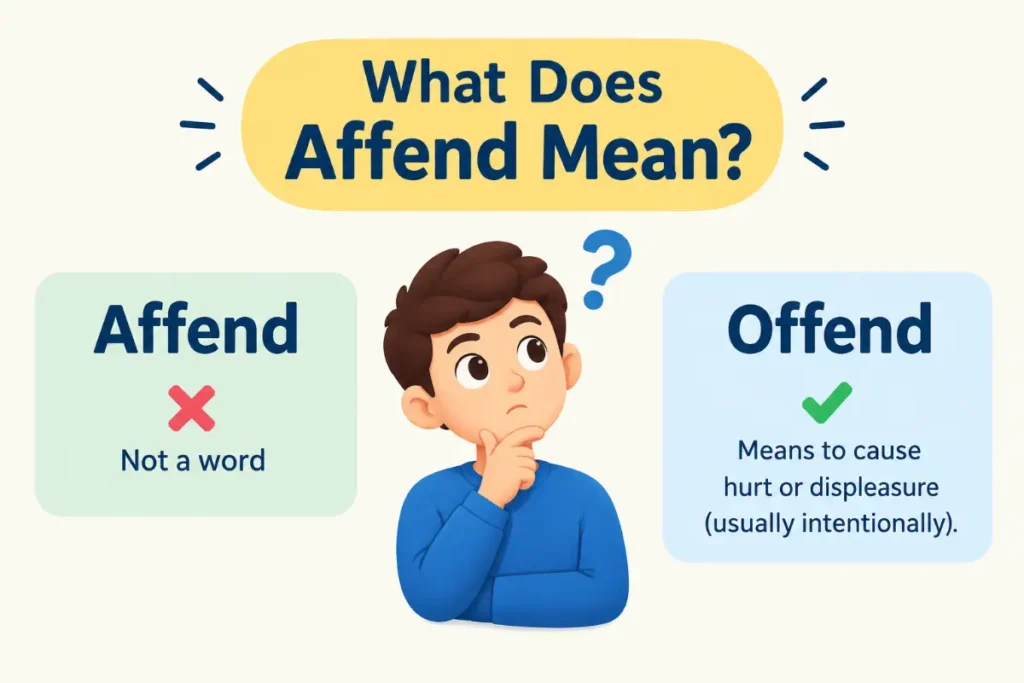
If you are unsure about affend vs offend, the answer is simple: offend is the standard English spelling. It is the verb used when someone causes another person to feel hurt, insulted, upset, or angry, or when an action violates a rule, standard, or accepted principle. Affend is not the normal modern English spelling of this word.
The confusion is understandable because both forms look like they could belong to English. The pronunciation of offend can also make the first vowel less obvious when the word is spoken quickly. In addition, English contains many words beginning with both af and of, so it is easy to remember the sound while forgetting the spelling.
This guide explains the difference clearly. You will learn what offend means, why affend is considered incorrect in ordinary modern English, how to pronounce the correct form, where the word came from, how to use it in sentences, and which related words can cause additional confusion. You will also see how the verb works in everyday conversation, professional writing, and different grammatical structures.
Quick Answer
Offend is the correct standard English spelling. It means to upset, insult, or hurt someone emotionally, or to violate a rule, law, or accepted standard. Affend is generally a misspelling and should not be used in normal American English writing. Use offend, offended, offending, and offends according to the sentence.
Affend vs Offend Comparison
| Feature | Offend | Affend |
|---|---|---|
| Correct form | Yes | No in standard modern English |
| Part of speech | Verb | Not normally used as a standard verb |
| Meaning | Upset, insult, or violate a rule | No standard modern meaning in this context |
| Origin | From Latin through French and English | Not the standard form of the verb |
| Formality | Neutral and widely accepted | Avoid in ordinary writing |
| US usage | Standard | Usually a spelling error |
| UK usage | Standard | Usually a spelling error |
| Common contexts | Personal feelings, laws, rules, principles | Usually appears as a misspelling |
| Example | I did not mean to offend you. | Incorrect: I did not mean to affend you. |
If you’re unsure about the spelling of a person who cries out or makes a public announcement, comparing the correct spelling of crier can help clear up another common word-choice confusion.
What Does Offend Mean
Offend is a verb with several closely connected meanings. The most common meaning is to cause someone to feel hurt, insulted, annoyed, or upset because of something you say or do.
For example:
I hope my comment did not offend you.
Here, the speaker is concerned that the comment may have hurt the other person’s feelings.
The verb can also describe breaking or violating a rule, law, principle, or accepted standard.
The company was fined for offending environmental regulations.
In this sense, the word is more formal and is often replaced by violate in modern American writing. Still, the legal and formal sense remains part of the word’s meaning.
Another use appears in phrases involving personal standards or beliefs.
The decision offended his sense of fairness.
This does not necessarily mean that someone directly insulted him. Instead, the decision strongly conflicted with his sense of what was right or acceptable.
The Core Meaning
At its center, offend describes an action that crosses a personal, social, moral, or formal boundary.
Depending on the context, that boundary might involve:
- Someone’s feelings.
- A person’s dignity.
- Social expectations.
- Moral standards.
- Religious beliefs.
- Rules or regulations.
- Laws.
- Accepted principles.
That broad range explains why the word appears in both casual conversation and formal writing.
Why Affend Is Usually Incorrect
The form affend is generally a spelling mistake created by confusing the beginning of offend with the sound or appearance of other English words.
If someone writes:
I did not mean to affend anyone.
The intended word is almost certainly offend.
The corrected sentence is:
I did not mean to offend anyone.
There is no standard modern spelling rule that changes offend into affend. The correct word begins with of, not af.
This is especially important in professional writing. A misspelling may be understood from context, but it can still make an email, essay, website, application, or report look careless.
The safest rule is simple:
Offend is the standard form.
What Does Affend Mean
In ordinary contemporary English, affend does not function as the standard spelling of the verb meaning to upset or insult someone.
You may occasionally encounter the form online in user generated content, informal writing, comments, social media posts, or other places where spelling mistakes are common. Its appearance does not make it an accepted alternative spelling.
If you are writing a sentence about causing offense, use offend.
For example:
- Correct: I did not intend to offend her.
- Incorrect: I did not intend to affend her.
The same principle applies to other forms of the verb.
- Correct: offended.
- Correct: offending.
- Correct: offends.
Do not change the first syllable to aff.
Key Differences Between The Two Forms
The most important difference is straightforward: offend is the standard word, while affend is normally an error.
Spelling
The correct spelling begins with off.
O F F E N D
Remembering the first three letters can prevent the most common mistake.
Meaning
Offend has established meanings in English. It can describe hurting someone’s feelings or violating a rule, law, principle, or standard.
Affend does not normally carry an independent modern English meaning that competes with it.
Grammar
Offend is a regular verb. It can take different forms depending on tense and sentence structure.
- Present: offend.
- Third person singular: offends.
- Past: offended.
- Present participle: offending.
There is no standard verb paradigm based on affend.
Usage
Native English speakers use offend naturally in phrases such as offend someone, be offended, deeply offended, and take offense.
The misspelled form does not belong in standard American English prose.
Context
The correct verb works in casual, professional, academic, legal, and literary contexts.
For example:
I hope I did not offend you.
This is conversational.
The ruling may offend established principles of fairness.
This has a more formal tone.
Examples In Sentences
Seeing the correct word in different situations is one of the easiest ways to remember it.
Offend In Everyday Conversation
- I hope I did not offend you with my question.
- She did not intend to offend anyone at the meeting.
- His joke might offend some people.
- Please tell me if I said something that offended you.
- I was worried that my comment would offend my friend.
- He apologized because he realized his words had offended her.
- The goal was to be honest, not to offend anyone.
- Some people may find that kind of humor offensive.
- I did not think the remark would offend him.
- She was careful not to offend her guests.
These examples show that the verb often appears when discussing someone’s reaction to words or actions.
Examples Showing The Incorrect Form
Because affend is normally a misspelling, it should not be presented as a standard alternative.
Incorrect:
I did not mean to affend you.
Correct:
I did not mean to offend you.
Incorrect:
His comment may affend some readers.
Correct:
His comment may offend some readers.
Incorrect:
She was afraid she would affend her coworkers.
Correct:
She was afraid she would offend her coworkers.
The correction is not a matter of American versus British spelling. The standard form is offend in both varieties.
How To Use Offend Correctly
The verb commonly appears with a direct object.
The comment offended me.
Here, the comment is the subject and me is the object.
You can also use the verb in the infinitive form after another verb.
I did not want to offend him.
It frequently appears after modal verbs.
You might offend someone with that remark.
The decision could offend some customers.
The verb also appears in passive constructions.
She was offended by the comment.
This structure is extremely common because people often focus on the person who experienced the emotional reaction rather than the action that caused it.
Offend And Be Offended
One of the most useful grammatical distinctions is the difference between offend and be offended.
When someone offends another person, the first person causes the reaction.
His comment offended me.
When someone is offended, that person experiences the reaction.
I was offended by his comment.
The meaning changes slightly depending on the grammatical perspective.
Compare:
The joke offended Maria.
Maria experienced the negative reaction.
Maria was offended by the joke.
The second sentence places Maria at the center of the statement.
Both constructions are common and grammatically correct.
Offend And Offensive
- Offend is the verb.
- Offensive is an adjective.
Compare:
- His comment offended me.
- His comment was offensive.
The first sentence describes what the comment did. The second describes the nature of the comment.
Another related form is offended, which usually describes a person’s emotional state.
She felt offended by the remark.
These distinctions matter because writers sometimes use the adjective and verb incorrectly.
Incorrect:
His comment was offend.
Correct:
His comment was offensive.
Correct:
His comment offended me.
Just as “affend” and “offend” can cause spelling confusion, another commonly confused word pair is “flatform” and “platform,” especially when writing quickly.
Offense And Offence
American English normally spells the noun as offense.
His comment caused offense.
British English commonly uses offence.
His comment caused offence.
This regional difference is important because it can make the spelling family appear more complicated than it really is.
The verb, however, remains offend in both American and British English.
The common American forms are:
- Offend.
- Offended.
- Offending.
- Offends.
- Offense.
- Offensive.
British English uses the same verb forms but commonly spells the related noun offence.
Do not infer that affend is an American or British variant. It is not the normal regional alternative to offend.
Common Mistakes With Offend
Several errors tend to appear around this word.
Writing Affend
This is the main spelling mistake.
Incorrect: I hope I did not affend you.
Correct: I hope I did not offend you.
Confusing Offend With Offensive
- Offend describes an action.
- Offensive describes something that causes offense or is likely to cause it.
- Correct: His words offended her.
- Correct: His words were offensive.
Confusing Offended With Offending
These forms have different roles.
Offended commonly describes the person who experienced the reaction.
She felt offended.
Offending describes the person, action, or thing that caused the reaction.
The offending comment was removed.
Using Offend When A More Precise Verb Works Better
Although offend is correct, it is sometimes too broad.
Instead of:
The decision offended the law.
a writer would normally choose:
The decision violated the law.
In modern American English, violate is generally clearer when the subject has broken a law or formal rule.
Pronunciation Of Offend
The standard pronunciation of offend is commonly represented in American English as:
/əˈfɛnd/
It has two syllables:
uh FEND
The stress falls on the second syllable.
The first vowel is weak in normal speech, which can make the spelling less obvious to language learners. The beginning often sounds closer to uh than a strongly pronounced off.
The word should not be pronounced as though it begins with a clearly emphasized AF sound. More importantly, pronunciation should not be used to invent the spelling affend.
Related forms follow similar patterns:
- offended: /əˈfɛndɪd/.
- offending: /əˈfɛndɪŋ/.
- offensive: /əˈfɛnsɪv/.
Word Origin And Etymology
The history of offend helps explain why the modern spelling begins with off.
The English verb developed through French from the Latin offendere, which carried senses connected with striking against, stumbling against, or encountering something in a harmful or hostile way. Over time, the word developed figurative meanings associated with displeasing, insulting, or violating accepted standards.
The modern English sense therefore reflects a long semantic development. The physical idea of striking against something became associated with crossing a social, moral, or personal boundary.
This history also explains why trying to create the spelling from pronunciation can be misleading. English words often preserve historical spellings that are not perfectly predictable from modern pronunciation.
American And British English Usage
There is no major spelling difference between American and British English for the verb offend.
American English:
I did not mean to offend anyone.
British English:
I did not mean to offend anyone.
The verb remains unchanged.
The related noun creates the more noticeable regional distinction.
American English generally uses offense.
British English generally uses offence.
The adjective remains offensive in both varieties.
So if you are writing for a US audience, use:
offend
offended
offending
offensive
offense
Do not replace the verb with affend.
Formal And Casual Usage
Offend is a neutral word that works across a wide range of situations.
In casual conversation, you might say:
I hope I did not offend you.
In a workplace email, you might write:
I apologize if my earlier message offended you.
In academic writing, you might encounter:
The argument may offend widely accepted ethical principles.
In journalism or formal commentary, you may see:
The remarks offended members of the community.
The word itself does not sound excessively formal. Context determines the overall tone.
In especially sensitive communication, writers sometimes choose softer alternatives such as upset, hurt, or disturb, depending on the intended meaning.
For example:
I did not want to upset you.
This is not always identical to I did not want to offend you, but it may sound gentler in a personal conversation.
Related Words You Should Know
Several words belong to the same semantic family.
Offended means upset or insulted because of something someone said or did.
Offensive describes something likely to cause offense or something considered insulting, inappropriate, or objectionable.
Offense is the American English noun for the act or feeling associated with being offended.
Offender refers to a person who commits an offense or does something wrong.
Offending can describe something that causes the problem.
Take offense is a common expression meaning to become upset or insulted.
For example:
She took offense at his comment.
These forms are related, but they should not be substituted for one another without considering their grammatical role.
Offend And Insult
Offend and insult overlap, but they are not exact synonyms.
Insult usually involves words or actions that deliberately or directly show disrespect toward someone.
Offend has a broader meaning. Something can offend a person without being intended as a direct insult.
For example:
The remark offended her religious beliefs.
The speaker may not have intended to insult her personally. The issue is that the remark conflicted with beliefs she considered important.
Other useful related words include upset, hurt, disturb, displease, and outrage. Each carries a different level or type of emotional response.
When two words look nearly identical but have different forms or meanings, a similar spelling distinction can be useful to examine, such as “symptomatology” versus “symptomology.”
Expert Usage Tips
The most reliable way to handle this spelling question is to separate spelling from meaning. If your intended meaning is to upset, insult, or violate an accepted standard, write offend.
Do not choose the spelling based on how the beginning sounds. The unstressed first syllable can make the word difficult to spell phonetically, especially for English learners.
It also helps to remember the word family:
offend → offended → offending → offensive → offense → offender
Seeing the shared off beginning across the family gives you a useful visual pattern.
Another practical tip is to pay attention to common expressions. Native speakers frequently use combinations such as offend someone, be offended, take offense, deeply offended, and potentially offensive. Learning these phrases as complete units can make correct usage more automatic.
Finally, do not confuse a frequent online spelling with a standard dictionary form. Internet writing contains countless typos, and search visibility does not turn a misspelling into an accepted alternative.
Frequently Asked Questions
Which Is Correct Affend Or Offend
Offend is correct in standard modern English. It is the verb used to describe causing someone to feel insulted, hurt, upset, or displeased, and it can also describe violating a rule or principle. Affend is normally a spelling error and should not be used in standard American English writing.
How Do You Spell Offend
The correct spelling is offend, with off at the beginning and end at the end. A useful way to remember it is to connect the word with its related forms offended, offending, and offensive. These words all retain the same off beginning.
Is Affend A Real Word
Affend is not the standard modern English spelling of the verb meaning to upset or insult someone. You may find the form online in informal writing or as part of a specific name, but those appearances do not make it the standard spelling. In ordinary English prose, use offend.
What Does Offend Mean
Offend usually means to cause someone to feel hurt, insulted, upset, or angry. It can also mean to violate a law, rule, principle, or accepted standard. The exact meaning depends on context. For example, a rude remark can offend someone, while an action can offend against an established principle.
How Do You Pronounce Offend
In American English, offend is commonly pronounced /əˈfɛnd/. It has two syllables, with the main stress on the second: uh FEND. Because the first syllable is weak in normal speech, learners may have trouble connecting the sound with the spelling. The correct written form still begins with off.
What Is The Difference Between Offend And Offensive
Offend is a verb, while offensive is an adjective. You can say His comment offended me because the verb describes the action. You can also say His comment was offensive because the adjective describes the comment. They are related but serve different grammatical functions.
Is Offend American Or British English
Offend is standard in both American and British English. The main regional difference appears in the related noun: American English generally uses offense, while British English commonly uses offence. The verb itself does not change to affend in either variety.
What Is A Synonym For Offend
Depending on the context, possible synonyms include insult, upset, hurt, displease, disturb, and outrage. They are not perfect substitutes in every sentence. Insult often suggests direct disrespect, while upset is broader and may describe an emotional reaction without suggesting an insult.
Conclusion
When choosing affend vs offend, use offend. It is the standard English verb for causing someone to feel insulted, hurt, upset, or displeased, and it can also describe violating a rule, principle, or accepted standard.
The spelling affend is normally a mistake rather than an American or British alternative. Remember the related word family offend, offended, offending, and offensive to reinforce the correct spelling. If you are writing an email, essay, article, school assignment, professional document, or everyday message, offend is the safe and natural choice.
The simplest rule is worth remembering: If you mean to upset or insult someone, spell it offend.