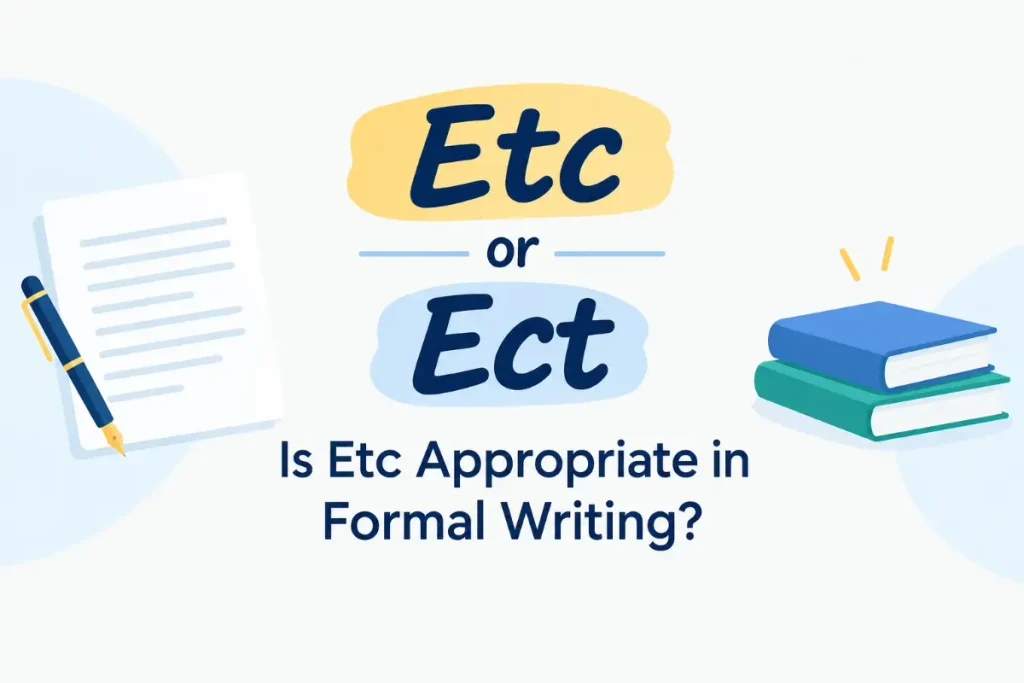
Have you ever written a sentence and wondered if etc or ect is the correct spelling? This small spelling difference can create confusion in emails, school assignments, text messages, and professional documents. Both forms look similar, but only one is the standard abbreviation used in English writing.
The correct spelling is etc., which stands for the Latin expression et cetera. It means “and other things,” “and so on,” or “and more of the same.” The spelling ect is generally a common typing or spelling mistake when someone intends to use this abbreviation.
Although the difference involves only two letters, using the wrong form can make your writing look careless. Fortunately, remembering the correct spelling is easy once you understand where the abbreviation comes from and how people use it.
This guide explains the meaning of etc., why ect is incorrect in ordinary writing, how to use the abbreviation in sentences, and which punctuation rules matter. You will also learn how to avoid common mistakes, use etc. in formal writing, and recognize situations where a different expression works better.
Quick Answer
Etc. is the correct spelling. It is an abbreviation of the Latin phrase et cetera, meaning “and other things” or “and so on.” Ect is generally a spelling mistake when used with this meaning. For example, write “Bring pens, notebooks, pencils, etc.” instead of “Bring pens, notebooks, pencils, ect.”
Etc or Ect Which Is Correct
The correct form is etc., with the letters E, T, C, followed by a period. It comes from the Latin phrase et cetera, which literally means “and the rest” or “and other things.”
Writers use etc. when they want to indicate that a list continues with similar items. Instead of naming every possible example, they mention a few and use the abbreviation to show that additional items belong to the same category.
For example:
- Please bring paper, pencils, markers, etc.
- The store sells shirts, jeans, jackets, etc.
- We discussed grammar, spelling, punctuation, etc.
- She enjoys hiking, swimming, cycling, etc.
- The office needs chairs, desks, lamps, etc.
In each example, etc. tells readers that the list includes more related items than the ones specifically mentioned.
The spelling ect does not represent the standard abbreviation. People often write it accidentally because they remember the sound of the word but forget the order of its letters.
Why Etc Is Correct
The abbreviation follows the spelling of the Latin expression et cetera.
Here is the breakdown:
| Part | Meaning |
|---|---|
| Et | And |
| Cetera | The remaining things |
| Et cetera | And the remaining things |
| Etc. | Abbreviation of et cetera |
The abbreviation keeps the first letter of et and the first three letters of cetera. This gives us E, T, C, which form the standard abbreviation etc.
The letters do not appear in the order E, C, T. That is why ect is incorrect when someone intends to write the abbreviation.

Why People Write Ect Instead
The mistake usually happens because people remember how the abbreviation sounds rather than how it is spelled. In everyday American English, etc. is commonly pronounced “et set er uh” or “et cetera,” depending on the speaker and context.
When people type quickly, they may accidentally switch the T and C. This is especially common in informal messages, social media posts, and rushed writing.
Another reason is that the abbreviation is often learned through speech before someone understands its Latin origin. If a person rarely sees it written, the correct letter order may not feel natural.
The best solution is to remember the original phrase: et cetera. The abbreviation begins with ET and continues with the first letter of CETERA.
What Does Etc Mean
Etc. means “and other things,” “and so on,” or “and the rest.” It indicates that a list contains additional examples that are similar to the ones already mentioned.
The abbreviation is useful when a writer wants to avoid listing every item. It allows readers to understand that the examples are not exhaustive.
For example:
“We bought apples, oranges, bananas, etc.”
This sentence means that the group bought apples, oranges, bananas, and other similar fruits. The writer does not need to name every fruit.
However, etc. does not mean that anything can follow the listed examples. The additional items should belong to the same general category.
Consider this sentence:
“I packed shirts, socks, shoes, etc.”
This is a natural use because the list contains clothing and personal items.
Now consider:
“I packed shirts, socks, shoes, etc., and a new laptop.”
The sentence is not necessarily grammatically incorrect, but it is less clear. The laptop does not fit naturally into the same category as the clothing items. A more precise list would improve the sentence.
Etc Meaning in Everyday English
In everyday communication, etc. helps shorten lists and avoid unnecessary detail.
For example:
- We need groceries such as milk, bread, eggs, etc.
- My favorite hobbies include painting, drawing, photography, etc.
- The children brought toys, books, games, etc.
- She studied biology, chemistry, physics, etc.
- You can contact us by phone, email, text, etc.
These sentences use etc. to indicate that more examples exist.
You can often replace etc. with “and so on” without changing the basic meaning.
For example:
“We need milk, bread, eggs, and so on.”
This sentence communicates the same general idea as:
“We need milk, bread, eggs, etc.”
How to Use Etc in a Sentence
The abbreviation is easy to use, but a few grammar and punctuation rules can make your writing more polished.
Use Etc at the End of a List
The most common position for etc. is at the end of a list of related items.
Examples:
- The supermarket sells vegetables, fruits, snacks, etc.
- You should bring a notebook, pen, calculator, etc.
- The company offers training, workshops, seminars, etc.
- We visited museums, parks, restaurants, etc.
- The website provides articles, videos, guides, etc.
In these examples, etc. appears after the final named item because it represents additional examples.
Use Etc After Similar Items
Etc. works best when the listed examples belong to the same category.
Correct: The kitchen contains plates, cups, bowls, etc.
Correct: He enjoys sports such as football, basketball, tennis, etc.
Incorrect: I bought a shirt, a notebook, a sandwich, etc.
The last example is not automatically wrong grammatically, but it is unclear because the items belong to different categories. If the writer wants to list different purchases, a more specific phrase may be better.
For example:
“I bought a shirt, a notebook, a sandwich, and several other items.”
This version gives readers a clearer idea of the list.
Use Etc in Emails and Workplace Writing
Etc. is common in business communication, especially when the writer wants to shorten a list of familiar items.
Examples:
- Please send the invoices, receipts, contracts, etc.
- The meeting will cover budgets, staffing, deadlines, etc.
- We need updated reports, charts, spreadsheets, etc.
- The office supplies include paper, pens, folders, etc.
- Please review the website content, images, layout, etc.
These examples are suitable for many ordinary workplace situations.
However, in legal documents, technical instructions, contracts, and formal reports, a complete list may be more appropriate. If the reader needs to know exactly which items are included, etc. can create uncertainty.
Use Etc in Academic Writing Carefully
Students often use etc. in essays, notes, and assignments. It can be acceptable when the list is clear and the additional examples are not important to the main point.
For example:
“Common renewable energy sources include solar, wind, hydroelectric, etc.”
This sentence is understandable, but it can be improved by writing:
“Common renewable energy sources include solar, wind, hydroelectric, and geothermal energy.”
The second version gives readers a more complete explanation.
Academic writing generally benefits from precise examples. Use etc. only when additional items do not need to be identified individually.
Etc Examples in Different Situations
Understanding how the abbreviation works in different contexts can help you use it naturally.
Everyday Conversation Examples
1. We need milk, eggs, bread, etc.
The list includes common grocery items.
2. I enjoy reading novels, biographies, mysteries, etc.
The abbreviation suggests other types of books.
3. She packed clothes, shoes, toiletries, etc.
The list includes additional travel essentials.
4. The children played with blocks, dolls, puzzles, etc.
The sentence indicates that the children used different toys.
5. You can decorate the room with flowers, candles, balloons, etc.
The writer gives examples of decorations without naming every possibility.
Text Message and Social Media Examples
Etc. also appears in casual digital communication.
1. I have homework, chores, cleaning, etc.
The writer indicates that several tasks remain.
2. We talked about movies, music, celebrities, etc.
The conversation included several entertainment topics.
3. Bring snacks, drinks, chips, etc.
The message suggests that additional refreshments are welcome.
4. My weekend plans include shopping, movies, dinner, etc.
The writer gives a quick summary of planned activities.
5. She loves cute outfits, accessories, shoes, etc.
The list includes several fashion related items.
Although etc. is acceptable in casual messages, some people prefer “and more” because it sounds more conversational.
School and Academic Examples
1. Students study mathematics, science, history, etc.
The abbreviation represents additional school subjects.
2. The assignment requires research, analysis, writing, etc.
The list includes different academic tasks.
3. The experiment used water, salt, sugar, etc.
The writer indicates that other materials were also involved.
4. The library contains novels, textbooks, dictionaries, etc.
The sentence lists examples of library materials.
5. The essay discusses education, technology, culture, etc.
The writer identifies several broad topics.
For academic writing, remember that etc. should not replace important information. If the assignment requires detailed examples, write them out.
Workplace and Professional Examples
1. Please bring the project files, notes, reports, etc.
The sentence identifies materials needed for a meeting.
2. The training covers communication, leadership, teamwork, etc.
The list represents several professional skills.
3. We need updated invoices, purchase orders, receipts, etc.
The sentence indicates that several financial documents are required.
4. The marketing team manages email campaigns, advertisements, social media, etc.
The abbreviation indicates other related marketing activities.
5. The presentation includes sales figures, customer feedback, performance data, etc.
The sentence summarizes the information included in a presentation.

Punctuation Rules for Etc
Correct punctuation is one of the most important parts of using etc. properly. Since it is an abbreviation, it normally includes a period.
Does Etc Always Need a Period
In standard American English, etc. normally ends with a period because it is an abbreviation of et cetera.
Correct: We bought apples, pears, oranges, etc.
Incorrect: We bought apples, pears, oranges, etc
The period is part of the abbreviation. However, if etc. appears at the end of a sentence, you do not need to add another period.
Correct: We bought apples, pears, oranges, etc.
The final period serves both as the abbreviation’s period and the sentence ending.
Should You Put a Comma Before Etc
In American English, writers usually place a comma before etc. when it follows items in a list.
Correct: Please bring pens, notebooks, folders, etc.
Correct: The store sells shoes, bags, hats, etc.
The comma separates the final named item from the abbreviation.
However, punctuation can depend on the sentence structure. If etc. appears within a sentence and additional material follows, you may need another punctuation mark.
Example:
“We purchased pens, notebooks, folders, etc., for the workshop.”
The comma after etc. closes the list and allows the sentence to continue.
Can You Use Etc in the Middle of a Sentence
Yes, etc. can appear in the middle of a sentence when the list ends before the sentence itself.
Examples:
- We purchased paper, pens, etc., before the meeting began.
- The company sells computers, tablets, etc., to local businesses.
- She collected books, magazines, etc., for the donation drive.
Notice the comma after etc. in each example. It separates the abbreviation from the remaining sentence.
This punctuation may look unusual, but it is correct in standard American English.
Should Etc Be Capitalized
Etc. is normally lowercase unless it appears at the beginning of a sentence or in a title where capitalization rules require it.
Correct: We need paper, pens, etc.
Correct: Etc. is commonly used in lists.
Although beginning a sentence with etc. is grammatically possible, it is usually better to rewrite the sentence. The abbreviation works most naturally after a list.
Common Mistakes With Etc
Many writers understand the meaning of etc. but still use it incorrectly. The following mistakes are worth avoiding.
Spelling Etc as Ect
Incorrect: We need paper, pencils, ect.
Correct: We need paper, pencils, etc.
The letters T and C appear in the opposite order in the incorrect version. Remember the original Latin phrase to avoid this mistake.
Writing Etcetera as Ectetera
Incorrect: We need paper, pencils, ectetera.
Correct: We need paper, pencils, et cetera.
The full expression is spelled et cetera. It contains the letters C and T in the correct order.
Using Etc After a List of Unrelated Items
Incorrect: I enjoy apples, computers, swimming, etc.
The examples do not belong to one clear category.
Better: I enjoy apples, oranges, bananas, etc.
Or:
“I enjoy apples, computers, swimming, and several other activities.”
A list should have a clear relationship between its items.
Using Etc With Including or Such As
A common style mistake occurs when etc. appears alongside words that already introduce examples.
Incorrect: We sell products such as shirts, pants, shoes, etc.
This sentence is common in casual writing, but many editors consider etc. unnecessary after “such as” because the phrase already signals examples.
Better: We sell products such as shirts, pants, and shoes.
Another example:
Incorrect: The course includes topics including grammar, spelling, punctuation, etc.
Better: The course includes grammar, spelling, punctuation, and other writing topics.
The improved sentences are more direct and avoid unnecessary repetition.
Using Etc When the List Needs to Be Complete
Sometimes a writer uses etc. when readers need exact information.
For example:
“Please submit your documents, etc., by Friday.”
This sentence is too vague if the recipient needs to know precisely which documents to submit.
Better:
“Please submit your resume, cover letter, references, and transcripts by Friday.”
In professional communication, specific instructions often work better than abbreviated lists.
Etc vs Other Similar Expressions
Etc. is not the only expression used to indicate that a list continues. Several alternatives can communicate a similar idea.
| Expression | Meaning | Best Use |
|---|---|---|
| Etc. | And other things | Lists of similar items |
| And so on | More examples continue | Conversational writing |
| And so forth | Similar additional examples | Formal or neutral writing |
| And more | Additional items or possibilities | Marketing and casual writing |
| Among others | Additional people or things | Identifying examples |
| Such as | Introduces examples | Lists and explanations |
Etc vs And So On
Etc. and “and so on” usually communicate the same general meaning.
Example:
“We need pens, paper, folders, etc.”
“We need pens, paper, folders, and so on.”
Both sentences suggest that additional similar items are needed.
Etc. is shorter and often works well in written lists. And so on sounds more conversational and may feel natural in speeches or informal writing.
Etc vs And So Forth
“And so forth” is another expression that means the list continues with similar items.
Example:
“The training covers communication, teamwork, leadership, and so forth.”
This phrase can sound slightly more formal than “and so on.” It works well in professional explanations and presentations.
Etc vs Among Others
Among others is often used when identifying people, organizations, or items that belong to a larger group.
Example:
“The event included teachers, students, parents, among others.”
A more polished version might be:
“The event included teachers, students, parents, and other community members.”
Unlike etc., among others can emphasize that the named people or items are only part of a larger group.
Is Etc Appropriate in Formal Writing
Etc. is acceptable in many formal situations, but its use depends on the purpose and audience of the document.
In ordinary professional emails, reports, and presentations, the abbreviation is widely understood. It can save space and make a list easier to read.
For example:
“The department manages recruitment, training, employee records, etc.”
This sentence may work in a general overview.
However, formal writing often benefits from complete and specific information. In legal contracts, academic research, technical documentation, and official instructions, etc. may create uncertainty.
Consider the following example:
“Employees must submit identification, tax forms, etc.”
The reader may not know which additional documents are required.
A clearer version would be:
“Employees must submit identification, tax forms, proof of address, and signed employment documents.”
The second sentence removes uncertainty.
When to Avoid Etc
Avoid etc. when:
- The reader needs an exact list.
- The document contains legal or contractual requirements.
- You are writing detailed technical instructions.
- The examples are essential to your argument.
- The abbreviation makes the sentence vague.
- The list contains unrelated items.
In these situations, write out the additional examples or explain the category more clearly.
Frequently Asked Questions
Is Etc or Ect Correct?
Etc. is the correct spelling of the abbreviation for et cetera. Ect is generally a spelling mistake when someone intends to mean “and other things.” Remember the letters E, T, and C in that order. For example, write “books, magazines, newspapers, etc.” rather than “books, magazines, newspapers, ect.”
What Does Etc Stand For?
Etc. stands for the Latin phrase et cetera, which means “and the rest” or “and other things.” English writers use it at the end of a list to indicate that additional similar items exist. It helps shorten sentences when naming every example is unnecessary.
Is Etc Short for Et Cetera?
Yes, etc. is the standard abbreviation for et cetera. The phrase contains two Latin words: et, meaning “and,” and cetera, meaning “the remaining things.” The abbreviation preserves the first letter of et and the first three letters of cetera.
Can I Use Etc in a Formal Email?
Yes, etc. is acceptable in many professional emails when the additional items are obvious and do not need to be listed individually. However, if the recipient needs exact information or instructions, write out the complete list. Specific wording is often better than an abbreviation in formal communication.
Should Etc Have a Period?
Yes, standard American English normally writes the abbreviation as etc. with a period. If it appears at the end of a sentence, the same period also serves as the sentence ending. You do not need to add a second period.
Is It Wrong to Write And Etc?
Yes, writing “and etc.” is generally considered redundant because the abbreviation already contains the meaning “and.” The Latin word et means “and.” Instead of writing “apples, oranges, and etc.,” write “apples, oranges, etc.” or “apples, oranges, and other fruits.”
Can Etc Be Used at the Beginning of a Sentence?
Although etc. can technically appear at the beginning of a sentence, it is usually awkward because the abbreviation refers to a list of items that should already have been mentioned. It is better to rewrite the sentence so that etc. follows the examples it summarizes.
Is Etc Used in British and American English?
Yes, etc. is used in both American and British English. The spelling and basic meaning remain the same. American English generally follows the abbreviation with a period, as in etc., while some British style guides may omit periods in certain abbreviations. Follow the style guide used by your publication.
Conclusion
The correct spelling is etc., not ect, when you want to indicate “and other things” or “and so on.” The abbreviation comes from the Latin phrase et cetera and is commonly used at the end of lists containing similar items. Remember the correct letter order, E, T, C, and include the period in standard American English writing.
Although etc. works well in everyday conversations, emails, and general writing, it is not always the best choice for formal documents. If readers need a complete list or exact instructions, spell out the additional items instead. Keep your examples related, avoid unnecessary repetition, and use etc. only when the meaning remains clear. A simple spelling habit can make your writing more accurate, professional, and easier to understand.