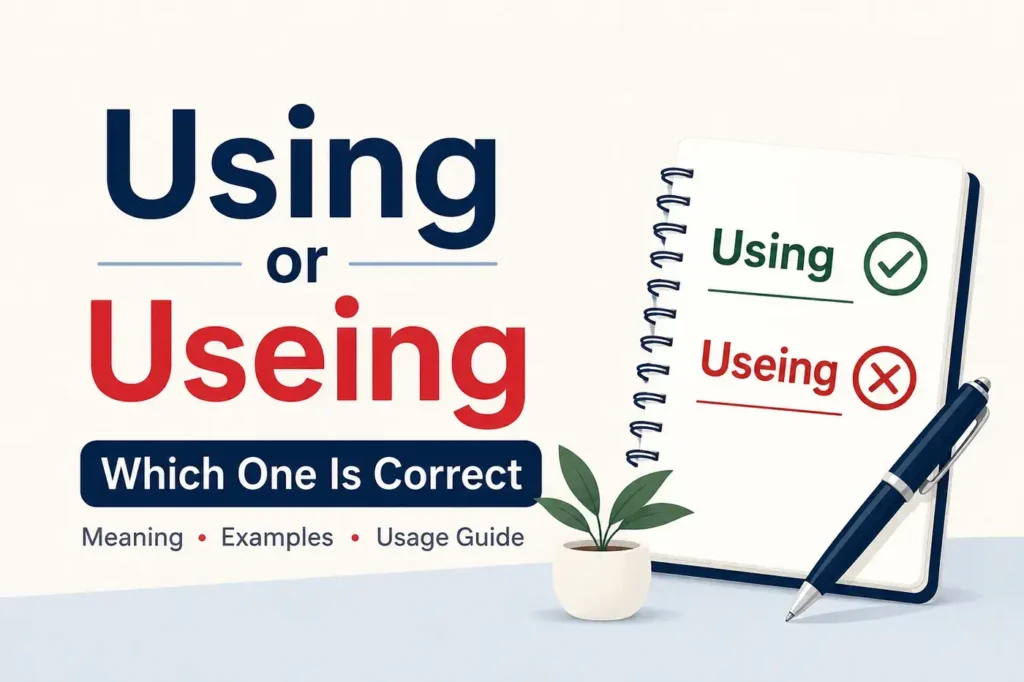
If you have ever paused while typing and wondered using or useing, you are not alone. This is one of the most common spelling questions in English because the word use ends with the letter e, yet the spelling changes when ing is added. Many people expect the word to become useing, but that is not how English spelling works.
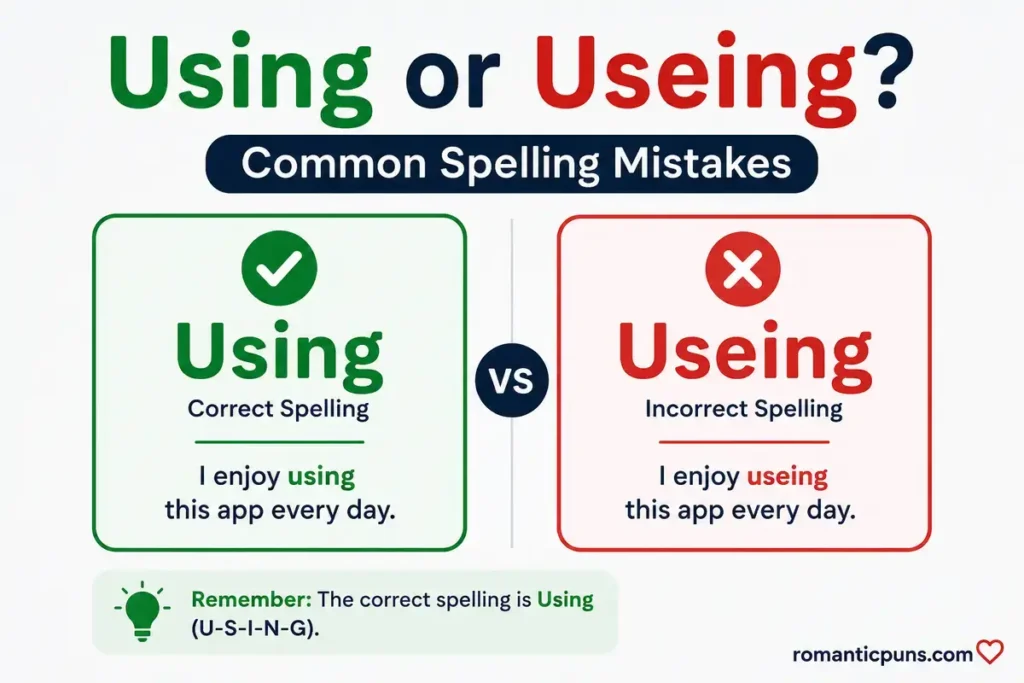
The correct spelling is using. The word useing is always incorrect and does not appear in standard English dictionaries or style guides. The silent e at the end of use is dropped before adding ing, creating the word using.
This spelling rule applies to many everyday verbs, which is why understanding it can improve your writing far beyond this single word. Once you learn the pattern, you will be able to spell similar words with confidence instead of guessing each time.
In this guide, you will learn the meaning of using, why useing is incorrect, the grammar rule behind the spelling, pronunciation, sentence examples, common mistakes, and practical tips that make the rule easy to remember.
Quick Definition
Using is the correct spelling of the present participle and gerund form of the verb use. The spelling useing is incorrect because English spelling rules require dropping the silent e before adding ing to most verbs ending in e.
Quick Answer
The answer is simple.
- Using is always correct.
- Useing is always a spelling mistake.
- Remove the silent e from use before adding ing.
- The same spelling rule applies to many common English verbs.
For example:
- She is using her laptop for work.
- They are using the new software.
- He enjoys using simple language.
Every example follows the same spelling rule.
Just as writers confuse using or useing, many also make mistakes with the correct spelling of “offered” when adding common verb endings.
Comparison Table
| Feature | Using | Useing |
|---|---|---|
| Spelling status | Correct | Incorrect |
| Part of speech | Present participle and gerund of use | Misspelling |
| Meaning | The act of employing or making use of something | No accepted meaning |
| Dictionary entry | Yes | No |
| Common contexts | Speaking writing education business technology | Typing errors and spelling mistakes |
| Formal writing | Accepted | Never accepted |
| Pronunciation | /ˈjuːzɪŋ/ | Not recognized |
| Example | She is using a calculator. | She is useing a calculator. ✗ |
Understanding The Meaning Of Using
The word using comes from the verb use, which means to employ something for a purpose or to put it into action. When ing is added, the word can describe an action that is happening now or act as a noun in a sentence.
For example:
- She is using her phone to make a video call.
- We are using fresh ingredients for dinner.
- They are using artificial intelligence to improve customer support.
In each example, the action is happening in the present.
The word can also function as a gerund.
Examples include:
- Using clear language improves communication.
- Using sunscreen helps protect your skin.
- Using reliable sources strengthens your research.
Here, using behaves like a noun because it names an activity instead of describing an ongoing action.
Why Useing Is Incorrect
Many spelling mistakes happen because English does not always follow the patterns people expect. At first glance, useing may seem logical because the base word ends with e. However, English spelling follows a different rule.
When a verb ends with a silent e, that e is usually removed before adding ing.
Here are a few familiar examples.
- Use becomes using.
- Make becomes making.
- Take becomes taking.
- Write becomes writing.
- Drive becomes driving.
- Bake becomes baking.
- Come becomes coming.
- Smile becomes smiling.
Notice the pattern. The silent e disappears before ing is added.
Because of this rule, useing is not recognized as a correct English word. You may occasionally see it online, but those examples are simply spelling errors rather than accepted usage.
Key Differences Between The Two Spellings
The difference goes beyond one extra letter. One form follows standard English spelling rules, while the other does not.
Here are the main differences.
| Using | Useing |
|---|---|
| Correct English spelling | Incorrect spelling |
| Found in dictionaries | Not found in dictionaries |
| Used by native speakers and professional writers | Appears mainly as a typing or spelling mistake |
| Accepted in schools universities and workplaces | Marked as incorrect by spell checkers |
| Follows English spelling rules | Breaks the silent e rule |
Remember this simple rule.
If the base verb ends with a silent e, remove it before adding ing. That single step prevents dozens of common spelling mistakes.
Which Spelling Should You Use
There is no situation where useing is considered the correct spelling in modern English.
Choose using in every type of writing, including:
- School assignments.
- College essays.
- Business emails.
- Professional reports.
- Blog articles.
- Social media posts.
- Text messages.
- Everyday conversations.
Even in informal writing, the correct spelling remains the same. Native speakers do not switch between the two forms because only one follows standard English conventions.
If you are unsure while writing, think about the base verb first.
- Start with use.
- Remove the silent e.
- Add ing.
- The result is using.
Following these steps takes only a few seconds and quickly becomes a habit.
Pronunciation Guide
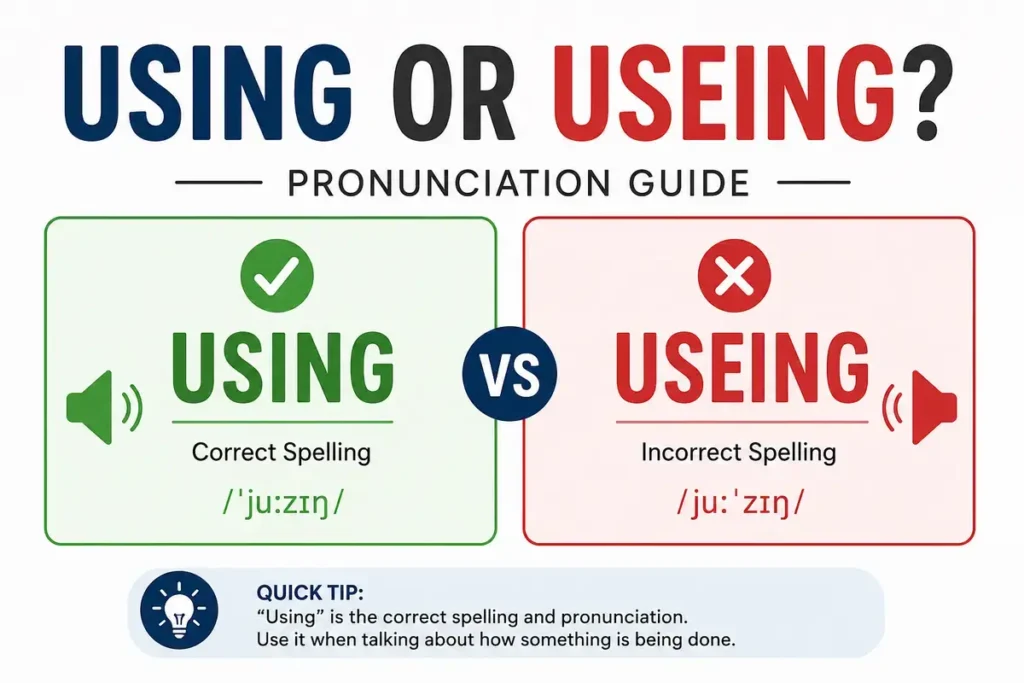
Many spelling mistakes happen because people spell words exactly as they hear them. In this case, pronunciation can make the confusion even stronger because the silent e is not pronounced.
IPA Pronunciation
Using
/ˈjuːzɪŋ/
Syllable Breakdown
Using
Us • ing
The word has two syllables.
Common Pronunciation Mistakes
Most learners pronounce using correctly, but a few mistakes appear from time to time.
- Adding an extra vowel sound between use and ing.
- Pronouncing the final s like s instead of z.
- Overemphasizing the second syllable.
A natural pronunciation sounds like YOO zing, with the stress on the first syllable.
Expert Language Insight
Experienced editors rarely think about using as a difficult word because they understand the spelling rule instead of memorizing individual words.
This is one of the most useful habits you can develop as a writer. Rather than asking yourself how to spell each word ending in ing, learn the rule once and apply it everywhere. The same pattern works for hundreds of common verbs, making your writing more accurate and your proofreading much faster.
Professional writers also rely on consistency. They do not guess spellings based on appearance. Instead, they understand how English word formation works, which helps them avoid errors before they reach the editing stage.
Examples In Sentences
The easiest way to remember the correct spelling is to see it in everyday writing. Notice how using fits naturally into each sentence. You will also see why useing should never appear in standard English.
Sentences With Using
These examples show the correct spelling in different situations.
- She is using her tablet to read an online book.
- We are using fresh vegetables for tonight’s dinner.
- They are using maps to plan their road trip.
- I am using a timer to stay focused while studying.
- The teacher is using simple examples to explain the lesson.
- He enjoys using recycled materials for his art projects.
- Our team is using customer feedback to improve the product.
- The company is using new technology to reduce waste.
- Doctors are using advanced equipment to diagnose patients.
- Using clear language helps readers understand difficult ideas.
These examples show that the word works naturally in conversations, academic writing, business communication, and professional documents.
Examples Of The Incorrect Spelling
The following sentences contain a common spelling mistake. They are shown only to help you recognize the error.
- She is useing her phone to check directions. ✗
- We are useing new software at work. ✗
- He enjoys useing simple words. ✗
- They are useing online tools for research. ✗
- I am useing my laptop every day. ✗
- The students are useing calculators during the test. ✗
- She keeps useing the wrong password. ✗
- The business is useing digital marketing. ✗
- They started useing reusable bottles. ✗
- We are useing a different approach this year. ✗
In every example above, replacing useing with using creates the correct sentence.
If you’re interested in similar spelling questions, another tricky spelling pair is whether shakey or shaky is the correct form in modern English.
Common Spelling Mistakes
Most people do not write useing because they do not know English. They write it because they apply a spelling pattern that seems logical. Once you understand the rule, the mistake becomes easy to avoid.
Here are the errors teachers and editors see most often.
Keeping The Silent E
This is the most common mistake.
Incorrect:
useing
Correct:
using
The silent e must be removed before adding ing.
Assuming Every Word Keeps Its Final Letter
English spelling follows patterns rather than simple formulas. Some words keep their final letters, while others do not. Trying to apply one rule to every verb often creates spelling mistakes.
Compare these examples.
- Use becomes using.
- Write becomes writing.
- Drive becomes driving.
- Hope becomes hoping.
Each word drops the silent e before adding ing.
Typing Too Quickly
Many spelling errors happen because people type faster than they proofread. Modern spell checkers usually catch useing, but it can still appear in emails, social media posts, and online comments if the writer skips proofreading.
Reading your work one final time helps catch simple errors before they reach your readers.
Confusing Pronunciation With Spelling
The word sounds almost the same as the base verb, so some learners assume the spelling should stay the same.
English does not always work that way. The pronunciation changes very little, but the spelling follows a specific rule.
Etymology And Word Origin
Learning where a word comes from often makes it easier to understand its spelling.
The verb use entered English through Old French from the Latin word usus, which relates to employing, practicing, or making use of something. Over time, the word became one of the most frequently used verbs in English because it describes an action people perform every day.
When English grammar developed its modern spelling conventions, verbs ending in a silent e began following a predictable pattern before ing was added. Instead of writing useing, writers dropped the silent e and formed using.
This pattern has remained unchanged for centuries and appears in dictionaries, grammar books, style guides, and educational materials throughout the English speaking world.
Regional Usage
Unlike some spelling differences in English, there is no regional variation here.
American English
American English always uses using. Schools, universities, publishers, and businesses all follow the same spelling.
British English
British English also uses using. The spelling does not change between British and American English.
Australian English
Australian English follows the same rule. You’ll find using in textbooks, newspapers, and official documents.
Canadian English
Canadian English also recognizes only using as the correct spelling.
This makes the word easier to learn because you do not need to remember different regional spellings.
Grammar Rules
Understanding the grammar behind the word is more valuable than memorizing a single spelling. Once you know the rule, you can apply it to hundreds of similar verbs.
Part Of Speech
The word can perform different grammatical functions depending on the sentence.
It can act as:
- A present participle.
- A gerund.
- Part of a continuous verb tense.
Examples include:
- She is using a dictionary.
- Using examples improves learning.
- They have been using this method for years.
Present Participle
The present participle works with helping verbs to describe actions in progress.
Examples include:
- I am using my computer.
- They were using different materials.
- She has been using this technique successfully.
Gerund
A gerund is a verb ending in ing that functions as a noun.
Examples include:
- Using evidence strengthens an argument.
- Using simple language makes writing clearer.
- Using examples helps students learn faster.
The Silent E Rule
This is one of the most useful spelling rules in English.
When a verb ends with a silent e, remove the e before adding ing.
Here are more examples.
- Make becomes making.
- Take becomes taking.
- Bake becomes baking.
- Come becomes coming.
- Write becomes writing.
- Drive becomes driving.
- Save becomes saving.
- Smile becomes smiling.
Learning this single pattern improves the spelling of dozens of common verbs.
Real Life Usage Examples
The word appears in almost every kind of communication because people constantly talk about how they use tools, ideas, technology, and everyday objects.
Daily Conversation
People naturally use the word in casual speech.
Examples include:
- I am using my phone to pay the bill.
- She is using my favorite recipe.
- We are using the back entrance today.
Academic Writing
Students and researchers often use the word when describing methods or evidence.
Examples include:
- The experiment was completed using two different techniques.
- The researchers analyzed the data using statistical software.
- Students improved their writing by using reliable sources.
Professional Communication
The word appears frequently in emails, reports, manuals, and presentations.
Examples include:
- We are using customer feedback to improve our services.
- The marketing team is using new analytics tools.
- Employees should avoid using personal devices for confidential work.
Literature And Media
Authors and journalists regularly use the word because it naturally describes actions and processes.
You’ll see it in novels, newspapers, magazines, blogs, and online articles without giving it a second thought because it is one of the most common verbs in everyday English.
Related Words And Commonly Confused Terms
Learning one spelling rule often helps you master many others. If you understand why using is correct, you’ll recognize the same pattern in dozens of everyday verbs.
Here are some closely related words.
| Base Word | Correct Form | Common Mistake |
|---|---|---|
| Use | Using | Useing |
| Make | Making | Makeing |
| Take | Taking | Takeing |
| Come | Coming | Comeing |
| Write | Writing | Writeing |
| Drive | Driving | Driveing |
| Save | Saving | Saveing |
| Bake | Baking | Bakeing |
Notice the pattern. Every verb ending with a silent e drops that letter before ing is added.
You may also come across these related grammar terms while learning English.
- Verb.
- Present participle.
- Gerund.
- Continuous tense.
- Base form.
- Root word.
- Silent e rule.
- Word formation.
- Inflection.
- Spelling convention.
Understanding these terms gives you a stronger foundation for grammar and makes similar spelling rules much easier to learn.
Understanding forming tricky plural words can also help with cases like bellies vs bellys, where English pluralization rules often cause confusion.
Synonyms Of Using
The best synonym depends on the sentence because using can express different ideas. In some contexts, it means operating a tool. In others, it means applying a method or making practical use of something.
Common synonyms include:
- Employing.
- Applying.
- Utilizing.
- Operating.
- Handling.
- Making use of.
- Working with.
- Practicing.
- Exercising.
- Adopting.
Although these words are similar, they are not always interchangeable. Choose the one that fits the meaning of your sentence instead of replacing using automatically.
How To Spell Using
If you ever hesitate while writing, this simple method will help.
- Start with the base verb use.
- Remove the silent e.
- Add ing.
- The correct spelling becomes using.
Do not keep the silent e when adding ing.
This same process works for many common English verbs, so learning it once will improve your spelling in many situations.
Expert Language Insight
One mistake many learners make is trying to memorize the spelling of every individual word. That approach becomes frustrating because English contains thousands of verbs.
Professional editors take a different approach. They learn the spelling patterns behind the language instead of memorizing isolated words. Once you understand that most verbs ending in a silent e drop that letter before adding ing, you can confidently spell words like making, taking, driving, saving, and using without stopping to think.
Native speakers rarely question this spelling because the pattern becomes automatic after years of reading and writing. You can build the same confidence by focusing on the rule instead of relying on guesswork.
Another helpful habit is proofreading slowly. Many spelling mistakes happen because writers know the correct form but type too quickly. Reading your work one final time often catches simple errors before anyone else sees them.
Frequently Asked Questions
Is using or useing correct?
Using is the correct spelling. Useing is a spelling mistake because English requires dropping the silent e before adding ing to most verbs ending in e.
Why is useing incorrect?
The word breaks a standard English spelling rule. When a verb ends with a silent e, that letter is usually removed before ing is added. That is why use becomes using, not useing.
What does using mean?
Using means employing, operating, applying, or making use of something. It can describe an action happening now or function as a gerund that names an activity.
How do you use using in a sentence?
Here is a simple example.
She is using her camera to take pictures.
Another example is:
Using clear examples makes difficult topics easier to understand.
Is using a verb or a noun?
It can be both, depending on the sentence. It acts as a present participle in continuous verb tenses and as a gerund when it functions like a noun.
Is the spelling different in British English?
No. American English, British English, Australian English, and Canadian English all use the same spelling. There is no regional variation for this word.
What is the easiest way to remember the correct spelling?
Remember the silent e rule. Remove the final e from use, then add ing. Practicing this pattern with similar verbs makes it easier to remember.
Do dictionaries recognize useing?
No. Standard English dictionaries list using as the correct word. Useing is treated as a spelling error rather than an accepted alternative.
Conclusion
Choosing between using or useing is actually straightforward once you understand the spelling rule. Using is the only correct form in modern English, while useing is always a misspelling.
The reason is simple. Most verbs ending with a silent e drop that letter before ing is added. This same pattern appears in everyday words like making, taking, driving, and writing. Learning the rule is far more useful than memorizing one word because it helps you spell many other verbs correctly.
Whenever you feel unsure, return to the base verb. Remove the silent e, add ing, and read the finished word aloud. With a little practice, the correct spelling becomes second nature and your writing becomes clearer, more polished, and more professional.