Have you ever typed offered vs offerred into a search engine after your spell checker highlighted one of them? It is a common mistake because English spelling rules are not always straightforward. Many verbs double their final consonant before adding ed, so it is easy to wonder if offer follows the same pattern.
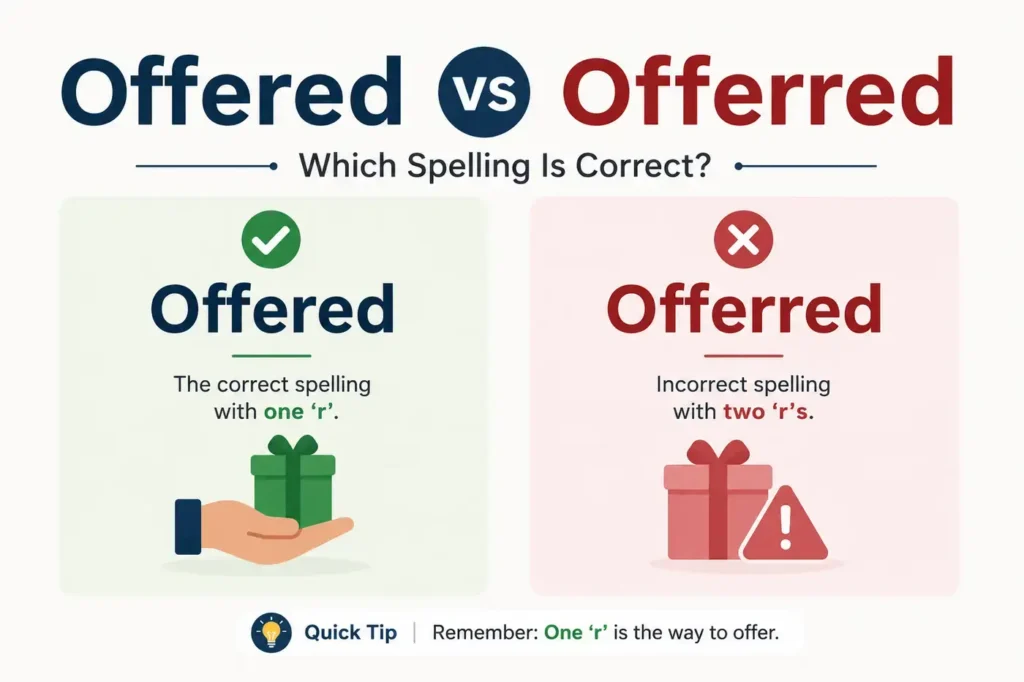
The short answer is simple. Offered is the only correct spelling. Offerred is a misspelling and does not appear in standard English dictionaries or style guides. The confusion usually comes from words like preferred, referred, and transferred, which do double the letter r because of how they are formed. The verb offer follows a different spelling rule, so its past tense and past participle keep a single r.
In this guide, you will learn why offered is correct, why offerred is incorrect, and how English spelling rules explain the difference. You will also discover real sentence examples, pronunciation tips, grammar guidance, common mistakes, and practical editing advice. By the end, you will know exactly which spelling to use and how to avoid making this mistake in your own writing.
Quick Definition
Offered is the correct past tense and past participle of the verb offer. Offerred is an incorrect spelling and should never be used in formal or informal writing. If you want to describe giving, presenting, or proposing something in the past, offered is always the correct choice.
Quick Answer
If you only need the answer, here it is.
- Offered is the correct spelling.
- Offerred is a spelling mistake.
- The verb offer does not double the final r before adding ed.
- This rule is the same in American English, British English, Australian English, and Canadian English.
Whenever you write about something that was given, presented, suggested, or made available in the past, use offered.
Comparison Table
| Feature | Offered | Offerred |
|---|---|---|
| Status | Correct spelling | Incorrect spelling |
| Part of speech | Verb past tense and past participle | Not a recognized English word |
| Meaning | Gave presented or proposed something | No accepted meaning |
| Origin | From the verb offer | Misspelling of offered |
| Accepted in dictionaries | Yes | No |
| Used in formal writing | Yes | No |
| Used in everyday English | Yes | No |
| Common contexts | Conversation business education literature journalism | Typographical error |
| Example | She offered to help her neighbor. | Incorrect spelling |
Like offered, many English mistakes come from words that sound alike, and another commonly confused expression is whether to write deep seated or deep seeded.
Understanding Offered
The word offered is the past tense and past participle of the verb offer. It describes an action that has already happened. Someone may have offered help, advice, support, money, information, or an opportunity.
The verb itself comes from the idea of presenting something willingly. Depending on the situation, it can mean giving, suggesting, proposing, volunteering, or making something available to another person.
Here are some common situations where offered appears naturally.
- Someone offered assistance during an emergency.
- A company offered a new position to a candidate.
- A teacher offered extra guidance before an exam.
- A restaurant offered customers a seasonal menu.
- A friend offered encouragement during a difficult time.
Because the word is used in so many situations, it appears frequently in everyday conversation, academic writing, business communication, news articles, and literature.
Does Offerred Have A Meaning
Many people assume offerred is another accepted spelling, but it is not.
Unlike regional spelling pairs such as color and colour, there is no English dialect where offerred is considered correct. It is simply a spelling error that usually happens because writers apply the wrong spelling rule.
You will not find offerred listed as a standard entry in reputable dictionaries because it has no separate meaning, pronunciation, or grammatical function. Whenever you see it, the intended word is almost always offered.
If your spell checker underlines offerred, it is doing exactly what it should.
Key Differences
Although these words look similar, only one belongs in standard English. Understanding the difference helps you avoid a mistake that editors notice immediately.
The biggest difference is simple. Offered is a real English word, while offerred is not. One appears in dictionaries, books, newspapers, and professional writing. The other appears mainly because of typing errors or confusion about spelling rules.
Here is a quick comparison.
| Offered | Offerred |
|---|---|
| Correct English spelling | Incorrect spelling |
| Found in dictionaries | Not found in standard dictionaries |
| Used by native speakers | Not accepted in edited writing |
| Grammatically correct | Grammatically incorrect |
| Appropriate for all writing | Should always be corrected |
Instead of trying to memorize this pair, remember the base verb. The word offer ends with a single r, and adding ed keeps that same spelling.
Which Spelling Should You Use
The answer is straightforward. You should always use offered.
There are no situations where offerred becomes correct because of regional spelling, formality, or writing style. Major dictionaries, educational institutions, publishing houses, and style guides all recognize only offered.
If you are proofreading your writing, make checking this word part of your editing routine.
- Look at the base verb.
- Confirm it is offer.
- Add ed without adding another r.
- Read the sentence again to make sure it sounds natural.
Following these simple steps will prevent one of the most common spelling mistakes involving this verb.
Pronunciation Guide
Although many people search for offered pronunciation, saying the word correctly is usually easier than spelling it.
IPA Pronunciation
Offered
UK: /ˈɒf.əd/
US: /ˈɔː.fɚd/
Syllable Breakdown
Of • fered
The first syllable carries the primary stress.
Common Pronunciation Mistakes
The spelling mistake offerred does not create a different pronunciation because it is not a recognized English word.
When saying offered, avoid these common errors.
- Adding an extra syllable.
- Pronouncing both e letters separately.
- Overemphasizing the ending.
Listening to native speakers and reading the word aloud in complete sentences can help you develop a more natural pronunciation.
Expert Language Insight
One reason this spelling mistake is so common is that English contains several verbs that really do double the final r before adding ed. Words like preferred, referred, and transferred encourage writers to assume the same rule applies to offer.
Professional editors rarely memorize individual words. Instead, they understand the spelling pattern behind them. Once you know that offer keeps its single r when adding ed, the correct spelling becomes much easier to remember. Learning the rule instead of memorizing the word also helps you avoid similar mistakes in future writing.
Examples in Sentences
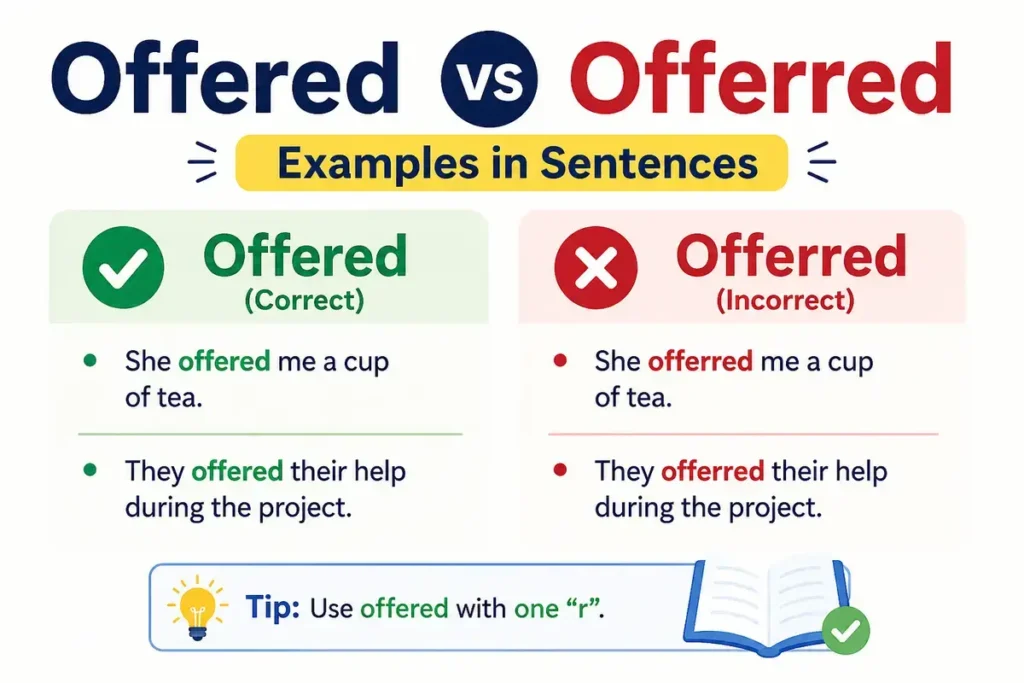
The easiest way to remember the correct spelling is to see it in natural context. Notice that every example uses offered because it is the only accepted form. You will not find offerred in professionally edited books, newspapers, or dictionaries.
Examples Using Offered
- She offered to drive me home after the meeting.
- The company offered its employees additional training.
- Our neighbors offered fresh vegetables from their garden.
- The teacher offered extra practice before the final exam.
- He offered a thoughtful solution that everyone appreciated.
- They offered free shipping on every online order.
- My parents offered helpful advice before my first job interview.
- The museum offered guided tours throughout the summer.
- The doctor offered several treatment options after reviewing the test results.
- We offered our guests coffee before dinner.
These examples show that offered can describe giving, presenting, suggesting, volunteering, or making something available. The exact meaning depends on the context, but the spelling never changes.
Examples Showing The Incorrect Form
The following sentences demonstrate a common spelling mistake. Each incorrect example is followed by the correct version.
- ❌ She offerred to help with the project.
✅ She offered to help with the project. - ❌ The hotel offerred complimentary breakfast.
✅ The hotel offered complimentary breakfast. - ❌ He offerred his seat to an elderly passenger.
✅ He offered his seat to an elderly passenger. - ❌ They offerred us a discount.
✅ They offered us a discount. - ❌ My friend offerred great advice.
✅ My friend offered great advice. - ❌ The coach offerred useful feedback.
✅ The coach offered useful feedback. - ❌ She offerred an apology after the mistake.
✅ She offered an apology after the mistake. - ❌ The school offerred several scholarship programs.
✅ The school offered several scholarship programs. - ❌ He offerred to pay for lunch.
✅ He offered to pay for lunch. - ❌ They offerred support during the difficult time.
✅ They offered support during the difficult time.
Looking at incorrect and correct versions side by side makes the spelling rule much easier to remember.
Common Mistakes
Most writers do not spell offerred incorrectly because they are careless. The mistake usually happens because they apply the wrong spelling rule to the verb offer.
Here are the mistakes editors see most often.
Adding An Extra Letter R
This is the most common error.
Many English verbs double their final consonant before adding ed, so writers naturally assume offer follows the same pattern. It does not.
Always write offered, never offerred.
Confusing Similar Verbs
Words such as preferred, referred, transferred, and deferred contain a double r. Since these words appear frequently in everyday writing, they can influence the way people spell offered.
The difference is that these verbs follow a different spelling pattern based on stress and word formation.
Ignoring Spell Check
Modern spelling tools usually identify offerred immediately.
Even so, it is worth proofreading your work because spell check cannot catch every writing mistake, especially if another valid word is used by accident.
Memorizing Words Instead Of Rules
Trying to memorize every English spelling is difficult.
A better strategy is to understand the rule behind the word. Once you know that offer simply becomes offered, you are much less likely to repeat the mistake.
Etymology And Word Origin
The verb offer has a long history that stretches back through several languages.
It entered Middle English from Old French ofrir, which meant to present, give, or bring forward willingly. That word traces even further back to the Latin verb offerre, meaning to bring before, present, or carry toward someone.
Over time, the meaning expanded beyond physical gifts. Today, offer can describe presenting help, proposing an idea, making a payment, providing a service, extending an invitation, or expressing willingness to do something.
The past tense offered has followed the same spelling pattern for centuries. Standard dictionaries and historical writing consistently use the single r spelling.
If you’re polishing formal writing, it’s also worth understanding where punctuation and footnotes belong to avoid common formatting mistakes in academic and professional documents.
Regional Usage
Many spelling questions have different answers in American and British English. This is not one of them.
American English
American English always uses offered.
You’ll see this spelling in newspapers, universities, government publications, legal documents, business communication, and everyday writing.
British English
British English also uses offered.
Major dictionaries, publishers, and educational institutions do not recognize offerred as an alternative spelling.
Australian English
Australian English follows the same standard.
Students, teachers, journalists, and professional writers all use offered.
Canadian English
Canadian English also accepts only offered.
Unlike words such as colour and colour, there is no regional variation for this verb.
No matter where English is spoken, the spelling remains the same.
Grammar Rules
Understanding the grammar behind offered makes the word much easier to use correctly.
Part Of Speech
Offered is the past tense and past participle of the verb offer.
Examples include:
- She offered to help yesterday.
- They have offered several solutions.
Past Tense
Use offered when describing an action completed in the past.
Examples:
- He offered his assistance immediately.
- The store offered a discount last weekend.
Past Participle
The word also functions as a past participle with helping verbs.
Examples:
- We have offered our support.
- The company had offered flexible working hours before the policy changed.
Passive Voice
You’ll also find offered in passive constructions.
Examples:
- A refund was offered to every customer.
- Additional training was offered to new employees.
Common Sentence Patterns
The verb appears naturally in many sentence structures.
- Offered someone something.
- Offered to do something.
- Offered help.
- Offered advice.
- Offered support.
- Offered an opportunity.
- Offered a solution.
- Offered a discount.
Learning these patterns helps your writing sound more natural.
Offered Meaning
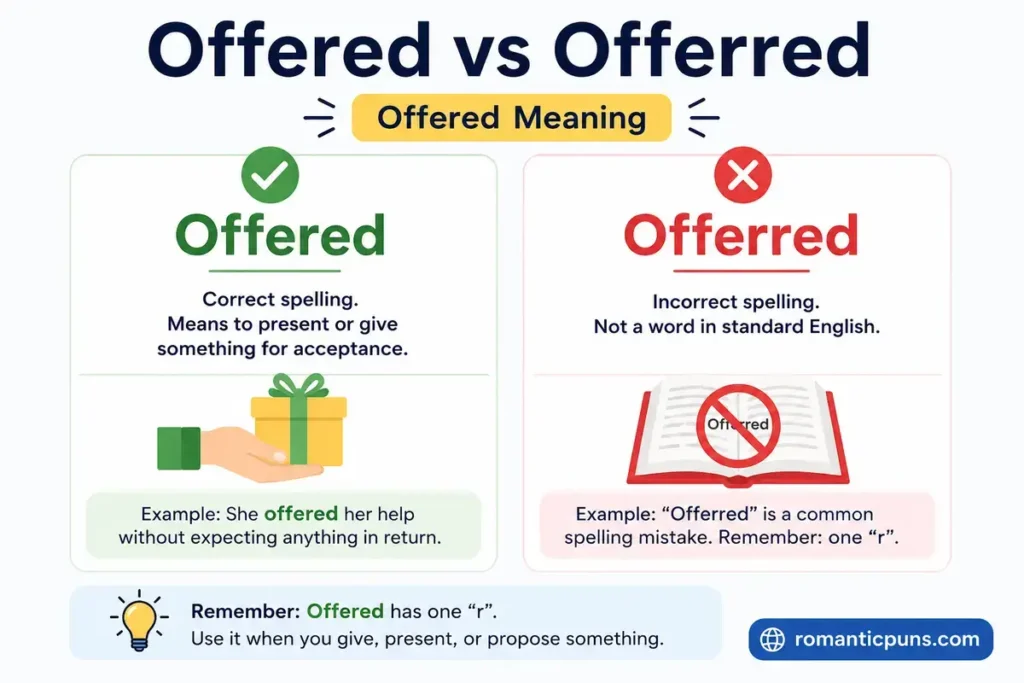
The meaning of offered depends on the sentence, but the central idea remains the same. It describes giving, presenting, suggesting, proposing, or making something available.
Depending on the context, offered can mean:
- Presented something to another person.
- Suggested an idea or solution.
- Volunteered assistance.
- Made a service or product available.
- Proposed an opportunity.
- Extended an invitation.
- Expressed willingness to do something.
The surrounding words determine the exact meaning.
Offered Synonym
Choosing a synonym depends on what is being offered.
Common alternatives include:
- Presented.
- Provided.
- Supplied.
- Suggested.
- Proposed.
- Extended.
- Gave.
- Volunteered.
- Introduced.
- Submitted.
These words are not perfect replacements in every sentence, so always choose the one that matches your intended meaning.
Real Life Usage
The word offered appears in almost every type of writing because people constantly give, suggest, and provide things.
Daily Conversation
People use the word naturally when talking about everyday experiences.
Examples include offering help, food, directions, transportation, or advice.
Academic Writing
Researchers may write that a study offered new evidence or a professor offered additional resources to students.
Professional Communication
Businesses often say they offered a promotion, refund, contract, service, interview, or employment opportunity.
Literature
Authors frequently write that a character offered a smile, apology, promise, explanation, or invitation. The verb helps move conversations and relationships forward.
Media
News reports regularly describe governments, organizations, companies, and individuals that offered financial aid, assistance, statements, recommendations, or support.
Across every type of writing, the spelling remains exactly the same. That consistency is one reason editors quickly notice the incorrect form.
Related Words And Commonly Confused Terms
English contains many words that look similar to offered, which explains why people sometimes make spelling mistakes. Learning the differences helps you write with more confidence and avoid common editing errors.
Here are some related words that often appear alongside offer.
| Word | Meaning | Example |
|---|---|---|
| Offer | To present or make available | They offer free delivery. |
| Offered | Past tense and past participle of offer | She offered helpful advice. |
| Offering | The act of presenting something | The charity accepted the offering. |
| Offers | Third person singular form | He offers excellent customer service. |
| Offeror | A person who makes an offer | The offeror signed the agreement. |
| Offeree | A person who receives an offer | The offeree accepted the proposal. |
Writers also confuse offered with words that legitimately double the final r before adding ed.
- Preferred.
- Referred.
- Transferred.
- Deferred.
- Inferred.
Although these verbs end differently, they follow their own spelling patterns. They are not models for spelling offered.
Offered Or Offerred Synonym
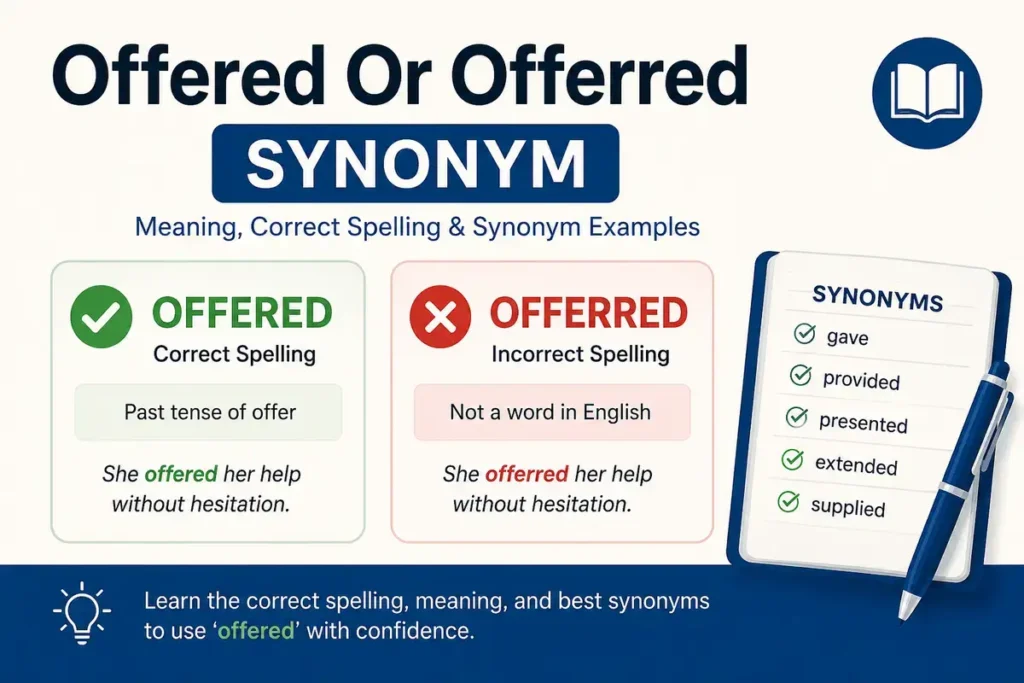
Since offerred is not a valid English word, it has no synonym.
If you’re looking for alternatives to offered, these words may fit depending on the sentence.
- Presented.
- Provided.
- Suggested.
- Proposed.
- Extended.
- Volunteered.
- Submitted.
- Gave.
- Introduced.
- Supplied.
Always choose a synonym based on context rather than replacing words automatically.
Offered Or Offerred Crossword
Crossword clues almost always use correctly spelled dictionary words.
If you come across a clue asking for the past tense of offer, the answer will always be offered. The spelling offerred does not appear in reputable crossword puzzles because it is not recognized as an English word.
Expert Language Insight
Professional editors rarely think about spelling as a matter of memory alone. Instead, they look for patterns that explain why a word is written a certain way.
The mistake offerred often appears because writers notice verbs like preferred and transferred and assume the same rule applies to offer. At first glance, that seems logical. However, English spelling depends on more than the last letter of a word. Factors such as stress patterns and word formation also influence spelling.
Experienced writers develop the habit of checking the base word before adding a suffix. In this case, the base verb is offer. Since standard English keeps the single r, adding ed produces offered, not offerred.
Another useful editing habit is reading your work after running a spell check. Software catches many spelling errors, but careful proofreading helps you spot mistakes that automated tools might miss. That extra review is one reason professional writing looks polished and consistent.
Similar spelling mix-ups appear in everyday vocabulary too, such as the difference between puddy and putty, where one form is standard English and the other is often a misspelling.
Frequently Asked Questions
Is offered or offerred correct?
Offered is the correct spelling. It is the accepted past tense and past participle of offer. Offerred is a misspelling and should not be used in any type of writing.
Why do people spell offered with two letter Rs?
Many writers confuse offered with verbs like preferred and transferred, which legitimately double the final r. Since those words are common, people sometimes apply the same rule to offer, even though it does not follow that spelling pattern.
Is offerred ever correct in British English?
No. British English, American English, Australian English, and Canadian English all use offered. There is no regional variety of English that accepts offerred as the correct spelling.
What does offered mean?
Offered means presented, gave, proposed, suggested, or made something available. The exact meaning depends on the sentence, but it always refers to an action that happened in the past.
How do you pronounce offered?
In American English, the word is commonly pronounced /ˈɔː.fɚd/. In British English, it is typically pronounced /ˈɒf.əd/. Although accents differ slightly, the spelling remains the same everywhere.
What is a good synonym for offered?
Some common synonyms include presented, provided, suggested, proposed, extended, volunteered, and gave. Choose the synonym that best matches the meaning of your sentence instead of replacing the word automatically.
Can I use offered in formal writing?
Yes. Offered is appropriate in academic papers, business communication, legal documents, journalism, professional emails, and everyday writing. It is a standard English word accepted by major dictionaries and style guides.
How can I remember the correct spelling?
Start with the base verb offer. Then add ed to form the past tense. Do not add another r. If you remember the original spelling of the verb, the correct past tense becomes much easier to write.
Conclusion
Choosing between offered and offerred is much easier once you understand the spelling rule. Offered is the only correct form because it is the standard past tense and past participle of the verb offer. The spelling offerred is simply a common mistake that results from applying the wrong pattern to the word.
Whenever you write about presenting, suggesting, giving, or making something available in the past, use offered with confidence. This rule does not change across American, British, Australian, or Canadian English. Dictionaries, style guides, publishers, and educators all agree on the correct spelling.
When comparing offered vs offerred, the answer is clear. Offered is the only correct spelling, while offerred is always a misspelling. Remember the base verb offer, add ed, and you will use the correct form every time.