If you’ve searched for puddy or putty, you’re probably trying to figure out which spelling is correct. Maybe you heard someone say the word out loud, saw it in a social media post, or noticed different spellings online. It’s an easy mix up because both words sound almost identical in everyday speech, but they don’t mean the same thing.
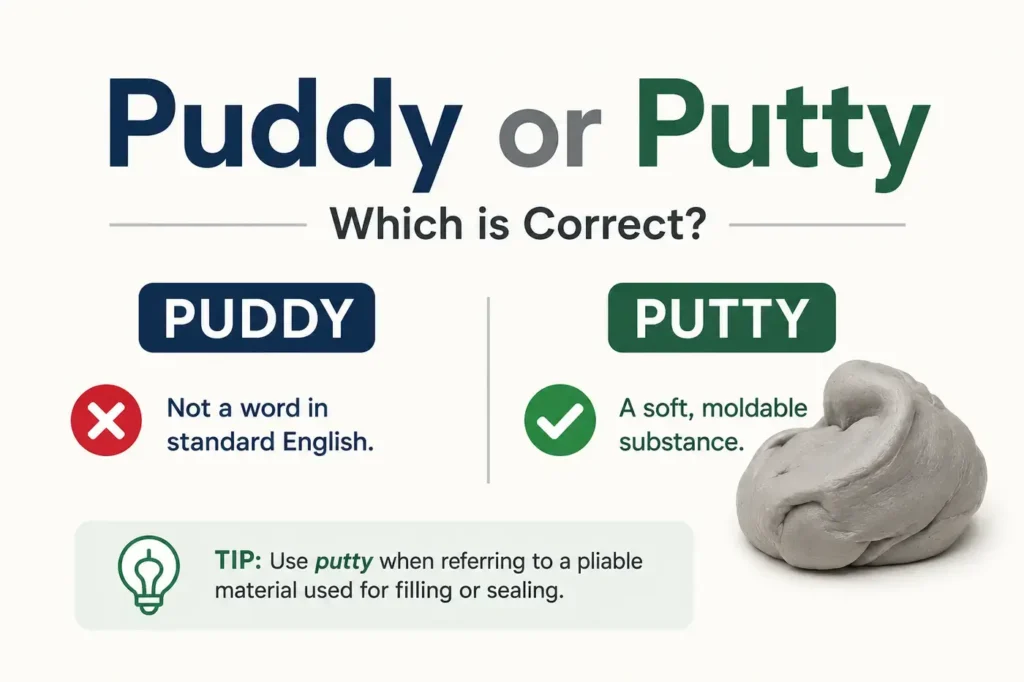
The short answer is simple. Putty is the correct English word in almost every situation. It refers to a soft material used for filling cracks, sealing windows, repairing walls, making crafts, or even playing with as a sensory toy. Puddy, on the other hand, isn’t a standard English spelling. It occasionally appears as a nickname, a fictional name, internet slang, or a misspelling of putty.
The confusion comes from pronunciation. In casual conversation, many English speakers pronounce putty with a soft sound that can make it seem like they’re saying puddy. Add internet memes, social media, and informal writing to the mix, and it’s easy to see why people search for both spellings.
This guide explains the difference in plain English. You’ll learn what each word means, how to pronounce putty correctly, where each term appears, common mistakes to avoid, and how native speakers actually use the word in everyday conversation.
Quick Definition
Putty is the correct English word for a soft, moldable material used in construction, repairs, crafts, and toys. Puddy isn’t a standard dictionary word and is usually a misspelling, a nickname, or a reference to a fictional character. In almost every writing situation, putty is the correct choice.
Quick Answer
If you’re deciding which spelling to use, here’s the answer.
- Putty is the correct spelling in standard English.
- Use putty when referring to a repair material, wall filler, glazing compound, modeling material, or sensory toy.
- Puddy is not a standard English word.
- You may see Puddy as a surname, nickname, online joke, or fictional character, but not as the name of the repair material.
If your goal is correct English, choose putty.
Comparison Table
| Feature | Putty | Puddy |
|---|---|---|
| Part of speech | Noun | Proper noun or informal spelling |
| Meaning | A soft material used to fill, seal, or shape | Usually a misspelling or a name |
| Origin | Middle English | No standard English origin as a common noun |
| Standard spelling | Yes | No |
| Formality | Standard English | Informal or nonstandard |
| Common contexts | Home repair, construction, crafts, toys | Nicknames, memes, fictional names, online posts |
| Usage frequency | Very common | Rare outside specific references |
| Example | Apply putty before painting the wall. | Puddy appears as a character name in some contexts. |
Understanding The Two Words
Although these spellings look similar, they have very different roles in English. One belongs in dictionaries and professional writing. The other appears only in limited situations.
What Does Putty Mean
Putty is a soft, moldable substance used to fill gaps, smooth surfaces, or seal joints. Different types serve different purposes, but they all share the same basic characteristic. They’re flexible before they dry or cure.
You might come across several kinds of putty, including:
- Wall putty used to smooth surfaces before painting.
- Glazing putty used around glass windows.
- Wood putty used to fill holes and scratches in timber.
- Plumbing putty used to create watertight seals.
- Therapy or sensory putty used for hand exercises and children’s activities.
- Modeling putty used in arts and crafts.
The exact material changes depending on its purpose, but the meaning of the word stays the same.
Wall Putty Meaning In English
Wall putty is a fine powder or paste applied to walls before painting. It fills tiny cracks, smooths uneven surfaces, and creates a stronger base for paint.
Professional painters use wall putty because it helps paint last longer and produces a cleaner finish. Instead of hiding imperfections with extra coats of paint, they prepare the surface first.
Putty For Walls
If you’re renovating a room, wall putty is one of the first products you’ll hear about. It’s applied after the plaster has dried and before the primer or paint.
Its main benefits include:
- Filling hairline cracks.
- Creating a smoother surface.
- Improving paint adhesion.
- Reducing paint absorption.
- Increasing the life of the painted finish.
Because of these advantages, it’s considered a standard part of wall preparation in many homes and commercial buildings.
What Does Puddy Mean
Unlike putty, puddy isn’t recognized as a standard English noun.
You may encounter it in a few specific situations.
- As a surname or family name.
- As a nickname.
- As the name of a fictional character.
- As an intentional playful spelling online.
- As a typing or spelling mistake.
If someone writes I bought puddy to repair the wall, the intended word is almost certainly putty.
Key Differences
The easiest way to remember the difference is to focus on meaning rather than spelling.
Putty has a clear definition and appears in dictionaries, textbooks, hardware stores, construction guides, and everyday conversation. Puddy doesn’t function as the standard English word for the material.
Here are the main differences.
| Putty | Puddy |
|---|---|
| Standard English word | Nonstandard spelling in most contexts |
| Listed in dictionaries | Rarely listed except as a proper name |
| Used for repairs, construction, crafts, and toys | Usually a name, nickname, or misspelling |
| Appropriate in formal writing | Not appropriate in standard writing unless referring to a name |
When editing documents, experienced writers almost always replace puddy with putty unless the word is someone’s name or part of a specific cultural reference.
Which Spelling Is Correct
For almost every situation, putty is the correct spelling.
That includes writing about home improvement, construction, decorating, woodworking, plumbing, crafts, children’s toys, and repair materials. Dictionaries, style guides, and professional publications consistently use putty because it’s the established English word.
There are only a few situations where Puddy is appropriate.
- It’s part of a person’s name.
- It’s the name of a fictional character.
- You’re quoting someone exactly as written.
- You’re discussing a meme or internet joke that intentionally uses that spelling.
Outside those situations, choosing putty is the safest and most accurate option.
Pronunciation Guide
One reason people confuse these spellings is that spoken English doesn’t always match written English.
IPA pronunciation
/ˈpʌti/
Syllable breakdown
Put • ty
The second consonant is pronounced with a soft sound in many American accents. Because of that, some listeners think they’re hearing puddy instead of putty.
Common pronunciation mistakes include:
- Stressing the second syllable.
- Pronouncing it as poo tee.
- Assuming the spoken sound changes the spelling.
The pronunciation may vary slightly across English speaking regions, but the spelling remains putty.
Expert Insight
Language teachers often remind students that English spelling doesn’t always match everyday pronunciation. This is a perfect example. Native speakers may pronounce putty in a way that sounds close to puddy, especially in fast conversation, but the written form doesn’t change.
When you’re unsure, rely on trusted dictionaries and the context of the sentence instead of the way the word sounds. That’s the approach professional editors use every day, and it helps avoid many common spelling mistakes.
Examples In Sentences
Seeing a word in context is one of the fastest ways to understand how it’s used. The examples below show the correct use of putty along with situations where Puddy appears as a name or intentional spelling.
Putty Examples
The word putty is commonly used for repair materials, craft products, and specialty compounds.
- Apply putty to the small crack before you start painting.
- The carpenter used wood putty to fill the nail holes.
- We bought wall putty to smooth the surface before adding a fresh coat of paint.
- The plumber sealed the sink with plumbing putty to prevent leaks.
- The children spent the afternoon shaping colorful putty into animals.
- She used glazing putty to secure the new windowpane.
- The repair guide recommends letting the putty dry completely before sanding.
- My physical therapist gave me exercise putty to strengthen my hand muscles.
- The hardware store carries several types of putty for different repair jobs.
- After sanding the dried putty, the wall looked perfectly smooth.
These examples show that the word fits naturally in construction, home improvement, woodworking, arts and crafts, and healthcare.
Puddy Examples
Although Puddy isn’t the standard English word, it does appear in a few specific contexts.
- Puddy is the last name of one of the guests at today’s meeting.
- The author named a fictional character Puddy.
- Someone accidentally typed puddy instead of putty in the online review.
- The social media post used puddy as part of a joke.
- A few internet users intentionally spell it as puddy for humor.
- The discussion compared the character Puddy with another television personality.
- One commenter thought puddy was the correct spelling until checking a dictionary.
- The nickname Puddy has been used by some sports fans.
- The editor corrected every instance of puddy in the article because they referred to the repair material.
- Online communities sometimes repeat the spelling puddy, even though the standard English word is putty.
These examples highlight an important point. Context determines if Puddy is appropriate. If you’re talking about the material, putty is almost always the correct choice.
Common Mistakes
The confusion around these words usually comes from pronunciation, internet culture, and typing errors rather than grammar.
Here are the mistakes people make most often.
Writing Puddy Instead Of Putty
This is by far the most common mistake.
Incorrect:
The wall needs puddy before painting.
Correct:
The wall needs putty before painting.
The pronunciation may sound similar, but standard English spelling doesn’t change.
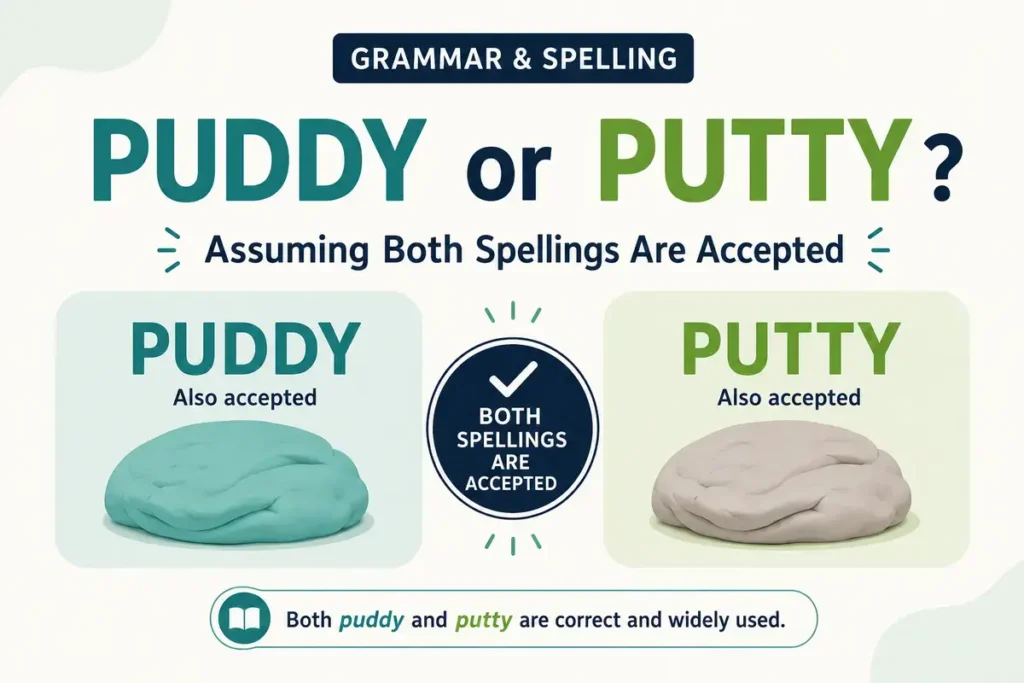
Assuming Both Spellings Are Accepted
Some words have two accepted spellings, such as gray and grey. That isn’t the case here.
Only putty is recognized as the standard English word for the repair material.
Confusing Character Names With Dictionary Words
People sometimes search online after seeing the name Puddy in entertainment or social media.
A proper name doesn’t create an alternative spelling for the common noun.
Trusting Informal Posts Instead Of Reliable Sources
Social media comments, memes, and casual discussions often contain spelling mistakes.
When accuracy matters, check a reputable dictionary or professional reference instead of relying on user generated content.
Word History And Origin
The history of putty goes back several centuries.
The word entered English through Middle English and ultimately traces back to the French word potée, referring to a mixture or paste. Over time, English speakers used putty to describe soft compounds designed to fill gaps, seal joints, and smooth surfaces.
As construction methods evolved, different varieties appeared for specialized jobs. Today the term includes products used in painting, woodworking, glazing, plumbing, automotive repair, and even medical rehabilitation.
The spelling has remained remarkably stable throughout its history. Unlike many English words that developed regional spelling variations, putty has kept the same standard form across major English speaking countries.
Regional Usage
One interesting fact about this word is its consistency. Unlike spellings such as color and colour, putty doesn’t change between major varieties of English.
American English
American speakers use putty in construction, home improvement, woodworking, and arts and crafts. Hardware stores, manufacturers, and professional contractors all use the same spelling.
British English
British English also uses putty. You’ll find it in DIY guides, building manuals, decorating books, and trade publications.
Australian English
Australian English follows the same standard spelling. Builders, painters, and retailers consistently use putty for repair materials and fillers.
Canadian English
Canadian English shows the same pattern. Although Canadian spelling sometimes blends American and British conventions, this word remains unchanged.
No matter where English is spoken, the standard spelling stays the same.
Grammar Rules
Understanding the grammar behind the word makes it easier to use correctly in both speech and writing.
Part Of Speech
Putty is primarily a noun.
Examples include:
- The putty needs more time to dry.
- This putty works well on wooden furniture.
In rare cases, it appears in compound nouns such as putty knife or wall putty.
Countable Or Uncountable
Most of the time, putty is an uncountable noun because it refers to a material rather than individual objects.
For example:
- We need more putty.
- The putty hasn’t dried yet.
When discussing different products or formulations, writers may use a plural expression naturally.
Examples include:
- Different putties are designed for different surfaces.
- The store sells several specialty putties for woodworking.
Common Word Combinations
You’ll frequently see these combinations.
- Wall putty.
- Wood putty.
- Glazing putty.
- Plumbing putty.
- Epoxy putty.
- Repair putty.
- Putty knife.
- Putty compound.
These combinations are widely used by professionals and appear in product labels, instruction manuals, and DIY guides.
Putty Slime And Sensory Products
Not every type of putty is designed for repairs. Some products are made for play, education, or therapy.
For example, thinking putty and sensory putty are popular with children and adults because they can be stretched, squeezed, twisted, and shaped without making a mess. Occupational therapists also use exercise putty to improve grip strength and finger mobility after injuries.
People sometimes compare these products with slime, but they aren’t exactly the same.
Here are the main differences.
- Putty usually holds its shape better than slime.
- Slime is softer and flows more easily.
- Therapy putty is designed for exercise rather than entertainment.
- Thinking putty often contains special effects such as glitter or color changing pigments.
Although online searches sometimes combine the two, they serve different purposes.
Real Life Usage
This word appears in many situations beyond home repairs.
Daily Conversation
People commonly mention putty when discussing painting projects, fixing furniture, or completing DIY jobs around the house.
Professional Communication
Builders, painters, plumbers, carpenters, and contractors regularly refer to different kinds of putty in estimates, work orders, and instruction manuals.
Academic And Technical Writing
Engineering, architecture, and construction courses often mention putty while explaining building materials and finishing techniques.
Media And Product Reviews
Home improvement magazines, renovation websites, and product reviewers compare different types of putty based on durability, drying time, flexibility, and ease of application.
The word also appears in toy reviews, especially when discussing thinking putty, therapy putty, and educational sensory products.
Related Words And Confused Terms
People searching for this topic often come across similar words that create even more confusion. Some are genuine English words, while others only appear in specific industries or online discussions.
Here are some related terms worth knowing.
| Word | Meaning |
|---|---|
| Putty | A soft material used for filling, sealing, or repairing surfaces. |
| Filler | A material used to fill holes or cracks before finishing a surface. |
| Sealant | A product that blocks air, water, or moisture from passing through joints. |
| Caulk | A flexible sealing material commonly used around bathrooms and windows. |
| Spackle | A paste used to repair small holes and dents in drywall. |
| Plaster | A building material used for coating walls and ceilings. |
| Mortar | A mixture that bonds bricks or stones together. |
| Epoxy | A strong resin used for repairs and bonding. |
| Modeling compound | A soft material used for crafts and sculpting. |
| Slime | A stretchy toy that is softer and more fluid than putty. |
Although some of these products perform similar jobs, they aren’t interchangeable. Each one is designed for a specific purpose.
Putty Person Meaning
The phrase putty person isn’t a formal dictionary expression, but native speakers sometimes use it figuratively.
When someone says a person is like putty in someone’s hands, they mean that person is easy to influence, persuade, or control. The comparison comes from the way putty can be shaped with very little effort.
For example:
- He was like putty in his granddaughter’s hands and couldn’t say no to her.
- Skilled salespeople know how to avoid treating customers like they’re putty.
- The movie describes the villain as someone who believes everyone is putty in his hands.
In these examples, the word has nothing to do with construction materials. Instead, it’s being used as a metaphor for someone who is easily molded.
Internet Searches Memes And Online Discussions
Search trends show that many people discover this spelling question after reading comments on social media or browsing discussion forums.
Puddy Or Putty Meme
Memes sometimes use the spelling puddy intentionally because it looks funny or reflects the way some people pronounce the word in casual speech. These jokes are usually playful rather than educational.
Even if a meme uses puddy, that doesn’t make it the standard spelling.
Puddy Or Putty Reddit
Discussion threads often include questions from people who heard the word in conversation and weren’t sure how to spell it.
A common pattern looks like this.
- Someone asks which spelling is correct.
- Other users explain that putty is the dictionary word.
- The discussion turns to pronunciation and regional accents.
These conversations highlight how spoken English can sometimes create spelling confusion.
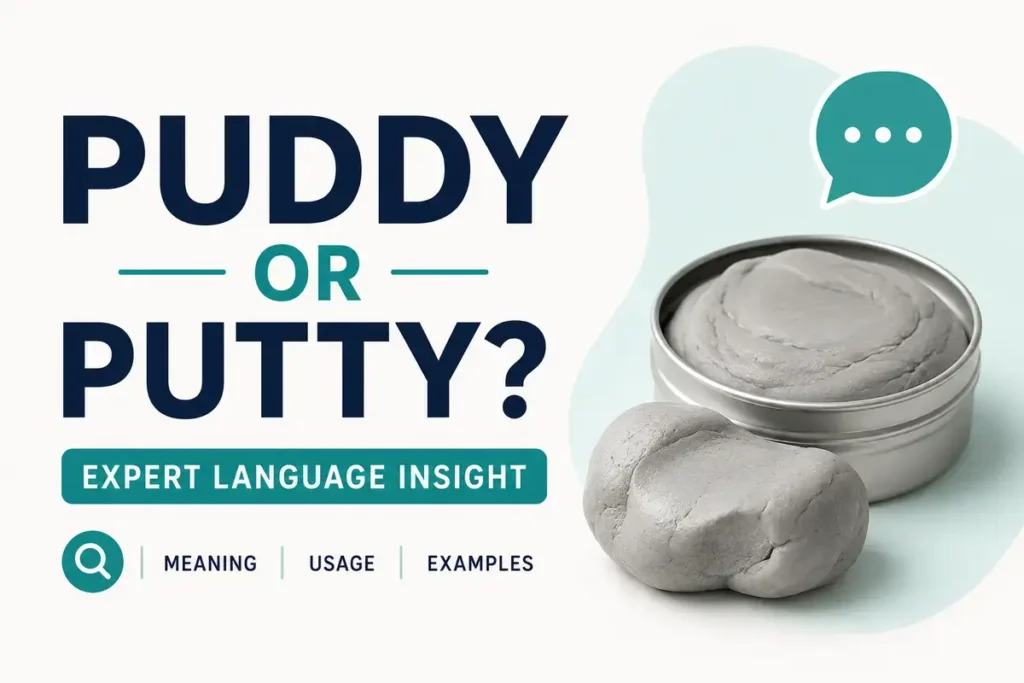
Expert Language Insight
From an editor’s perspective, this is a straightforward spelling decision. If you’re referring to the soft material used for repairs, crafts, or sealing, putty is the correct word every time.
The confusion doesn’t come from grammar or competing spellings. It comes from pronunciation. In many American accents, the middle consonant sounds softer than it appears in writing. That makes putty sound similar to puddy, especially during fast conversation.
Professional editors don’t rely on pronunciation when checking spelling. They look at meaning and context. If the sentence refers to a repair compound, wall filler, or modeling material, the correct spelling is always putty. If Puddy appears as a person’s name or part of a fictional work, it should remain unchanged because proper names keep their original spelling.
A simple habit can prevent mistakes. If the word could appear on the label of a hardware store product or in a dictionary definition, write putty. If it’s someone’s name, keep the original spelling.
Frequently Asked Questions
Is puddy a real word?
Puddy isn’t a standard English noun. Most dictionaries don’t list it as the name of a repair material. You’ll usually see it as a surname, a fictional character’s name, a nickname, or a spelling mistake.
Which spelling should I use?
Use putty whenever you’re talking about the soft material used for repairs, sealing, woodworking, painting, crafts, or therapy products. It’s the accepted spelling in standard English.
Why do people spell it as puddy?
The confusion comes mainly from pronunciation. In everyday speech, especially in some American accents, putty can sound similar to puddy. People sometimes write the word exactly as they think they hear it.
Is there a difference between wall putty and wood putty?
Yes. Wall putty prepares walls for painting by smoothing the surface and filling small imperfections. Wood putty is designed to repair holes, scratches, and minor damage in wooden furniture and trim. Each product is made for a different material.
Is putty the same as slime?
No. Although both are soft and moldable, they behave differently. Putty usually holds its shape better, while slime is stretchier and flows more easily. Some sensory toys resemble both, but they’re made for different experiences.
What does putty mean in English?
In English, putty refers to a soft, moldable substance used to fill, seal, shape, or repair surfaces. The exact composition depends on its intended use, but the general meaning remains the same across construction, crafts, and specialty products.
Does the spelling change in British English?
No. Unlike some English words that have American and British spelling variations, putty keeps the same spelling in both varieties of English.
Why is pronunciation different from spelling?
English pronunciation has changed over centuries, while many spellings have remained the same. That’s why some words don’t sound exactly the way they’re look on the page. Putty is one example where pronunciation can mislead people into guessing the wrong spelling.
Conclusion
The answer is clear once you understand the context. Putty is the correct English word for the soft material used in repairs, construction, woodworking, crafts, and many specialty products. Puddy isn’t an accepted alternative spelling. In most cases, it’s a misspelling, a nickname, or a proper name.
The confusion comes from pronunciation rather than grammar. Because many native speakers pronounce putty with a soft middle sound, listeners sometimes assume the spelling should be puddy. Standard English doesn’t work that way. Dictionaries, style guides, manufacturers, and professional writers consistently use putty.
If you’re writing about wall repairs, woodworking, plumbing, glazing, or sensory products, choose putty with confidence. If you come across Puddy, check the context. It may refer to a person, a fictional character, or an intentional joke rather than the material itself.
Understanding that small distinction will help you write more accurately and avoid one of the most common spelling mistakes related to this word.