If you’ve searched for me either vs me neither, you’re probably trying to figure out which expression is correct and why native English speakers seem to use both. It’s a common point of confusion because grammar books often recommend one answer while everyday conversations suggest another.
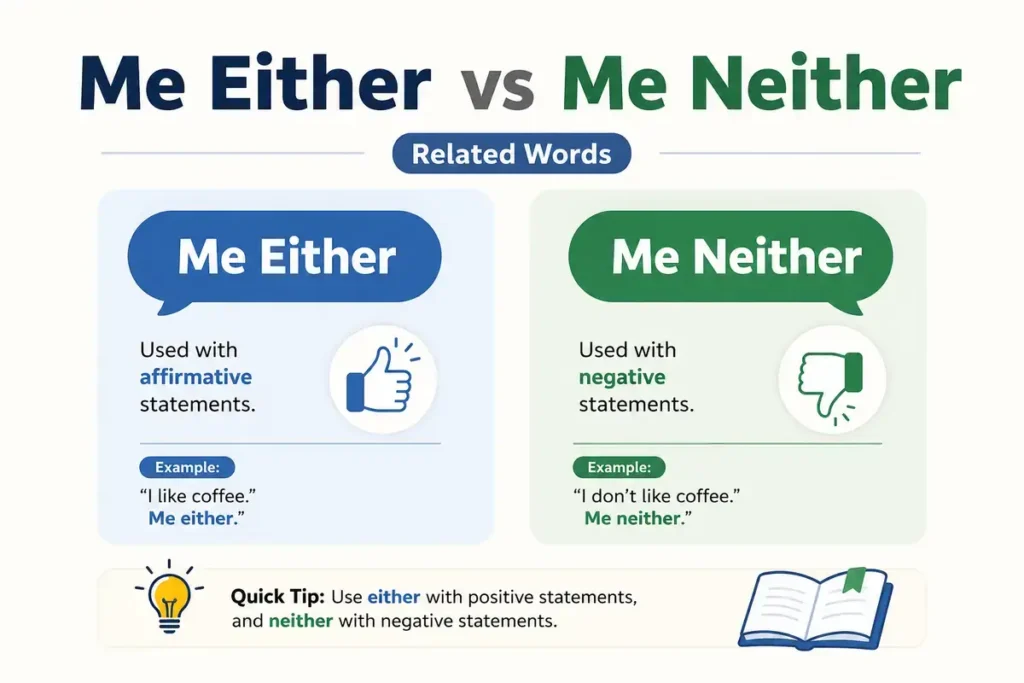
The short answer is that both expressions are common, but they aren’t always appropriate in the same situation. Me neither is traditionally considered the grammatically correct response to a negative statement. Me either, on the other hand, has become widely accepted in casual American English and is something you’ll hear every day in conversations, TV shows, movies, and social media.
The confusion comes from the difference between formal grammar and natural speech. Native speakers often choose expressions that sound smooth and familiar instead of following grammar rules perfectly. That’s why you can hear educated speakers use me either in casual settings, even though many teachers and style guides still recommend me neither in formal writing.
This guide explains the meaning of both expressions, how they’re different, when each one sounds natural, and which choice fits different situations. You’ll also find grammar tips, real life examples, pronunciation guidance, common mistakes, and practical advice that helps you speak and write with confidence.
Quick Definition
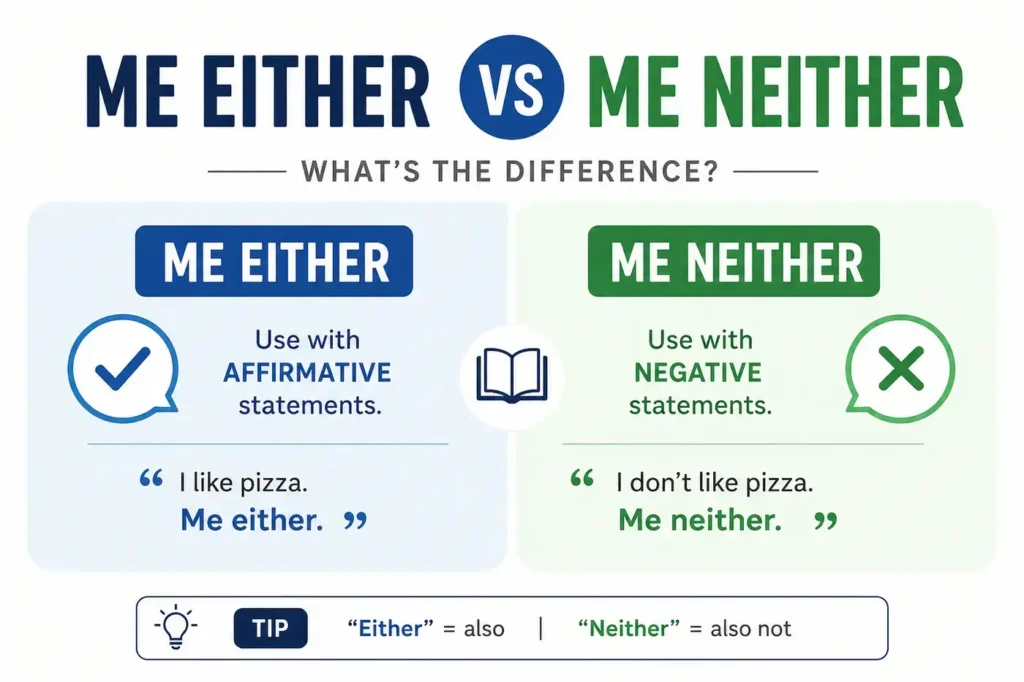
Me neither is the traditional and grammatically accepted response to a negative statement, while me either is an informal alternative that has become common in everyday American English. Both expressions show agreement with something negative, but me neither remains the safer choice in formal writing and edited content.
Quick Answer
If you want the safest answer, use me neither after a negative statement.
For example:
- I don’t drink coffee.
Me neither. - She wasn’t invited to the meeting.
Me neither.
You’ll also hear many native English speakers say me either, especially in casual American conversations.
For example:
- I can’t swim.
Me either.
Although this sounds completely natural to many Americans, traditional grammar guides still prefer me neither, particularly in formal writing, academic work, and professional communication.
Comparison Table
| Feature | Me Either | Me Neither |
|---|---|---|
| Part of speech | Elliptical response phrase | Elliptical response phrase |
| Meaning | I also do not | I also do not |
| Traditional grammar | Informal and debated | Grammatically standard |
| Common use | Casual American conversation | Formal and informal English |
| Formality | Informal | Neutral to formal |
| Usage frequency | Very common in spoken American English | Common in both speech and writing |
| Best for | Conversations text messages social media | Essays business writing professional communication |
| Example | I don’t like onions. Me either. | I don’t like onions. Me neither. |
Understanding Both Expressions
Although these expressions serve the same purpose, they reached modern English through slightly different paths. Understanding each one makes it easier to choose the right response.
What Does Me Neither Mean
Me neither means I don’t either or the same is true for me after someone makes a negative statement.
For example:
Person A says, “I haven’t seen that movie.”
Person B replies, “Me neither.”
The second speaker is saying they also haven’t seen the movie.
You’ll commonly hear me neither after statements like these.
- I don’t enjoy cold weather.
- I can’t stay late tonight.
- I never skip breakfast.
- I wasn’t expecting that.
- I haven’t finished the book.
In each case, me neither agrees with the negative idea without repeating the entire sentence.
What Does Me Either Mean
Me either communicates exactly the same idea in everyday conversation. Even though many grammar books have traditionally discouraged it, the expression has become deeply rooted in spoken American English.
For example:
Person A says, “I don’t eat mushrooms.”
Person B replies, “Me either.”
Most native speakers immediately understand the meaning, and very few would consider it confusing in casual speech.
You’ll hear me either regularly in places like these.
- Conversations with friends.
- Family discussions.
- Television shows.
- Movies.
- Podcasts.
- Social media posts.
- Text messages.
Its popularity comes from how naturally it fits everyday conversation rather than from traditional grammar rules.
Key Differences At A Glance
The biggest difference isn’t the meaning. It’s the level of formality and grammatical acceptance.
Both expressions tell the listener that you share the same negative experience or opinion. The choice depends on the situation and your audience.
Here are the main differences.
| Me Either | Me Neither |
|---|---|
| Common in casual American speech | Accepted in formal and informal English |
| Frequently heard in conversations | Preferred by teachers editors and style guides |
| Sounds natural to many native speakers | Considered the standard grammatical response |
| Best for relaxed communication | Best for academic and professional writing |
If you’re chatting with friends, either expression will usually sound natural in American English. If you’re writing an essay, business email, or anything that will be edited, me neither is the stronger choice.
Which One Is Correct
This question doesn’t have a simple yes or no answer because grammar and real world usage don’t always match perfectly.
From a traditional grammar standpoint, me neither is the correct response to a negative statement. That’s the version recommended by most style guides, grammar references, and English teachers.
At the same time, language changes through everyday use. Millions of native speakers say me either without thinking twice, especially in the United States. It’s so common that many people never realize it’s considered informal by traditional standards.
A practical way to decide is to think about your audience.
- Choose me neither for essays, reports, business communication, and professional writing.
- Use me either in relaxed conversations if it matches your natural speaking style.
- Stay consistent with the tone of your conversation or document instead of switching between the two forms.
Understanding this distinction helps you sound natural without sacrificing grammatical accuracy.
Pronunciation Guide
Both expressions are easy to pronounce, but learners sometimes stress the wrong word or pronounce either differently depending on the variety of English they’re learning.
Me Either
IPA pronunciation in American English:
/mi ˈiðər/
Common pronunciation:
Mee EE thur.
Me Neither
IPA pronunciation in American English:
/mi ˈniðər/
Common pronunciation:
Mee NEE thur.
In British English, either and neither may also be pronounced with the long eye sound instead of the long ee sound. Both pronunciations are accepted, and native speakers generally understand each version without difficulty.
Expert Language Insight
One reason this topic creates so much confusion is that grammar books and everyday conversation don’t always tell the same story.
As editors, we regularly see me either in interviews, dialogue, and informal writing because that’s how many people naturally speak. At the same time, edited publications, academic institutions, and professional organizations usually prefer me neither because it follows traditional grammar conventions.
That’s why experienced writers don’t ask which expression is always right. They ask which one best fits the audience, purpose, and level of formality. Choosing the expression that matches the situation is a stronger writing habit than trying to force one answer into every context.
Examples in Sentences
The easiest way to understand the difference is to see both expressions in natural conversations. Notice that the first speaker always makes a negative statement, and the second speaker responds by showing agreement.
Examples Using Me Either
These examples reflect everyday American English. While many grammar guides classify this expression as informal, you’ll hear it constantly in casual conversations.
- “I don’t like waking up early.”
“Me either.” - “I can’t believe how cold it is today.”
“Me either.” - “I haven’t watched that series yet.”
“Me either.” - “I don’t drink soda anymore.”
“Me either.” - “I wasn’t ready for that surprise.”
“Me either.” - “I can’t find my keys.”
“Me either.” - “I don’t understand this question.”
“Me either.” - “I never liked horror movies.”
“Me either.” - “I couldn’t hear what she said.”
“Me either.” - “I don’t want to leave yet.”
“Me either.”
These conversations sound completely natural among American speakers, especially with friends, family members, or coworkers in informal settings.
Examples Using Me Neither
These examples use the traditional grammatical response that works well in both speech and writing.
- “I don’t enjoy crowded places.”
“Me neither.” - “I haven’t finished the report.”
“Me neither.” - “I wasn’t invited to the meeting.”
“Me neither.” - “I can’t stay after work.”
“Me neither.” - “I don’t eat seafood.”
“Me neither.” - “I never saw that movie.”
“Me neither.” - “I couldn’t solve the puzzle.”
“Me neither.” - “I don’t remember his name.”
“Me neither.” - “I wasn’t expecting that result.”
“Me neither.” - “I haven’t traveled overseas.”
“Me neither.”
You’ll find this version in classrooms, professional communication, published writing, and formal conversations where standard grammar matters.
Grammar Rules
The confusion surrounding these expressions comes from the way English handles agreement with negative statements. Once you understand the grammar, choosing the right response becomes much easier.
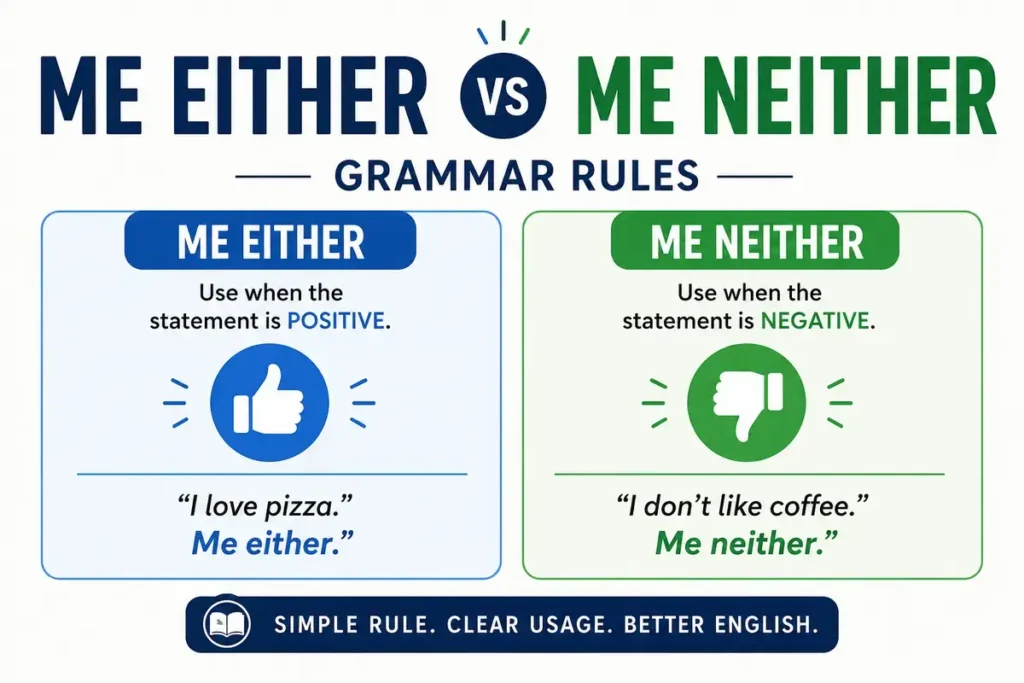
The traditional rule is straightforward. After a negative statement, use a negative response.
For example:
Person A says, “I don’t like coffee.”
The traditional response is:
“Me neither.”
This works because neither carries a negative meaning. It agrees naturally with the negative sentence that came before it.
Many grammar books also recommend using a complete response.
For example:
- Neither do I.
- Neither have I.
- Neither can I.
- Neither was I.
These forms are considered grammatically complete because they include the auxiliary verb from the original sentence.
Why Do People Say Me Either
This is where spoken English differs from textbook grammar.
Over time, millions of native speakers began using me either in everyday conversation. Instead of following the traditional grammatical pattern, they treated either as a conversational shortcut that listeners easily understand.
Although many editors still avoid it in formal writing, the phrase has become part of natural spoken American English.
This difference highlights an important point about language. Native speakers don’t always follow formal grammar rules during casual conversations. Spoken English often develops its own patterns that become widely accepted through everyday use.
Neither Do I Or Me Neither
These expressions share the same meaning, but they differ in structure.
- Neither do I is a complete grammatical sentence.
- Me neither is an elliptical response, meaning part of the sentence has been omitted because it’s already understood.
For example:
Person A says, “I don’t enjoy spicy food.”
You can reply with either of these.
- Neither do I.
- Me neither.
Both responses express the same idea. The second version is simply shorter.
Me Neither Or Me Too
This is another area where learners sometimes get confused. Use me too after a positive statement.
For example:
Person A says, “I love chocolate.”
Person B replies, “Me too.”
Use me neither after a negative statement.
For example:
Person A says, “I don’t like broccoli.”
Person B replies, “Me neither.”
Choosing the response that matches the original statement helps your conversation sound natural.
Common Mistakes
These expressions are simple once you understand the basic rule, but learners still make several common mistakes.
Using Me Too After A Negative Statement
This is one of the most frequent errors.
Incorrect:
Person A says, “I don’t like olives.”
Person B says, “Me too.”
Correct:
Person B should say, “Me neither.”
The response should agree with the negative statement.
Thinking Me Either Is Always Wrong
Many learners are told that me either is incorrect in every situation.
That’s an oversimplification.
Traditional grammar prefers me neither, especially in formal writing. At the same time, me either is extremely common in everyday American speech and sounds completely natural to many native speakers.
The better approach is to match your language to the situation.
Using Either In Formal Writing
If you’re writing an academic paper, business report, or professional document, me neither or neither do I is usually the better choice.
Using me either in those situations may sound too conversational.
Forgetting The Original Sentence
Your response should always match the statement you’re answering.
For example:
Positive statement:
“I enjoyed the concert.”
Correct response:
“Me too.”
Negative statement:
“I didn’t enjoy the concert.”
Correct response:
“Me neither.”
Paying attention to the original sentence prevents most mistakes.
Word Origin And History
The words either and neither have been part of English for centuries.
Either comes from Old English and originally referred to one of two choices. Over time, it developed additional uses, including appearing in negative sentences like “I don’t like it either.”
Neither also comes from Old English and literally means “not either” or “not one nor the other.” Because it already carries a negative meaning, it naturally became the traditional response to negative statements.
The expression Neither do I appeared in English long before me neither became common. Later, everyday speech shortened the response to simply me neither, making conversations quicker and more natural.
The rise of me either happened much later through spoken American English. As television, movies, and popular culture spread conversational speech, the expression became familiar to millions of speakers even though traditional grammar books continued recommending me neither.
Today, both expressions are widely recognized. The main difference is their level of formality rather than their meaning.
Regional Usage
English speakers around the world understand both expressions, but their popularity isn’t exactly the same everywhere.
American English
In the United States, you’ll hear me either and me neither regularly.
Informal conversations often include me either, while schools, editors, and professional writers generally recommend me neither in formal contexts.
British English
British speakers usually prefer me neither or neither do I. Although me either is understood, it appears less often than it does in American English.
Australian English
Australian English generally follows British grammar conventions. Me neither remains the more common choice, especially in writing, though conversational speech may vary from one speaker to another.
Canadian English
Canadian English combines influences from both American and British English. As a result, you’ll hear both expressions, but me neither is still the safer option for formal communication.
The pattern across English speaking countries is remarkably consistent. Formal writing favors me neither, while informal American conversation is much more likely to include me either.
Real Life Usage
Understanding grammar is important, but seeing how native speakers actually use these expressions is just as valuable.
Everyday Conversation
Friends and family usually choose whichever expression feels natural.
Examples include:
- Talking about favorite foods.
- Discussing movies.
- Sharing opinions.
- Reacting to daily events.
- Having casual conversations.
Academic Writing
Teachers and editors generally expect standard grammar.
Most style guides recommend:
- Me neither.
- Neither do I.
Professional Communication
Business emails, reports, and workplace documents should follow formal grammar.
Using me neither or a complete response creates a more polished impression.
Television And Movies
American television shows frequently include me either because scriptwriters try to reflect natural speech instead of textbook grammar.
Books And Journalism
Published books, newspapers, and magazines are more likely to follow editorial style guides, making me neither and neither do I more common than me either.
Related Words And Commonly Confused Expressions
Once you understand the difference between these two responses, you’ll notice several similar expressions that serve the same purpose. Some are more formal, while others are common in everyday conversation.
Here are the ones English learners mix up most often.
| Expression | Best Used After | Formality | Example |
|---|---|---|---|
| Me neither | Negative statement | Neutral | I don’t like tea. Me neither. |
| Me either | Negative statement | Informal | I can’t swim. Me either. |
| Neither do I | Negative statement | Formal | I haven’t seen it. Neither do I. |
| Me too | Positive statement | Neutral | I love pizza. Me too. |
| So do I | Positive statement | Formal | I enjoy reading. So do I. |
| Nor do I | Negative statement | Formal | I wasn’t there. Nor do I. |
Each expression has its place. Choosing the right one depends on the tone of the conversation and the type of writing you’re producing.
Another phrase worth knowing is I don’t either. It expresses the same idea as me neither and sounds natural in everyday English.
For example:
Person A says, “I don’t eat seafood.”
Person B replies, “I don’t either.”
This response is grammatically complete and widely accepted in both speech and writing.
Expert Language Insight
If you ask a grammar teacher and a native speaker the same question, you may hear two different answers.
A grammar teacher is likely to recommend me neither because it follows the traditional rule for responding to negative statements. That’s also the version you’ll see in style guides, textbooks, and edited publications.
A native speaker, especially in the United States, may use me either without giving it a second thought. In casual conversations, most listeners won’t notice the difference because both expressions communicate the same idea clearly.
Professional editors look beyond grammar alone. They also consider audience, tone, and purpose. A novel filled with realistic dialogue may intentionally use me either because that’s how the character naturally speaks. An academic paper, on the other hand, would almost always use me neither or neither do I.
This illustrates an important lesson about English. Good writing isn’t just about following rules. It’s also about choosing language that fits the situation. Knowing both expressions gives you the flexibility to sound natural in conversation while maintaining accuracy in formal writing.
Frequently Asked Questions
Is me either correct?
Yes, me either is correct in many informal conversations, especially in American English. Although traditional grammar guides prefer me neither, millions of native speakers use me either naturally in everyday speech. For formal writing, me neither remains the safer option.
What is the meaning of me either?
Me either means I don’t either or the same is true for me after someone makes a negative statement. It expresses agreement without repeating the entire sentence.
What is the difference between me either and me neither?
The meaning is almost identical, but the level of formality is different. Me neither follows traditional grammar and works well in both formal and informal situations. Me either is considered more conversational and is especially common in American English.
Which expression should I use in formal writing?
Choose me neither or the complete form neither do I. These expressions follow standard grammar and are widely accepted in academic, professional, and edited writing.
Why do so many Americans say me either?
Language naturally changes over time. In everyday American English, me either became popular through casual conversation and eventually appeared in television shows, movies, and social media. Its widespread use doesn’t change the traditional grammar rule, but it does explain why the expression sounds natural to many native speakers.
Should I say me neither or neither do I?
Both responses are grammatically correct. Neither do I is a complete sentence and sounds slightly more formal. Me neither is shorter, more conversational, and equally appropriate in most situations.
Is me either used in British English?
British speakers generally prefer me neither or neither do I. While me either is understood, it isn’t nearly as common as it is in the United States.
How can I remember the correct response?
Start by listening to the original statement.
- If the statement is positive, respond with me too or so do I.
- If the statement is negative, respond with me neither, neither do I, or, in casual American conversation, me either.
Matching your response to the original sentence quickly becomes second nature with practice.
Conclusion
The debate over me either vs me neither isn’t really about right versus wrong. It’s about understanding the difference between formal grammar and everyday speech.
If you’re writing an essay, business email, report, or any document that calls for standard English, me neither is the better choice. It follows traditional grammar, appears in respected style guides, and works in almost every situation.
If you’re chatting with friends or listening to native American speakers, you’ll probably hear me either quite often. It’s a natural part of informal conversation and is widely understood, even though many grammar references still recommend me neither.
The most important takeaway is to match your language to your audience. Knowing both expressions gives you the confidence to speak naturally in casual conversations and write accurately in formal settings. That’s exactly how experienced writers and editors approach modern English.