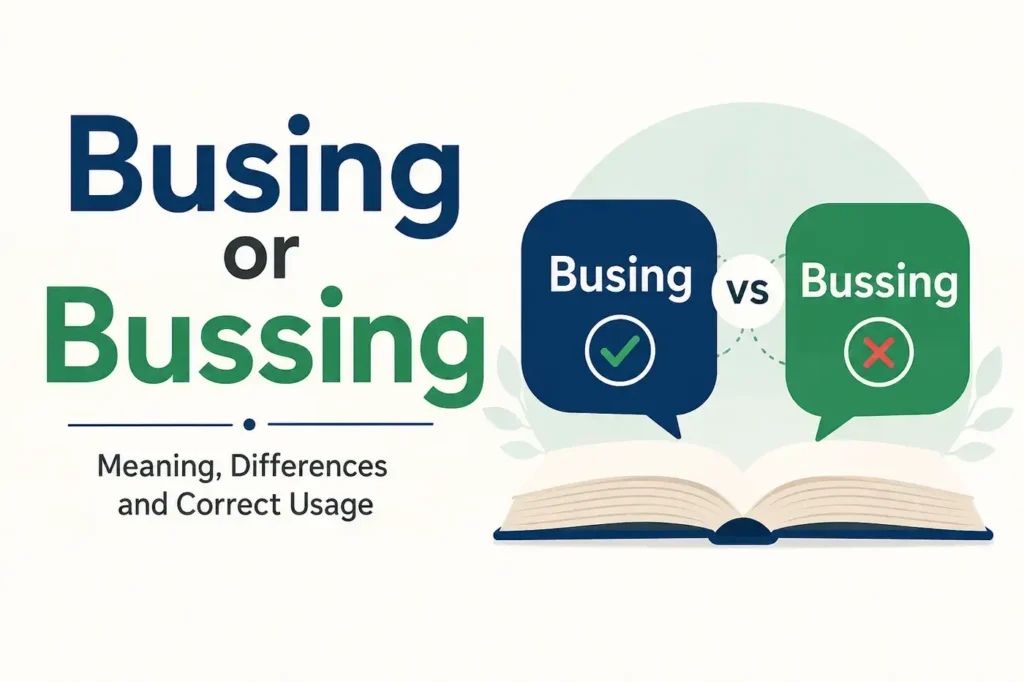
If you’ve searched for busing or bussing, you’ve probably noticed that both spellings appear online. One article uses busing, another says bussing, and restaurant job listings often switch between the two. That leaves many writers wondering if one spelling is wrong or if both are acceptable.
The short answer is that both spellings are correct, but they are not always preferred in the same context. Style guides, dictionaries, and regional writing conventions influence which form you’ll see. In American English, busing is commonly used when referring to transporting people by bus, while bussing frequently appears in the restaurant industry to describe clearing tables. Even so, you’ll find overlap because many dictionaries recognize both spellings.
The confusion grows because the verb bus has more than one meaning. It can describe transporting students or passengers by bus, or it can refer to removing dishes from restaurant tables. On top of that, different publications follow different editorial styles, making both spellings seem equally common.
This guide explains the spelling differences in plain English. You’ll learn which form fits different situations, how dictionaries and style guides treat each spelling, where each version is most common, and how native English speakers naturally use these words in everyday conversation and professional writing.
Quick Definition
Both busing and bussing are accepted present participle forms of the verb bus. Busing is more common when talking about transportation, while bussing often appears in restaurant settings to describe clearing tables. Many modern dictionaries recognize both spellings, but usage depends on context, editorial style, and regional preference.
Quick Answer
If you need a fast answer, remember these simple rules.
- Use busing when writing about transportation, school buses, or moving passengers by bus.
- Use bussing when referring to clearing tables in restaurants, especially if you’re following hospitality industry terminology.
- Check your organization’s style guide because some publishers prefer one spelling for every context.
- Stay consistent throughout your writing instead of switching between both forms.
In most cases, readers understand either spelling. Choosing the one that matches the topic and your audience simply makes your writing look more polished.
Comparison Table
| Feature | Busing | Bussing |
|---|---|---|
| Part of speech | Present participle and gerund | Present participle and gerund |
| Base verb | Bus | Bus |
| Primary meaning | Transporting people by bus | Clearing restaurant tables or transporting by bus |
| Dictionary status | Standard spelling | Standard spelling |
| Origin | Derived from the verb bus | Derived from the verb bus |
| Formality | Standard | Standard |
| Common contexts | Education transportation public transit | Restaurants hospitality food service transportation |
| Usage frequency | More common in transportation writing | More common in restaurant writing |
| Example | The district is busing students to nearby schools. | She is bussing tables during the dinner rush. |
Understanding The Two Meanings
Many spelling questions become easier once you realize the verb bus has more than one definition. The spelling doesn’t change the meaning by itself. Instead, the context tells readers what you’re talking about.
The first meaning relates to transportation. Schools, cities, and transportation companies use the verb when people travel by bus from one place to another. The second meaning belongs mainly to the hospitality industry, where restaurant staff clear used dishes, glasses, and utensils from tables after guests finish eating.
Because both meanings come from the same verb, it’s easy to assume there should be only one accepted spelling. English doesn’t always work that neatly. Over time, both forms became established, and many dictionaries now list each as correct.
Just as writers often confuse busing and bussing, business emails and hotel bookings frequently contain mix-ups that are clarified in our suit and suite explained guide.
What Does Busing Mean
In its most familiar sense, busing means transporting people by bus. You’ll often see the word in education, public transportation, news reports, and government documents.
For example, a school district may provide busing for students who live several miles from campus. A city may expand busing services to improve access to jobs or healthcare. In these situations, the focus is on transportation rather than restaurant work.
You’ll commonly encounter this meaning in topics such as:
- School transportation.
- Public transit.
- Educational policy.
- Community planning.
- Accessibility services.
Because this spelling appears frequently in newspapers and official publications, many writers automatically choose busing whenever transportation is involved.
What Does Bussing Mean
In restaurants, bussing usually means clearing tables after customers finish their meals. A person who performs this task is often called a busser, although some businesses still use the older term busboy or busgirl.
The job includes much more than removing dirty plates. A busser may wipe tables, replace table settings, refill water glasses, and prepare the dining area for the next guests. During busy hours, this role helps servers work more efficiently and keeps the restaurant running smoothly.
You may also see bussing used outside the hospitality industry when referring to transportation. While this spelling is less common in educational writing, several dictionaries recognize it as a valid alternative. That’s one reason the spelling debate continues today.
Key Differences
Although both spellings are accepted, understanding their typical usage makes choosing the right one much easier.
The biggest difference is context. Writers discussing transportation often prefer busing, while restaurant professionals frequently write bussing because that’s the spelling many hospitality employers use in job descriptions and training materials.
Here are the main distinctions.
- Busing usually refers to transporting people by bus.
- Bussing commonly refers to clearing tables in restaurants.
- Both spellings appear in major dictionaries.
- Editorial style guides may recommend one spelling over the other.
- Consistency is more important than switching between forms within the same article.
Rather than asking which spelling is universally correct, ask which one best matches your audience and subject.
Which Spelling Is Correct
Both spellings are correct, but they serve different writing situations.
If you’re discussing school transportation, public transit, or moving passengers, busing is the spelling most readers expect. It aligns with the conventions used in many educational publications and news organizations.
If you’re writing about restaurants, food service, or hospitality jobs, bussing often feels more natural because it’s widely used within the industry. Many restaurant managers, training manuals, and employment listings use this spelling when describing table clearing duties.
If your organization has a style guide, follow it. Otherwise, choose the spelling that best matches the topic and use it consistently throughout your writing.
Pronunciation Guide
One reason people question the spelling is that both words sound exactly the same when spoken.
Busing
IPA pronunciation:
/ˈbʌsɪŋ/
Syllable breakdown:
Bus ing
Bussing
IPA pronunciation:
/ˈbʌsɪŋ/
Syllable breakdown:
Bus sing
Despite the different spellings, native speakers pronounce both forms the same way. The extra s changes the appearance of the word but not its pronunciation.
When reading sentences aloud, focus on the meaning instead of the spelling. The surrounding words almost always make the intended meaning clear.
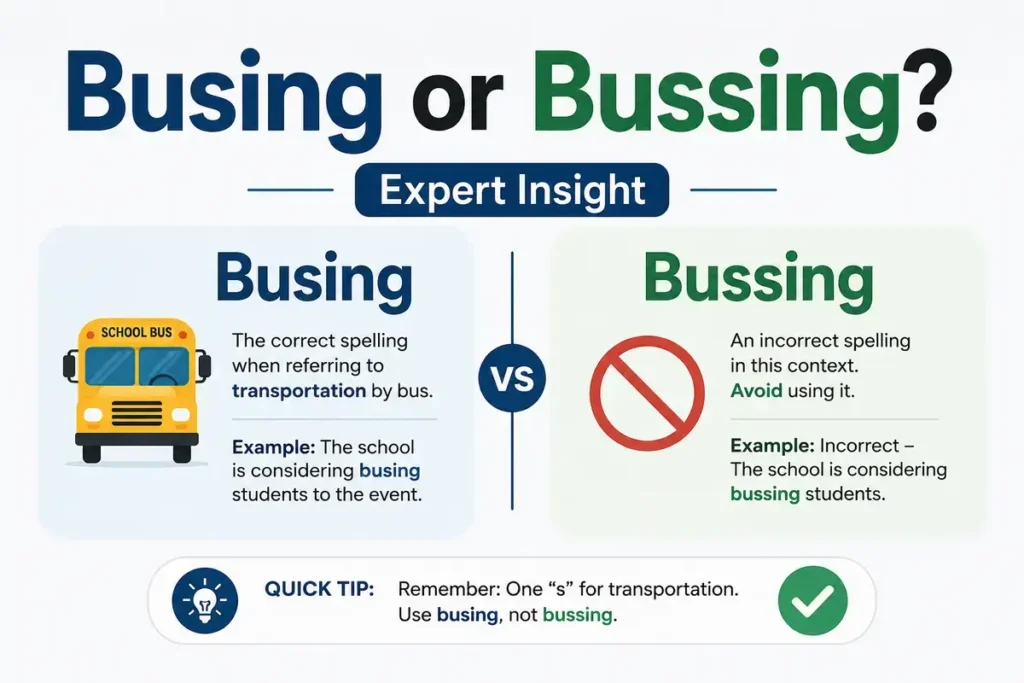
Expert Insight
Experienced editors rarely choose between these spellings based on personal preference. They consider three things before making a decision.
- The subject of the article.
- The publication’s style guide.
- The expectations of the target audience.
Following those principles produces writing that feels consistent and professional. Readers care far more about clarity than the number of letters in a word, so choosing the spelling that fits the context is almost always the best approach.
Examples In Sentences
Seeing each spelling in context makes the difference much easier to understand. The examples below reflect the situations where each form is most commonly used. Remember that many dictionaries accept both spellings, but context often determines which one feels more natural.
Busing Examples
These examples focus on transportation.
- The school district is busing students to a newly built campus.
- The city began busing commuters during the rail strike.
- The county expanded its busing program for rural communities.
- Parents supported busing because it reduced travel time for students.
- The transportation department improved its busing schedule this year.
- Officials discussed busing children to neighboring schools after the storm.
- The organization provides busing services for senior citizens.
- The university is busing visitors from the parking area to the stadium.
- The company started busing employees between office buildings.
- New funding will help improve school busing across the district.
Bussing Examples
These examples relate to restaurants and food service.
- She spent the evening bussing tables during the dinner rush.
- He started bussing tables before becoming a server.
- The restaurant hired two students for bussing duties on weekends.
- Efficient bussing kept the dining room ready for new guests.
- The manager thanked everyone for helping with bussing after a busy shift.
- My first restaurant job involved bussing tables and refilling water glasses.
- Good bussing improves the overall dining experience.
- They shared bussing responsibilities to keep service running smoothly.
- The team finished bussing every table before closing.
- Training covered serving guests, cleaning tables, and bussing responsibilities.
These examples highlight an important point. Readers usually understand the intended meaning from the surrounding words, even if they are more familiar with the other spelling.
Common Mistakes
Most confusion comes from assuming one spelling is always correct. In reality, both forms are accepted, but they are not always the best choice for every situation.
Here are the mistakes writers make most often.
Assuming One Spelling Is Wrong
Many people believe bussing is a misspelling because bus contains only one s.
Modern dictionaries recognize bussing as a standard spelling, particularly in hospitality contexts.
Ignoring Context
Using bussing in an article about school transportation is not necessarily incorrect, but busing is the spelling most readers expect.
Likewise, restaurant professionals often prefer bussing because it reflects common industry usage.
Mixing Spellings
Some writers use busing in one paragraph and bussing in the next without any reason.
Choose one spelling that matches your topic and remain consistent throughout the article.
Following Social Media Instead Of Reliable Sources
Online discussions sometimes claim that only one spelling is correct.
Instead of relying on random comments, check respected dictionaries and established style guides before making a decision.
Confusing The Job Title
People sometimes think busser should be spelled buser because of the spelling busing.
That is incorrect.
The accepted job title is busser, and it remains the standard term in the restaurant industry.
If you’re editing formal documents, it’s worth checking the correct plural of attorney alongside other commonly misspelled word pairs to ensure professional, error-free writing.
Etymology And Word Origin
The word bus began as a shortened form of omnibus, a Latin word meaning for all. During the nineteenth century, English speakers shortened omnibus to bus, and the shorter form eventually became the standard name for public transportation.
As the noun became more common, English naturally turned it into a verb. Writers began using bus to describe transporting passengers by bus.
Later, the hospitality industry adopted the same verb in a different way. Restaurant workers used bus to describe clearing dishes and preparing tables for the next guests. Although the exact origin of this restaurant meaning is debated, it has been part of English for many decades.
Over time, both busing and bussing appeared in published writing. Since English spelling often develops through common usage, dictionaries eventually accepted both forms.
Regional Usage
Unlike spelling pairs such as gray and grey, the difference between busing and bussing is not strictly based on geography. Context usually matters more than location.
American English
American publications generally prefer busing when discussing transportation.
In restaurants, however, you’ll frequently see bussing in job advertisements, employee handbooks, and hospitality training materials.
British English
British English recognizes both spellings, although transportation writing often favors busing. Restaurant terminology varies depending on the publication and editorial style.
Australian English
Australian writers usually follow the same pattern. Transportation articles commonly use busing, while hospitality businesses often write bussing when describing restaurant duties.
Canadian English
Canadian English accepts both spellings as well. Newspapers, schools, and government publications often prefer busing, while restaurants frequently use bussing.
Across all four regions, readers understand both forms. The difference is more about convention than correctness.
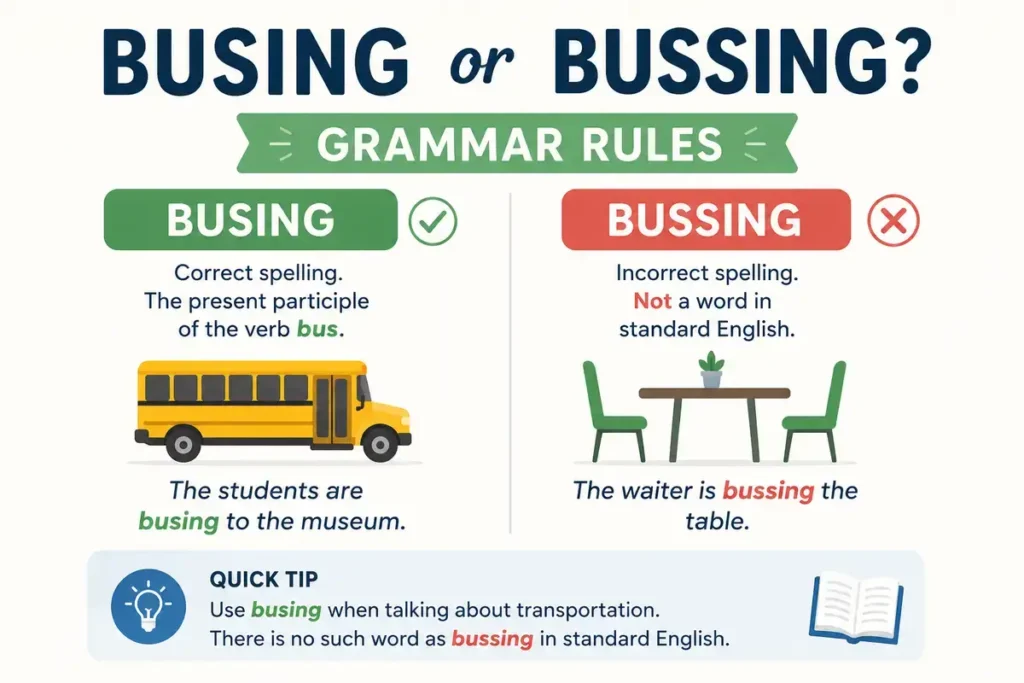
Grammar Rules
Understanding the grammar behind these words makes them easier to use correctly.
Part Of Speech
Both busing and bussing function as:
- Present participles.
- Gerunds.
- Verbal adjectives in some contexts.
Examples include:
- The district is busing students.
- Busing students requires careful planning.
- She is bussing tables tonight.
- Bussing tables taught him valuable customer service skills.
Verb Tenses
The base verb is bus.
Examples include:
- Present: They bus students every morning.
- Past: They bused students last year.
- Present participle: They are busing students.
For restaurant work:
- Present: They bus tables quickly.
- Past: They bussed tables all evening.
- Present participle: They are bussing tables now.
Common Sentence Patterns
You’ll often see these structures.
- Bus someone to school.
- Bus passengers across town.
- Bus tables after dinner.
- Bus dishes from the dining room.
- Bus guests between locations.
Choosing the right spelling depends on your editorial style and the context of the sentence.
Real Life Usage Examples
These words appear in many different situations, not just grammar books.
Daily Conversation
People naturally use these terms when talking about school transportation or restaurant work.
Examples include:
- My son is busing to school this semester.
- She earns extra money by bussing tables on weekends.
Academic Writing
Educational researchers often discuss school busing when studying transportation policies, student access, and district planning.
Professional Communication
Restaurant managers regularly mention bussing duties in employee schedules, training manuals, and job descriptions. Transportation departments usually refer to busing programs when discussing routes and services.
Literature And Media
News reports commonly mention school busing during discussions about education or public transportation. Restaurant reviews and hospitality publications often refer to bussing staff when describing customer service and dining operations.
Online Discussions
Many people search for topics such as busing or bussing reddit because they notice both spellings online. Community discussions often compare dictionary entries, style guides, and restaurant practices. While opinions differ, respected dictionaries generally agree that both spellings are acceptable when used appropriately.
Likewise, questions such as Is bussing a word appear frequently in search engines. The answer is yes. Bussing is a recognized English word and has been used in published writing for many years.
Another common question is bussing pronunciation. Fortunately, there is no difference in pronunciation. Both busing and bussing are pronounced /ˈbʌsɪŋ/, making the choice purely a matter of spelling and context.
You’ll also find searches for bussing meaning food and bussing tables meaning. In both cases, the phrase refers to clearing used dishes, wiping tables, and preparing the dining area for the next customers. It is a standard hospitality term used in restaurants around the world.
Related Words And Commonly Confused Terms
Once you understand the difference between busing and bussing, you’ll notice several related words that appear in the same conversations. Some belong to transportation, while others are commonly used in restaurants and hospitality.
Transportation Related Terms
These words often appear alongside busing in educational and public transportation discussions.
- Bus.
- School bus.
- Public transit.
- Shuttle.
- Transportation.
- Commute.
- Passenger transport.
- Transit system.
- School transportation.
- Bus route.
Although these terms are closely related, they are not interchangeable. For example, a shuttle usually follows a short route between two locations, while busing refers to transporting people by bus as an activity or service.
Restaurant Related Terms
In hospitality, bussing is often used with other job specific terms.
- Busser.
- Food runner.
- Server.
- Waitstaff.
- Table service.
- Dining room.
- Table turnover.
- Restaurant operations.
- Food service.
- Hospitality industry.
A busser clears tables, while a server takes orders and serves food. In many restaurants, both roles work together to provide a smooth dining experience.
Words People Often Confuse
Writers sometimes mix these terms because they look or sound similar.
- Bus and buss.
- Busser and server.
- Busing and boarding.
- Bussing and serving.
- Transportation and transit.
Understanding the context usually removes any confusion. The surrounding words tell readers which meaning is intended.
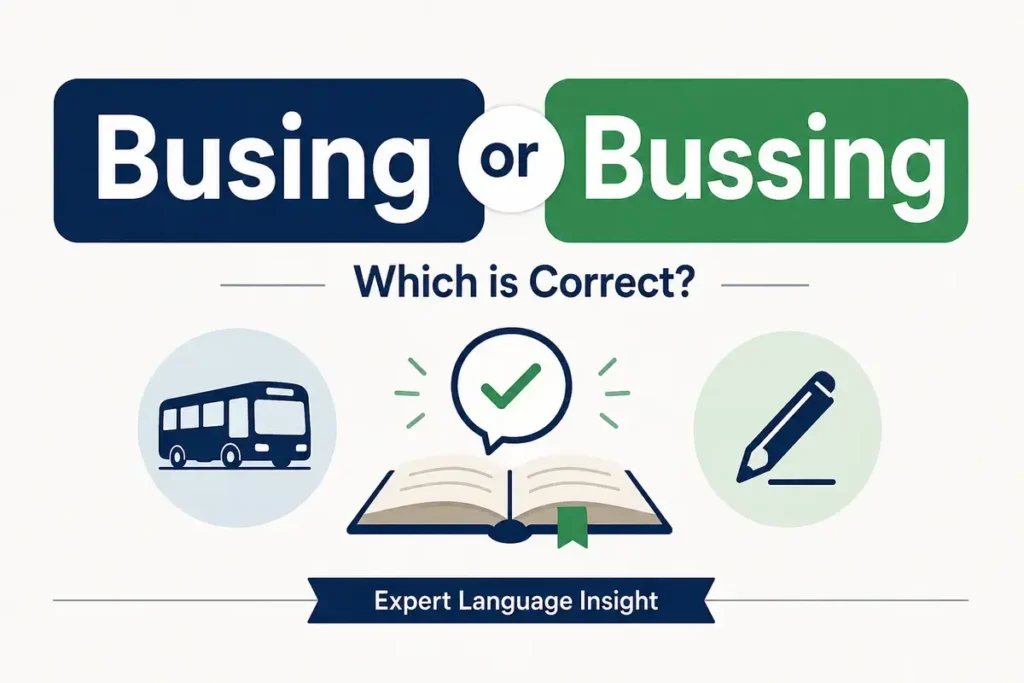
Expert Language Insight
Editors rarely decide between spellings by guessing. They look at the subject, the audience, and the publication’s style guide before making a choice.
For transportation topics, busing remains the preferred spelling in many newspapers, educational publications, and government documents because it has become the standard form in those fields.
Restaurant writing follows a different pattern. Hospitality professionals commonly use bussing because it has long been part of industry vocabulary. You’ll see it in job advertisements, employee manuals, training materials, and restaurant management resources.
This difference explains why both spellings continue to appear in reliable sources. It is not a case of one spelling replacing the other. Instead, English has allowed both forms to develop naturally in different contexts.
If you’re unsure which spelling to choose, ask yourself a simple question.
What is my article about?
If the answer is transportation, busing will usually be the better fit. If the article focuses on restaurants or hospitality, bussing often matches reader expectations more closely.
Above all, stay consistent. Readers are far more likely to notice changing spellings than they are to question a spelling that fits the context.
Readers who enjoy untangling tricky spelling distinctions may also find bearer vs. barer in plain English helpful when comparing similar-sounding words with very different meanings.
Frequently Asked Questions
Is bussing a real word?
Yes. Bussing is a recognized English word that appears in major dictionaries. It is especially common in the restaurant industry, where it refers to clearing tables and preparing them for the next customers. Some dictionaries also list it as an alternative spelling for transporting people by bus.
Which spelling should I use in a restaurant article?
If you’re writing about clearing tables, bussing is the spelling many hospitality professionals expect. It appears frequently in restaurant job descriptions, employee training guides, and food service publications. Using this spelling helps your writing match common industry practice.
Which spelling is better for transportation?
For school transportation, public transit, or moving passengers by bus, busing is generally the preferred spelling. It is widely used in educational materials, news reporting, and government publications, making it the more familiar choice for transportation topics.
Why do dictionaries list both spellings?
English spelling often develops through actual usage rather than fixed rules. Since both forms have appeared in published writing for many years, dictionaries recognize them as accepted spellings. They simply note that one may be more common in certain contexts than the other.
Does pronunciation change with the spelling?
No. Both words are pronounced /ˈbʌsɪŋ/. Native speakers do not pronounce the extra s, so the difference exists only in writing.
What does bussing tables mean?
Bussing tables means removing used plates, glasses, and utensils after guests finish eating. The job often includes wiping the table, replacing table settings, and preparing the dining area for the next customers. It is an essential role in many restaurants.
Why do people search for busing or bussing Reddit?
Many writers notice conflicting advice online and turn to discussion forums for practical opinions. While community discussions can be helpful, they often reflect personal preferences rather than editorial standards. Reliable dictionaries and respected style guides remain the better source when choosing the appropriate spelling.
Can I use both spellings in the same article?
It’s possible if you’re discussing both transportation and restaurant work, but avoid switching spellings for the same meaning. Consistency makes your writing easier to read and gives it a more professional appearance.
Conclusion
The answer to the spelling question is simpler than it first appears. Both busing and bussing are accepted English spellings, but they are most effective in different contexts.
When you’re writing about transporting students, commuters, or passengers by bus, busing is the spelling readers are most likely to expect. In restaurant and hospitality settings, bussing is widely used to describe clearing tables and preparing the dining area for new guests.
Instead of searching for one universal rule, focus on your audience and the subject you’re writing about. Choose the spelling that fits naturally, follow your preferred style guide, and use that spelling consistently from beginning to end.
That approach creates clear, professional writing that readers trust and understand without stopping to question the spelling.