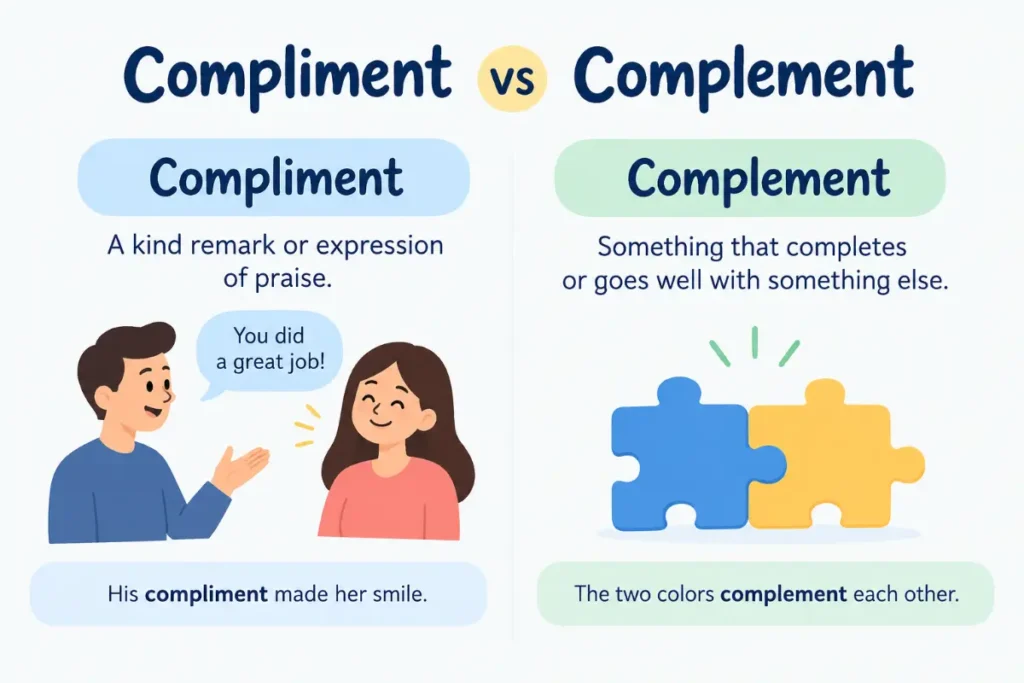
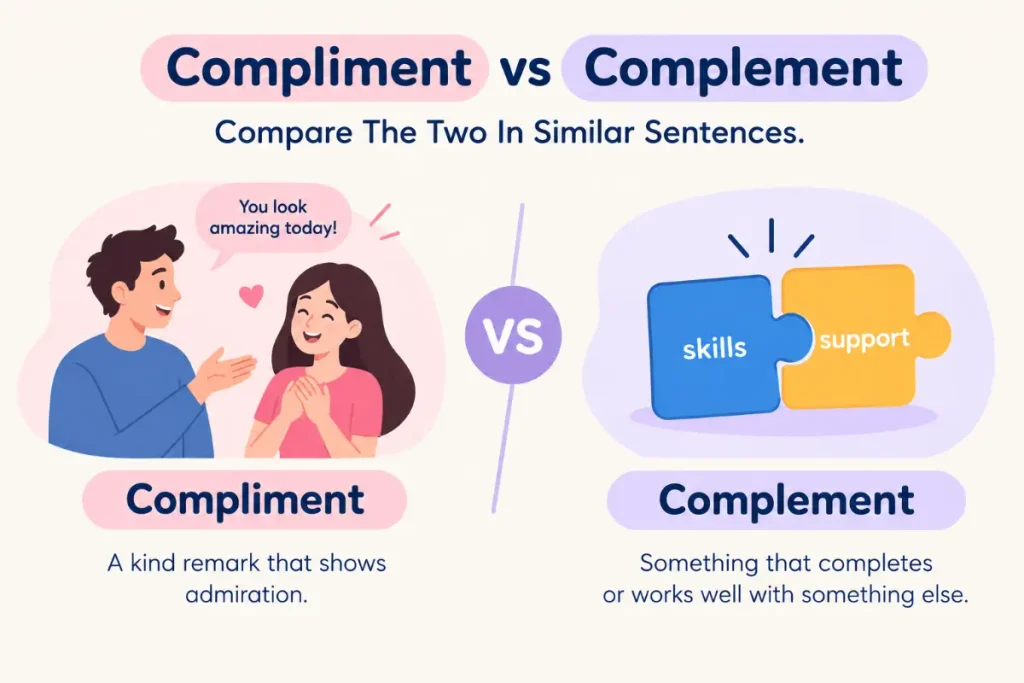
The difference between compliment vs complement comes down to one letter, but that small spelling difference changes the meaning completely. Compliment relates to praise, admiration, or a polite expression of approval. Complement describes something that completes, improves, or works well with something else.
These words are easy to confuse because they sound the same in standard American English. They are also closely related in meaning, which makes the spelling even harder to remember when you are writing quickly. You might want to say that a jacket looks good with a shirt, praise someone’s work, or describe two skills that work well together. The correct word depends on the idea you want to express.
This guide explains the difference between the two words with clear definitions, grammar rules, pronunciation, examples, common mistakes, etymology, and practical usage. You will also learn simple memory tricks that make it easier to choose the right spelling in emails, school assignments, workplace writing, messages, and everyday conversation.
Quick Answer
Compliment means a polite expression of praise or admiration. Complement means something that completes, improves, or works well with something else. For example, She complimented my dress uses the word for praise, while The shoes complement my dress uses the word for something that goes well with it.
Confusing accept or except is another common word-choice mistake, especially when both words appear in otherwise similar sentences.
Compliment Meaning
Compliment is a noun and a verb connected with praise, approval, or admiration. As a noun, it means a kind or flattering remark given to someone. As a verb, it means to praise someone or express approval of something.
You might compliment a coworker on a successful presentation, tell a friend that you like their new haircut, or compliment a restaurant on its excellent service. In each case, the word involves positive words or an expression of appreciation.
Common examples include:
- She gave me a nice compliment about my presentation.
- He complimented the chef on the meal.
- The manager complimented the team on its hard work.
- I wanted to compliment you on your excellent writing.
- Her compliment made me smile.
The important idea is praise. If you are saying something positive about a person, performance, appearance, skill, or achievement, compliment is usually the word you need.
Compliment As A Noun
As a noun, compliment refers to the actual expression of praise. The compliment can be spoken, written, or communicated in another way.
For example, That was a thoughtful compliment means that someone made a thoughtful statement of praise. Similarly, He received several compliments on his new suit means that several people said positive things about the suit.
The noun can appear with common verbs such as give, receive, pay, and offer.
- She gave me a wonderful compliment.
- He received several compliments after his speech.
- The customer paid the chef a compliment.
- I appreciate the compliment.
Compliment As A Verb
As a verb, compliment means to praise someone or something. The person doing the praising is the subject, while the person or thing receiving the praise can follow the verb.
For example, The teacher complimented Maya on her essay means the teacher praised Maya for the quality of her essay.
Notice the common structure compliment someone on something. The preposition on often appears when you identify the quality, achievement, or feature being praised.
- She complimented him on his leadership.
- I complimented her on her presentation.
- The customer complimented the staff on their service.
- My supervisor complimented me on the report.
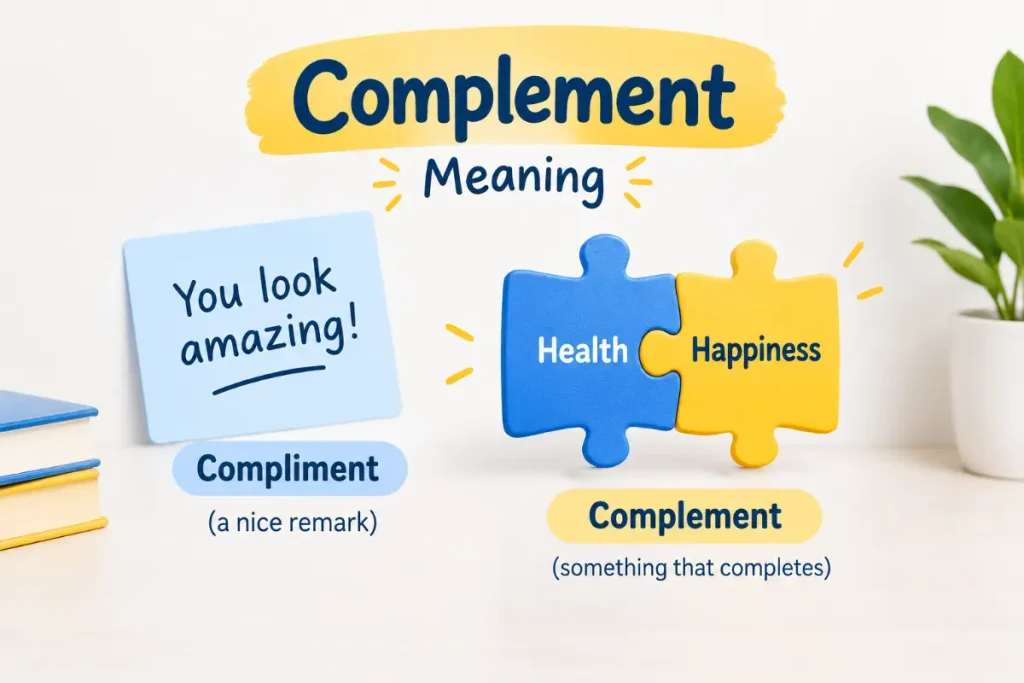
Complement Meaning
Complement means something that completes, enhances, balances, or works particularly well with something else. It can be a noun or a verb.
For example, a blue shirt might complement a gray jacket because the two colors work well together. A side dish can complement a main course because it adds something that improves the meal. A person’s skills can complement another person’s skills when the two sets of abilities work effectively together.
The central idea is completion or compatibility, not praise.
- The curtains complement the color of the walls.
- Her experience complements his technical knowledge.
- The sauce complements the grilled vegetables.
- The two colors complement each other.
- His calm personality complements her energetic nature.
In these sentences, nobody is necessarily praising anything. Instead, one thing works well with another.
Complement As A Noun
As a noun, complement can refer to something that completes or enhances another thing. It can also describe a group or amount that completes something, depending on the context.
For example, The wine was a perfect complement to the meal means the wine worked well with the meal. Similarly, The new employee is a valuable complement to the team means the employee adds useful qualities to the existing group.
The noun is common in descriptions of food, clothing, design, teams, skills, and systems.
- The salad was a perfect complement to the main course.
- The blue pillows are a nice complement to the sofa.
- Her skills are a valuable complement to the team.
- The lighting provides a warm complement to the room.
Complement As A Verb
As a verb, complement means to complete, improve, or work well with something else.
For example, The dark wood complements the light walls means the dark wood works well with the light walls. It does not mean that the wood praises the walls.
This distinction is especially important because compliment and complement can both appear as verbs in similar sentence structures.
Compare:
- The designer complimented the client on the beautiful room.
- The designer said the furniture complements the room.
In the first sentence, the designer is expressing praise. In the second, the furniture works well with the room.
Compliment vs Complement Comparison
The two words have the same pronunciation in standard American English, but their meanings and grammatical functions differ.
| Feature | Compliment | Complement |
|---|---|---|
| Main meaning | Praise or admiration | Completion or compatibility |
| Part of speech | Noun and verb | Noun and verb |
| Core idea | Saying something positive | Adding to or completing something |
| Common use | People, work, appearance, achievements | Colors, food, skills, design, systems |
| Verb example | She complimented my work. | The colors complement each other. |
| Noun example | He gave me a compliment. | The sauce was a complement to the meal. |
| Pronunciation | Usually /ˈkɑːmpləmənt/ | Usually /ˈkɑːmpləmənt/ |
| Memory idea | Praise | Complete |
The easiest distinction is simple: compliment is connected with something you say positively, while complement is connected with something that adds to or completes something else.
How To Remember The Difference
The spelling difference becomes easier when you connect each word with a useful memory clue.
Think of compliment as the word for praise. Both words begin with compl but the spelling contains i after the l. You can associate the i with the idea of saying something positive about I or another person. This is only a memory device, not an explanation of the word’s history.
For complement, remember the e. You can connect it with complete, because something that complements another thing can help complete or improve it.
Another useful test is to ask what the sentence is describing. If someone is saying something nice, choose compliment. If one thing goes well with, improves, or completes another, choose complement.
For example:
- I complimented her on her new dress. She received praise.
- The necklace complements her new dress. The necklace goes well with it.
- He complimented the chef. He praised the chef.
- The sauce complements the dish. The sauce enhances the dish.
Compliment vs Complement Examples
The best way to understand these words is to see them in different contexts. The examples below cover common situations in conversation, workplace communication, food, clothing, design, and everyday writing.
Examples With Compliment
Use compliment when someone gives praise or expresses admiration.
- She complimented me on my new haircut.
- The manager complimented the team on its excellent work.
- He gave his colleague a sincere compliment.
- I received a compliment about my presentation.
- The customer complimented the staff on their helpful service.
- She complimented him on his cooking.
- The teacher complimented the student on her progress.
- He paid her a compliment after the performance.
- I wanted to compliment you on your article.
- Her kind compliment made my day.
The common thread is praise. Someone is saying something favorable about a person, action, appearance, skill, or achievement.
Examples With Complement
Use complement when something completes, enhances, balances, or works well with something else.
- The blue curtains complement the gray walls.
- Her skills complement his experience.
- The sauce complements the grilled chicken.
- The shoes complement her outfit.
- The new software complements the existing system.
- The two flavors complement each other.
- His practical experience complements her academic background.
- The lighting complements the room’s design.
- The side dish was a perfect complement to the main course.
- Their personalities complement each other well.
The focus is not on praise. It is on the relationship between two things and how one adds value to the other.
Just as compliment and complement have different roles, advice and advise also differ in meaning and grammatical function.
Compare The Two In Similar Sentences
Sometimes the easiest way to see the difference is to place the words in almost identical sentences.
She complimented my dress.
This means she praised the dress.
The necklace complemented my dress.
This means the necklace looked good with the dress or enhanced its appearance.
Another pair shows the difference in a workplace setting:
My manager complimented my report.
The manager praised the report.
My research complements the team’s existing work.
The research adds something useful to the team’s work.
These examples show why the two words cannot be treated as interchangeable. One describes an expression of praise, while the other describes a relationship between things.
Common Mistakes
The most common mistake is using complement when you mean praise or using compliment when you mean that two things work well together. Because the words sound identical, spelling errors can easily survive proofreading if you do not check the meaning.
Using Complement For Praise
Incorrect: She complemented me on my new hairstyle.
Correct: She complimented me on my new hairstyle.
The person is praising the hairstyle, so complimented is correct.
Using Compliment For Compatibility
Incorrect: The blue curtains compliment the gray walls.
Correct: The blue curtains complement the gray walls.
The curtains are not praising the walls. They work well with the walls, so complement is the correct verb.
Confusing A Compliment With A Complement
Incorrect: He gave me a complement about my presentation.
Correct: He gave me a compliment about my presentation.
A spoken expression of praise is a compliment.
By contrast, you could say:
The visual design was a useful complement to the presentation.
Here, the visual design adds something to the presentation, so complement is appropriate.
Forgetting That Both Can Be Verbs
Many people learn compliment as a noun and complement as a word used to describe matching things. Both words can function as verbs.
- She complimented the speaker.
- The colors complement the design.
Remembering the verb forms is especially useful because this is where spelling errors often appear in professional writing.
Grammar Rules For Compliment And Complement
Both words can function as nouns and verbs, but they perform different grammatical jobs.
As a noun, compliment refers to praise.
That was a wonderful compliment.
As a verb, compliment means to praise.
She complimented me on my work.
As a noun, complement refers to something that completes, enhances, or works well with something else.
The sauce was a perfect complement to the meal.
As a verb, complement means to complete, enhance, or work well with something.
The sauce complements the meal.
The grammar becomes easier when you identify the relationship described by the sentence. If a person is expressing approval, use compliment. If one thing adds to another, use complement.
Common Verb Patterns
Compliment often appears in the pattern compliment someone on something.
- She complimented him on his presentation.
- They complimented us on the service.
Complement often appears directly before the thing being enhanced.
- The colors complement the room.
- The new system complements the existing software.
Both patterns are standard, but their meanings are different.
Compliment And Complement In Professional Writing
These words are especially easy to confuse in workplace communication because both can appear when discussing quality, performance, and collaboration.
If you are praising someone’s work, use compliment.
The director complimented the team on its successful launch.
If you are describing how two skills, departments, or systems work well together, use complement.
Her communication skills complement his technical expertise.
This distinction can make professional writing more precise. Saying that a manager complimented an employee means the manager praised the employee. Saying that one employee’s skills complement another employee’s skills means the two skill sets work effectively together.
Complement In Food Fashion And Design
Complement is particularly common when describing things that work well together visually, functionally, or in taste.
In food writing, one ingredient can complement another because the flavors balance or enhance each other.
- The fresh herbs complement the soup.
- The citrus flavor complements the rich sauce.
In fashion, colors, accessories, shoes, and fabrics can complement one another.
- The brown belt complements the shoes.
- The scarf complements her coat.
In interior design, furniture, lighting, colors, and materials can complement the overall space.
- The wooden table complements the modern chairs.
- The warm lighting complements the room’s neutral colors.
In all these examples, the word describes compatibility or enhancement rather than praise.
Pronunciation
In standard American English, compliment and complement are pronounced the same. They are homophones, meaning they have the same pronunciation but different spellings and meanings.
A common General American pronunciation is approximately /ˈkɑːmpləmənt/. The first syllable receives the main stress, followed by a lighter sequence of syllables.
Because the pronunciation is the same, saying the sentence aloud does not help you decide which spelling to use. You need to examine the meaning.
This is an important difference from some spelling pairs where pronunciation provides a clue. With compliment and complement, the context has to do the work.
Word Origin And Etymology
Although compliment and complement are different words today, they share a historical connection. Both ultimately trace back to Latin roots associated with the idea of completing or filling up, and their meanings developed in different directions as they entered English through French.
Complement retained a closer connection to the idea of completion. Its meanings developed around something that completes, fills out, or enhances another thing.
Compliment developed toward the idea of an expression of courtesy, admiration, or praise. The modern meaning of a flattering remark is now clearly separate from the idea of completion.
Their shared history helps explain why the spellings are so similar. It does not mean that the words have the same modern meaning.
Is Compliment Or Complement The One That Means Free
Neither word normally means free by itself.
This confusion may arise because complimentary has two distinct uses. It can mean something given free of charge, as in complimentary breakfast, and it can also relate to praise, as in complimentary remarks.
The meaning depends on context. Complimentary tickets are free tickets, while complimentary comments are positive or praising comments.
This distinction is useful because complimentary is derived from the word family associated with compliment, while complementary belongs to the family associated with complement.
Compare:
- The hotel offers complimentary breakfast. Free breakfast.
- The review was highly complimentary. Full of praise.
- The two colors are complementary. They work well together.
Compliment And Complement In American English
American English uses both words as standard vocabulary, and the spelling distinction is the same as in British English. The pronunciation is also generally the same, although individual accents can produce small differences in vowel quality.
There is no separate American spelling that replaces one word with the other. American writers should use compliment for praise and complement for something that completes or enhances another thing.
British, Canadian, and Australian English follow the same basic distinction. Regional differences are not the reason these words are commonly confused. Their identical pronunciation and similar spellings are the main sources of difficulty.
Formal And Casual Usage
Both compliment and complement are neutral standard English words. They are appropriate in casual conversation, workplace writing, academic writing, journalism, and formal communication.
You can use compliment in a casual sentence such as She complimented my jacket, or in a professional sentence such as The client complimented the team on its responsiveness.
Likewise, complement works naturally in everyday writing and technical contexts. You might say Those shoes complement your outfit in conversation or The new software complements the company’s existing infrastructure in professional writing.
The words themselves do not have a strongly formal or informal tone. Context determines the overall style.
If you sometimes mix up food-related and place-related words, an easy desert vs dessert guide can help you remember which spelling belongs to which meaning.
Related Words And Similar Confusions
Several related forms can make the distinction easier to understand.
Complimentary And Complementary
Complimentary usually means expressing praise or provided free of charge.
- The review was complimentary.
- Guests receive complimentary breakfast.
Complementary means serving to complete, enhance, or work well with something else.
- The colors are complementary.
- The two skills are complementary.
This is one of the most important extensions of the distinction.
Praise And Complement
Praise is closely related to compliment because both involve expressing approval or admiration. However, complement is not normally a synonym for praise.
If you praise someone’s work, you compliment them. If one skill improves another skill, the skills complement each other.
Homophones
English contains many pairs of words that sound alike but have different meanings and spellings. Examples include principal and principle, stationary and stationery, and affect and effect.
Like those pairs, compliment and complement require you to use context rather than pronunciation to select the correct spelling.

Expert Usage Tips
A simple editing habit can prevent most mistakes with these words. Before choosing the spelling, ask yourself what relationship the sentence describes.
If the sentence involves praise, admiration, approval, or a flattering remark, choose compliment. If it involves completion, enhancement, balance, or two things working well together, choose complement.
Pay particular attention to sentences where both people and objects appear. For example, The designer complimented the customer on her choice describes praise. The designer said the colors complement the customer’s choice describes compatibility.
Another useful distinction is that a compliment usually moves from one person to another as an expression. A complement usually describes a relationship between things. This is not an absolute rule because compliment can praise objects and complement can describe people or skills, but it provides a reliable starting point.
Frequently Asked Questions
What is the difference between compliment and complement
Compliment means praise or an expression of admiration, while complement means something that completes, improves, or works well with something else. You compliment someone on their work, but their skills might complement another person’s skills. The words sound alike but have different meanings and spellings.
Which is correct compliment or complement
Both are correct words, but they are used in different situations. Use compliment when you mean praise or admiration. Use complement when you mean that something completes, enhances, balances, or works well with something else. The correct choice depends on the meaning of your sentence.
Is compliment the one that means praise
Yes. Compliment is the word connected with praise, admiration, or approval. For example, She complimented me on my presentation means she praised my presentation. As a noun, compliment can mean the actual positive remark, as in He gave me a nice compliment.
Is complement the one that means complete
Yes. Complement is closely connected with the idea of completing, enhancing, or making something work better as part of a whole. For example, The sauce complements the meal means the sauce adds to or enhances the meal. A useful spelling reminder is to associate the e in complement with complete.
Are compliment and complement homophones
Yes. In standard American English, compliment and complement are pronounced the same. They are homophones because they have the same pronunciation but different spellings and meanings. Since pronunciation cannot distinguish them, writers need to rely on context and meaning to choose the correct word.
What is the difference between complimentary and complementary
Complimentary can mean expressing praise or provided free of charge. Complementary means serving to complete, enhance, or work well with something else. For example, The hotel offers complimentary breakfast means the breakfast is free, while The colors are complementary means they work well together.
How do I remember compliment and complement
Remember compliment as the word for praise. Remember complement by connecting its e with complete. You can also ask a simple question. Am I saying something positive about someone or something? Use compliment. Am I describing how two things work together or enhance each other? Use complement.
Can compliment and complement both be verbs
Yes. Compliment as a verb means to praise, as in The manager complimented the employee. Complement as a verb means to complete, enhance, or work well with something, as in The new system complements the existing software. The spelling depends entirely on the meaning.
Conclusion
The difference between compliment vs complement is easier to remember once you connect each spelling with its core meaning. Compliment is about praise, admiration, or approval. Complement is about completing, enhancing, balancing, or working well with something else.
When you are unsure, focus on the relationship in the sentence. If someone is saying something positive, use compliment. If one thing adds value to another or works well alongside it, use complement. The same distinction applies to complimentary and complementary, so learning the core difference gives you a useful foundation for several commonly confused words.