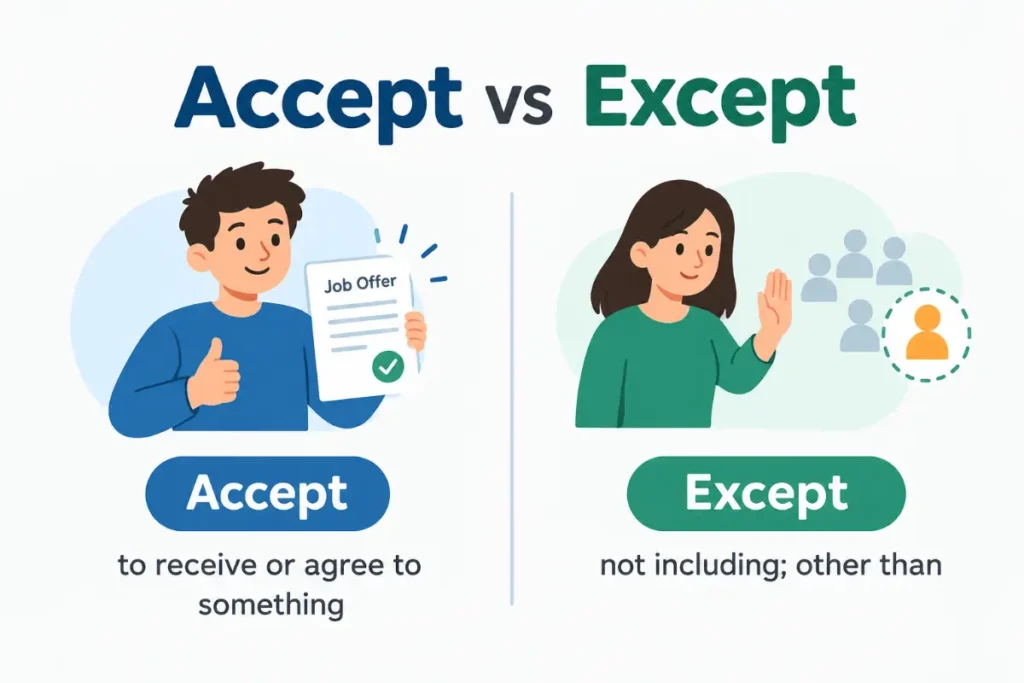
Accept vs except can be confusing because the two words look and sound similar, but they have completely different meanings and grammatical functions. Accept is a verb that means to receive, agree to, approve, or recognize something. Except usually means to leave something or someone out, and it can work as a preposition, conjunction, or verb.
The difference becomes much easier when you focus on the action or relationship in the sentence. If someone agrees to an offer, receives something, or recognizes something as true, accept is usually the word you need. If something or someone is excluded from a group, statement, rule, or situation, except is generally correct.
This distinction matters in everyday conversation, school writing, workplace emails, applications, instructions, and formal documents. A single letter can completely change the meaning of a sentence. This guide explains the meanings, grammar, pronunciation, common mistakes, examples, word origins, and practical usage of both words so you can choose the right one with confidence.
Quick Answer
Accept is a verb meaning to receive, agree to, approve, or recognize something. Except means to exclude or leave out someone or something. For example, I accept your offer means I agree to it, while Everyone came except John means John did not come. They sound similar but have different meanings.
What Does Accept Mean
Accept is a verb with several closely related meanings. At its most basic level, it describes receiving something willingly or agreeing to something. You can accept a gift, accept an invitation, accept an offer, accept responsibility, or accept a decision.
The word can also describe recognizing something as true, valid, or unavoidable. For example, someone might accept the facts, accept the results, or accept that a mistake was made. In these cases, the person is not necessarily receiving a physical object. Instead, they acknowledge or come to terms with an idea, fact, situation, or outcome.
Common uses include:
- I accept your invitation.
- She accepted the job offer.
- He accepted the package this morning.
- We accept credit cards.
- They accepted responsibility for the mistake.
- I accept that the decision has been made.
- The school accepted her application.
- Please accept my apology.
The exact meaning depends on context, but the central idea is usually receiving, agreeing, approving, or acknowledging something.
Accept As Receive
One common meaning of accept is to receive something that someone gives, sends, or offers. The receiver willingly takes it rather than refusing it.
For example, if someone gives you a gift and you take it, you accept the gift. If a company receives a delivery, it can accept the shipment. If a website allows a particular form of payment, it may say that it accepts credit cards.
- She accepted the gift with a smile.
- The office accepted the delivery.
- The store accepts cash and credit cards.
- He accepted the documents from the courier.
Here, accept involves receiving something offered or presented.
Accept As Agree
Accept can also mean agreeing to an offer, proposal, invitation, request, or arrangement.
- I accepted the job offer.
- They accepted our proposal.
- She accepted the invitation to dinner.
- The client accepted the terms of the agreement.
In these examples, the person or organization could have rejected the offer instead. Accept communicates that the offer or proposal was received favorably.
Accept As Acknowledge
Another important meaning involves recognizing something as true, valid, or real. This use often appears with facts, responsibility, circumstances, limitations, and outcomes.
- He accepted responsibility for the error.
- She accepted the results of the test.
- We have to accept the fact that plans can change.
- The company accepted the findings of the investigation.
This meaning is slightly different from physically receiving something, but the basic idea of taking something as given remains.
If you still confuse the forms used for placing something down and reclining, our guide to lay and lie explained can help you tell them apart quickly.
What Does Except Mean
Except generally means excluding, apart from, or with the exception of. It identifies a person, thing, group, or situation that is not included.
For example, Everyone attended except Maria means Maria did not attend. The sentence starts with a general group, everyone, and then identifies one person who is excluded.
- Everyone passed except Tom.
- The store is open every day except Sunday.
- I like all vegetables except broccoli.
- The entire team agreed except one member.
- We work every day except Saturday.
Unlike accept, except is usually concerned with exclusion rather than receiving or agreeing.
Except As A Preposition
Except often functions as a preposition before a noun or pronoun. In this structure, it means that someone or something is excluded from the larger group.
- Everyone was invited except me.
- The restaurant is open every day except Monday.
- Nobody knew the answer except Sarah.
- All the rooms were occupied except one.
The word after except identifies the person or thing left out.
Except As A Conjunction
Except can also introduce a clause. It often appears in structures such as except that, which introduces an exception to a statement.
- I would have gone, except that I was sick.
- The plan worked, except that it took longer than expected.
- Everything was ready, except that we were missing one document.
Here, except introduces a reason or circumstance that creates an exception to what was just stated.
Except As A Verb
Less commonly, except can function as a verb meaning to exclude someone or something. This use is more formal and less common in everyday American English.
- The rule excepts certain employees from the requirement.
- The agreement excepts emergency situations from the restriction.
Most readers are more familiar with except as a word meaning excluding or apart from. The verb form is useful to recognize, but it does not need to be your first choice in ordinary conversation.
Accept vs Except Difference
The simplest distinction is that accept involves receiving, agreeing, approving, or acknowledging, while except involves excluding or leaving something out.
| Feature | Accept | Except |
|---|---|---|
| Main meaning | Receive, agree, approve, or acknowledge | Exclude or leave out |
| Common part of speech | Verb | Preposition or conjunction |
| Can describe an action | Yes | Yes, but less commonly as a verb |
| Common pattern | Accept an offer | Everyone except John |
| Opposite idea | Reject or refuse | Include |
| Example | I accept your offer. | Everyone came except John. |
| Pronunciation | Usually /əkˈsept/ | Usually /ɪkˈsept/ |
The first syllable provides an important pronunciation difference. Accept normally begins with a reduced vowel sound, while except commonly begins with an unstressed ih sound. The final part of both words sounds the same.
A useful meaning test is even more reliable than pronunciation. If the sentence means receive, agree to, approve, or acknowledge, choose accept. If it means excluding, apart from, or leaving out, choose except.
How To Remember Accept And Except
A simple memory trick is to connect accept with the idea of approval or receiving. You might accept an invitation, accept a gift, accept an offer, or accept responsibility.
Connect except with exclusion. The beginning of except can remind you of exclude, because both relate to leaving something out. This is a memory aid rather than an explanation of their word histories, but it can be useful when you are writing quickly.
Try asking one of these questions:
- Am I receiving or agreeing to something? Use accept.
- Am I leaving someone or something out? Use except.
- Could I replace the word with reject or refuse as its opposite? Accept may be correct.
- Could I replace the word with excluding or apart from? Except may be correct.
For example, I accept everyone except one applicant contains both words because they perform different jobs. Accept describes the decision to approve or receive, while except identifies the person who is not included.
Accept vs Except Examples
Examples make the distinction much easier because the surrounding words show the function of each term.
Examples With Accept
Accept can describe receiving something, agreeing to something, approving something, or recognizing something.
- I accept your invitation to dinner.
- She accepted the job offer yesterday.
- The store accepts major credit cards.
- He accepted the package from the delivery driver.
- The school accepted my application.
- Please accept my apology.
- They accepted responsibility for the mistake.
- We accept the terms of the agreement.
- She accepted the award on behalf of the team.
- He eventually accepted that the decision was final.
Notice that the objects of accept vary widely. You can accept a physical object, an offer, an invitation, an apology, responsibility, an award, or a fact. The common idea is that something is received, approved, acknowledged, or taken as valid.
Examples With Except
Except identifies something that is excluded from a larger group or statement.
- Everyone was ready except Mark.
- The office is closed every day except Friday.
- I eat almost everything except mushrooms.
- All students passed except two.
- The store sells every size except extra small.
- Nobody knew about the change except the manager.
- We have meetings every day except Monday.
- All the seats were occupied except one.
- The entire family attended except my brother.
- I would help, except that I am already busy.
The word except often follows words such as all, everyone, everything, every, nobody, no one, and similar expressions. It creates a boundary around the general statement by identifying an exception.
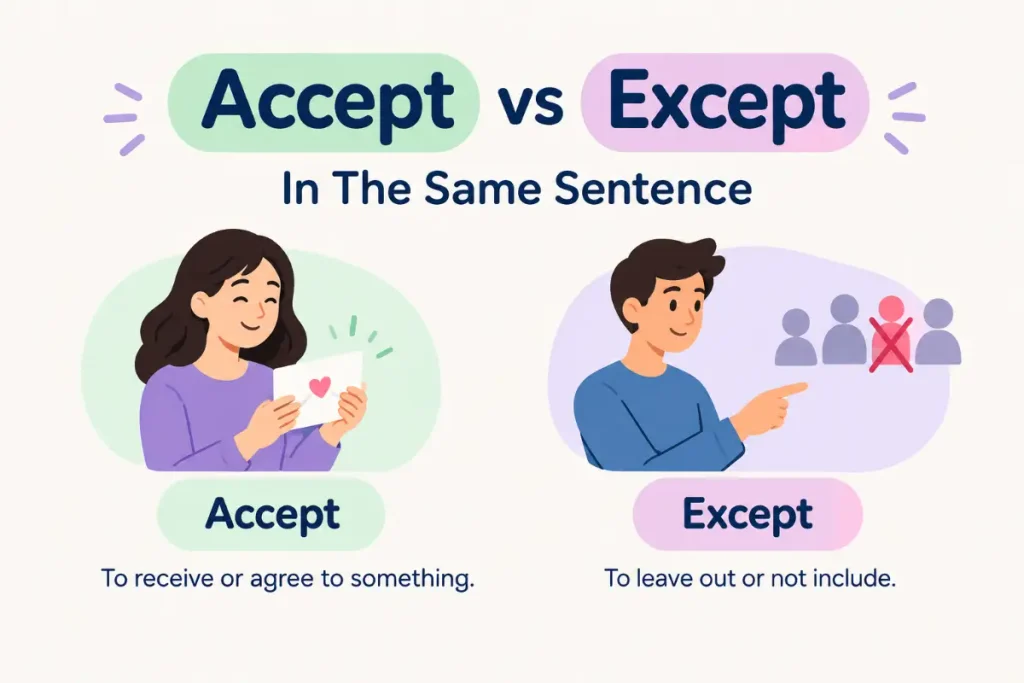
Accept And Except In The Same Sentence
Because the meanings are different, both words can appear naturally in the same sentence.
Consider:
The company accepted every application except mine.
Here, accepted means the company approved or received the applications. Except means the writer’s application was not included in the accepted group.
Another example is:
I accepted every invitation except the one for Saturday.
The first word describes agreement to the invitations. The second identifies the invitation that was excluded.
You can also write:
The restaurant accepts all major credit cards except one type.
In this sentence, accepts describes what forms of payment the restaurant takes, while except identifies the payment type it does not take.
These examples show why the two words cannot simply be treated as alternate spellings. They express different relationships within the sentence.
Common Mistakes With Accept And Except
The most common errors occur when writers remember that the words sound similar but do not stop to consider their meanings. Since the difference is only one letter in spelling, typing quickly can also lead to mistakes.
Accept Instead Of Except
Incorrect: Everyone was invited accept John.
Correct: Everyone was invited except John.
The sentence identifies John as the person who was excluded. It does not say that someone received or agreed to John.
Except Instead Of Accept
Incorrect: I except your apology.
Correct: I accept your apology.
The speaker is acknowledging and receiving the apology, so accept is required.
Accept The Rule And Except One Case
A sentence can become especially confusing when both words appear close together.
The committee accepted the new rule except for one provision.
The committee agreed to the rule, but one part was excluded from that agreement. Both words are correct because they describe different actions.
Confusing Accept With Except In Emails
These mistakes can be particularly noticeable in professional writing because the words can change the meaning of a sentence.
Compare:
We accept all applications except those submitted after the deadline.
This means applications are generally received or approved, but late applications are excluded.
If you accidentally replace except with accept, the sentence becomes grammatically and logically incorrect. Careful proofreading is especially useful when the two words appear close together.
Grammar Rules For Accept And Except
Accept is primarily a transitive verb, which means it commonly takes a direct object. You can accept an offer, an invitation, a gift, responsibility, a decision, or an explanation.
Common structures include:
- accept + noun
- accept + pronoun
- accept + that clause
- accept + responsibility
- accept + an offer
- accept + an invitation
For example, She accepted the invitation uses invitation as the direct object. In He accepted that the plan had failed, the clause following accepted expresses what he acknowledged.
Except has several grammatical roles. As a preposition, it can appear before a noun or pronoun, as in everyone except Sarah. As a conjunction, it can introduce a clause, especially in structures such as except that.
The grammatical difference helps explain why the words cannot substitute for one another. Accept normally describes an action performed by a subject. Except normally identifies an exclusion or exception.
Accept And Except In Negative Sentences
Both words can appear in negative sentences, but the meaning needs careful attention.
I did not accept the offer means I rejected or refused the offer. The focus is on not agreeing to or receiving something.
Everyone did not attend except John is a different and potentially confusing construction because negative words can change how readers interpret the sentence. Clearer wording might be Everyone attended except John if that is the intended meaning.
When using except, place it close enough to the word or group it modifies that the exception is obvious. Clear sentence structure matters more than simply choosing the correct spelling.
Accept Or Except In Everyday Writing
In everyday communication, accept appears frequently with offers, invitations, apologies, payments, applications, and responsibilities.
You might write:
- I accept your invitation.
- We accept cash and cards.
- Please accept my apology.
- She accepted the position.
- They accepted the terms.
Except commonly appears when discussing schedules, groups, rules, preferences, and exceptions.
You might write:
- The gym is open every day except Sunday.
- Everyone is coming except James.
- I like all of them except the blue one.
- The discount applies to everything except gift cards.
These patterns are useful because the surrounding vocabulary often provides a clue about which word belongs in the sentence.
Just as accept and except serve different grammatical roles, knowing when to choose good or well can make your writing more precise.
Formal And Casual Usage
Both accept and except are standard English words and can be used in formal, professional, academic, and casual writing. Neither word is inherently informal.
The important issue is accuracy. In a professional email, I accept the terms of the proposal clearly communicates agreement. In a workplace policy, The rule applies to all employees except temporary contractors clearly identifies an exception.
You do not need to replace either word with a more complicated synonym simply to sound formal. Accept and except are precise, familiar words that work well in professional communication.
Accept vs Except Pronunciation
Although accept and except look very similar, they are not normally pronounced exactly the same.
In standard American English, accept is commonly pronounced approximately /əkˈsɛpt/. The first syllable is weak, and the main stress falls on the second syllable.
Except is commonly pronounced approximately /ɪkˈsɛpt/. It also has stress on the second syllable, but its first vowel differs from the first vowel in the common pronunciation of accept.
Both words end with the same sept sound. The similar pronunciation contributes to spelling confusion, particularly for people who encounter the words mainly in conversation.
The spelling distinction is therefore worth learning separately from pronunciation. Hearing the words in a sentence may give you a clue, but meaning and grammar provide the more reliable answer.
Word Origin And Etymology
Accept comes from Latin accipere, meaning to receive or take. The word entered English through French and developed meanings related to receiving, agreeing to, and recognizing something.
Except also has Latin roots. It comes from excipere, which carries the idea of taking out or excluding. The Latin elements reflect the basic contrast that remains visible in modern English. Accept is associated with receiving, while except is associated with taking out or leaving something aside.
The similar appearance of the words is therefore not accidental, but their meanings developed along different paths. Understanding the historical connection can make the modern distinction easier to remember, although you do not need to know Latin to use either word correctly.
American English And Regional Usage
American English uses accept and except with the same basic meanings described here. British, Canadian, and Australian English also use both words in the same core grammatical roles.
There is no major American versus British spelling distinction for these two words. Accept is the standard spelling for the verb meaning to receive or agree to something, while except is the standard form for an exclusion or exception.
Pronunciation can vary slightly across English speaking regions, but the spelling and fundamental meanings remain stable. If you are writing for an American audience, you should use the same standard forms.
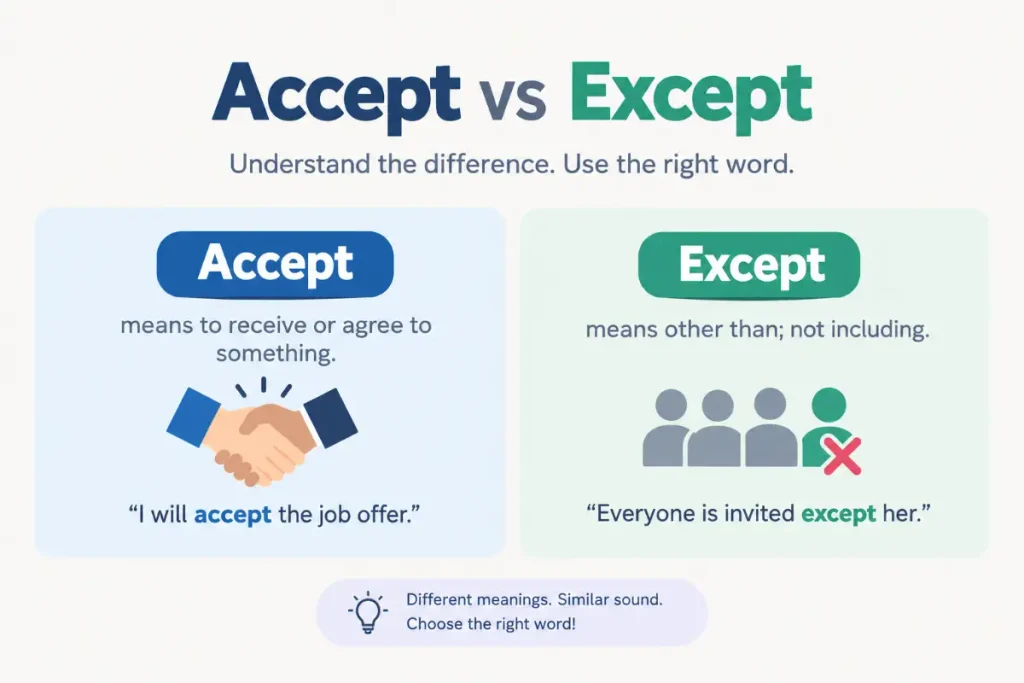
Accept And Except Synonyms
Understanding synonyms can reinforce the difference between the two words.
Depending on context, synonyms for accept can include:
- receive
- approve
- agree to
- acknowledge
- admit
- embrace
- take
Not every synonym works in every sentence. For example, accept responsibility can sometimes become acknowledge responsibility, but receive responsibility does not normally express the same idea.
Synonyms for except can include:
- excluding
- apart from
- with the exception of
- but
- other than
Again, context matters. Everyone came except Sarah can become Everyone came apart from Sarah, but the latter may sound more natural in some varieties of English than in American English.
The key difference remains simple. Accept involves taking, agreeing, or acknowledging. Except identifies what is left out.
Similar Words People Confuse
English contains many word pairs that cause confusion because they look or sound alike. Understanding one pair can make you more alert to another.
Affect And Effect
Affect is commonly used as a verb meaning to influence, while effect is commonly used as a noun meaning a result.
The weather affected our plans.
The storm had a major effect on travel.
Advice And Advise
Advice is a noun meaning a recommendation or guidance. Advise is a verb meaning to give guidance.
- She gave me good advice.
- She advised me to wait.
Principal And Principle
Principal can refer to a person in charge of a school or something that is most important. Principle refers to a rule, belief, or fundamental idea.
These examples demonstrate the same broader lesson. Similar spelling does not guarantee similar meaning.
Similar distinctions appear in relative clauses, where understanding that or which in a sentence can help you avoid common usage mistakes.
Expert Usage Tips
The most useful way to distinguish accept and except is to focus on the relationship between the word and the rest of the sentence.
If a person is taking something, agreeing to something, approving something, or acknowledging something, think accept. If a sentence establishes a general group and then identifies someone or something that is not included, think except.
Another effective proofreading technique is substitution. Try replacing accept with receive, agree to, or approve. If the sentence still expresses the intended meaning, accept is likely correct. Try replacing except with excluding, apart from, or with the exception of. If that works, except is likely the correct choice.
Pay particular attention when writing quickly. The two words are close enough in appearance that autocorrect or typing habits can produce errors without making the sentence immediately look strange. Reading the entire sentence for meaning, rather than checking spelling alone, catches these mistakes more reliably.
Frequently Asked Questions
What is the difference between accept and except
Accept means to receive, agree to, approve, or acknowledge something. Except means to exclude someone or something. For example, I accept the invitation means I agree to the invitation, while Everyone came except Lisa means Lisa was not included. The words look similar but have different grammatical functions.
Is it accept or except an offer
The correct word is accept when you agree to or receive an offer. You would write I accept your offer or She accepted the job offer. Except would not fit because the sentence is not describing an exclusion. A useful test is to replace accept with agree to.
Is it accept or except an apology
The correct word is accept. You can accept an apology when you acknowledge or receive someone’s apology. For example, I accept your apology means that you acknowledge the apology and are willing to move forward. Except would change the sentence into an exclusion and would not express this meaning.
How do you remember accept and except
Think of accept as receiving or agreeing and except as excluding. You can accept a gift, accept an offer, or accept responsibility. You can exclude someone from a group or describe everyone as present except one person. Connecting except with exclude can be a useful spelling memory aid.
Are accept and except homophones
No. They are similar sounding words, but they are not normally exact homophones in standard American English. Accept is commonly pronounced approximately /əkˈsɛpt/, while except is approximately /ɪkˈsɛpt/. Their similar final sounds and spelling make them easy to confuse, especially when writing from speech.
Can accept and except be used together
Yes. A sentence can use both words correctly when it describes acceptance and an exception. For example, The company accepted every application except one means the company approved or received all the applications but excluded one from the accepted group.
What is the opposite of accept
Depending on context, common opposites of accept include reject, refuse, decline, and deny. The best opposite depends on the meaning. For example, accept an invitation contrasts naturally with decline an invitation, while accept an offer can contrast with reject an offer.
What is the opposite of except
The opposite idea of except is generally include. If everyone except Maria came to the meeting, Maria was excluded. If everyone including Maria came to the meeting, she was included. The exact opposite wording depends on the sentence, but inclusion is the central contrast.
Conclusion
The difference between accept and except comes down to two very different ideas. Accept means to receive, agree to, approve, or acknowledge something. Except means to exclude, leave out, or identify an exception to a general statement.
When you are unsure, focus on the sentence rather than the similar spelling. If you could use receive, agree to, or approve, choose accept. If you could use excluding, apart from, or with the exception of, choose except. Once you connect each word with its grammatical function, the distinction becomes much easier to recognize in emails, schoolwork, professional writing, and everyday conversation.