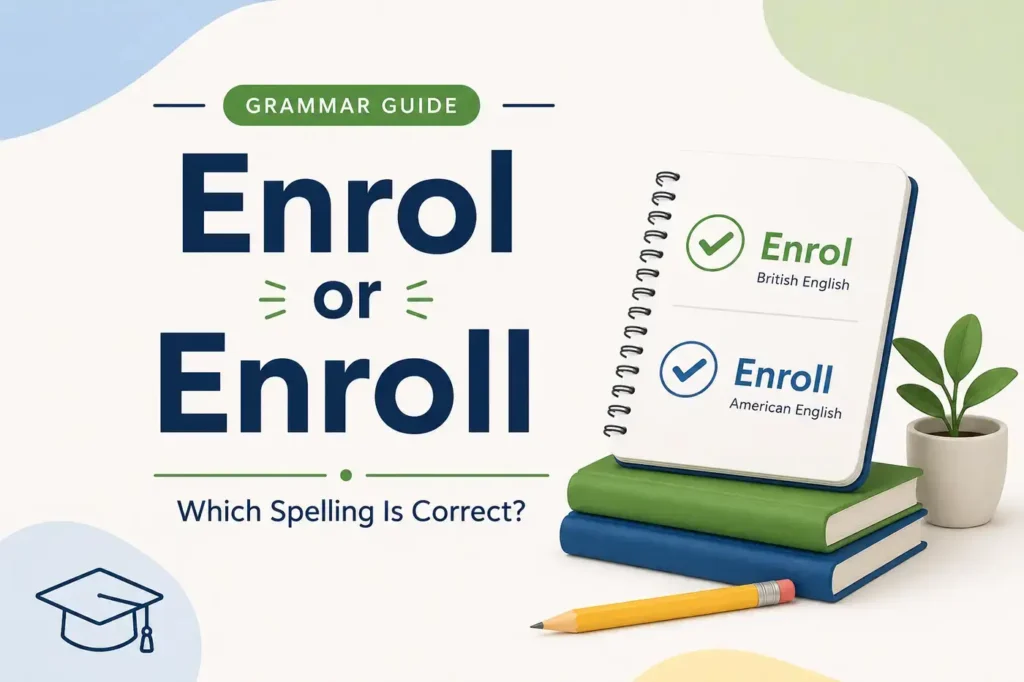
If you have ever typed enrol or enroll and stopped to wonder which spelling belongs in your sentence you are dealing with one of the most common differences between British and American English. Both forms are correct. The choice depends mainly on the variety of English you are using and the audience reading your content.
Enrol is the standard spelling in British English and is widely used in countries that follow British spelling conventions. Enroll is the preferred spelling in American English. The two forms have the same meaning and pronunciation. They both mean to officially register someone for a course program school membership or other organized activity.
The confusion often comes from the extra l in the American form. American English frequently doubles the final consonant before adding certain endings while British English often keeps the shorter form in this particular word. That small spelling difference can make a simple registration message feel surprisingly complicated.
This guide explains the difference clearly. You will learn the meaning of each form how the spelling developed which version belongs in American British Australian Canadian and Singaporean English how to use the word in real sentences and which form to choose in formal writing. You will also find grammar guidance pronunciation help common mistakes and practical advice for writing phrases such as enroll now or enrol now naturally.
Quick Definition
Enrol and enroll are two regional spellings of the same verb. Enrol is preferred in British English while enroll is preferred in American English. Both mean to officially register someone or yourself for a course program school membership or organized activity. Their meaning pronunciation and grammatical function are the same.
Quick Answer
Both spellings are correct. Use enrol when following British English and enroll when following American English.
The easiest rule is:
- Enrol is the usual British spelling.
- Enroll is the usual American spelling.
- Both forms mean to register officially.
- The pronunciation is the same.
- Use the spelling that matches the English style of your audience.
For example an American college may write Enroll now for fall classes while a British university may write Enrol now for the autumn term. The message is the same. Only the regional spelling changes.
Comparison Table
| Feature | Enrol | Enroll |
|---|---|---|
| Part of speech | Verb | Verb |
| Meaning | To register officially | To register officially |
| Standard variety | British English | American English |
| Origin | From French and Latin roots through English | Same historical origin |
| Formality | Standard and formal | Standard and formal |
| Common contexts | Schools universities courses memberships programs | Schools universities courses memberships programs |
| Usage frequency | Common in British English | Common in American English |
| Present form | Enrol | Enroll |
| Third person | Enrols | Enrolls |
| Present participle | Enrolling | Enrolling |
| Past tense | Enrolled | Enrolled |
| Example | Enrol in the course today. | Enroll in the course today. |
If you’re interested in other commonly confused spellings, our guide on the correct spelling of whiny explains which version is accepted in standard English and why.
Meaning Of Both Terms
The two spellings have the same basic meaning. The difference is regional rather than semantic.
Enrol Meaning
Enrol means to officially register a person or to register yourself for something. The activity usually involves joining an educational course training program organization membership or other structured activity.
For example:
- Students can enrol in the summer program.
- She decided to enrol at a local university.
- Members may enrol in the health plan online.
The word often suggests an official process rather than a casual decision. You might decide to attend a free public lecture without enrolling. You usually enrol when an organization records your participation and accepts you as a student member participant or registered user.
British English commonly uses this spelling in education and administration. You may see it on university websites school forms government pages and course registration portals.
Enroll Meaning
Enroll has exactly the same meaning. It is the preferred American spelling of the verb.
For example:
- Students can enroll in the summer program.
- She decided to enroll at a local university.
- Members may enroll in the health plan online.
American schools colleges companies and government agencies regularly use this form. You will also see it in phrases such as enroll in a class, enroll in college, enroll your child in school, and enroll now.
The spelling with two l letters is not a different word. It is simply the standard American form.
Key Differences
The main difference is spelling preference. The meaning remains the same.
A British editor will normally choose enrol. An American editor will normally choose enroll. Writers in other English speaking countries may follow one tradition based on local usage institutional style or the influence of nearby English varieties.
The differences can be summarized like this:
- Meaning. Both forms mean to register officially.
- Pronunciation. Both forms are pronounced the same way.
- Grammar. Both forms function as verbs and follow the same grammatical patterns.
- Regional spelling. British English prefers enrol while American English prefers enroll.
- Past tense. Both forms become enrolled.
- Present participle. Both forms become enrolling.
- Noun form. Both use enrollment in American English and enrolment in British English.
The final point is especially important. The regional difference continues in related nouns. An American college may ask students to complete their enrollment while a British university may refer to student enrolment.
Which Spelling Is Correct
Both forms are correct. The correct choice depends on the English variety you are following. Use enrol for:
- British English.
- Many British Commonwealth contexts.
- Writing that follows British spelling conventions.
- Publications or institutions that specifically use the shorter form.
Use enroll for:
- American English.
- United States schools and universities.
- American business communication.
- Content written primarily for a US audience.
The important thing is consistency. Do not choose enrol in one section and enroll in another unless you are deliberately comparing the two forms. A reader may understand both, but inconsistent regional spelling can make an article or document look poorly edited.
The same principle applies to related words. If you choose the American form enroll, use enrollment. If you choose the British form enrol, use enrolment.
Pronunciation Guide
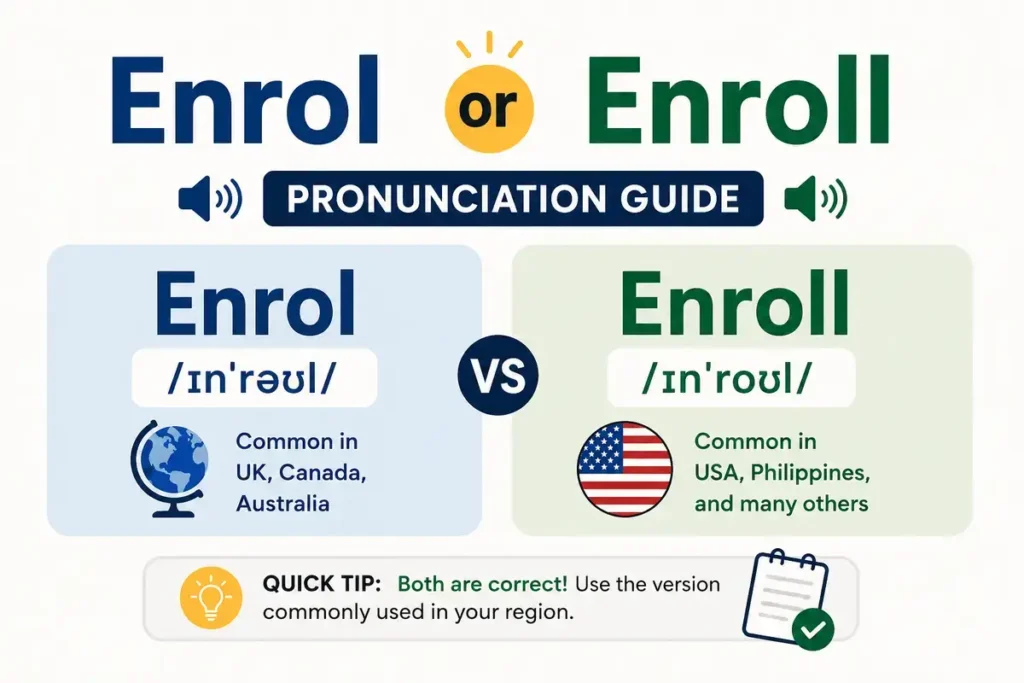
Both spellings have the same pronunciation.
IPA Pronunciation
Enrol and enroll are commonly pronounced:
/ɪnˈroʊl/ in American English.
British pronunciation may use a slightly different vowel quality depending on the speaker and accent but the basic word remains recognizable as two syllables.
Syllable Breakdown
The word has two syllables:
en roll
The main stress falls on the second syllable.
Common Pronunciation Mistakes
English learners sometimes make the first syllable too strong or try to pronounce the spelling difference. That is unnecessary. The extra l in the American spelling does not create an extra sound.
Both forms sound like:
in ROLL
The pronunciation stays the same even though the written forms differ.
How To Remember The Spelling
A useful way to remember the difference is to connect the spelling to the English variety.
- British English uses enrol.
- American English uses enroll.
- British English uses enrolment.
- American English uses enrollment.
You can also remember that the American form doubles the final l before certain endings while the British form keeps the shorter base spelling.
The best practical habit is to decide your audience before you start writing. If you are creating content for American students use enroll consistently. If you are writing for readers in the United Kingdom use enrol. This simple decision prevents most spelling problems before they happen.
The same rule applies to calls to action. An American education website may write Enroll now while a British education website may write Enrol now. Both phrases are correct for their intended audiences.
Enrol Or Enroll Examples And Usage
The difference between the two spellings becomes much easier to understand when you see them in natural sentences. The examples below show how the verb works in real communication and how the spelling changes according to the English variety being used.
The meaning does not change. Only the regional spelling changes.
Enrol Examples
These examples follow British English spelling.
- Students must enrol in their chosen courses before the registration deadline.
- You can enrol in the evening class through the college website.
- Parents may enrol their children in the summer reading program.
- She decided to enrol at a university in London.
- The school invited new students to enrol before the autumn term began.
- Members can enrol in the fitness program at any time.
- He plans to enrol in a professional training course next month.
- The university allows international students to enrol online.
- You must enrol before attending the first lesson.
- Thousands of students enrol in distance learning programs every year.
These sentences sound natural in British English and other contexts that follow British spelling conventions.
Enroll Examples
These examples follow American English spelling.
- Students must enroll in their chosen courses before the registration deadline.
- You can enroll in the evening class through the college website.
- Parents may enroll their children in the summer reading program.
- She decided to enroll at a university in California.
- The school invited new students to enroll before the fall semester began.
- Members can enroll in the fitness program at any time.
- He plans to enroll in a professional training course next month.
- The university allows international students to enroll online.
- You must enroll before attending the first class.
- Thousands of students enroll in online programs every year.
The structure and meaning remain the same. The main difference is the spelling convention.
Just as enroll follows standard spelling conventions, understanding when to use “suing” correctly can help you avoid another frequently misspelled English word.
Common Mistakes
Most errors come from mixing regional spelling systems or confusing the verb with related nouns. A few simple rules can prevent nearly all of them.
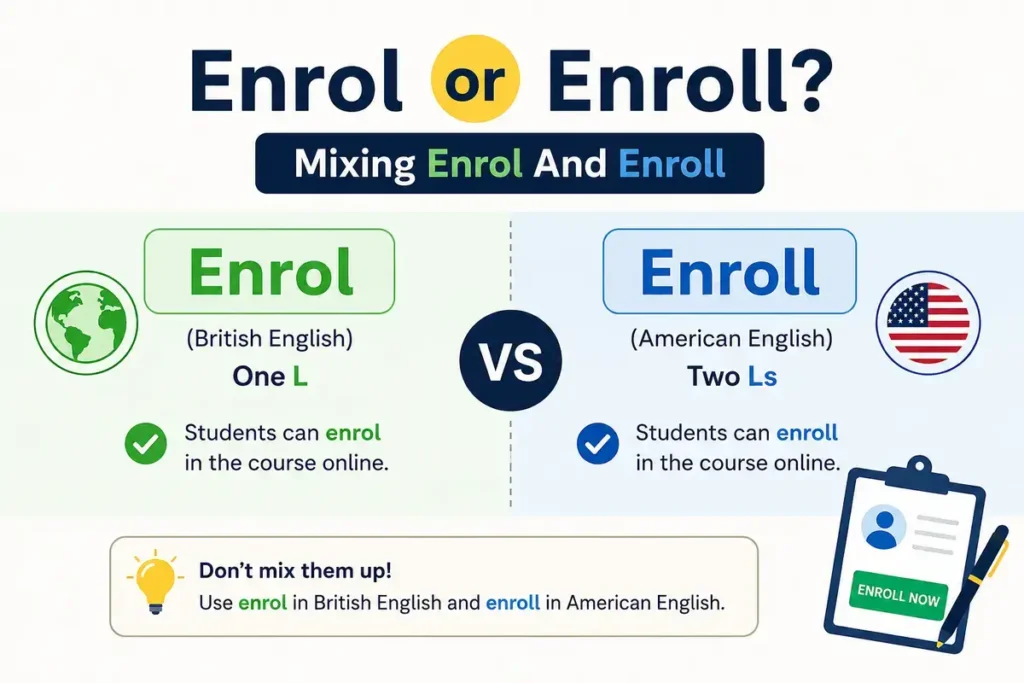
Mixing Enrol And Enroll
A writer may use enrol in one paragraph and enroll in another. This is not a serious grammar error, but it creates an inconsistent style.
Choose one regional form and use it throughout the document. For example, an American article should normally use:
- Enroll.
- Enrolled.
- Enrolling.
- Enrollment.
A British article should normally use:
- Enrol.
- Enrolled.
- Enrolling.
- Enrolment.
Assuming One Form Is Incorrect
Some writers believe enrol is a misspelling because they learned American English. Others believe enroll is wrong because they learned British English. Neither assumption is correct. Both forms are standard. The difference is regional.
Confusing The Verb And Noun
The verb describes the action.
Students enroll in courses.
The noun describes the process or status.
Student enrollment begins in August.
In British English the corresponding noun is usually enrolment. This distinction matters because the spelling pattern changes when the word becomes a noun.
Adding An Unnecessary Preposition
The most common structure is enrol in or enroll in.
Examples:
- She enrolled in a photography course.
- He enrolled in the program last week.
When talking about registering a person, you can use the direct object structure.
Examples:
- The parents enrolled their daughter in school.
- The company enrolled its employees in a training program.
Confusing Enrol With Join
These words can overlap but they are not always identical.
Join is broader and often sounds more informal.
You might say:
I joined the gym.
You might say:
I enrolled in a fitness program.
The first focuses on becoming a member. The second emphasizes official registration in a specific program or course.
Etymology And Word Origin
The word has a long history that helps explain its modern meaning.
It ultimately traces back to Old French enroller which meant to place a name on a roll or list. The underlying idea was simple. An official list recorded the names of people who belonged to a group or had registered for a particular purpose.
The word entered English through the influence of French and developed into the forms associated with registration and membership.
Over time the meaning expanded. People could enrol or enroll in:
- Schools.
- Universities.
- Military organizations.
- Professional groups.
- Training programs.
- Membership schemes.
The central idea remained the same. A person’s name was officially recorded as part of an organization or activity.
The spelling difference developed through the separate evolution of British and American English. American English commonly preserves doubled consonants in forms such as enroll while British English generally uses enrol.
The past tense does not preserve the visible difference in the same way. Both varieties use enrolled and enrolling.
Regional Usage
Regional spelling is one of the most important parts of this comparison.
United Kingdom
British English prefers enrol.
You will commonly see it in:
- University admissions.
- School registration.
- Government services.
- Professional training.
- Membership programs.
The related noun is usually enrolment.
A British university may write:
Enrol now for the autumn term.
United States
American English prefers enroll.
The form appears throughout:
- Colleges.
- Public schools.
- Private schools.
- Online education.
- Healthcare programs.
- Business training.
The related noun is enrollment.
An American college may write:
Enroll now for fall classes.
Australia
Australian English generally follows the British spelling enrol.
You may see:
- Enrol.
- Enrolled.
- Enrolling.
- Enrolment.
Australian institutions often use British style conventions even though Australian English has its own distinctive vocabulary and pronunciation.
Canada
Canadian English can show variation because it combines influences from British and American English.
Both enrol and enroll may appear in Canadian usage, but institutional style can determine which form is preferred. Writers should follow the style guide of the organization or publication they are writing for.
Consistency matters more than trying to force one universal form.
Singapore
Singaporean English often follows British spelling conventions in formal education and government contexts. As a result, enrol and enrolment are commonly seen in official and educational writing.
However, international companies and American influenced digital platforms may use enroll.
If you are writing specifically for Singapore, check the style used by the institution or organization involved. The audience and local house style should guide your choice.
Grammar Rules
The grammar is the same for both spellings. Only the regional spelling changes.
Part Of Speech
Both forms are verbs. They can describe the action of officially registering a person or becoming officially registered.
Examples:
- I enrolled in the course.
- She enrolled her son in school.
- They are enrolling new members.
Present Tense
Use the base form after subjects such as I, you, we, and they.
Examples:
- I enrol in evening classes.
- I enroll in evening classes.
- They enrol in the program.
- They enroll in the program.
With he, she, or it, add s.
Examples:
- She enrols in a new course every year.
- She enrolls in a new course every year.
Past Tense
Both varieties use enrolled.
Examples:
- She enrolled in the course last month.
- They enrolled their children at the local school.
The spelling becomes identical in the past tense.
Present Participle
Both forms use enrolling.
Examples:
- Students are enrolling in record numbers.
- The school is enrolling new students.
The final l is doubled before the ing ending in both varieties.
Common Structures
The most common structure is:
enrol or enroll in + course program school or activity
Examples:
- He enrolled in a business course.
- She enrolled in college.
- They enrolled in the training program.
Another common structure is:
enrol or enroll + person + in + program
Examples:
- The parents enrolled their child in school.
- The company enrolled its employees in a safety course.
If you enjoy learning about tricky word forms, you may also want to explore whether homemade is one word and how it differs from the two-word alternative.
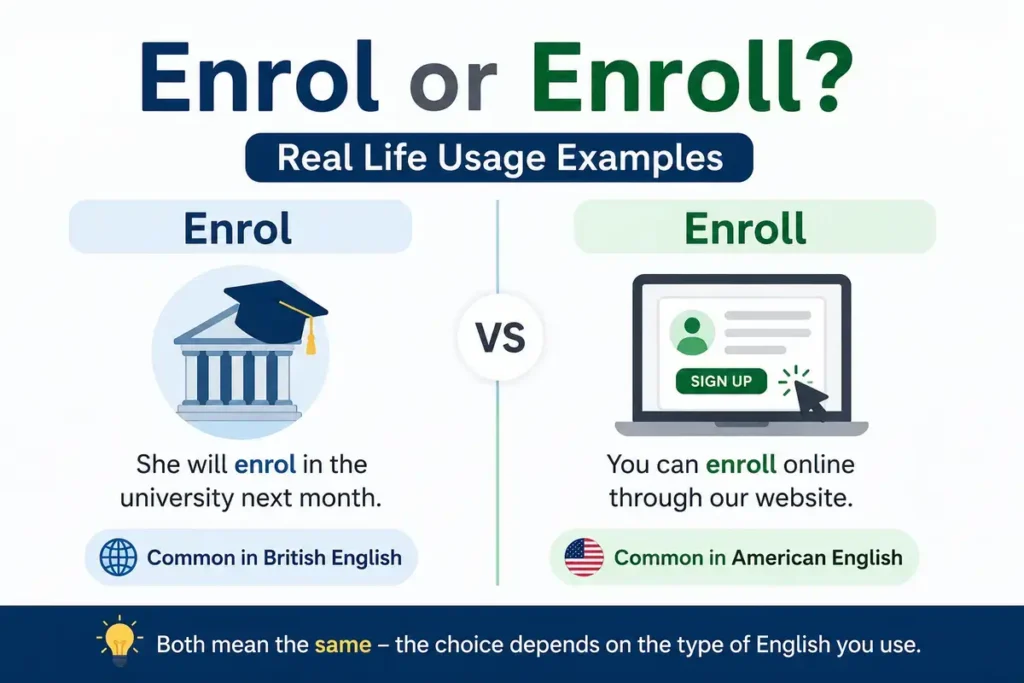
Real Life Usage Examples
The verb appears in many areas of daily life.
Daily Conversation
People use it when discussing education and activities.
Examples:
- Have you enrolled in your classes yet?
- I am thinking about enrolling in a cooking course.
- My daughter enrolled in a summer camp.
Academic Writing
Universities and researchers use the word when discussing participants and students.
Examples:
- The study enrolled 500 participants.
- Students who enrol in the program must complete an introductory course.
- The research team enrolled adults between the ages of 18 and 65.
Professional Communication
Businesses use the word for training programs benefits schemes and professional development.
Examples:
- Employees can enroll in the new training program.
- Staff members must enrol in the required safety course.
- The company opened enrollment for its leadership program.
Literature
In literary writing the word may describe joining an institution group or cause.
For example a character may enrol at a school or enroll in a military organization. The spelling depends on the English variety used by the author and publisher.
Media
News reports frequently use the word when discussing school admissions online courses and public programs. The American press generally uses enroll while British and many Commonwealth publications generally use enrol.
Related Words And Confused Terms
The difference between enrol and enroll becomes easier to understand when you place both forms beside the words that commonly appear with them. Some of these terms are close in meaning while others describe a different part of the registration process. Knowing the difference helps you write more naturally and avoid using a formal registration word in a situation where a simpler verb would sound better.
| Word | Meaning | Example |
|---|---|---|
| Enrol or enroll | Officially register for something | She enrolled in a course. |
| Enrolment or enrollment | The act or process of registering | Enrollment opens Monday. |
| Register | Enter a name or details on an official list | Please register for the event. |
| Sign up | Register in an informal way | I signed up for the workshop. |
| Join | Become a member of a group or organization | He joined the club. |
| Admit | Officially accept someone into an institution | The university admitted 2,000 students. |
| Apply | Formally request entry or acceptance | She applied to three colleges. |
| Attend | Go to a class or event | He attends evening classes. |
| Participate | Take part in an activity | They participated in the training. |
The most important distinction is between apply, admit, and enrol or enroll. A student may first apply to a university. The university may then admit the student. After acceptance, the student may enrol or enroll in classes. These verbs describe different stages of the process.
The noun forms also deserve attention. British English generally uses enrolment while American English generally uses enrollment. Both nouns describe the process or condition of being officially registered.
Expert Language Insight
From an editorial perspective, the most important rule is not deciding that one spelling is universally correct. The important rule is matching your spelling to your chosen English variety and then staying consistent.
A British publication that suddenly switches from enrol to enroll can look inconsistent. An American article that uses enrol may appear to contain a spelling error to its intended audience. Neither form is inherently better. The audience determines the best choice.
Experienced editors also pay attention to the noun form. A document that uses enroll in one section and enrolment in another has mixed regional conventions. The same applies in reverse. If you choose the American form use enrollment. If you choose the British form use enrolment.
The phrase enroll now is especially common in American marketing and education. A British institution will generally write enrol now. Both calls to action are natural within their respective varieties of English.
For online content the audience should guide the decision. A US education website should normally use enroll because that is the form its readers expect. A UK or Singaporean institution may prefer enrol. If the content serves an international audience the best approach is to choose one style for the page and apply it consistently rather than switching between forms.
One final editorial point matters. Searchers often type both spellings into search engines because they are comparing regional usage. That does not mean an article needs to repeat both forms in every paragraph. Clear explanations supported by related vocabulary such as register, admission, enrollment, course registration, and student registration provide better coverage without making the writing sound forced.
Frequently Asked Questions
Is enrol or enroll correct?
Both spellings are correct. Enrol is the standard form in British English and is common in countries that follow British spelling conventions. Enroll is the standard American English form. Both words have the same meaning and pronunciation. Choose the spelling that matches the English variety used by your audience or organization.
What is the meaning of enrol or enroll?
The verb means to officially register someone or to register yourself for a course school program membership or other organized activity. For example a student may enrol or enroll in a university course. The word suggests an official registration process rather than simply attending an event or casually joining an activity.
Should I write enrol or enroll now?
Use enroll now for American English and enrol now for British English. Both phrases are correct calls to action. The best choice depends on your audience. A US college would normally write Enroll now for fall classes while a British university might write Enrol now for the autumn term.
Is enrol or enroll UK English?
Enrol is the standard UK English spelling. British writers also generally use enrolment as the related noun. For example a UK university may write Enrolment opens in September. The American forms are enroll and enrollment.
Is enrol or enroll used in Singapore?
Singaporean English often follows British spelling in formal education and institutional writing so enrol and enrolment are commonly used. However organizations may follow their own style guides and international companies may use American spelling. When writing for a specific Singaporean institution follow its established spelling conventions for consistency.
What are some enrol or enroll examples?
Examples include I enrolled in a photography course, She enrolled her child in school, and Students can enrol in the program online. The sentence structure and meaning stay the same. Only the spelling of the base verb changes between British and American English.
Is enrol vs enroll a grammar difference?
No. The difference is primarily regional spelling rather than grammar. Both forms function as verbs and follow the same sentence patterns. The past tense is enrolled in both varieties and the present participle is enrolling. The main related noun difference is enrolment in British English and enrollment in American English.
What is the difference between enrol vs enroll?
There is no difference in meaning or pronunciation. Enrol is preferred in British English while enroll is preferred in American English. The difference developed through regional spelling conventions. Writers should choose one form based on their audience and maintain that choice throughout the document.
Conclusion
The answer is simple. Enrol and enroll are both correct spellings of the same verb. The difference comes from regional English conventions rather than meaning grammar or pronunciation.
Use enrol when writing in British English and in many formal contexts influenced by British spelling. Use enroll when writing for an American audience. Australia and Singapore commonly use the British form while Canadian usage can vary depending on the institution or publication style.
The same pattern continues in the related noun. British English generally uses enrolment while American English uses enrollment. Keeping the verb and noun forms consistent gives your writing a polished and professional feel.
If you are writing for a specific audience the practical choice is easy. Match the spelling to your readers and keep it consistent from the headline to the final sentence. The goal is not to prove that one version is better. The goal is to use the form that fits the English style you have chosen. The strongest rule to remember is this: British English enrols while American English enrolls.