If you have ever paused while writing about a legal dispute and wondered suing or sueing is correct you are not alone. This spelling question catches many people because the verb sue ends with a silent e and the usual rules for adding ing can feel inconsistent.
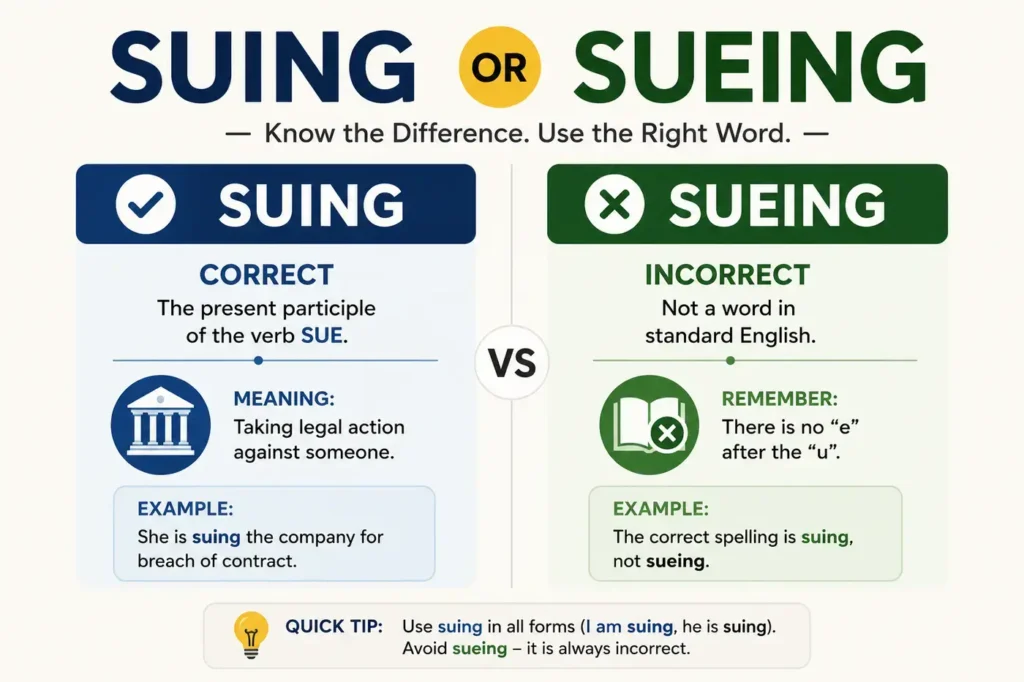
The correct spelling is suing. The form sueing is incorrect in standard English. When you add the suffix ing to sue the final silent e is removed. That gives you suing rather than sueing.
The word means taking legal action against someone or an organization in court. You might see it in phrases such as suing someone, suing for damages, or suing for emotional distress. The word also appears in everyday discussions about lawsuits and formal legal writing.
This guide explains the spelling rule clearly and shows how the word works in real sentences. You will learn its meaning in law, pronunciation, grammar, word origin, related terms, common mistakes, regional usage, and the difference between the correct form and similar words such as sue, sued, and lawsuit.
Quick Definition
Suing is the correct spelling. It is the present participle and gerund form of the verb sue. The word means taking legal action against a person or organization. Sueing is a common misspelling. The final silent e in sue is dropped before adding ing.
Quick Answer
The correct form is suing.
Write:
She is suing the company for damages.
Do not write:
She is sueing the company for damages.
The spelling follows the common English rule of dropping a final silent e before adding ing. The same pattern appears in words such as make becoming making and write becoming writing.
The main difference is simple:
- Sue is the base verb.
- Suing is the form used with is, am, or are and as a gerund.
- Sueing is a misspelling.
Just as writers often confuse the difference between whiny and whiney, spelling mistakes like suing and sueing are easy to make until you learn the correct rule.
Comparison Table
| Feature | Suing | Sueing |
|---|---|---|
| Part of speech | Present participle and gerund | Incorrect spelling |
| Base word | Sue | Sue |
| Correct form | Yes | No |
| Meaning | Taking legal action against someone | Intended to mean suing |
| Origin | From the verb sue | Misspelled form |
| Formality level | Standard and appropriate for legal writing | Not appropriate in standard writing |
| Common contexts | Lawsuits legal claims court cases and everyday speech | Informal typing and spelling mistakes |
| Usage frequency | Common | Uncommon compared with the correct form |
| Example | The family is suing the hospital. | Incorrect |
| Pronunciation | /ˈsuːɪŋ/ | Usually intended to sound the same |
Meaning Of Suing And Sueing
The two spellings do not represent two different meanings. One is correct and the other is a spelling error.
What Suing Means
Suing means bringing a legal claim against a person company organization or another party. The person or group starting the legal action is generally called the plaintiff. The person or organization being taken to court is generally called the defendant.
For example:
The customer is suing the company over the alleged injury.
This sentence means the customer has started or is pursuing a legal claim against the company. The word can refer to many types of civil legal disputes including:
- Personal injury claims.
- Breach of contract cases.
- Property disputes.
- Employment claims.
- Defamation cases.
- Product liability claims.
- Claims for emotional distress.
- Business disputes.
The exact legal meaning can depend on the legal system and the type of case. In everyday English though the central idea remains the same. Someone is taking legal action against another party.
What Sueing Means
Sueing is not the standard spelling of the verb form. People usually write it because they apply the wrong spelling rule to sue. They see the word sue and simply add ing without removing the final silent e.
That creates:
sue + ing = sueing
But standard English changes the spelling to:
sue + ing = suing
The incorrect form is understandable to readers because the intended word is obvious. Still it should be corrected in professional writing schoolwork legal documents and published content.
Suing Or Sueing Key Differences
The difference is mainly spelling and grammatical correctness rather than meaning. Suing is the standard form used in English. Sueing is a misspelling that results from adding the suffix ing directly to the base word.
The spelling rule is especially important here because sue looks unusual. The word ends in ue but the final e is silent. When the ing suffix is added the spelling changes.
Compare these forms:
- Sue becomes suing.
- Argue becomes arguing.
- Rescue becomes rescuing.
- Pursue becomes pursuing.
The same basic pattern appears across these verbs. The final silent e disappears before ing is added.
Meaning Difference
There is no genuine meaning difference between the two spellings. A person who writes sueing almost always means suing.
Grammar Difference
Suing is grammatically correct. It can function as a present participle or a gerund. Sueing is not the correct grammatical form because it is misspelled.
Formality Difference
Suing works in every type of English writing including legal documents academic work news reports business communication and everyday conversation. Sueing should be avoided in all standard writing.
Context Difference
You may see the incorrect form in:
- Online comments.
- Social media posts.
- Informal messages.
- Search queries.
- User generated content.
That does not make it an accepted alternative. People often search for a misspelling precisely because they are unsure which form is correct.
Which One Is Correct
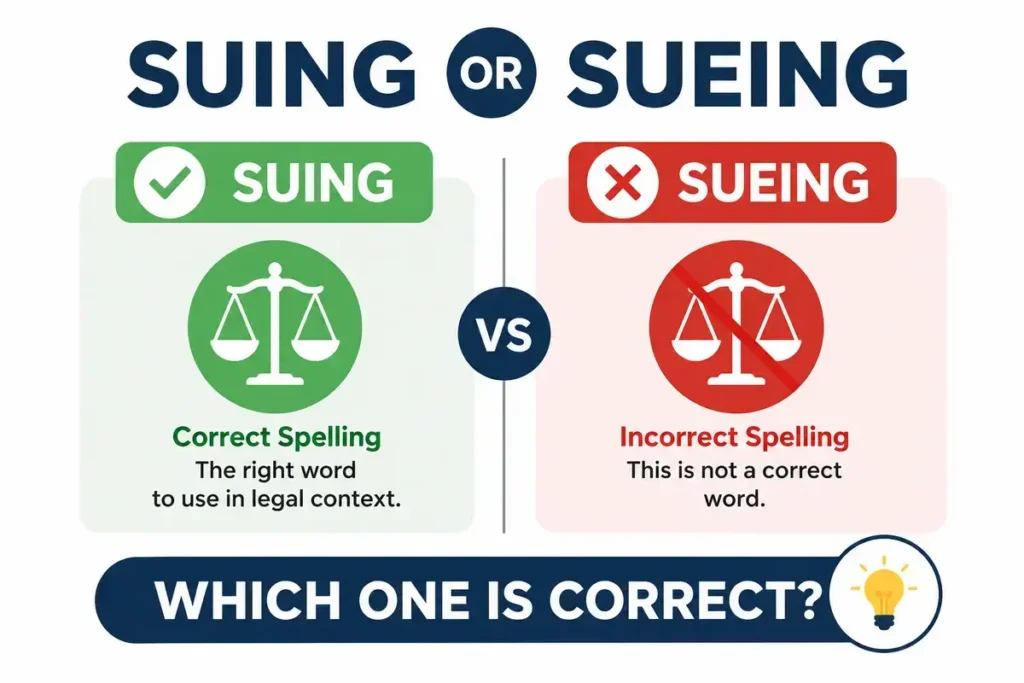
Suing is the correct spelling. The spelling follows the rule for verbs ending in a silent e. When the suffix ing is added the final e is normally removed. The process looks like this:
Sue + ing = suing
The same rule explains these examples:
- Use becomes using.
- Move becomes moving.
- Write becomes writing.
- Give becomes giving.
- Take becomes taking.
The spelling sueing keeps the final e when it should be dropped. That is why it is considered incorrect.
A useful editing tip is to remember that the final e is usually silent. When you add ing the spelling often becomes cleaner without that extra letter.
Suing Meaning In Law
In legal language suing generally means bringing a civil claim against another party through the court system. The claim may ask for money damages another legal remedy or a court order.
For example:
The homeowner is suing the contractor for breach of contract.
This means the homeowner has brought a legal claim based on an alleged failure to follow the agreement. The word is often connected with other legal terms such as:
- Lawsuit.
- Plaintiff.
- Defendant.
- Claim.
- Complaint.
- Damages.
- Settlement.
- Civil court.
- Legal action.
- Litigation.
It is important to understand that everyday uses of suing can be broader than precise legal terminology. Someone might say I am suing them during an argument even before a formal case has been filed. In professional legal writing the exact procedural stage matters much more.
Suing Someone
The phrase suing someone means taking legal action against that person. The person may be an individual business employer landlord manufacturer or another legal entity.
Examples include:
The customer is suing the manufacturer after the product allegedly caused an injury.
The employee is suing the company over an alleged workplace dispute.
The homeowner is suing the contractor for failing to complete the project.
The phrase does not automatically tell you who will win the case. It only describes the act of bringing or pursuing a legal claim.
This distinction matters because casual conversation often treats suing as if it means proving wrongdoing. It does not. A lawsuit is a legal process. The court must still consider the evidence arguments and applicable law.
Suing For Emotional Distress
Suing for emotional distress refers to seeking legal compensation or another remedy based on serious emotional harm allegedly caused by another party.
The exact legal requirements differ by jurisdiction and by the type of claim. Emotional distress may be discussed in connection with personal injury cases harassment discrimination intentional misconduct or other legal disputes.
In everyday writing you might see:
The plaintiff is suing for emotional distress after the incident.
A more precise legal explanation may require details about the specific claim and the applicable law. For that reason writers should avoid presenting the phrase as if every emotional experience automatically creates a valid lawsuit.
From a language perspective the phrase is grammatically straightforward:
suing + for + noun phrase
Examples include:
- Suing for emotional distress.
- Suing for damages.
- Suing for negligence.
- Suing for breach of contract.
The legal meaning depends on the facts and jurisdiction. The grammar does not.
Pronunciation Guide
The correct word suing has two syllables.
IPA Pronunciation
/ˈsuːɪŋ/
Some pronunciation guides may represent the sound slightly differently depending on the accent. The basic pronunciation remains close to:
SOO ing
Syllable Breakdown
Su ing
The first syllable sounds like soo. The second syllable begins with the short vowel sound in ing.
Common Pronunciation Mistakes
Some speakers try to compress the word into one syllable because the spelling looks short. That can make the pronunciation unclear.
Common mistakes include:
- Pronouncing it like sung.
- Dropping the second syllable.
- Pronouncing it as sue ing with an unnatural pause.
- Confusing it with sewing.
The words suing and sewing can sound very similar in some accents. Context usually makes the meaning clear.
For example:
She is suing the company.
Means she is taking legal action.
She is sewing a button onto her shirt.
Means she is using a needle and thread.
The spelling and context separate the meanings even when the pronunciation sounds close.
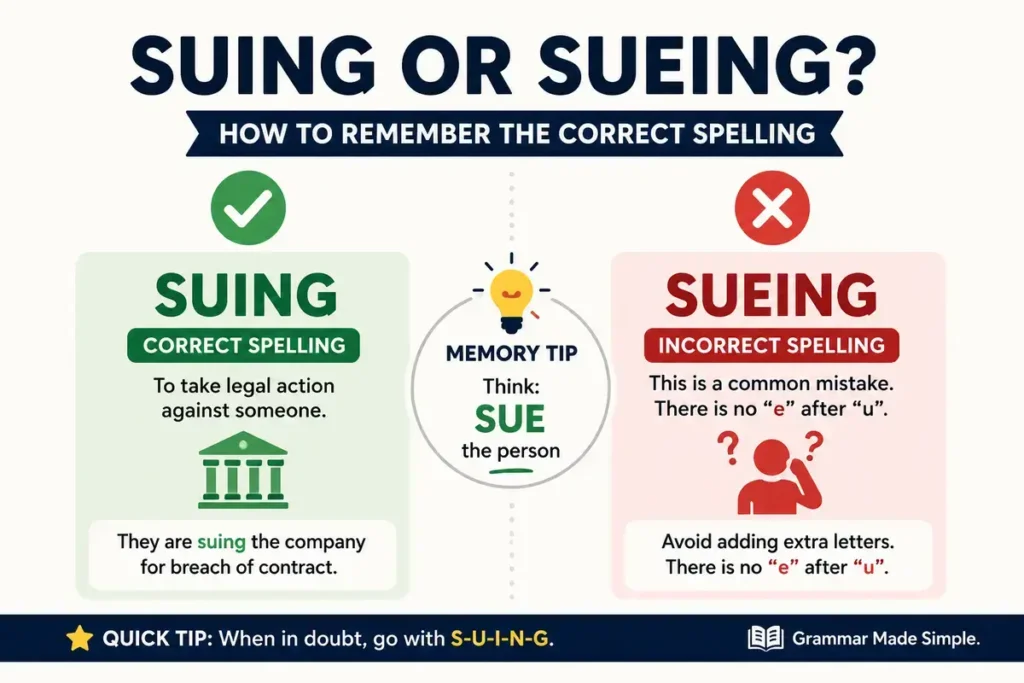
How To Remember The Correct Spelling
The easiest way to remember the spelling is to focus on the base verb and the suffix.
Start with:
sue
Then add:
ing
Before adding the suffix remove the final silent e.
That gives you:
suing
You can remember the pattern with these related verbs:
- Argue becomes arguing.
- Rescue becomes rescuing.
- Pursue becomes pursuing.
- Continue becomes continuing.
- Value becomes valuing.
A second useful trick is to remember that sueing looks visually crowded. The standard form suing removes the silent letter and creates the natural spelling used by native speakers and professional writers. When proofreading your work search for sueing. If you find it in ordinary text change it to suing.
Examples In Sentences
The best way to understand a verb is to see how people actually use it. The following examples show the correct form in different situations, from everyday conversation to formal legal writing.
Examples Using Suing
- The family is suing the hospital after the accident.
- The company is suing its former partner over an alleged breach of contract.
- She is suing the manufacturer for damages caused by the defective product.
- The homeowner is suing the contractor for failing to complete the renovation.
- The employee is considering suing her former employer.
- The plaintiff is suing for compensation related to the alleged injury.
- The celebrity is suing a newspaper for alleged defamation.
- The customer said he was thinking about suing the company.
- The injured passenger is suing the airline over the incident.
- The organization is suing the government over the disputed decision.
Each example uses suing as the present participle of sue. The word commonly appears after forms of be such as is, am, and are.
Examples Using Sueing
The following examples show the spelling that should be avoided.
- She is sueing the company. Incorrect.
- They are sueing their former landlord. Incorrect.
- He is sueing for emotional distress. Incorrect.
- The family is sueing the manufacturer. Incorrect.
- The business is sueing its competitor. Incorrect.
- She considered sueing after the dispute. Incorrect.
- The customer threatened to start sueing the company. Incorrect.
- They discussed sueing for damages. Incorrect.
- The employee talked about sueing her former employer. Incorrect.
- The plaintiff began sueing the defendant. Incorrect.
In every example above, replace sueing with suing.
Common Mistakes
The most common mistake is adding ing directly to sue without changing the spelling. This creates sueing, which looks logical at first glance but does not follow standard English spelling rules.
Keeping The Final E
The incorrect pattern looks like this:
sue + ing = sueing
The standard form is:
sue + ing = suing
The final silent e is removed before the suffix is added.
Confusing Suing With Sewing
Suing and sewing can sound similar in some accents, but they have completely different meanings.
Suing means taking legal action.
Sewing means joining fabric with a needle and thread.
Compare these sentences:
The company is suing the supplier.
She is sewing a button onto her jacket.
The context makes the difference clear.
Assuming The Word Has Two Accepted Spellings
Some writers see sueing online and assume it is an accepted alternative. It is not the standard spelling.
The internet contains countless spelling errors. Search frequency alone does not determine correctness.
Using A Legal Word Too Casually
People often say I am suing you during an argument. In casual conversation this can simply mean I am thinking about taking legal action.
In formal legal writing the situation is more precise. The word may refer to an actual civil action or a specific stage of litigation. Writers should avoid using legal language carelessly when the exact legal status matters.
Confusing Suing With Winning
The word describes legal action. It does not mean the person bringing the claim has won.
A person can be suing someone and still lose the case. The court must decide the outcome based on the applicable law and evidence.
Using The Wrong Verb Form
These forms are different:
- Sue is the base form.
- Sues is the third person singular present form.
- Sued is the simple past and past participle.
- Suing is the present participle and gerund.
Examples:
I plan to sue the company.
She sues the manufacturer for damages.
They sued the contractor last year.
The family is suing the hospital.
Understanding these forms prevents many grammar mistakes.
Etymology And Word Origin
The verb sue has a long history in English and is connected to the development of legal language in medieval Europe.
It ultimately comes from Anglo French and Old French forms related to following a legal process or bringing a claim. The word is connected to the broader Latin root sequi, meaning to follow. The legal sense developed around the idea of pursuing a claim or following a matter through a formal process.
Over time the word became firmly established in English legal vocabulary. It eventually developed the familiar forms used today:
- Sue.
- Sues.
- Sued.
- Suing.
The spelling of the present participle follows the broader English pattern in which a final silent e is removed before ing is added.
The history of the word also explains why its meaning is strongly connected with pursuing a legal remedy. A person who sues someone is not simply complaining. They are pursuing a formal legal claim through the appropriate process.
If you’re trying to improve your writing accuracy, reviewing common sentence spelling mistakes can help you avoid errors that frequently appear in everyday English.
Regional Usage
The spelling suing is standard throughout the major varieties of English. Unlike words that differ between American and British English, this verb does not have a regional spelling variation.
American English
American English uses suing in everyday conversation, news reporting, court documents, academic writing, and business communication.
Common phrases include:
- Suing someone.
- Suing for damages.
- Suing for emotional distress.
- Suing a company.
- Suing the government.
The misspelling sueing appears online but is not accepted in formal American English.
British English
British English also uses suing. The spelling rule remains the same.
British legal writing may use different terminology for certain court procedures and legal claims, but the verb itself is spelled suing.
Australian English
Australian English follows the same standard spelling.
You will find suing in legal reporting, professional writing, news coverage, and ordinary conversation.
Canadian English
Canadian English also uses suing.
Although Canadian English includes a mixture of British and American influences in different areas of vocabulary and spelling, this form remains consistent.
The key point is simple. English speakers across these regions use the same standard spelling.
Grammar Rules
Understanding the grammar of this word becomes easy once you identify its base form.
The base verb is sue.
The word suing is formed by adding the suffix ing after removing the final silent e.
Present Continuous Tense
Use suing with a form of be to describe an action in progress.
Examples include:
- I am suing the company.
- She is suing her former employer.
- They are suing the manufacturer.
The structure is:
Subject + am is or are + suing
Gerund Use
The same form can act as a gerund. A gerund looks like a verb ending in ing but functions as a noun.
Examples include:
Suing can be expensive.
Suing someone should not be treated as a casual decision.
The possibility of suing remained under discussion.
In these sentences the word refers to the activity itself.
After Certain Verbs
The gerund form can follow verbs such as consider, discuss, and avoid.
Examples include:
- She is considering suing the company.
- They discussed suing for damages.
- The lawyer advised against suing without stronger evidence.
After Prepositions
The ing form commonly follows a preposition.
Examples include:
- They talked about suing the company.
- He was worried about suing his former business partner.
- She received advice before suing the manufacturer.
Simple Past Form
The past form is sued. Examples include:
The company sued its competitor last year.
The family sued the hospital after the incident.
Do not use suing when you need a completed past action.
Third Person Singular
The present tense form is sues.
Example:
The company regularly sues competitors over trademark disputes.
This form is different from suing because it describes a present action performed by a singular third person subject.
Real Life Usage Examples
The word appears in many areas of modern communication. Its meaning stays connected to legal action, but the tone changes depending on the setting.
Daily Conversation
In casual speech people often use the word to discuss possible legal action. Examples include:
She says she is suing the company.
He threatened to sue after the argument.
They are thinking about suing the landlord.
Everyday speakers may use the word loosely. A person might say they are suing when they have only discussed the possibility. Formal legal writing requires more precision.
Academic Writing
Academic writers may use the term when discussing law, politics, business, medicine, or social policy. Examples include:
The study examines why individuals choose to pursue civil claims.
The company faced litigation after several customers filed claims.
Academic writing often prefers terms such as filing a lawsuit, bringing a civil action, or initiating litigation when greater precision is needed.
Professional Communication
Businesses use the word in legal notices, internal communications, contracts, and discussions with attorneys. Examples include:
The company is considering suing the supplier.
The legal department advised against suing until more evidence was available.
The organization is suing over an alleged breach of contract.
In professional communication the writer should distinguish between a threat of legal action, a planned claim, and a lawsuit that has already been filed.
Legal Writing
Legal professionals may use the word in plain language explanations, news articles, and general communication. Formal legal documents often use more specific procedural language.
For example, a lawyer may write that a client:
- Filed a complaint.
- Commenced an action.
- Brought a claim.
- Initiated proceedings.
- Sought damages.
The word suing remains perfectly understandable, but the best term depends on the document and the legal system involved.
Literature
Writers may use the word to show conflict, anger, fear, or a character’s determination to seek justice. A character might say:
I am suing them for every dollar they owe me.
This sounds more conversational than a formal legal statement. Fiction often reflects how real people speak rather than how lawyers draft court documents.
Media
News reports frequently use phrases such as:
The family is suing the company.
The actor is suing the publisher.
The organization is suing over the policy.
Journalists often choose this wording because it is clear to a general audience. More technical legal details may appear later in the article.
Suing For Emotional Distress In Real Usage
The phrase suing for emotional distress appears frequently in online searches and everyday discussions. It describes a claim involving alleged serious emotional harm, but the legal requirements depend on the relevant jurisdiction and the facts of the case.
From a language perspective, the phrase follows a simple structure:
suing + for + claimed harm
Other examples include:
- Suing for medical expenses.
- Suing for lost wages.
- Suing for property damage.
- Suing for emotional distress.
The phrase is common in general discussions, but legal accuracy requires more than simply identifying emotional suffering. The applicable law determines what a claimant must prove.
Suing Someone In Everyday Language
The phrase suing someone is common because it is direct and easy to understand. People use it to discuss:
- A possible lawsuit.
- An active civil case.
- A threat of legal action.
- A dispute involving compensation.
- A court claim that has already begun.
The exact meaning depends on context. If someone says I am suing my former employer, the statement suggests active legal proceedings. If someone says I might sue, they are only considering that option. That distinction is important in careful writing.
Related Words And Confused Terms
Understanding the related vocabulary around a legal claim can make your writing much more precise. Many words appear similar to suing, but they do not always mean exactly the same thing.
Sue
Sue is the base verb.
Examples:
They plan to sue the company.
She may sue for damages.
Sued
Sued is the simple past form and past participle.
Examples:
The company was sued last year.
The family sued the manufacturer.
Suing
Suing is the present participle and gerund form.
Examples:
The customer is suing the company.
Suing can be expensive.
Lawsuit
A lawsuit is a legal case brought by one party against another. It is a noun rather than a verb.
Example:
The company is facing a lawsuit.
Litigation
Litigation refers to the process of resolving a dispute through the courts. It is often more formal and broader than the everyday word suing.
Example:
The dispute resulted in years of litigation.
Claim
A claim is an assertion that someone has a legal right to compensation or another remedy. A claim may lead to a lawsuit, but the words are not always interchangeable.
Legal Action
Legal action is a broad phrase for steps taken through the legal system. It can include filing a lawsuit, seeking an injunction, appealing a decision, or pursuing another legal remedy.
Plaintiff
The plaintiff is the party bringing a civil case.
Defendant
The defendant is the person or organization responding to the claim.
Settlement
A settlement is an agreement that resolves a dispute without the case continuing to a final court judgment. Many civil disputes end through settlement.
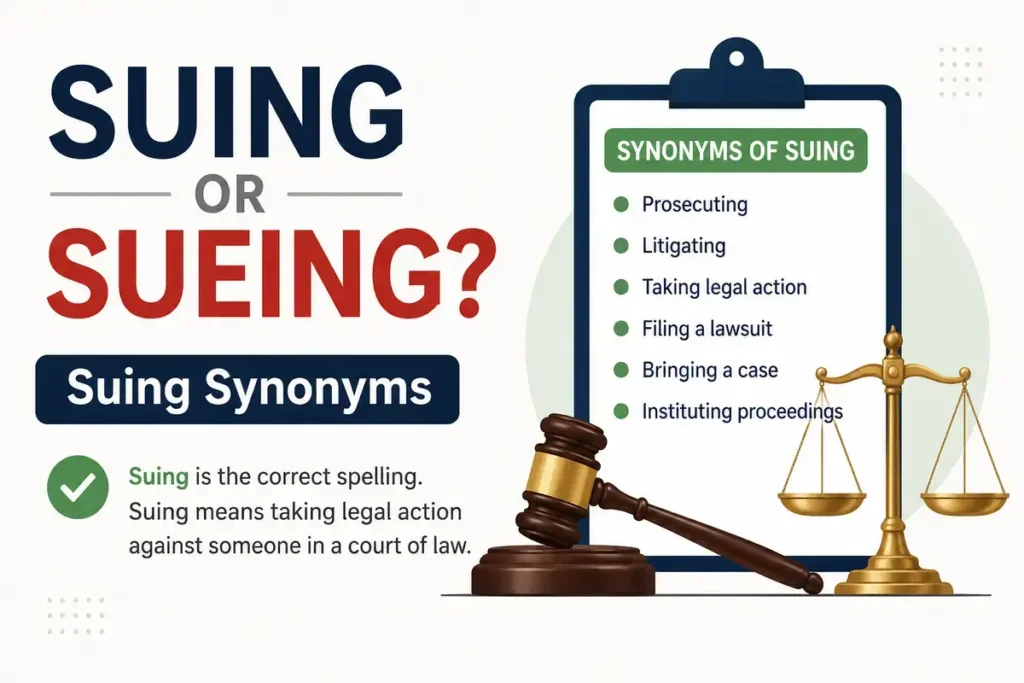
Suing Synonyms
People searching for a suing synonym often want a different way to express the same general idea. The best alternative depends on the context.
Common related expressions include:
- Taking legal action.
- Filing a lawsuit.
- Bringing a legal claim.
- Initiating litigation.
- Filing a civil action.
- Pursuing legal action.
- Bringing proceedings.
- Seeking damages through the courts.
These expressions are related but not perfectly interchangeable. A careful writer chooses the phrase that matches the actual legal situation.
For example, threatening legal action is not the same as filing a lawsuit. Someone can threaten to sue without ever starting a court case.
Business writing also has its own tricky expressions, including whether to write “touch base” as two words, making it worthwhile to learn the correct usage before sending professional emails.
Expert Language Insight
From an editing perspective, the biggest mistake is not the spelling itself. It is using legal language more precisely than the facts support.
In everyday speech, people often say I am suing them when they mean I am thinking about taking legal action. That is perfectly understandable in casual conversation. In professional writing, however, the distinction matters.
An editor should ask what has actually happened.
- Has the person only threatened legal action?
- Has a lawyer been contacted?
- Has a formal claim been filed?
- Is a lawsuit already active?
- Has the case reached a settlement?
The answer determines the most accurate wording.
For example, She is considering suing the company suggests a possible future action. She is suing the company suggests an active legal claim. She sued the company places the action in the past. These small differences can change the meaning significantly.
The spelling itself is much easier. If the base verb is sue and you need the ing form, remove the final silent e.
Sue becomes suing.
That is the rule worth remembering.
Another useful editorial point involves the phrase suing for emotional distress. It is common and understandable, but writers should avoid presenting it as a universal legal category with identical requirements everywhere. Legal terminology can vary by jurisdiction. Good writing keeps the language clear while avoiding claims that go beyond the available facts.
Frequently Asked Questions
Is suing or sueing the correct spelling?
Suing is the correct spelling. Sueing is a common misspelling created by adding ing to sue without removing the final silent e. The correct form is sue + ing = suing. Use this spelling in school assignments, business writing, legal discussions, articles, and everyday communication.
What is the suing meaning?
The word means taking legal action against another person, company, organization, or entity. It is the ing form of the verb sue. For example, The customer is suing the company means the customer is pursuing a legal claim against that company.
What does suing mean in law?
In law, the term generally refers to bringing or pursuing a civil legal claim against another party. The exact procedure varies by jurisdiction and case type. A person may seek damages, an injunction, or another legal remedy. The word itself does not mean the claimant has won.
What is a synonym for suing?
Possible alternatives include taking legal action, filing a lawsuit, bringing a claim, initiating litigation, and pursuing legal action. The best choice depends on the situation. For example, filing a lawsuit is more specific than considering legal action, which describes a possible future step.
How do you pronounce suing?
The word is commonly pronounced /ˈsuːɪŋ/ and has two syllables. It sounds approximately like SOO ing. Some speakers may pronounce the transition between the two syllables smoothly, but the word should not be reduced to a single syllable that sounds like sung.
What does suing someone mean?
Suing someone means bringing a legal claim against that person. The phrase can also refer to taking formal legal action against a company or organization. In casual conversation, people sometimes use it loosely to mean they are considering a lawsuit, but formal writing should distinguish between a possible claim and an active case.
What does suing for emotional distress mean?
The phrase refers to seeking a legal remedy based on alleged serious emotional harm. The exact legal requirements depend on the jurisdiction and the facts. Emotional distress alone does not automatically establish a successful claim. Writers should explain the specific legal context instead of treating the phrase as universally defined.
Is sueing ever an acceptable spelling?
In standard English, sueing is not the correct spelling of the ing form of sue. It may appear in informal online writing because people apply the suffix incorrectly. If you are referring to the legal action, use suing. The final silent e is removed before the suffix ing is added.
Conclusion
The correct spelling is suing. The form sueing is a common spelling mistake, not a standard alternative. The reason is the familiar English spelling rule that removes a final silent e before adding ing. Start with sue, remove the final e, and add ing. The result is suing.
The word means taking legal action against another party. You can use it in phrases such as suing someone, suing for damages, and suing for emotional distress. The exact legal meaning depends on the situation and the applicable law, but the spelling remains the same across American English, British English, Australian English, and Canadian English. Remember the difference between the main forms.
- Sue is the base verb.
- Sues is the third person singular present form.
- Sued is the past form.
- Suing is the present participle and gerund.
- Sueing is the misspelling to avoid.
The simplest rule is also the most useful one. When sue takes ing, the silent e disappears. Write suing, and you will get the spelling right every time.