Have you ever typed sentence or sentance and suddenly stopped because one spelling looked unfamiliar? This is a common spelling question because the two forms look almost identical. The difference is only one vowel, yet that small detail changes the entire word.
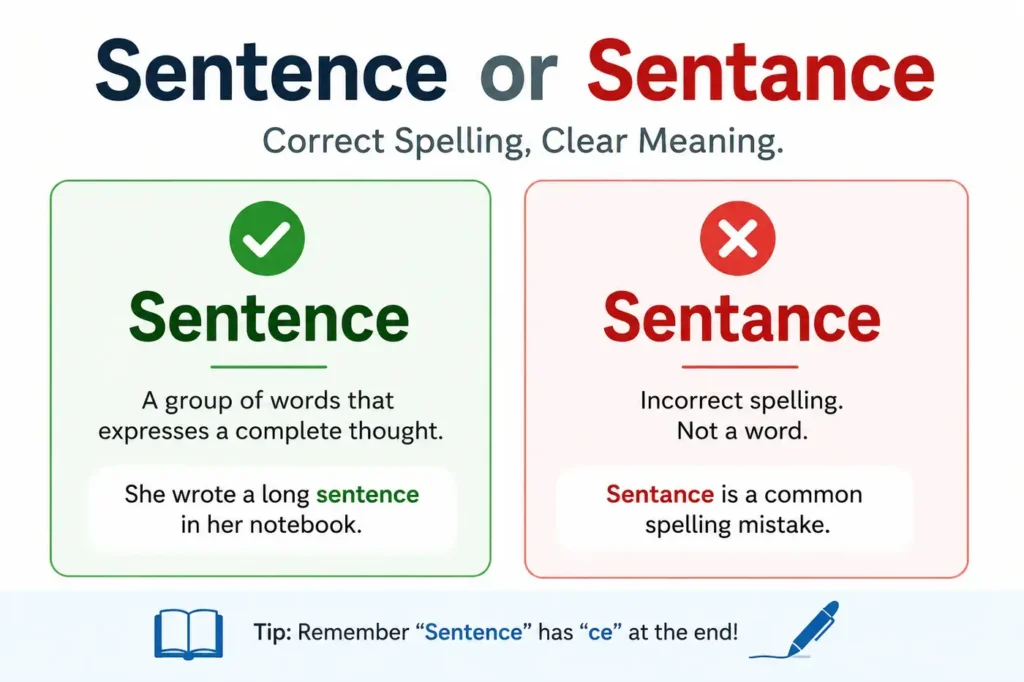
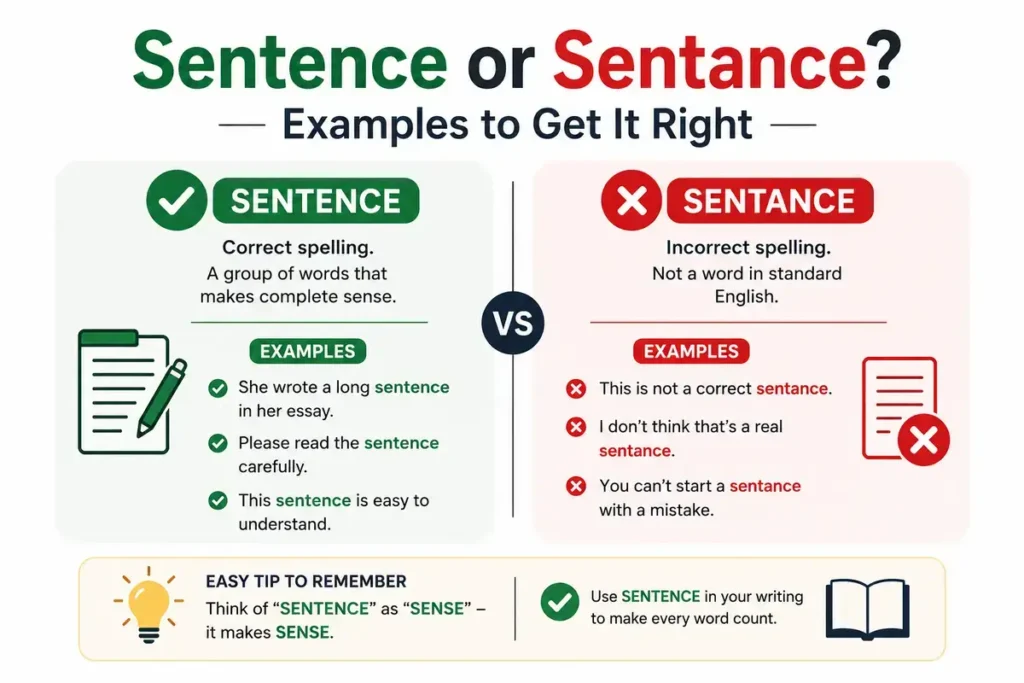
The correct spelling is sentence. Sentance is a misspelling and is not the standard form used in English. The confusion usually comes from pronunciation. In many accents the unstressed vowel in the middle of the word is not strongly pronounced, so the spelling can feel uncertain. People may also confuse the word with related terms such as sentence, sentences, sentential, or sentence fragment.
This guide gives you a clear answer and then goes deeper. You will learn the meaning and origin of the word, how to pronounce it, how to use it in grammar, how to spell the plural form, and how to avoid common mistakes. You will also see natural examples and practical explanations that make the correct spelling easier to remember. If you have ever searched for is sentance a word or wondered how to spell sentences, this guide will settle the question.
Quick Definition
Sentence is the correct spelling. It is a group of words that expresses a complete thought, such as The dog is sleeping. The spelling sentance is incorrect in standard English. The word can also refer to a judgment given by a court, as in The judge announced the sentence.
If you’re interested in other commonly confused spellings, understanding the correct spelling of laser is another useful example of how English favors standard forms over popular misspellings.
Quick Answer
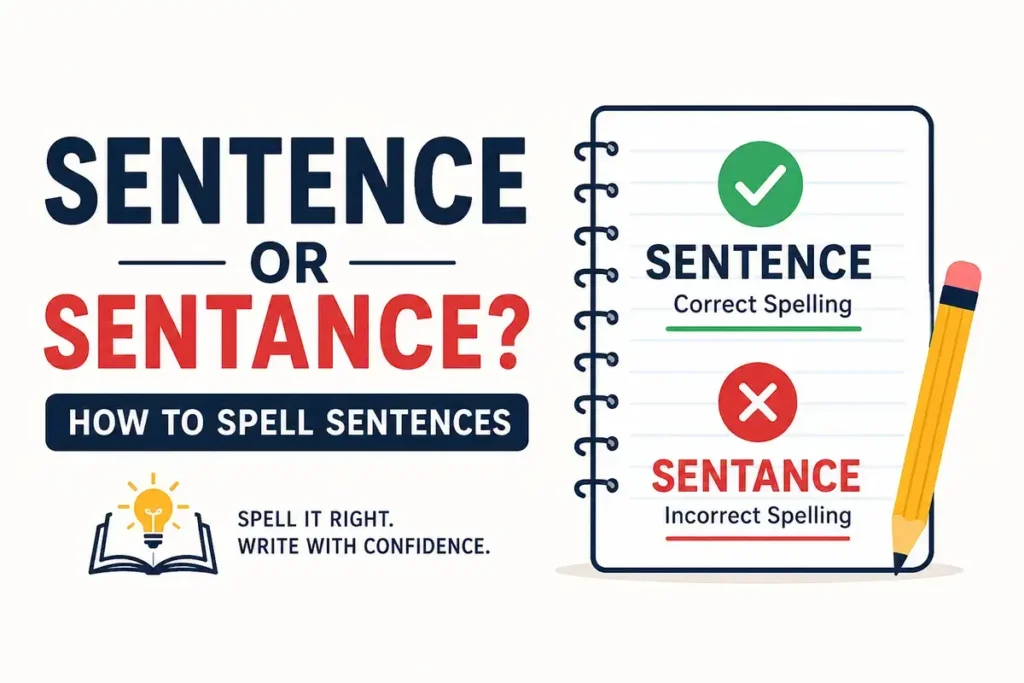
The correct spelling is sentence with an e in the middle. Sentence is a standard English word used in grammar and law. Sentance is a spelling mistake and should not be used in schoolwork, professional writing, academic work, or published content.
Remember this simple pattern:
sent + ence = sentence
If you are writing about a group of words that expresses a complete thought, use sentence.
Comparison Table
| Feature | Sentence | Sentance |
|---|---|---|
| Correct spelling | Yes | No |
| Part of speech | Noun and verb | Not a standard English word |
| Meaning | A group of words expressing a complete thought or a legal judgment | Usually an attempted spelling of sentence |
| Origin | Latin through Old French and Middle English | No independent standard word origin |
| Formality | Standard in all forms of English | Nonstandard |
| Common contexts | Grammar, writing, law, education, communication | Spelling mistakes and informal internet searches |
| Usage frequency | Extremely common | Very uncommon in edited writing |
| Example | Write a complete sentence. | Incorrect spelling |
| Plural form | Sentences | Not applicable |
The table gives you the essential answer, but the difference becomes easier to remember once you understand what the correct word means and how English speakers use it.
Meaning Of Sentence
The word sentence has two major meanings in modern English. One belongs to grammar and writing. The other belongs to law. Both meanings are standard, and both use the same spelling.
Sentence In Grammar
In grammar, a sentence is a group of words arranged to express a complete thought. A basic sentence usually contains a subject and a verb, although the exact structure can become much more complex.
For example:
- The baby smiled.
- Maria finished her homework.
- The old train arrived late.
- We are planning a trip.
- The birds flew across the sky.
Each example communicates a complete idea. The length can vary, but the key point is completeness.
A sentence can be short and simple or long and detailed. For example, Rain fell is a complete sentence. So is After the storm passed, the children went outside to play in the garden. The second example contains more information, but both examples perform the same basic grammatical job.
Sentence In Law
The word also has a legal meaning. A court can give a person a sentence after a conviction. In this context, the word refers to the punishment or legal decision imposed by a judge.
For example:
The judge handed down a five year sentence.
This meaning developed from the broader idea of a formal decision or judgment. The grammatical meaning and the legal meaning are related historically, although modern speakers usually understand them as separate meanings.
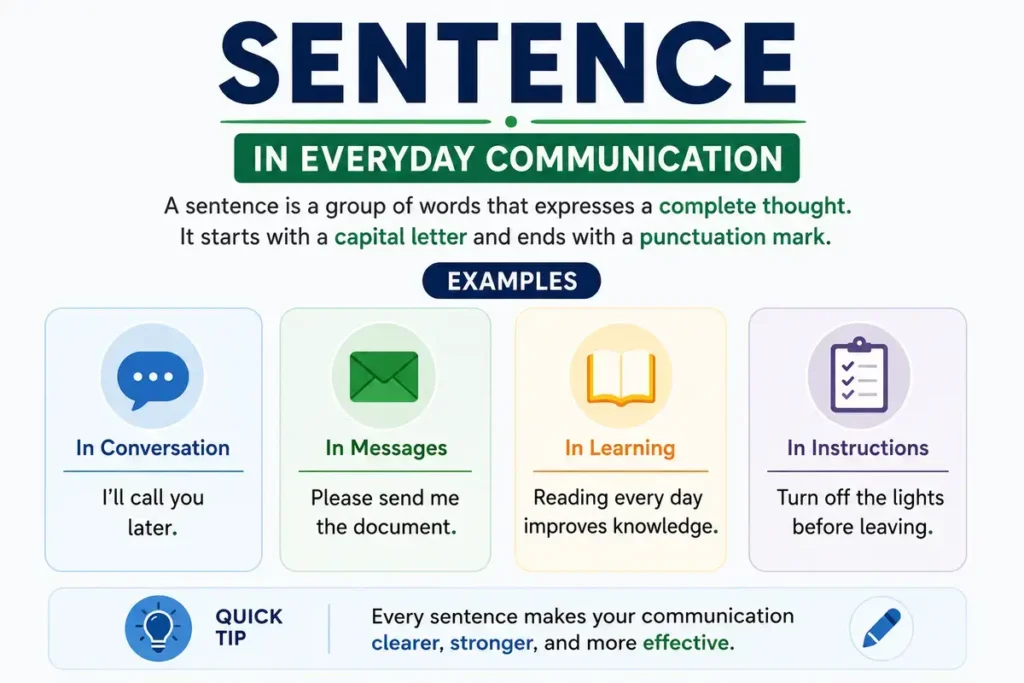
Sentence In Everyday Communication
People also use the word when discussing writing quality.
You might hear someone say:
- This sentence is too long.
- That sentence sounds awkward.
- The first sentence needs a stronger verb.
- Please rewrite the final sentence.
- This sentence explains the main idea clearly.
This is why the word appears so frequently in school, work, publishing, editing, and everyday communication.
Sentence Or Sentance Key Differences
The main difference is simple. Sentence is the correct English spelling. Sentance is not a standard alternative spelling.
The two forms are not different words with different meanings. Instead, one is the accepted word and the other is a spelling error.
Several factors cause the confusion.
- The words look almost identical.
- The middle vowel is not strongly stressed in normal speech.
- English spelling does not always match pronunciation perfectly.
- Writers may remember the sound but not the exact spelling.
- Online searches can make a misspelling appear more familiar than it really is.
The difference is therefore a spelling issue rather than a grammar difference. You do not need to choose between two accepted forms. You simply need to use sentence.
Which One Is Correct
Sentence is correct.
Sentance is incorrect in standard English.
Use sentence in every ordinary writing situation, including:
- School assignments.
- Grammar lessons.
- Emails.
- Articles.
- Academic writing.
- Business communication.
- Books.
- Legal writing.
The only reason you might see sentance is because someone has made a spelling mistake or is searching for the correct form. It is not a regional spelling like color and colour. Also, it is not an accepted variation like gray and grey. It is simply a misspelling of sentence.
This distinction matters because English contains many pairs that look similar but follow different rules. A good editor does not rely only on how a word sounds. The spelling, meaning, grammatical function, and context all matter.
Pronunciation Guide
The correct word sentence has two syllables.
IPA Pronunciation
Sentence is commonly pronounced:
/ˈsɛntəns/
In some accents, the final vowel may sound slightly different, but the general pronunciation remains the same.
Syllable Breakdown
sen tence
The first syllable receives the main stress.
You can think of the pronunciation as:
SEN tens
The second syllable is weaker and shorter.
Why The Spelling Causes Confusion
The middle sound is an unstressed vowel. In natural speech, unstressed vowels often become less distinct. This means the pronunciation does not clearly tell you whether the middle spelling should contain e or a.
That is one reason people write sentance. They hear a weak vowel and choose a spelling that seems to match the sound. English spelling makes this especially tricky because the same sound can sometimes be represented by different letters in different words.
The best solution is to remember the written form rather than trying to spell the word entirely from pronunciation.
Is Sentance A Word
Sentance is not the standard spelling of an English word. When people write it, they almost always mean sentence.
You may still find the spelling online because people make spelling mistakes, search for words they are unsure about, or use informal writing that has not been edited. The presence of a spelling on the internet does not automatically make it a correct standard word.
This is an important lesson for language learners. Search engines index mistakes as well as correct writing. A misspelled word can appear thousands of times online, especially when many people make the same error. That does not give the spelling standard status.
If you are asking is sentance a word, the practical answer is no in standard English. Write sentence instead.
How To Remember The Correct Spelling
The easiest way to remember the spelling is to connect it with the word’s structure.
Think of:
sent + ence = sentence
The word begins with sent and ends with ence.
Another useful trick is to connect it with related words:
- Sentence.
- Sentences.
- Sentential.
- Sententially.
The spelling remains connected to the base form sentence.
You can also remember a simple rule:
A sentence ends with ence, not ance.
This is not a universal spelling rule for every English word, so do not apply it blindly to unrelated words. It is simply a useful memory aid for this particular spelling.
If you are teaching a child or English learner, visual repetition works well. Write the correct word several times in meaningful examples instead of copying it repeatedly without context.
For example:
- Write one complete sentence.
- This sentence has a clear subject.
- The final sentence summarizes the paragraph.
Seeing the word in real language helps the spelling stay in memory much better than memorizing isolated letters.
Why People Confuse The Spelling
The confusion is not random. English spelling often preserves historical forms that are not perfectly obvious from modern pronunciation. This means a word can sound clear while its written form remains uncertain.
The word sentence is especially easy to misspell because the second syllable is weak. A learner may hear something close to sentens and then try to reconstruct the spelling from sound. That can lead to sentance.
There is also a visual reason. The endings ance and ence appear in many English words, including:
- Distance.
- Importance.
- Performance.
- Difference.
- Existence.
- Evidence.
Because both endings are common, writers may choose the wrong one when they are unsure.
The best approach is to treat sentence as a word that needs to be remembered as a whole. Once you have seen and used it enough times, the correct spelling begins to look natural and the misspelling starts to look obviously wrong.
Sentence In English
A sentence is one of the basic building blocks of English communication. It allows a writer or speaker to express an idea, ask a question, give a command, or show emotion.
The four traditional sentence types are:
- Declarative sentences make statements.
- Interrogative sentences ask questions.
- Imperative sentences give commands or instructions.
- Exclamatory sentences express strong emotion.
Here are simple examples:
- The store opens at nine. This is declarative.
- What time does the store open? This is interrogative.
- Please close the door. This is imperative.
- What a beautiful view! This is exclamatory.
Understanding these categories helps you see why the word matters so much in grammar. A sentence is not simply a group of words placed together. It needs a structure that allows the reader or listener to understand the intended idea.
Sentence Or Sentance Grammar
The correct word sentence is a noun in most grammar discussions.
For example:
This sentence has a clear subject and predicate.
It can also appear in compound nouns and related grammatical terms.
Examples include:
- Sentence structure.
- Sentence length.
- Sentence fragment.
- Sentence variety.
- Sentence pattern.
- Sentence construction.
- Sentence-level editing.
The word also has a legal noun use, as in:
The court announced the sentence.
There is also a verb form connected with the legal meaning. To sentence someone means to impose a legal punishment.
For example:
The court sentenced the defendant to five years in prison.
The spelling remains connected to the same word family.
Sentence Vs Sentance Examples
The best way to understand the correct spelling is to see it in natural writing. The examples below show how sentence works in grammar, everyday communication, education, law, and professional writing.
10 Examples With Sentence
- Please write one complete sentence about your favorite book.
- The first sentence immediately caught the reader’s attention.
- I deleted the final sentence because it repeated the same idea.
- The teacher asked the students to identify the subject in each sentence.
- This sentence needs a comma before the final clause.
- The paragraph contains three short sentences and one longer sentence.
- She practiced writing a sentence in English every day.
- The editor suggested changing the opening sentence.
- The judge announced the sentence after hearing both sides of the case.
- A strong sentence can express a clear idea without unnecessary words.
These examples show the two main meanings of the word. Most examples relate to grammar and writing, while the legal example uses the word in a different but equally standard sense.
Common Mistakes With The Spelling
The most common mistake is writing sentance instead of sentence. This usually happens because the middle vowel is weak in pronunciation.
A writer may know exactly what the word means but still choose the wrong vowel while typing. That is a spelling problem, not a vocabulary problem.
Here are the most common errors.
Using Sentance As An Alternative Spelling
Some writers assume that sentance is an accepted variation. It is not. English does not have two standard spellings for this word.
The correct form is:
Sentence
The incorrect form is:
Sentance
Confusing Sound With Spelling
English pronunciation can mislead writers. The unstressed vowel in the second syllable is not strongly pronounced, so the sound does not clearly tell you which letter belongs there.
This is why spelling from sound alone can cause mistakes. The same problem appears in many English words where pronunciation and spelling do not match perfectly.
Forgetting The Plural Form
The plural is sentences.
For example:
The article contains five sentences.
The plural does not become sentances. The base spelling remains sentence, followed by s.
Confusing A Sentence With A Fragment
A sentence must express a complete thought. A fragment may look like a sentence but lack an essential grammatical element.
For example:
Because the rain was heavy.
This is a fragment because the reader expects to learn what happened because of the rain.
A complete version would be:
Because the rain was heavy, the game was canceled.
This distinction matters because spelling the word correctly is only one part of writing clearly. Good writing also requires complete grammatical structures.
Sentance Vs Sentence Fragment
The phrase sentance vs sentence fragment combines two different issues.
First, sentance is a spelling mistake.
Second, a sentence fragment is a grammar problem.
These should not be confused.
A sentence fragment is an incomplete group of words that does not express a complete thought. It may lack a subject, a verb, or a complete relationship between ideas.
Compare these examples:
Fragment: After the meeting ended.
Complete sentence: We went home after the meeting ended.
The first example leaves the reader waiting for more information. The second expresses a complete thought.
A fragment can sometimes be used intentionally in creative writing or advertising. For example:
No excuses.
In formal grammar, this may be classified as a fragment, but it works effectively as a short rhetorical statement. Context matters.
Etymology And Word Origin
The history of sentence reaches back through French and Latin.
The word comes from Middle English sentence, which was borrowed through Old French from Latin sententia. The Latin term was connected with a thought, opinion, judgment, or meaning.
The deeper root is associated with the Latin verb sentire, meaning to feel or to perceive.
Over time, the word developed several related meanings. A sentence could represent a thought or opinion. It could also refer to a formal judgment. In modern English, these meanings remain visible in grammar and law.
This history explains why the same word can describe both a grammatical unit and a court’s judgment. Both uses are connected to the broader idea of an expressed thought or formal decision.
The word’s journey through different languages also shows why modern English spelling cannot always be predicted from pronunciation alone. English has absorbed vocabulary from Latin, French, Greek, Old Norse, and many other languages. Historical spelling often remains even after pronunciation changes.
Regional Usage
Unlike spelling differences such as color and colour, the correct spelling of this word does not change across the major varieties of English.
American English
American English uses sentence in schools, publishing, journalism, business, and everyday speech.
Examples include:
- Sentence structure.
- Sentence fragment.
- Sentence length.
- Complete sentence.
British English
British English also uses sentence.
The spelling remains the same in grammar books, newspapers, universities, and legal writing.
Australian English
Australian English follows the same standard spelling.
The word appears in the same grammatical and legal contexts as it does in other major varieties of English.
Canadian English
Canadian English also uses sentence.
Although Canadian spelling sometimes follows a mixture of American and British conventions, this word does not vary between them.
The misspelling sentance is not a regional form. If you see it in any English speaking country, it is generally an error rather than a local spelling preference.
Just as choosing the right word matters here, learning the difference between ballot and bullet can help you avoid confusing two terms that have completely different meanings and contexts.
Grammar Rules For Sentence
Understanding the grammatical role of the word helps you use it correctly in different contexts.
Sentence As A Noun
The most common use is as a noun.
Examples:
- The sentence is too long.
- The sentence contains a dependent clause.
- I rewrote the sentence.
The plural form is sentences.
Example:
The paragraph contains four sentences.
Sentence As A Verb
The word can also function as a verb in legal contexts.
Example:
The judge sentenced him to three years in prison.
The verb forms include:
- Sentence.
- Sentences.
- Sentenced.
- Sentencing.
The legal verb and the grammatical noun share the same word family.
Common Grammatical Structures
You will often see the word in these structures:
- A sentence + verb. The sentence explains the idea.
- Adjective + sentence. The complex sentence needs editing.
- Sentence + noun. Sentence structure affects readability.
- Verb + sentence. Rewrite the sentence.
- Number + sentences. The paragraph has six sentences.
These patterns appear constantly in writing instruction and professional editing.
Sentence Types In English
A strong understanding of sentence types helps readers write with more variety and control.
Simple Sentences
A simple sentence contains one independent clause.
Example:
The child laughed.
It can still contain more than one subject or verb.
Example:
The child laughed and ran outside.
Compound Sentences
A compound sentence joins two independent clauses.
Example:
The rain stopped, and the children went outside.
The two ideas could stand alone, but they are connected to create a smoother flow.
Complex Sentences
A complex sentence contains an independent clause and at least one dependent clause.
Example:
Although the rain stopped, the field remained wet.
This structure helps writers show relationships such as time, cause, contrast, and condition.
Compound Complex Sentences
A compound complex sentence combines multiple independent clauses with at least one dependent clause.
Example:
Although the rain stopped, the field remained wet, and the players waited another hour.
Longer structures need careful punctuation and organization.
Real Life Usage Examples
The word appears in almost every area of written communication.
Daily Conversation
People often discuss sentences when talking about writing or communication.
Examples include:
That sentence sounds confusing.
Can you say that in a shorter sentence?
I do not understand the last sentence.
Academic Writing
Students and researchers regularly discuss sentence structure, clarity, grammar, and organization.
A teacher may ask a student to vary sentence length or combine short sentences to improve the flow of a paragraph.
Academic editors also examine sentence construction closely because unclear writing can make complex ideas difficult to understand.
Professional Communication
In business writing, sentence clarity matters. A long or poorly structured sentence can create confusion in an email, report, contract, or instruction manual.
Professional editors often look for:
- Unnecessary words.
- Confusing sentence structure.
- Missing punctuation.
- Repeated ideas.
- Unclear pronoun references.
The goal is not to make every sentence short. The goal is to make every sentence easy to understand.
Literature
Authors use sentence length and structure deliberately. A short sentence can create tension or emphasis. A long sentence can slow the pace and allow several ideas to unfold.
That is why sentence variety is an important part of style. Good writing does not make every sentence sound identical.
Media
News articles, advertisements, online content, and social media all rely on clear sentence construction.
Short sentences often work well for headlines and quick information. Longer sentences can provide context and explanation.
The best choice depends on the audience and purpose.
How To Spell Sentences
The plural form is sentences. The spelling follows this pattern:
sentence + s = sentences
The final e remains before the plural ending.
Correct examples include:
- The paragraph has three sentences.
- These sentences explain the main idea.
- I edited the sentences for clarity.
A common mistake is to change the ending to sentances. That form is incorrect. A useful way to remember the plural is to learn the singular form first. Once you know sentence, simply add s.
Sentence → sentences.
The pronunciation changes slightly in the plural because the final sound becomes voiced. However, the spelling remains straightforward.
Related Words And Confused Terms
The word sentence belongs to a larger group of grammar and writing terms. Understanding these related concepts can help you avoid mistakes and improve your writing.
Sentence And Clause
A clause is a group of words that contains a subject and a verb. Some clauses can stand alone as complete sentences, while others cannot.
For example:
The students finished their work.
This is an independent clause and a complete sentence.
Because the students finished their work.
This is a dependent clause and a fragment when it appears alone. The difference matters because not every group of words with a subject and verb is a complete sentence.
Sentence And Phrase
A phrase is a group of words that works together but does not contain a complete subject and verb combination that expresses a complete thought.
Examples include:
- In the morning.
- Walking through the park.
- The tall building.
- After the long journey.
These phrases can become part of a complete sentence.
We walked through the park in the morning.
Sentence And Paragraph
A paragraph usually contains several connected sentences that develop one main idea. A single sentence can sometimes stand alone as a paragraph, especially in advertisements, journalism, or creative writing, but most informative paragraphs contain multiple sentences.
Strong paragraphs usually have a clear relationship between their sentences. Each sentence should either develop the main point, provide evidence, explain an idea, or move the reader forward.
Sentence And Statement
A statement is an expression of an idea or claim. A sentence can be a statement, but not every sentence makes a statement.
For example:
The store closes at six.
This is both a sentence and a statement.
Does the store close at six?
This is a sentence but a question rather than a statement.
Sentence And Fragment
A sentence fragment is an incomplete grammatical unit presented as though it were a complete sentence.
Example:
When the meeting ended.
The reader expects more information.
Complete version:
When the meeting ended, everyone returned to work.
In formal writing, fragments should generally be corrected. In creative writing, advertising, and casual communication, writers sometimes use them deliberately for emphasis.
Sentence And Run On Sentence
A run on sentence occurs when two or more independent clauses are joined incorrectly.
Example:
The movie ended we went home.
The ideas need proper punctuation or a conjunction.
Correct versions include:
- The movie ended, and we went home.
- The movie ended. We went home.
- The movie ended; we went home.
Learning the difference between fragments and run on sentences helps writers identify two of the most common sentence structure problems.
If you often write emails or workplace messages, it’s also worth knowing whether “touch base” should be one or two words to keep your writing clear and professional.
Expert Language Insight
From an editor’s perspective, the most important lesson is that a good sentence is not defined by length alone. Many people are taught to avoid long sentences, but that advice is too simple. A short sentence can be unclear, and a long sentence can be elegant and easy to follow.
The real question is whether the structure serves the idea.
For example:
The meeting ended.
This is short and clear.
But a longer sentence can also work well:
After the meeting ended, the team stayed behind for another twenty minutes to discuss the budget changes and agree on the next steps.
The second sentence contains more information, yet its structure remains easy to follow.
Experienced editors look at several factors:
- Clarity. Can the reader understand the meaning on the first reading?
- Structure. Do the subject and verb work together clearly?
- Punctuation. Does the punctuation accurately show the relationship between ideas?
- Rhythm. Does the writing sound natural when read aloud?
- Purpose. Does the sentence do useful work?
- Audience. Is the language appropriate for the intended reader?
One of the most common editing mistakes is cutting every sentence into short pieces. That can make writing feel choppy and mechanical. Strong writing usually combines short, medium, and long sentences.
Another useful editorial principle is to revise at the sentence level after revising the larger structure. First make sure the paragraph has a clear idea. Then make sure each sentence supports that idea. Finally, examine individual words.
This order saves time. There is little value in perfecting a sentence that later needs to be removed because it does not belong in the paragraph.
Frequently Asked Questions
Is sentence or sentance the correct spelling?
Sentence is the correct spelling. Sentance is a common misspelling caused mainly by the weak vowel sound in the second syllable. The standard word is used in grammar, writing, education, law, and everyday communication. If you are writing about a group of words that expresses a complete thought, use sentence.
Is sentance a word?
No. Sentance is not the standard spelling of an English word. People may use it when they accidentally misspell sentence, and the form can appear in online searches or unedited writing. In formal, academic, professional, and published content, use sentence.
How do you spell sentences correctly?
The singular form is sentence. To make it plural, add s: sentences. The final e remains in the plural form. A simple way to remember it is sentence plus s equals sentences. The spelling sentances is incorrect.
What is the difference between a sentence and a sentence fragment?
A complete sentence expresses a complete thought and normally contains an independent clause. A sentence fragment is an incomplete group of words that cannot stand alone as a complete idea. For example, Because the rain continued is a fragment, while Because the rain continued, the game was canceled is complete.
How do you pronounce sentence?
The word is commonly pronounced /ˈsɛntəns/ and has two syllables. The first syllable receives the main stress. It sounds approximately like SEN tens. The weak vowel in the second syllable can make the spelling difficult to remember, but the correct written form is sentence.
What are the four types of sentences in English?
The four traditional types are declarative, interrogative, imperative, and exclamatory. Declarative sentences make statements. Interrogative sentences ask questions. Imperative sentences give commands or instructions. Exclamatory sentences express strong emotion. These categories describe the purpose of a sentence rather than simply its length.
Why do people spell sentence as sentance?
The most common reason is pronunciation. The second syllable is unstressed, so its vowel sound is weak and may not clearly suggest the letter e. Writers may also confuse the word with other words ending in ance. Repeated exposure to the correct spelling helps make sentence easier to remember.
What is a sentence in English grammar?
In English grammar, a sentence is a group of words arranged to express a complete thought. It usually contains an independent clause with a subject and a predicate. Sentences can be simple, compound, complex, or compound complex, depending on the number and relationship of their clauses.
Conclusion
The correct spelling is sentence. The form sentance is a misspelling, not a regional variation or an alternative accepted form.
The word has several important uses. In grammar, it describes a group of words that expresses a complete thought. In law, it can refer to a punishment or formal judgment imposed by a court. It also appears in countless terms related to writing, including sentence structure, sentence fragment, sentence length, sentence pattern, and sentence construction.
The easiest way to remember the spelling is to focus on the ending:
sentence
not:
sentance
The same spelling continues in the plural:
sentence → sentences
If you are learning how to spell sentences or improving your sentence grammar, focus on the complete word rather than trying to spell it only from pronunciation. English spelling often contains details that speech does not make obvious.
A final practical tip is worth remembering. Good writing depends on more than correct spelling. A strong sentence should communicate a clear idea, fit naturally with the surrounding paragraph, and serve the reader. Once you can spell the word correctly and understand how sentences work, you have a stronger foundation for writing clear and confident English.