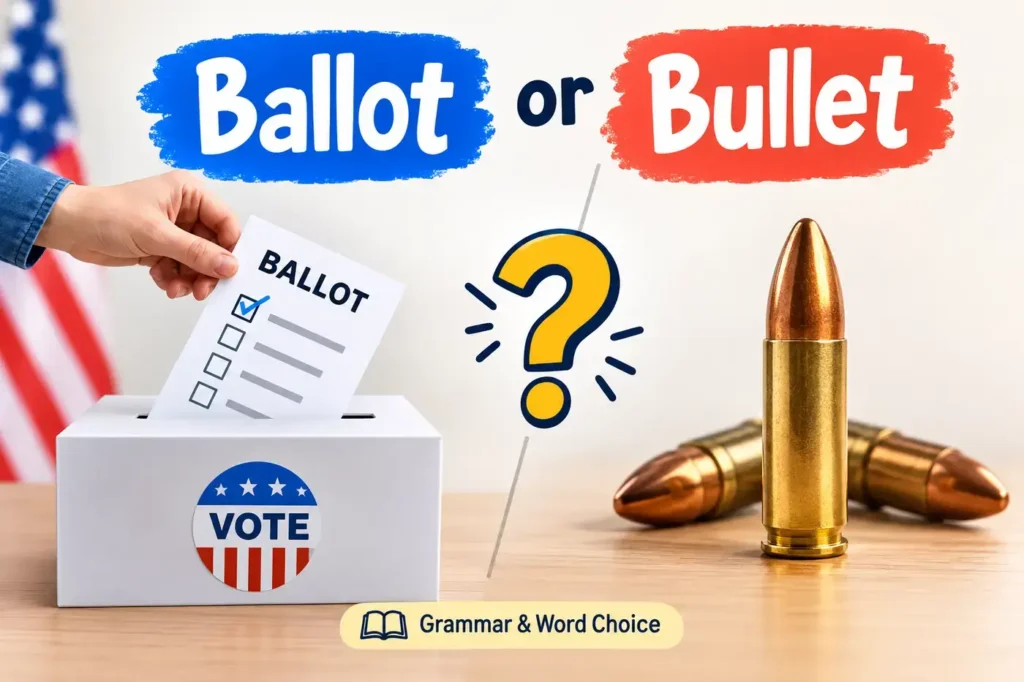
If you searched for ballot or bullet, you are probably wondering if these words are related or if one is the correct choice in a particular sentence. They sound somewhat similar, but their meanings are completely different. Using the wrong one can quickly change the meaning of your writing and confuse your readers.
The direct answer is simple. A ballot is a paper, digital form, or method used to cast a vote in an election or decision making process. A bullet is a projectile fired from a firearm. The two words are not alternative spellings, regional variations, or interchangeable terms. Each belongs to a different context and serves a different purpose.
The confusion usually comes from pronunciation, typing mistakes, or reading the words too quickly. Since both begin with the same three letters and share a similar rhythm, they can easily be mixed up by English learners and even native speakers.
This guide explains the meaning of each word, their origins, pronunciation, grammar, and real world usage. You will also learn the key differences, common mistakes, memory tips, and practical examples so you can choose the right word with confidence every time.
Quick Definition
A ballot is a voting paper or electronic voting method used to record a person’s choice in an election or poll. A bullet is a metal projectile fired from a firearm. Although the words sound somewhat alike, they have completely different meanings, uses, and histories.
Quick Answer
If you only need a quick explanation, remember these points.
- Ballot relates to voting, elections, and decision making.
- Bullet refers to ammunition used in firearms.
- The words are not interchangeable.
- Use ballot in political or voting contexts.
- Use bullet when discussing firearms, ballistics, history, or related topics.
Just as people confuse ballot and bullet, many writers also struggle with common spelling mix-ups like finaly versus finally, making careful proofreading essential.
Comparison Table
| Feature | Ballot | Bullet |
|---|---|---|
| Part of speech | Noun | Noun |
| Correct spelling | Yes | Yes |
| Meaning | A vote or voting paper | A projectile fired from a firearm |
| Origin | Italian and French roots related to voting | French word referring to a small ball |
| Formality | Standard English | Standard English |
| Common contexts | Elections democracy polls organizations | Firearms hunting military law enforcement history |
| Usage frequency | Common | Common |
| Example | She submitted her ballot before the polls closed. | The bullet struck the target. |
Meaning Of Both Terms
Although these words may sound similar at first, they describe completely different things. Understanding each meaning separately is the easiest way to avoid confusion.
What Does Ballot Mean
A ballot is a method of recording a person’s vote during an election, referendum, contest, or organizational decision.
Traditionally, a ballot was a paper listing candidates or choices. Today, ballots may also be electronic, mailed, or completed online in places where electronic voting is permitted.
You will commonly see this word in contexts such as:
- National elections.
- Local elections.
- School elections.
- Company voting.
- Labor union elections.
- Community polls.
- Government referendums.
Examples include:
- Ballot box.
- Ballot paper.
- Secret ballot.
- Mail in ballot.
- Ballot measure.
The word often symbolizes democracy, participation, and the right to vote.
What Does Bullet Mean
A bullet is a metal projectile designed to be fired from a firearm. It travels at high speed after being propelled from a cartridge by expanding gases.
The word appears in many fields beyond firearms, including history, law enforcement, military studies, forensic science, and engineering.
Common contexts include:
- Firearm safety.
- Hunting.
- Military history.
- Criminal investigations.
- Ballistics.
- Shooting sports.
- Firearms training.
The term can also appear figuratively in expressions such as bite the bullet, which means facing a difficult situation with courage.
It is also important not to confuse this meaning with bullet points, which are small symbols used to organize information in writing. Although they share the same word, their meanings are different.
Key Differences
The differences between these two words go far beyond spelling. They belong to separate subjects and are almost never used in the same context.
Here are the most important distinctions.
| Ballot | Bullet |
|---|---|
| Used for voting | Used in firearms |
| Associated with democracy | Associated with ammunition |
| Found in elections and polls | Found in weapons and ballistics |
| Represents a choice | Represents a projectile |
| Connected with civic participation | Connected with firearms and related fields |
You can also compare them this way.
- One helps people express their opinion.
- The other is a physical object fired from a gun.
- One appears in election news.
- The other appears in discussions about firearms, history, law enforcement, or sports shooting.
Even though the words sound somewhat alike, their meanings never overlap in standard English.
When Should You Use Each Word
Instead of asking which word is correct, ask which situation you are describing.
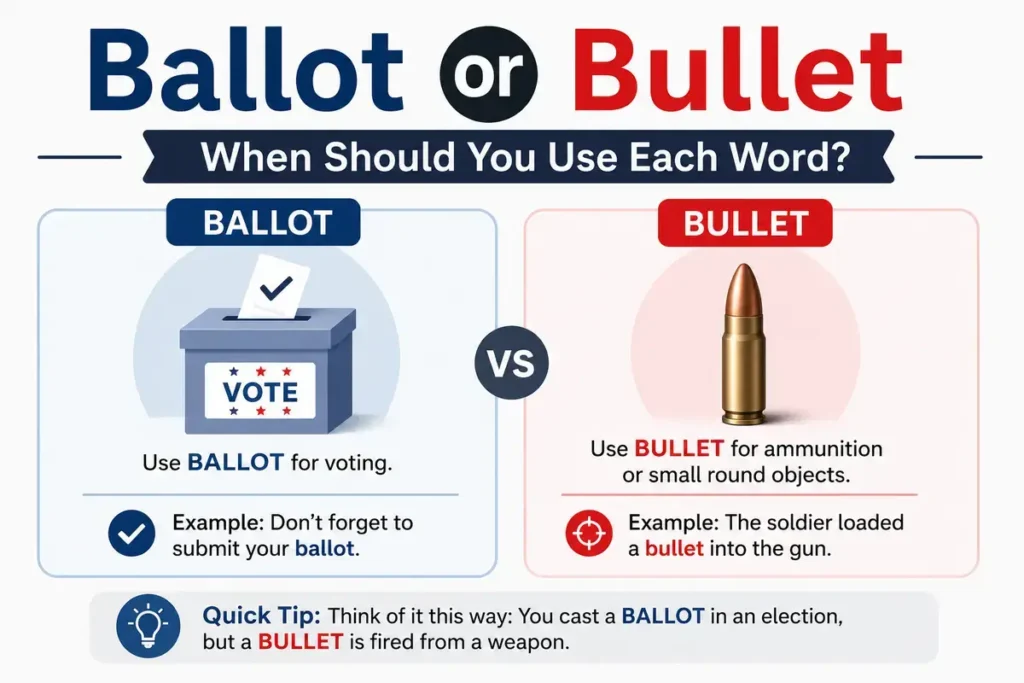
Choose ballot when writing about:
- Elections.
- Voting.
- Polls.
- Referendums.
- Democratic processes.
- Organizational elections.
Choose bullet when writing about:
- Firearms.
- Hunting.
- Military history.
- Ballistics.
- Crime investigations.
- Safety training.
Making the right choice depends entirely on the topic. Neither word replaces the other because they describe different objects and ideas.
Pronunciation Guide
Although these words share similar sounds at the beginning, they are pronounced differently enough that careful listening makes the distinction clear.
IPA Pronunciation
Ballot
/ˈbæl.ət/
Bullet
/ˈbʊl.ɪt/
Syllable Breakdown
Ballot
Bal ut
Bullet
Bul it
Notice that the vowel sounds are different even though both words contain two syllables.
Common Pronunciation Mistakes
Learners sometimes confuse these words because they begin with the letters b a l or b u l and have a similar rhythm.
Here are the most common mistakes.
- Pronouncing ballot like bullet.
- Pronouncing bullet with the vowel sound from ballot.
- Reading too quickly and assuming both words are related.
Listening to native speakers and reading the words in context helps eliminate this confusion.
How To Remember The Difference
A simple memory trick can help you choose the correct word every time.
Think about the first vowel in each word.
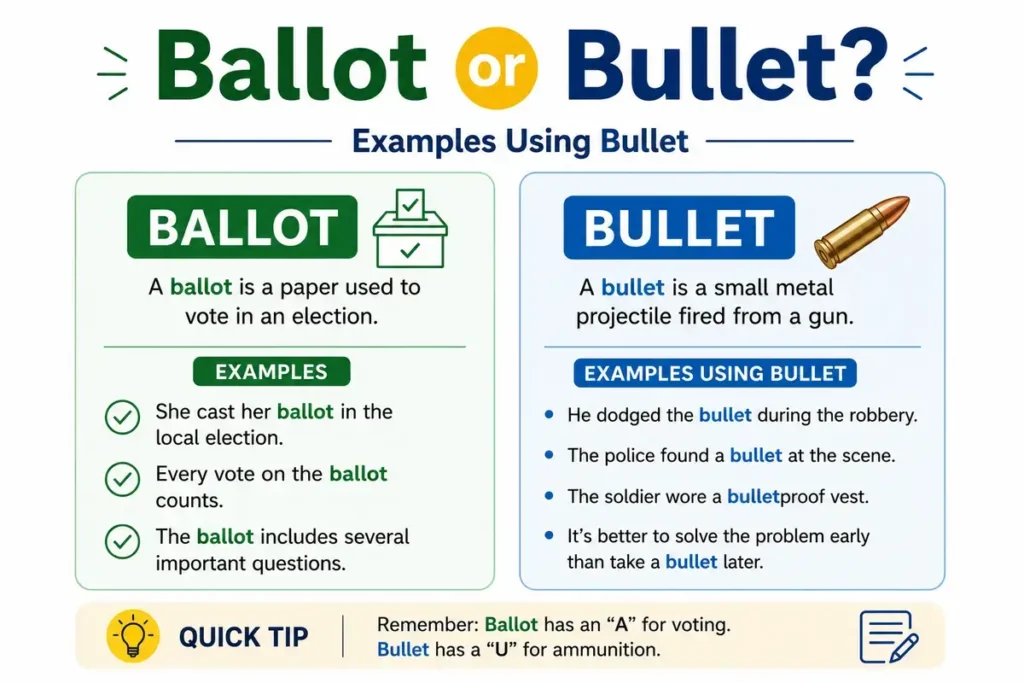
- Ballot contains A, which can remind you of election, answer, or America, all connected with voting and civic participation.
- Bullet contains U, which you can associate with used in firearms.
Another helpful strategy is to focus on the topic before the spelling.
If the sentence is about voting, elections, or making a choice, ballot is the word you need.
If the sentence discusses firearms, ammunition, history, or ballistics, bullet is the correct choice.
Rather than memorizing spellings alone, connect each word to its real world meaning. That habit makes the distinction much easier to remember and greatly reduces mistakes in everyday writing.
Examples In Sentences
The easiest way to remember the difference is to see each word used naturally. Notice how the context immediately tells you which one belongs in the sentence.
Examples Using Ballot
These examples show the correct use of ballot in voting and decision making.
- Every registered voter received a ballot before election day.
- She carefully marked her ballot and placed it in the ballot box.
- The committee approved the proposal through a secret ballot.
- Thousands of mail in ballots arrived before the deadline.
- Election officials counted each ballot according to state law.
- The school held a student council election using paper ballots.
- Citizens were encouraged to cast their ballot early.
- The referendum appeared on the same ballot as the local election.
- Observers monitored the ballot counting process throughout the night.
- The organization elected its new president by anonymous ballot.
These examples all involve voting, elections, or making an official choice.
Examples Using Bullet
These examples show the correct use of bullet in different contexts.
- The bullet struck the target with great accuracy.
- Police recovered a bullet during the investigation.
- The museum displayed bullets from the Civil War.
- Hunters must follow local laws regarding firearms and ammunition.
- Ballistics experts examined the bullet for evidence.
- The instructor explained how different bullet designs affect performance.
- The detective compared the recovered bullet with test samples.
- The author described the sound of a single bullet in the novel.
- Safety training emphasized responsible firearm handling at all times.
- The expression bite the bullet encourages people to face difficult situations with courage.
Although the final example is an idiom, the word still originates from its historical connection to firearms.
Common Mistakes
Because these words share a similar rhythm, writers occasionally confuse them. Most mistakes happen while typing quickly or relying on sound instead of meaning.
Here are the errors people make most often.
Using The Wrong Word In Context
This is the most common mistake.
Incorrect:
Every citizen should cast a bullet.
Correct:
Every citizen should cast a ballot.
Likewise:
Incorrect:
Investigators recovered the ballot from the crime scene.
Correct:
Investigators recovered the bullet from the crime scene.
Always think about the subject of the sentence before choosing the word.
Assuming They Are Alternative Spellings
Some people believe the words are spelling variations because they look somewhat alike.
They are not.
Each is a separate English word with its own meaning, history, and usage.
Confusing Ballot With Bullet Points
The word bullet has another meaning in writing. A bullet point is the small symbol placed before items in a list.
For example:
- Apples
- Oranges
- Grapes
This meaning has no connection to voting, even though the same word is used.
Mixing Idioms With Literal Meanings
The phrase bite the bullet is an idiom that means accepting something difficult with courage. It has nothing to do with elections or voting.
Similarly, cast a ballot is a fixed expression connected with elections and should never be replaced with bullet.
If you’re interested in commonly confused English terms, understanding the difference between distress and duress can help you choose the right word in legal, emotional, and everyday contexts.
Etymology And Word Origin
Learning where these words came from makes the difference easier to remember.
Ballot
The word ballot entered English through French and Italian.
Its roots trace back to the Italian word ballotta, meaning a small ball. In early voting systems, people sometimes used small balls to record their choices. Over time, the word came to represent the voting process itself rather than the object used.
Today, ballot refers to any official method of recording a vote, regardless of whether it is paper based or electronic.
Bullet
The word bullet also comes from French.
It developed from the French word boulet, meaning a small ball. Early projectiles fired from firearms were often round, which explains the connection.
As firearms evolved, the shape of projectiles changed, but the name remained.
Although both words share historical connections to the idea of a small ball, their meanings separated centuries ago and have never become interchangeable.
Regional Usage
Unlike some English words that change spelling between countries, these two words remain the same across major English speaking regions.
American English
American English uses ballot when discussing elections and voting. Bullet refers to ammunition or appears in expressions such as bite the bullet and bullet point.
British English
British English follows the same conventions.
The meanings, spellings, and pronunciation remain consistent.
Australian English
Australian English also uses both words exactly as American and British English do. Election coverage, legal writing, and newspapers all follow the same usage.
Canadian English
Canadian English maintains the same distinction. You will not find regional spelling differences for either word. Across all four varieties of English, the meanings stay consistent. The context changes the word, not the country.
Grammar Rules
Both words are nouns, but they function in different grammatical patterns.
Ballot As A Noun
The word commonly refers to a vote or the document used for voting.
Examples include:
- Ballot paper.
- Ballot box.
- Ballot measure.
- Ballot initiative.
- Secret ballot.
- Mail in ballot.
Common sentence patterns include:
- Cast a ballot.
- Count the ballots.
- Submit a ballot.
- Mark the ballot.
Bullet As A Noun
The word refers to a projectile or, in writing, a list marker.
Examples include:
- Bullet.
- Bullet point.
- Bullet hole.
- Bullet casing.
- Bullet trajectory.
- Bullet train.
Notice that bullet train has nothing to do with firearms. The name refers to the train’s streamlined shape and speed.
Common sentence patterns include:
- Fire a bullet.
- Recover a bullet.
- Examine the bullet.
- Use bullet points.
Plural Forms
Both words form their plurals regularly.
- Ballot → Ballots.
- Bullet → Bullets.
These plural forms appear frequently in news reports, textbooks, and everyday communication.
Real Life Usage Examples
Both words appear regularly in daily life, but in very different settings.
Elections And Government
News organizations use ballot when reporting on elections, voter turnout, recounts, and referendums.
Examples include:
- Early voting began this week.
- Officials verified every ballot before announcing the results.
- The proposal appeared on the statewide ballot.
Professional Communication
Organizations often use the word ballot when employees or members vote on important decisions.
Examples include:
- Union ballot.
- Board election.
- Shareholder ballot.
Literature And Media
Novelists, journalists, and historians use bullet in stories involving crime, war, law enforcement, hunting, or personal safety.
The idiom bite the bullet also appears regularly in newspapers, books, podcasts, and everyday conversations to describe accepting an unpleasant situation.
Everyday Conversation
Most people encounter these words without thinking about them.
You might hear someone say:
- I mailed my ballot yesterday.
- The presentation looks better with bullet points.
- The museum displayed artifacts from the battlefield.
Each sentence belongs to a completely different topic, making the correct word easy to identify once you understand its meaning.
Related Words And Confused Terms
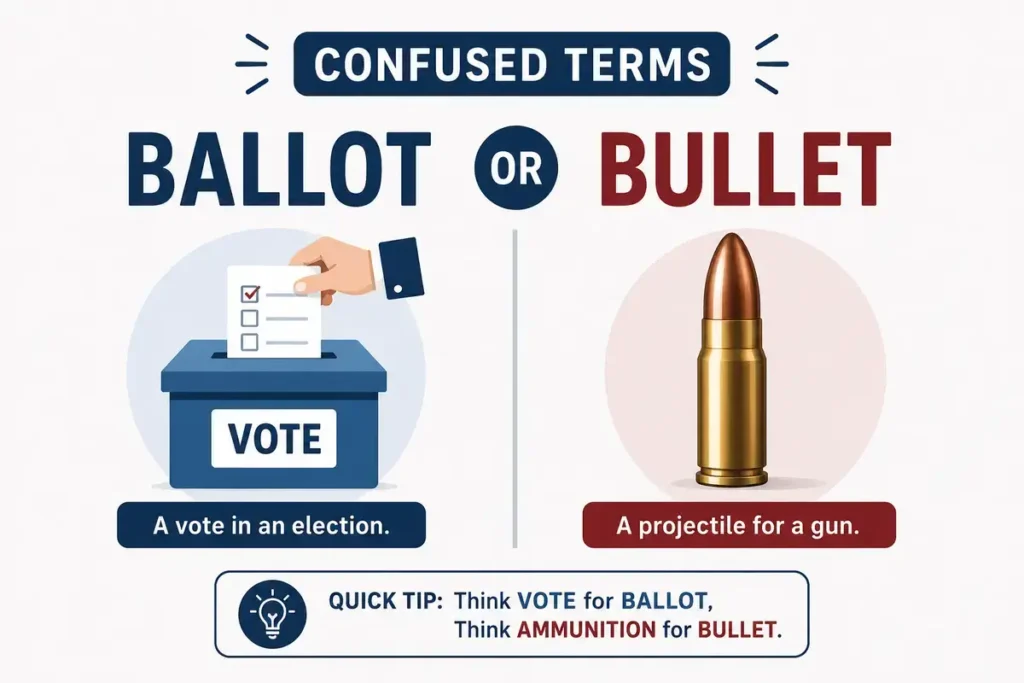
People searching for these words often encounter other terms that look or sound similar. Knowing the difference helps you avoid mistakes and improves your vocabulary.
| Word | Meaning | Common Context |
|---|---|---|
| Ballot | A vote or voting document | Elections and voting |
| Vote | A person’s choice in an election or decision | Government organizations schools |
| Election | A formal process of choosing leaders | Politics and public office |
| Referendum | A public vote on a specific issue | Government and law |
| Poll | A survey or voting process | Research elections media |
| Bullet | A projectile fired from a firearm | Firearms history law enforcement |
| Bullet point | A symbol used to organize a list | Writing presentations documents |
| Ammunition | Material fired from a firearm | Military hunting shooting sports |
| Cartridge | A complete unit containing a bullet and other components | Firearms and ballistics |
People also confuse these words with similar sounding terms such as:
- Ballet.
- Ballad.
- Ballot.
- Bullet.
- Pellet.
Reading the entire sentence usually makes the intended meaning obvious.
Similar to the confusion between ballot and bullet, many people also wonder why “laser” is the correct spelling and whether lazer is ever acceptable in standard English.
Expert Language Insight
From an editor’s perspective, this comparison is less about spelling and more about choosing the right word for the right situation.
Native speakers rarely confuse these words in conversation because the surrounding context makes the meaning clear. Most mistakes appear while typing quickly, relying on spellcheck, or writing without proofreading.
Professional editors use a simple habit to avoid errors. They look at the subject of the sentence before checking individual words.
If the topic involves elections, democracy, voting, or public decisions, ballot is almost certainly the correct choice. If the topic involves firearms, history, law enforcement, or the idiom bite the bullet, then bullet belongs in the sentence.
Another source of confusion is bullet points. In writing, a bullet has nothing to do with firearms. It is simply a small symbol that organizes information into an easy to read list. Because this meaning is so common, readers usually understand it immediately from the surrounding text.
The best habit is to think about meaning first and spelling second. When you connect each word to its real world use, choosing the correct one becomes almost automatic.
Frequently Asked Questions
Is ballot or bullet the correct word?
Both words are correct, but they mean completely different things. Ballot relates to voting and elections, while bullet refers to a projectile used in firearms or a symbol used in lists. The correct choice depends entirely on the context.
Why do people confuse ballot and bullet?
The words have a similar rhythm and begin with the same three letters, so they can be mistaken for one another during fast reading or typing. English learners may also confuse them because they are unfamiliar with both meanings.
Can ballot and bullet be used interchangeably?
No. They describe different objects and belong to different topics. Replacing one with the other changes the meaning of the sentence and creates an obvious language error.
What does ballot mean?
A ballot is an official method of recording a vote. It may be a paper form, a mailed document, or an electronic voting system used in elections, polls, or organizational decisions.
What does bullet mean?
A bullet is a projectile fired from a firearm. The word also refers to the small symbols used to organize information into lists, commonly called bullet points.
Are there regional spelling differences?
No. American English, British English, Australian English, and Canadian English all use the same spellings and meanings. Unlike some English words, these terms do not change from one country to another.
What is the difference between a bullet and a bullet point?
A bullet is normally a projectile used in firearms. A bullet point is a typographic symbol used to organize information in documents, presentations, and web pages. Although they share the same word, their meanings are different.
How can I remember the difference?
Associate ballot with voting and elections. Associate bullet with firearms or list formatting. Thinking about the topic before choosing the word is the easiest way to avoid mistakes.
Conclusion
Although ballot and bullet look somewhat similar, they are entirely different words with different meanings, histories, and uses.
Use ballot when writing about elections, voting, referendums, or any process that records a person’s choice. Use bullet when referring to a firearm projectile, discussing ballistics, or describing bullet points in writing.
The easiest way to avoid confusion is to focus on the context instead of the spelling. Ask yourself what the sentence is describing. If it involves voting, choose ballot. If it involves firearms or list formatting, choose bullet.
Building this habit will improve your writing, reduce common mistakes, and help you communicate more clearly in both academic and everyday situations.