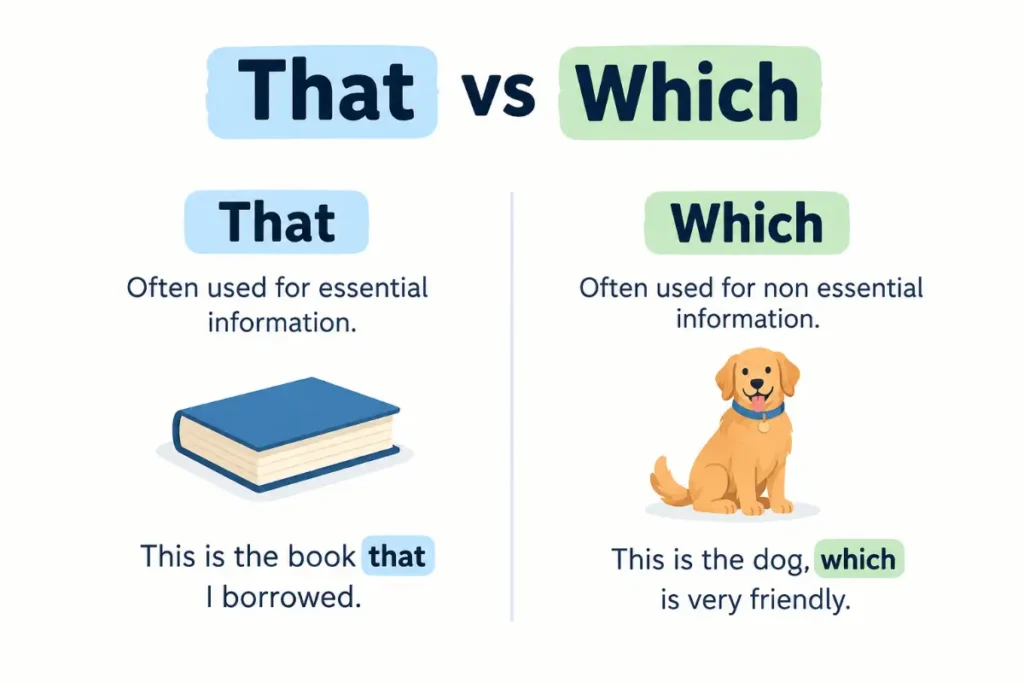
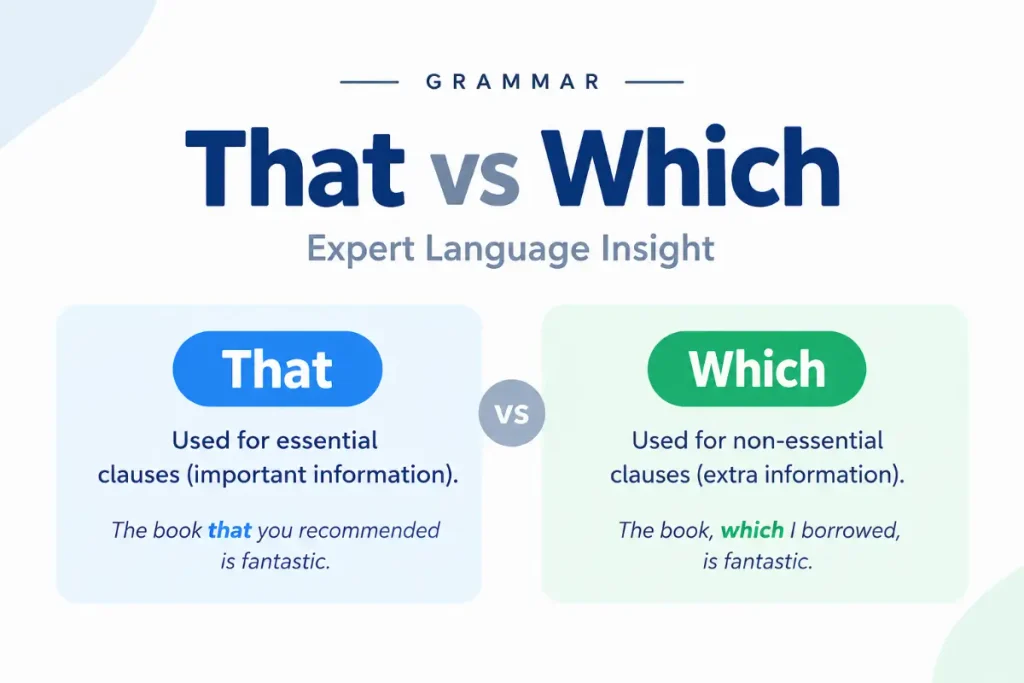
Choosing between that vs which can be confusing because both words can introduce information about a noun. The difference becomes clearer once you look at the kind of information the clause provides and how punctuation affects the sentence. In American English, that is commonly used for restrictive clauses, while which is commonly used for nonrestrictive clauses set off by commas.
For example, The book that I bought yesterday is on the desk identifies a particular book. The information about buying the book helps tell us which book we mean. In contrast, The book, which I bought yesterday, is on the desk treats the buying information as additional detail rather than information needed to identify the book.
This distinction is especially useful in formal writing, academic work, business communication, journalism, and editing. However, real English usage is more nuanced than the simple rule that says that always goes with essential information and which always goes with nonessential information. The type of clause, the noun being modified, punctuation, and writing style all matter.
Quick Answer
Use that most often for a restrictive relative clause that identifies which person or thing you mean. Use which for a nonrestrictive clause that adds extra information and is usually set off by commas. For example, The car that I bought is blue identifies the car, while My car, which I bought last year, is blue adds extra information.
What Is The Difference Between That And Which
The main difference is the role each word plays in a relative clause. A restrictive relative clause gives information that helps identify the noun. A nonrestrictive relative clause adds information that the reader can remove without losing the basic identification of the noun.
Compare these sentences:
- The laptop that has a cracked screen needs repair.
- My laptop, which has a cracked screen, needs repair.
In the first sentence, that has a cracked screen identifies the laptop. The writer may have several laptops in mind, so the clause tells the reader which one. In the second sentence, which has a cracked screen provides additional information about an already identified laptop.
This distinction explains the most useful practical rule. If the relative clause is necessary to identify the noun, that is the traditional and very common choice in American English. If the clause simply adds extra information and is separated by commas, which is the standard choice.
Restrictive Clauses
A restrictive clause narrows the meaning of the noun. Without the clause, the reader may not know exactly which person or thing the sentence refers to.
For example:
- The employees that work remotely need access to the new system.
- The phone that I ordered arrived this morning.
- The restaurant that serves vegan food is closed today.
- The documents that you requested are attached.
The relative clauses provide identifying information. They tell the reader which employees, phone, restaurant, or documents are being discussed.
Removing the clause changes the reference:
The phone arrived this morning.
That sentence may be perfectly grammatical, but it does not tell us which phone. Adding that I ordered makes the reference more specific.
Nonrestrictive Clauses
A nonrestrictive clause gives extra information about a noun that is already sufficiently identified. In standard edited American English, it is set off with commas.
- My phone, which I bought last month, is already having problems.
- Sarah’s car, which is parked outside, needs new tires.
- The library, which opened in 1925, is being renovated.
- Our new manager, who previously worked in Chicago, starts Monday.
If you remove the relative clause, the main reference remains clear:
My phone is already having problems.
The information about when the phone was purchased adds context, but it does not identify which phone the writer means.
That In Relative Clauses
That can introduce a restrictive relative clause referring to people, animals, things, and ideas in many common constructions. It is especially common in everyday American English and is often the natural choice when the information is essential to identifying the noun.
Consider these examples:
- The movie that we watched was surprisingly good.
- The student that won the award gave a short speech.
- The house that sits on the corner is for sale.
- The advice that you gave me was helpful.
- The shoes that I ordered are too small.
In each sentence, the clause helps narrow the reference. The writer is not simply adding a side comment. The information helps identify the particular movie, student, house, advice, or shoes.

Understanding the difference between restrictive and nonrestrictive clauses can make word-choice questions much easier, much like knowing when to use farther and further correctly.
When That Is A Natural Choice
That is especially common when the relative clause is closely connected to the noun and forms an important part of the sentence’s meaning.
For example:
The report that the manager requested is finished.
The phrase that the manager requested tells us which report is finished. If several reports exist, the clause narrows the reference.
Another example is:
The employee that handles payroll is on vacation.
The relative clause identifies the employee by describing the person’s role. The sentence is not simply adding a random fact about an already identified employee.
Which In Relative Clauses
Which can introduce a relative clause that provides additional information about a noun. In traditional American style, this use is especially clear when the clause is nonrestrictive and surrounded by commas.
For example:
The house, which was built in 1905, has been completely renovated.
The phrase which was built in 1905 adds historical information. The reader already knows which house is being discussed.
Another example is:
The meeting, which lasted three hours, ended at noon.
The fact that the meeting lasted three hours gives extra information. It does not identify the meeting.
Which With Things
Which commonly refers to things rather than people when it introduces a relative clause.
- The computer, which I bought last year, still works well.
- The restaurant, which opened recently, is already popular.
- The book, which contains several useful examples, is easy to follow.
- The policy, which applies to all employees, takes effect Monday.
For people, who is generally the natural relative pronoun in standard modern English.
The teacher, who lives nearby, walks to school.
That sentence is preferable to using which for a person in ordinary standard usage.
That vs Which Comparison
The difference becomes easier to remember when the main features are placed side by side.
| Feature | That | Which |
|---|---|---|
| Common function | Restrictive relative clause | Nonrestrictive relative clause |
| Main purpose | Identifies or narrows the noun | Adds extra information |
| Commas | Usually not used | Usually used for nonrestrictive clauses |
| Typical reference | People or things | Primarily things |
| American English | Very common for restrictive clauses | Very common for nonrestrictive clauses |
| Example | The book that I need is missing. | The book, which is old, is valuable. |
The table gives the basic pattern, but it should not be treated as an absolute rule for every sentence in every variety of English. English relative clauses have several structures, and writers sometimes choose different forms based on style, rhythm, emphasis, or regional convention.
When Should You Use That
Use that when the information following it is needed to identify the noun in a restrictive relative clause. This is particularly common when the noun could refer to more than one person or thing.
For example:
The dress that she wore to the wedding was beautiful.
The clause that she wore to the wedding identifies the dress. Without it, The dress was beautiful gives much less information.
More examples include:
- The student that submitted the project early received feedback first.
- The key that opens the back door is missing.
- The website that sells those shoes has a discount today.
- The apartment that we rented has two bedrooms.
- The questions that appear on the test require careful reading.
In each case, the clause helps the reader determine the intended noun.
When Should You Use Which
Use which when you are adding nonessential information about an already identified noun. In standard edited American prose, this type of clause is normally separated from the main sentence with commas.
For example:
The apartment, which has two bedrooms, is near the subway.
The reader already knows which apartment is being discussed. The fact that it has two bedrooms is additional information.
Other examples include:
- The conference, which starts tomorrow, is being held downtown.
- My brother’s truck, which is nearly ten years old, still runs well.
- The museum, which attracts thousands of visitors each year, reopened Monday.
- The software, which was updated yesterday, now runs faster.
The commas matter because they signal that the clause is parenthetical or supplementary rather than necessary for identifying the noun.
Why Commas Matter
Punctuation can change the meaning of a relative clause. Consider these two sentences:
- The students who studied passed the exam.
- The students, who studied, passed the exam.
The first sentence suggests that the students who studied passed. The relative clause identifies a particular group of students. It leaves open the possibility that other students did not study or did not pass.
The second sentence presents who studied as additional information about the students. The commas imply that the students being discussed are already identified and that the writer is simply adding the fact that they studied.
This is why punctuation is not just a cosmetic detail in this area of grammar. It can affect the meaning of the sentence.
That vs Which Examples
The clearest way to understand the distinction is to compare examples that use the same basic noun but change the function of the relative clause.
Examples With That
- The car that has the flat tire belongs to John.
- The book that you recommended was excellent.
- The employee that handles customer complaints is out today.
- The cookies that we baked yesterday are gone.
- The house that has the red door is ours.
- The software that the company uses is expensive.
- The restaurant that serves breakfast opens at six.
- The documents that you sent are on my desk.
Each clause helps identify the noun. If you remove it, the reader may not know exactly which car, book, employee, cookies, house, software, restaurant, or documents are meant.
Examples With Which
- My car, which has a flat tire, is in the driveway.
- The book, which you recommended, was excellent.
- Our employee, who handles customer complaints, is out today.
- The cookies, which we baked yesterday, are gone.
- Our house, which has a red door, is easy to find.
- The software, which the company adopted last year, is expensive.
- The restaurant, which serves breakfast, opens at six.
- The documents, which you sent yesterday, are on my desk.
Here, the nouns are already identified. The relative clauses provide additional information rather than narrowing the reference.
The Difference In Meaning
Sometimes the choice between that and which is not simply about grammar. It can change what the reader understands.
Consider:
The employees that completed the training received certificates.
This sentence identifies a particular group. The employees who completed the training received certificates. The sentence does not necessarily say that every employee completed the training.
Now compare:
The employees, who completed the training, received certificates.
The commas suggest that the employees are already identified and that the writer is adding the information that they completed the training. The sentence can therefore imply that all of the employees in question completed the training.
This distinction is especially important in professional, academic, technical, and legal writing, where a small grammatical difference can affect interpretation.
Can Which Be Used Without Commas
In American English, many traditional style guides recommend that for restrictive clauses and which for nonrestrictive clauses. However, which can appear in restrictive clauses in actual English usage, particularly in British English and in some American writing styles.
For example, you may encounter:
The book which I bought yesterday is on the table.
This construction is grammatical in many varieties of English. It does not automatically make the sentence incorrect.
For a US focused website, the clearest practical guidance is to use that for restrictive clauses and which for nonrestrictive clauses in standard edited American prose. This follows a widely taught American convention and makes the intended distinction easy for readers to recognize.
The key point is that English usage is broader than a simple rule saying which without commas is always wrong. That claim is too absolute.
Can That Be Used With Commas
In standard edited American English, that is generally not used to introduce a nonrestrictive relative clause set off by commas.
For example, this is not the usual standard construction:
My car, that I bought last year, is blue.
The preferred form is:
My car, which I bought last year, is blue.
If the information is restrictive, remove the commas and use that:
The car that I bought last year is blue.
This creates a useful pattern. The presence or absence of commas often works together with the choice of relative pronoun to show the writer’s intended meaning.
That vs Which In American English
American English traditionally makes a stronger distinction between restrictive that and nonrestrictive which than some other varieties of English. This distinction is particularly common in edited prose, journalism, academic writing, and professional style.
British English often permits which in restrictive clauses more freely. For example, a British writer may naturally write The car which I bought last year is blue, where an American editor might prefer The car that I bought last year is blue.
This does not mean American readers cannot understand restrictive which. They can. The difference is mainly one of grammatical convention and editorial preference.
For US readers, using that for restrictive clauses is a reliable choice when you want clear, conventional American usage.
That vs Which And Who
The choice becomes slightly broader when people are involved. Who is generally the preferred relative pronoun for people, especially in nonrestrictive clauses.
Compare:
- The woman who lives next door is a doctor.
- The woman, who lives next door, is a doctor.
- The car that is parked outside belongs to her.
- The car, which is parked outside, belongs to her.
The pattern is straightforward. Who commonly refers to people, which commonly refers to things, and that can introduce restrictive clauses referring to people or things.
In everyday American English, you may also hear that used for people in restrictive clauses:
The person that called earlier left a message.
This is common and generally accepted, although who may be preferred in more formal or carefully edited prose when referring to a person.
Just as common verb confusion can make lay and lie difficult to distinguish, choosing between that and which becomes easier once you understand the grammatical role each word plays.
Common Mistakes
The biggest mistakes with these words usually involve punctuation, clause meaning, or treating the restrictive versus nonrestrictive distinction as a simple spelling choice.
Mistake 1 Using Which For Every Clause
Incorrect for the preferred American restrictive pattern:
The laptop which I bought yesterday is broken.
Preferred in standard edited American English:
The laptop that I bought yesterday is broken.
The original sentence is found in real English, particularly outside the United States, but that makes the restrictive relationship clearer for a US audience.
Mistake 2 Using That After A Comma
Incorrect in standard edited American prose:
My laptop, that I bought yesterday, is broken.
Better:
My laptop, which I bought yesterday, is broken.
The commas indicate that the clause is nonrestrictive, so which is the natural choice.
Mistake 3 Adding Commas To A Restrictive Clause
Consider:
The employees, that work remotely, need new software.
The commas incorrectly separate information that is intended to identify the employees. The clearer version is:
The employees that work remotely need new software.
The absence of commas tells the reader that the clause identifies which employees need the software.
Mistake 4 Assuming That Always Means Essential Information
The restrictive versus nonrestrictive distinction is more useful than memorizing a mechanical rule about the words themselves. What matters is how the clause functions in the sentence.
Ask yourself whether the clause identifies the noun or simply adds information about an already identified noun. That question gives you a much more reliable answer than treating that and which as interchangeable vocabulary items.
Grammar Rules For That And Which
In relative clauses, that and which can function as relative pronouns. They connect a clause to a noun or noun phrase that appears earlier in the sentence.
In The movie that we watched was long, the relative clause is that we watched. The word that connects the clause to movie.
In The movie, which we watched last night, was long, the relative clause is which we watched last night. The commas show that this information is supplementary.
One important feature of that is that it can often be omitted when it functions as the object of the relative clause.
- The book that I bought is expensive.
- The book I bought is expensive.
Both are standard. The second version leaves out the relative pronoun because the grammatical relationship remains clear.
The same type of omission is not normally possible when the relative pronoun is the subject of its clause.
The book that contains the answers is expensive.
You cannot simply remove that here and write:
The book contains the answers is expensive.
The resulting sentence is ungrammatical because the relative clause needs a subject.
Can You Replace That With Which
Sometimes you can replace that with which, but the result may change the style or punctuation of the sentence. In restrictive clauses, that is the standard choice in traditional American usage, while restrictive which is also found in real English, particularly in British usage.
For example:
The computer that I bought is fast.
can appear as:
The computer which I bought is fast.
The second version is understandable and grammatical in many varieties of English. For a US focused article or professional document, however, that is often the cleaner choice when the clause is restrictive.
The important lesson is not that one form is universally possible and the other universally impossible. The choice depends on clause type, regional convention, and style.
Formal And Casual Usage
The distinction between that and which matters most in edited writing. In casual conversation, speakers often use relative clauses naturally without consciously thinking about the traditional rules. Context and intonation help listeners understand the intended meaning.
In professional and academic writing, punctuation becomes more important because readers cannot rely on tone of voice. A carefully written sentence should make the relationship between the noun and its relative clause clear.
For example:
The proposal that the committee approved will move forward.
is clear when the clause identifies the proposal.
For additional information, write:
The proposal, which the committee approved yesterday, will move forward.
The second sentence is especially useful when the noun is already clearly identified.
That vs Which In Legal Writing
Legal writing often pays close attention to restrictive and nonrestrictive clauses because the scope of a statement can matter. A restrictive clause can limit the group or thing being discussed, while a nonrestrictive clause can add information about an already defined subject.
For example:
The contracts that contain arbitration clauses require review.
This refers specifically to contracts containing arbitration clauses.
Compare:
The contracts, which contain arbitration clauses, require review.
The commas can suggest that the contracts already identified all contain arbitration clauses.
Legal drafting can involve additional conventions and interpretation issues, so writers should follow the applicable legal style guide and drafting standards. Still, the underlying grammatical distinction is useful because it shows how punctuation and relative clauses can affect meaning.
How To Choose The Right Word
When you are unsure, use a simple three step test.
- Identify the noun. Find the person, thing, or idea that the relative clause describes.
- Ask if the clause identifies it. If the clause tells the reader which specific noun you mean, use a restrictive construction. In American English, that is usually the clearest choice.
- Ask if the clause only adds information. If the noun is already identified and the clause provides an additional fact, use which with commas.
For example:
The house that has a blue door is for sale.
The clause identifies the house.
My house, which has a blue door, is for sale.
The house is already identified as my house, so the clause adds information.
This test works in most everyday writing and is much easier to remember than a long list of isolated grammar rules.
Paying attention to how a word functions in a sentence is also essential when choosing good and well in context, since similar-looking choices can serve very different grammatical purposes.
Expert Language Insight
The most useful way to understand this issue is to think about information structure rather than simply memorizing that equals essential and which equals extra. The real question is what the writer needs the relative clause to accomplish.
A restrictive clause narrows the reference. It helps the reader identify the intended noun. A nonrestrictive clause assumes the noun is already identified and then supplies another fact.
This also explains why commas matter so much. The commas tell the reader to treat the clause as an aside or supplementary detail. Without them, the clause can become part of the noun’s identifying description.
For American English, the safest editorial pattern is simple: use that for restrictive clauses and which for nonrestrictive clauses. Use who naturally for people, especially in polished prose. This approach is clear, familiar, and easy for readers to process.
At the same time, avoid correcting every occurrence of restrictive which as if it were universally ungrammatical. Real English usage varies, and British English permits this construction more freely. Good editing considers the audience, regional standard, intended meaning, and house style.
Frequently Asked Questions
Which is correct that or which
Both can be correct, but they commonly serve different functions in American English. Use that for a restrictive clause that identifies the noun, and use which for a nonrestrictive clause that adds information and is set off by commas. For example, The car that I bought is blue identifies the car, while My car, which I bought last year, is blue adds information.
What is the main rule for that vs which
The main American English convention is to use that for restrictive relative clauses and which for nonrestrictive relative clauses. A restrictive clause helps identify the noun, while a nonrestrictive clause provides additional information. Punctuation helps show the difference because nonrestrictive clauses are normally separated with commas.
Can I use which instead of that
You can find which used in restrictive clauses, particularly in British English and in some American writing. For a US focused audience, that is usually the clearer conventional choice for a restrictive clause. The issue is therefore more nuanced than saying restrictive which is always grammatically wrong.
Should that and which have commas
Which normally has commas when it introduces a nonrestrictive clause. That normally does not use commas when it introduces a restrictive clause. Compare The book that I bought is new with The book, which I bought yesterday, is new. The punctuation helps communicate whether the information identifies the noun or simply adds detail.
Can that refer to people
Yes. That can refer to people in restrictive relative clauses, especially in everyday American English. For example, The employee that called earlier left a message is common and understandable. In formal or carefully edited writing, who is often preferred for people, particularly when the person is the focus of the sentence.
Is which always used for things
Which is commonly used for things, especially in nonrestrictive relative clauses. For example, The car, which is parked outside, belongs to me uses which to add information about the car. It is not correct to treat which as a word that can never refer to people in any construction, but who is the normal choice for people in standard modern English.
Is which without a comma wrong in American English
Not always. Restrictive which occurs in American English, although many traditional American style guides prefer that in this position. For a US focused audience, that is generally the safer conventional choice for a restrictive clause. Calling every restrictive which construction wrong would oversimplify actual English usage.
What is an easy way to remember that and which
Ask whether the relative clause identifies the noun or simply adds information. If it identifies which person or thing you mean, use that in the standard American pattern. If it adds extra information about an already identified noun, use which with commas. This simple test works well for most everyday writing.
Conclusion
The choice between that vs which becomes much easier when you focus on the purpose of the relative clause. In standard American English, that is the conventional choice for restrictive clauses that identify or narrow a noun. Which is commonly used for nonrestrictive clauses that add information and are set off by commas.
The distinction is not an absolute rule across every form of English. Restrictive which appears in real usage, especially in British English, and style preferences can vary. For US readers and polished American writing, however, the restrictive that and nonrestrictive which pattern is a clear and dependable choice. When editing, always ask what information the clause contributes and use punctuation to make that relationship clear.