Lay vs lie is one of the most confusing verb comparisons in American English because both words can describe putting yourself or something down. The confusion becomes even greater when past tense enters the picture. You may know that lay takes an object and lie usually does not, yet forms such as laid, lay, laying, lying, lain, and laying down can still make the choice difficult.
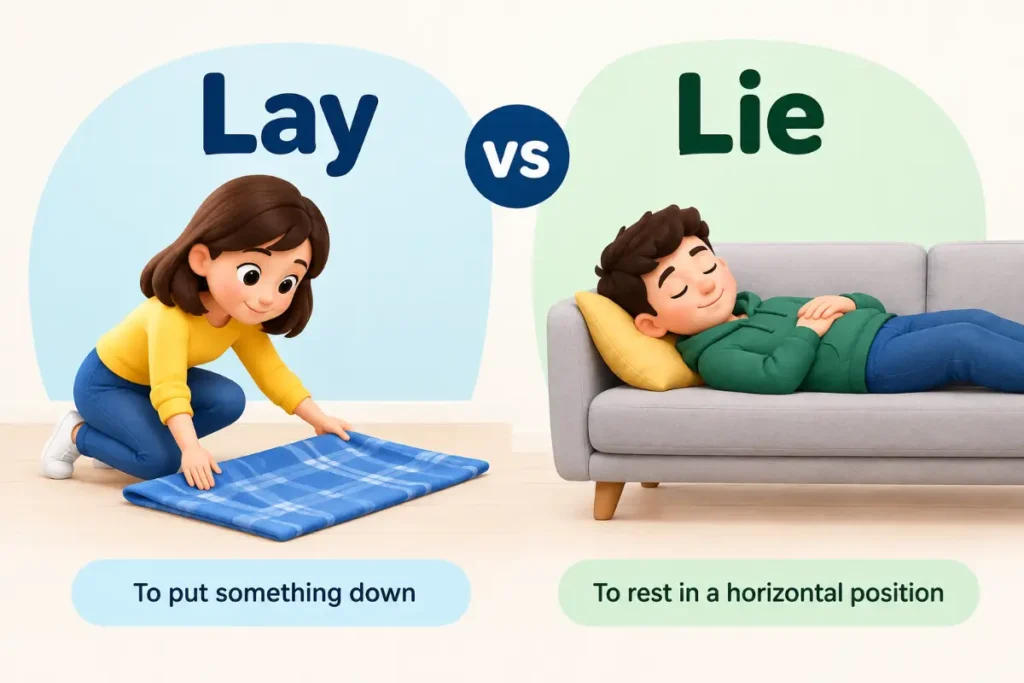
The basic distinction is actually straightforward. Lay means to put or place something somewhere, so it normally needs a direct object. Lie means to recline or rest in a particular position, so it normally does not take a direct object. The tricky part is that the past tense of lie is lay, which creates the same form that causes much of the confusion.
This guide explains the difference in plain American English. You will learn the verb forms, past tense patterns, common mistakes, practical examples, pronunciation, grammar rules, and a few simple tests that can help you choose the right word quickly.
Quick Answer
Lay means to put or place something somewhere and usually takes an object. Lie means to recline or rest and usually does not take an object. For example, Lay the book on the table uses lay, while I need to lie down uses lie. The past tense of lie is lay, which causes much of the confusion.
Just as choosing between lay and lie depends on the word’s grammatical role, knowing who or whom to use depends on whether the pronoun functions as a subject or an object.
What Does Lay Mean
Lay is a transitive verb, which means it normally acts on a direct object. When you lay something somewhere, you put, place, or position that thing in a particular location. The object can be a physical item, a person in some contexts, or something abstract.
Look at these examples:
- Lay the keys on the counter.
- She laid the baby in the crib.
- Please lay the papers on my desk.
- He is laying the foundation for the new building.
- They laid the flowers beside the memorial.
In each sentence, something is being placed somewhere. The direct object answers the question what or whom after the verb. You lay the keys, lay the papers, or lay the flowers.
This gives you one of the most useful rules in the entire topic. If you are putting or placing something, you generally need lay or one of its forms.
Lay Needs An Object
The easiest way to recognize lay is to look for the thing being placed. In Lay the book on the table, the book is the direct object. In She laid her phone beside the bed, her phone is the object.
Try asking What is being placed? If the sentence has a clear answer, you are likely dealing with lay.
- Lay the blanket on the couch. What is being placed? The blanket.
- He laid the package by the door. What was placed? The package.
- She is laying the tiles carefully. What is being placed? The tiles.
- They had laid the documents on the desk. What had been placed? The documents.
The object does not always have to be a physical thing. Lay can also appear in expressions involving plans, foundations, responsibilities, or other abstract ideas.
- The committee laid out its plan.
- The workers laid the foundation.
- She laid the groundwork for the project.
The central idea remains the same. Something is being put, positioned, established, or arranged.
What Does Lie Mean
Lie has a different meaning when it describes a person’s or animal’s position. It means to recline, rest, or remain in a horizontal position. In this sense, lie is generally an intransitive verb, so it does not take a direct object.
For example:
- I need to lie down.
- She likes to lie on the couch.
- The dog is lying on the floor.
- He lay on the beach for an hour.
- They were lying in bed.
You are not putting something down in these sentences. The subject is taking or remaining in a resting position.
This distinction is the key to understanding the two verbs. Lay describes placing something. Lie describes the subject resting or reclining.
Lie Does Not Usually Take An Object
Compare these two sentences:
I lay the book on the desk.
I lie on the bed.
In the first sentence, the book is the object being placed. In the second sentence, there is no object receiving the action. The speaker is the one who reclines.
This is why I need to lay down is traditionally considered incorrect when you mean that you need to recline yourself. The standard form is I need to lie down.
The confusion is understandable because people use lay correctly in many other contexts, and the past tense of lie is also lay. The problem becomes much easier once you separate the present tense from the past tense.
Lay vs Lie Comparison
The main difference is the relationship between the verb and the object. Lay normally places something somewhere. Lie normally describes a subject resting or reclining.
| Feature | Lay | Lie |
|---|---|---|
| Basic meaning | Put or place something | Recline or rest |
| Verb type | Transitive | Intransitive |
| Direct object | Normally required | Normally not used |
| Present form | lay | lie |
| Present participle | laying | lying |
| Simple past | laid | lay |
| Past participle | laid | lain |
| Example | Lay the book down | I need to lie down |
The table reveals the part that causes the most confusion. The present form of one verb is lay, while the past form of the other verb is also lay. That means the surrounding grammar and time reference matter.
The Verb Forms You Need To Know
Memorizing the full forms makes this topic much easier because most mistakes happen when writers mix the forms together.
Lay Forms
The verb lay has these common forms:
- Present: lay
- Third person singular: lays
- Present participle: laying
- Simple past: laid
- Past participle: laid
Examples include:
- I lay the clothes on the bed every morning.
- She lays the documents on the table.
- He is laying the carpet.
- She laid the keys by the door.
- They have laid the foundation.
Notice that laid is both the simple past and past participle of lay.
Lie Forms
The verb lie, when it means to recline or rest, has these forms:
- Present: lie
- Third person singular: lies
- Present participle: lying
- Simple past: lay
- Past participle: lain
Examples include:
- I lie down after work.
- She lies on the couch when she reads.
- He is lying on the floor.
- They lay on the beach yesterday.
- She has lain in bed all morning.
The unusual sequence is what makes this verb difficult. The present form is lie, the past is lay, and the past participle is lain.
Why Lay And Lie Are So Confusing
The biggest problem is that lay has two roles in this family of verb forms. It is the present tense of the verb meaning to put something somewhere, but it is also the simple past of lie when the meaning is to recline.
Compare these sentences:
I lay the book on the table every morning.
This describes an action in the present. The speaker places the book on the table.
I lay on the couch yesterday.
This describes an action in the past. The speaker reclined on the couch.
The same spelling appears in both sentences, but the verbs are different. In the first sentence, lay is the present form of the placement verb. In the second, lay is the past tense of lie.
Context tells you which meaning is intended.
How To Choose The Correct Word
A simple question can solve most present tense problems. Ask yourself Am I putting something somewhere, or am I resting somewhere?
If you are putting something somewhere, use lay.
If you are resting or reclining yourself, use lie.
Consider these examples:
- Lay the towel on the chair.
- Lie on the towel.
- Lay your jacket on the bed.
- Lie on the bed.
- Lay the baby in the crib.
- Lie down and get some rest.
The difference becomes obvious when you identify the action. One action places an object. The other describes the subject’s position.
There is another useful test. Try identifying the direct object after the verb. If you can answer what is being placed, lay is usually correct. If there is no direct object because the subject is simply reclining, lie is usually the correct present form.
Lay vs Lie Examples
Examples are especially useful because the confusion often appears in ordinary expressions rather than isolated definitions.
Examples With Lay
Use lay when you put or place something somewhere.
- Lay the book on the table.
- Please lay the clothes on the bed.
- She will lay the baby in the crib.
- He laid his phone beside the computer.
- They laid the documents on the desk.
- We are laying new flooring in the kitchen.
- She has laid the cards on the table.
- The workers laid the bricks carefully.
- Lay the blanket over the chair.
- He laid the package near the front door.
Each sentence has something that receives the action. The book, clothes, baby, phone, documents, flooring, cards, bricks, blanket, and package are all being placed or positioned.
Examples With Lie
Use lie when the subject reclines or rests.
- I need to lie down.
- She likes to lie on the couch.
- The dog is lying beside the door.
- He decided to lie on the grass.
- They lie in bed and read every night.
- I want to lie down for a few minutes.
- The cat is lying under the table.
- She has decided to lie down before dinner.
- We can lie on the beach after lunch.
- He needs to lie still for a moment.
In these examples, the subject is resting or remaining in a position. Nothing is being placed by the subject.
Lay vs Lie Past Tense
The past tense is where many writers get stuck. The simple past of lay is laid, but the simple past of lie is lay.
That means you can correctly write She laid the book on the table and She lay on the couch yesterday. The first sentence means she placed something. The second means she reclined.
The easiest way to keep them separate is to memorize the complete patterns rather than trying to remember only individual words.
Lay: lay, laid, laid.
Lie: lie, lay, lain.
The difference becomes especially important when you use helping verbs. After has, have, or had, the past participle is needed.
- She has laid the book on the table.
- She has lain on the couch all afternoon.
- They had laid the towels beside the pool.
- They had lain in the sun for hours.
Using lay after has when you mean reclining is a common mistake. The correct past participle is lain.
When explaining the difference between lay and lie, be precise with examples, just as proper i.e. and e.g. usage helps make explanations clearer and easier to understand.
Laid vs Lay
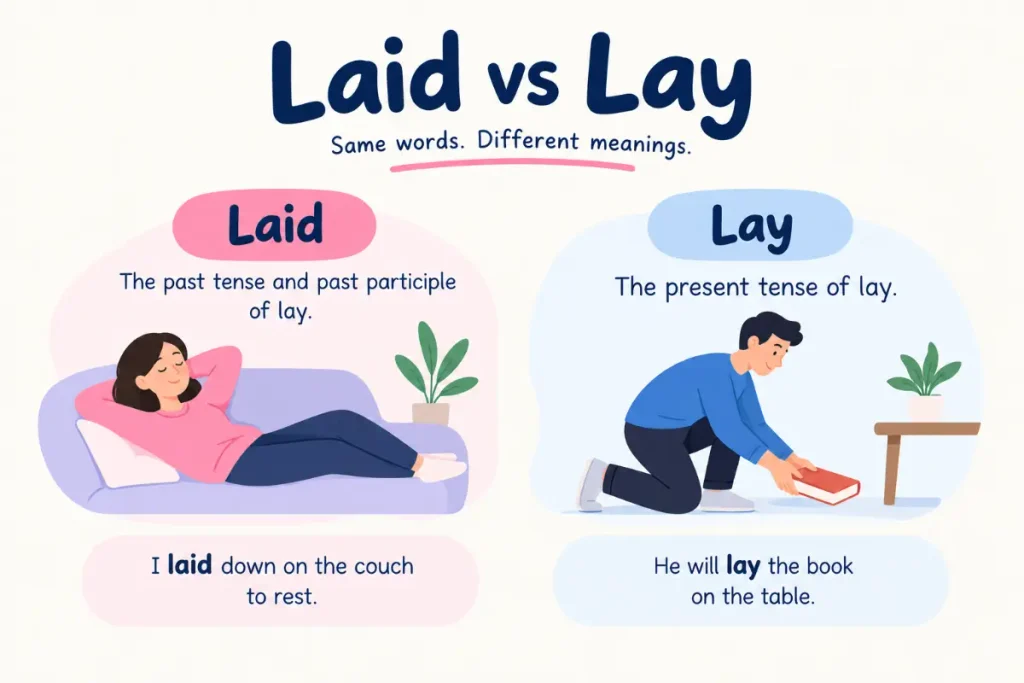
Laid is the simple past and past participle of lay. It means that someone placed something somewhere.
Lay can be either the present form of lay or the past form of lie. You need context to determine which one it is.
Compare these examples:
- I lay the keys on the counter every morning. Present action of placing.
- I laid the keys on the counter yesterday. Past action of placing.
- I lie on the couch every evening. Present action of reclining.
- I lay on the couch yesterday. Past action of reclining.
This four sentence pattern is worth remembering because it shows the entire distinction in a compact way.
Lay vs Lie Down
The phrase lie down is one of the most common places where this confusion appears. When you are telling someone to recline or rest, the standard form is lie down.
- I need to lie down.
- Please lie down and rest.
- The doctor told him to lie down.
- She went upstairs to lie down.
Use lay down when an object is being placed somewhere.
- Lay the blanket down.
- Lay the book down.
- Lay your phone down for a minute.
- She laid the baby down gently.
The presence of an object makes the difference clear. In Lay the book down, the book is being placed. In Lie down, the subject is reclining.
Why People Say Lay Down
You may hear lay down used in casual American conversation to mean lie down. This usage is widespread in everyday speech, but traditional edited English distinguishes the two verbs based on whether there is a direct object.
For careful writing, especially in school, academic, or professional contexts, use lie down when the subject is reclining and lay something down when an object is being placed.
Common Mistakes
Most mistakes happen because speakers hear lay and lie used interchangeably in conversation. The past tense of lie adds another layer of confusion, so even careful writers sometimes choose the wrong form.
Incorrect I Need To Lay Down
Incorrect: I need to lay down.
Correct: I need to lie down.
Here, the speaker is talking about reclining. There is no object being placed, so lie is the standard form.
Incorrect Please Lie The Book Down
Incorrect: Please lie the book down.
Correct: Please lay the book down.
The book is the direct object being placed. That requires lay.
Incorrect She Has Lay On The Couch
Incorrect: She has lay on the couch all morning.
Correct: She has lain on the couch all morning.
After has, the past participle is needed. The past participle of lie is lain.
Incorrect He Laid On The Bed Yesterday
Incorrect: He laid on the bed yesterday.
Correct: He lay on the bed yesterday.
The subject reclined in the past. The simple past of lie is lay, not laid.
Incorrect She Lay The Book On The Desk
Incorrect: She lay the book on the desk yesterday.
Correct: She laid the book on the desk yesterday.
The book is being placed, so the past tense of lay is laid.
Grammar Rules For Lay And Lie
The most important grammar rule is based on transitivity. Lay is normally transitive, so it takes a direct object. Lie in the reclining sense is normally intransitive, so it does not take a direct object.
This distinction can sound technical, but the practical difference is simple. If someone lays something, that thing receives the action. If someone lies, the person or animal is the one occupying the resting position.
Consider this pair:
She laid the baby on the bed.
The baby lay on the bed.
In the first sentence, the baby is the object being placed. In the second, the baby is the subject doing the resting. The grammar changes because the action changes.
A Quick Object Test
Ask What is being placed?
If you can identify an object, lay is usually the correct base form.
Lay the keys on the table.
What is being placed? The keys.
Now ask the same question about I need to lie down. Nothing is being placed. The subject is changing position. That points to lie.
This test is especially useful when you are writing quickly and cannot remember the full verb chart.
Pronunciation
The verbs lay and lie are pronounced differently in American English. Lay is commonly pronounced /leɪ/, which sounds like say or day with the initial consonant changed. Lie is commonly pronounced /laɪ/, which rhymes with my and sky.
The difference becomes especially important because the past tense of lie is lay. The pronunciation changes from /laɪ/ in the present to /leɪ/ in the past.
The forms can be summarized like this:
- lay /leɪ/
- lie /laɪ/
- laid /leɪd/
- lay as the past of lie /leɪ/
- lain /leɪn/
Pronunciation can help you distinguish lay and lie in the present tense, but it cannot tell you the grammatical meaning of lay when it appears as a past tense form.
Laying vs Lying
The present participles create another common spelling problem. The correct form of lay is laying, while the correct form of lie is lying.
Use laying when something is being placed.
- She is laying the books on the table.
- They are laying the carpet.
- He is laying the foundation.
Use lying when someone or something is reclining.
- She is lying on the couch.
- The dog is lying on the floor.
- He is lying in bed.
The spelling of lying may look unusual because the final e of lie changes before the suffix ing. The result is lying, not lieing.
American English And Regional Usage
American English follows the same traditional distinction between lay and lie in careful edited writing. British, Canadian, and Australian English also recognize the same basic grammatical difference.
You may hear lay used more broadly in casual speech, including expressions such as I am going to lay down. Everyday speech does not always follow the traditional distinction perfectly. However, formal and edited writing generally preserves the difference between lay for placing an object and lie for reclining.
The verb lie also has another completely separate meaning: to tell something that is not true. Its forms are lie, lied, lied, as in He lied about what happened. This is a different verb from lie meaning to recline, whose forms are lie, lay, lain.
Formal And Casual Usage
The distinction between lay and lie matters most in careful writing. In casual conversation, people often use lay in places where traditional grammar would use lie, especially in the phrase lay down.
You do not need to change your entire speaking style to communicate clearly. For professional writing, school assignments, formal correspondence, and edited content, however, the traditional distinction is the safest choice.
Use lie down when you mean to recline.
Use lay something down when you mean to place an object.
That small distinction will keep most of your sentences correct.
Related Verb Confusions
Lay and lie belong to a larger group of English verbs that confuse writers because their forms do not follow the patterns learners expect.
One related confusion involves rise and raise. Rise describes something moving upward by itself, while raise normally takes an object.
- Prices rise.
- The company raises prices.
Another useful comparison is sit and set. Sit describes a person or animal taking a seated position, while set can mean to place something.
- I sit in the chair.
- I set the book on the chair.
These pairs follow a similar grammatical idea. One verb describes the subject changing position, while the other usually describes someone placing or moving an object.
Understanding this pattern can make lay and lie easier to remember because you are focusing on sentence structure rather than memorizing isolated spellings.
English has many pairs that are easy to confuse, and the difference between farther and further is another useful example of how seemingly similar words can serve different purposes.
Expert Usage Tips
The best way to master these verbs is to stop memorizing lay and lie as simple synonyms. They describe different actions. Think of lay as an action performed on an object and lie as a position taken by the subject.
When the sentence is in the present tense, the distinction is especially easy. Lay the phone on the desk means place the phone. Lie on the couch means recline yourself.
Past tense requires more attention. Remember the two short patterns:
Lay, laid, laid.
Lie, lay, lain.
If you only memorize one thing, memorize those patterns. They explain why I laid the book down and I lay down yesterday can both be correct.
Another useful proofreading habit is to look for the object. If lay appears without an obvious object, stop and check the sentence. It may need lie, although there are legitimate constructions where the grammatical object is understood or where lay has another meaning.
Finally, remember that lie can mean two completely different things. I lie on the bed means I recline on the bed. I lie about my age means I tell an untruth. The first verb has the irregular forms lay and lain, while the second has the regular forms lied and lied.
Frequently Asked Questions
What is the difference between lay and lie
Lay means to put or place something somewhere, while lie means to recline or rest. Lay normally takes a direct object, as in Lay the book on the table. Lie normally does not, as in I need to lie down. The main complication is that the past tense of lie is lay.
Is it lay down or lie down
Lie down is the standard form when you mean to recline or rest. For example, I need to lie down for a few minutes is correct. Use lay down when an object is being placed, as in Lay the blanket down. The presence of an object is the key difference.
What is the past tense of lie
The past tense of lie, when it means to recline, is lay. For example, I lie on the couch every evening becomes I lay on the couch yesterday. Its past participle is lain, so you would write I have lain on the couch all afternoon.
Is laid the past tense of lie
No. Laid is the past tense and past participle of lay, meaning to put or place something. The past tense of lie, meaning to recline, is lay. For example, She laid the book on the table is different from She lay on the couch yesterday.
Is laying or lying correct
Both laying and lying are correct, but they come from different verbs. Laying is the present participle of lay, as in She is laying the books on the desk. Lying is the present participle of lie, as in She is lying on the couch.
Why is lay the past tense of lie
English developed these irregular verb forms over many centuries. The modern pattern is simply something writers need to learn as part of English grammar. The verb meaning to recline has the sequence lie, lay, lain, while the verb meaning to place has lay, laid, laid. The shared form lay creates the main confusion.
Is I laid down correct
I laid down is traditionally incomplete when you mean that you reclined, because lay normally needs an object. The standard form is I lay down for the past tense of reclining. However, I laid the book down is correct because the book is the object being placed.
What is the easiest way to remember lay and lie
Think of lay as putting something somewhere and lie as resting yourself. If you can name the object being placed, lay is usually correct. If you are describing your own position or the position of another person or animal, lie is usually correct in the present tense.
Conclusion
The simplest way to remember lay vs lie is to focus on the action. Lay means to put or place something, so it normally takes an object. Lie means to recline or rest, so it normally does not take an object. The main complication comes from the past tense: the past of lie is lay, while the past of lay is laid.
Keep these two patterns nearby when you need a quick reminder: lay, laid, laid and lie, lay, lain. Then ask yourself one question: What is being placed? If something is being placed, use the appropriate form of lay. If the subject is simply resting or reclining, use the appropriate form of lie.