Choosing between who vs whom vs whose can feel unnecessarily complicated, especially when all three words refer to people. The confusion usually comes from trying to remember a grammar rule without understanding what each word does in a sentence. Once you identify the role of the word, the choice becomes much easier.
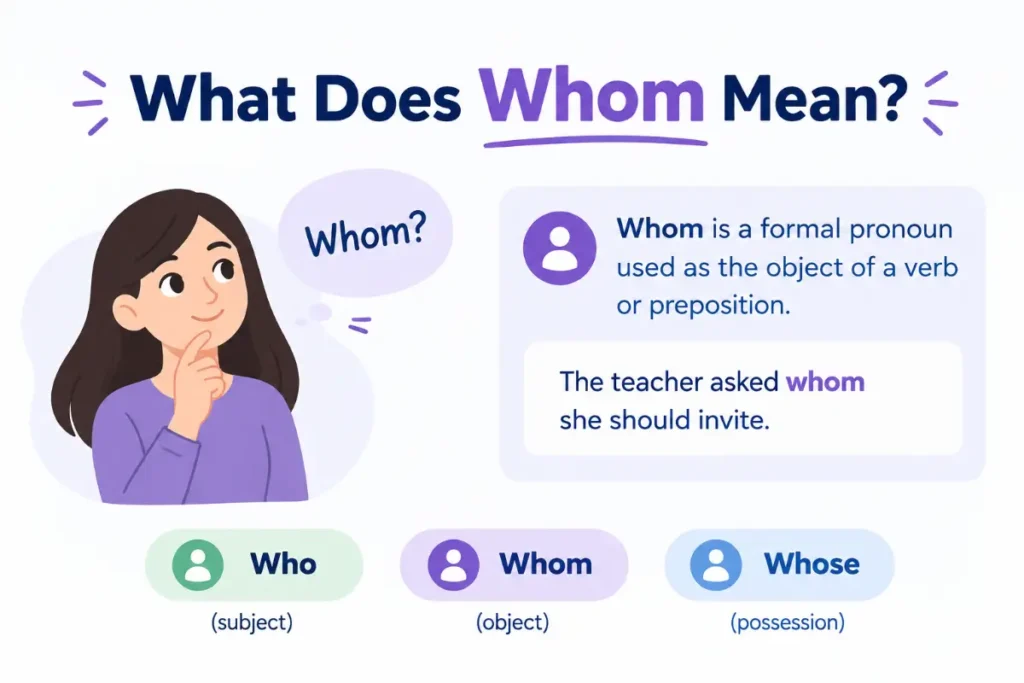
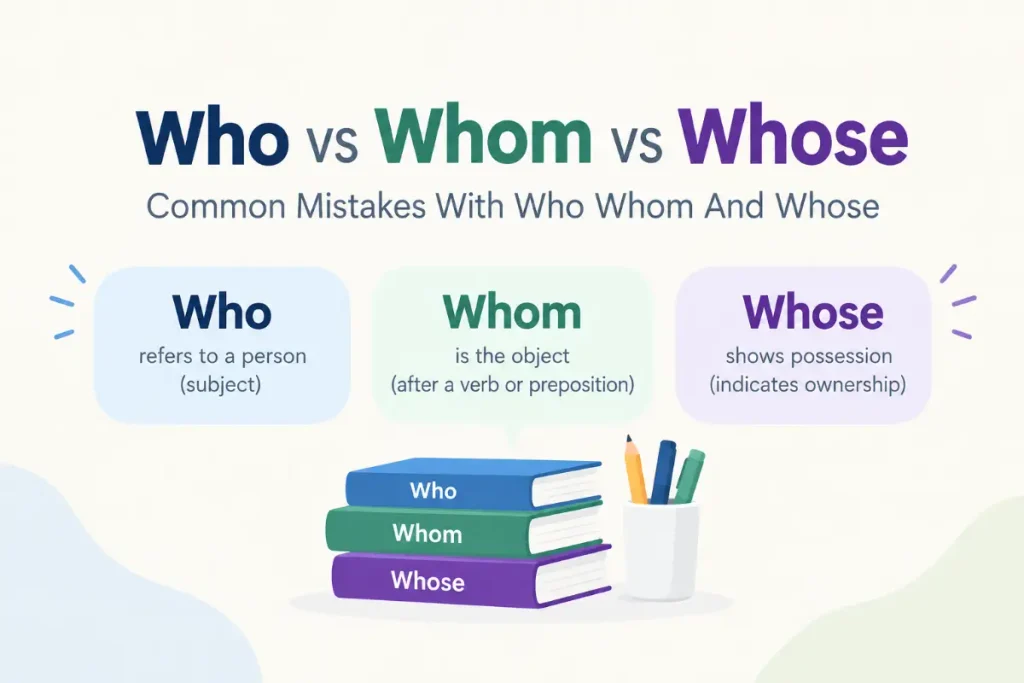
Who usually refers to the person performing an action or acting as the subject of a sentence. Whom traditionally refers to the person receiving an action or acting as an object. Whose shows possession or asks who something belongs to. In everyday American English, who is much more common than whom, especially in conversation.
This guide explains the difference between all three forms with clear grammar rules, practical examples, simple tests, pronunciation guidance, common mistakes, and real world usage. It also explains when whom sounds formal, when who is natural, and how whose works differently from both.
Quick Answer
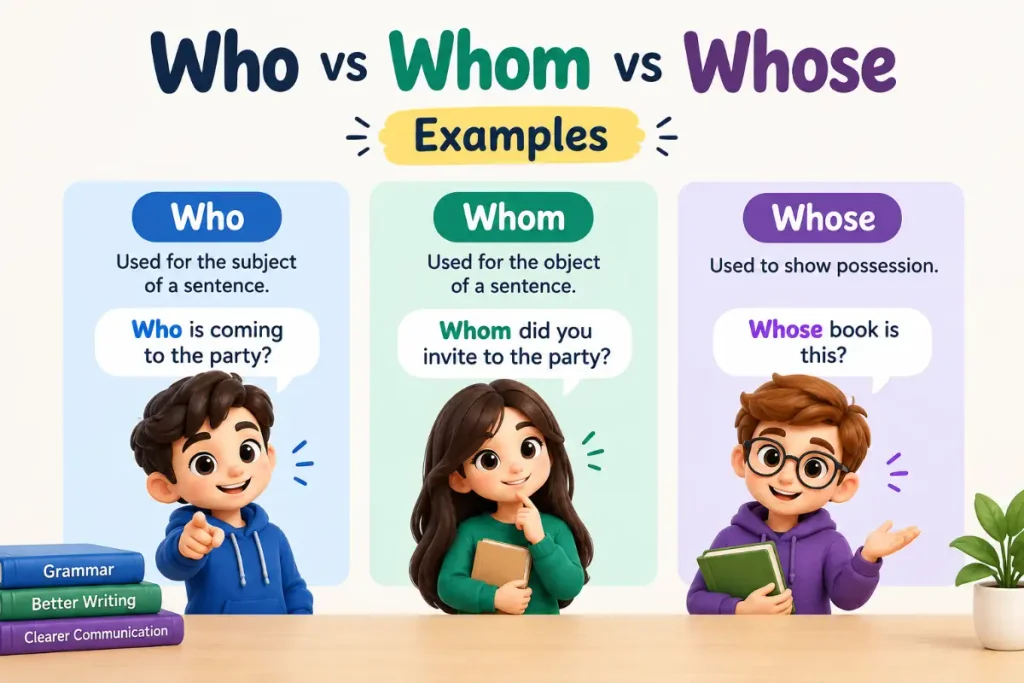
Who is generally used for the subject, whom for the object, and whose for possession. For example, Who called you?, Whom did you call?, and Whose phone is this? In everyday American English, who often replaces whom, especially in informal speech, but whom remains standard in certain formal structures.
What Does Who Mean
Who is an interrogative pronoun used to ask about a person or people. It can also introduce a relative clause that gives information about a person. In traditional grammar, who is used when the person is the subject of the clause, meaning that person performs the action.
Consider the question Who called you? The unknown person performed the action of calling, so who is the subject. The same pattern appears in Who opened the door?, Who sent this email?, and Who wants coffee?
You can often identify who by replacing it with he, she, they, or another subject pronoun.
- Who called the office?
- She called the office.
- Who wrote this report?
- He wrote this report.
- Who wants to come with us?
- They want to come with us.
The replacement does not have to produce a complete answer that you actually know. It simply helps you recognize the grammatical role of the unknown person.
Who As A Subject
When the person performs the action, traditional grammar calls that person the subject. This is the clearest environment for who.
- Who made this cake?
- Who broke the window?
- Who lives next door?
- Who answered the phone?
- Who brought the documents?
In each sentence, the unknown person is responsible for the action. That is why who is the natural choice.
Who In Relative Clauses
Who can also introduce a relative clause that describes a person.
- The woman who called you is my manager.
- I know the teacher who wrote the book.
- She is the person who helped me.
- We met a doctor who works at the hospital.
In these examples, who is connected to the person being described. It can function as the subject of the relative clause.
For example, in the woman who called you, the woman is the person who performed the action of calling. That makes who the subject.
If you’re comparing there, their, and they’re, remember that each word has a different grammatical function and meaning.
What Does Whom Mean
Whom is traditionally the object form of who. It refers to a person who receives an action or follows a preposition in formal grammar.
For example, in Whom did you invite?, the person being invited receives the action. The subject is you, because you performed the inviting. Whom represents the person affected by that action.
- Whom did you invite?
- Whom did she call?
- Whom are you meeting?
- Whom should I contact?
The word whom is grammatically traditional, but it is less common in everyday American conversation. Many speakers naturally use who instead.
Whom As An Object
The easiest traditional rule is to use whom when the unknown person is the object of the verb.
Compare these two questions:
Who called the manager?
Whom did the manager call?
In the first sentence, who performed the action. In the second, the manager performed the action and whom received it.
You can test this by replacing the unknown person with him, her, or them.
- Whom did you call?
- I called him.
Because him is an object pronoun, whom is the traditional grammatical match.
Whom After A Preposition
Whom can also appear after a preposition, especially in formal writing.
- To whom should I send the letter?
- With whom did you speak?
- For whom was the gift intended?
- From whom did you receive the message?
- About whom are they talking?
These structures are grammatically traditional and still common in formal writing, professional communication, legal language, and carefully edited prose.
However, everyday American English often places the preposition at the end and uses who instead.
Who did you speak with?
This is natural in ordinary conversation. With whom did you speak? is more formal.
What Does Whose Mean
Whose is a possessive interrogative pronoun and determiner. It asks who owns something or who something belongs to or is associated with.
For example, Whose jacket is this? asks about the person associated with the jacket. Whose car is parked outside? asks who owns or is using the car.
- Whose phone is ringing?
- Whose book is this?
- Whose keys are on the table?
- Whose idea was it?
- Whose office is upstairs?
Unlike who and whom, whose is about possession or association. It does not tell you who performed or received an action.
Whose Before A Noun
Whose commonly appears directly before a noun.
- Whose car is that?
- Whose laptop are you using?
- Whose decision was this?
- Whose name is on the document?
- Whose dog is in the yard?
The noun that follows whose identifies the thing connected with the unknown person.
It can also appear without a noun when the meaning is already clear.
Whose is this?
Here, the noun is understood from context. The question could mean Whose phone is this? or Whose jacket is this?
Who vs Whom vs Whose Comparison
The three words have different grammatical functions, so looking at them together makes the distinction easier to remember.
| Feature | Who | Whom | Whose |
|---|---|---|---|
| Main function | Subject | Object | Possession |
| Basic question | Who performs the action? | Who receives the action? | Who owns or is connected with it? |
| Pronoun type | Subject form | Object form | Possessive form |
| Common example | Who called you? | Whom did you call? | Whose phone is this? |
| Everyday US usage | Very common | Less common | Very common |
| Formal usage | Standard | Often preferred in formal structures | Standard |
| Useful replacement | He, she, they | Him, her, them | His, her, their |
A simple way to remember the distinction is to focus on three ideas: who acts, whom receives, and whose owns or has a connection with something.
The Who And Whom Trick
The most useful traditional trick is to replace the unknown person with a personal pronoun.
Use he, she, or they to test for who. Use him, her, or them to test for whom.
For example:
Who called you?
Try she called you. The structure works, so who is correct.
Now consider:
Whom did you call?
Try I called him. The unknown person matches him, so whom is the traditional choice.
The trick becomes especially useful in complicated questions.
Who do you think will win?
Try She will win. The person is performing the action of winning, so who is correct.
Now consider:
Whom do you think they will choose?
Try They will choose him. The unknown person receives the action of choosing, so whom is the traditional form.
The Him And He Test
You do not have to memorize complicated terminology to use the test. Just remember:
- He, she, they → who
- Him, her, them → whom
Here are a few examples:
- Who is coming? → She is coming.
- Whom did you invite? → I invited him.
- Who wrote the article? → He wrote the article.
- Whom did the article criticize? → It criticized them.
This method is particularly useful when the sentence has several verbs or clauses.
Another common source of confusion is the tricky its and it’s distinction, especially when deciding whether the apostrophe signals possession or a contraction.
Who vs Whom Examples
Examples make the difference clearer because the correct form depends on the grammatical role of the person.
Examples With Who
Use who when the person performs the action or serves as the subject of the clause.
- Who called you this morning?
- Who wrote this email?
- Who wants another cup of coffee?
- Who left the package at the door?
- Who knows the answer?
- Who is responsible for this project?
- Who lives in that house?
- Who made the final decision?
- Who will lead the meeting?
- Who told you about the change?
A useful question to ask is Who did the action? If the unknown person is the one performing it, who is the traditional choice.
Examples With Whom
Use whom when the person is the object of the verb or follows a preposition in formal grammar.
- Whom did you invite to the party?
- Whom did the manager hire?
- Whom should I contact about the problem?
- Whom did you see at the conference?
- To whom should I address the letter?
- With whom did you travel?
- For whom was this package delivered?
- Whom are they planning to interview?
- From whom did you receive the information?
- About whom were they talking?
In casual American conversation, many speakers would use who in several of these questions. For example, Who did you invite? sounds completely natural in everyday speech.
Examples With Whose
Use whose when asking about possession, ownership, or association.
- Whose phone is ringing?
- Whose car is parked outside?
- Whose jacket did you borrow?
- Whose idea was this?
- Whose name is on the contract?
- Whose keys are on the desk?
- Whose office is next to yours?
- Whose dog is running in the yard?
- Whose responsibility is this?
- Whose advice did you follow?
The easiest clue is often the noun that follows whose. If the question asks who something belongs to or is connected with, whose is the appropriate form.
Who Or Whom In Everyday American English
The distinction between who and whom is more complicated in actual American usage than traditional grammar rules suggest. In formal grammar, whom is the object form. In everyday American English, however, who is often used in places where traditional grammar would call for whom.
For example, both of these may appear:
- Whom did you call?
- Who did you call?
The first follows the traditional object rule. The second is extremely common in ordinary American speech and informal writing.
This does not mean that whom has disappeared. It remains useful in formal constructions, especially after prepositions.
To whom it may concern is a familiar formal expression. Whom should I contact? can also be appropriate in professional or carefully edited writing.
The practical lesson is that grammar and natural usage are both important. If you are writing a formal document, traditional whom can provide a formal tone. In everyday conversation, who is often the more natural choice.
When Should You Use Whom
Use whom when you need the traditional object form and the context calls for formal or carefully edited English. It is especially useful after a preposition when the preposition remains directly before the pronoun.
Common examples include:
- To whom should I send this email?
- With whom are you meeting?
- For whom was the position created?
- From whom did you receive the letter?
It is also appropriate when a sentence clearly distinguishes the subject and object.
Whom did the committee select?
The committee performed the action of selecting. The unknown person received that action, so whom fits the traditional rule.
However, do not force whom into every sentence simply because it sounds more formal. A technically traditional choice can sound stiff in ordinary conversation.
When Is Who Better Than Whom
Who is usually the better choice when it acts as the subject. It is also often the natural choice in informal American English when the traditional grammar rule would use whom.
For example:
Who did you talk to?
This is natural and common in everyday American English.
To whom did you talk?
This is more formal and follows traditional grammar.
Both structures communicate the same basic idea. The difference is mainly grammatical structure and register.
A useful writing principle is to match the form to the situation. Use traditional whom when formal grammar or a formal tone makes it useful. Use who naturally in everyday writing and conversation when it fits the way people actually communicate.
Common Mistakes With Who Whom And Whose
The most common errors happen when writers rely on appearance rather than sentence structure. Another common problem is using whom simply because it sounds formal.
Mistake 1 Using Whom As The Subject
Incorrect in traditional grammar: Whom called you yesterday?
Correct: Who called you yesterday?
The unknown person performed the action of calling. That makes the person the subject, so who is the traditional form.
Mistake 2 Using Who After A Preposition In Formal Writing
In everyday American English, Who did you speak with? is completely natural. In highly formal writing, you may prefer With whom did you speak?
The issue here is not that the first sentence is automatically wrong. It is a difference in register and traditional grammar.
Mistake 3 Confusing Whose And Who’s
Whose shows possession.
Who’s is a contraction of who is or who has.
Compare:
- Whose car is this?
- Who’s coming to dinner?
- Whose idea was that?
- Who’s responsible for the report?
The apostrophe changes the meaning completely.
Mistake 4 Using Whom When Whose Is Needed
Incorrect: Whom phone is this?
Correct: Whose phone is this?
The question asks about ownership or association, so whose is required.
Mistake 5 Forgetting The Clause Structure
Consider:
Who do you think will win?
The phrase do you think can make the sentence look complicated, but the important part is who will win. The unknown person performs the action of winning, so who is correct.
Now consider:
Whom do you think the company will hire?
The company performs the action of hiring. The unknown person receives that action, so whom is the traditional form.
Who Whom And Whose In Questions
Question structure often determines which form you need. Start by identifying the verb and asking what role the person has in relation to it.
Consider these pairs:
Who invited Sarah?
Here, the unknown person performed the action of inviting.
Whom did Sarah invite?
Here, Sarah performed the action and the unknown person received it.
Now compare:
Who is calling?
The person is performing the action.
Whom are you calling?
You are performing the action, and the unknown person receives it.
Finally:
Whose phone are you calling from?
This asks about possession or association, not the person performing or receiving the action.
This method works even when sentences become longer. Identify the clause containing the unknown person, then determine the person’s grammatical role inside that clause.
Whose Versus Who’s
One of the most common spelling problems involving these words is the difference between whose and who’s.
Whose is possessive. It asks who owns or is associated with something.
Who’s is a contraction meaning who is or who has.
Compare:
- Whose coat is this?
- Who’s wearing that coat?
- Whose turn is it?
- Who’s next?
- Whose name is on the list?
- Who’s been calling you?
A simple substitution test works well for who’s. Expand it to who is or who has. If the sentence works, who’s is correct.
Pronunciation
In American English, who, whom, and whose do not sound identical, although who and whom share a closely related pronunciation.
- Who is commonly pronounced approximately /huː/.
- Whom is commonly pronounced approximately /huːm/.
- Whose is commonly pronounced approximately /huːz/.
The final sound provides a useful distinction. Whom ends with an m sound, while whose ends with a z sound.
Pronunciation can vary slightly among speakers and accents, but these basic forms are stable in standard American English.
Just as important is understanding than and then usage, since the two words sound similar but serve completely different grammatical purposes.
Word Origin And Etymology
Who, whom, and whose belong to the same historical family of English interrogative and relative pronouns. Their different forms reflect older grammatical distinctions involving case.
Who developed from Old English forms related to hwā, which was used for asking about a person. Whom comes from the object form of the same pronoun family. Whose developed from the possessive form.
English has gradually lost many of the case distinctions that were more visible in earlier stages of the language. The difference between who and whom remains as one of the clearest surviving examples of this older system.
This history also helps explain why the forms look related but behave differently. The endings are not random spelling variations. They reflect different grammatical functions that English inherited from earlier forms.
American English And British English
American and British English generally share the same traditional distinction between who, whom, and whose. The larger difference is often found in how frequently speakers use whom.
In both varieties, whom appears naturally in formal writing and traditional grammatical structures. In everyday speech, who is common even when whom would be expected under a strict traditional analysis.
The same basic pattern occurs in other major English varieties, including Canadian and Australian English. Regional differences can affect tone and frequency, but the core meanings of the three words remain the same.
For US readers, the most practical approach is to understand the traditional rule while also recognizing how who is commonly used in everyday American English.
Formal And Casual Usage
Who is neutral and works across casual, professional, academic, and formal contexts. It is rarely a problem when used as the subject.
Whom has a more formal or traditional feel in many modern contexts. It can be useful in formal letters, legal language, academic prose, and professional communication, especially after a preposition.
Whose is neutral and standard in both casual and formal writing.
For example, a casual speaker might say:
Who did you send the email to?
A formal document might say:
To whom did you send the email?
The second sentence is more formal, but the first is natural American English. The choice should reflect the tone and audience rather than an attempt to make every sentence sound sophisticated.
Related Words And Similar Confusions
The who, whom, and whose group is part of a larger set of English pronoun distinctions that can cause confusion.
Who and who’s differ because who is a pronoun while who’s is a contraction.
Whose and who’s are particularly easy to confuse because they look almost identical. Remember that whose is possessive, while who’s means who is or who has.
Other common pronoun questions include who vs which, who vs that, and whoever vs whomever. These involve related grammatical choices, but they require separate rules and should not be treated as simple spelling variations.
Expert Language Insight
The most useful way to understand who, whom, and whose is to stop thinking of them as three competing spellings. They answer different grammatical questions.
Ask who when you want to identify the person doing something. Ask whom when the person is the object of an action or follows a preposition in traditional formal grammar. Ask whose when you want to identify possession or association.
The he or him test is still one of the best practical tools. If you could answer with he, she, or they, choose who. If you could answer with him, her, or them, traditional grammar points to whom.
There is one important practical caution. Do not assume that using whom always makes writing better. In contemporary American English, forcing whom into casual sentences can make them sound unusually formal. Good editing means choosing language that is both grammatically sound and appropriate for the situation.
Frequently Asked Questions
Which is correct who or whom?
Both who and whom are correct, but they have different traditional grammatical functions. Who is the subject form, while whom is the object form. In everyday American English, who is also widely used where traditional grammar would use whom, especially in informal questions such as Who did you call?
How do you remember who vs whom?
Use the he or him test. If the answer would be he, she, or they, use who. If the answer would be him, her, or them, traditional grammar calls for whom. For example, Who called? becomes She called, while Whom did you call? becomes I called him.
Is whom still used in American English?
Yes. Whom is still used in American English, particularly in formal writing and after prepositions. Examples include To whom should I address this letter? and With whom did you speak? However, who is extremely common in everyday American speech and informal writing, including situations where traditional grammar would use whom.
What is the difference between whose and who’s?
Whose is a possessive form that asks who owns or is associated with something. Who’s is a contraction of who is or who has. For example, Whose car is this? asks about possession, while Who’s driving the car? means Who is driving the car?
Can I use who instead of whom?
In many everyday American English situations, yes. Who did you call? is natural and widely used. In formal writing, you may prefer whom when the person is the object or follows a preposition. The choice depends on grammatical structure and the level of formality you want.
Is whom more formal than who?
Whom often sounds more formal or traditional than who, especially in questions. For example, To whom should I send this? has a formal tone, while Who should I send this to? sounds more conversational. Both communicate the same basic idea, so the best choice depends on context and audience.
Is whose a pronoun or a determiner?
Whose can function as a possessive determiner when it comes before a noun, as in Whose book is this? It can also function independently as a possessive pronoun, as in Whose is this? In both cases, it asks about ownership or association.
What is the easiest way to tell who whom and whose apart?
Think of the three words by function. Who identifies the person doing the action. Whom traditionally identifies the person receiving the action. Whose asks about possession or association. If you remember who acts, whom receives, and whose owns, you can solve most everyday questions quickly.
Conclusion
The difference between who, whom, and whose becomes much simpler when you focus on the job each word performs. Who is generally the subject, whom is traditionally the object, and whose expresses possession or association.
For everyday American English, who is the form you will use most often when asking about a person. Whom remains useful in formal writing and traditional grammatical structures, especially after prepositions. Whose is the clear choice when you are asking who owns something or who it is connected with.
When you are unsure, use the simple he or him test. If he, she, or they fits, choose who. If him, her, or them fits, traditional grammar points to whom. If the question is about possession, use whose.