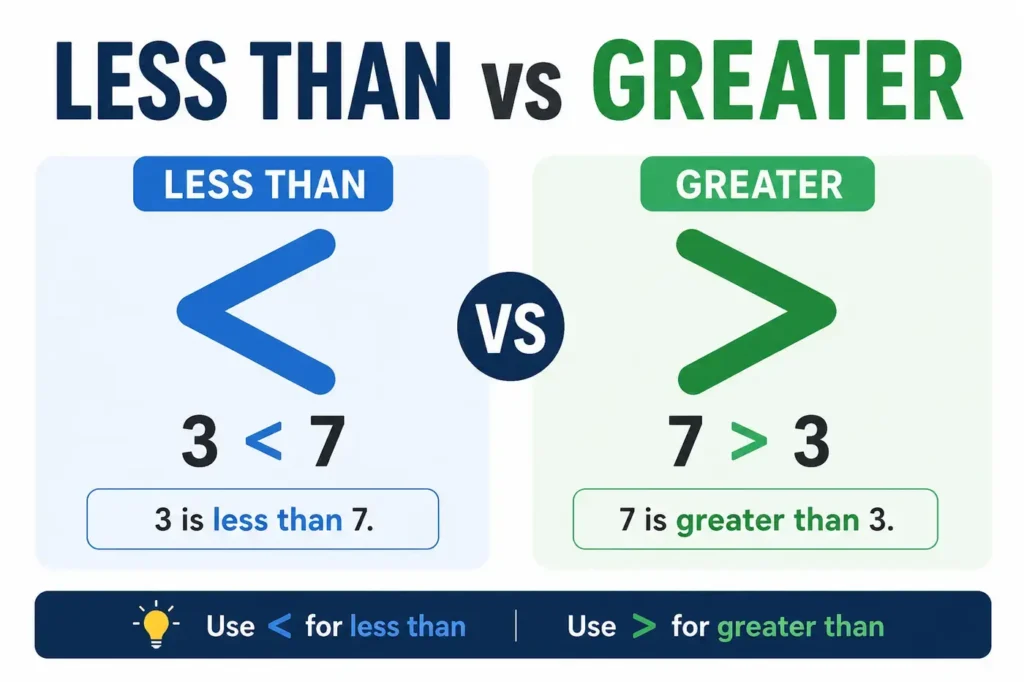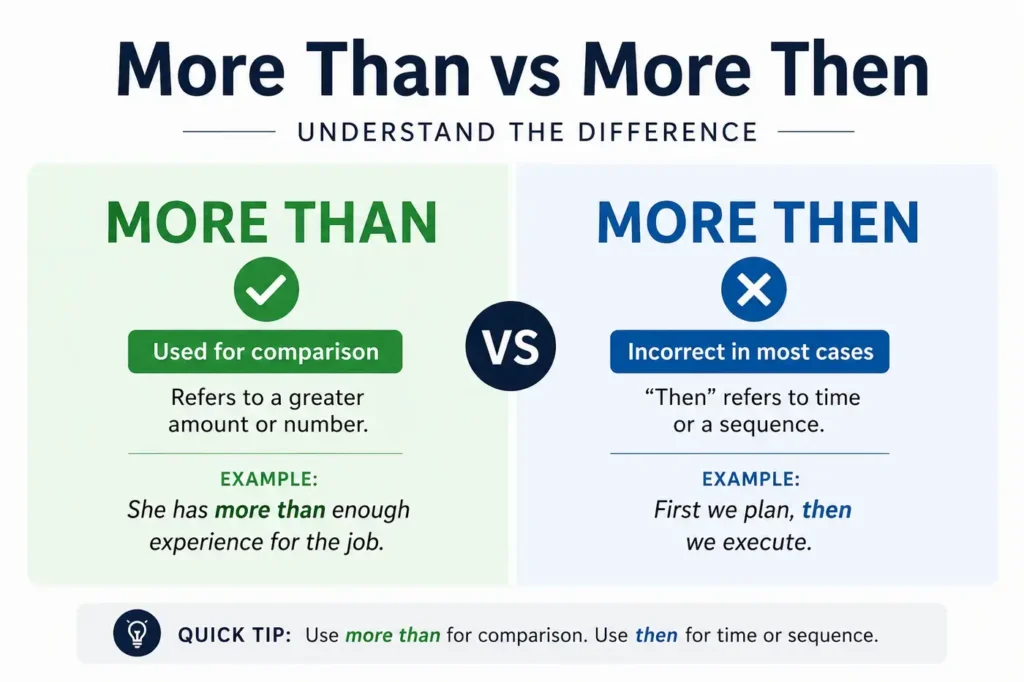
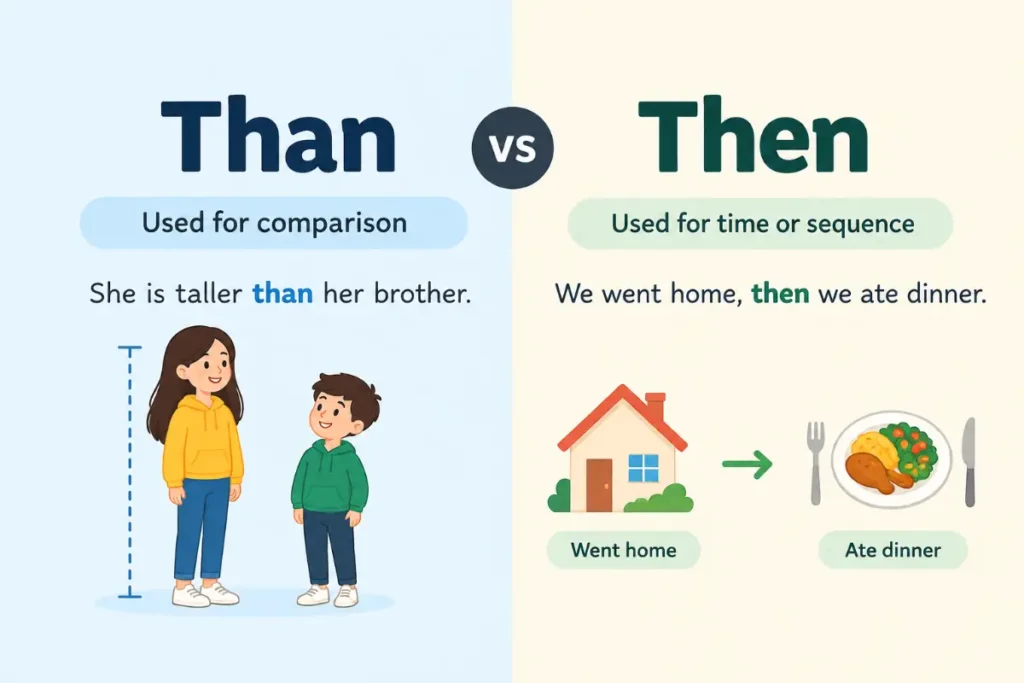
Than vs then is a common English usage question because the two words look and sound similar, yet they perform completely different jobs in a sentence. Than is mainly used when comparing people, things, amounts, or ideas. Then usually refers to time, sequence, or a result. Knowing that basic distinction makes most sentences much easier to correct.
The confusion often appears in phrases such as better than, more than, less than, rather than, and first this then that. It can also appear in everyday writing when someone means after that but accidentally types than, or when a comparison calls for than but the writer uses then.
This guide explains the difference in plain American English. You will learn what each word means, how each functions grammatically, how to recognize common patterns, and how to avoid mistakes in school, work, email, texting, and everyday writing. You will also see practical examples, pronunciation guidance, common expressions, and a simple test you can use whenever you are unsure which word belongs in a sentence.
Quick Answer
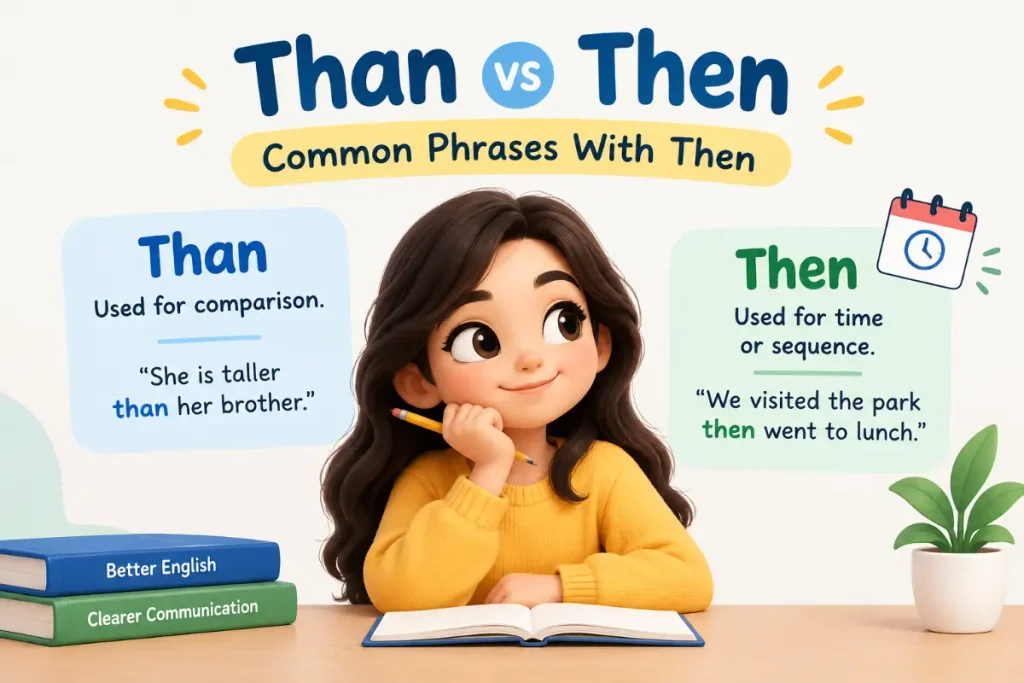
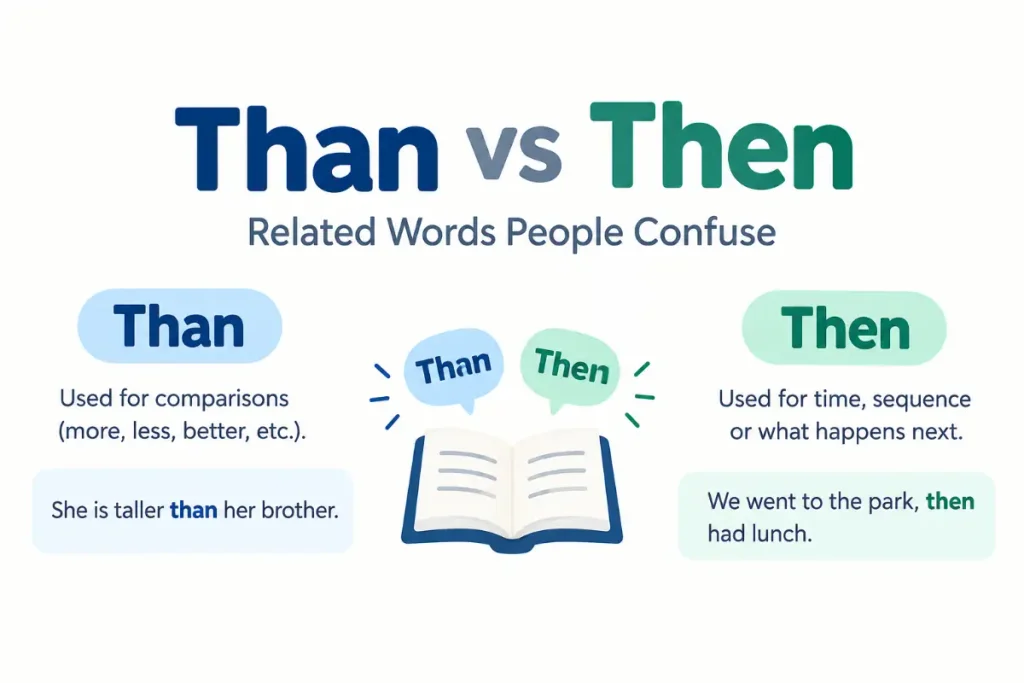
Than is used mainly for comparisons, as in She is taller than her brother or I have more than enough. Then refers to time, sequence, or consequence, as in We ate dinner then went home or If you finish early then you can leave. A simple rule is than compares, then tells when or what happens next.
What Does Than Mean
Than is primarily a conjunction or preposition used to introduce the second part of a comparison. It helps show that one person, thing, amount, quality, or action is different from another in degree, size, quantity, preference, or some other measurable or noticeable way.
You commonly see than after comparative words such as better, bigger, smaller, faster, more, less, older, younger, and easier. It can also appear in expressions such as rather than, other than, and more than.
Consider these examples:
- My car is older than yours.
- This test is easier than the last one.
- She runs faster than I do.
- We need more than two hours.
- He chose tea rather than coffee.
In every example, than creates a relationship between two things. The sentence compares, contrasts, limits, or distinguishes one thing from another.
Than In Comparisons
The most important use of than is comparison. Comparative adjectives and adverbs often signal that than is coming next.
For example, This book is better than the movie compares a book with a movie. My new phone is faster than my old phone compares two phones. Today is colder than yesterday compares temperatures across two different times.
Other common patterns include:
- This route is shorter than the other one.
- Your answer is clearer than mine.
- The blue jacket is cheaper than the black one.
- He arrived earlier than expected.
- The second option seems more practical than the first.
The comparison does not always have to involve two physical objects. You can compare ideas, actions, amounts, experiences, or situations.
Than With More And Less
Than frequently follows more and less because these words establish a comparison of quantity, degree, or amount.
- I have more work than I expected.
- She spends less money than her brother.
- The meeting lasted more than an hour.
- There were fewer people than we expected.
- This job requires less experience than the other position.
The word than introduces the point of comparison. In more than an hour, the comparison is between the stated amount and one hour. In less money than her brother, the sentence compares the amount she spends with the amount her brother spends.
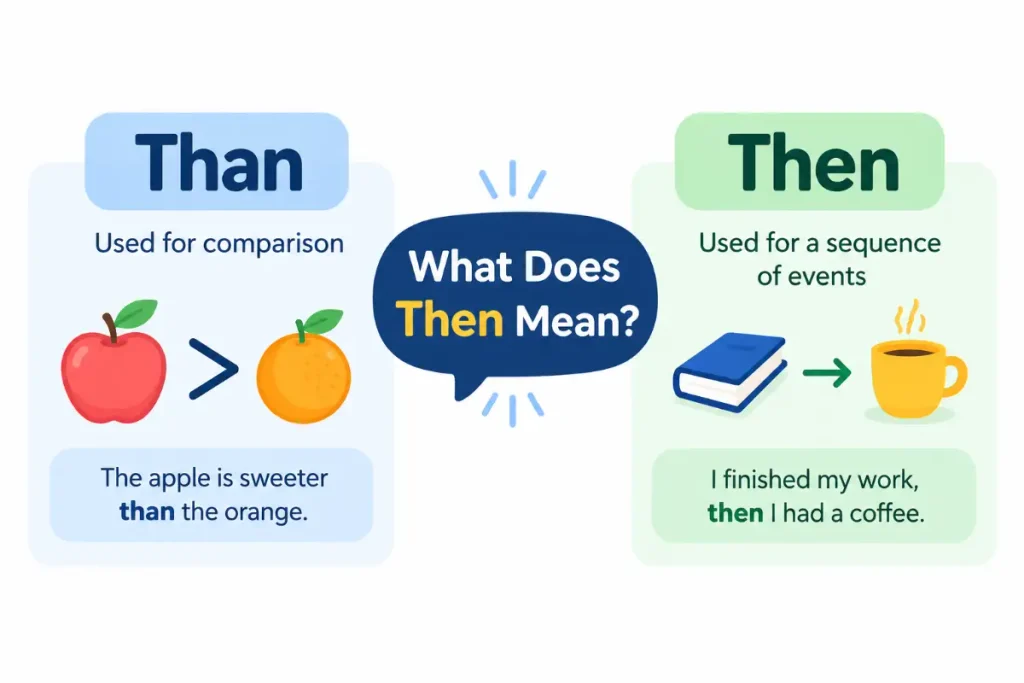
Just as small spelling differences can change meaning, understanding your vs you’re explained can help you avoid another common mistake in everyday writing.
What Does Then Mean
Then is mainly associated with time, sequence, and consequence. It can describe something that happened at a particular time, something that happened next, or a result that follows from a condition.
For example, I lived in Chicago then uses then to refer to a particular time in the past. Finish your homework then watch TV uses it to show sequence. If you are ready then we can leave uses it to introduce a result or consequence.
These uses are different from the comparison function of than.
Then For Time
When then refers to a time, it often means at that time or at that point. The exact time may already be clear from the surrounding conversation.
- I was living in New York then.
- She was much younger then.
- Things were different then.
- I did not understand it then.
- We did not have the technology we have now back then.
In these sentences, then points to a time rather than comparing two things.
Then For Sequence
Then can also show that one action follows another. This is especially common when giving instructions, telling a story, or describing a process.
- First, wash the vegetables. Then, cut them into small pieces.
- We went to dinner and then watched a movie.
- Finish the report, then send it to your manager.
- She packed her bag and then left for the airport.
Here, then means something close to next or after that. A useful test is to replace then with next or after that. If the sentence still makes sense, then is likely correct.
Then For A Result
Another important use appears in conditional sentences. In this structure, then can introduce the result that follows from a condition.
- If you need help, then call me.
- If it rains, then we will stay inside.
- If you are finished, then you can leave.
- If the store is closed, then we will come back tomorrow.
In everyday American English, then can sometimes be omitted from these sentences without changing the basic meaning.
- If you need help, call me.
- If you need help, then call me.
Both can be correct. The version with then can place slightly more emphasis on the result.
Than vs Then Comparison
The clearest way to understand the difference is to look at their grammatical jobs side by side.
| Feature | Than | Then |
|---|---|---|
| Main function | Comparison | Time, sequence, or result |
| Basic meaning | In comparison with | At that time, next, or as a result |
| Common pattern | better than, more than, less than | first then, now then, if then |
| Part of speech | Conjunction or preposition | Adverb |
| Common question | Compared with what? | When or what happens next? |
| Example | This is better than that. | We ate then left. |
The simplest memory rule is than compares and then tells when or what comes next. It is not a complete description of every grammatical use, but it works for the vast majority of everyday situations.
How To Tell The Difference
When you are unsure, look at the relationship between the words in the sentence instead of focusing on how they sound.
First, ask yourself if the sentence is making a comparison. If it compares two people, objects, amounts, qualities, actions, or ideas, than is probably the correct word.
Next, ask if the word refers to time or sequence. If it means at that time, next, or after that, use then.
You can use these quick tests:
- Is the sentence comparing something? Use than.
- Can you replace the word with next or after that? Use then.
- Can you replace it with at that time? Use then.
- Does it follow a comparative such as better, bigger, more, less, faster, or older? Use than.
For example, consider This car is faster than mine. The sentence compares two cars, so than is correct.
Now consider We went to the store then came home. The word means after that, so then is correct.
Than vs Then Examples
Examples make the difference easier to recognize because the two words can appear in similar looking sentences while performing completely different jobs.
Examples With Than
Use than when a sentence compares two things, people, amounts, or ideas.
- My new laptop is faster than my old one.
- This restaurant is better than the one downtown.
- She is taller than her sister.
- The blue shirt costs more than the white shirt.
- This route is shorter than the highway.
- He finished earlier than expected.
- I would rather stay home than go out tonight.
- There are more students in this class than in the morning class.
- The problem was harder than I thought.
- We need more than ten minutes to finish.
Each example involves a comparison or contrast. The word than introduces the second side of that relationship.
Examples With Then
Use then when you are talking about time, sequence, or a consequence.
- We had dinner then went home.
- First, read the instructions then start the test.
- I was living in Texas then.
- She was younger then.
- Finish your work then take a break.
- If you agree, then we can begin.
- He opened the door and then walked inside.
- Back then, people used different technology.
- If the weather improves, then we will go outside.
- I will call you then.
These examples do not compare two things. Instead, then establishes a time, sequence, or result.
Common Phrases With Than
Learning common expressions can make the correct spelling almost automatic. Many comparison phrases naturally require than.
Better Than
Better than compares two things based on quality, performance, or preference.
- This version is better than the original.
- I think this option is better than the other one.
Never use then simply because the phrase sounds familiar. The phrase expresses comparison, so than is required.
More Than
More than can compare quantities or indicate an amount beyond a particular point.
- The box weighs more than five pounds.
- She has more than enough experience.
- More than 100 people attended the event.
Less Than
Less than compares amounts, degrees, or quantities.
- The trip takes less than two hours.
- This phone costs less than $500.
- He spends less than his brother.
Rather Than
Rather than introduces an alternative or preference.
- I would walk rather than wait.
- She chose to call rather than send a text.
- We decided to stay home rather than drive in the storm.
The phrase rather than is especially useful because writers sometimes mistakenly type rather then. In standard English, the correct expression is rather than when you are presenting an alternative.
Other Than
Other than means something different from or in addition to the thing mentioned.
- Do you need anything other than water?
- I do not know anyone other than Sarah who can help.
If you’re working on other frequently confused words, three commonly confused words such as there, their, and they’re are also worth mastering.
Common Phrases With Then
Then also appears in many familiar expressions and structures.
And Then
And then usually introduces the next event in a sequence.
- We finished dinner and then went home.
- She called me and then sent an email.
Back Then
Back then refers to an earlier period.
- Back then, we did not have smartphones.
- Things were much different back then.
Until Then
Until then means up to that point in time.
- I will stay here until then.
- We will continue with the current plan until then.
Every Now And Then
Every now and then means occasionally.
- I still visit that restaurant every now and then.
- She calls me every now and then.
This expression always uses then, not than, because it is connected with time.
If Then
If then can connect a condition with its consequence.
- If the store is open, then we can go inside.
- If you finish early, then you can leave.
In many sentences, the then is optional, but it is still grammatically valid.
Common Mistakes
The confusion between than and then usually happens because the words are similar in spelling and pronunciation. A writer may type one automatically without noticing that the sentence requires the other.
Better Then
- Incorrect: This option is better then the first one.
- Correct: This option is better than the first one.
The word follows the comparative adjective better, so the sentence is making a comparison.
First Than
- Incorrect: First, wash your hands than prepare the food.
- Correct: First, wash your hands then prepare the food.
The sentence describes a sequence. The second action happens after the first one, so then is correct.
Rather Then
- Incorrect: I would stay home rather then drive.
- Correct: I would stay home rather than drive.
The expression rather than introduces an alternative or preference.
More Then
- Incorrect: The repair will cost more then $100.
- Correct: The repair will cost more than $100.
The phrase compares the expected cost with $100, so than is required.
First Then Than
Sometimes a sentence genuinely needs both words.
First, compare the prices, then choose the cheaper option rather than the more expensive one.
Here, then shows sequence, while than appears in rather than and cheaper than could also be used in a comparison. The words can appear close together without being interchangeable.
Than Or Then In Everyday Writing
In casual communication, the error can be easy to overlook because readers often understand the intended meaning from context. Someone who writes better then mine almost certainly means better than mine, and someone who writes finish this than call me may mean finish this then call me.
Even so, the distinction matters in professional and academic writing. Repeated confusion between the two words can make otherwise clear writing look careless. A quick proofreading check is usually enough to catch the problem.
Pay particular attention after comparative words. If you see better, more, less, faster, older, younger, easier, or similar comparison language, check the following word carefully. If the sentence describes what happens next, check for then.
Grammar Rules For Than And Then
Than is generally used to connect the elements of a comparison. It can introduce a noun phrase, pronoun, clause, or other comparison point.
- She is older than me.
- She is older than I am.
- This is more difficult than I expected.
- He runs faster than his brother.
In formal writing, constructions can sometimes be more carefully structured around subject and object forms, but everyday American English commonly uses phrases such as older than me.
Then functions mainly as an adverb. It can modify an action by identifying when it happened, show the next step in a sequence, or connect a condition with its consequence.
- We lived there then.
- She left then.
- We ate then went home.
- If you agree, then we can start.
The key grammatical distinction is therefore simple. Than connects a comparison. Then modifies or connects information about time, sequence, or consequence.
Pronunciation
In standard American English, than and then are pronounced differently, although the difference can be subtle for some speakers. Than is commonly pronounced approximately /ðæn/, while then is commonly pronounced approximately /ðɛn/.
The first consonant is the voiced th sound in both words. The main difference is the vowel. Than has the vowel sound found in words such as cat, while then has a vowel closer to the one in bed.
A simple pronunciation guide is:
- Than sounds like than with a broad short a.
- Then sounds like then with a short e.
Because the vowel difference can become less noticeable in fast speech or certain accents, spelling and sentence meaning remain more reliable than pronunciation alone.
Word Origin And Etymology
Than and then have different historical origins even though their forms became similar over time.
Than developed from Old English þanne and related forms that were used in comparative constructions. Its history is closely connected with the development of comparison in English.
Then comes from Old English þanne and related forms associated with time and sequence. The historical forms of the two words overlapped significantly, which helps explain why their modern spellings are so similar.
Over the history of English, spelling and grammatical functions became more clearly differentiated. Modern standard English now treats than primarily as a comparison word and then primarily as a word connected with time, sequence, and consequence.
American English And Regional Usage
American English uses than and then with the same basic distinctions described in this article. British, Canadian, and Australian English also use both words in these core grammatical roles.
The main issue is not a difference between American and British spelling. It is a word choice problem. Better than is standard in both American and British English, while then remains the normal form for sequence or time.
Pronunciation can vary by region and speaker, but the written distinction is stable. A US reader encountering better then will normally understand the intended meaning from context, but the standard written form is better than.
Formal And Casual Usage
Both than and then are standard words used in formal and informal English. There is no special casual version of either word that should replace the standard spelling.
You can use than in academic writing, professional reports, emails, and everyday conversation:
The results were more positive than expected.
You can use then in the same range of contexts:
The team reviewed the results and then prepared the report.
The important issue is choosing the word that matches the meaning. Unlike some slang or regional expressions, neither than nor then is inherently formal or informal.
Related Words People Confuse
The confusion between than and then is part of a larger group of English word choice problems. Several pairs look or sound similar but have different grammatical functions.
There Their And They’re
There commonly refers to a place or introduces existence. Their shows possession. They’re means they are.
- The keys are there.
- Their keys are missing.
- They’re looking for their keys.
Your And You’re
Your is possessive, while you’re means you are.
- Your phone is ringing.
- You’re late.
Its And It’s
Its is possessive, while it’s usually means it is or it has.
- The company changed its policy.
- It’s changing quickly.
To Too And Two
To has several grammatical uses, too commonly means also or excessively, and two refers to the number 2.
These examples show why similar pronunciation does not always indicate similar meaning or function.
Expert Usage Tips
The most useful habit is to stop memorizing isolated spellings and start identifying the relationship between the words in the sentence. If the sentence compares one thing with another, look for than. If the sentence tells you when something happened, what happens next, or what result follows, look for then.
Another useful proofreading method is to search for common comparison words. When you see better, worse, more, less, faster, slower, older, younger, easier, or similar forms, check the word that follows. Many mistakes become obvious once you recognize that a comparison is being made.
You can also check for sequence language. Words such as first, next, after, and finally often appear near then because they describe the order of events. This is not an absolute grammar rule, but it is a useful signal during proofreading.
Most importantly, do not assume that the similar spelling means the words are interchangeable. Than and then have separate grammatical functions. Once you connect each word with its main job, the distinction becomes much easier to remember.
Another useful comparison is the difference between its and it’s, since the apostrophe can easily lead to confusion in quick writing.
Frequently Asked Questions
Which is correct than or then
Both than and then are correct words, but they are used in different situations. Use than for comparisons, as in better than mine. Use then for time, sequence, or consequence, as in finish your work then leave. The correct choice depends on what the sentence is trying to express.
What is the easiest way to remember than and then
Remember than compares and then tells what happens next or when something happened. For example, This car is faster than mine is a comparison. We ate then left describes sequence. You can also replace then with after that or at that time to test its meaning.
Is it better than or better then
The correct phrase is better than. Better is a comparative adjective, so it normally introduces a comparison with than. For example, This restaurant is better than the one near my house compares two restaurants. Better then is not the standard spelling for this meaning.
Is it rather than or rather then
The correct expression is rather than. It introduces an alternative or preference, as in I would walk rather than wait. The phrase is standard in American English and British English. Rather then is a common spelling mistake caused by confusion between the two words.
Is it more than or more then
The correct expression is more than when you are comparing an amount or degree. For example, The project took more than three weeks compares the project duration with three weeks. More then is incorrect when this comparison is intended.
Can then be used at the beginning of a sentence
Yes. Then can begin a sentence when it refers to a time, introduces the next step, or connects to a previous idea. For example, Then we went home means that going home happened next. It can also introduce a consequence in a suitable conditional structure.
Can than be used without a comparison
Yes. Than is strongly associated with comparison, but the comparison does not always need to be expressed as a simple adjective plus than. It can appear in phrases such as rather than, other than, and more than, where it still establishes contrast, preference, difference, or comparison.
Why do people confuse than and then
People confuse them because the words are visually similar, have related historical forms, and can sound somewhat similar in ordinary speech. Fast typing and autocorrect can add to the problem. The most reliable solution is to focus on function: than signals comparison, while then usually signals time, sequence, or consequence.
Conclusion
The difference between than and then is straightforward once you connect each word with its main grammatical job. Than is used for comparisons, including common phrases such as better than, more than, less than, and rather than. Then is used for time, sequence, and results, as in back then, first this then that, and if this happens then that follows.
When proofreading, ask one simple question: Am I comparing something, or am I talking about time or sequence? If you are comparing, choose than. If you mean at that time, next, after that, or a resulting action, choose then. With that distinction in mind, than vs then becomes much easier to handle in everyday and professional writing.