If you have ever hesitated between its vs it’s, you are dealing with one of the most common punctuation and grammar problems in English. The two forms look almost identical and sound the same in ordinary speech, but they do completely different jobs in a sentence. The apostrophe is the key difference, but knowing when to use it requires more than simply remembering that one spelling has an apostrophe.
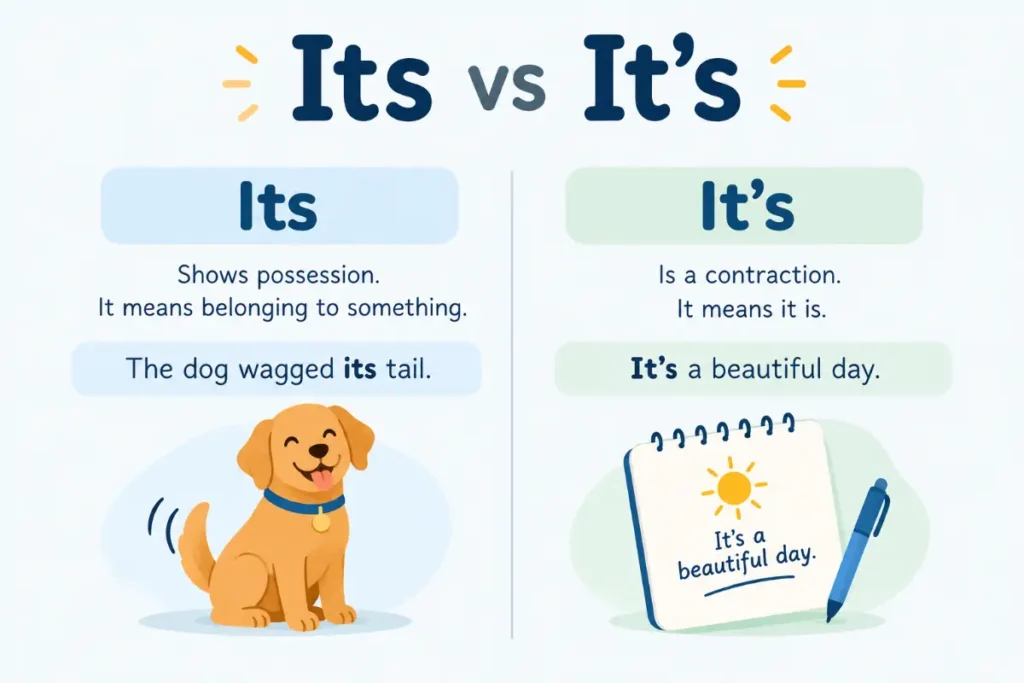
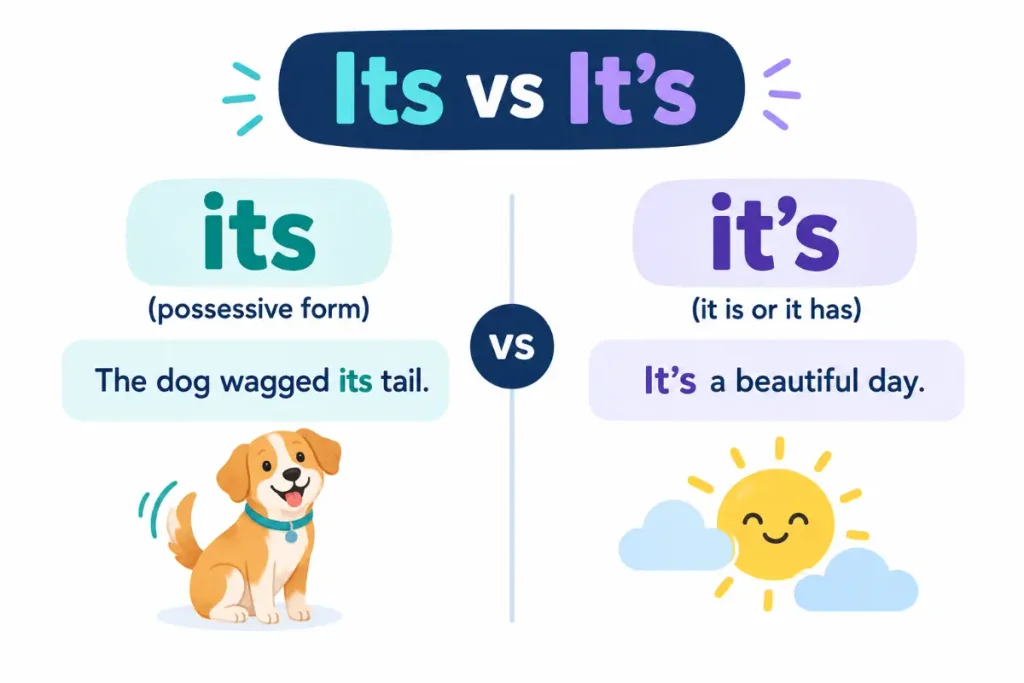
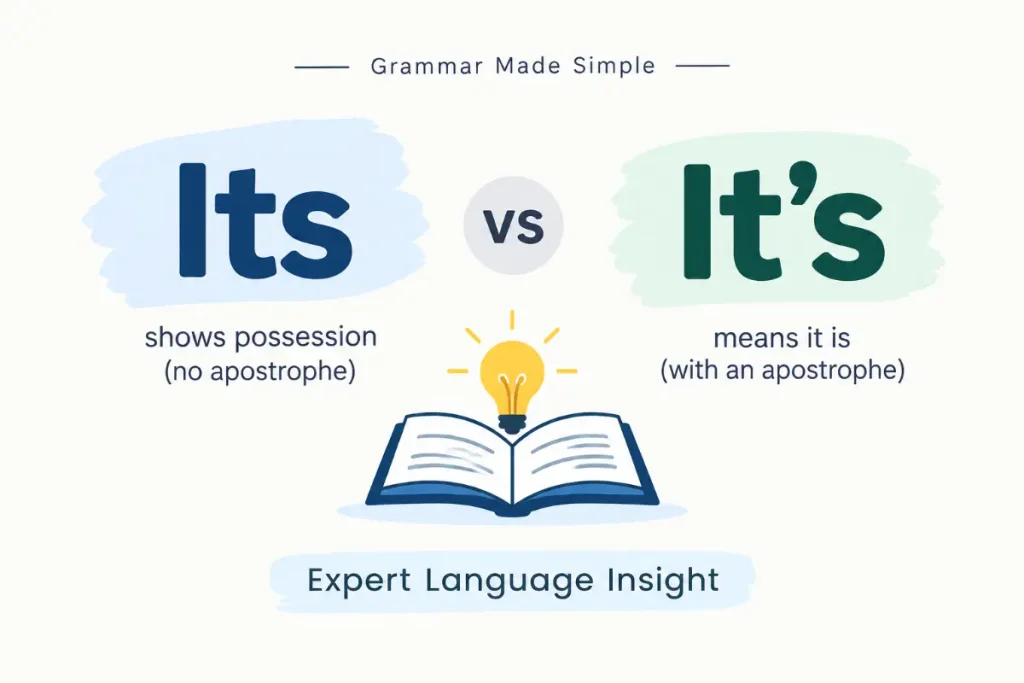
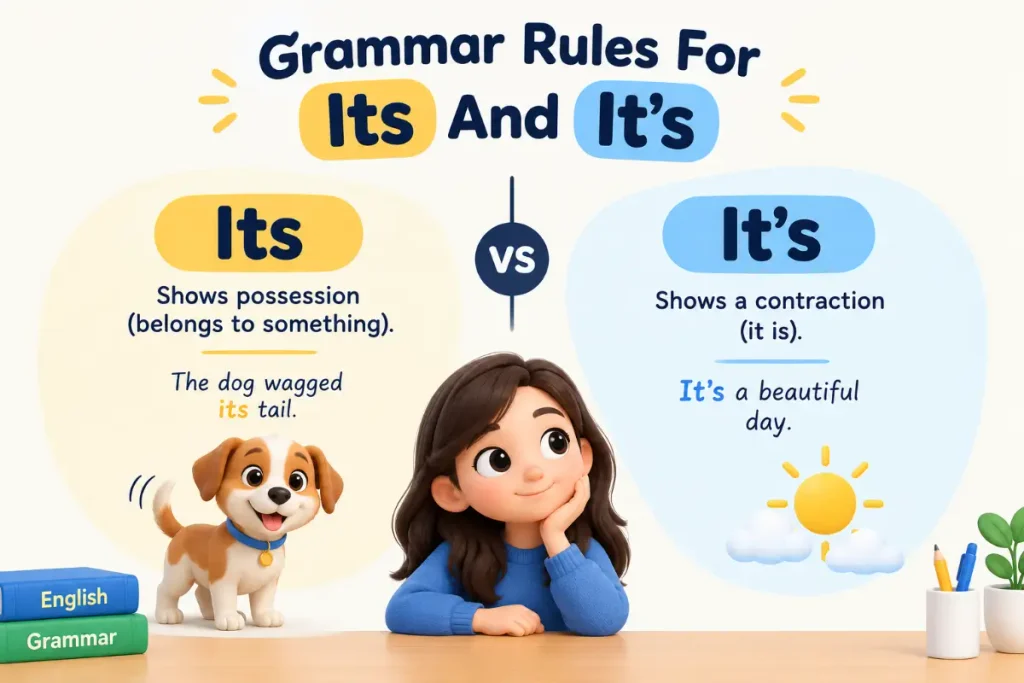
Its is a possessive word. It shows that something belongs to, relates to, or is associated with a thing, animal, organization, or other singular noun. It’s is a contraction that usually means it is or sometimes it has. For example, The dog wagged its tail uses the possessive form, while It’s raining means It is raining.
This distinction becomes much easier once you learn a simple replacement test. If you can replace it’s with it is or it has, the apostrophe belongs there. If neither expansion works and you are showing possession, its is the correct choice.
Quick Answer
Its is the possessive form used to show that something belongs to or is connected with a thing or animal. It’s is a contraction of it is or it has. Use its in The company changed its policy and it’s in It’s a beautiful day.
What Does Its Mean
Its is a possessive determiner. It shows ownership, association, connection, or a characteristic belonging to something previously mentioned. Unlike many other possessive words, its does not have an apostrophe.
You can use its when the owner is a singular nonhuman noun or when the thing being discussed is treated with the pronoun it. Common examples include the dog and its owner, the company and its employees, the car and its engine, and the tree and its branches.
Consider these examples:
- The cat cleaned its paws.
- The company changed its logo.
- The computer lost its connection.
- The school updated its website.
- The car needs its tires replaced.
- The tree lost its leaves.
In each sentence, its shows a relationship between something and another noun. The cat has paws. The company has a logo. The computer has a connection. The school has a website.
The important point is that its works like other possessive determiners such as my, your, his, her, our, and their. You would say my phone, your phone, her phone, and their phone. In the same pattern, you say its phone when it is the possessor.
Its Shows Possession
The word its does not always describe literal ownership. Possession in grammar can mean a broader relationship or association.
For example, The company announced its decision does not mean the company physically owns the decision. The decision is associated with the company. Similarly, The book lost its cover describes a part of the book, not ownership in the ordinary sense.
Here are more examples:
- The restaurant changed its menu.
- The phone needs its battery replaced.
- The bird spread its wings.
- The house needs its roof repaired.
- The organization announced its plans.
- The website changed its design.
In each case, its connects the first noun with something related to it.
Its Before A Noun
A useful way to recognize its is to look at what follows it. Its normally appears directly before a noun or noun phrase.
For example:
- its color
- its name
- its purpose
- its owner
- its location
- its original design
- its main advantage
If you see a sentence such as The phone lost its signal, the noun signal follows its, and the word shows a relationship between the phone and the signal.
This structure can help you distinguish its from it’s. If you are trying to say that something possesses or relates to a noun, its is usually the form you need.
If you often confuse affect and effect explained, you may also find its vs. it’s tricky because both pairs look similar but serve different grammatical roles.
What Does It’s Mean
It’s is a contraction. It can represent it is or it has. The apostrophe indicates that letters have been omitted when the two words are combined.
The most common use is it is.
- It’s cold outside. → It is cold outside.
- It’s a great idea. → It is a great idea.
- It’s difficult to explain. → It is difficult to explain.
- It’s ready now. → It is ready now.
The second use is it has, usually when has functions as an auxiliary verb.
- It’s been a long day. → It has been a long day.
- It’s changed since last year. → It has changed since last year.
- It’s already started. → It has already started.
- It’s become more popular. → It has become more popular.
The simplest way to identify it’s is to expand it. Replace it’s with it is. If that does not work, try it has. If one of those versions makes sense, it’s is correct.
It’s Means It Is
The it is meaning appears in a wide range of sentences. It can describe a condition, identify something, give an opinion, or make a statement about a situation.
- It’s raining outside.
- It’s too late to call.
- It’s my favorite restaurant.
- It’s difficult to find parking here.
- It’s important to check the details.
- It’s better to wait.
Try expanding each sentence. It is raining outside and It is my favorite restaurant are both grammatical, so the contraction it’s is appropriate.
It’s Means It Has
The it has meaning often appears before a past participle.
- It’s been three weeks.
- It’s changed a lot.
- It’s already happened.
- It’s become a popular choice.
- It’s grown considerably.
This use sometimes causes confusion because readers remember only the rule that it’s means it is. That rule is helpful for beginners, but it is incomplete. It’s can also mean it has.
Its vs It’s Comparison
The difference becomes clearer when the two forms are placed next to each other.
| Feature | Its | It’s |
|---|---|---|
| Main function | Possessive determiner | Contraction |
| Meaning | Belonging to it or associated with it | It is or it has |
| Apostrophe | No | Yes |
| Common position | Before a noun | Before a description, noun, phrase, or verb form |
| Example | The dog hurt its paw. | It’s hurt. |
| Replacement test | Belonging to it | It is or it has |
| Common mistake | Adding an apostrophe for possession | Using it for possession |
The key difference is grammatical rather than visual. Its shows a relationship of possession or association. It’s combines two words.
This is why the common idea that apostrophes always indicate possession does not work here. In it’s, the apostrophe signals a contraction. In its, there is no apostrophe because the word is already the standard possessive form.
How To Tell The Difference
The most reliable way to choose between its and it’s is to use the expansion test.
Step One
Look at it’s and replace it with it is.
For example:
It’s cold today.
becomes:
It is cold today.
The sentence works, so it’s is correct.
Step Two
If it is does not work, try it has.
For example:
It’s been a difficult week.
becomes:
It has been a difficult week.
The sentence works, so it’s is correct.
Step Three
If neither it is nor it has works, ask if the word shows possession or association.
For example:
The company changed its name.
Try the expansion:
The company changed it is name.
That clearly does not work. The sentence needs a possessive form before name, so its is correct.
This test works because the two forms have fundamentally different grammatical functions. You are not simply memorizing spelling. You are identifying what the word means in the sentence.
Its vs It’s Examples
Examples make the distinction easier because they show how the words behave in natural sentences.
Examples With Its
Use its when you need to show possession, association, or a relationship with something.
- The dog wagged its tail.
- The company announced its new product.
- The restaurant changed its hours.
- The phone lost its connection.
- The school updated its rules.
- The tree dropped its leaves.
- The car needs its oil changed.
- The computer restarted after its update.
- The organization published its annual report.
- The business built its reputation through good service.
Notice that every example connects its with a noun. The tail belongs to or is part of the dog. The product is associated with the company. The hours belong to the restaurant’s operating schedule. The connection belongs to the phone.
Examples With It’s
Use it’s when you mean it is or it has.
- It’s a beautiful morning.
- It’s time to leave.
- It’s difficult to know what happened.
- It’s much easier than I expected.
- It’s ready to use.
- It’s raining outside.
- It’s been a busy week.
- It’s already started.
- It’s changed since we last visited.
- It’s become a popular option.
Try expanding each example. The first six can use it is, while the final four can use it has.
Its And It’s In The Same Sentence
Sometimes both forms can appear in one sentence. This is useful because it shows that the difference depends entirely on function.
The company changed its website because it’s outdated.
Here, its shows that the website belongs to or is associated with the company. It’s means it is, because the website is outdated.
Another example is:
The dog hurt its paw, and it’s resting now.
The first word shows possession or association. The second means it is.
You can also use both forms in longer sentences:
The restaurant changed its menu because it’s trying to offer healthier options.
Again, its is possessive, while it’s means it is.
Just as with your and you’re correctly, remembering the difference between its and it’s becomes much easier once you identify the grammatical role each form plays.
Common Mistakes With Its And It’s
The most common mistake is adding an apostrophe to its simply because the writer thinks possession requires one. English does not follow that pattern with this particular pronoun.
Using It’s For Possession
Incorrect: The dog wagged it’s tail.
Correct: The dog wagged its tail.
The tail belongs to or is part of the dog, so the possessive form its is required. You cannot expand it’s to it is because The dog wagged it is tail is not grammatical.
Using Its Instead Of It’s
Incorrect: Its raining outside.
Correct: It’s raining outside.
The intended meaning is It is raining outside. Since the expansion works, the contraction it’s is correct.
Using It’s Before A Possessive Noun
Incorrect: The company changed it’s policy.
Correct: The company changed its policy.
The word before policy needs to show that the policy belongs to or is associated with the company. Its performs that function.
Using Its In A Contraction
Incorrect: Its been a long day.
Correct: It’s been a long day.
Here, it’s means it has. The expanded version is It has been a long day, so the apostrophe is necessary.
Relying On The Apostrophe Rule
A common memory rule says that an apostrophe means possession. That rule works for many possessive nouns, such as Sarah’s book or the dog’s collar, but it does not apply to its.
Pronouns have their own possessive forms. Compare:
- the dog’s collar
- Sarah’s phone
- its collar
- her phone
- their house
The possessive pronoun its does not take an apostrophe.
Grammar Rules For Its And It’s
Understanding the grammar behind the two forms makes the distinction easier to remember.
Its is a possessive determiner. It normally appears before a noun and identifies a relationship between that noun and something previously mentioned.
It’s is a contraction. It combines the pronoun it with either is or has. Because it’s contains a verb, it can participate in the predicate of a sentence.
Compare these structures:
The company changed its policy.
Here, its comes before policy, which is the thing associated with the company.
It’s changing its policy.
The first it’s means it is, while the second its shows possession or association.
This distinction is useful because a contraction and a possessive determiner cannot simply be exchanged. They perform different grammatical jobs.
Its Does Not Mean It Is
One of the most important rules is simple:
Its never means it is.
If you need it is, use it’s.
- It’s important. → It is important.
- It’s cold. → It is cold.
- It’s difficult. → It is difficult.
If you need possession or association, use its.
- The dog lifted its head.
- The company changed its name.
- The country updated its laws.
This rule eliminates most mistakes.
It’s Does Not Show Possession
The reverse rule is equally useful:
It’s does not function as the possessive form of it.
If you mean something belongs to or relates to it, use its.
- The machine lost its power.
- The bird opened its wings.
- The website changed its layout.
- The business expanded its services.
Do not add the apostrophe just because the sentence expresses possession.
Why Is Its Possessive But Has No Apostrophe
This question causes confusion because many English possessives use apostrophes. The answer is that its is a possessive pronoun form that developed without an apostrophe, while the apostrophe in it’s marks omitted letters in a contraction.
The same general pattern appears with other pronouns. We write his, hers, ours, and theirs without apostrophes. We do not write her’s, our’s, or their’s in standard English.
Likewise, the correct possessive form is its, not it’s.
The apostrophe in it’s has a completely different job. It represents the missing letters in it is or it has.
Pronunciation
In standard American English, its and it’s are normally pronounced the same. Both are commonly pronounced approximately /ɪts/.
This makes the distinction impossible to hear in most ordinary conversations. If someone says The dog hurt its paw and It’s cold outside, the words may sound identical even though their grammatical functions are completely different.
That is why this is primarily a writing problem rather than a pronunciation problem. You need to understand the sentence rather than rely on the sound.
The same principle applies to many English contractions and possessive forms. Context, grammar, and spelling work together to communicate the intended meaning.
Word Origin And Etymology
The history of its and it’s helps explain why the modern forms look the way they do.
It comes from Old English forms related to the neuter third person pronoun. The possessive form developed over time into its, which became the standard form used before nouns to show possession or association.
The contraction it’s developed from the combination of it and is, and later also came to represent it has. The apostrophe indicates that letters have been omitted.
The modern distinction is therefore grammatical and historical. The two spellings are not simply optional versions of the same word. Its developed as a possessive form, while it’s developed as a contraction.
American English And Regional Usage
American English uses its and it’s with the same basic grammatical distinction described here. British, Canadian, Australian, and other major varieties of English also generally use the same spellings and meanings.
There is no American spelling variation that changes the basic rule. Its remains the possessive form, while it’s remains the contraction of it is or it has.
Pronunciation can vary slightly among English speaking regions, but the two forms are generally pronounced alike. This means that regional pronunciation does not usually help writers decide which spelling to use.
Formal And Casual Usage
Both its and it’s are standard English forms. Neither is inherently informal.
Its is used in formal writing whenever possession or association is intended. You will see it in business documents, academic writing, news writing, technical material, and everyday communication.
It’s is also grammatically standard. It is common in conversation, email, journalism, general nonfiction, and many forms of professional writing. Some highly formal writing may prefer it is instead of the contraction, but it’s is not grammatically incorrect.
For example, a formal report might say:
It is important to review the results carefully.
A more conversational version might say:
It’s important to review the results carefully.
The difference is primarily one of tone and style. The grammar remains clear in both.
How To Use Its In Professional Writing
Its is especially common in professional writing because organizations, companies, products, systems, and institutions are frequently described as singular entities.
Consider these examples:
- The company updated its privacy policy.
- The organization changed its hiring process.
- The software improved its security features.
- The business expanded its customer support team.
- The university announced its new program.
These sentences use its to connect an organization or thing with something associated with it.
This pattern appears frequently in reports, presentations, websites, product descriptions, academic papers, and business communication. Using the correct possessive form helps keep professional writing clear and polished.
Like there, their, and they’re, its and it’s are another commonly confused trio of forms that sound similar or look closely related but have different meanings and functions.
Expert Language Insight
The most useful way to think about its vs it’s is not as an apostrophe problem but as a grammar problem. Writers often remember that apostrophes can indicate possession, but it’s demonstrates why that rule is too broad. In this pair, the apostrophe signals a contraction, not possession.
A strong editing habit is to expand every it’s during proofreading. Ask yourself if the sentence works with it is or it has. If it does, keep it’s. If it does not, check if you need the possessive its.
This method is more reliable than simply asking if the sentence seems to describe ownership. Possession can be subtle, especially with organizations and objects. A sentence such as The company announced its results describes association rather than physical ownership, but its is still the correct form.
Another useful habit is to notice what follows the word. If its comes before a noun such as name, color, purpose, owner, or design, it is likely functioning as a possessive determiner. If it’s can be expanded to it is or it has, the apostrophe belongs there.
Related Words That Cause Similar Confusion
The its vs it’s problem belongs to a larger group of English spelling and grammar distinctions. Many of these involve contractions and possessive forms.
Your And You’re
Your is possessive, while you’re means you are.
- Your phone is ringing.
- You’re late.
The same expansion test works. You’re late becomes You are late, so the contraction is correct.
Their And They’re
Their shows possession, while they’re means they are.
- Their car is new.
- They’re buying a new car.
The apostrophe in they’re marks a contraction, just as it does in it’s.
Who’s And Whose
Who’s usually means who is or who has, while whose shows possession.
- Who’s coming tonight?
- Whose jacket is this?
Again, the contraction has an apostrophe, while the possessive form does not.
Its And Its
When people search for its vs its, they may simply be comparing the same spelling in different contexts or looking for clarification about capitalization and usage. There is normally no separate standard English word distinguished by changing the capitalization. Its remains the possessive form, while it’s is the contraction.
Frequently Asked Questions
Which is correct its or it’s
Both its and it’s are correct, but they have different meanings. Its is possessive and shows that something belongs to or is associated with something else. It’s is a contraction of it is or it has. Use the expansion test to choose the correct form.
What is the difference between its and it’s
Its shows possession or association, as in The company changed its name. It’s means it is or it has, as in It’s a new company or It’s been successful. The apostrophe in it’s marks the missing letters in the contraction.
Does its mean it is
No. Its does not mean it is. It is the possessive form of it. For example, The dog moved its tail uses its to show a relationship between the dog and its tail. If you mean it is, use it’s, as in It’s moving.
Does it’s always mean it is
No. It’s can mean it is or it has. For example, It’s cold means It is cold, while It’s been a long day means It has been a long day. The surrounding words usually make the intended meaning clear.
Why does its have no apostrophe
Its is a possessive form that is written without an apostrophe in standard English. The apostrophe in it’s has a different function because it marks omitted letters in a contraction. This is why its is correct for possession, while it’s is correct for it is or it has.
How can I remember its and it’s
Use the expansion test. Replace it’s with it is or it has. If the sentence works, use it’s. If neither expansion works and you are showing possession or association, use its. This simple test is more reliable than trying to remember an apostrophe rule.
Is it’s acceptable in formal writing
Yes. It’s is a standard grammatical contraction and can appear in many types of professional and formal writing. Some highly formal styles prefer the full form it is, but that is a matter of tone and style rather than grammatical correctness. Its is also fully standard in formal writing when possession is intended.
Is its only used for animals
No. Its can refer to animals, objects, organizations, institutions, systems, countries, and other things represented by it. Examples include the dog and its owner, the company and its employees, and the machine and its controls. The important point is the grammatical use, not the type of noun.
Conclusion
The difference between its and it’s is simple once you focus on what each form does. Its is possessive and shows that something belongs to or is associated with something else. It’s is a contraction of it is or it has.
The easiest proofreading method is to expand it’s. If it is or it has fits the sentence, keep the apostrophe. If the sentence needs a possessive form before a noun, use its without an apostrophe. Remembering that one distinction will prevent most mistakes and make your writing clearer in school, professional communication, emails, and everyday writing.