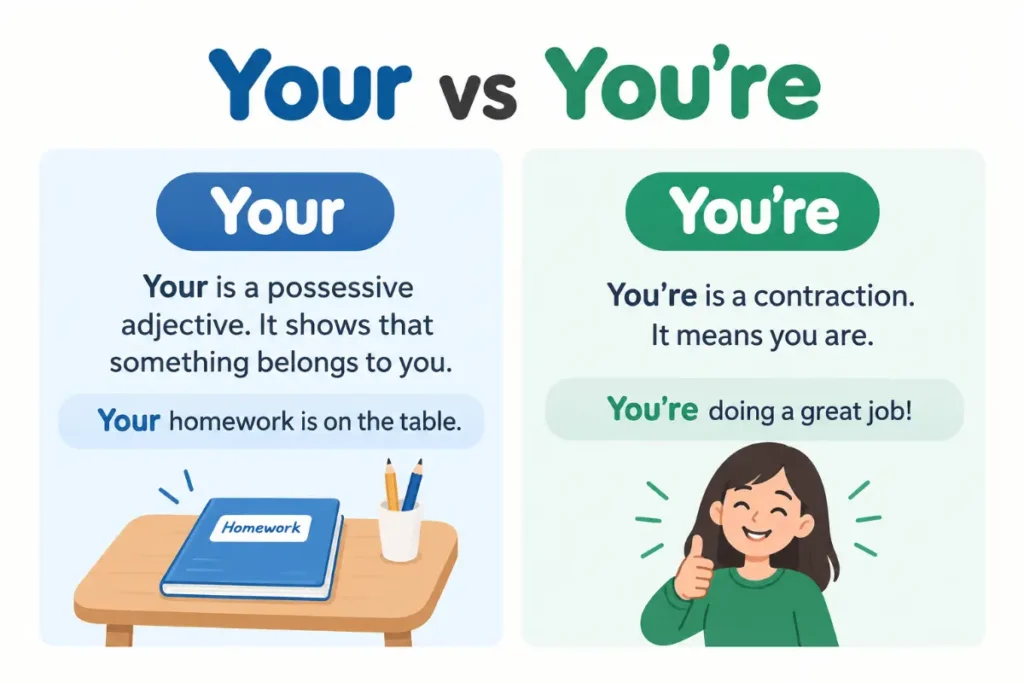
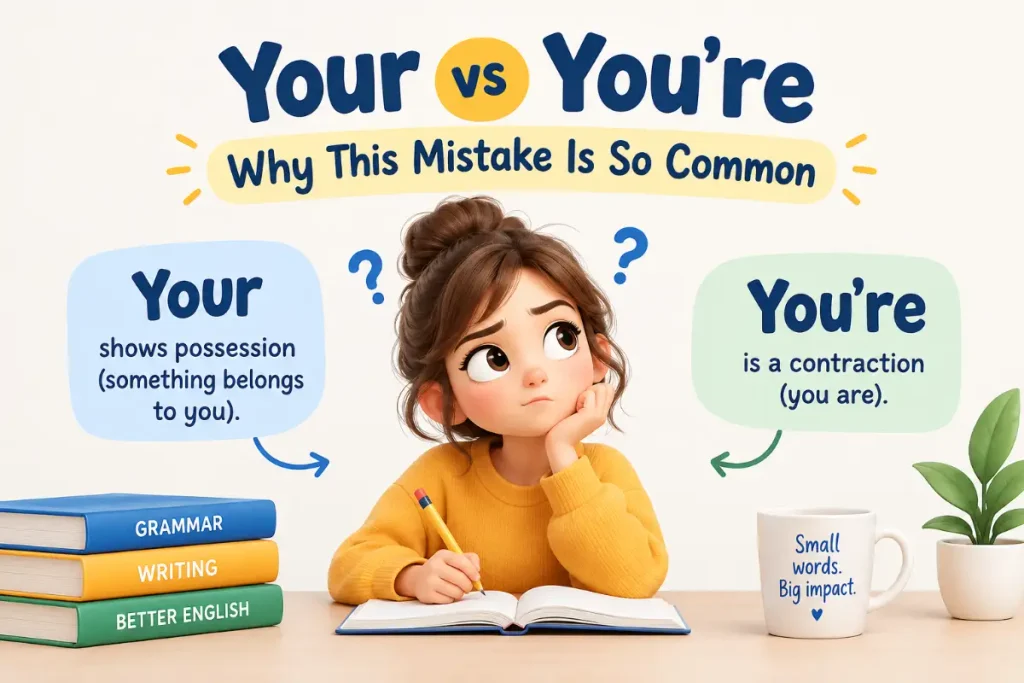
Confusing your vs you’re is one of the most common grammar mistakes in American English. The two forms sound exactly alike in normal speech, but they have completely different jobs in a sentence. One shows that something belongs to or is connected with someone. The other is a contraction of two words.
The good news is that the difference is easy to understand once you stop relying on pronunciation. Your is a possessive determiner, while you’re means you are. That simple substitution test can solve most cases in seconds.
The confusion usually appears in fast writing, texting, emails, school assignments, social media posts, and casual online conversations. Because both forms sound the same, listening cannot tell you which spelling belongs on the page. You have to look at the grammatical role of the word.
This guide explains the difference between the two forms, shows how each one works in real sentences, covers common mistakes, explains pronunciation and word history, and gives you practical ways to choose the correct form without second guessing yourself.
Quick Answer
Your shows possession or association, as in “your phone” or “your idea.” You’re is short for you are, as in “you’re ready” or “you’re welcome.” If you can replace the word with “you are” and the sentence still makes sense, use you’re. Otherwise, use your.
Your vs You’re At A Glance
| Feature | Your | You’re |
|---|---|---|
| Correct form | Your | You’re |
| Part of speech | Possessive determiner | Contraction |
| Full form | No expanded form | You are |
| Main meaning | Belonging or relating to you | You are |
| Pronunciation | Usually the same | Usually the same |
| Common use | Before a noun | Before an adjective, noun phrase, or present participle |
| Example | Your car is outside. | You’re very early. |
| Common mistake | Using it for you are | Using it to show possession |
The key distinction is grammatical rather than phonetic. Your normally works with a noun, while you’re contains the subject you and the verb are.
For example, compare these sentences:
- Your jacket is on the chair.
- You’re sitting on the chair.
The first sentence tells us which jacket belongs to or is associated with you. The second sentence tells us what you are doing.
If you’re unsure about other commonly confused word pairs, the channel and Chanel distinction is another useful example of how spelling can completely change meaning.
What Does Your Mean
Your is a possessive determiner. It identifies something as belonging to, being associated with, or being connected to the person or people addressed as you.
The word does not always describe literal ownership. It can indicate a relationship, responsibility, identity, preference, or connection.
Consider these examples:
- Your house looks beautiful.
- I like your idea.
- Please bring your identification.
- How was your trip.
- Your teacher called earlier.
- I understand your concern.
In each sentence, your comes before a noun or noun phrase.
The house is associated with you. The idea belongs to you in the sense that you proposed it. The teacher is connected with you. The concern is attributed to you.
This broader idea of association explains why your appears in so many different contexts.
Your As A Possessive Determiner
Traditional grammar sometimes calls words such as my, your, his, her, its, our, and their possessive adjectives. Modern grammatical descriptions often use the term possessive determiner because these words determine or specify a noun.
For everyday writing, you do not need to worry about the terminology. The important rule is simple:
Your normally comes before a noun.
Examples include:
- your name
- your answer
- your family
- your opinion
- your favorite movie
- your new computer
- your responsibility
The noun can also be modified by other words.
Your new car looks great.
Here, your identifies whose car the sentence discusses.
What Does You’re Mean
You’re is a contraction of you are.
The apostrophe shows that letters have been omitted when the two words are combined.
you + are = you’re
Examples include:
- You’re late.
- You’re very kind.
- You’re doing a great job.
- You’re ready for the meeting.
- You’re the person I was looking for.
- You’re working too hard.
- You’re probably right.
- You’re welcome.
The form can represent several grammatical structures because are can function in different ways.
- In you’re tired, the adjective tired follows the verb.
- In you’re a teacher, the noun phrase a teacher follows the verb.
- In you’re working, the present participle working follows the verb.
In all three cases, you’re means you are.
The Simplest Test
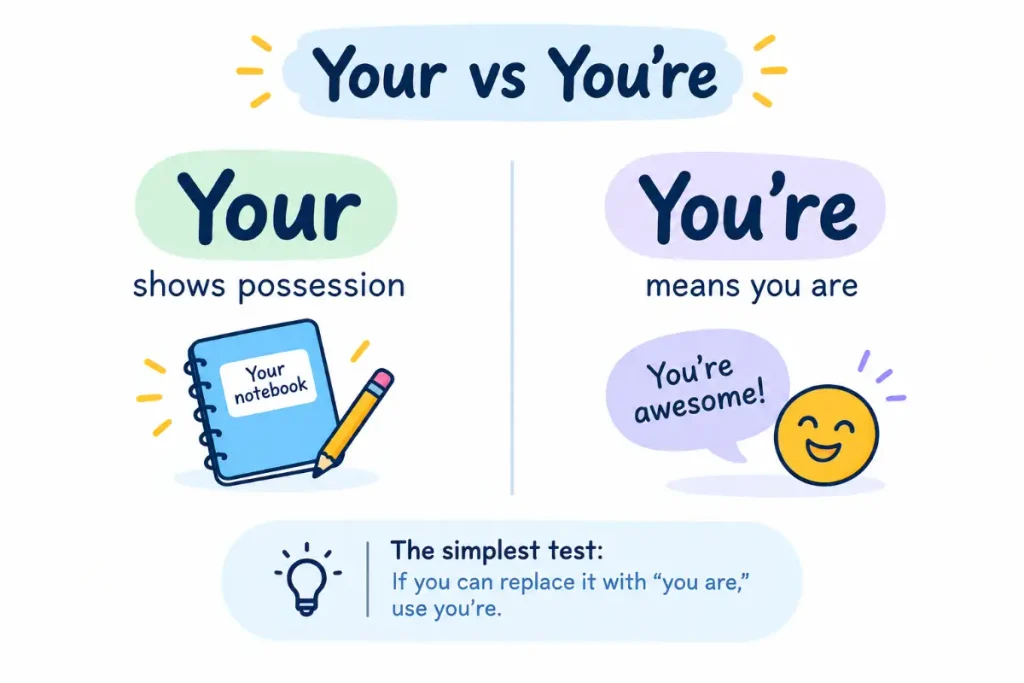
The fastest way to solve the spelling problem is to expand the contraction.
Replace you’re with you are.
If the sentence still makes sense, you’re is correct.
For example:
You’re very helpful.
Replace it:
You are very helpful.
The sentence works, so you’re is correct.
Now consider:
Your very helpful.
Replace it:
You are very helpful.
That might look tempting, but the original sentence contains your where a verb is required. The correct sentence is:
You’re very helpful.
Now try:
I like you’re new shoes.
Replace it:
I like you are new shoes.
That does not make sense. The sentence needs the possessive determiner your:
I like your new shoes.
This substitution test is one of the most reliable ways to catch the mistake.
The Main Difference Between Your And You’re
The difference is not meaning alone. It is also grammatical function.
- Your identifies a noun as belonging to or being associated with the person being addressed.
- You’re contains a subject and a verb. It means you are.
Compare:
- Your dog is friendly.
- You’re friendly.
In the first sentence, your modifies dog. In the second sentence, you’re provides the subject and verb before the adjective friendly.
Another useful comparison is:
- Your answer is correct.
- You’re correct.
The first sentence describes an answer associated with you. The second describes you as being correct. The words may sound identical, but their grammatical structures are completely different.
Examples In Sentences
The best way to learn the distinction is to see the forms in varied contexts.
Examples With Your
- Your keys are on the kitchen counter.
- I enjoyed your presentation yesterday.
- Please check your email before the meeting.
- Your sister left a message for you.
- The teacher praised your essay.
- I agree with your suggestion.
- Did you remember your appointment.
- Your package should arrive tomorrow.
- We need your signature on this form.
- What is your favorite restaurant.
Notice that your is connected to a noun in every example. It identifies the person associated with the keys, presentation, email, sister, essay, suggestion, appointment, package, signature, or restaurant preference.
Examples With You’re
- You’re early for the appointment.
- You’re doing better than you think.
- You’re welcome to join us.
- You’re responsible for the final decision.
- You’re getting better at this.
- You’re exactly right.
- You’re going to enjoy the movie.
- You’re the first person here.
- You’re making a good point.
- You’re ready to begin.
Each example can be expanded by replacing you’re with you are.
You’re making a good point becomes You are making a good point.
The meaning stays intact.
Common Mistakes With Your And You’re
The most common errors happen because the two forms have the same pronunciation.
Mistake One
Your going to love this book.
Correct:
You’re going to love this book.
The intended meaning is you are going to love this book, so the contraction is required.
Mistake Two
I like you’re new haircut.
Correct:
I like your new haircut.
The word comes before the noun phrase new haircut, so it needs to show association or possession.
Mistake Three
Your the best person for the job.
Correct:
You’re the best person for the job.
The sentence means you are the best person for the job.
Mistake Four
I hope your feeling better.
Correct:
I hope you’re feeling better.
The phrase means you are feeling better.
Mistake Five
Is this you’re car.
Correct:
Is this your car.
The word identifies the car as belonging to or being associated with you.
Just as your and you’re have different grammatical roles, understanding village and subdivision meanings can help you choose the right term when describing a place or community.
Why This Mistake Is So Common
Speech gives you almost no help here. In most American English accents, your and you’re are pronounced the same or nearly the same in ordinary conversation.
That means a listener can understand the intended meaning from context without knowing the spelling. Writing removes that advantage.
The mistake also becomes more common when people type quickly. Text messages, social media comments, gaming chats, and informal emails often encourage fast communication. Autocorrect can sometimes make the problem worse by selecting a form that looks grammatically plausible but does not fit the sentence.
Another reason is that English has many contractions and possessive forms. Learners may know the difference in theory but still choose the wrong form automatically when writing quickly.
The solution is not to memorize dozens of examples. Learn the grammatical difference and use the you are test.
Pronunciation Of Your And You’re
In standard American English, your and you’re are commonly pronounced alike.
A common pronunciation for your is represented as /jʊr/ or /jɚ/ depending on the pronunciation system and speech context.
You’re is commonly represented as /jʊr/ or /jʊɚ/.
In natural speech, the vowel quality can change depending on the speaker, surrounding sounds, stress, and speaking speed. In many everyday sentences, listeners will not hear a clear difference between the two forms.
This is why pronunciation is not a reliable spelling test.
If someone says:
Your late.
You cannot determine from the sound alone that the sentence should be written You’re late.
Likewise:
I like you’re jacket.
Sounds like the intended sentence, but the written form should be:
I like your jacket.
When deciding between them, focus on grammar rather than sound.
A Simple Memory Trick
Use this two question method.
Question one: Does the sentence mean you are.
If yes, use you’re.
Question two: Is the word describing or identifying a noun connected with you.
If yes, use your.
You can make the rule even shorter:
- You’re = you are.
- Your = belongs to or relates to you.
For example:
You’re funny.
You are funny.
Your joke is funny.
The joke is associated with you. This distinction works across almost every ordinary sentence.
Grammar Rules You Need To Know
The two forms behave differently because they belong to different grammatical categories.
Your Comes Before A Noun
The most common structure is:
your + noun
Examples include:
- your phone
- your brother
- your question
- your job
- your opinion
- your home
The noun does not have to immediately follow your. Adjectives and other modifiers can appear between them.
Your beautiful new house looks amazing.
Here, your still determines the noun house.
You’re Contains The Verb Are
The basic structure is:
you are + complement
The contraction changes this to:
you’re + complement
Examples include:
- You’re tired.
- You’re a student.
- You’re working late.
- You’re very patient.
- You’re in the right place.
The word after you’re can be an adjective, noun phrase, prepositional phrase, or verb form.
Your Does Not Mean You Are
This is the central grammar rule.
You cannot use your as a replacement for you are.
Incorrect:
Your going home.
Correct:
You’re going home.
The sentence contains the verb phrase are going, so the contraction you’re is required.
You’re Does Not Show Possession
You also cannot use you’re to show possession.
Incorrect:
Where is you’re phone.
Correct:
Where is your phone.
The sentence asks about a phone associated with you. It does not mean you are phone, so the contraction cannot work.
American English Usage
American English uses both forms constantly. There is no American spelling rule that changes the distinction. The same basic difference applies in British, Canadian, Australian, and other major varieties of English.
Regional pronunciation can vary, but the spelling rule remains stable.
In formal American writing, your and you’re are both perfectly standard. The contraction you’re is not inherently incorrect or unprofessional. It is simply less expanded than you are.
For example, an academic writer can correctly write:
If you’re interested in the results, review the next section.
A more formal version might use:
If you are interested in the results, review the next section.
Both are grammatical. The choice depends on tone and style.
Formal And Casual Usage
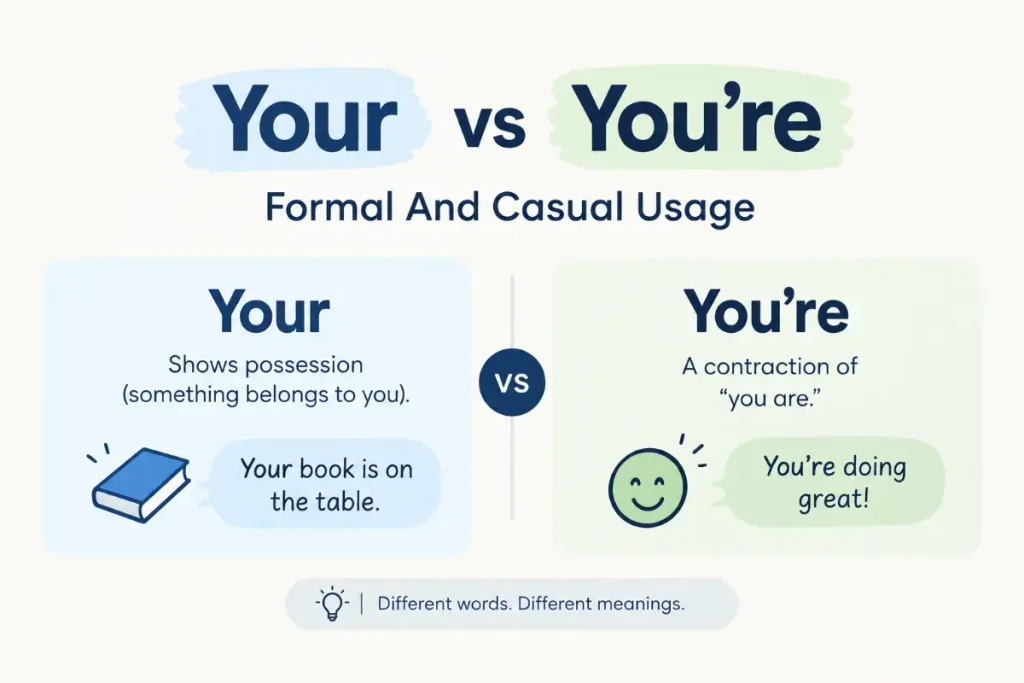
You’re is a normal English contraction, not slang. It appears in conversation, emails, journalism, books, business communication, educational material, and everyday writing.
That said, some highly formal documents may prefer you are instead of contractions. This is a style choice rather than a rule that makes you’re grammatically wrong.
For casual communication:
You’re going to love this.
For professional communication:
You’re invited to attend the meeting.
For especially formal writing:
You are invited to attend the meeting.
All three can be correct.
Your does not have a formal or casual version. It remains the standard possessive determiner in both everyday and formal English.
Related Words And Similar Forms
The confusion becomes easier to manage when you compare these forms with other related words.
Your And Yours
Your normally comes before a noun.
- Your book is on the table.
Yours can stand alone and does not normally require a following noun.
- The book is yours.
This gives us another useful distinction:
- your + noun
- yours = belonging to you
You’re And You Are
These forms have the same basic meaning.
You’re ready.
You are ready.
The difference is that you’re is the contracted form.
You And Your
You is a pronoun that can function as a subject or object.
- You called me.
- I called you.
Your is a possessive determiner.
Your phone is ringing.
These words are related because both refer to the person being addressed, but they perform different grammatical jobs.
Your And Their
Your refers to the person or people being addressed.
- Your car is outside.
Their refers to other people.
- Their car is outside.
The distinction depends on who owns or is associated with the noun.
These small differences in word function are also important when choosing between affect and effect, two terms that are frequently confused in everyday writing.
Your And You’re In Digital Communication
Texting and social media make this distinction especially important because people often write quickly and casually.
A message such as:
You’re going to love this restaurant.
is perfectly normal.
So is:
Your table is ready.
The forms may be mixed up in informal writing, but the grammatical distinction does not disappear just because the setting is casual.
If you are writing a public post, business message, resume, application, school assignment, or customer response, using the correct form is worth the extra second of attention.
A useful editing habit is to search for every occurrence of your and you’re after finishing a document. Read each one in context and ask if you are fits.
Frequently Asked Questions
Which Is Correct Your Or You’re
Both are correct words, but they are used for different purposes. Your shows possession or association and normally comes before a noun. You’re is the contraction of you are. The correct choice depends on the sentence. Use you’re when you mean you are, and use your when referring to something connected with you.
How Do You Remember The Difference
The easiest memory trick is to expand you’re into you are. If the sentence still makes sense, use you’re. If it does not, you probably need your. You can also remember that your usually appears directly before a noun, such as your car, your idea, or your name.
Is Your A Pronoun
In modern grammatical terminology, your is usually classified as a possessive determiner rather than a pronoun. It determines a noun by showing that the noun is associated with the person addressed. Yours, by contrast, can function independently as a possessive pronoun, as in The choice is yours.
Is You’re Always A Contraction
Yes. You’re is the standard contraction of you are. The apostrophe represents omitted letters from the original two word form. It can appear before adjectives, noun phrases, prepositional phrases, and present participles. For example, you’re ready, you’re a teacher, and you’re working all contain the same contraction.
Are Your And You’re Homophones
Yes. In standard English, your and you’re are generally treated as homophones because they have the same or nearly the same pronunciation while having different meanings and grammatical functions. This shared pronunciation is a major reason writers confuse them. Context and grammar rather than sound determine the correct written form.
Is You’re Grammatically Correct
Yes. You’re is completely grammatical when it is used as the contraction of you are. It is common in everyday American English and is also accepted in many forms of formal writing. Some formal style preferences favor expanded forms such as you are, but that is a matter of style rather than grammatical correctness.
Can Your Come Before An Adjective
Yes, but the adjective normally modifies a noun that follows. For example, your new car contains the possessive determiner your, the adjective new, and the noun car. The word your does not function as a substitute for you are. That is why your happy is incorrect when the intended meaning is you are happy.
What Is The Difference Between Your And Yours
Your normally comes before a noun, while yours can stand alone. For example, your jacket identifies a jacket associated with you, while That jacket is yours states that the jacket belongs to you. Both forms express possession, but they have different grammatical positions in a sentence.
The Best Way To Choose The Correct Form
When you are writing quickly, do not try to remember every example you have ever seen. Use the structure of the sentence.
If the sentence contains a noun that is connected with the person being addressed, your is usually the right choice.
Your appointment is tomorrow.
If the sentence means you are, use you’re.
You’re scheduled for tomorrow.
If you are still unsure, expand the contraction.
You’re = you are.
If the expanded sentence sounds wrong, do not use you’re.
This method is more dependable than trying to judge the spelling from pronunciation because the two forms sound alike in most everyday speech.
Final Takeaway
The difference between your vs you’re is simple once you focus on grammar instead of pronunciation. Your is a possessive determiner used before a noun to show possession, association, or connection. You’re is a contraction meaning you are.
Remember the two core patterns:
- Your + noun
- You’re = you are
So write your phone, your opinion, and your answer when something is associated with you. Write you’re ready, you’re correct, and you’re welcome when the sentence means you are.
When in doubt, expand you’re to you are. If the sentence still works, you have your answer. That small habit can eliminate one of the most common spelling and grammar mistakes in everyday English.