Have you ever typed theater or theatre and stopped to wonder which spelling is actually correct? It’s a common question because both versions appear in books, newspapers, school assignments, movie listings, and performing arts websites. At first glance, they look like different words, but they share the same meaning.
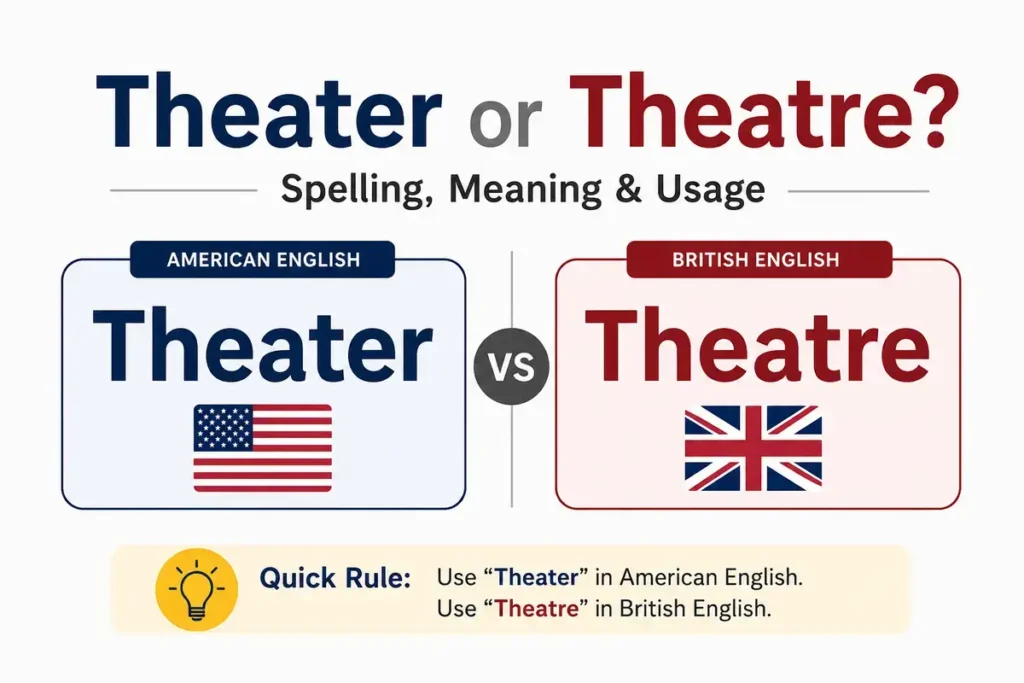
The short answer is simple. Both spellings are correct. The difference comes down to the variety of English you’re using and, in some cases, the style guide or organization you’re writing for. In the United States, theater is the standard spelling for most everyday writing, while theatre is the preferred form in British English. You’ll also notice that many American performance venues intentionally choose Theatre as part of their official names for artistic or historical reasons.
This spelling difference often leaves students, writers, and English learners wondering which version they should use in essays, professional writing, standardized tests, or everyday conversations. The confusion grows because dictionaries accept both spellings, and you’ll find examples of each across the English speaking world.
This guide explains the difference in clear, practical language. You’ll learn the meaning of both words, their history, pronunciation, grammar, regional preferences, real world examples, common mistakes, and expert writing advice. By the end, you’ll know exactly which spelling fits your audience and why.
Quick Definition
Both theater and theatre refer to a place where plays, musicals, concerts, or other live performances take place. They can also describe the dramatic arts as a whole. Theater is the preferred spelling in American English, while theatre is more common in British English. The meaning and pronunciation are the same, so the choice depends on regional language conventions or a specific style guide.
Quick Answer
If you’re looking for the simplest answer, remember these rules.
- Use theater when writing for an American audience unless an organization’s official name uses Theatre.
- Use theatre for British English, Australian English, and many other countries that follow British spelling conventions.
- Both spellings are correct because they refer to the same place and the same performing art.
- Stay consistent throughout your writing instead of switching between the two forms.
Think of this spelling difference the same way you think about color and colour. The meaning doesn’t change. Only the regional preference does.
Comparison Table
| Feature | Theater | Theatre |
|---|---|---|
| Part of speech | Noun | Noun |
| Meaning | A building for live performances or movies. Also the performing arts. | A building for live performances or the performing arts. |
| Origin | From Greek through Latin and French with American spelling development | Same historical origin with British spelling development |
| Preferred spelling | American English | British English |
| Formality | Standard | Standard |
| Common contexts | Schools, businesses, entertainment, movie venues, journalism | Performing arts, education, literature, British publications |
| Usage frequency | Most common in the United States | Most common in the United Kingdom, Australia, and New Zealand |
| Pronunciation | Same as theatre | Same as theater |
| Example | We went to the movie theater after dinner. | She studies theatre at the university. |
Meaning of Each Word
Although the spellings differ, both words describe the same core idea. They can refer to a physical place where performances happen or to the performing arts as a field of study and creative expression.
What Does Theater Mean
In American English, theater is the standard spelling for most situations. It commonly refers to a building where people watch movies, plays, musicals, comedy shows, concerts, or other live performances.
The word also describes the art of acting, directing, producing, and performing on stage.
Here are a few common examples.
- We bought tickets to the local theater.
- She teaches theater at a high school.
- The community theater performs several plays each year.
- He hopes to build a career in musical theater.
- They spent the evening at the movie theater.
You’ll also find theater in military writing. The phrase theater of war describes a geographic area where military operations take place. This meaning has nothing to do with performing arts, but it shares the same historical root.
What Does Theatre Mean
Theatre carries exactly the same meaning. The difference is that it’s the preferred spelling in British English and many countries that follow British language conventions.
The word can describe a performance venue, the dramatic arts, or an academic subject.
Examples include.
- She studies theatre at university.
- We visited a historic theatre in London.
- The local theatre hosts live productions every weekend.
- He has worked in theatre for more than twenty years.
- Their school offers theatre classes after regular lessons.
In the medical field, you’ll also hear the term hospital theatre or operating theatre in British English. In American English, the same room is usually called an operating room. The function is identical. The wording simply reflects regional language preferences.
Key Differences
Since both spellings refer to the same concept, the differences are almost entirely regional and stylistic rather than grammatical or semantic.
The biggest distinction is the audience you’re writing for. American readers generally expect theater, while readers in the United Kingdom and many Commonwealth countries naturally expect theatre. Both spellings appear in dictionaries, and both are considered correct.
Here are the main differences at a glance.
- Theater is the standard American spelling.
- Theatre is the standard British spelling.
- The meaning stays exactly the same.
- The pronunciation doesn’t change.
- Grammar rules apply equally to both spellings.
- Some American performing arts organizations intentionally use Theatre in their official names to reflect tradition or artistic identity.
Understanding that last point helps explain why you’ll sometimes see both spellings in the United States. An official name should always be written exactly as the organization chooses to spell it.
Which Spelling Is Correct
The correct spelling depends on your audience, not on the word itself.
If you’re writing for readers in the United States, theater is almost always the better choice. It follows standard American spelling conventions and matches major style guides, including AP Style, which recommends theater except when using the official name of an organization.
If your audience uses British English, theatre is the expected spelling. That’s the version you’ll see in newspapers, universities, books, and performing arts organizations throughout the United Kingdom and many other English speaking countries.
A simple way to choose is to match the rest of your writing.
- If you write color, favorite, and center, use theater.
- If you write colour, favourite, and centre, use theatre.
- If you’re writing about an organization’s official name, always keep the spelling exactly as the organization uses it.
Following these guidelines keeps your writing consistent and shows attention to detail, which readers and editors both appreciate.
Pronunciation Guide
One reason many people assume there’s a difference in meaning is that the spellings look quite different. In reality, native speakers pronounce both words exactly the same.
IPA Pronunciation
Theater: /ˈθiː.ə.tɚ/ in American English.
Theatre: /ˈθɪə.tə/ or /ˈθiː.ə.tə/ in British English.
Syllable Breakdown
- Thea.
- Ter.
Both words contain two syllables in everyday speech, although the vowel sound may vary slightly between American and British accents.
Common Pronunciation Mistakes
People learning English sometimes pronounce the final letters differently because the spellings look different. Native speakers don’t do this. The spelling changes, but the word is spoken almost the same in everyday conversation.
For exams such as IELTS, pronunciation isn’t affected by the spelling you choose. Examiners care about clear, natural speech rather than regional spelling preferences.
Expert Language Insight
Professional editors don’t think of theater and theatre as competing words. They think of them as regional spelling variants, much like organize and organise or traveler and traveller.
The first question an experienced editor asks is, “Who will read this?” Once the audience is clear, choosing the appropriate spelling becomes straightforward. Editors also check official names carefully because many performance venues, schools, and organizations intentionally preserve a specific spelling as part of their identity.
That attention to consistency is one of the simplest ways to make your writing look polished and trustworthy.
Examples in Sentences
Seeing both spellings in context is one of the easiest ways to understand how they’re used. Since the meaning stays the same, the examples mainly show how the preferred spelling changes based on the audience or publication.
Theater Examples
These examples follow American English conventions.
- We spent Friday night at the movie theater watching the latest action film.
- My sister studies theater at a university in California.
- The community theater is putting on a classic musical this weekend.
- Their school opened a new theater for student performances.
- The director has worked in theater for more than twenty years.
- We arrived at the theater early to find our seats.
- The children performed their first play in the school theater.
- Our town recently renovated its historic theater.
- She dreams of performing on a Broadway theater stage one day.
- The theater was completely sold out before the weekend.
Theatre Examples
These examples reflect British English usage.
- They visited a famous theatre in London during their vacation.
- My cousin studies theatre at a university in Manchester.
- The local theatre presents new productions throughout the year.
- We enjoyed a wonderful evening at the theatre.
- She hopes to build a career in musical theatre.
- The theatre company announced its upcoming season.
- The old theatre has become one of the city’s most popular landmarks.
- Students performed Shakespeare in the college theatre.
- Their theatre festival attracts visitors from around the world.
- He has loved theatre since he was a child.
Common Mistakes
The spelling difference seems simple, but a few common mistakes continue to confuse writers, students, and English learners.
Mixing Both Spellings
The most common mistake is using theater in one paragraph and theatre in another.
For example, an article might begin with the American spelling and later switch to the British version without any reason. This creates inconsistency and makes the writing feel less polished.
The best approach is simple.
- Choose the spelling that matches your audience.
- Use it consistently from beginning to end.
- Keep official names exactly as the organization spells them.
Assuming One Spelling Is Wrong
Many people think only one version is correct.
That’s not true.
Modern dictionaries recognize both spellings because they represent different regional standards rather than different meanings.
Changing Official Names
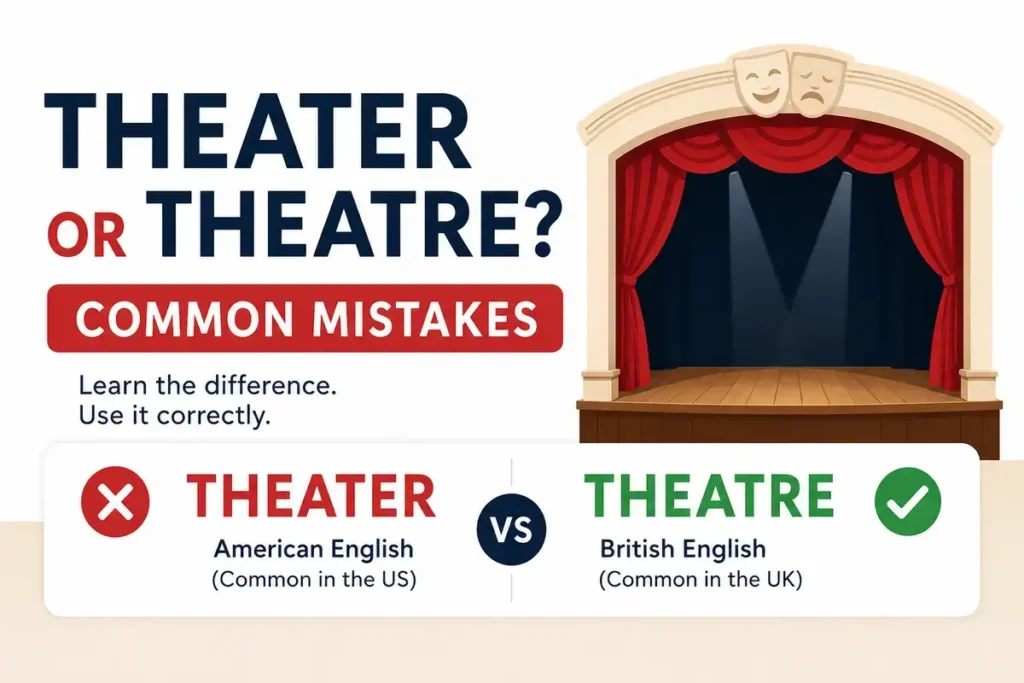
Some American organizations intentionally spell their names with Theatre even though American English usually prefers theater.
For example, if a venue officially calls itself Theatre, don’t change it to Theater. Official names should always remain exactly as the organization uses them.
Confusing Performing Arts With Military Usage
Another source of confusion is the phrase theater of war.
In military writing, theater describes a geographic area where military operations take place. It doesn’t refer to actors, stages, or performances.
British publications may also use theatre of war, reflecting regional spelling rather than a different meaning.
Confusing Hospital Terms
People sometimes wonder why they see hospital theatre in one country and operating room in another.
The answer is regional English.
- American English usually says operating room.
- British English commonly uses operating theatre or hospital theatre.
Both terms describe the same medical facility.
Etymology And Word Origin
The history of these spellings stretches back thousands of years.
The word began with the Ancient Greek term theatron, meaning a place for watching. It later entered Latin as theatrum before passing into Old French.
From there, it became part of Middle English, where spelling was far less standardized than it is today. Writers often used several spellings for the same word, and no single version was considered official.
As English developed, regional spelling differences became more common. British English eventually settled on theatre, while American English gradually adopted theater as the preferred spelling.
Despite the difference in spelling, both forms still trace back to the same Greek root and carry exactly the same meaning.
Regional Usage
Regional preference is the biggest difference between these spellings. Understanding your audience makes choosing the correct form much easier.
American English
American English generally prefers theater in schools, newspapers, business writing, government publications, and everyday communication.
You’ll also find it in the Associated Press Stylebook, which recommends theater except when an organization’s official name uses Theatre.
British English
British English almost always uses theatre.
This spelling appears in newspapers, universities, literature, government publications, and performing arts organizations throughout the United Kingdom.
British English also uses operating theatre in medical settings, a term that may sound unfamiliar to American readers.
Australian English
Australian English follows British spelling conventions, so theatre is the standard choice.
The same preference appears in schools, universities, arts organizations, and media publications across Australia.
Canadian English
Canadian English includes influences from both American and British English, but theatre is generally more common in educational, cultural, and performing arts contexts.
Some businesses that primarily serve American customers may still choose theater to match their audience.
Grammar Rules
Although the spelling changes, the grammar does not.
Both forms function as countable nouns and follow the same grammatical rules.
Part Of Speech
Both theater and theatre are nouns.
Examples include.
- The theater is full.
- The theatre opens at seven.
Singular And Plural Forms
The plural depends on the spelling you choose.
- Theater becomes theaters.
- Theatre becomes theatres.
Examples.
- Several theaters reopened after renovation.
- Historic theatres attract many tourists each year.
Common Sentence Patterns
You’ll often see the word used in structures like these.
- Go to the theater.
- Study theatre.
- Work in theater.
- Perform at the theatre.
- Community theater.
- Musical theatre.
Each phrase sounds natural because native speakers use them regularly.
Consistency Matters
Grammar isn’t the challenge here. Consistency is.
If you’re writing in American English, use American spelling throughout the article. If you’re writing in British English, keep the British spelling consistent from beginning to end.
Real Life Usage Examples
These words appear in many different settings beyond stage performances.
Daily Conversation
People commonly use the word when talking about entertainment.
Examples include.
- Let’s meet at the theater before the movie starts.
- She bought tickets for the theatre next Saturday.
Education
Schools and universities often offer drama courses.
Examples include.
- He enrolled in a theater class to improve his public speaking.
- She chose theatre as her university major.
Professional Communication
The word appears in marketing, event planning, journalism, and entertainment industries.
Examples include.
- The theater announced its new performance schedule.
- The theatre company is hiring stage technicians.
Literature And Media
Authors, journalists, and critics regularly use both spellings depending on the publication’s style guide.
Readers rarely notice the spelling itself because it matches the variety of English used throughout the publication.
Popular Culture
You may also hear the informal phrase theater kid. It describes someone, usually a student, who loves acting, musicals, singing, or stage performances. The phrase is especially common in American schools and social media.
Like the spelling itself, the expression reflects regional language habits rather than a different meaning.
Related Words And Commonly Confused Terms
Once you understand the spelling difference, you’ll notice several related words and expressions that appear in similar contexts. Knowing how they’re connected can make your writing more accurate and help you recognize the right term in different situations.
Related Terms
These words frequently appear alongside discussions about live performances, film, drama, and entertainment.
- Drama.
- Play.
- Stage.
- Performance.
- Musical.
- Acting.
- Actor.
- Actress.
- Playhouse.
- Auditorium.
- Amphitheater.
- Cinema.
- Movie theater.
- Performing arts.
- Stage production.
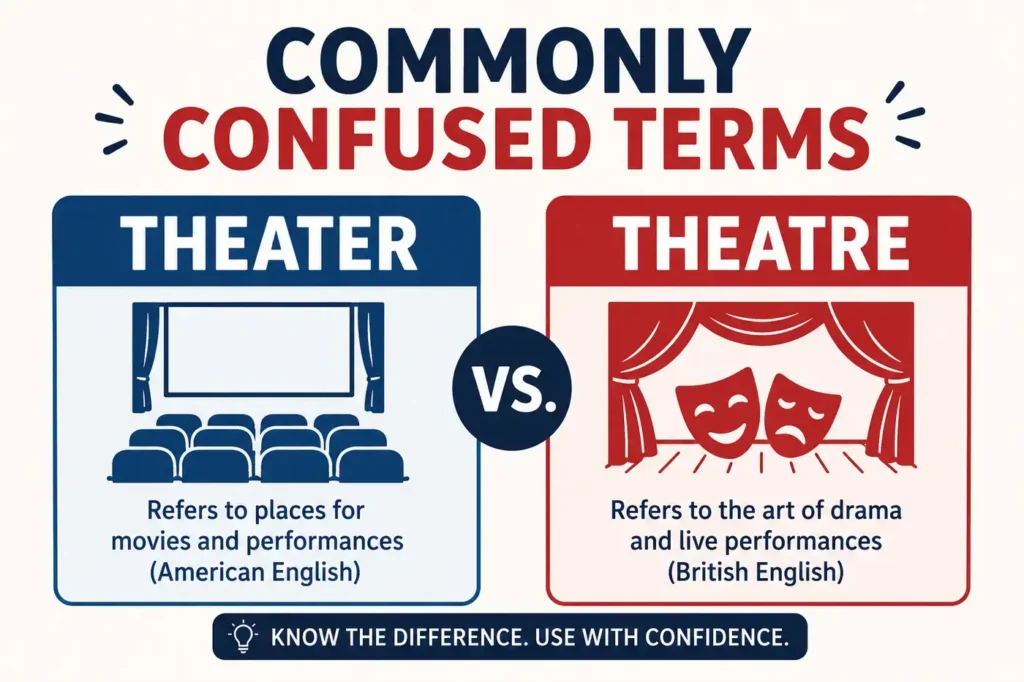
Although these terms are related, they aren’t interchangeable. For example, a cinema is primarily used for showing films, while a theater or theatre often hosts live performances, depending on the context.
Commonly Confused Expressions
Some phrases cause confusion because the word takes on a specialized meaning.
- Theater of war describes the geographic area where military operations take place.
- Operating theatre refers to a surgical room in British English.
- Operating room is the American English equivalent.
- Movie theater usually refers to a cinema in American English.
- Theater kid is an informal term for someone who enjoys acting, singing, musicals, or stage productions, especially during school.
Understanding these expressions helps you recognize the word in different contexts instead of assuming it always refers to live stage performances.
Expert Language Insight
Professional editors rarely spend time debating which spelling is better because there isn’t a universal winner. The decision almost always comes down to audience, publication style, and consistency.
For American readers, theater feels natural because it’s the spelling they’ve seen throughout school, newspapers, and everyday life. Readers in the United Kingdom, Australia, and several other countries have the same reaction to theatre.
There’s also one detail that surprises many writers. Some American performing arts organizations intentionally use Theatre in their official names because they believe it reflects tradition, artistic heritage, or a stronger connection to live stage productions. That doesn’t change standard American spelling. It simply means official names should always be written exactly as the organization presents them.
Experienced editors also avoid changing official titles in books, advertisements, websites, or news articles. Accuracy matters just as much as consistency, especially when referring to schools, venues, or businesses.
If you’re unsure which spelling to choose, ask yourself one simple question.
Who is going to read this?
The answer almost always tells you which spelling fits best.
Frequently Asked Questions
Is theater or theatre correct?
Both spellings are correct. Theater is the standard spelling in American English, while theatre is preferred in British English and many countries that follow British spelling conventions. The meaning, pronunciation, and grammar are the same, so your audience should guide your choice.
Why do some American theaters use theatre?
Many performing arts organizations choose Theatre as part of their official name for historical, artistic, or branding reasons. This is a stylistic decision rather than a grammar rule. When referring to an official organization, always use the spelling it has adopted.
Is there a difference in pronunciation?
No. Native speakers pronounce both spellings almost identically. The only variation comes from regional accents, not from the spelling itself. American and British speakers may pronounce certain vowel sounds differently, but the word remains easily recognizable.
Which spelling should I use for IELTS?
If you’re taking IELTS, either spelling is acceptable as long as you stay consistent. Since the exam follows international English standards, British spelling is common, but American spelling is also accepted if you don’t switch between the two.
Which spelling does AP Style recommend?
The Associated Press Stylebook recommends theater for general use. The exception is an official name, such as a venue or organization that spells its name Theatre. In those cases, always keep the original spelling.
What is an operating theatre?
An operating theatre is the British English term for the room where surgeons perform medical procedures. In American English, the same place is usually called an operating room. The function is identical even though the terminology differs.
What does theater kid mean?
A theater kid is an informal expression for someone who enjoys acting, musicals, choir, drama club, or other stage activities. The phrase is especially popular in schools and on social media, where it’s often used with affection or humor.
Can I use both spellings in the same article?
It’s best to avoid mixing them unless you’re specifically comparing the two forms or using an organization’s official name. Consistent spelling makes your writing look more professional and prevents readers from wondering if the changes were accidental.
Conclusion
Choosing between theater and theatre is much easier once you understand the reason behind the two spellings. They refer to the same place and the same performing arts tradition. The only meaningful difference is regional preference.
If you’re writing for an American audience, theater is the standard choice in schools, journalism, business writing, and everyday communication. If your readers use British English, theatre is the expected spelling. You should also preserve the official spelling used by theaters, universities, companies, and other organizations.
Instead of trying to remember two separate rules, focus on your audience and stay consistent throughout your writing. That simple habit will help your work look polished, professional, and easy to read.