Many English mistakes happen because a word sounds right even when it isn’t. That’s exactly why laid or layed confuses so many people. You may have seen both spellings online, in text messages, social media posts, and even published content. As a result, it’s easy to wonder if both forms are acceptable or if one is actually a mistake.
The short answer is simple. Laid is the correct spelling in standard English. Layed is almost always considered a misspelling. The confusion comes from the verb lay, which has several forms that people often mix up with the verb lie. Once those verb patterns get tangled together, many writers assume that layed must be the past tense. It isn’t.
Understanding the difference matters because laid appears frequently in everyday communication. You’ll see it in phrases like laid down, laid off, laid out, and laid in bed. Using the correct form makes your writing look more polished and helps you avoid a mistake that editors notice immediately.
This guide explains the correct spelling, meaning, grammar rules, pronunciation, sentence examples, common errors, and the real reason so many people get this word wrong.
If you’re refining your everyday English, it’s also worth knowing when to say “me either” or “me neither” so your responses sound natural in different situations.
Quick Definition
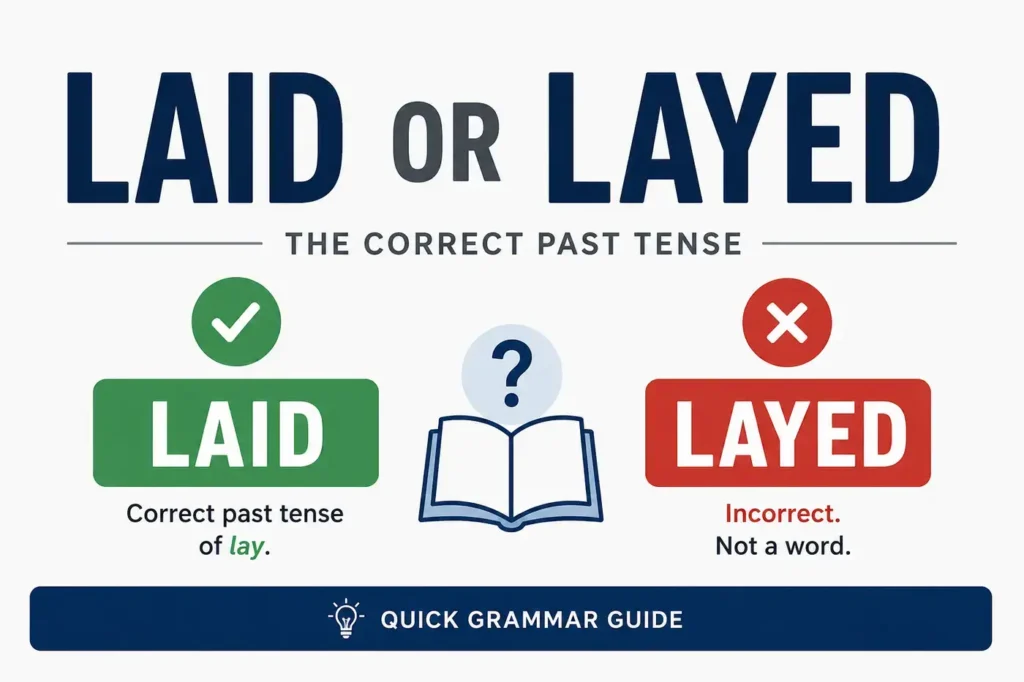
Laid is the correct past tense and past participle form of the verb lay, which means to place or put something down. Layed is generally considered a misspelling in modern English and should be avoided in formal, academic, professional, and everyday writing.
Quick Answer
If you’re deciding between these two spellings, choose laid.
Examples:
- She laid the book on the table.
- The workers were laid off last month.
- He laid out the plans for the project.
- The blanket was laid on the grass.
In standard English, layed is almost never correct. Most grammar guides, dictionaries, editors, teachers, and style manuals recognize laid as the proper form.
Laid or Layed Comparison Table
| Feature | Laid | Layed |
|---|---|---|
| Part of speech | Verb form | Usually a misspelling |
| Origin | Past tense of lay | Nonstandard spelling |
| Correct form | Yes | No in standard English |
| Meaning | Put or placed something down | Usually intended to mean laid |
| Formality level | Accepted in all contexts | Not accepted in formal writing |
| Common contexts | Writing, speech, literature, journalism | Typing mistakes and informal online usage |
| Dictionary recognition | Recognized as standard English | Generally listed as incorrect or nonstandard |
| Usage frequency | Extremely common | Rare outside errors |
| Example | She laid the keys on the counter. | She layed the keys on the counter. |
Understanding The Search Intent
People searching this topic usually aren’t looking for a vocabulary definition. They’re trying to answer one practical question:
Which spelling should I use?
Most users also want help with:
- Grammar rules.
- Past tense usage.
- Common phrases.
- Sentence examples.
- The difference between lay and lie.
- Real world writing situations.
That’s why the focus of this guide is correctness and usage rather than simple definitions.
Meaning Of Laid
The word laid is the past tense and past participle of the verb lay.
The verb lay means to place, put, set, position, or arrange something somewhere.
Examples include:
- She laid her phone on the desk before the meeting started.
- The gardener laid fresh soil around the plants.
- He laid the documents next to the computer.
- They laid new flooring throughout the house.
- The chef carefully laid the ingredients on the plate.
Notice that every example involves placing or positioning something.
This is an important clue because lay is a transitive verb. In simple terms, it usually needs an object. Something is being placed somewhere.
For example:
- She laid the book on the shelf.
- They laid the foundation last year.
- He laid the cards face up.
Each sentence answers the question “laid what?”
Meaning Of Layed
In modern standard English, layed is usually a misspelling of laid.
People often write it because English spelling can be unpredictable. Many verbs form their past tense by adding ed.
Examples include:
- Play becomes played.
- Stay becomes stayed.
- Display becomes displayed.
Because of this pattern, some writers assume:
- Lay becomes layed.
However, English contains many irregular verbs that don’t follow standard patterns.
Examples include:
- Say becomes said.
- Pay becomes paid.
- Lay becomes laid.
The correct past tense developed through historical language changes rather than regular spelling rules.
Key Differences Between The Two Forms
At first glance, these words seem almost identical. The difference is only one letter. Yet that small difference completely changes the correctness of the word.
Here are the most important distinctions.
Spelling Difference
The first difference is simple.
- Laid is the accepted spelling.
- Layed is usually incorrect.
Grammar Difference
Only one form functions as the proper past tense and past participle of lay.
Examples:
- Correct: She laid the baby in the crib.
- Incorrect: She layed the baby in the crib.
Professional Writing Difference
Editors, teachers, publishers, and professional writers expect to see laid.
Using layed can weaken credibility because it appears to be a spelling mistake.
Dictionary Difference
Major dictionaries list laid as the standard form.
When layed appears, it’s generally marked as nonstandard, rare, historical, or incorrect for most modern usage.
Which One Is Correct
The correct choice is laid.
This rule applies in:
- American English.
- British English.
- Australian English.
- Canadian English.
- Academic writing.
- Business communication.
- Journalism.
- Creative writing.
If you’re unsure, choose laid.
Consider these examples:
- The workers were laid off after the company downsized.
- She laid the package near the front door.
- The architect laid out the design plans.
- He laid down his tools and went home.
Every sentence uses the standard and accepted form.
One reason the mistake persists is that English speakers naturally expect verbs ending in certain sounds to take an ed ending. Unfortunately, lay belongs to a group of irregular verbs that follow their own historical pattern.
Learning that pattern once will save you from making the same mistake again.
Pronunciation Guide
One reason people write the wrong spelling is that both forms sound nearly identical when spoken.
Laid Pronunciation
IPA pronunciation:
/leɪd/
Syllable breakdown:
Laid
The word contains only one syllable.
Examples:
- She laid the book on the desk.
- He laid the bricks carefully.
Layed Pronunciation
People usually pronounce layed exactly the same way because they’re attempting to write the word laid.
IPA pronunciation:
/leɪd/
This identical pronunciation explains why the spelling mistake is so common online.
When people learn the word through conversation rather than reading, they often guess the spelling based on sound alone.
Expert Language Insight
As an editor, this is one of the most common grammar mistakes I encounter. The error isn’t caused by poor writing skills. It’s usually caused by logical reasoning.
Writers notice patterns like played, stayed, and displayed. Then they naturally assume layed should exist too.
English doesn’t always reward logic. Many of its most common verbs are irregular. That’s why we write said instead of sayed, paid instead of payed in most contexts, and laid instead of layed.
Understanding the underlying verb pattern is much more useful than memorizing a single spelling. Once you learn how lay, laid, and lying work together, the confusion largely disappears.
Examples Using Laid In Sentences
The easiest way to remember the correct form is to see it in real sentences. As you read these examples, notice that laid always works as the past tense or past participle of lay, which means to put or place something somewhere.
Here are some natural examples you might hear or read every day.
- She laid the keys on the kitchen counter before leaving.
- The carpenter laid the wooden boards across the floor.
- He laid his backpack beside the chair.
- They laid fresh grass in the backyard last weekend.
- The teacher laid the papers on each student’s desk.
- My grandmother laid a warm blanket over the baby.
- We laid the picnic basket under a large oak tree.
- The company laid new cables throughout the neighborhood.
- The workers laid bricks carefully to build the garden wall.
- She laid the phone on silent before the meeting began.
Each sentence includes an object because lay is a transitive verb. Something is being placed, moved, or positioned.
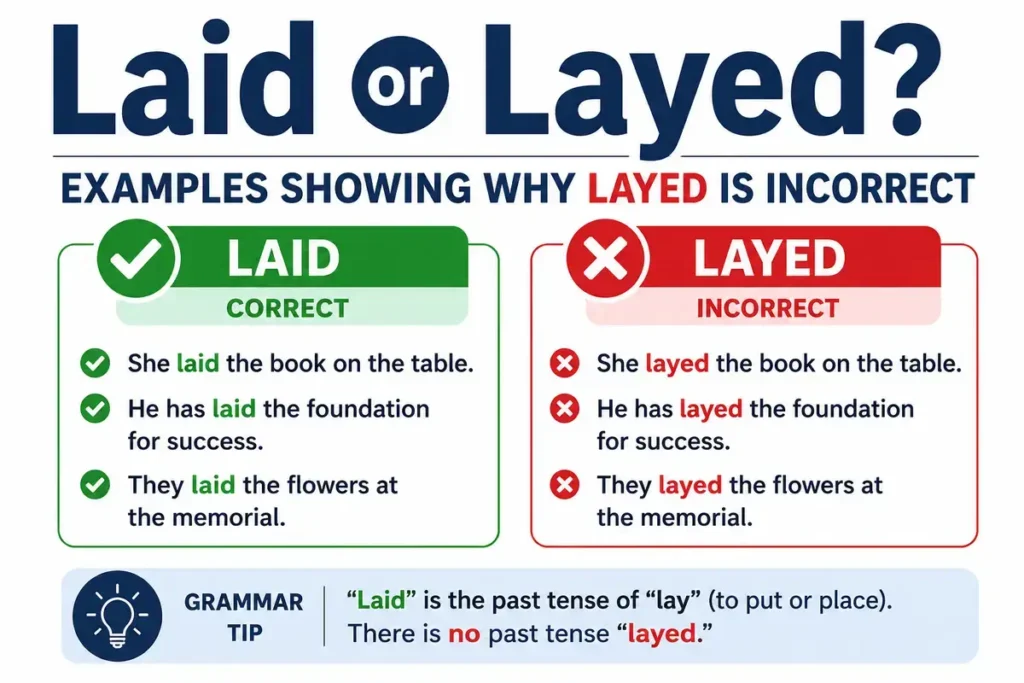
Examples Showing Why Layed Is Incorrect
You may come across layed online, especially in comments, forums, or social media posts. Even though it appears frequently on the internet, it isn’t the standard spelling.
Compare these examples.
| Incorrect | Correct |
|---|---|
| She layed the book on the table. | She laid the book on the table. |
| They layed new carpet yesterday. | They laid new carpet yesterday. |
| He layed his jacket on the couch. | He laid his jacket on the couch. |
| The workers layed concrete all morning. | The workers laid concrete all morning. |
| She layed the baby in the crib. | She laid the baby in the crib. |
Seeing the incorrect and correct forms side by side makes the difference much easier to remember.
Common Phrases People Search For
Many people don’t search for the word by itself. They type complete phrases because they’re writing an email, text message, school assignment, or social media post.
Let’s look at the most common ones.
Laid Or Layed In Bed
This phrase causes confusion because two different verbs can fit depending on what you mean.
If you’re talking about placing someone or something on a bed, laid is correct.
Examples include:
- She laid the baby in bed before reading a story.
- He laid the blanket on the bed.
If you’re talking about resting your own body, the verb is lie.
Examples include:
- I lay in bed for another hour yesterday.
- I was lying in bed when the phone rang.
This is one of the biggest reasons English learners mix up lay and lie.
Laid Or Layed Down
The correct phrase is laid down when you’re talking about placing something.
Examples include:
- She laid down her notebook.
- He laid down the tools after finishing work.
- The dog laid down its toy beside the couch.
If you’re describing your own movement into a resting position, the correct verb may be lay down or lie down, depending on the tense.
Examples include:
- I lay down for a short nap yesterday.
- I like to lie down after dinner.
The grammar changes because different verbs are involved.
Laid Or Layed Off
The correct expression is always laid off.
Examples include:
- Hundreds of employees were laid off last year.
- She was laid off after the company closed one of its offices.
- Many businesses avoid laying off workers unless it’s absolutely necessary.
You’ll never see layed off in edited professional writing.
Laid Or Layed Out
The correct phrase is laid out.
Examples include:
- The designer laid out several ideas for the new website.
- She laid out the clothes for tomorrow.
- The coach laid out the game plan before practice.
This expression is common in business, education, and everyday conversation.
Laid Or Layed Past Tense
The correct past tense of lay is laid.
Here’s the complete pattern.
- Present tense: lay.
- Past tense: laid.
- Past participle: laid.
- Present participle: laying.
Notice that layed doesn’t appear anywhere in the standard verb forms.
Laid Or Layed Meaning
The meaning of laid depends on the sentence, but it generally means placed, put, set, or positioned.
For example:
- She laid the flowers on the table.
- They laid the foundation for the new house.
- The chef laid fresh herbs over the finished dish.
In each example, something is carefully placed somewhere else.
Common Mistakes
Many writers make this mistake for understandable reasons. English has plenty of irregular verbs, and this is one of them.
Here are the errors editors see most often.
Adding Ed To Every Verb
Many English verbs form the past tense by adding ed.
Examples include:
- Walk becomes walked.
- Jump becomes jumped.
- Open becomes opened.
Because this pattern is so common, people naturally assume lay becomes layed.
Unfortunately, it doesn’t.
Mixing Up Lay And Lie
This is one of the most confusing verb pairs in English.
A simple way to remember the difference is this:
- Lay usually needs an object.
- Lie usually doesn’t.
Compare these sentences.
- She laid the book on the shelf.
- She lay on the sofa all afternoon.
The first sentence places something. The second describes a person’s position.
Trusting Internet Examples
Search engines index billions of web pages, including pages with grammar mistakes.
Just because you find layed online doesn’t mean it’s correct.
Professional editors rely on dictionaries, grammar references, and style guides instead of internet popularity.
Forgetting Irregular Verb Patterns
English contains many irregular verbs that don’t follow predictable spelling rules.
Examples include:
- Say becomes said.
- Pay becomes paid.
- Lay becomes laid.
- Teach becomes taught.
- Bring becomes brought.
Learning these verbs together makes them easier to remember.
Etymology And Word Origin
The verb lay comes from Old English lecgan, which meant to place or put something down. Over hundreds of years, its pronunciation and spelling changed, eventually giving us the modern forms lay, laid, and laying.
The word shares roots with several Germanic languages, many of which have similar verbs describing the act of placing or setting something.
The spelling laid wasn’t created recently. It has been the accepted past tense for centuries and appears throughout classic English literature, historical documents, and modern publications.
The spelling layed occasionally appeared in older records because English spelling wasn’t standardized. Today, however, dictionaries and style guides recognize laid as the correct form for nearly every situation.
Similar grammar mix-ups are surprisingly common, and understanding why “time flies” is correct can help you avoid another frequently misspelled expression.
Regional Usage
Unlike some spelling differences, this isn’t a case of American English versus British English.
Every major variety of English follows the same rule.
American English
American writers use laid in newspapers, books, schools, businesses, and government publications.
British English
British English also uses laid as the standard past tense of lay.
Australian English
Australian English follows the same grammar rule, and laid is the accepted spelling.
Canadian English
Canadian English agrees with both American and British usage. Professional writing consistently uses laid.
This makes the rule refreshingly simple. No matter where your audience lives, laid is the spelling you should choose.
Grammar Rules
Understanding the grammar behind these verbs makes the spelling much easier to remember.
Lay Is A Transitive Verb
The verb lay usually needs an object because something is being placed somewhere.
Examples include:
- She laid the notebook on the desk.
- They laid fresh concrete yesterday.
- He laid his coat across the chair.
Each sentence answers the question “laid what?”
Lie Is Usually Intransitive
The verb lie doesn’t normally take an object. It describes a person or thing resting in a position.
Examples include:
- I like to lie on the beach.
- The cat lay near the fireplace yesterday.
- The children were lying on the floor reading books.
This distinction explains why so many people become confused when discussing beds, couches, or resting positions.
Once you know which verb you’re using, choosing the correct past tense becomes much easier.
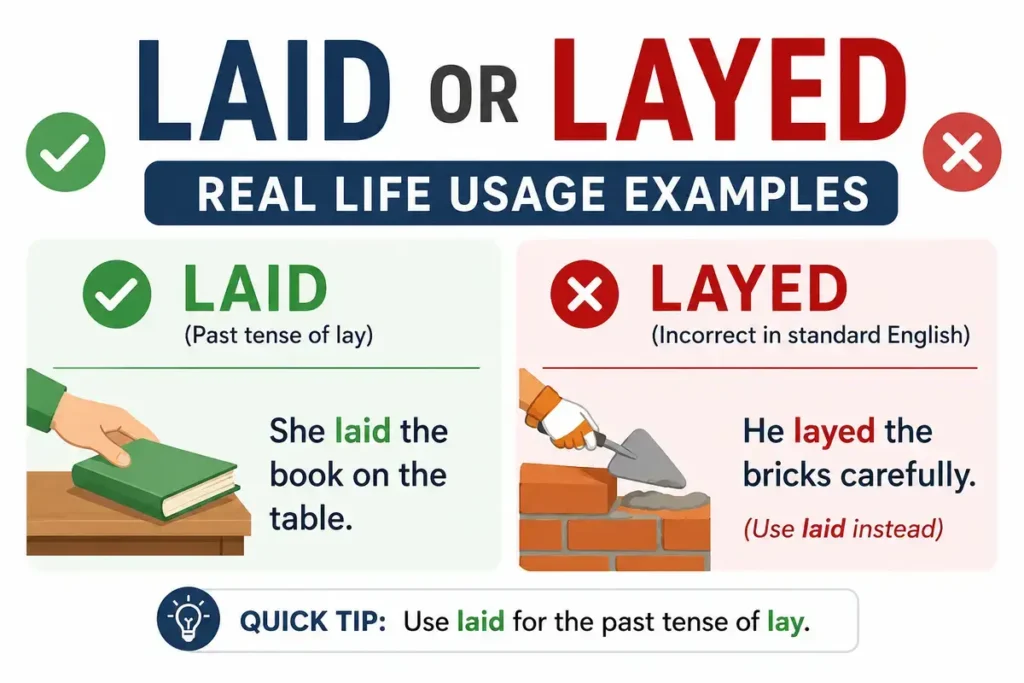
Real Life Usage Examples
Learning grammar is helpful, but seeing it in everyday situations makes the rule much easier to remember. The word laid appears in conversations, books, news articles, workplaces, and schools because it’s a common past tense verb.
Daily Conversation
People use laid naturally when talking about everyday actions that involve placing something somewhere.
Examples include:
- She laid the groceries on the kitchen counter.
- I laid my wallet next to the keys.
- He laid the towels by the pool.
- We laid the maps across the table before our trip.
- They laid the decorations out early for the party.
These sentences sound natural because something is being placed in a specific location.
Academic Writing
Schools and universities expect students to use the correct verb forms. Using layed in an essay or assignment is usually marked as a spelling or grammar mistake.
Examples include:
- The researcher laid the evidence out in chronological order.
- The author laid the foundation for the argument in the opening chapter.
- The professor laid several books on the desk before class.
Professional Communication
Business writing also relies on the correct form.
Examples include:
- The manager laid out the project timeline during the meeting.
- The company laid off several employees after the merger.
- The engineer laid the blueprints on the conference table for review.
Using the correct spelling helps your writing appear polished and professional.
Literature And Media
Published books, newspapers, magazines, and trusted online publications consistently use laid because it’s the standard English form.
You’ll often see expressions such as:
- Laid the groundwork.
- Laid the blame.
- Laid eyes on.
- Laid aside.
- Laid down the law.
These are well established expressions that have been part of English for generations.
Related Words And Commonly Confused Terms
The confusion doesn’t end with laid. Several related verbs cause similar problems because their forms don’t follow regular spelling patterns.
Here’s a quick comparison.
| Base Verb | Past Tense | Past Participle |
|---|---|---|
| Lay | Laid | Laid |
| Lie | Lay | Lain |
| Pay | Paid | Paid |
| Say | Said | Said |
| Lead | Led | Led |
The verbs lay and lie are especially confusing because one of the forms of lie is lay.
Here’s a simple reference.
- Today I lay the book on the table.
- Yesterday I laid the book on the table.
- Today I lie on the couch.
- Yesterday I lay on the couch.
- I have lain there for an hour.
Many writers mix these verb patterns together, which explains why spelling mistakes happen so often.
Expert Language Insight
Professional editors rarely need to think twice about laid because the spelling has been standard for centuries. The mistake usually appears when someone writes the word based on how it sounds instead of how the verb changes.
One useful habit is to identify the base verb before writing the sentence.
Ask yourself this question:
Am I talking about placing something somewhere, or am I talking about resting?
If you’re placing an object, the verb is lay, and the past tense is laid.
If you’re describing someone resting in a position, you’re usually working with the verb lie, which follows a different pattern.
Another helpful habit is reading your sentence aloud. For example, “She laid the notebook on the desk” sounds natural because it clearly describes placing an object. If a sentence doesn’t sound right when you read it, it’s often worth checking the verb form before you publish or submit your work.
Frequently Asked Questions
Is laid or layed correct?
Laid is the correct spelling in standard English. It is the past tense and past participle of the verb lay. Layed is generally considered a misspelling and shouldn’t be used in formal, academic, or professional writing.
Why do people write layed?
Many people assume every English verb forms the past tense by adding ed. Since words like played and stayed follow that pattern, it’s easy to think layed should be correct. The verb lay is irregular, so its past tense is laid instead.
Is layed ever correct?
In modern English, almost never. Outside a few rare historical references or specialized names, standard dictionaries and grammar guides recommend using laid.
Is it laid in bed or layed in bed?
If you’re talking about placing someone in bed, laid is correct.
If you’re talking about resting yourself in bed, the correct verb is lie, so the sentence changes depending on the tense.
Examples include:
- She laid the baby in bed.
- I lay in bed yesterday.
- I like to lie in bed on Sunday mornings.
Is it laid down or layed down?
The correct phrase is laid down.
Examples include:
- He laid down his phone.
- She laid down the documents.
- They laid down new flooring.
Layed down is considered incorrect in standard English.
Is laid off correct?
Yes. Laid off is the correct expression when talking about losing a job because of business or economic reasons.
Example:
The company laid off fifty employees during the restructuring.
How can I remember the correct spelling?
Think of other irregular verbs.
- Say becomes said.
- Pay becomes paid.
- Lay becomes laid.
Grouping similar verbs together makes the spelling much easier to remember than treating each word as a separate rule.
Do American and British English use different spellings?
No. American English, British English, Australian English, and Canadian English all use laid as the correct past tense of lay. This is a grammar rule rather than a regional spelling difference.
Conclusion
Choosing between laid and layed is much easier once you understand how the verb works. Laid is the correct past tense and past participle of lay, and it’s the form used in dictionaries, classrooms, books, newspapers, and professional writing. Layed, on the other hand, is almost always a spelling mistake that results from applying a regular verb pattern to an irregular verb.
The confusion often comes from mixing lay with lie, two verbs that have different meanings and different verb forms. Instead of memorizing isolated spellings, focus on the action in the sentence. If you’re talking about placing something somewhere, the past tense is laid.
If you’re interested in other common spelling differences, learning the difference between “theater” and “theatre” can help you write more confidently for both American and British audiences.