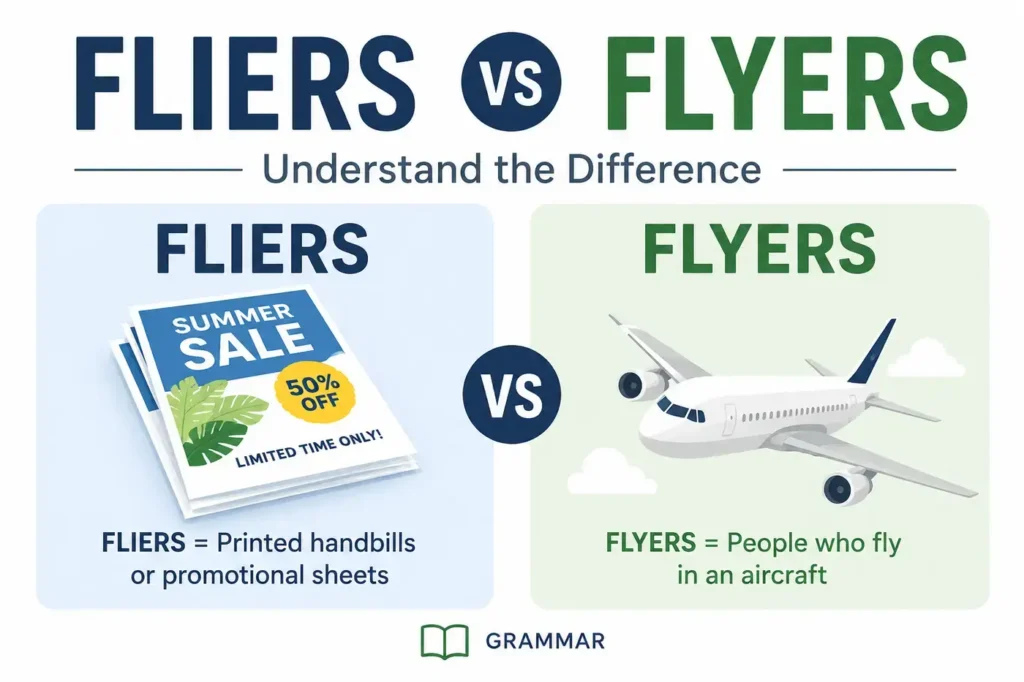
You finish designing an advertisement and get ready to print it. Then one small question slows everything down. Should it say fliers vs flyers? At first glance, the words seem interchangeable. Open a few dictionaries or style guides, though, and you’ll notice they don’t always agree. That leaves many writers, students, marketers, and business owners wondering which spelling is actually correct.
The short answer is that both spellings are correct, but they aren’t always used in exactly the same way. In modern American English, flyer is the more common spelling for a printed advertisement, while flier often refers to someone or something that flies. Even so, many dictionaries recognize both spellings for both meanings, and some publications follow their own editorial preferences.
This guide clears up the confusion with practical explanations instead of complicated grammar rules. You’ll learn how each spelling developed, what major dictionaries recommend, how professional editors make their choice, and when one version sounds more natural than the other. You’ll also find real examples, comparison tables, style guide recommendations, and expert writing tips that make choosing the right spelling much easier.
Quick Definition
Both flier vs flyer are accepted English spellings. Today, flyer is the preferred spelling for a printed advertisement in most everyday writing, while flier is often used for a person, animal, or machine that flies. Some dictionaries accept both spellings for both meanings, so the best choice depends on your audience and the style guide you’re following.
Quick Answer
If you need a quick rule, use this one.
- Choose flyer when referring to a printed advertisement, promotional handout, or marketing leaflet.
- Use flier for someone or something that flies, especially if you’re following traditional editorial guidance.
- Follow your organization’s style guide if one exists.
- Stay consistent throughout your document instead of switching between spellings.
Most readers won’t notice the difference, but consistent spelling makes your writing look polished and professional.
Comparison Table
| Feature | Flier | Flyer |
|---|---|---|
| Part of speech | Noun | Noun |
| Primary meaning | Someone or something that flies | Printed advertisement or someone who flies |
| Modern advertising use | Less common | Most common |
| Origin | Derived from the verb fly | Alternative spelling of flier |
| Formality | Standard English | Standard English |
| Common contexts | Aviation sports travel | Marketing retail events business |
| Usage frequency | Less common overall | More common in modern American English |
| Dictionary status | Correct | Correct |
| Example | She is a frequent flier. | We handed out flyers for the event. |
Meaning of Each Word
Although the spellings look nearly identical, their most common uses have gradually become different in modern English. Understanding those everyday preferences helps you choose the version that fits naturally.
What Does Flier Mean
Traditionally, flier describes someone or something that flies. It may refer to a pilot, a bird, an insect, an aircraft, or even a person who travels frequently by air.
You’ll often see it in contexts like these.
- Aviation.
- Wildlife.
- Sports.
- Travel.
- Historical writing.
Examples include:
- She became a skilled flier after years of training.
- The eagle is a powerful flier.
- He earned rewards as a frequent flier.
- Early fliers relied on simple aircraft.
- The young bird is becoming a confident flier.
Although these uses remain common, some publications now use flyer for many of the same meanings.
Another commonly confused spelling is why putty is the correct spelling, especially when referring to the material used for repairs rather than the misspelled form “puddy.”
What Does Flyer Mean
Today, flyer most often refers to a printed advertisement or promotional handout distributed to attract attention. Businesses, schools, charities, and event organizers frequently create flyers to advertise products, services, sales, or community events.
You’ll commonly see this spelling in situations such as:
- Business marketing.
- School announcements.
- Local events.
- Restaurant promotions.
- Political campaigns.
Examples include:
- We printed 500 flyers for the fundraiser.
- The coffee shop displayed colorful flyers in the neighborhood.
- She designed a flyer for the charity event.
- Every student received a flyer about the science fair.
- The new gym mailed promotional flyers across town.
Because advertising is the meaning most people encounter, flyer has become the more familiar spelling in everyday American English.
Key Differences
The biggest difference isn’t grammar. It’s usage.
Over time, writers and publishers naturally started favoring one spelling for advertising and the other for flying. That preference makes reading easier because the intended meaning becomes clear right away.
Here’s a simple comparison.
| Flier | Flyer |
|---|---|
| Traditionally refers to someone or something that flies | Commonly refers to a printed advertisement |
| Often appears in aviation and travel | Frequently appears in marketing and business |
| Used in the phrase frequent flier | Used in the phrase promotional flyer |
| Accepted by major dictionaries | Accepted by major dictionaries |
Keep these practical points in mind.
- Both spellings are correct English.
- Flyer has become the dominant choice for advertisements.
- Flier remains common in aviation and travel.
- Some publishers use flyer for every meaning to keep spelling consistent.
Rather than treating one spelling as right and the other as wrong, think about the context. The surrounding sentence usually tells readers exactly what you mean.
Which Spelling Is Correct
Many people expect a simple answer, but English doesn’t always work that way.
Both spellings appear in respected dictionaries, books, newspapers, and professional publications. That means you won’t be considered wrong simply because you choose one over the other. The better question is which spelling fits your audience and your purpose.
If you’re creating a promotional handout for a business, school, or community event, flyer is generally the safer and more familiar choice. It’s the spelling most readers expect to see on advertisements and marketing materials.
If you’re talking about a pilot, a bird, an athlete, or someone who flies often, flier still feels natural in many situations, especially in traditional editorial writing.
To make the choice easier, remember these guidelines.
- Use flyer for advertisements and promotional materials.
- Use flier for people or things that fly when appropriate.
- Follow your publication’s style guide if one exists.
- Once you’ve chosen a spelling, use it consistently throughout your writing.
Pronunciation Guide
One reason these words confuse so many people is that they sound exactly alike. The spelling changes, but the pronunciation doesn’t.
Flier
IPA pronunciation:
/ˈflaɪ.ər/
Syllable breakdown:
fli er
Flyer
IPA pronunciation:
/ˈflaɪ.ər/
Syllable breakdown:
fly er
Native speakers pronounce both words the same way. Readers understand the intended meaning from the surrounding context rather than the pronunciation.
Expert Tip Before You Choose
If you’re writing for a website, business, or publication, don’t spend too much time searching for the single correct spelling. Professional editors usually make this decision long before an article is published by following a house style guide.
If no style guide exists, choose the spelling that best matches your audience and use it consistently. For most marketing content, flyer will sound more familiar to readers. For aviation or travel topics, flier may feel more natural.
Consistency is what gives your writing a polished and trustworthy appearance.
Examples in Sentences
Reading words in context is one of the easiest ways to remember how they’re used. The examples below reflect the meanings you’ll see most often in modern English. Keep in mind that some style guides allow both spellings in either sense, so context and consistency matter more than memorizing a rigid rule.
Flier Examples
In these examples, flier refers to a person, animal, or thing that flies.
- She became an experienced flier after earning her pilot’s license.
- The young eagle is already a strong flier.
- He’s a frequent flier who spends more time in airports than at home.
- The museum displayed photographs of early fliers and their aircraft.
- Every successful flier understands the importance of safety checks.
- The injured bird will become a confident flier again after it recovers.
- The airline rewarded every frequent flier with bonus miles.
- That small insect is a surprisingly fast flier.
- Amelia Earhart inspired generations of aspiring fliers.
- The instructor congratulated the new flier after the first solo flight.
Flyer Examples
In these examples, flyer refers to a printed advertisement or promotional handout.
- We handed out a flyer to every visitor at the event.
- The restaurant designed a colorful flyer for its weekend specials.
- She posted a flyer on the community bulletin board.
- The school sent home a flyer about the upcoming field trip.
- Every business on the street displayed the same promotional flyer.
- The charity created a flyer to attract more volunteers.
- I found a concert flyer at the local coffee shop.
- The real estate agent included a flyer with every information packet.
- They printed thousands of flyers before the grand opening.
- A well designed flyer can attract attention in just a few seconds.
These examples reflect the usage you’ll encounter most often, especially in business, education, and everyday communication.
Common Mistakes
Many people assume one spelling is completely wrong, but that’s where the confusion begins. Both forms are accepted English words. Most mistakes happen because writers don’t consider context or the style guide they’re following.
Here are the errors that appear most often.
Assuming Only One Spelling Is Correct
Some writers believe flyer is always correct, while others insist on flier for every situation.
Neither view is accurate.
Major dictionaries recognize both spellings, although they may recommend one over the other for specific meanings.
Ignoring Context in Fliers vs Flyers
Choosing a spelling without thinking about the topic can make writing feel less natural.
For example, readers usually expect flyer when talking about promotional material. On the other hand, frequent flier remains a familiar expression in travel and aviation.
Matching the spelling to the context improves clarity.
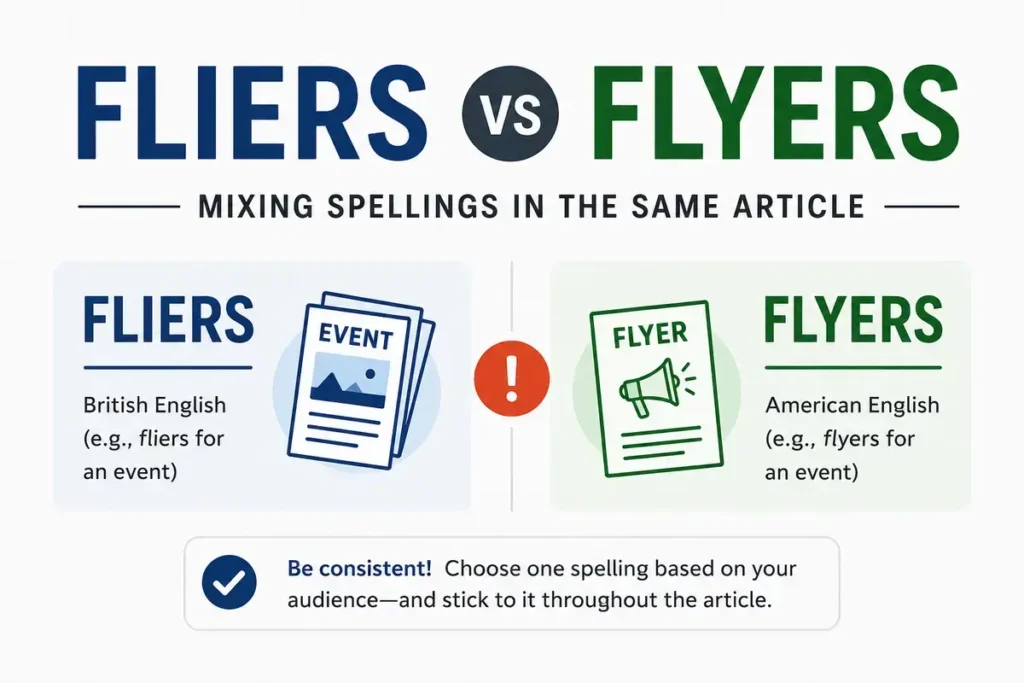
Mixing Spellings In The Same Article
One paragraph mentions a flyer, while the next refers to a flier describing the same advertisement.
That inconsistency distracts readers and gives the impression that the spelling changes were accidental.
Professional editors choose one style and apply it consistently unless there’s a specific reason to distinguish between the two meanings.
Assuming Search Results Set The Rule
Different search engines may favor one spelling because of your location or browsing history.
Instead of relying on search suggestions, use a trusted dictionary or follow the style guide required by your school, workplace, or publication.
Word Origin And History
Both spellings come from the English verb fly, which has existed for centuries. As English evolved, writers began forming nouns from verbs in different ways, creating spellings like flier and flyer.
For many years, flier was the more common form in American English. As advertising grew during the twentieth century, flyer became increasingly popular for printed promotional materials. Businesses, printers, and marketers adopted the spelling because it looked natural alongside words like buyer and player.
Today, both forms continue to appear in dictionaries, newspapers, books, and online publications. Rather than replacing one another, they’ve gradually developed preferred uses based on context.
That evolution is common in English. Language changes over time, and usage often shapes the accepted standard just as much as grammar rules do.
Regional Usage
Unlike many spelling differences, this isn’t simply a matter of American English versus British English. Both spellings appear in several English speaking countries, although usage patterns vary.
American English
In the United States, flyer is the spelling most people expect for printed advertisements, marketing materials, and event handouts.
Flier still appears in aviation, travel, and some editorial publications. You’ll also see it in the familiar travel phrase frequent flier.
British English
British publications generally favor flyer for advertisements. The spelling flier appears less often, although readers still recognize it without confusion.
Australian English
Australian English also leans toward flyer when referring to promotional material. Newspapers, businesses, and schools commonly use this spelling in printed and digital advertising.
Canadian English
Canadian English follows a similar pattern. Flyer is widely used in advertising, retail promotions, and community announcements, while flier appears more often in aviation related contexts.
Although preferences vary slightly, flyer has become the dominant spelling for advertisements in most modern English publications.
Grammar Rules
Both words function as countable nouns. Their grammatical behavior is identical, so the spelling doesn’t affect sentence structure.
Singular Forms
Use the singular form when referring to one person, one advertisement, or one object.
Examples:
- She designed a flyer for the fundraiser.
- He’s an experienced flier.
Plural Forms
The plural depends on the spelling you’ve chosen.
- Flier becomes fliers.
- Flyer becomes flyers.
Use the plural naturally in sentences.
Examples:
- Volunteers distributed hundreds of flyers before the event.
- The airline recognized its most loyal fliers.
This also answers a common question about fliers or flyers plural. Both plural forms are correct because each one matches its singular spelling.
Similar comparison rules also apply when using less than and greater than correctly in mathematical expressions and everyday writing.
Common Sentence Patterns
You’ll often see these words used in patterns like these.
- Design a flyer.
- Print flyers.
- Hand out flyers.
- Become a skilled flier.
- Frequent flier program.
- Experienced flier.
Reading these phrases repeatedly helps them become familiar.
Real Life Usage
These words appear in many different situations, although one meaning is much more common than the other.
Daily Conversation
People usually use flyer when talking about advertisements they receive in the mail or pick up at local businesses.
Examples include:
- I found a flyer for a neighborhood festival.
- Did you see the grocery store flyer?
Business And Marketing
Marketing professionals almost always choose flyer for printed promotional material.
Examples include:
- Designing event flyers.
- Printing promotional flyers.
- Creating product flyers.
- Distributing advertising materials.
Travel And Aviation
Travel writing often continues to use flier, especially in established expressions.
Examples include:
- Frequent flier benefits.
- Experienced military flier.
- Commercial airline flier.
Books And Media
Modern books and newspapers use both spellings, but editorial style guides usually determine which version appears in print.
Some publications prefer flyer for all meanings, while others reserve flier for aviation related topics. That’s why you’ll occasionally notice both spellings across different sources.
Related Words And Confused Terms
The confusion doesn’t end with fliers vs flyers. English has several similar words that describe printed materials, promotional content, or people who travel by air. Understanding the differences makes your writing more precise and helps you choose the right word for the situation.
Here are some closely related terms.
| Word | Meaning | Common Use |
|---|---|---|
| Flyer | Printed advertisement or promotional handout | Marketing and advertising |
| Flier | Person or thing that flies | Aviation and travel |
| Leaflet | Small printed informational sheet | Education healthcare tourism |
| Pamphlet | Folded booklet with detailed information | Business nonprofits government |
| Brochure | Promotional booklet with multiple pages | Travel real estate marketing |
| Handout | Printed material distributed to a group | Schools meetings presentations |
| Circular | Printed advertisement sent to many people | Retail promotions |
| Poster | Large printed display | Events advertising announcements |
Although these words all involve printed communication, they aren’t interchangeable. A brochure usually contains more information than a flyer, while a leaflet is often educational rather than promotional.
You may also come across the phrases below while researching this topic.
- Frequent flier.
- Promotional flyer.
- Marketing handout.
- Advertising leaflet.
- Event announcement.
- Direct mail piece.
- Sales circular.
- Community notice.
Learning these related terms expands your vocabulary and helps you choose words that fit your audience more naturally.
Expert Language Insight
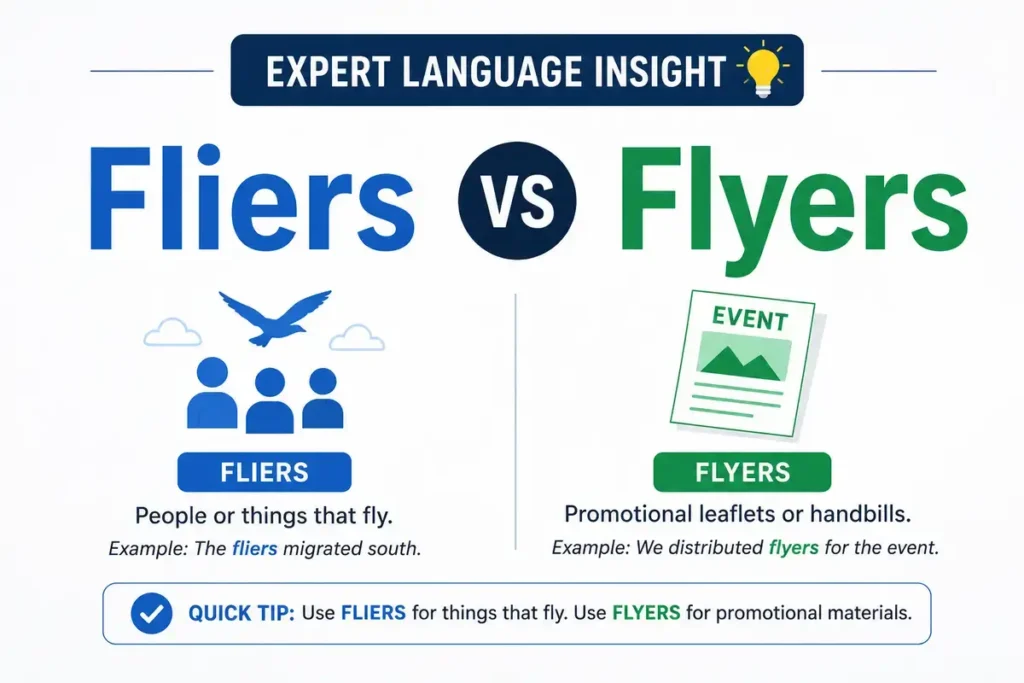
Editors rarely spend time debating which spelling is “right.” Instead, they ask a more useful question.
Does this spelling match the context and the publication’s style guide?
For example, if an editor is reviewing a restaurant promotion, flyer is almost always the natural choice because that’s the spelling most readers expect. If the article discusses aviation history or airline loyalty programs, flier may fit better, especially when referring to a person who flies or the familiar expression frequent flier.
This is one of those situations where usage matters more than strict grammar. English evolves through everyday use, and dictionaries reflect those changes over time. That’s why respected references recognize both spellings while also noting the contexts where each one appears most often.
If you’re writing for a business website, school project, blog, or marketing campaign, don’t overthink the choice. Pick the spelling that best fits your audience, follow any required style guide, and stay consistent from beginning to end. That simple habit makes your writing look polished, professional, and trustworthy.
Frequently Asked Questions
Is flier or flyer correct?
Both spellings are correct. In modern English, flyer is the more common choice for printed advertisements, while flier often refers to a person or thing that flies. The best option depends on the meaning and the style guide you’re following.
Which spelling should I use for an advertisement?
For advertisements, event handouts, promotional materials, and marketing pieces, flyer is generally the preferred spelling. It’s the version most readers recognize and the one commonly used by businesses, schools, and organizations.
What is the plural of flyer and flier?
The plural follows the singular spelling.
- Flyer becomes flyers.
- Flier becomes fliers.
Both plural forms are correct because they match their respective singular forms.
What does AP Style recommend?
AP Style traditionally distinguishes between the two spellings. It generally uses flier for someone who flies and flyer for a printed advertisement. Many news organizations follow this guidance to maintain consistency across their publications.
What does Merriam Webster say?
Merriam Webster recognizes both spellings as standard English. The dictionary notes that flyer is especially common for advertising materials, while flier also remains an accepted spelling, particularly in aviation related contexts.
Why do people disagree about these spellings?
The disagreement comes from different dictionaries, style guides, and personal writing habits. Since both spellings have been accepted for many years, writers often follow the source they trust most or the editorial standards required by their workplace or publication.
Which spelling is more common today?
For everyday writing, flyer appears more frequently, especially in advertising, business, education, and marketing. Flier still appears regularly in aviation, travel, and established expressions such as frequent flier.
Should I use both spellings in the same article?
In most cases, no. Choose the spelling that matches your topic and use it consistently throughout your document. The only exception is when you’re explaining the difference between the two words, as in this guide.
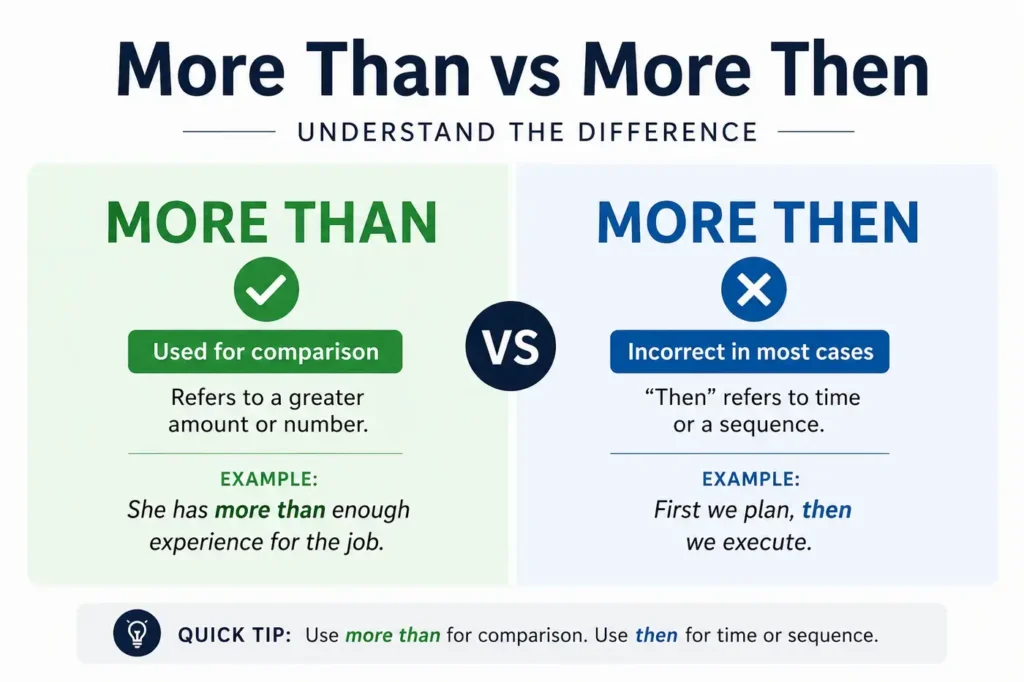
If you’re trying to avoid common writing mistakes, understanding the difference between more than and more then can help you write with greater accuracy.
Conclusion
Choosing between flier and flyer is much easier once you understand how the words are commonly used. Both spellings are correct, and major dictionaries recognize each one. The difference is largely based on context rather than grammar.
If you’re talking about a printed advertisement, flyer is the spelling most readers expect. It’s widely used in marketing, retail, education, and community events. If you’re referring to someone or something that flies, flier remains a familiar and widely accepted choice, especially in aviation and travel.
The most important rule isn’t picking the perfect spelling. It’s choosing the version that fits your audience and using it consistently throughout your writing. That approach keeps your content clear, professional, and easy to read.
When in doubt, check the style guide you’re following. If no style guide applies, flyer is usually the safest choice for promotional materials, while flier works naturally in aviation related writing. Understanding that simple distinction will help you write with confidence in almost any situation.