Have you typed shiny vs shiney into a search bar after seeing both spellings online? It’s a common question, especially if you’ve come across fan forums, social media posts, or gaming communities where people often write words informally. At first glance, both spellings seem reasonable because they sound exactly alike. That’s what makes this pair so confusing.
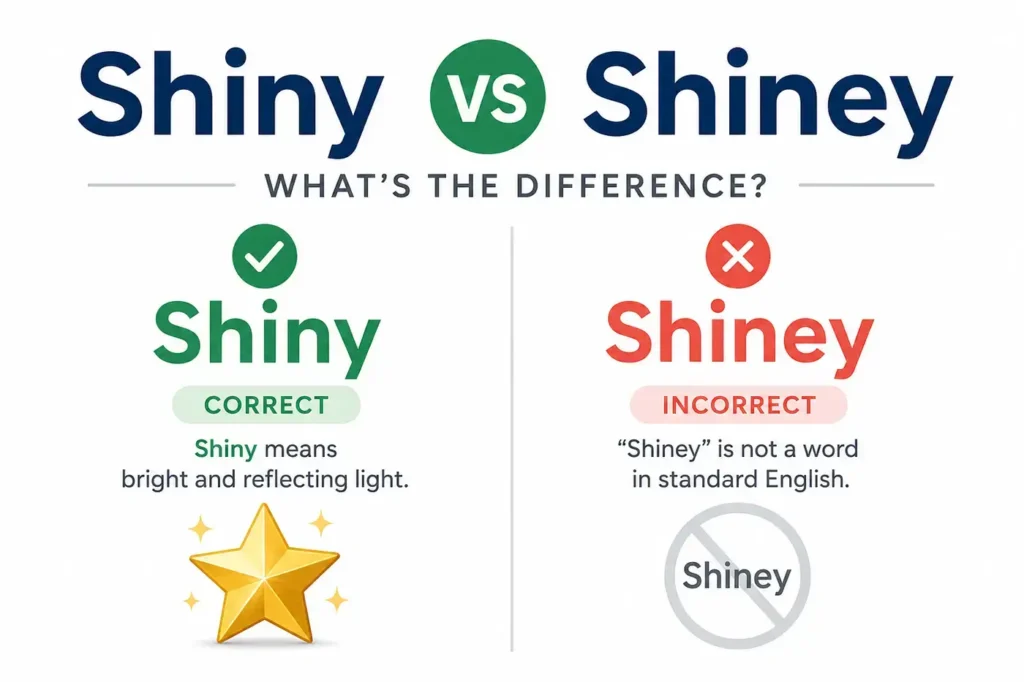
The short answer is simple. Shiny is the correct spelling in standard English. Shiney is considered a misspelling and doesn’t appear as the standard form in major English dictionaries. Even though you’ll occasionally see shiney in online conversations, blog comments, or user generated content, it isn’t accepted in formal writing.
In this guide, you’ll learn why shiny is the correct spelling, where the confusion comes from, how native speakers actually use the word, and how to avoid this common mistake. We’ll also cover pronunciation, grammar, real world examples, regional usage, common questions about Shiny Pokémon, and practical writing tips that help you use the word with confidence.
Quick Definition
Shiny is the correct English adjective used to describe something that reflects light or has a bright, glossy appearance. Shiney is a common misspelling and isn’t recognized as the standard spelling in American English, British English, Australian English, or Canadian English.
Quick Answer
If you’re writing in English, always choose shiny.
Here’s the rule in plain English.
- Shiny is the correct spelling.
- Shiney is a spelling mistake in standard English.
- The rule stays the same in both American and British English.
- Use shiny in school assignments, professional writing, websites, emails, and everyday communication.
You’ll still find shiney on forums and social media because spelling mistakes spread quickly online. That doesn’t make it a correct alternative.
Shiny vs Shiney Comparison Table
| Feature | Shiny | Shiney |
|---|---|---|
| Part of speech | Adjective | Misspelling of shiny |
| Meaning | Reflecting light or having a bright surface | Same intended meaning but incorrect spelling |
| Correct form | Yes | No |
| Origin | From the verb shine with the adjective suffix y | Created through spelling confusion |
| Formality | Standard in all contexts | Not accepted in formal writing |
| Common contexts | Everyday English literature marketing gaming science | Mostly informal online posts typing mistakes and user generated content |
| Usage frequency | Extremely common | Rare outside spelling errors |
| Example | The car looked shiny after the wash. | The car looked shiney after the wash. Incorrect. |
Meaning of Shiny and Shiney
Although people often compare these two spellings, only one belongs in standard English.
To explore more regional spelling variations, take a look at our guide to American and British spelling differences, including when to use theater or theatre.
What Does Shiny Mean
Shiny is an adjective that describes something reflecting light or having a smooth polished surface. It can also describe anything that appears attractive, new, or eye catching.
You’ll hear it in everyday conversations, books, advertisements, classrooms, and professional writing.
Here are a few common examples.
- The new shoes still look shiny.
- She polished the silver until it became shiny.
- The puppy has a shiny black coat.
- The fresh paint gave the door a shiny finish.
- The stars looked shiny against the dark sky.
The word can also be used figuratively. For example, people sometimes describe a new idea or product as shiny because it feels exciting or brand new.
What Does Shiney Mean
Shiney isn’t a separate English word. Nearly every time it appears, the writer intended to write shiny.
The confusion usually happens because the adjective comes from the verb shine. Some people naturally assume the extra e should remain when adding the ending. English doesn’t follow that pattern here.
That’s why dictionaries, style guides, and professional editors recommend using shiny every time.
Key Differences
The biggest difference between these spellings isn’t pronunciation or meaning. It’s correctness.
Here’s a quick comparison.
- Shiny is the accepted dictionary spelling.
- Shiney is considered a misspelling.
- Both are pronounced the same because people usually intend the same word.
- Only shiny should appear in formal writing, academic work, business communication, and published content.
Another difference is credibility. Readers rarely notice the word shiny, but many immediately recognize shiney as a spelling mistake. Small errors like this can reduce confidence in your writing, especially if you’re publishing educational or professional content.
Which Spelling Is Correct
The correct spelling is shiny.
This spelling follows normal English word formation. The adjective comes from the verb shine, but the final e is dropped before adding the ending y.
The same pattern appears in many familiar English words.
- Ice becomes icy.
- Juice becomes juicy.
- Noise becomes noisy.
- Bone becomes bony.
English often drops the silent e before adding endings that begin with a vowel sound. Shiny follows this same spelling rule, which is why shiney isn’t considered standard English.
If you’re writing for school, work, a website, or social media, using shiny is always the safest and most accurate choice.
Pronunciation Guide
Although the spellings look different, people pronounce them the same way because shiney is simply a misspelling of shiny.
IPA pronunciation:
/ˈʃaɪ.ni/
Syllable breakdown:
Shi ny
It has two syllables, with the stress on the first syllable.
Say it like this.
SHY nee
Common pronunciation mistakes include stretching the second syllable or overemphasizing the ending. Native speakers normally pronounce the word smoothly with equal emphasis on the natural rhythm of everyday speech.
Expert Language Insight
As an editor, I rarely see experienced writers intentionally use shiney. Most instances come from typing quickly, relying on autocorrect, or assuming the spelling should match the verb shine.
This mistake is understandable because English isn’t always predictable. Still, dictionaries, publishers, schools, and professional style guides consistently recognize only shiny as the standard spelling.
If you’re unsure while writing, remember a simple rule. The adjective loses the silent e, just as many other English words do. That one habit will help you avoid the mistake every time.
Examples Using Shiny and Shiney
The easiest way to remember the correct spelling is to see it in real sentences. As you read these examples, notice that shiny fits naturally into every sentence. The examples with shiney are included only to show the common mistake and explain why it should be avoided.
Correct Examples With Shiny
The adjective shiny describes something that reflects light or has a smooth, polished appearance. It can also describe something that looks attractive, new, or eye catching.
- She wore shiny black shoes to the wedding.
- The mechanic polished the car until it looked shiny.
- The lake looked shiny in the morning sunlight.
- We bought a shiny new coffee machine for the office.
- His dog has a shiny brown coat.
- The child picked up a shiny gold coin from the sidewalk.
- The kitchen floor looked shiny after it was cleaned.
- The jeweler displayed shiny diamonds under bright lights.
- The freshly painted fence still looked shiny.
- The magazine cover used a shiny finish that stood out on the shelf.
You’ll notice that the word works naturally in everyday conversations, descriptive writing, product descriptions, and professional communication.
Incorrect Examples With Shiney
The following examples show a spelling mistake that appears online from time to time. In each sentence, shiny is the correct choice.
- The bike looks shiney. ✗ Write shiny instead.
- She bought a shiney dress. ✗ Use shiny.
- The table has a shiney surface. ✗ The correct spelling is shiny.
- My new watch is shiney. ✗ It should be shiny.
- The puppy has shiney fur. ✗ Use shiny.
- I like your shiney shoes. ✗ Write shiny.
- The ornament looks shiney in the sunlight. ✗ Replace it with shiny.
- The polished floor became shiney. ✗ The accepted spelling is shiny.
- He wants a shiney sports car. ✗ Use shiny.
- The leaves looked shiney after the rain. ✗ The correct adjective is shiny.
If you ever see shiney in an article, email, or social media post, treat it as a spelling error instead of an accepted alternative.
Common Mistakes
This spelling mistake is surprisingly common because it seems logical at first. After all, the adjective comes from the verb shine, so many people assume the final e should remain.
English doesn’t work that way in this case.
Here are the mistakes writers make most often.
Keeping The Silent E
Many people write shiney because they start with the verb shine and simply add y.
The standard spelling drops the silent e, creating shiny.
Assuming Both Spellings Are Correct
Some words have accepted spelling variations, such as gray and grey. That isn’t true here.
Major dictionaries recognize shiny as the standard spelling. Shiney isn’t considered an alternative spelling.
Trusting User Generated Content
You’ll occasionally see shiney on forums, social media, gaming communities, and comment sections. Those examples reflect typing habits rather than correct English.
When checking spelling, rely on dictionaries, educational resources, or trusted style guides instead of random online posts.
Letting Autocorrect Go Unchecked
Spell checkers catch many mistakes, but they aren’t perfect. Some applications overlook uncommon spelling errors, especially when names or custom dictionaries are involved.
A quick proofread helps catch mistakes that automated tools miss.
Etymology And Word Origin
The adjective shiny comes from the verb shine, which has been part of English for centuries.
The verb traces its roots to Old English, where words related to brightness, light, and glowing developed into the modern verb shine. As English evolved, writers formed the adjective by removing the silent e and adding the ending y.
This pattern appears in several familiar English words.
- Ice becomes icy.
- Noise becomes noisy.
- Juice becomes juicy.
- Bone becomes bony.
- Spice becomes spicy.
These examples show that dropping the silent e is a normal spelling pattern in English. Shiny follows the same rule, which explains why shiney never became the accepted spelling.
Another frequent spelling mistake involves the past tense of lay, and our explanation of why “layed” is incorrect clears up the confusion with easy-to-follow examples.
Regional Usage
One of the first questions people ask is if shiney might be correct in another English speaking country.
The answer is no.
Unlike pairs such as color and colour, this isn’t a regional spelling difference. English speaking countries all recognize shiny as the standard spelling.
American English
American dictionaries, schools, publishers, and businesses all use shiny.
You’ll see it in newspapers, books, advertisements, product descriptions, and everyday writing.
British English
British English follows exactly the same spelling.
There isn’t a British preference for shiney.
Australian English
Australian English also uses shiny in formal and informal writing.
Educational materials, media outlets, and businesses follow the standard spelling.
Canadian English
Canadian English matches the same convention.
You’ll find shiny in dictionaries, schools, and professional publications across Canada.
No matter where English is spoken, shiny is the accepted spelling.
Grammar Rules
Understanding how the word functions in a sentence makes it easier to use correctly.
Part Of Speech
Shiny is primarily an adjective.
It describes the appearance or condition of a noun.
Examples include:
- A shiny coin.
- Shiny shoes.
- A shiny surface.
- Shiny hair.
Comparative And Superlative Forms
Like many adjectives ending in y, the word forms comparisons by changing the ending.
- Shiny.
- Shinier.
- Shiniest.
Examples:
- This ring is shinier than the old one.
- That car has the shiniest paint in the showroom.
Plural Form
Because shiny is an adjective, it doesn’t have a plural form.
Instead, it describes plural nouns.
Examples:
- Shiny coins.
- Shiny windows.
- Shiny bicycles.
Common Sentence Patterns
You’ll often see the adjective used in these ways.
- Before a noun.Example: A shiny necklace caught everyone’s attention.
- After a linking verb.Example: The floor looks shiny after being polished.
- In descriptive writing.Example: The bird’s shiny feathers reflected the sunlight beautifully.
Real Life Usage
The word appears in far more places than many people realize.
Daily Conversation
People often use shiny to describe objects that look clean, polished, or brand new.
Examples include:
- Your shoes look shiny.
- That’s a shiny new truck.
- The kitchen sink finally looks shiny again.
Academic Writing
Science and art textbooks use the word to describe reflective surfaces, minerals, metals, and materials.
Students may also use it in descriptive essays and creative writing.
Professional Communication
Marketing teams frequently describe products as shiny to highlight their appearance.
You’ll find the word in advertisements for cars, jewelry, electronics, furniture, beauty products, and household items.
Literature And Media
Authors often use shiny to create vivid imagery.
A simple adjective can help readers picture polished armor, sparkling water, bright stars, or freshly cleaned glass without adding unnecessary detail.
The word is short, familiar, and instantly understood, making it a favorite choice in descriptive writing.
Related Words And Commonly Confused Terms
Once you know that shiny is the correct spelling, it’s helpful to look at a few related words that people often search for or confuse with it. Understanding these terms gives you a better grasp of how the word fits into everyday English.
Similar Words
These words are closely related in meaning.
- Bright.
- Glossy.
- Polished.
- Reflective.
- Lustrous.
- Gleaming.
- Sparkling.
- Radiant.
- Metallic.
- Smooth.
Although each word has its own shade of meaning, they all describe something that reflects light or has an attractive appearance.
Words That Cause Confusion
Some spelling mistakes happen because English has many words that look similar.
- Shine and shiny.
- Shine and shining.
- Shiny and glossy.
- Bright and shiny.
- Glossy and reflective.
The word shine is a verb, while shiny is an adjective. That’s an important distinction because they serve different purposes in a sentence.
For example:
- The sun will shine all afternoon.
- The polished table looks shiny.
Shiny Pokémon
Many people discover this spelling question while playing Pokémon games or Pokémon GO. In the Pokémon series, a Shiny Pokémon is a rare version with a different color palette than the standard version. The official games, websites, and community resources consistently use the spelling Shiny Pokémon.
Because players type quickly in chats and forums, you may occasionally see shiney Pokémon, but that’s simply a spelling mistake rather than an accepted gaming term.
If you’re interested in other commonly confused spelling variations, our guide on the difference between fliers and flyers explains which version is preferred in different contexts.
Expert Language Insight
One pattern stands out after editing thousands of pages of English content. Writers usually don’t misspell shiny because they don’t know the word. They misspell it because they overthink it.
The brain sees the verb shine and naturally wants to keep the final e. That’s understandable, but English spelling doesn’t always work by simple addition. Many adjectives drop the silent e before adding another ending, and shiny follows that pattern.
Professional editors rarely need to debate this spelling because dictionaries and style guides are consistent. If shiney appears in a manuscript, it’s corrected immediately without changing the meaning of the sentence.
If you write articles, emails, school assignments, or website content, using the standard spelling helps your writing look more polished and credible. Small details like this may seem minor, but they leave a strong impression on readers.
Frequently Asked Questions
Is shiny or shiney correct?
Shiny is the correct spelling in standard English. Shiney is considered a misspelling and isn’t recognized as the accepted form in major dictionaries. You’ll sometimes see it online, but it shouldn’t be used in formal or professional writing.
Why do people spell shiny as shiney?
Most people make this mistake because the adjective comes from the verb shine. They assume the final e should remain when adding the ending. In English, the silent e is dropped, producing the correct spelling shiny.
Is shiney accepted in British English?
No. British English uses shiny, just like American English, Australian English, and Canadian English. This isn’t a regional spelling difference like color and colour.
How do you pronounce shiny?
The word is pronounced /ˈʃaɪ.ni/.
It has two syllables.
- Shi.
- Ny.
The stress falls on the first syllable, making it sound like SHY nee.
What is the plural of shiny?
Shiny is an adjective, so it doesn’t have a plural form. Instead, it describes singular or plural nouns.
For example:
- A shiny coin.
- Shiny coins.
What does shiny mean?
The word describes something that reflects light or has a smooth, glossy, or polished appearance. It can also describe something new, attractive, or visually impressive.
Is Shiny Pokémon the correct spelling?
Yes. Shiny Pokémon is the official spelling used throughout the Pokémon games, Pokémon GO, and related media. The spelling shiney Pokémon is simply an error made by some players online.
Can I use shiney in casual writing?
You can, but it will still be viewed as a spelling mistake by most readers. Even in casual messages, using shiny is the better choice because it’s the accepted spelling and instantly recognized by everyone.
Conclusion
The answer is straightforward. Shiny is the correct spelling, while shiney is a common misspelling that appears mostly in online conversations and typing errors. The pronunciation doesn’t change, the meaning stays the same, and there isn’t a regional version that makes shiney acceptable.
The confusion usually comes from the verb shine, which leads some people to keep the final e when forming the adjective. Standard English follows a different pattern, dropping the silent e to create shiny.
If you’re writing for school, work, a website, or social media, choose shiny every time. It’s the spelling recognized by dictionaries, publishers, educators, and native speakers across the English speaking world. Getting this small detail right makes your writing clearer, more professional, and more trustworthy.