Have you ever wondered if bailer or baler is the correct spelling? These two words look almost identical, and they differ by just one letter. However, they have different meanings and describe two completely different things. Choosing the wrong spelling can change the meaning of your sentence, especially in professional, agricultural, and everyday writing.
The good news is that both spellings are correct English words. Bailer refers to a person or device that removes water from a boat, container, or other enclosed space. Baler, on the other hand, refers to a machine that compresses materials such as hay, straw, paper, or plastic into compact bundles called bales.
The confusion often comes from their similar appearance and pronunciation. People may also assume that one spelling is simply a mistake or an alternative version of the other. However, each word has its own meaning, grammatical role, and practical use.
In this guide, you will learn the difference between these words, their definitions, pronunciation, origins, and correct usage. You will also find practical examples, common mistakes, and simple tips to help you choose the right spelling every time.
Quick Answer
Both bailer and baler are correct English words, but they have different meanings. A bailer removes water or other liquid from a boat or container, while a baler is a machine that compresses materials into compact bundles. Use bailer when referring to removing liquid and baler when discussing agricultural or recycling equipment.
What Is the Difference Between Bailer and Baler
The main difference is their function. A bailer is associated with removing liquid, while a baler is associated with compressing solid materials into bundles.
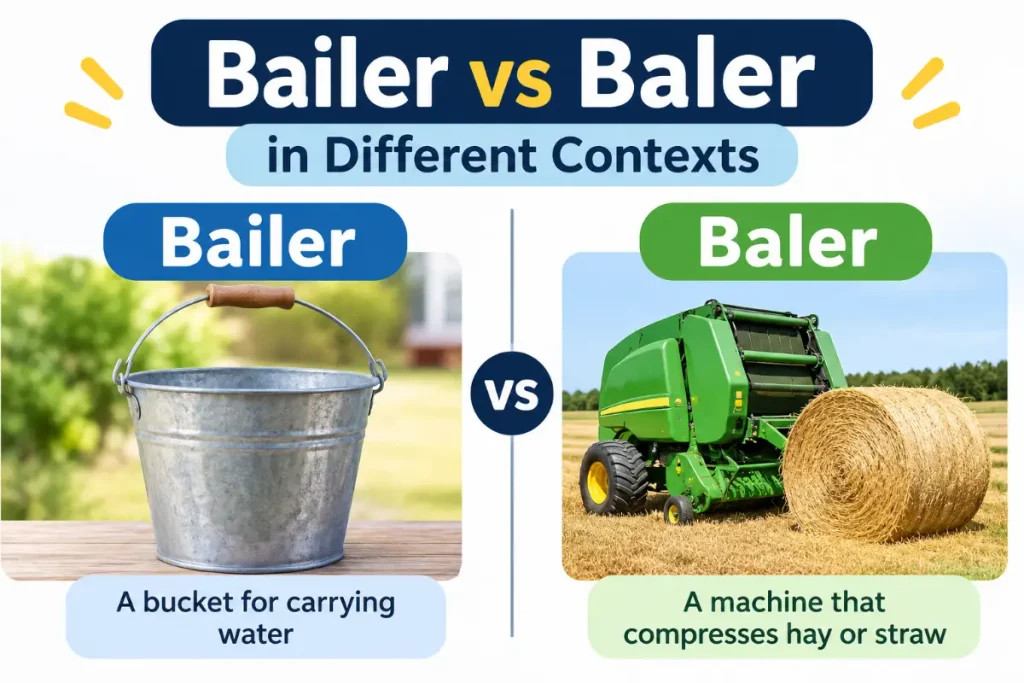
Although the words look similar, they belong to different contexts. You are more likely to encounter bailer in boating, fishing, or water management. Baler is commonly used in agriculture, farming, recycling, and waste management.
Here is a quick comparison:
| Feature | Bailer | Baler |
|---|---|---|
| Meaning | A person or device that removes liquid | A machine that compresses materials |
| Main purpose | Removing water or liquid | Creating compact bundles |
| Related verb | Bail | Bale |
| Common industries | Boating, fishing, water management | Farming, agriculture, recycling |
| Common materials | Water and other liquids | Hay, straw, paper, cardboard, plastic |
| Example | The bailer removed water from the boat. | The baler compressed the hay into bundles. |
The easiest way to remember the difference is to connect each spelling with its action. A bailer helps remove water, while a baler produces bales.

What Does Bailer Mean
A bailer is a person or device that removes water or another liquid from a boat, container, or enclosed space. The word comes from the verb bail, which means to remove liquid by scooping, pumping, or using a suitable device.
For example, imagine a small fishing boat taking on water during a storm. Someone might use a bucket or hand operated pump to remove the water and keep the boat from filling up. That person or device can be described as a bailer.
The term is especially relevant in boating and water related activities. However, it can also describe equipment used to remove liquids from other places.
Common Uses of Bailer
A bailer can refer to different people or tools depending on the situation.
1. Boat bailer
A boat bailer is a tool or device used to remove unwanted water from inside a boat. It may be a simple bucket, scoop, or specially designed piece of equipment.
Example: Keep a bailer inside your fishing boat in case water collects on the floor.
2. Hand bailer
A hand bailer is a container or scoop that someone uses manually to remove water.
Example: The sailor used a hand bailer to empty the water from the small canoe.
3. Automatic bailer
Some boats use devices that help remove unwanted water without requiring someone to scoop it out manually. Depending on the design, these systems may use pumps or other mechanisms.
Example: The automatic bailer helped keep the boat’s interior dry.
4. Well bailer
In certain water management and drilling applications, a bailer is a tool used to remove water, sediment, or other material from a well or borehole.
Example: The workers used a well bailer to remove accumulated material during maintenance.
These examples show that bailer is not limited to one particular type of boat or container. Its central meaning remains connected to removing liquid or material from an enclosed space.
Bailer in a Sentence
Here are some natural examples showing how to use bailer correctly.
- The fisherman grabbed a bailer to remove water from his boat.
- Every small boat should have a suitable bailer.
- The sailor used a plastic bailer to empty the canoe.
- We kept an extra bailer near the boat’s storage area.
- The crew checked the bailer before leaving the dock.
- A broken bailer made it difficult to remove the water.
- She used a bucket as a temporary bailer.
- The boat owner replaced the old bailer with a new one.
- The emergency bailer helped remove water after the heavy rain.
- The instructor showed us how to use a hand bailer safely.
In each sentence, the word refers to a person or tool associated with removing water or another substance.
What Does Baler Mean
A baler is a machine that compresses loose materials into compact bundles called bales. These machines are commonly used in farming, agriculture, recycling, and industrial waste management.
For example, farmers use balers to collect and compress cut grass, hay, or straw. Instead of leaving these materials spread across a field, the machine gathers them and forms manageable bundles. Farmers can then store, transport, or use the bales as needed.
Recycling facilities also use balers to compress cardboard, paper, plastic, and other recyclable materials. Compressing these items saves storage space and makes transportation more efficient.
Unlike a bailer, which removes liquid, a baler works with solid materials.
Common Types of Baler
Different balers are designed for different materials and working conditions. Some are used in agriculture, while others are built for recycling and industrial applications.
1. Hay baler
A hay baler collects and compresses cut grass or hay into bales. Farmers use these machines to prepare animal feed for storage and transportation.
Example: The farmer used a hay baler to prepare the grass for winter storage.
2. Round baler
A round baler produces large cylindrical bales. These machines are common on farms because they can collect and compress large amounts of hay or straw.
Example: The round baler created several large hay bales in the field.
3. Square baler
A square baler produces rectangular bundles. These bales are often easier to stack and arrange in storage areas.
Example: We used a square baler to prepare straw for transportation.
4. Agricultural baler
An agricultural baler is designed to collect and compress crops or other farm materials. Depending on its design, it may produce round or rectangular bales.
Example: The agricultural baler helped the workers finish the harvest more quickly.
5. Recycling baler
A recycling baler compresses materials such as cardboard, paper, and plastic into compact bundles. Recycling centers use these machines to prepare materials for storage and transportation.
Example: The recycling baler compressed the cardboard boxes into manageable bundles.
6. Industrial baler
An industrial baler is used in manufacturing plants, warehouses, and waste management facilities. It can compress large quantities of recyclable or waste materials.
Example: The factory installed an industrial baler to reduce the space occupied by packaging waste.
Baler in a Sentence
The following examples demonstrate how to use baler correctly in different situations.
- The farmer purchased a new baler for the harvest season.
- Our farm uses a round baler to collect hay.
- The machine compressed the straw into large bundles.
- The recycling center installed a modern cardboard baler.
- The worker checked the baler before starting the machine.
- A damaged baler delayed the harvesting process.
- The square baler produced neatly arranged bundles.
- The company uses a plastic baler to process recyclable materials.
- We need a larger baler to handle the additional cardboard.
- The farmer cleaned the baler after finishing the work.
In these examples, baler refers to a machine that compresses materials into bales.
Bailer vs Baler in Different Contexts
Understanding the context is one of the easiest ways to choose between these words. Both are nouns, but their meanings are connected to different activities.
Agriculture and Farming
In agriculture, baler is the correct word when discussing equipment that compresses hay, straw, grass, or other crops.
Example: The farmer used a baler to prepare hay for the animals.
Using bailer in this sentence would be incorrect because the machine is not removing water.
However, a bailer may still be relevant on a farm if workers need to remove water from a container, tank, or other enclosed space.
Boating and Fishing
In boating, bailer is the appropriate term for a tool or device used to remove unwanted water.
Example: The fisherman used a bailer to remove water from his boat.
A baler would not be suitable in this context because it refers to equipment that compresses solid materials into bales.
Recycling and Waste Management
In recycling, baler is the correct term for a machine that compresses recyclable materials.
Example: The recycling facility purchased a cardboard baler to manage packaging waste.
A bailer would not describe this machine because its function is not to remove liquid.
Construction and Industrial Work
Industrial environments may use both words, but for different purposes. A baler compresses materials such as cardboard, plastic, and other recyclable waste. A bailer may be used in specialized equipment or processes that involve removing water, sediment, or liquid from an enclosed area.
Example: The warehouse worker operated the baler to compress cardboard boxes.
Example: The maintenance team used a bailer to remove accumulated water from the equipment area.
The surrounding sentence makes the intended meaning clear.
How to Remember the Correct Spelling
If you frequently confuse these words, a simple memory trick can help you remember their meanings.
Connect Bailer With Water
Think of the word bail as an action involving the removal of water. A bailer helps someone bail water out of a boat or another container.
Remember:
Bailer = Bail + er = Someone or something that bails.
Example: The sailor used a bailer to remove water from the boat.
Connect Baler With Bales
Think of the word bale. A bale is a compact bundle of hay, straw, paper, or another material. A baler is the machine that makes these bundles.
Remember:
Baler = Bale + r = A machine that makes bales.
Example: The farmer used a baler to compress the hay.
Use the Material Test
Another useful technique is to look at the material involved.
- Water or liquid: Bailer.
- Hay or straw: Baler.
- Cardboard or paper: Baler.
- Water inside a boat: Bailer.
- Plastic waste being compressed: Baler.
This method works well because the materials usually reveal the intended meaning.
Common Mistakes When Using Bailer and Baler
Even experienced English writers sometimes confuse similar looking words. The best way to avoid mistakes is to understand the function of each word before choosing its spelling.
Using Baler When Talking About Water
Incorrect: The fisherman grabbed a baler to remove water from the boat.
Correct: The fisherman grabbed a bailer to remove water from the boat.
Explanation: The tool is being used to remove water, so bailer is the correct word.
Using Bailer When Talking About Hay
Incorrect: The farmer used a bailer to compress the hay.
Correct: The farmer used a baler to compress the hay.
Explanation: A baler compresses hay into bundles. The word comes from bale, which refers to a compact bundle of material.
Confusing Their Related Verbs
The words also come from different verbs.
- Bail means to remove water or liquid from a boat or container.
- Bale means to compress material into a bundle.
For example:
Correct: We need to bail the water out of the boat.
Correct: The workers will bale the hay tomorrow.
Using the wrong verb can create confusion even when the sentence is otherwise grammatically correct.
Assuming One Spelling Is Incorrect
Incorrect: Bailer is not a real English word.
Correct: Bailer is a valid English word with a meaning related to removing water or liquid.
Explanation: Both words are legitimate. The correct choice depends on the activity or object being described.
Relying Only on Sound
Because the two words sound very similar, pronunciation alone may not help you identify the correct spelling.
Instead, focus on the meaning. Ask yourself what the person or machine is doing. If it removes water, use bailer. If it compresses material into bundles, use baler.
Pronunciation of Bailer and Baler
Bailer and baler are generally pronounced the same way in American English. Both have two syllables and sound like the word baylor.
Their similar pronunciation makes them homophones in common American usage. Homophones are words that sound alike but have different spellings and meanings.
Here is a simple pronunciation guide:
| Word | American Pronunciation | Syllables |
|---|---|---|
| Bailer | /ˈbeɪ.lər/ | 2 |
| Baler | /ˈbeɪ.lər/ | 2 |
The first syllable carries the main stress. The second syllable has a relaxed sound.
Since pronunciation does not usually distinguish these words, you need to rely on their meanings and spelling when writing.

Origin and History of Bailer and Baler
The two words have different linguistic roots, which helps explain their separate meanings.
Origin of Bailer
Bailer comes from the verb bail, which has a long history in English. In the relevant sense, bail means to remove water from a boat or container.
The word developed into a noun describing a person or device that performs this action. The ending -er commonly forms nouns referring to someone or something that carries out an action.
You can see the same pattern in words such as worker, painter, and cleaner.
Therefore, a bailer is something or someone that performs the action of bailing.
Origin of Baler
Baler comes from the verb bale, meaning to compress or pack materials into a bundle. The noun bale refers to the resulting compact bundle.
Adding the agent ending creates baler, a word describing the machine that produces those bundles.
This pattern is similar to other English words that describe machines or people by the action they perform.
Understanding these origins makes the spelling difference easier to remember. Bailer comes from bail, while baler comes from bale.
Frequently Asked Questions
Is Bailer or Baler Correct?
Both spellings are correct, but they have different meanings. Bailer refers to a person or device that removes water or liquid, while baler refers to a machine that compresses materials into bales. Choose the spelling based on the action or equipment you are describing.
What Is a Bailer Used For?
A bailer is used to remove water or other liquid from a boat, container, well, or enclosed space. It can be a simple bucket, scoop, or specialized tool. For example, a fisherman may use a bailer to remove water that collects inside a small boat.
What Is a Baler Used For?
A baler is used to compress loose materials into compact bundles called bales. Farmers use balers for hay and straw, while recycling facilities use them for cardboard, paper, and plastic. These machines make materials easier to store, handle, and transport.
Are Bailer and Baler Pronounced the Same?
Yes, they are generally pronounced the same way in American English. Both have two syllables and share the same common pronunciation. Their meanings and spellings are different, so you must use the context to identify the correct word.
Is a Baler a Farming Machine?
Yes, a baler is commonly used in farming and agriculture. It collects and compresses materials such as hay, straw, and grass into manageable bundles. Some balers produce round bales, while others create rectangular ones.
Is Bailer a Real English Word?
Yes, bailer is a real English word. It describes a person or device that removes water or liquid from a boat or another enclosed space. It is commonly associated with boating, fishing, and certain water management activities.
What Is the Difference Between Bail and Bale?
Bail means to remove water or liquid from a boat or container. Bale means to compress materials into a compact bundle. For example, you bail water out of a boat, but you bale hay on a farm. Their related nouns are bailer and baler.
How Can I Remember Bailer and Baler?
Connect bailer with bail and water removal. Connect baler with bale and compressed bundles. A bailer removes liquid, while a baler creates bales of solid material. Remembering these two actions makes it much easier to choose the correct spelling.
Conclusion
Both bailer and baler are correct English words, but they describe different things. A bailer removes water or liquid from a boat, container, or other enclosed space. A baler compresses materials such as hay, straw, cardboard, and plastic into compact bundles.
The easiest way to remember the difference is to connect bailer with removing water and baler with making bales. Their pronunciation is generally identical in American English, so meaning and context are more important than sound when choosing the spelling. Before writing either word, think about the action being performed. This simple habit will help you use both words accurately in everyday conversations, professional documents, and academic writing.